Archive for the The Universe and Stuff Category

ESA Endorses Euclid

Posted in Euclid, Science Politics, The Universe and Stuff with tags , , , , , , on June 20, 2012 by telescoper

I’m banned from my office for part of this morning because the PHYSX elves are doing mandatory safety testing of all my electrical whatnots. Hence, I’m staying at home, sitting in the garden, writing this little blog post about a bit of news I found on Twitter earlier.

Apparently the European Space Agency, or rather the Science Programme Committee thereof, has given the green light to a space mission called Euclid whose aim is to “map the geometry of the dark Universe”, i.e. mainly to study dark energy. Euclid is an M-class mission, pencilled in for launch in around 2019, and it is basically the result of a merger between two earlier proposals, the Dark Universe Explorer (DUNE, intended to measure effects of weak gravitational lensing) and the Spectroscopic All Sky Cosmic Explorer (SPACE, to measure wiggles in the galaxy power spectrum known as baryon acoustic oscillations); Euclid will do both of these.

Although I’m not directly involved, as a cosmologist I’m naturally very happy to see this mission finally given approval. To be honest, I am a bit sceptical about how much light Euclid will actually shed on the nature of dark energy, as I think the real issue is a theoretical not an observational one. It will probably end up simply measuring the cosmological constant to a few extra decimal places, which is hardly the issue when the value we try to calculate theoretically is a over a hundred orders of magnitude too large! On the other hand, big projects like this do need their MacGuffin..

The big concern being voiced by my colleagues, both inside and outside the cosmological community, is whether Euclid can actually be delivered within the agreed financial envelope (around 600 million euros). I’m not an expert in the technical issues relevant to this mission, but I’m told by a number of people who are that they are sceptical that the necessary instrumental challenges can be solved without going significantly over-budget. If the cost of Euclid does get inflated, that will have severe budgetary implications for the rest of the ESA science programme; I’m sure we all hope it doesn’t turn into another JWST.

I stand ready to be slapped down by more committed Euclideans for those remarks.

The Higgs Buzz

Posted in The Universe and Stuff with tags , , , , on June 19, 2012 by telescoper

Reaction to rumours about the Higgs, and a not-entirely good-tempered comment thread about the ethics of blogging. All in a day’s work for a particle physicist, I guess! Read the inside story on this post…

..and if you read this article you’ll see where the rumour originated.

Matt Strassler's avatarOf Particular Significance

The rumors about the Higgs particle at the Large Hadron Collider [LHC] have begun again, and since that’s all anyone is going to want to talk about until we actually get the news for real, at the ICHEP conference in Melbourne in a couple of weeks, we may as well get started.

[This is especially true since we learned last year that some well-known non-particle-physicist bloggers have information pipelines directly into the experiments.  It is perhaps inevitable that there are scientists who see it in their best interest to subvert the scientific process.]

The current hot rumor is that the LHC experiments ATLAS and CMS have seen, in the new 2012 data, very roughly what they saw last December in the 2011 data, at least as far as the signal from a Higgs decaying to two photons (particles of light) in the mass range of 125 GeV/c2

View original post 1,101 more words

Classical Fluids via Quantum Mechanics

Posted in The Universe and Stuff with tags , , , , , , on June 17, 2012 by telescoper

The subject of this post is probably a bit too technical to interest many readers, but I’ve been meaning to post something about it for a while and seem to have an hour or so to spare this morning so here goes. This is going to be a battle with the clunky WordPress latex widget too so please bear with me if it’s a little difficult to read.

The topic something I came across a while ago when thinking about the way the evolution of the matter distribution in cosmology is described in terms of fluid mechanics, but what I’m going to say is not at all specific to cosmology, and perhaps isn’t all that well known, so it might be of some interest to readers with a general physics background.

Consider a fluid with density \rho= \rho (\vec{x},t). The velocity of the fluid at any point is \vec{v}=\vec{v}(\vec{x},t). The evolution of such a fluid can be described by the continuity equation:

\frac{\partial \rho}{\partial t} + \vec{\nabla}\cdot (\rho\vec{v})= 0

and the Euler equation

\frac{\partial \vec{v}}{\partial t} + (\vec{v}\cdot\vec{\nabla})\vec{v} +\frac{1}{\rho} \vec{\nabla} P + \vec{\nabla} V = 0,

in which P is the fluid pressure (pressure gradients appear in the above equation) and V is a potential describing other forces on the fluid (in a cosmological context, this would include its self-gravity). To keep things as simple as possible, consider a pressureless fluid (as might describe cold dark matter) and restrict consideration to the case of a potential flow, i.e. one in which

\vec{v} = \vec{\nabla}\phi

where \phi=\phi(\vec{x},t) is a velocity potential; such a flow is curl-free. It is convenient to take the first integral of the Euler equation with respect to the spatial coordinates, which yields an equation for the velocity potential (cf. the Bernoulli equation):

\frac{\partial \phi}{\partial t} + \frac{1}{2} (\nabla \phi)^{2} + V=0.

The continuity equation becomes

\frac{\partial \rho}{\partial t} + \vec{\nabla}\cdot(\rho\vec{\nabla}\phi) = 0

This is all standard basic classical fluid mechanics. Now here’s the interesting thing. Introduce a new quantity \Psi defined by

\Psi(\vec{x},t) \equiv R\exp(i\phi/\nu),

in which R=R(\vec{x},t) and \nu is a constant. Using this construction, it turns out that

\rho = \Psi\Psi^{\ast}= |\Psi|^2=R^2.

After a little bit of fiddling around putting this in the previous equation you can obtain the following:

i\nu \frac{\partial \Psi}{\partial t} = -\frac{\nu^2}{2} \nabla^2{\Psi} + V\Psi + Q\Psi

which, apart from the last term Q and a slightly different notation, is identical to the Schrödinger equation of quantum mechanics; the term \nu would be  proportional to Planck’s constant h in that context, but in this context is a free parameter.

The mysterious term Q is pretty horrible:

Q = \frac{\nu^2}{2} \frac{\nabla^2 R}{R},

and it turns the Schrödinger equation into a non-linear equation, but its role can be understood by seeing what happens if you start with the normal single-particle Schrödinger equation and work backwards; this is the approach taken historically by David Bohm and others. In that case the term Q appears as a strange extra potential term in the Bernoulli equation which is sometimes called the quantum potential. In the context of fluid flow, however, the term describes  the the effect of pressure gradients that would arise if the fluid were barotropic. In the approach I’ve outlined, going in the opposite direction, this term is consequently sometimes called the “quantum pressure”. The parameter \nu controls the size of this term, which has the effect of blurring out the streamlines of the purely classical solution.

This transformation from classical fluid mechanics to quantum mechanics is not a new idea; in fact it goes back to Madelung who, in the 1920s, was trying to find a way to express quantum theory in the language of classical fluids.

What interested me about this approach, however, is more practical. It might seem strange to want transform relatively simple classical fluid-mechanical setup into a quantum-mechanical framework, which isn’t the obvious way to make progress, but there are a number of advantages of doing so. Perhaps chief among them is that the construction of \Psi means that the density \rho is guranteed positive definite; this means that a perturbation expansion of \Psi will not lead to unphysical negative densities in the same way that happens if perturbation theory is applied to \rho directly. This approach also has interesting links to other methods of studying the growth of large-scale structure in the Universe, such as the Zel’dovich approximation; the “waviness” controlled by the parameter \nu is useful in ensuring that the density does not become infinite at shell-crossing, for example.

Anyway, here are some links to references with more details:

http://adsabs.harvard.edu/abs/1993ApJ…416L..71W
http://adsabs.harvard.edu/abs/1997PhRvD..55.5997W
http://adsabs.harvard.edu/abs/2002MNRAS.330..421C
http://adsabs.harvard.edu/abs/2003MNRAS.342..176C
http://adsabs.harvard.edu/abs/2006JCAP…12..012S
http://adsabs.harvard.edu/abs/2006JCAP…12..016S
http://adsabs.harvard.edu/abs/2010MNRAS.402.2491J

I think there are many more ways this approach could be extended, so maybe this will encourage someone out there to have a look at it!

Power versus Pattern

Posted in Bad Statistics, The Universe and Stuff with tags , , , , , on June 15, 2012 by telescoper

One of the challenges we cosmologists face is how to quantify the patterns we see in galaxy redshift surveys. In the relatively recent past the small size of the available data sets meant that only relatively crude descriptors could be used; anything sophisticated would be rendered useless by noise. For that reason, statistical analysis of galaxy clustering tended to be limited to the measurement of autocorrelation functions, usually constructed in Fourier space in the form of power spectra; you can find a nice review here.

Because it is so robust and contains a great deal of important information, the power spectrum has become ubiquitous in cosmology. But I think it’s important to realise its limitations.

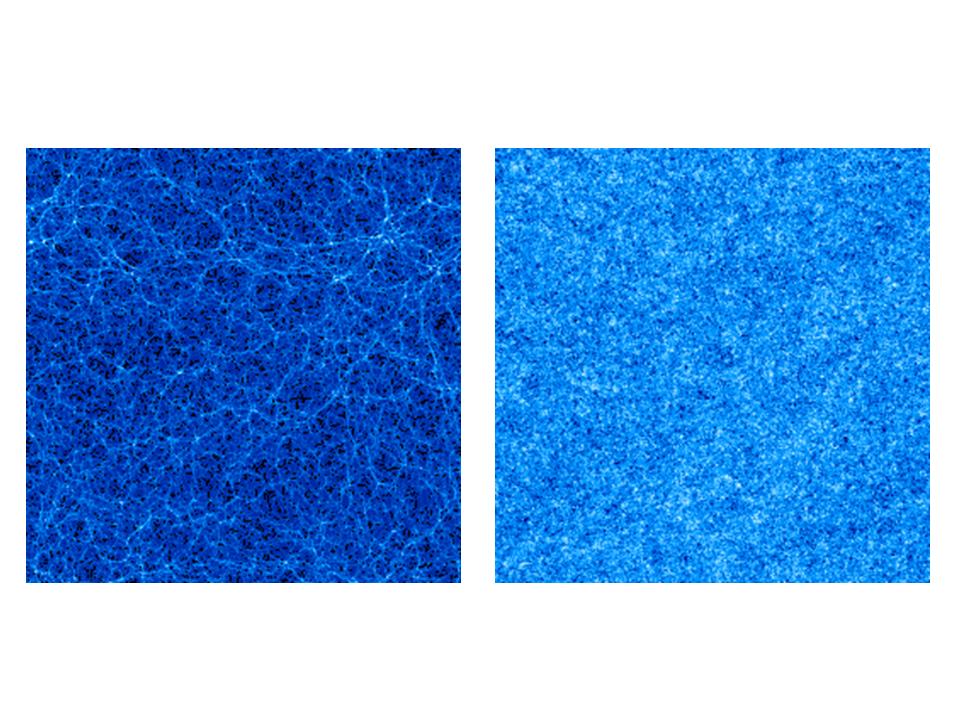
Take a look at these two N-body computer simulations of large-scale structure:

The one on the left is a proper simulation of the “cosmic web” which is at least qualitatively realistic, in that in contains filaments, clusters and voids pretty much like what is observed in galaxy surveys.

To make the picture on the right I first  took the Fourier transform of the original  simulation. This approach follows the best advice I ever got from my thesis supervisor: “if you can’t think of anything else to do, try Fourier-transforming everything.”

Anyway each Fourier mode is complex and can therefore be characterized by an amplitude and a phase (the modulus and argument of the complex quantity). What I did next was to randomly reshuffle all the phases while leaving the amplitudes alone. I then performed the inverse Fourier transform to construct the image shown on the right.

What this procedure does is to produce a new image which has exactly the same power spectrum as the first. You might be surprised by how little the pattern on the right resembles that on the left, given that they share this property; the distribution on the right is much fuzzier. In fact, the sharply delineated features  are produced by mode-mode correlations and are therefore not well described by the power spectrum, which involves only the amplitude of each separate mode.

If you’re confused by this, consider the Fourier transforms of (a) white noise and (b) a Dirac delta-function. Both produce flat power-spectra, but they look very different in real space because in (b) all the Fourier modes are correlated in such away that they are in phase at the one location where the pattern is not zero; everywhere else they interfere destructively. In (a) the phases are distributed randomly.

The moral of this is that there is much more to the pattern of galaxy clustering than meets the power spectrum…

My Even Newer Theory of the Universe

Posted in The Universe and Stuff with tags , , on June 13, 2012 by telescoper

I have decided this evening to unveil my new cosmological theory.

My previous work  was based on the idea that the Universe was obtained from the Swedish furniture and home accessory emporium IKEA. This “Easy Self Assembly” hypothesis dispenses with the need for creation from nothing, and also accounts naturally for the observed geometry of space (it came in a flat pack).

My subsequent study of this scenario has focussed on properties of the Universe that can’t be explained in the earlier version of the theory, specifically  the cosmic microwave background. However, making my supper just now I suddenly hit upon the answer to that particular puzzle. Clearly, wanting to achieve the best results possible, on his/her way back from IKEA the Divine Creator stopped off at Marks and Spencer …

Astronomy’s Next Big Thing

Posted in Science Politics, The Universe and Stuff with tags , , , , on June 12, 2012 by telescoper

I woke up this morning to hear an item about astronomy on the 7 o’clock news on BBC Radio 3. That doesn’t happen very often so I thought I’d follow it up with a short post before I head off to work.

The news item I heard followed up an announcement yesterday that the governing Council of the European Southern Observatory (ESO) had  approved the European Extremely Large Telescope (E-ELT) programme – which is to produce what will be the world’s largest ground-based optical telescope. Extremely Large is putting in mildly, of course. Its main mirror will be a colossal 39 metres in diameter (with a collecting area of almost a thousand square metres) and will have to made in bits with a sophisticated adaptive optics system to ensure that it can counter the effects of the Earth’s atmosphere and the limitations  of its own structure to  reach a phenomenal angular resolution of 0.001 arc seconds.

For more details on the telescope, see the official website here or the wikipedia article here, where you can also read more about the science to be done with E-ELT.

This telescope has been in planning for many years, of course. In fact, it began as an even more ambitious concept, a 100-metre diameter monster which I used to call the FLT. Over the years, however, for a mixture of technical and financial reasons, this was progressively de-scoped.

Yesterday’s announcement doesn’t mean that work will start immediately on building the E-ELT. That won’t happen until sufficient funding is secured and in the case of some countries, governmental approval obtained. Recent decisions by the UK Science and Technology Facilities Council to close down telescopes in Hawaii clearly anticipated the need to make some headroom in future budgets to enable this to happen. The best-case scenario is probably for E-ELT to take a decade or so to complete.

Of course the concentration of funding in ever and ever larger international facilities – such as E-ELT and the Square Kilometre Array – does create tensions within the UK astronomical community. Many scientists do excellent work with relatively small facilities, including those about to be closed down to make room for E-ELT. In the near future, the only ground-based optical facilities to which UK astronomers will have access will be operated by the European Southern Observatory. With fewer but larger (and more expensive) facilities operated by international agencies carrying out projects run by vast consortia, observational astronomy is definitely going the way of particle physics…

The problem  comes when the Next Big Thing  is too big to be built.  We might have already seen X-ray astronomy bubble burst in this way. To quote my learned friend Andy Lawrence:

Fundamentally, the problem is that X-ray astronomy has hit the funding wall. Everything gets inexorably bigger and more ambitious. Eventually its all or nothing… so when the answer is nothing … ah.

What will come after the Large Hadron Collider, or the E-ELT?  Is Big Science about to get too big?

Sic Transit Gloria Monday

Posted in The Universe and Stuff with tags , , , on June 11, 2012 by telescoper

I can never resist a terrible pun, so thought this would be an especially  good day to post this video from NASA’s Solar Dynamics Observatory,  showing views of last week’s Transit of Venus taken at several different wavelengths..


Big Bang: Who’s the Daddy?

Posted in History, The Universe and Stuff with tags , , , , on June 8, 2012 by telescoper

Time, I think, for a frivolous Friday poll.

I stumbled across a post on the Physics World Blog concerning a radio broadcast about Georges Lemaître.

Here’s a description of said programme:

Few theories could claim to have a more fundamental status than Big Bang Theory. This is now humanity’s best attempt at explaining how we got here: A Theory of Everything. This much is widely known and Big Bang Theory is now one of the most recognisable scientific brands in the world. What’s less well known is that the man who first proposed the theory was not only an accomplished physicist, he was also a Catholic priest. Father Georges Lemaître wore his clerical collar while teaching physics, and not at Oxford, Cambridge or MIT but at the Catholic University of Leuven in Belgium. It was this unassuming Catholic priest in an academic backwater who has changed the way we look at the origins of the universe. His story also challenges the assumption that science and religion are always in conflict. William Crawley introduces us to the “Father” of the Big Bang.

The question is whether the word “Father” in the last sentence should be taken as anything more than a play on the title he’d be given as a Catholic priest?

Lemaître’s work was highly original and it undoubtedly played an important role in the development of the Big Bang theory, especially in Western Europe and in the United States. However, a far stronger claim to the title of progenitor of this theory belongs to Alexander Alexandrovich Friedman, who obtained the cosmological solutions of Einstein’s general theory of relativity, on which the Big Bang model is based, independently of and shortly before Lemaître did. Unfortunately the Russian Friedman died in 1925 and it was many years before his work became widely known in the West. At least in my book, he’s the real “father” of the Big Bang, but I’m well aware that this is the source of a great deal of argument at cosmology conferences, which makes it an apt topic for a quick poll:

P.S. I prefer to spell Friedman with one “n” rather than two. His name in his own language is Алекса́ндр Алекса́ндрович Фри́дман and the spelling “Friedmann” only arose because of later translations into German.

Most Exciting Venus Transit Pictures Ever!

Posted in The Universe and Stuff with tags , , on June 6, 2012 by telescoper

Before

After

Tinker Tailor Soldier…Astronomer?

Posted in Science Politics, The Universe and Stuff with tags , on June 4, 2012 by telescoper

Tinker Tailor Soldier…Astronomer?

andyxl's avatarThe e-Astronomer

Not often I write two posts in one day, but here is an unexpected piece of news. It seems that the US National Reconnaisance Office have given two free telescopes to NASA. Its all explained at this NY Times article. They are as big as HST but have a wider field of view. They were designed for looking down of course.  Apparently there has been a secret study team and their conclusion is that one of these beasts would be perfect WFIRST, which had seemed to be kicked into the long grass.

They don’t exactly have the rest of the money yet or an actual approval … but the WFIRST fans are talking about shooting for 2020 … a year behind Euclid.

Ooooo what fun. Spot of healthy competition.

View original post