Archive for the The Universe and Stuff Category

LHC Hasn’t Destroyed Earth Yet (via Today’s New Reason to Believe)

Posted in The Universe and Stuff with tags , , , , , , on June 19, 2011 by telescoper

I thought I’d reblog this as it relates to the pronouncements about the LHC by Otto Rössler I mentioned yesterday.

LHC Hasn’t Destroyed Earth Yet As I predicted nearly two-and-a-half years ago, it looks like the Earth will survive the most powerful accelerator ever built. A recent article validates my prediction. On September 8, 2008, I recorded a Science News Flash podcast addressing concerns that the Large Hadron Collider (LHC) would produce a shower of black holes that would, in turn, consume Earth from the inside out. I predicted that Earth would not only survive the experiments perfor … Read More

via Today's New Reason to Believe

You might also want to read this older blog post about the kerfuffle when the LHC was switched on. I quote:

Rössler turns out to be quite a strange fellow. He is an MD who stayed in academia, moved into biochemistry, and then made a name in the relatively new field of chaos theory. He seems to think of himself as a visionary, having founded a new field of physics called “endophysics,” which is supposed to take into account the observer’s inner state. Or something like that. Have you heard of it? Neither had I.

Recently, at the age of sixty-eight, Rössler, despite having no particle physics or blackhole physics credentials, announced that he had found important new results, alarmingly relevant to the destructive potential of microscopic black holes in LHC proton-proton collisions. Rössler variously estimates the likelihood of such blackhole production by LHC as being from 10% to 50% though he appears to have pulled these numbers out of a hat.

And there’s also this most excellent video that John Butterworth told me about because he’s in it…

Topological Escapology

Posted in Education, The Universe and Stuff with tags , on June 13, 2011 by telescoper

The occasional  teasers I post on here seem to go down quite well so I thought I’d try this one on you.  I recently found it in an old book on the topic of  topology, a fascinating field that finds many applications in physics, including several in my own field of  cosmology.

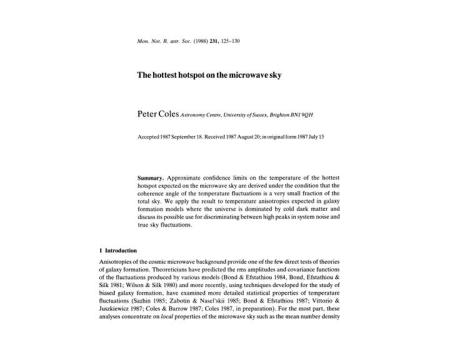
It’s probably best not to ask why, but the two gentlemen in the picture, A and B, are tied together in the following way. One end of a piece of rope is tied about A’s right wrist, the other about his left wrist. A second rope is passed around the first and its ends are tied to B’s wrists.

Can A and B free each other without cutting either rope, performing amputations,  or untying the knots at either person’s wrists?

If so, how?

The Laws of Extremely Improbable Things

Posted in Bad Statistics, The Universe and Stuff with tags , , , , , , , , on June 9, 2011 by telescoper

After a couple of boozy nights in Copenhagen during the workshop which has just finished, I thought I’d take things easy this evening and make use of the free internet connection in my hotel to post a short item about something I talked about at the workshop here.

Actually I’ve been meaning to mention a nice bit of statistical theory called Extreme Value Theory on here for some time, because not so many people seem to be aware of it, but somehow I never got around to writing about it. People generally assume that statistical analysis of data revolves around “typical” quantities, such as averages or root-mean-square fluctuations (i.e. “standard” deviations). Sometimes, however, it’s not the typical points that are interesting, but those that appear to be drawn from the extreme tails of a probability distribution. This is particularly the case in planning for floods and other natural disasters, but this field also finds a number of interesting applications in astrophysics and cosmology. What should be the mass of the most massive cluster in my galaxy survey? How bright the brightest galaxy? How hot the hottest hotspot in the distribution of temperature fluctuations on the cosmic microwave background sky? And how cold the coldest? Sometimes just one anomalous event can be enormously useful in testing a theory.

I’m not going to go into the theory in any great depth here. Instead I’ll just give you a simple idea of how things work. First imagine you have a set of n observations labelled X_i. Assume that these are independent and identically distributed with a distribution function F(x), i.e.

\Pr(X_i\leq x)=F(x)

Now suppose you locate the largest value in the sample, X_{\rm max}. What is the distribution of this value? The answer is not F(x), but it is quite easy to work out because the probability that the largest value is less than or equal to, say, z is just the probability that each one is less than or equal to that value, i.e.

F_{\rm max}(z) = \Pr \left(X_{\rm max}\leq z\right)= \Pr \left(X_1\leq z, X_2\leq z\ldots, X_n\leq z\right)

Because the variables are independent and identically distributed, this means that

F_{\rm max} (z) = \left[ F(z) \right]^n

The probability density function associated with this is then just

f_{\rm max}(z) = n f(z) \left[ F(z) \right]^{n-1}

In a situation in which F(x) is known and in which the other assumptions apply, then this simple result offers the best way to proceed in analysing extreme values.

The mathematical interest in extreme values however derives from a paper in 1928 by Fisher \& Tippett which paved the way towards a general theory of extreme value distributions. I don’t want to go too much into details about that, but I will give a flavour by mentioning a historically important, perhaps surprising, and in any case rather illuminating example.

It turns out that for any distribution F(x) of exponential type, which means that

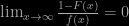
\lim_{x\rightarrow\infty} \frac{1-F(x)}{f(x)} = 0

then there is a stable asymptotic distribution of extreme values, as n \rightarrow \infty which is independent of the underlying distribution, F(x), and which has the form

G(z) = \exp \left(-\exp \left( -\frac{(z-a_n)}{b_n} \right)\right)

where a_n and b_n are location and scale parameters; this is called the Gumbel distribution. It’s not often you come across functions of the form e^{-e^{-y}}!

This result, and others, has established a robust and powerful framework for modelling extreme events. One of course has to be particularly careful if the variables involved are not independent (e.g. part of correlated sequences) or if there are not identically distributed (e.g. if the distribution is changing with time). One also has to be aware of the possibility that an extreme data point may simply be some sort of glitch (e.g. a cosmic ray hit on a pixel, to give an astronomical example). It should also be mentioned that the asymptotic theory is what it says on the tin – asymptotic. Some distributions of exponential type converge extremely slowly to the asymptotic form. A notable example is the Gaussian, which converges at the pathetically slow rate of \sqrt{\ln(n)}! This is why I advocate using the exact distribution resulting from a fully specified model whenever this is possible.

The pitfalls are dangerous and have no doubt led to numerous misapplications of this theory, but, done properly, it’s an approach that has enormous potential.

I’ve been interested in this branch of statistical theory for a long time, since I was introduced to it while I was a graduate student by a classic paper written by my supervisor. In fact I myself contributed to the classic old literature on this topic myself, with a paper on extreme temperature fluctuations in the cosmic microwave background way back in 1988..
Of course there weren’t any CMB maps back in 1988, and if I had thought more about it at the time I should have realised that since this was all done using Gaussian statistics, there was a 50% chance that the most interesting feature would actually be a negative rather than positive fluctuation. It turns out that twenty-odd years on, people are actually discussing an anomalous cold spot in the data from WMAP, proving that Murphy’s law applies to extreme events…

From Time to Time

Posted in Biographical, The Universe and Stuff with tags , , on June 5, 2011 by telescoper

It having been my birthday yesterday, and very nice it was too, thank you for asking, I’m filled this morning with thoughts about the passage of time. It’s strange how working in education imposes a cycle on your life: admissions, teaching, exams, graduation ceremonies, summer recess, and so on. The main thing that breaks this pattern of recurrence is when students finish their finals and leave for the big wide world. Since I moved to Cardiff in 2007, the 4th year students who have just finished their examinations are the first cohort that I’ve seen through their whole degree programme at Cardiff University, and it will be great to see them all get their degrees next month in St David’s Hall, but it will be yet another reminder of the passage of the years.

Not that I’m one to get depressed about such things. I’ve taken surprisingly well to middle age and gracefully (?) surrendered the things of youth some time ago. However, time is such a mysterious thing it’s hard not to think about its passing every now and then.

This time last year I was in Copenhagen for a small cosmology workshop. There’ll be a repeat performance next week too, so I’ll be off to Denmark for a few days. In fact I bought my ticket some time ago, but realised only on Friday that it was next week, and not the week after, so have had to rearrange a few things rather hastily. The advancing years have obviously addled my brain.

Anyway, all this talk about time and cycles gives me some sort of excuse to post the following video from the ESO Very Large Telescope in Chile. The photography is wonderful. Pity about the music, though. Spoils it a bit if you ask me…

D+E+F+W=$500000

Posted in The Universe and Stuff with tags , , , , , , , on June 2, 2011 by telescoper

Just a quickie this fine summer morning to pass on the news – for those of you who haven’t heard yet – that this year’s Gruber Prize for Cosmology has been awarded to Marc Davis (Berkeley, USA), George Efstathiou (Cambridge, UK), Carlos Frenk (Durham, UK) and Simon White (Garching, Germany). This prestigious award is given for their pioneering work on the Cold Dark Matter model of structure formation, which included some of the first large-scale N-body computer simulations. The “Gang of Four” produced a number of papers during the 1980s that established the idea that galaxies form by hierarchical clustering from small initial fluctuations in a matter distribution dominated by massive collisionless non-baryonic particles, the most famous of their papers being pretty universally referred to as DEFW.

In fact, if you’ll forgive me going on a trip down memory lane, that paper, published in 1985, was one of the first papers I read when I started my research degree the same year at Sussex. It was back in the days when everyone seemed to use a VAX for big computing jobs and the simulations presented in that paper involved a mere 323 = 32768 particles. You could probably run that kind of simulation on a mobile phone these days!

This early work on Cold Dark Matter wasn’t the final word, of course. Subsequent observational evidence for an accelerating Universe resulting in our standard cosmological model being modifiel to include an additional (large) component of dark energy in addition to dark matter. Nevertheless, the core ideas presented by DEFW established the basic foundations of structure formation upon which the current standard model is built.

Incidentally, you can read an interesting account of the discovery of the accelerating universe here; a cosmologist by the name of “George F. Stathew” plays a prominent role in that piece and it’s curious I’ve never heard of him before now.

Each of the four winners gets a share of the $500000 Gruber Prize, i.e. in “normalized” terms, they get $125000 each. Why is it so controversial to suggest dividing citation counts the same way? The DEFW paper has about 1500 citations according to ADS, so I think it’s quite reasonable to award the authors 370-odd each towards their respective h-indices. That’s still a pretty good result by any bibliometric standard!

The four also get a Gold Medal each to wear at parties, although by my previous logic they should have to share one between them. Perhaps George might consider donating his to Arsenal Football Club, as their trophy cabinet is looking rather empty these days?

None of the winners are Australian undergraduates, so this award probably won’t be considered newsworthy by the mass media. Believe it or not, however, the Gruber Prize is held in even higher regard by cosmologists than the Templeton Prize, so I’d like to take this opportunity to congratulate them myself for their thoroughly well-deserved honour!

Missing Mass Hysteria

Posted in Astrohype, The Universe and Stuff with tags , , , on May 30, 2011 by telescoper

It’s usually very satisfying to see science get covered in the popular media. Even if the story gets a little simplified or, more likely, garbled, press coverage often succeeds in getting at least a bit of the truth across. My own field of astrophysics has more popular appeal than many other branches of physics, but can nevertheless involve complex theoretical ideas and difficult observations that can be difficult to disseminate in a form suitable for public consumption. For the most part, the press do a good job for astronomy but occasionally news stories emerge that are simply ridiculous.

Take this one, for example, which begins:

A Monash student has made a breakthrough in the field of astrophysics, discovering what has until now been described as the Universe’s ‘missing mass’. Amelia Fraser-McKelvie, working within a team at the Monash School of Physics, conducted a targeted X-ray search for the matter and within just three months found it – or at least some of it.

What makes the discovery all the more noteworthy is the fact that Ms Fraser-McKelvie is not a career researcher, or even studying at a postgraduate level. She is a 22-year-old undergraduate Aerospace Engineering/Science student who pinpointed the missing mass during a summer scholarship, working with two astrophysicists at the School of Physics, Dr Kevin Pimbblet and Dr Jasmina Lazendic-Galloway.

On the face of it, this sounds an extremely interesting story not only because it apparently involves a major scientific breakthrough, but also because the result was achieved by an undergraduate student working on a summer programme. Unfortunately, however, a little digging reveals that there is much less to it than meets the eye. I know of many astronomers around the world who think the Press Office at Monash University is guilty of shameless exaggeration in the press release that initiated this bubble. This sort of deliberately misleading distortion is very bad for science, as it almost inevitably ends up splattered in unrecognisable form all over the media, especially the downmarket end.

Here is the abstract of the actual paper which this story is supposed to be about:

Most of the baryons in the Universe are thought to be contained within filaments of galaxies, but as yet, no single study has published the observed properties of a large sample of known filaments to determine typical physical characteristics such as temperature and electron density. This paper presents a comprehensive large-scale search conducted for X-ray emission from a population of 41 bona fide filaments of galaxies to determine their X-ray flux and electron density. The sample is generated from Pimbblet et al.’s (2004) filament catalogue, which is in turn sourced from the 2 degree Field Galaxy Redshift Survey (2dFGRS). Since the filaments are expected to be very faint and of very low density, we used stacked ROSAT All-Sky Survey data. We detect a net surface brightness from our sample of filaments of (1.6 +/- 0.1) x 10^{-14} erg cm^{-2} s^{-1} arcmin^{-2} in the 0.9-1.3 keV energy band for 1 keV plasma, which implies an electron density of n_{e} = (4.7 +/- 0.2) x 10^{-4} h_{100}^{1/2} cm^{-3}. Finally, we examine if a filament’s membership to a supercluster leads to an enhanced electron density as reported by Kull & Bohringer (1999). We suggest it remains unclear if supercluster membership causes such an enhancement.

You won’t find anything in there about finding the “missing mass” of the Universe, nor will you find it anywhere else in the paper, because they haven’t. The “targeted X-ray search” involved stacking old ROSAT observations of filaments that were discovered and catalogued in previous papers; this study merely matched them to existing X-ray data. ROSAT ceased operations in 1999. The results do give some evidence for a higher electron density than previously thought in some of the filaments, so it’s a fairly interesting “incremental” paper, not by any stretch of the imagination revolutionary.

I’ve got nothing against Amelia Fraser-McKelvie, who seems to have done some solid scientific work during her summer internship, and who may not have played any role in spinnng the shameless press release that led to this story getting into the world’s media. However, the more senior scientists involved in this work should not have let the story come out in this form.

Echo of Creation – the Trailer

Posted in Education, The Universe and Stuff with tags , , , on May 27, 2011 by telescoper

Each day I find myself pressed for time and unable to think of anything to post, something seems to come along to rescue me. I found this on Twitter this morning and couldn’t resist sharing it, partly because it’s a cute video in its own right, and partly because it gives me the chance to advertise the event that it trails. Here’s the film …

..and it advertises a forthcoming event at the Cheltenham Science Festival, featuring the excellent Andrew Pontzen who is based at the Institute of Astronomy in Cambridge. Andrew is not only a whizzkid cosmology theorist but also an excellent public speaker, so do go and see his lecture if you can. Here’s the blurb:

Billions of years after the birth of the Universe, scientists realised they could tune into an echo of creation itself using nothing more sophisticated than a de-tuned television set. Andrew Pontzen explains the cosmos’ ‘background noise’ with hula hoops, beach balls and amazing telescopic pictures. But hold onto your hats: all is not as it seems with space and time…

Sounds fascinating! The talk is on Saturday 11th June 2011, 10am at the Town Hall in Cheltenham. You can book tickets here.

The Cosmos according to Disney

Posted in The Universe and Stuff with tags , , on May 25, 2011 by telescoper

Not really time for a proper post today but I’m grateful to one of my PhD students for coming to the rescue by pointing out this clip in which our own Professor Mike Disney tell us everything he knows about cosmology. The video lasts 2 minutes and 48 seconds.

Share/Bookmark

Whatever happened to Euclid?

Posted in Education, The Universe and Stuff with tags , , , , , , on May 24, 2011 by telescoper

An interesting article on the BBC website about the innate nature of our understanding of geometry reminded me that I have been meaning to post something about the importance of geometry in mathematics education – and, more accurately, the damaging consequences of the lack of geometry in the modern curriculum.

When I was a lad – yes, it’s one of those tedious posts about how things were better in the old days – we grammar school kids spent a disproportionate amount of time learning geometry in pretty much the way it has been taught since the days of Euclid. In fact, I still have a copy of the classic Hall & Stevens textbook based on Euclid’s Elements, from which I scanned the proof shown below (after checking that it’s now out of copyright).

This, Proposition 5 of Book I of the Elements, is in fact quite a famous proof known as the Pons Asinorum:

The old-fashioned way we learned geometry required us to prove all kinds of bizarre theorems concerning the shapes and sizes of triangles and parallelograms, properties of chords intersecting circles, angles subtended by various things, tangents to circles, and so on and so forth. Although I still remember various interesting results I had to prove way back then – such as the fact that the angle subtended by a chord at the centre of a circle is twice that subtended at the circumference (Book III, Proposition 20) – I haven’t actually used many of them since. The one notable exception I can think of is Pythagoras’ Theorem (Book I, Proposition 47), which is of course extremely useful in many branches of physics.

The apparent irrelevance of most of the theorems one was required to prove is no doubt the reason why “modern” high school mathematics syllabuses have ditched this formal approach to geometry. I think this was a big mistake. The bottom line in a geometrical proof is not what’s important – it’s how you get there. In particular, it’s learning how to structure a mathematical argument.

That goes not only for proving theorems, but also for solving problems; many of Euclid’s propositions are problems rather than theorems, in fact. I remember well being taught to end the proof of a theorem with QED (Quod Erat Demonstrandum; “which was to be proved”) but end the solution of a problem with QEF (Quod Erat Faciendum; “which was to be done”).

You can see what I mean by looking at the Pons Asinorum, which is a very simple theorem to prove but which illustrates the general structure:

  1. GIVEN
  2. TO PROVE
  3. CONSTRUCTION
  4. PROOF

When you have completed many geometrical proofs this way it becomes second nature to confront any  problem in mathematics (or physics) by first writing down what is given (or can be assumed), often including the drawing of a diagram. These are key ingredients of a successful problem solving strategy. Next you have to understand precisely what you need to prove, so write that down too. It seems trivial, but writing things down on paper really does help. Not all theorems require a “construction”, and that’s usually the bit where ingenuity comes in so is more difficult. However, the “proof” then follows as a series of logical deductions, with reference to earlier (proved) propositions given in the margin.

This structure carries over perfectly well to problems involving algebra or calculus (or even non-Euclidean geometry) but I think classical geometry provides the ideal context to learn it because it involves visual as well as symbolic logic – it’s not just abstract reasoning in that compasses, rulers and protractors can help you!

I don’t think it’s a particular problem for universites that relatively few students know how to prove the perpendicular bisector theorem, but it definitely is a problem that so many have no idea what a mathemetical proof should look like.

Come back Euclid, all is forgiven!

Share/Bookmark

Can the CMB Alone Provide Evidence for Dark Energy? (via astrobites)

Posted in The Universe and Stuff with tags , , , on May 22, 2011 by telescoper

While I’m in reblogging mood I’ll try to send some traffic the way of this post, which is somewhat related to Friday’s one about the Wigglezeddy survey (or whatever it’s called)…

Can the CMB Alone Provide Evidence for Dark Energy? Paper Title: The Atacama Cosmology Telescope: Evidence for Dark Energy from the CMB Alone Authors: Blake D. Sherwin et al. 1st Author’s Affiliation: Dept. of Physics, Princeton University Introduction Continuing with Monday’s theme of cosmology, today’s astrobite features an ApJ Letter that describes new evidence for dark energy.  In the past decade a number of cosmological tests have been developed that show a need for a cosmological constant th … Read More

via astrobites