Hot from the press today is a release of all-sky images from the European Space Agency’s Planck mission, including about a year’s worth of data. You can find a full set of high-resolution images here at the ESA website, along with a lot of explanatory text, and also here and here. Here’s a low-resolution image showing the galactic dust (blue) and radio (pink) emission concentrated in the plane of the Milky Way but extending above and below it. Only well away from the Galactic plane do you start to see an inkling of the pattern of fluctuations in the Cosmic Microwave Background that the survey is primarily intended to study.
It will take a lot of sustained effort and clever analysis to clean out the foreground contamination from the maps, so the cosmological interpretation will have to wait a while. In fact, the colour scale seems to have been chosen in such a way as to deter people from even trying to analyse the CMB component of the data contained in these images. I’m not sure that will work, however, and it’s probably just a matter of days before some ninny posts a half-baked paper on the arXiv claiming that the standard cosmological model is all wrong and that the Universe is actually the shape of a vuvuzela. (This would require only a small modification of an earlier suggestion.)
These images are of course primarily for PR purposes, but there’s nothing wrong with that. Apart from being beautiful in its own right, they demonstrate that Planck is actually working and that results it will eventually produce should be well worth waiting for!
Oh, nearly forgot to mention that the excellent Jonathan Amos has written a nice piece about this on the BBC Website too.
I was reading through a collection of poems by Rupert Brooke this lazy sunday afternoon and found this. I haven’t posted much poetry recently so thought I’d add it here. I’m sure my many friends who work on astrophysical dust will enjoy it, especially those involved with the European Space Agency’s Herschel Space Observatory. Apparently they’re all “passionate about dust”. If that’s true I wonder if one of them might want to write a wikipedia entry on the subject, because for some reason there isn’t one…
When the white flame in us is gone,
And we that lost the world’s delight
Stiffen in darkness, left alone
To crumble in our separate night;
When your swift hair is quiet in death,
And through the lips corruption thrust
Has still’d the labour of my breath –
When we are dust, when we are dust !
Not dead, not undesirous yet,
Still sentient, still unsatisfied,
We’ll ride the air, and shine, and flit,
Around the places where we died,
And dance as dust before the sun,
And light of foot and unconfined,
Hurry from road to road, and run
About the errands of the wind.
And every mote, on earth or air,
Will speed and gleam, down later days,
And like a secret pilgrim fare
By eager and invisible ways,
Nor ever rest, nor ever lie,
Till, beyond thinking, out of view,
One mote of all the dust that’s I
Shall meet one atom that was you.
Then in some garden hush’d from wind,
Warm in a sunset’s afterglow,
The lovers in the flowers will find
A sweet and strange unquiet grow
Upon the peace; and, past desiring,
So high a beauty in the air,
And such a light, and such a quiring,
And such a radiant ecstasy there,
They’ll know not if it’s fire, or dew,
Or out of earth, or in the height,
Singing, or flame, or scent, or hue,
Or two that pass, in light, to light,
Out of the garden, higher, higher. . . .
But in that instant they shall learn
The shattering ecstasy of our fire,
And the weak passionless hearts will burn
And faint in that amazing glow,
Until the darkness close above;
And they will know – poor fools, they’ll know!
One moment, what it is to love.
I found this on Youtube. The programme was made for the BBC TV series Horizon and first broadcast in the UK in 2005. You’ll find yours truly in a couple of places, when I was working at the University of Nottingham and had more hair. In fact got a bit of stick, from some people at a certain University I used to attend, for being insufficiently reverential in my comments about Stephen Hawking but, for what it’s worth, I stand by everything I said. I do admire him enormously as a physicist, but I think his very genuine contributions are sometimes lost in the cult that has developed around him.
Anyway, I thought the programme turned out relatively well. Horizon has gone steadily downhill since 2005, obviously because I haven’t been involved…
It’s in 5 parts so if you want to watch all of it, you will need to click through to the next at the end of each segment.
This triptych shows the region of sky around the massive galaxy cluster Abell 2218, as seen by the SPIRE instrument on Herschel and by the Hubble Space Telescope. On the far left, we have images at the three SPIRE wavelength bands (in the far-infrared part of the spectrum), while the centre image is a false-colour composite. The centre of the galaxy cluster is shown as a white cross-hair, while the large orange-yellow blob just below it is a much more distant galaxy.
On the far right you can see an optical image of the same cluster taken using the Hubble Space Telescope. Working at much shorter, optical wavelengths, the resolution here is much higher. This makes it possible to see the complicated pattern of arcs caused by the distortion of light as it travels through the gravitational field of the cluster from background sources to the observer. The cluster acts as a gigantic optical system that produces magnified but warped images of very distant galaxies that lie behind it. It’s not designed to act as proper lens, of course, so the images it produces are deformed versions of the original, but they yield sufficient clues to work out the optical properties of the gravitational lens.
Clusters like this tend to contain lots of elliptical galaxies which are not bright in the SPIRE wavebands, so what we see with Herschel is very different from the Hubble view. What Herschel has done in this particular case is to reveal that this gravitational lens produces at least one bright image in the far-infrared part of the spectrum. This is produced by a very distant galaxy which we probably would not have been able to see at all, even with Herschel, had it not been located fortuitously close to a perfect alignment with the optical axis of the Abell 2218 system. Although the image we see is distorted we can still learn a lot about the source that produced using the new data.
I got back from yesterday’s trip to a very muggy London with a raging sore throat and a brain as sluggish as an England defender on an action replay. Come to think of it, I must be as sick as a parrot. I’m sweating like a pig too, although I don’t know whether that’s a symptom of anything nasty or just because it’s still so warm and humid. Anyway, in view of my likely incoherence I thought I’d keep it brief (again) and just mention a few salient points from the last day or two.
I went to London as part of my duties as External Examiner for the MSc Course in Astrophysics at Queen Mary, University of London. Of course all the proceedings are confidential so I’m not going to comment on anything in detail, except that I spent a bit of time going through the exam scripts before the Examiners’ Meeting in a room that did a very passable impersonation of a heat bath. When I was later joined by the rest of the Exam Board the temperature soared still further. Fortunately the business went relatively smoothly so nobody got too hot under the collar and after concluding the formal business, a few of us cooled off with a beer or two in the Senior Common Room.The students spend the next couple of months writing their dissertations now that the written exams are over, so we have to reconvene in October to determine the final results. I hope it’s a bit cooler by then.
I couldn’t stay long at Queen Mary, however, as I had a working dinner to get to. Regular readers of this blog (both of them) may remember that I’m involved in project called Beyond Entropy which is organized by the Architectural Association School of Architecture. I’ve been working on this occasionally over the months that have passed since I first blogged about it, but deadlines are now looming and we need to accelerate our activity. Last night I met with the ever-enthusiastic Stefano Rabolli Pansera at the house of Eyal Weizman by Victoria Park in the East End, handily close to Queen Mary’s Mile End campus. Assisted by food and wine we managed to crystallise our ideas into something much more tangible than we had managed to do before on our theme of Gravitational Energy. The School has offered us expert practical assistance in making prototypes and I’m now much more optimistic about our exhibit coming together, not to mention excited at the prospect of seeing it on display at the Venice Architecture Biennale. I won’t say what we’re planning just yet, though. I’d rather wait until it’s done before unveiling it.
Incidentally, here’s a link to a lecture by Eyal Weizman where he gives some interesting perspectives on architectural history.
Finally, and nothing to do with my trip to the Big Smoke, I noticed today on the Research Fortnight Blog that the Higher Education Funding Council for Wales (HEFCW) is planning to reduce the number of universities in Wales “significantly” from its current level of 12. This is an interesting development and one that I’ve actually argued for here. Quoting Leighton Andrews, Welsh Assembly Minister responsible for higher education, the piece says
“This target does not mean fewer students,” he said in a statement. “But it is likely to mean fewer vice chancellors. We will have significantly fewer HE institutions in Wales but they will be larger and stronger.”
How these reductions will be achieved remains to be seen, but it seems obvious that quite a few feathers will be ruffled among the management’s plumage in some institutions and it looks like some vice chancellors will be totally plucked!
I’ve wanted to post this little clip for some time, just because it’s so marvellous.
I wonder what you felt as you watched it? What went through your mind? Amusement? Fascination? I’ll tell you how it was for me when I first saw it. I marvelled.
Seeing the extraordinary behaviour of this incredible creature filled me with a sense of wonder. But I also began to wonder in another sense too. How did the Lyre Bird evolve its bizarre strategy? How does it learn to be such an accurate mimic? How does it produce such a fascinating variety of sounds? How can there be an evolutionary advantage in luring a potential mate to the sound of foresters and a chainsaw?
The Lyre Bird deploys its resources in such an elaborate and expensive way that you might be inclined to mock it, if all it does is draw females to “look at its plumes”. I can think of quite a few blokes who adopt not-too-dissimilar strategies, if truth be told. But if you could ask a Lyre Bird it would probably answer that it does this because that’s what it does. The song defines the bird. That’s its nature.
I was moved to post the clip in response to a characteristically snide and ill-informed piece by Simon Jenkins in yesterday’s Guardian. Jenkins indulges in an anti-science rant every now and again. Sometimes he has a point, in fact. But yesterday’s article was just puerile. Perhaps he had a bad experience of science at school and never got over it.
I suppose I can understand why some people are cynical about scientists stepping into the public eye to proselytise about science. After all, it’s also quite easy to come up with examples of scientists who have made mistakes. Sadly, there are also cases of outright dishonesty. Science is no good because scientists are fallible. But scientists are people, no better and no worse than the rest. To err is human and all that. We shouldn’t expect scientists to be superhuman any more than we should believe the occasional megalomaniac who says they are.
To many people fundamental physics is a just a load of incomprehensible gibberish, the Large Hadron Collider a monstrous waste of money, and astronomy of no greater value to the world than astrology. Any scientist trying to communicate science to the public must be trying to hoodwink them, to rob them of the schools and hospitals that their taxes should be building and sacrifice their hard-earned income on the altar of yet another phoney religion.
And now the BBC is participating in this con-trick by actually broadcasting popular programmes about science that have generated huge and appreciative audiences. Simon Jenkins obviously feels threatened by it. He’s probably not alone.
I don’t have anything like the public profile of the target of Jenkins’ vitriol, Lord Rees, but I try to do my share of science communication. I give public lectures from time to time and write popular articles, whenever I’m asked. I also answer science questions by email from the general public, and some of the pieces I post on here receive a reasonably wide distribution too.
Why do I (and most of my colleagues) do all this sort of stuff? Is it because we’re after your money? Actually, no it isn’t. Not directly, anyway.
I do all this stuff because, after 25 years as a scientist, I still have a sense of wonder about the universe. I want to share that as much as I can with others. Moreover, I’ve been lucky enough to find a career that allows me to get paid for indulging my scientific curiosity and I’m fully aware that it’s Joe Public that pays for me to do it. I’m happy they do so, and happier still that people will turn up on a rainy night to hear me talk about cosmology or astrophysics. I do this because I love doing science, and want other people to love it too.
Scientists are wont to play the utilitarian card when asked about why the public should fund fundamental research. Lord Rees did this in his Reith Lectures, in fact. Physics has given us countless spin-offs – TV sets, digital computers, the internet, you name it – that have created wealth for UK plc out of all proportion to the modest investment it has received. If you think the British government spends too much on science, then perhaps you could try to find the excessive sum on this picture.
Yes, the LHC is expensive but the cost was shared by a large number of countries and was spread over a long time. The financial burden to the UK now amounts to the cost of a cup of coffee per year for each taxpayer in the country. I’d compare this wonderful exercise in friendly international cooperation with the billions we’re about to waste on the Trident nuclear weapons programme which is being built on the assumption that international relations must involve mutual hatred.
This is the sort of argument that gets politicians interested, but scientists must be wary of it. If particle physics is good because it has spin-offs that can be applied in, e.g. medicine, then why not just give the money to medical research?
I’m not often put in situations where I have to answer questions like why we should spend money on astronomy or particle physics but, when I am, I always feel uncomfortable wheeling out the economic impact argument. Not because I don’t believe it’s true, but because I don’t think it’s the real reason for doing science. I know the following argument won’t cut any ice in the Treasury, but it’s what I really think as a scientist (and a human being).
What makes humans different from other animals? What defines us? I don’t know what the full answer to that is, or even if it has a single answer, but I’d say one of the things that we do is ask questions and try to answer them. Science isn’t the only way we do this. There are many complementary modes of enquiry of which the scientific method is just one. Generally speaking, though, we’re curious creatures.
I think the state should support science but I also think it should support the fine arts, literature, humanities and the rest, for their own sake. Because they’re things we do. They make us human. Without them we’re just like any other animal that consumes and reproduces.
So the real reason why the government should support science is the song of the Lyre Bird. No, I don’t mean as an elaborate mating ritual. I don’t think physics will help you pull the birds. What I mean is that even in this materialistic, money-obsessed world we still haven’t lost the need to wonder, for the joy it brings and for the way it stimulates our minds; science doesn’t inhibit wonder, as Jenkins argues, it sparks it.
Got bored with the football (England 0 Algeria 0…zzzzz). Tedious. Depressing. Decided to read some poetry instead. Found this, by Patric Dickinson, called Jodrell Bank. Is football just another expression of loneliness?
Who were they, what lonely men
Imposed upon the fact of night
The fiction of constellations
And made commensurable
The distances between
Themselves their loves and their doubt
Of government and nations;
Who made the dark stable
When the light was not? Now
We receive the blind codes
Of spaces beyond the span
Of our myths, and a long dead star
May only echo how
There are no loves nor gods
Men can invent to explain
How lonely all men are.
.. to the 7am news on BBC Radio 3, including a story about how GCSE science examinations are not “sufficiently rigorous”. Then, on Twitter, I saw an example of an Edexcel GCSE (Multiple-choice) Physics paper. It’s enough to make any practising physicist weep.
Most of the questions are very easy, but there’s just as many that are so sloppily put together that they don’t make any sense at all. Take Question 1:
I suppose the answer is meant to be C, but since it doesn’t say that A is the orbit of a planet, as far as I’m concerned, it might just as well be D. Are we meant to eliminate D simply because it doesn’t have another orbit going through it?
On the other hand, the orbit of a moon around the Sun is in fact similar to the orbit of its planet around the Sun, since the orbital speed and radius of the moon around its planet are smaller than those of the planet around the Sun. At a push, therefore you could argue that A is the closest choice to a moon’s orbit around the Sun. The real thing would be something close to a circle with a 4-week wobble variation superposed.
You might say I’m being pedantic, but the whole point of exam questions is that they shouldn’t be open to ambiguities like this, at least if they’re science exams. I can imagine bright and knowledgeable students getting thoroughly confused by this question, and many of the others on the paper.
Here’s a couple more, from the “Advanced” section:
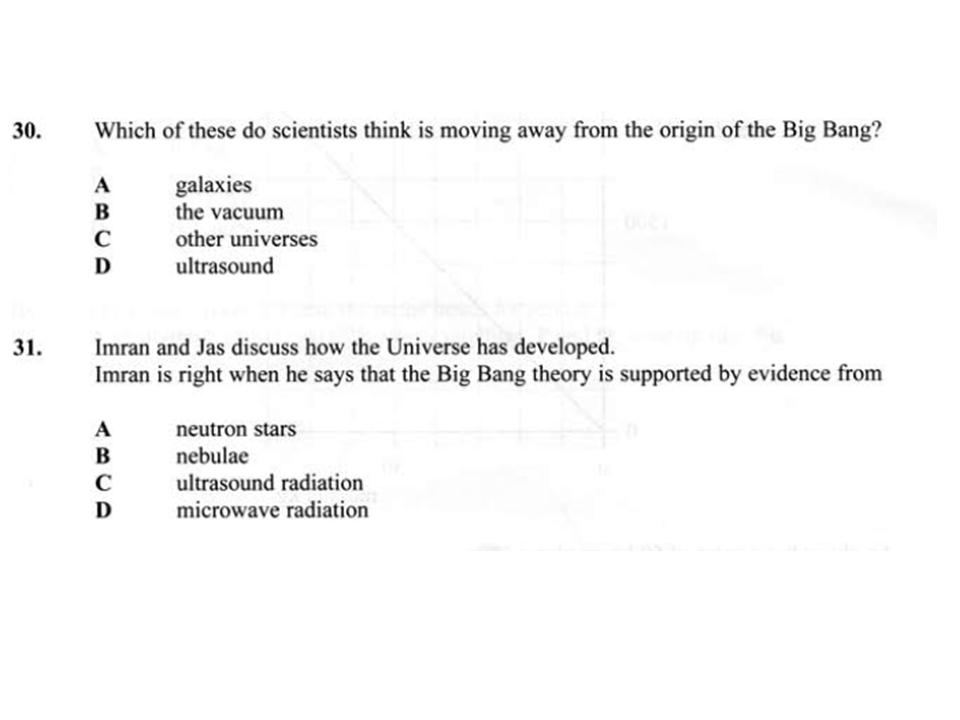
The answer to Q30 is, presumably, A. But do any scientists really think that galaxies are “moving away from the origin of the Big Bang”? I’m worried that this implies that the Big Bang was located at a specific point. Is that what they’re teaching?
Bearing in mind that only one answer is supposed to be right, the answer to Q31 is presumably D. But is there really no evidence from “nebulae” that supports the Big Bang theory? The expansion of the Universe was discovered by observing things Hubble called “nebulae”..
I’m all in favour of school students being introduced to fundamental things such as cosmology and particle physics, but my deep worry is that this is being done at the expense of learning any real physics at all and is in any case done in a garbled and nonsensical way.
Lest I be accused of an astronomy-related bias, anyone care to try finding a correct answer to this question?
The more of this kind of stuff I see, the more admiration I have for the students coming to study physics and astronomy at University. How they managed to learn anything at all given the dire state of science education in the UK is really quite remarkable.
I mentioned this a while ago, but I thought it wouldn’t do any harm to repeat the official advertisement here. Cardiff is going large (or at least larger) in experimental physics, and the first deadline is approaching..
..so get cracking with your applications now!
Chair in Experimental Physics
Reader/Senior Lecturer/Lecturer in Experimental Physics
School of Physics and Astronomy
As the first stage of a major initiative to broaden its research activity the School of Physics and Astronomy at Cardiff University has some immediate vacancies for permanent faculty positions at either full Professor/Reader/Senior Lecturer/Lecturer level in any area of Experimental Physics, other than Astrophysics.
Applications are welcome in fields new to the School as well as those complementary to the existing strengths. Candidates working in interdisciplinary areas with a firm Physics base are also welcomed. You will be expected to have demonstrated an established programme of research, and will also be expected to teach Physics at undergraduate and postgraduate level.
The School of Physics and Astronomy at Cardiff University has strong research groups in Photons & Matter (theory and experimental), Gravitational Physics and Nanophysics, as well as a large Astrophysics programme.
You should have a PhD in Physics, Mathematics or closely-related subject.
Salary:
A point on the Cardiff Professorial Salary Scale (Chair)
£45155 – £55535 per annum (Reader)
£37839 – £43840 per annum (Senior Lecturer)
£29853 – £35646 per annum (Lecturer)
Informal enquiries regarding these positions may be made to Professor Walter Gear, Head of School, email Walter.Gear@astro.cardiff.ac.uk
To work for an employer that values and promotes equality of opportunity, visit www.cardiff.ac.uk/jobs telephone + 44 (0) 29 2087 4017 or email vacancies@cardiff.ac.uk for an application form quoting vacancy number 186 for the Chair position and 188 for the Reader/Senior Lecturer/Lecturer position.
Closing date: Friday, 23 July 2010.
Please note vacancies are for one Chair and three Senior Lecturer/Lecturer positions.
Interesting press release today from the Royal Astronomical Society about a paper (preprint version here) which casts doubt on whether the Wilkinson Microwave Anisotropy Probe supports the standard cosmological model to the extent that is generally claimed. Apologies if this is a bit more technical than my usual posts (but I like occasionally to pretend that it’s a science blog).
The abstract of the paper (by Sawangwit & Shanks) reads
Using the published WMAP 5-year data, we first show how sensitive the WMAP power spectra are to the form of the WMAP beam. It is well known that the beam profile derived from observations of Jupiter is non-Gaussian and indeed extends, in the W band for example, well beyond its 12.’6 FWHM core out to more than 1 degree in radius. This means that even though the core width corresponds to wavenumber l ~ 1800, the form of the beam still significantly affects the WMAP results even at l~200 which is the scale of the first acoustic peak. The difference between the beam convolved Cl; and the final Cl is ~ 70% at the scale of the first peak, rising to ~ 400% at the scale of the second. New estimates of the Q, V and W-band beam profiles are then presented, based on a stacking analysis of the WMAP5 radio source catalogue and temperature maps. The radio sources show a significantly (3-4σ) broader beam profile on scales of 10′-30′ than that found by the WMAP team whose beam analysis is based on measurements of Jupiter. Beyond these scales the beam profiles from the radio sources are too noisy to give useful information. Furthermore, we find tentative evidence for a non-linear relation between WMAP and ATCA/IRAM 95 GHz source fluxes. We discuss whether the wide beam profiles could be caused either by radio source extension or clustering and find that neither explanation is likely. We also argue against the possibility that Eddington bias is affecting our results. The reasons for the difference between the radio source and the Jupiter beam profiles are therefore still unclear. If the radio source profiles were then used to define the WMAP beam, there could be a significant change in the amplitude and position of even the first acoustic peak. It is therefore important to identify the reasons for the differences between these two beam profile estimates.
The press release puts it somewhat more dramatically
New research by astronomers in the Physics Department at Durham University suggests that the conventional wisdom about the content of the Universe may be wrong. Graduate student Utane Sawangwit and Professor Tom Shanks looked at observations from the Wilkinson Microwave Anisotropy Probe (WMAP) satellite to study the remnant heat from the Big Bang. The two scientists find evidence that the errors in its data may be much larger than previously thought, which in turn makes the standard model of the Universe open to question. The team publish their results in a letter to the journal Monthly Notices of the Royal Astronomical Society.
I dare say the WMAP team will respond in due course, but this paper spurred me to mention some work on this topic that was done by my friend (and former student) Lung-Yih Chiang. During his last visit to Cardiff we discussed this at great length and got very excited at one point when we thought we had discovered an error along the lines that the present paper claims. However, looking more carefully into it we decided that this wasn’t the case and we abandoned our plans to publish a paper on it.
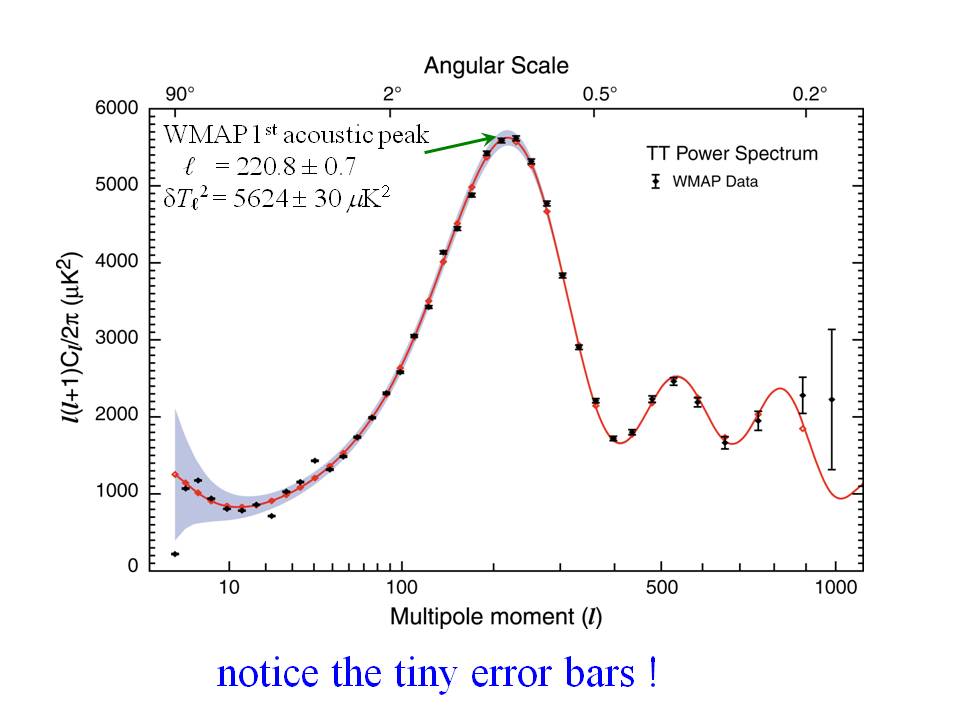
Let me show you a few slides from a presentation that Lung-Yih gave to me a while ago. For a start here is the famous power-spectrum of the temperature fluctuations of the cosmic microwave background which plays an essential role in determining the parameters of the standard cosmology:
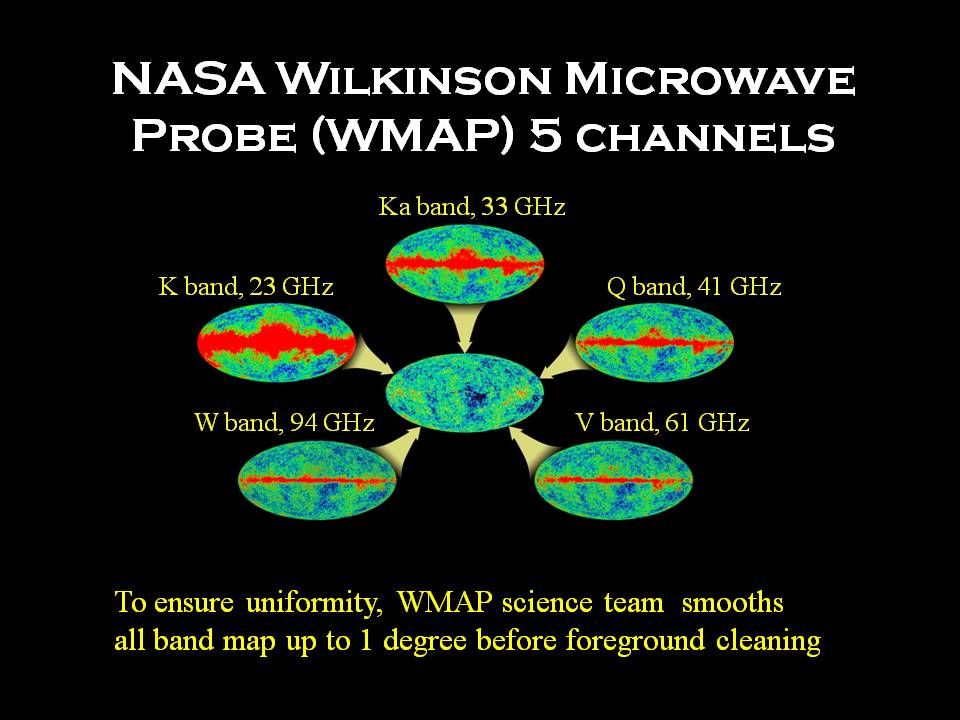
The position of the so-called “acoustic peak” plays an important role in determining the overall curvature of space-time on cosmological scales and the higher-order peaks pin down other parameters. However, it must be remembered that WMAP doesn’t just observe the cosmic microwave background. The signal it receives is heavily polluted by contamination from within our Galaxy and there is also significant instrumental noise. To deal with this problem, the WMAP team exploit the five different frequency channels with which the probe is equipped, as shown in the picture below.
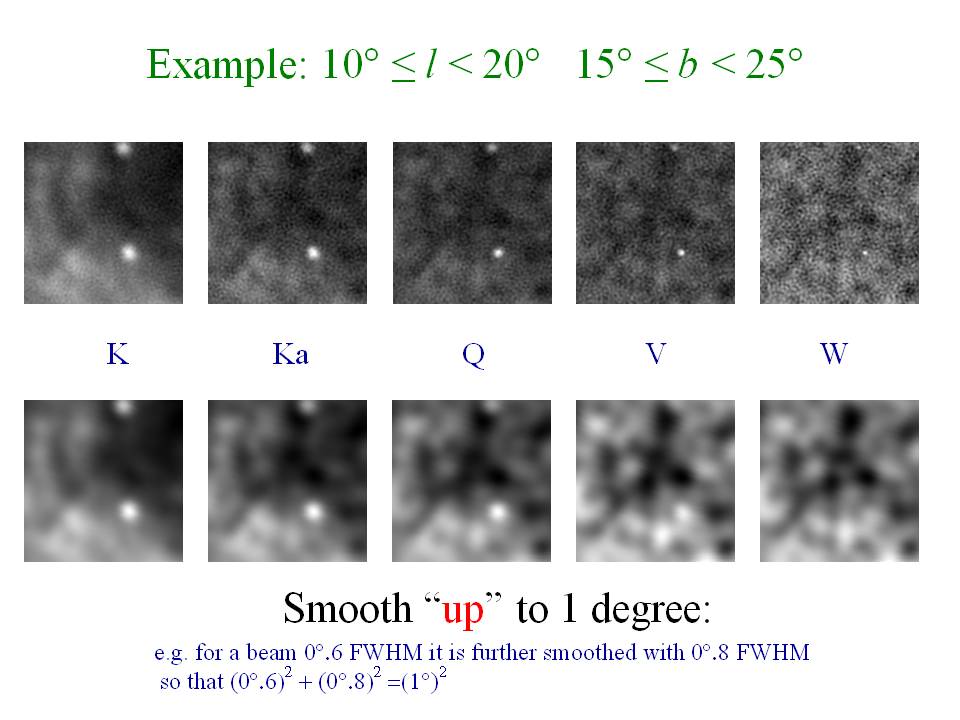
The CMB, being described by a black-body spectrum, has a sky temperature that doesn’t vary with frequency. Foreground emission, on the other hand, has an effective temperature that varies with frequency in way that is fairly well understood. The five available channels can therefore be used to model and subtract the foreground contribution to the overall signal. However, the different channels have different angular resolution (because they correspond to different wavelengths of radiation). Here are some sample patches of sky illustrating this
At each frequency the sky is blurred out by the “beam” of the WMAP optical system; the blurring is worse at low frequencies than at high frequencies. In order to do the foreground subtraction, the WMAP team therefore smooth all the frequency maps to have the same resolution, i.e. so the net effect of optical resolution and artificial smoothing produces the same overall blurring (actually 1 degree). This requires accurate knowledge of the precise form of the beam response of the experiment to do it accurately. A rough example (for illustration only) is given in the caption above.
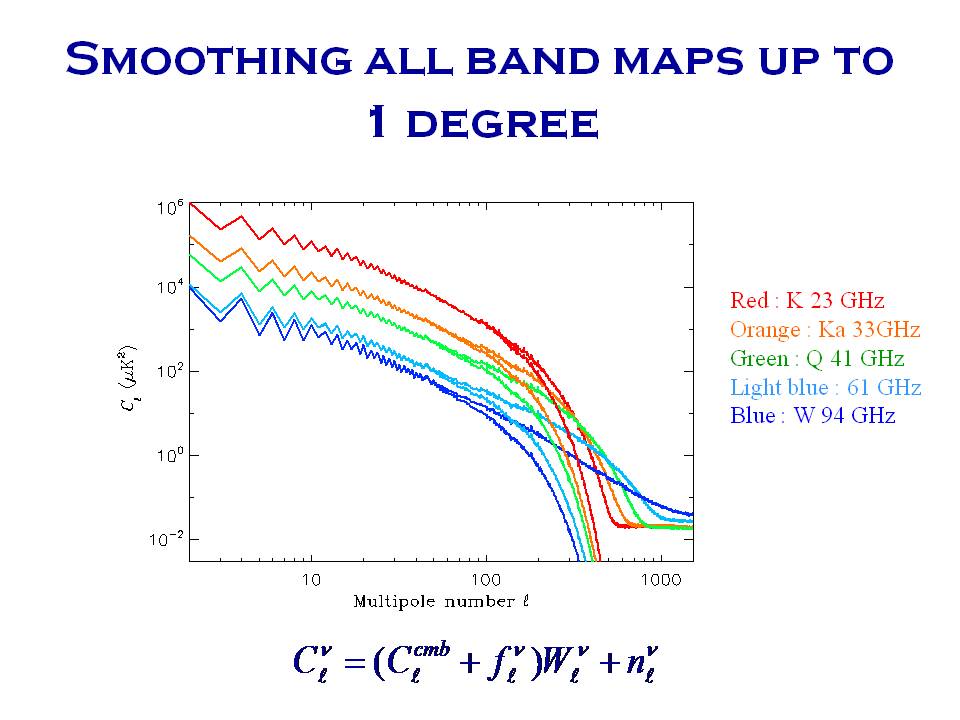
Now, here are the power spectra of the maps in each frequency channel
Note this is Cl not l(l+1)Cl as in the first plot of the spectrum. Now you see how much foreground there is in the data: the curves would lie on top of each other if the signal were pure CMB, i.e. if it did not vary with frequency. The equation at the bottom basically just says that the overall spectrum is a smoothed version of the CMB plus the foregrounds plus noise. Note, crucially, that the smoothing suppresses the interesting high-l wiggles.
I haven’t got space-time enough to go into how the foreground subtraction is carried out, but once it is done it is necessary to “unblur” the maps in order to see the structure at small angular scales, i.e. at large spherical harmonic numbers l. The initial process of convolving the sky pattern with a filter corresponds to multiplying the power-spectrum with a “window function” that decreases sharply at high l, so to deconvolve the spectrum one essentially has to divide by this window function to reinstate the power removed at high harmonics.
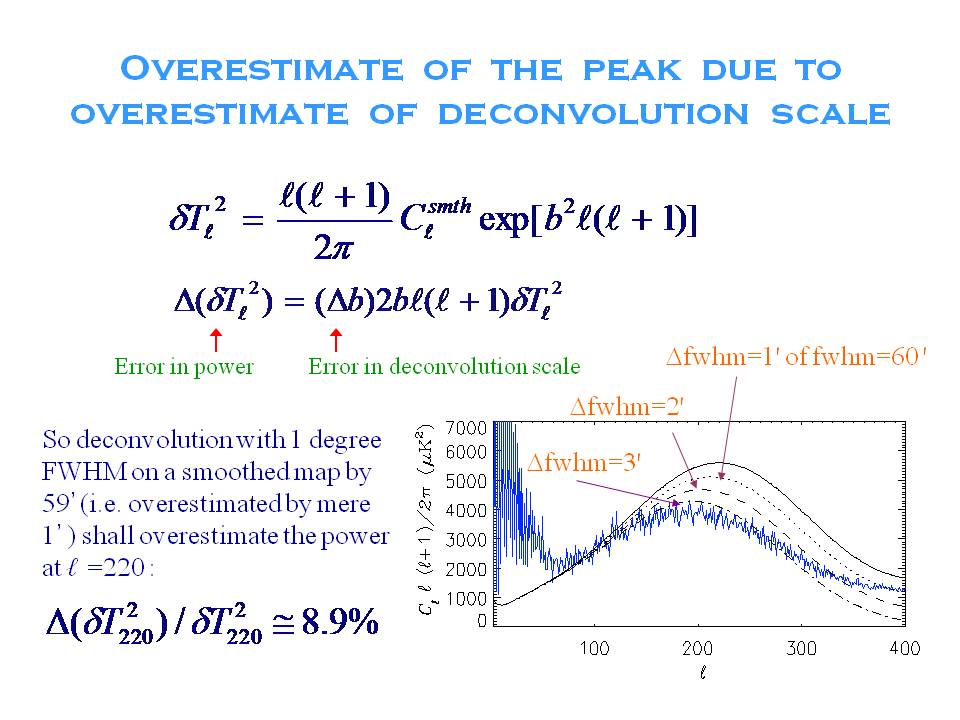
This is where it all gets very tricky. The smoothing applied is very close to the scale of the acoustic peaks so you have to do it very carefully to avoid introducing artificial structure in Cl or obliterating structure that you want to see. Moreover, a small error in the beam gets blown up in the deconvolution so one can go badly wrong in recovering the final spectrum. In other words, you need to know the beam very well to have any chance of getting close to the right answer!
The next picture gives a rough model for how much the “recovered” spectrum depends on the error produced by making even a small error in the beam profile which, for illustration only, is assumed to be Gaussian. It also shows how sensitive the shape of the deconvolved spectrum is to small errors in the beam.
Incidentally, the ratty blue line shows the spectrum obtained from a small patch of the sky rather than the whole sky. We were interested to see how much the spectrum varied across the sky so broke it up into square patches about the same size as those analysed by the Boomerang experiment. This turns out to be a pretty good way of getting the acoustic peak position but, as you can see, you lose information at low l (i.e. on scales larger than the patch).
The WMAP beam isn’t actually Gaussian – it differs quite markedly in its tails, which means that there’s even more cross-talk between different harmonic modes than in this example – but I hope you get the basic point. As Sawangwit & Shanks say, you need to know the beam very well to get the right fluctuation spectrum out. Move the acoustic peak around only slightly and all bets are off about the cosmological parameters and, perhaps, the evidence for dark energy and dark matter. Lung-Yih looked at the way the WMAP had done it and concluded that if their published beam shape was right then they had done a good job and there’s nothing substantially wrong with the results shown in the first graph.
Sawangwit & Shanks suggest the beam isn’t right so the recovered angular spectrum is suspect. I’ll need to look a bit more at the evidence they consider before commenting on that, although if anyone else has worked through it I’d be happy to hear from them through the comments box!
The views presented here are personal and not necessarily those of my employer (or anyone else for that matter).
Feel free to comment on any of the posts on this blog but comments may be moderated; anonymous comments and any considered by me to be vexatious and/or abusive and/or defamatory will not be accepted. I do not necessarily endorse, support, sanction, encourage, verify or agree with the opinions or statements of any information or other content in the comments on this site and do not in any way guarantee their accuracy or reliability.