Archive for the The Universe and Stuff Category
Alternative Galaxy Dynamics Examination
Posted in Education, The Universe and Stuff with tags astronomy, Cosmology, education, Meaning of Life, Monty Python on June 12, 2010 by telescoperCauchy Statistics
Posted in Bad Statistics, The Universe and Stuff with tags astronomy, Cauchy Distribution, cosmic variance, Cosmology, Gaussian distribution on June 7, 2010 by telescoperI was attempting to restore some sort of order to my office today when I stumbled across some old jottings about the Cauchy distribution, which is perhaps more familiar to astronomers as the Lorentz distribution. I never used in the publication they related to so I thought I’d just quickly pop the main idea on here in the hope that some amongst you might find it interesting and/or amusing.
What sparked this off is that the simplest cosmological models (including the particular one we now call the standard model) assume that the primordial density fluctuations we see imprinted in the pattern of temperature fluctuations in the cosmic microwave background and which we think gave rise to the large-scale structure of the Universe through the action of gravitational instability, were distributed according to Gaussian statistics (as predicted by the simplest versions of the inflationary universe theory). Departures from Gaussianity would therefore, if found, yield important clues about physics beyond the standard model.
Cosmology isn’t the only place where Gaussian (normal) statistics apply. In fact they arise generically, in circumstances where variation results from the linear superposition of independent influences, by virtue of the Central Limit Theorem. Noise in experimental detectors is often treated as following Gaussian statistics, for example.
The Gaussian distribution has some nice properties that make it possible to place meaningful bounds on the statistical accuracy of measurements made in the presence of Gaussian fluctuations. For example, we all know that the margin of error of the determination of the mean value of a quantity from a sample of size 

However, although the Gaussian assumption often applies it doesn’t always apply, so if we want to think about non-Gaussian effects we have to think also about how well we can do statistical inference if we don’t have Gaussianity to rely on.
That’s why I was playing around with the peculiarities of the Cauchy distribution. This comes up in a variety of real physics problems so it isn’t an artificially pathological case. Imagine you have two independent variables 


which is a form of the Cauchy distribution. There’s nothing at all wrong with this as a distribution – it’s not singular anywhere and integrates to unity as a pdf should. However, it does have a peculiar property that none of its moments is finite, not even the mean value!
Following on from this property is the fact that Cauchy-distributed quantities violate the Central Limit Theorem. If we take 
The Cauchy distribution has infinite variance so the distribution of the sum of independent Cauchy-distributed quantities 
This was essentially the point I made in a previous post about the dangers of using standard statistical techniques – which usually involve the Gaussian assumption – to distributions of quantities formed as ratios.
We cosmologists should be grateful that we don’t seem to live in a Universe whose fluctuations are governed by Cauchy, rather than (nearly) Gaussian, statistics. Measuring more of the Universe wouldn’t be any use in determining its global properties as we’d always be dominated by cosmic variance..
Signs of the Times
Posted in Biographical, Science Politics, The Universe and Stuff with tags Copenhagen, Dark Cosmology Centre, Niels Bohr Institute, Nyhavn on June 5, 2010 by telescoperWell, I’m back from sunny Copenhagen to a very muggy Cardiff. I arrived by train just as this afternoon’s rugby match between Wales and South Africa finished so I got caught up in the crowds and had to follow a lengthy diversion to get home. I was a bit tetchy with the heat and feeling a bit tired, but feel a bit mellower now after a nice shower. Apparently it was a cracking game, with Wales losing narrowly to the Springboks in the end. I missed it all.
Not feeling like doing anything more energetic blogwise, I thought I’d just put up a few pictures of the trip before making dinner. I heard while I was in Copenhagen that there are plans to relocate the historic Niels Bohr Institute to new accommodation nearby. I’m very attached to the old place and I think it will be a terrible shame if the original buildings are flogged off or bulldozed. I believe that’s not going to happen but I’m not sure what their fate is going to be. Anyway, I asked one of the locals, Tamara Davis, to take a picture in front of the sign outside the old NORDITA building, looking grumpy, to show my disapproval. I think she caught the mood perfectly.

Actually, Tamara isn’t really a local because she’s Australian, but she spends a couple of months a year in Denmark at the Dark Cosmology Centre, which is about ten minutes’ walk from the Niels Bohr Institute. I sat next to her at the conference dinner and found out that she’s also an international quality Ultimate Frisbee player. I wish I could pretend I knew what that was, but it sounds impressive. The fact that she’s training for a major event at the moment meant that she wasn’t drinking much wine so, being a gentleman, I drank the surplus on her behalf.
I wonder if there’s such a sport as Penultimate Frisbee?
Here’s another picture in front of the same building, featuring some folks from the workshop.
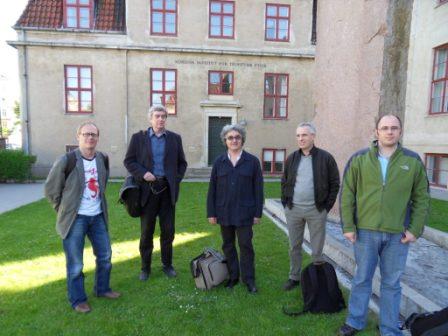
From left they are Dominik Schwarz (Bielefeld, Germany), Anthony Lasenby (Cambridge, UK), Carlo Burigana (Bologna, Italy), Sabino Matarrese (Padova, Italy) and Paolo Natoli (Rome, Italy).
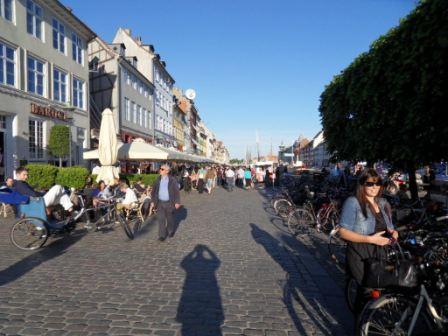
Last one shows the view in the evening sun looking down towards the picturesque old harbour area, called Nyhavn. I took this in anticipation of a nice cold beer among the crowds of people out enjoying themselves in the lovely weather. I wasn’t disappointed!
The Meaning of Inflation
Posted in Biographical, The Universe and Stuff with tags cosmic inflation, Cosmology, Oxford English Dictionary on June 4, 2010 by telescoperOur little meeting here in Copenhagen is more-or-less over and I’ve now got a free day to enjoy my birthday. It’s a lovely sunny morning and I’m looking forward to being a tourist. Yesterday we had a busy day of talks and discussions followed by a pleasant dinner in a nearby restaurant. One of the good things about small informal meetings like this is that you really get the chance to ask proper questions and have a meaningful dialogue, although sometimes things get a bit heated – especially when people like Leonid Grishchuk are present!
Leonid’s talk yesterday contained various polemical statements about cosmic inflation involving words like “bullshit” and “nonsense”. In the subsequent discussion the question arose as to what, precisely, the word inflation means.
In a nutshell, cosmic inflation is the name given to a short period of rapidly accelerating expansion in the very early Universe that caused it to expand by an enormous factor and also laid down a spectrum of fluctuations through quantum-mechanical processes. Inflation is a part of the standard “Big Bang” cosmological model, and there is a great deal of circumstantial evidence for it having happened and it’s a very elegant theory. I think it’s safe to say that there isn’t definitive proof but it’s certainly a thriving industry associated with its many versions.
However, the point is that there are many variants of the basic inflationary universe scenario – involving different fields, energy scales and so on – and, although they share some common features, they also differ dramatically from one to the other. What, it was asked, are the essential elements of inflation and what bits are just the trimmings?
In order to contribute meaningfully to the discussion I called upon the assistance of the Oxford English Dictionary to see how it defines inflation. The result was unexpectedly hilarious. Here are the first four definitions as they appear in the OED’s online edition:
- The action of inflating or distending with air or gas
- The condition of being inflated with air or gas, or being distended or swollen as if with air
- The condition of being puffed up with vanity, pride or baseless notions
- The quality of language or style when it is swollen with big or pompous words; turgidity, bombast
I was quite surprised that definitions to do with economics only appear further down the list, but cosmology’s position even lower down wasn’t unexpected. However, the leading entries are brilliant, especially definition number 3, which I think is hilarious. I’ll never be able to mention inflation again without thinking of that!
I fear I may have given Leonid quite a bit of ammunition for future anti-inflation rants although if he uses the phrase “baseless notions” in future talks he should perhaps also be careful to steer clear of “bombast”…
(Guest Post) FQXi
Posted in The Universe and Stuff with tags Foundational Questions Institute on June 2, 2010 by telescoperI’m happy to post the following message from Brendan Foster of the Foundational Questions Institute in order to help advertise their Large Grants Program. I should make clear that I have no formal connection with this Institute so if you have any questions about the program please contact them as advised in the post. And if you wish to apply, good luck!
-0-
I’d like to announce the 2010 round of the Foundational Questions
Institute (FQXi) Large Grants Program. Initial applications are due
in under two weeks, so get started now!
FQXi is an independent, philanthropically funded non-profit organization. Our mission is to catalyze, support, and disseminate research on questions at the foundations of physics and cosmology. We want to bring special focus to new frontiers and innovative ideas integral to a deep understanding of reality, but unlikely to be supported by conventional funding sources.
As part of our mission, we now invite proposals for research on foundational questions in physics and cosmology. The focus for this grant round is “Time and Foundations”. We wish to especially encourage projects targeted on the Nature of Time. To quote from the Request for Proposals, “The topic of Time is of both deep and broad interest for research in foundational questions in physics and cosmology. Science, and particularly physics, has produced dramatic insights into the nature of time…Careful consideration of time has
likewise caused revolutions in physics, and may again do so.”
We will also consider more general proposals of exceptional quality, including suitable outreach projects. All proposed projects should qualify as foundational and unconventional. You can get a sense of the range of supported work by checking out the funded projects from the previous grant rounds, at
http://www.fqxi.org/grants/large/awardees/list
The application consists of a two-step, online process, with review by an external panel of experts. The Initial Proposal is short and simple, consisting of little more than a page of summary and a rough budget. You should have more than enough time to get ready by the Initial Proposal deadline: June 14, 2010 (midnight, EST).
We will then invite selected proposals to be expanded into Full Proposals based on the selections of the Review Panel. Funds for approved Full Proposals will be available (via a Donor Advised Fund) soon after January 1, 2011.
To view full instructions and the application form, go to
http://www.fqxi.org/grants/large/initial.
The deadline again is Monday, June 14.
While you’re at it, visit our blog and online forums, at
You’ll find articles, essays, and discussions on foundational physics questions, including the Nature of Time. Send any questions to us at mail@fqxi.org.
Discovering Copenhagen
Posted in The Universe and Stuff with tags Copenhagen, Discovery Center, Niels Bohr Institute on June 2, 2010 by telescoperHere I am, again, in the fine city of Copenhagen in Denmark. It’s a lot warmer here than last time I was here, in January, but I’m here for a short meeting at the Discovery Center which we be held on the premises of the Niels Bohr Institute over the next few days.
It looks like being a funny little meeting, because nobody is allowed to talk about any Planck results yet so most speakers are talking about extraneous matters, almost like they’ll be talking about their hobbies. Should be fun. I haven’t decided what I’ll talk about yet, but my talk isn’t until tomorrow…
I travelled yesterday from Heathrow Airport with Leonid Grishchuk who I met in the airport. It turns out he had checked in extra-specially early for the the short flight to Copenhagen. The result of this enthusiasm was that his bags didn’t arrive with the plane. After filing a lost luggage report the usually avuncular Leonid turned into grumpy Grishchuk for the short Metro journey downtown. I saw him at breakfast just now and he told me his bag had actually been delivered to the hotel late last night. All’s well that ends well. It sounds like it must have come on the later flight, which probably means it never left Heathrow.
I was worried for a while I was going to miss the flight because my train from Cardiff was late as a result of being stuck in the Swansea area behind a broken-down train. Despite the delay and the fact that only one automatic check-in machine was working at the airport, I still had plenty of time to make the flight. My bag was one of the first out of the carousel.
Our meeting doesn’t start until lunchtime, so I’m going to take a walk around and do a little sightseeing beforehand. I know the city fairly well, but it will be nice to see how things have changed over the years. If memory serves, I think the first time I came here was in 1988. Quite a few of the places I went during that time have now closed but then I’m too old now to go them anyway!
Clustering in the Deep
Posted in Bad Statistics, The Universe and Stuff with tags astronomy, Cosmology, European Space Agency, Genesis 22:17, HERMES, Herschel, SPIRE on May 27, 2010 by telescoperI couldn’t resist a quick lunchtime post about the results that have come out concerning the clustering of galaxies found by the HerMES collaboration using the Herschel Telescope. There’s quite a lengthy press release accompanying the new results, and there’s not much point in repeating the details here, so I’ll just show a wonderful image showing thousands of galaxies and their far-infrared colours.

Image Credit: European Space Agency, SPIRE and HERMES consortia
According to the press release, this looks “like grains of sand”. I wonder if whoever wrote the text was deliberately referring to Genesis 22:17?
.. they shall multiply as the stars of the heaven, and as the grains of sand upon the sea shore.
However, let me take issue a little with the following excerpt from said press release:
While at a first glance the galaxies look to be scattered randomly over the image, in fact they are not. A closer look will reveals that there are regions which have more galaxies in, and regions that have fewer.
A while ago I posted an item asking what “scattered randomly” is meant to mean. It included this picture
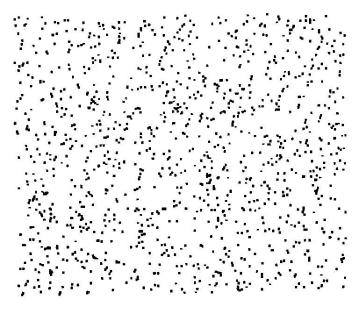
This is what a randomly-scattered set of points actually looks like. You’ll see that it also has some regions with more galaxies in them than others. Coincidentally, I showed the same picture again this morning in one of my postgraduate lectures on statistics and a majority of the class – as I’m sure do many of you seeing it for the first time – thought it showed a clustered pattern. Whatever “randomness” means precisely, the word certainly implies some sort of variation whereas the press release implies the opposite. I think a little re-wording might be in order.
What galaxy clustering statistics reveal is that the variation in density from place-to-place is greater than that expected in a random distribution like that shown. This has been known since the 1960s, so it’s not the result that these sources are clustered that’s so important. In fact, The preliminary clustering results from the HerMES surveys – described in a little more detail in a short paper available on the arXIv – are especially interesting because they show that some of the galaxies seen in this deep field are extremely bright (in the far-infrared), extremely distant, high-redshift objects which exhibit strong spatial correlations. The statistical form of this clustering provides very useful input for theorists trying to model the processes of galaxy formation and evolution.In particular, the brightest objects at high redshift have a propensity to appear preferentially in dense concentrations, making them even more strongly clustered than rank-and-file galaxies. This fact probably contains important information about the environmental factors responsible for driving their enormous luminosities.
The results are still preliminary, but we’re starting to see concrete evidence of the impact Herschel is going to have on extragalactic astrophysics.
Water and Energy
Posted in Biographical, Science Politics, The Universe and Stuff with tags Martin Rees, Severn Barrage, Sustainable Energy, Tidal Power, Welsh Assembly Government, Wind Power on May 25, 2010 by telescoperI’ve refrained from blogging about the fraught history of my attempts to have a new gas boiler installed in my house. Today, however, at last I have finally succeed in getting a state-of-the-art high-efficiency condensing contraption fit for the 21st Century, which will hopefully save me a few bob in gas bills over the winter but, more importantly, actually produce hot water for more than a minute or so without switching itself off.
The chaps that did the job for me actually had to test all the radiators too, which meant switching them all up to maximum. It wasn’t quite as hot today as it was yesterday but nevertheless the inside of the house was like a Turkish bath for a while. I therefore sat outside in the Sun for a bit waiting for them to get finished and tidy everything up.
While I was sitting there I got thinking about sustainable energy and so on, and was reminded of a comment Martin Rees made in his Reith Lecture not long ago. Wanting to sound positive about renewable energy he referred to the prospect of generating significant tidal power using a Severn Barrage. Given the local relevance to Cardiff – one of the main ideas is a barrage right across the Severn Estuary from Cardiff to Weston-super-Mare -so he presumably thought he was on safe ground mentioning it. In fact there was a lot of uneasy shuffling in seats at that point and the question session at the end generated some tersely sceptical comments. Many locals are not at all happy about the possible environmental impact of the Severn Barrage. That, and the cost – probably in excess of £20 billion – has to be set against the fact that such a barrage could in principle generate 2GW average power from an entirely renewable source. This would reduce our dependence on fossil fuels and increase our energy security too. The resources probably aren’t available right now given the parlous state of the public finances, but I’m glad that the Welsh Assembly Government is backing serious study of the various options. It may be that it won’t be long before we’re forced to think about it anyway. The Wikipedia page on the various proposals for a Severn Barrage is very comprehensive, so I won’t rehearse the arguments here. In any case, I’m no engineer and can’t comment on the specifics of the technology required to construct, e.g., a tidal-stream generator. However, I have to say that I find the idea pretty compelling, provided ways can be found to mitigate its environmental impact.
For a start it’s instructive to look at turbine-generated power. Wind turbines are cropping up around the British isles, either individually or in wind farms. A typical wind turbine can generate about 1MW in favourable weather conditions, but it needs an awful lot of them to produce anything like the power of a conventional power station. They’re also relatively unpredictable so can’t be relied upon on their own for continuous power generation. The power 

where 


The same formula would apply to a turbine placed in water, immediately showing the advantage of tidal power. For comparable efficiencies and sizes the ratio of power generated in a tidal-stream turbine to a wind turbine would be
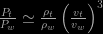
The speed of the water in a tidal stream can be comparable to the airspeed in a moderate wind, in which case the term in brackets doesn’t matter and it’s just the ratio of the densities of water and air that counts, and that’s a large number! Of course wind speed can sometimes be larger than the fastest tidal current, but wind turbines don’t work efficiently in such conditions and in any case it isn’t the
Not all proposals for the Severn Barrage involve tidal stream turbines. Some exploit the gravitational potential energy rather than the kinetic energy of the water by exploiting the vertical rise and fall during a tidal cycle rather than the horizontal flow. The energy to be exploited in, for example, a tidal basin of area

where 

Another thing that struck me doodling these things on the back of an envelope in the garden is that this sort of thing is what we should be getting physics students to think about. I’m quite ashamed to admit that we don’t…
Follow @telescoperA Star is Porn
Posted in The Universe and Stuff with tags astronomy, Cosmology, pornography, virtual reality on May 16, 2010 by telescoperI started thinking about the analogy between astronomy and pornography after seeing a hilarious blog post by Amanda Bauer that has a connection with my forthcoming (popular) book, which has the working title Naked Universe. It’s basically a collection of essays about cosmology, trying to look at the subject from unusual and provocative angles. I decided to give you a bit of a flavour of this connection here. It’s intended to be a bit of a joke, but it does make a semi-serious point about the difference between astronomy and other branches of science.
Although it’s one of the oldest fields of scientific enquiry, astronomy possesses a number of features that set it apart from most other branches of science. One of the most important is that it isn’t really an experimental science, but an observational one. Hands-on disciplines, specifically those involving laboratory experiments, require a dialogue between the scientist and nature. The scientist can control the physical parameters of the system under scrutiny and explore its behaviour under different conditions in order to establish patterns and test theoretical explanations. The scientist chooses the questions to ask, the experiment is run, and nature gives its answer. If more information is needed, another experiment is set up with different parameter choices.
Astronomy is different. Its subject matter, the Universe of stars and galaxies, is remote and inaccessible. We only have what is “out there” already. We had no hand in setting it up, and we can’t intervene if it behaves in an unexpected way. We are forced to work only with what has been given to us. Out there in the darkness the Cosmos may be beautiful, but all we can do is look at pictures of it. We never get to experience it in the flesh. Experimentalists have real intercourse with nature, but astronomers have to be content with being mere voyeurs.
This is not to say that all astronomers are dirty old men in grubby raincoats – although I have to say that I know a few who could be described like that – but many mainstream scientists do indeed tend to look down on us, at least partly because of the unconventional practices I’ve alluded to. On the other hand, I suspect they also secretly envy us. From time to time they probably also have a guilty peek at their favourite pictures too. Every time physicists look at astronomical images, do they feel just a little bit guilty?
You can hardly go on the internet these days without finding a website devoted to pornography astronomy.This is hardly surprising because both astronomy and pornography have led to technological advances that helped fuel the digital revolution. Astronomy gave us the CCD camera, which ushered in the digital camera that has made it much easier for both amateurs and professionals to make their own pornographic astronomical images. On the other hand, the porn industry was largely responsible for the rapid evolution of video-streaming technology. That must be why astronomers spend so much of their time doing video conferences…
Astronomers also led the way in the development of virtual reality. Frustrated by their inability to get up close and personal with the objects of their desire, they have resorted to the construction of elaborate three-dimensional computer simulations. In these they can interact with and manipulate what goes on until they reach a satisfactory outcome. I’ve never found this kind of thing at all rewarding – the simulations are just not sufficiently realistic – but large numbers of cosmologists seem to be completely hooked on them.
Herschel’s First Year in Space
Posted in The Universe and Stuff with tags ESA, Herschel, RAS on May 14, 2010 by telescoperJust about to journey to the RAS for the Annual General Meeting and the last club dinner before the summer break, I’m reminded by a tweet from Chris North that it’s exactly a year since we gathered nervously, fortified by booze, to watch the launch of the far-infrared observatory Herschel, together with its sister spacecraft Planck. I haven’t got time to write much about this because I’ve got a train to catch, but you can in any case find a nice retrospective of the Herschel’s first year in space here. I couldn’t resist, however, putting up the nice video that’s been put together by the European Space Agency to mark the anniversary.
It’s all been going swimmingly on the Herschel front since the launch, and the first science papers have been making their way onto the ArXiv this week. Thankfully it’s not been quite the deluge that I’d feared, more of a steady stream. I’ve even had a chance to read a few of them.
The next major milestone coming up will be announcement of opportunity for open time access (OT1) which will be released on 20th May with a deadline of 22nd July. I’m sure the huge success that Herschel has been so far will mean a lot of people putting in proposals. There is talk of putting in a proposal for a big cosmology survey – a sort of son of ATLAS and HERMES – which will be good timing for me and my little team at Cardiff because our theoretical models are almost ready to rumble…
Anyway, here’s to at least another three years of Herschel, although I’ll have to wait until this evening to raise a glass!


