Archive for the The Universe and Stuff Category

Factoid-based Learning

Posted in Books, Talks and Reviews, The Universe and Stuff with tags , on March 16, 2009 by telescoper

There’s a post over on cosmic variance that asks the question What is Scientific Literacy? Some of the comments reminded me of a book review I did for Nature a while ago, so I thought I’d put it on here.

My point is that teaching science isn’t about teaching facts, it’s about trying to develop critical thinking and problem-solving skills.
At least that’s what it should be, if only the dumbers-down would stop meddling.

BOOK REVIEWED Heavenly Errors: Misconceptions about the Real Nature of the Universe

by Neil F. Comins

Columbia University Press: 2001. 288 pp. $27.95, £18.95

Astronomy is a curious subject to teach. Even the most unpromising fledgling scientist has probably, at some stage, looked at the night sky and wondered about the meaning of it all. Students usually therefore enter the classroom with some preconceived notions about astronomical matters. These notions are often naïve, sometimes inaccurate, and occasionally downright bogus. The teaching of astronomy does not, therefore, begin with a blank piece of paper, as it does with other topics in physical science, but with the correction of misconceptions that may be deeply held.

In Heavenly Errors, Neil F. Comins illustrates the ambivalent consequences of astronomy’s peculiar allure with a series of commonly held misconceptions, misunderstandings and errors of logic. It is a promising idea for a book, particularly when the author has enlisted the willing help of thousands of undergraduate students to compile a list of frequently held wrong ideas about the Solar System and beyond. It is interesting to read of the origins of these misconceptions: Hollywood movies, astrology, the Internet and bad reporting of science all share some of the blame. But it’s even more interesting to look at the different kinds of misconception and what they tell us about the chasm that often lies between scientific thinking and the ‘common-sense’ reasoning they represent.

Ask why the weather is colder in the winter and you may well get the reply that, because its orbit is elliptical, the Earth is further from the Sun during winter than it is during summer and therefore receives less of the Sun’s power at that time of year. This explanation fails to explain why the Southern Hemisphere experiences summer at the same time as the Northern Hemisphere experiences winter, that is, at the same stage of the Earth’s orbit around the Sun. Talking through the logic of this example with students not only corrects the misconception, but also illustrates the scientific method by examining other necessary consequences of a given explanation before settling on the correct one. In this case, it is to do with the varying length of day and angle of the Sun in the sky.

Many of the examples presented by Comins are simple errors of fact. For example, “Polaris is the brightest star in the night sky”, comes in at number 8 in the top 50 Cosmic Clangers (it is Sirius). Many others do not justify being called misconceptions at all. Time travel, which Comins takes to be self-evidently impossible, is not, as he claims, excluded by the general theory of relativity. On the other hand, he states that black holes are definitely not black because they give off Hawking radiation — this despite the fact that Hawking radiation has not yet been observed in an astronomical object.

And what is a misconception anyway? Contrary to popular belief, planetary orbits are not circular, and yet circles provide a useful approximate description for many purposes. We are told that they are actually elliptical, but this is itself an approximation that ignores perturbations from other bodies and relativistic effects. Most scientific explanations are misconceptions if you view them like this.

Much of the early part of Heavenly Errors is excellent, particularly its explanations of the basic astronomical properties of the Sun, planets and comets. But further on, the book goes badly off the rails. Through its conflation of fact and theory, and its blurring of the distinction between truth and approximation, it turns into a misguided crusade that encourages the rote learning of factoids as a means to “acquire a sound scientific foundation for understanding nature”. I think this does more harm than good. T. H. Huxley, who knew a thing or two about science, put it best: “irrationally held truths may be more harmful than reasoned errors.”

Late Arrivals at the Physics Ball

Posted in The Universe and Stuff, Uncategorized with tags , , on March 13, 2009 by telescoper

Today is the day we have to endure Comic Relief, an event which happens mercifully only once a year. The idea is to raise money for charity by doing something funny. If only.

I’ve also recently been persuaded to part with £30 to buy a ticket for the annual Physics Ball, organized by Chaos (Cardiff University Physics student-staff society). In the light of this I thought I’d add yet another item of debatable comic value to Comic Relief. My old friend Bryn Jones and I have been taking a leaf out of the I’m Sorry I Haven’t a Clue book of appalling puns.

Without further ado, therefore, it gives us great pleasure to announce the late arrivals at the Physics Ball:

Mr. and Mrs. Sirquashens and their son Maxwell
Mr and Mrs Rowave and their son Mike
Mr and Mrs Ofmotion and their daughter Constance
Mr and Mrs Destate and their son Solly
And from Ireland, Mr and Mrs O’genesis and their son Barry who has brought his two pet newts (Ron and Reno).
Mr and Mrs Yabatick and their daughter Ada.
Mr and Mrs Dardtemperatureandpressure and their son, Stan.
Mr and Mrs Hertz and their son Terry.
Mr and Mrs Avolt and their energetic daughter Meg
Mr and Mrs Persymmetry and their daughter Sue
Mr and Mrs Mentum and their daughter Mo.
Mr and Mrs Sticity and their daughter Ella.
Mr and Mrs Ryovrelativity and their son, Theo, who has a successful career in the military, yes it’s General Theo Ryovrelativity. He’s brought a couple of friends too: Chris Toffle-Cymbals and Joe Desick. Oh, and have you met Rick Tensor?

Here’s Mr and Mrs Zeinstein-Condensate with their son Bo.
Mr and Mrs Gular-velocity and their daughter Anne.
And now we have Mr. and Mrs. Ihilation and their destructive daughter Ann.
Here are Mr. and Mrs. Barr and their highly pressured daughter Millie.

Mr. and Mrs. Farparticull with their son Al.
Mr. and Mrs. Diantflucks and their bright son Ray.
And the coach party has arrived from Ireland with Mr. and Mrs. O’Moshun and their important son Newt Onslow.
Mr. and Mrs. O’Lissforss and their daughter rotating daughter Kerry.
From the Institute of Electrical Engineers we have Mr. and Mrs. Arrsirkitt and their pulsating daughter Elsie.
We now have Mr. and Mrs. Rectcurrant and their son Dai.
Mr and Mrs Hair-Theorem and their son Noah.
Mr and Mrs Mix and their daughter Dinah
Mr and Mrs Clotron and their son Si
Mr and Mrs Yaolis and, doing her best to circulate, their daughter Cora
Mr and Mrs Daze-Lore and their Daughter Farrah
From the Ruritanian principality of Energee we have Prince Ippilocon-Servashun of Energee.
Mr. and Mrs. Jeenslaw and their far-from-energetic son Ray Lee.
Mr. and Mrs. Minnusflucks and their bright son Lou.
Mr. and Mrs. Litonian and their dynamic son Hammy.
Mr. and Mrs. Shuoffheet-Capassitees and their son Ray.
And more arrivals from Ireland: Mr. O’Savar-Law and his attractive wife Bea.
Mr. and Mrs. O’Watt and their powerful daughter Meg.
Mr. and Mrs. O’Particull and their petite daughter Nan
Mr and Mrs Ear-accelerator and their daughter Lynne

And although I don’t think they were invited here are Mr and Mrs Osoficklenonsense and their son Phil along with Mr and Mrs Logicaldistraction and their son Theo.

And a definitely unwelcome are Mr and Mrs Thropic-principle and their daughter Anne

Sorry you can’t come in wearing those jeans. You might not like it, but we do have a Jeans criterion.

Mr and Mrs Ittifluctuation and their son Dennis
Mr and Mrs Punovexponent and their rather chaotic daughter, Leah
Mr and Mrs Stransition and their daughter Fay
Mr and Mrs Trope with their children Polly and Barry.
And we now welcome Mr. and Mrs. Way-Veckwashunn and their canny daughter Inga; that’s the shrewd Inga Way-Veckwashunn.
Mr. and Mrs. Broywavelength and their daughter Deb.
Please welcome Mr. and Mrs. Noldsnumber and their turbulent son Ray.

And now it’s Cabaret time!

First we’ve got sensational pop in the form of singer Larry Tee, followed by a quick burst of Pump up the Volume, folllowed by Norwegian artist Lars Kattering, then chillout with the smooth background sounds of The Three Degrees and ending up with a number of fading stars performing Back to Black.

For those of you wanting something more traditional, we’ve got folk music by The Spinors.

Mr. and Mrs. Helmholtz-Instability and their unstable son Kelvin.
Mr. and Mrs. Tensor and their son Richie
From Wales, Mr and Mrs Menshanalanalissis and their son Dai
Mr and Mrs Eyelength and their daughter Deb Eyelength
Mr and Mrs Notanotherloadofbolloxaboutstringtheory and their son Gordon Bennett Notanotherloadofbolloxaboutstringtheory
Mr and Mrs Dingo-Flyte and their son Ben
From Norway, Mr and Mrs Tableorbit and their son Lars
Mr and Mrs Sonscattering and their son Tom.
Mr. Skelleration and his rapidly moving wife Constance.
Mr. and Mrs. Vennspeed and their son Alf.
And the Welsh electrician, Dai Electric.
From Germany we have Herr Diffraction and his wife Frau Enhofer Diffraction.
Mr. and Mrs. Offslaw and their electrical engineer son Kirk.
Mrs and Mrs Ginvariance and their daughter Gay
Mr and Mrs Terry-Matrix and their daughter Una
And here is Solly, the only member of the Ton family who could make it, but then he always comes on his own
Mr and Mrs On and their daughter Kay and son Barry
Mr and Mrs Roscopic-quantity and their son Mac.
Mr. and Mrs. Moment and their bipolar son Dai Paul.
Mr. and Mrs. Covraydiashonn and their glowing daughter Cherry Ann.
Mr. and Mrs. Arisation and their son Paul.
Mr. and Mrs. Onsprinkippiah and their very important son Newt.
Mr. and Mrs. Cannsoyldropp-Experryment and their very practical daughter Millie.
Mr. and Mrs. Sonnmorlie-Experryment, and here comes their son Michael with no positive result.
Mr. Menterryparticalls and his fundamentally important wife Ellie.
Mr. and Mrs. Swelldeemon and their problematic son Max.
Mr. and Mrs. Defect and their slightly spolit daughter Crystal.
Mr. Formmotion and his constant wife Una.
And here are the Tonn children with their father Newt, and their father’s unmarried sister Prue – that’s Auntie Prue Tonn.
The coach party has arrived from Wales, with Mr. and Mrs. Nammicks and their fast-moving son Dai.
Mr. and Mrs. Vergance-Theorem and their son Dai.
Mr. and Mrs. Oolie-Ekwayshonn and their son Bernie.
From America, Mr and Mrs Chure and their spaced-out son Cosmic Tex Chure
Mr and Mrs Wurld and their son Brian
Mr and Mrs Theory and their Daughter Emma
and here are the Structive-interference family, with brother and sister Des and Connie
Mr and Mrs Medes-Principle with their son Archie
Mr and Mrs Fishalsatellites and their son Artie
In a bit of a whirl here’s Mr and Mrs Currants and their son Eddy

From Germany, Mr and Mrs Duranium and their son Heinrich
Mr and Mrs Photon and their son Virgil
Mr and Mrs Velocity and their typical son Aramis
Mr and Mrs Gadrowsnumber and their daughter Ava
Mr and Mrs Experryment and their son Jules
Mr and Mrs Psimeson and their son Jay
Mr and Mrs Dington-Limit and their son Ed.
Mr. and Mrs. Eslaw and their son Charles.

From the Institution of Electrical Engineers we have Mr. and Mrs. Acksialcabell and their shielded son Carl.
We are pleased to receive Mr. Tennar and his wife Ann.
And from the Science and Technology Facilities Council we have their chief accountants, Mrs. Nanshall-Dissastar and Mr. Jettery-Kayoss: that’s Fi Nanshall-Dissastar and Bud Jettery-Kayoss.

Mr. Motiff-Forss and his magnetic wife Elektra.
Here from the left come Mr. and Mrs. Saslaw and their charged son Guy, and in the opposite direction their son Len.
Mr. and Mrs. Annicall-Annerjee and their son Mike.
Mr. and Mrs. Tamass and their son Rhys.
Mr. and Mrs. Statickpotenshall and their daughter Elektra.
Mr. Jenner-Ait-Annerjee-Levell and his wife Dee.
Mr. and Mrs. Mental-Constance and their humorous, light-hearted son Dai. That’s fun Dai Mental-Constance

Feel free to add more via the comments if you get the idea! The more excruciating the better…

The First Digit Phenomenon

Posted in Bad Statistics, The Universe and Stuff with tags , , on March 11, 2009 by telescoper

I thought it would be fun to put up this quirky example of how sometimes things that really ought to be random turn out not to be. It’s also an excuse to mention a strange connection between astronomy and statistics.

The astronomer Simon Newcomb (right) was born in 1835 in Nova Scotia picture2(Canada). He had no real formal education at all, but since there wasn’t much else to do in Nova Scotia, he taught himself mathematics and astronomy and became very adept at performing astronomical calculations with great diligence. He began work in a lowly position at the US Nautical Almanac Office in 1857, and by 1877 he was director. He became was professor of Mathematics and Astronomy and Johns Hopkins University from 1884 until 1893 and was made the first ever president of the American Astronomical Society in 1899; he died in 1909.

Newcomb was performing lengthy numerical calculations in an era long before the invention of the pocket calculator or desktop computer. In those days many such calculations, including virtually anything involving multiplication, had to be done using logarithms. The logarithm (to the base ten) of a number x is defined to be the number a such that x=10a. To multiply two numbers whose logarithms are a and b respectively involves simply adding the logarithms: 10a times 10b=10(a+b), which helps a lot because adding is a lot easier than multiplying if you have no calculator. The initial logarithms are simply looked up in a table; to find the answer you use different tables to find the “inverse” logarithm.

Newcomb was a heavy user of his book of mathematical tables for this type of calculation, and it became very grubby and worn. But he also noticed that the first pages of the logarithms seemed to have been used much more than the others. This puzzled him greatly. Logarithm tables are presented in order of the first digit of the number required: the first pages therefore contain logarithms for numbers beginning with the digit 1. Newcomb used the tables for a vast range of different calculations of different things. He expected the first digits of numbers that he had to look up to just be as likely to be anything. Shouldn’t they be randomly distributed? Shouldn’t all the pages be equally used?

Once raised, this puzzle faded away until it was re-discovered in 1938 and acquired the name of Benford’s law, or the first digit phenomenon. In virtually any list you can think of – street addresses, city populations, lengths of rivers, and so on – there are more entries beginning with the digit “1” than any other digit.

To give another example, although I admit this one is much harder to explain, in the American Physical Society’s list of fundamental constants, or at least the last version I happened to look at, no less than 40% begin with the digit 1. If you’ve been writing physics examination papers recently like I have, you will notice a similar behaviour. Out of the 16 physical constants listed in the rubric of a physics examination paper lying on my desk right now, 6 begin with the digit 1.

So what is going on?

There is a (relatively) simple answer, and a more complicated one. I’ll take the simple one first.

Consider street numbers in an address book as an example. Suppose Any street will be numbered from 1 to N. It doesn’t really matter what N is as long as it is finite (and nobody has ever built an infinitely long street). Now think about the first digits of the addresses. There are 9 possibilities, because we never start an address with 0. On the face of it, we might expect a fraction 1/9 (approximately 11%) of the addresses will start with 1. Suppose N is 200. What fraction actually starts with 1? The answer is more than 50%. Everything from 100 upwards, plus 1, and 11 to 19. Very few start with 9: only 9 itself, and 90-99 inclusive. If N is 300 then there are still more beginning with 1 than any other digit, and there are no more that start with 9. One only gets close to an equal fraction of each starting number if the value of N is an exact power of 10, e.g. 1000.

Now you can see why pulling numbers out of an address book leads to a distribution of first digits that is not at all uniform. As long as the numbers are being drawn from a collection of streets each of whom has a finite upper limit, then the result is bound to be biased towards low starting digits. Only if every street contained an exact power of ten addresses would the result be uniform. Every other possibility favours 1 at the start.

The more complicated version involves a scaling argument and is a more suitable explanation for the appearance of this phenomenon in measured physical quantities. Lengths, heights and weights of things are usually measured with respect to some reference quantity. In the absence of any other information, one might imagine that the distribution of whatever is being measured possesses some sort of invariance or symmetry with respect to the scale being chosen. In this case the prior distribution p(x) can be taken to have the so-called Jeffreys form, which is uniform in the logarithm, i.e. p(x) is proportional to 1/x. There obviously must be a cut-off at some point as this can’t be allowed to go on forever as it doesn’t converge for large x, but this doesn’t really matter for the sake of this argument. We can suppose anyway that there are many powers of ten involved before this upper limit is reached.

In this case the probability that the first digit is D is just given by the ratio of two terms: In the numerator we have the integral between D and D+1 of p(x) (that’s a measure of how much of the distribution represents numbers starting with the digit D) and on the denominator we have the integral between 1 and 10 of p(x) (the overall measure). The result, if we take p(x) to be proportional to 1/x, is just log (1+1/D).

picture1

The shape of this distribution is shown in the Figure. Note that about 30% of the first digits are expected to be 1. Of course I have made a number of simplifying assumptions that are unlikely to be exactly true, and the case of the physical constants is complicated by the fact that some are measured and some are defined, but I think this captures the essential reason for the curious behaviour of first digits.

If nothing else, it provides a valuable lesson that you should be careful in what variables you assume are uniformly distributed!

Throwing a Fit

Posted in Bad Statistics, The Universe and Stuff with tags , on February 18, 2009 by telescoper

I’ve just been to a very interesting and stimulating seminar by Subir Sarkar from Oxford, who spoke about Cosmology Beyond the Standard Model, a talk into which he packed a huge number of provocative comments and interesting arguments. His abstract is here:

Precision observations of the cosmic microwave backround and of the large-scale clustering of galaxies have supposedly confirmed the indication from the Hubble diagram of Type Ia supernovae that the universe is dominated by some form of dark energy which is causing the expansion rate to accelerate. Although hailed as having established a ‘standard model’ for cosmology, this raises a profound problem for fundamental physics. I will discuss whether the observations can be equally well explained in alternative inhomogeneous cosmological models that do not require dark energy and will be tested by forthcoming observations.

He made no attempt to be balanced and objective, but it was a thoroughly enjoyable polemic making the point that it is possible that the dark energy whose presence we infer from cosmological observations might just be an artifact of using an oversimplified model to interpret the data. I actually agreed with quite a lot of what he said, and certainly think the subject needs people willing to question the somewhat shaky foundations on which the standard concordance cosmology is built.

But near the end, Subir almost spoiled the whole thing by making a comment that made me decide to make  another entry in my Room 101 of statistical horrors.  He was talking about the  spectrum of fluctuations in the temperature of the Cosmic Microwave Background as measured by the Wilkinson Microwave Anisotropy Probe (WMAP):


I’ve mentioned the importance of this plot in previous posts. In his talk, Subir wanted to point out that the measured spectrum isn’t actually fit all that well by the concordance cosmology prediction shown by the solid line.

A simple way of measuring goodness-of-fit is to work out the value of chi-squared which relates to the sum of the squares of the residuals between the data and the fit. If you do this with the WMAP data you will find that the value of chi-squared is actually a bit high, so high indeed that there is only a 7 per cent chance of such a value arising in a concordance Universe.  The reason is probably to do with the behaviour at low harmonics (i.e. large scales) where there are some points that do appear to lie off the model curve. This means that the best fit concordance model  isn’t a really brilliant fit, but it is acceptable at the usual 5% significance level.

I won’t quibble with this number, although strictly speaking the data points aren’t entirely independent so the translation of chi-squared into a probability is not quite as easy as it may seem.  I’d also stress that I think it is valuable to show that the concordance model isn’t by any means perfect.  However, in Subir’s talk the chi-squared result morphed into a statement that the  probability of the concordance model being right is only 7 per cent.

No! The probability of chi-squared given the model is 7%, but that’s quite different to the probability of the model given the value of chi-squared…

This is a thinly disguised example of the prosecutor’s fallacy which came up in my post about Sir Roy Meadow and his testimony in the case against Sally Clark that resulted in a wrongful conviction for the murder of her two children.

Of course the consequences of this polemicist’s fallacy aren’t so drastic. The Universe won’t go to prison. And it didn’t really spoil what was a fascinating talk. But it did confirm in my mind that statistics is like alcohol. It makes clever people say very silly things.

Ecliptic Anomalies

Posted in Cosmic Anomalies, The Universe and Stuff with tags , , , , on February 12, 2009 by telescoper

Once a week the small band of cosmologists at Cardiff University have a little discussion group during which we look at an interesting and topical subject. Today my PhD student Rockhee chose an interesting paper by Diego et al entitled “WMAP anomalous signal in the ecliptic plane”. I thought I’d mention it here because it relates to an ongoing theme of mine, and I’ll refrain from commenting on the poor grammatical construction of the title.

The WMAP referred to is of course the Wilkinson Microwave Anisotropy Probe and I’ve blogged before about the tantalising evidence it suggests of some departures from the standard cosmological theory. These authors do something very simple and the result is extremely interesting.

In order to isolate the cosmic microwave background from foreground radiation produced in our own Galaxy, the WMAP satellite is equipped with receivers working at different frequencies. Galactic dust and free-free emission dominate the microwave sky temperature at high frequencies and Galactic synchotron takes over at low frequencies. The cosmic microwave background has the same temperature at all frequencies (i.e. it has a thermal spectrum) so it should be what’s left when the frequency-dependent bits are cleaned out.

What Diego et al. did was to make a map by combining the cleaned sky maps obtained at different frequencies obtained by WMAP in such a way as to try to eliminate the thermal (CMB) component. What is left when this is done should be just residual noise, as it should contain neither known foreground or CMB. The map they get is shown here.ecliptic

What is interesting is that the residual map doesn’t look like noise that is uniformly distributed over the sky: there are two distinct peaks close to the Ecliptic plane delineated by the black tramlines. Why the residuals look like this is a mystery. The peaks are both very far from the Galactic plane so it doesn’t look like they are produced by Galactic foregrounds.

One suggestion is that the anomalous signal is like an infra-red extension of the Zodiacal light (which is produced inside the Solar System and therefore is too local to be confined to the Galactic plane). The authors show, however, that a straightforward extrapolation of the known Zodiacal emission (primarily measured by the IRAS satellite) does not account for the signal seen in WMAP. If this is the explanation, then, there has to be a new source of Zodiacal emission that is not seen by IRAS but kicks in at WMAP frequencies.

Another possibility is that it is extragalactic. This is difficult to exclude, but is disfavoured in my mind because there is no a priori reason why it should be concentrated in the Ecliptic plane. Coincidences like this make me a bit uncomfortable. Some turn out to be real coincidences, but more often than not they are clues to something important. Agatha Christie would have agreed:

“Any coincidence,” said Miss Marple to herself, “is always worth noting. You can throw it away later if it is only a coincidence.”

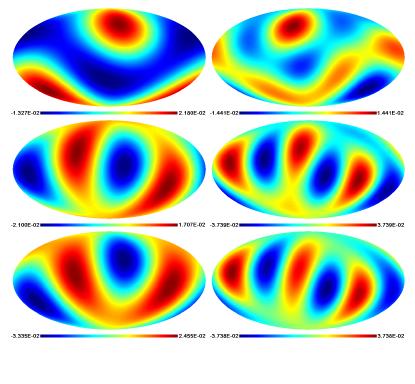
On the other hand, the dipole asymmetry of the CMB (thought to be caused by our motion through a frame in which it is isotropic) is also lined up in roughly the same direction:

The dipole has a hot region and a cold region in places where the residual map has two hot regions and anyway it’s also a very large scale feature so the chances of it lining up by accident with the ecliptic plane to the accuracy seen is actually not small. Coincidences definitely do happen, and the rougher they are the more commonly they occur.

Obviously, I don’t know what’s going on, but  I will mention another explanation that might fit. As I have already blogged, the WMAP satellite scans the sky in a way that is oriented exactly at right angles to the Ecliptic plane. If there is an as yet unknown systematic error in the WMAP measurements, which is related in some way to the motion of the satellite, it could at least in principle produce an effect with a definite orientation with respect to the Ecliptic.

The only way we can rule out this (admittedly rather dull) explanation is by making a map using a different experiment. It’s good, then, that the Planck satellite is going to be launched in only a few weeks’ time (April 16th 2009). Fingers crossed that we can solve this riddle soon.

From Here to Eternity

Posted in Books, Talks and Reviews, The Universe and Stuff with tags , , , , on February 3, 2009 by telescoper

I posted an item about astronomy and poetry a couple of days ago that used a phrase I vaguely remember having used somewhere else before. I’ve only just remembered where. It was in this book review I did for Nature some time ago. Since I’m quite keen on recycling, I’d thought I’d put it on here.

How do physicists cope with the concept of infinity in an expanding Universe?

BOOK REVIEWED – The Infinite Cosmos: Questions from the Frontiers of Cosmology

by Joseph Silk

Oxford University Press: 2006. 256 pp. £18.99, $29.95

Scientists usually have an uncomfortable time coping with the concept of infinity. Over the past century, physicists have had a particularly difficult relationship with the notion of boundlessness. In most cases this has been symptomatic of deficiencies in the theoretical foundations of the subject. Think of the ‘ultraviolet catastrophe’ of classical statistical mechanics, in which the electromagnetic radiation produced by a black body at a finite temperature is calculated to be infinitely intense at infinitely short wavelengths; this signalled the failure of classical statistical mechanics and ushered in the era of quantum mechanics about a hundred years ago. Quantum field theories have other forms of pathological behaviour, with mathematical components of the theory tending to run out of control to infinity unless they are healed using the technique of renormalization. The general theory of relativity predicts that singularities in which physical properties become infinite occur in the centre of black holes and in the Big Bang that kicked our Universe into existence. But even these are regarded as indications that we are missing a piece of the puzzle, rather than implying that somehow infinity is a part of nature itself.

The exception to this rule is the field of cosmology. Somehow it seems natural at least to consider the possibility that our cosmos might be infinite in extent or duration. If the Universe is defined as everything that exists, why should it necessarily be finite? Why should there be some underlying principle that restricts it to a size our human brains can cope with?

But even if cosmologists are prepared to ponder the reality of endlessness, and to describe it mathematically, they still have problems finding words to express these thoughts. Physics is fundamentally prosaic, but physicists have to resort to poetry when faced with the measureless grandeur of the heavens.

In The Infinite Cosmos, Joe Silk takes us on a whistle-stop tour of modern cosmology, focusing on what we have learned about the size and age of the Universe, how it might have begun, and how it may or may not end. This is a good time to write this book, because these most basic questions may have been answered by a combination of measurements from satellites gathering the static buzz of microwaves left over from the Big Bang, from telescopes finding and monitoring the behaviour of immensely distant supernova explosions, and from painstaking surveys of galaxy positions yielding quantitative information about the fallout from the primordial fireball. Unless we are missing something of fundamental importance, these observations indicate that our expanding Universe is about 14 billion years old, contains copious quantities of dark matter in some unidentified form, and is expanding at an accelerating rate.

According to the standard model of cosmology that emerges, the Universe has a finite past and (perhaps) an infinite future. But is our observable Universe (our ‘Hubble bubble’) typical of all there is? Perhaps there is much more to the cosmos than will ever meet our eyes. Our local patch of space-time may have its origin in just one of an infinite and timeless collection of Big Bangs, so the inferences we draw from observations of our immediate neighbourhood may never tell us anything much about the whole thing, even if we correctly interpret all the data available to us.

What is exciting about this book is not so much that it is anchored by the ramifications of infinity, but that it packs so much into a decidedly finite space. Silk covers everything you might hope to find in a book by one of the world’s leading cosmologists, and much more besides. Black holes, galaxy formation, dark matter, time travel, string theory and the cosmic microwave background all get a mention.

The style is accessible and informative. The book also benefits from having a flexible structure, free from the restrictions of the traditional historical narrative. Instead there are 20 short chapters arranged in a way that brings out the universality of the underlying physical concepts without having too much of a textbook feel. The explanations are nicely illustrated and do not involve any mathematics, so the book is suitable for the non-specialist.

If I have any criticisms of this book at all, they are only slight ones. The conflation of the ‘expanding Universe’ concept with the Big Bang theory, as opposed to its old ‘steady state’ rival, is both surprising and confusing. The steady-state model also describes an expanding Universe, but one in which there is continuous creation of matter to maintain a constant density against the diluting effect of the expansion. In the Big Bang, there is only one creation event, so the density of the expanding Universe changes with time. I also found the chapter about God in cosmology to be rather trite, but then my heart always sinks when I find myself lured into theological territory in which I am ill-equipped to survive.

Poems of Space

Posted in Books, Talks and Reviews, Poetry, The Universe and Stuff with tags , , , , , , , on February 1, 2009 by telescoper

A couple of weeks ago I bought a copy of Dark Matter: Poems of Space, an anthology of poems old and new with astronomical connections edited by Maurice Riordan and Dame Jocelyn Bell Burnell.

I quite like having anthologies because if you open one randomly you’re not absolutely sure what’s going to crop up, which can lead to pleasant surprises. But they’re also unsatisfactory to read through from cover to cover because there are huge differences in style and substance that are difficult to adjust to on a poem-by-poem basis. Random access is definitely better than sequential for this type of thing, so rather than attempt to study it all, over the last fortnight or so I’ve been taking regular dips into this particular collection, and very interesting it has been too.

The book contains over 200 poems mostly by different authors, although there is more than one contribution from a few (including Shelley and Auden). It’s a mixture of the familiar and the brand new, including some commissioned especially for this book. I couldn’t possibly write about the whole, but a few things struck me as I sampled various tidbits.

The first is that while many of these poems celebrate the beauty and majesty of the heavens, and some even embrace the wonder of scientific discovery, quite a few are quite anti-scientific. Two examples spring to mind (both of them paradoxically by favourite poets of mine!). This excerpt from The Song of the Happy Shepherd, a very early poem by WB Yeats is a good example

………………………………Seek, then,
No learning from the starry men,
Who follow with the optic glass
The whirling ways of stars that pass –
Seek, then, for this is also sooth,
No word of theirs – the cold star-bane
Has cloven and rent their hearts in twain,
And dead is all their human truth.

Hardly a ringing endorsement of observational astronomy, although strictly speaking it only refers to optical techniques so I suppose those working in radio-, X-ray and other types of astronomy are off the hook.

Incidentally, if I’d been given the task of picking a poem by Yeats for this collection it would have been this:

HAD I the heavens’ embroidered cloths,
Enwrought with gold and silver light,
The blue and the dim and the dark cloths
Of night and light and the half light,
I would spread the cloths under your feet:
But I, being poor, have only my dreams;
I have spread my dreams under your feet;
Tread softly because you tread on my dreams.

It’s not really much to do with astronomy or space but it’s one of his most beautiful lyrical verses, with a wonderful use of repetition (e.g. light, dreams, spread, tread) and assonance (light/night, spread/tread).

Anyway, another example of this kind of attitude displayed by Yeats Happy Shepherd is provided by Walt Whitman:

WHEN I heard the learn’d astronomer;
When the proofs, the figures, were ranged in columns before me;
When I was shown the charts and the diagrams, to add, divide, and measure them;
When I, sitting, heard the astronomer, where he lectured with much applause in the lecture-room,
How soon, unaccountable, I became tired and sick;
Till rising and gliding out, I wander’d off by myself,
In the mystical moist night-air, and from time to time,
Look’d up in perfect silence at the stars.

I think I’ve been to enough boring seminars to understand how he feels, but the theme of both these poems is that  studying the stars or applying science to them somehow robs them of their wonder. I think many non-scientists probably go along with this view: it’s beautiful to gaze at the sky but reducing it to measurements and graphs somehow ruins it.

Andromeda_gendler_smOf course I don’t agree.  Without professional astronomers we would never have discovered that, say, the Andromeda Nebula (shown above) was a galaxy just like our own Milky Way containing thousands of millions of stars like our Sun  and that it is rotating about its axis with a timescale of hundreds of millions of years. Knowing things like this surely increases the sense of wonder rather than decreasing it?

On the other hand it is true that the nature of science makes it rather prosaic. When scientists try to write for a popular readership they often spice up their accounts with quotations from poems, even if the quotes aren’t really all that appropriate. Perhaps some will turn to this collection for a source of such snippets. I know I will!

Another thing that struck me was that I always tended to think that engagement between science and poetry was a relatively recent thing, typified by WH Auden’s humorously perplexed After Reading a Child’s Guide to Modern Physics:

Our eyes prefer to suppose
That a habitable place
Has a geocentric view,
That architects enclose
A quiet Euclidian space:
Exploded myths – but who
Could feel at home astraddle
An ever expanding saddle?

But in fact the metaphysical poets of the 17th century also grappled with such issues. Consider this fragment from John Donne’s An Anatomy of the World:

We think the Heavens enjoy their spherical,
Their round proportion embracing all.
But yet their various and perplexed course,
Observed in divers ages, doth enforce
Men to find out so many eccentric parts,
Such divers down-right lines, such overthwarts,
As disproportion that pure form….

That could almost have been written about the possibility of a lop-sided universe that I’ve blogged about here and there, and which is a major topic of current cosmological research.

Other reactions I had were more personal. There is a poem in the collection by Fleur Adcock, who visited the Royal Grammar School in Newcastle when I was there. She judged a poetry reading competition (which I didn’t win) for which the test piece was Stevie Smith’s Not Waving but Drowning. I remember that she was quite a glamorous-looking lady, but she got everybody’s name wrong in her presentation address. She must be getting on a bit by now.

I have also met one of the other poets represented here too, Gwyneth Lewis, who was elected the first national poet for Wales and also spent some time as poet-in-residence in the School of Physics & Astronomy at Cardiff University where I now work. She wrote a number of poems about science but is probably most famous for writing the words “In These Stones Horizons Sing” which are incorporated in the design of the facade of the Wales Millennium Centre.

Anyway, I thoroughly recommend this book which is a rich treasury of verse ancient and modern. Some of the lovely things in it are quite new to me and I am definitely going to read more by some of the poets represented in it. That’s the way to use an anthology: go and read more systematically whoever catches your eye.

Being an old-fashioned romantic I think I’ll finish off with an excerpt from William Wordsworth‘s epic The Prelude. Regular readers (both of you) will know that I greatly admire Wordsworth and, for me, The Prelude is one of the highest pinnacles in all of English literature.

The universal spectacle throughout
Was shaped for admiration and delight,
Grand in itself alone, but in that breach
Through which the homeless voice of waters rose,
That dark deep thoroughfare, had Nature lodged
The Soul, the Imagination of the whole.

A New Theory of the Universe

Posted in The Universe and Stuff with tags , , , , on January 24, 2009 by telescoper

Yesterday I went on the train to London to visit my old friends in Mile End. I worked at the place that is now called Queen Mary, University of London for nearly a decade and missed it quite a lot when I moved to Nottingham. More recently I’ve had a bit more time and plausible excuses to visit London, including yesterday’s invitation to give a seminar at the Astronomy Unit. Although we were a bit late starting, owing to extremely slow service in the restaurant where we had lunch before the talk, it all seemed to go quite well. Afterwards we had a few beers and a nice chat before I took the train back to Cardiff again.

In the pub (which was the Half Moon, formerly the Half Moon Theatre,  a place of great historical interest) I remembered a joke I sometimes make during cosmology talks but had forgotten to do in the one I had just given.  I’m not sure it will work in written form, but here goes anyway.

I’ve blogged before about the current state of cosmology, but it’s probably a good idea to give a quick reminder before going any further. We have a standard cosmological model, known as the concordance cosmology, which accounts for most relevant observations in a pretty convincing way and is based on the idea that the Universe began with a Big Bang.  However, there are a few things about this model that are curious, to say the least.

First, there is the spatial geometry of the Universe. According to Einstein’s general theory of relativity, universes come in three basic shapes: closed, open and flat. These are illustrated to the right. The flat space has “normal” geometry in which the interior angles of a triangle add up to 180 degrees. In a closed space the sum of the angles is greater than 180 degrees, and  in an open space it is less. Of course the space we live in is three-dimensional but the pictures show two-dimensional surfaces.

But you get the idea.

The point is that the flat space is very special. The two curved spaces are much more general because they can be described by a parameter called their curvature which could in principle take any value (either positive for a closed space, or negative for an open space). In other words the sphere at the top could have any radius from very small (large curvature) to very large (small curvature). Likewise with the “saddle” representing an open space. The flat space must have exactly zero curvature. There are many ways to be curved, but only one way to be flat.

Yet, as near as dammit, our Universe appears to be flat. So why, with all the other options theoretically available to it, did the Universe decide to choose the most special one, which also happens in my opinion to be also the most boring?

Then there is the way the Universe is put together. In order to be flat there must be an exact balance between the energy contained in the expansion of the Universe (positive kinetic energy) and the energy involved in the gravitational interactions between everything in it (negative potential energy). In general relativity, you see, the curvature relates to the total amount of energy.

On the left you can see the breakdown of the various components involved in the standard model with the whole pie representing a flat Universe. You see there’s a vary strange mixture dominated by dark energy (which we don’t understand) and dark mattter (which we don’t understand). The bit we understand a little bit better (because we can sometimes see it directly) is only 4% of the whole thing. The proportions look very peculiar.

And then finally, there is the issue that I talked about in my seminar in London and have actually blogged about (here and there) previously, which is why the Universe appears to be a bit lop-sided and asymmetrical when we’d like it to be a bit more aesthetically pleasing.

All these curiosities are naturally accounted for in my New Theory of the Universe, which asserts that the Divine Creator actually bought  the entire Cosmos  in IKEA.

This hypothesis immediately explains why the Universe is flat. Absolutely everything in IKEA comes in flat packs. Curvature is not allowed.

But this is not the only success of my theory. When God got home he obviously opened the flat pack, found the instructions and read the dreaded words “EASY SELF-ASSEMBLY”. Even the omnipotent would struggle to follow the bizarre set of cartoons and diagrams that accompany even the simplest IKEA furniture. The result is therefore predictable: strange pieces that don’t seem to fit together, bits left over whose purpose is not at all clear, and an overall appearance that is not at all like one would have expected.

It’s clear  where the lop-sidedness comes in too. Probably some of the parts were left out so the whole thing isn’t  held together properly and is probably completely unstable. This sort of thing happens all the time with IKEA stuff. And why is it you can never find the right size Allen Key to sort it out?

So there you have it. My new Theory of the Universe. Some details need to be worked out, but it is as good an explanation of these issues as I have heard. I claim my Nobel Prize.

If anything will ever get me a trip to Sweden, this will.

What’s all the Noise?

Posted in Science Politics, The Universe and Stuff with tags , , , , on January 18, 2009 by telescoper

Now there’s a funny thing…

I’ve just come across a news item from last week which I followed up by looking at the official NASA press release. I’m very slow to pick up on things these days, but I thought I’d mention it anyway.

The experiment concerned is called ARCADE 2, which is an somewhat contrived acronym derived from Absolute Radiometer for Cosmology, Astrophysics and Diffuse Emission. It is essentially a balloon-borne detector designed to analyse radio waves with frequencies in the range 3 to 90 Ghz. The experiment actually flew in 2006, so it has clearly taken considerable time to analyse the resulting data.

Being on a balloon that flies for a relatively short time (2.5 hours in this case) means that only a part of the sky was mapped, amounting to about 7% of the whole celestial sphere but that is enough to map a sizeable piece of the Galaxy as well as a fairly representative chunk of deep space.

There are four science papers on the arXiv about this mission: one describes the instrument itself; another discusses radio emission from our own galaxy, the Milky Way; the third discusses the overall contribution of extragalactic origin in the frequency range covered by the instrument; the last discusses the implications about extragalactic sources of radio emission.

The thing that jumps out from this collection of very interesting science papers is that there is an unexplained, roughly isotropic, background of radio noise, consistent with a power-law spectrum. Of course to isolate this component requires removing known radio emission from our Galaxy and from identified extragalactic sources, as well as understanding the systematics of the radiometer during its flight. But after a careful analysis of these the authors present strong evidence of excess emission over and above known sources. The spectrum of this radio buzz falls quite steeply with frequency so appears in the two long-wavelength channels at 3 and 8 GHz.

So where does this come from? Well, we just don’t know.

The problem is that no sensible extrapolation of known radio sources to high redshift appears to be able to generate an integrated flux equivalent to that observed. Here is a bit of the discussion from the paper:

It is possible to imagine that an unknown population of discrete sources exist below the flux limit of existing surveys. We argue earlier that these cannot be a simple extension of the source counts of star-forming galaxies. As a toy model, we consider a population of sources distributed with a delta function in flux a factor of 10 fainter than the 8.4 GHz survey limit of Fomalont et al. (2002). At a flux of 0.75 μJy, it would take over 1100 such sources per square arcmin to produce the unexplained emission we see at 3.20 GHz, assuming a frequency index of −2.56. This source density is more than two orders of magnitude higher than expected from extrapolation to the same flux limit of the known source population. It is, however, only modestly greater than the surface density of objects revealed in the faintest optical surveys, e.g., the Hubble Ultra Deep Field (Beckwith et al. 2006).  The unexplained emission might result from an early population of non thermal emission from low-luminosity AGN; such a source would evade the constraint implied by the far-IR measurements.

The point is that ordinary galaxies produce a broad spectrum of radiation and it is difficult to boost the flux at one frequency without violating limits imposed at others. It might be able to invoke Active Galactic Nuclei (AGN) to do the trick, but I’m not sure. I am sure there’ll be a lot work going on trying to see how this might fit in with all the other things we know about galaxy formation and evolution but for the time being it’s a mystery.

I’m equally sure that these results will spawn a plethora of more esoteric theoretical explanations, inevitably including the ridiculous as well as perhaps the sublime. Charged dark matter springs to mind.

Or maybe it’s not even extragalactic. Could it be from an unknown source inside the Milky Way? If so, it might shed some light on the curiosities we find in the cosmic microwave background that I’ve mentioned here and there, but it seems to peak at too low a frequency to account for much of the overall microwave sky temperature.

But it does have a lesson for astronomy funders. ARCADE 2 is a very cheap experiment (by NASA standards). Moreover, the science goals of the experiment did not include “discovering a new cosmic background”. It just goes to show that even in these times of big, expensive and narrowly targetted missions there is still space for serendipity.

Job Advertisement

Posted in The Universe and Stuff with tags , , on January 14, 2009 by telescoper

This may not be a conventional use for a blog, but I thought I’d give it a go.

After receiving the news a while ago that I had a new research grant, I subsequently got official approval to advertise for a new postdoc and the advert has now been submitted to various places. I thought I might as well put the advertisement on here as well as the usual outlets. It will be on the AAS Jobs Register next month.

Research Associate
Cardiff School of Physics and Astronomy

Applications are invited for a position as Research Associate in Theoretical Cosmology in the School of Physics & Astronomy at Cardiff University. You will undertake research into departures from the standard “concordance” cosmological model and methods for extracting relevant evidence from observations of the cosmic microwave background and large-scale structure in the galaxy distribution. This position is funded by a grant from the Science & Technology Facilities Council.

You will have (or expect to obtain very soon) a PhD or have equivalent research experience in astronomy, astrophysics, cosmology or a closely related subject. A strong theoretical background and experience in the analysis of cosmological data are essential.

The School of Physics & Astronomy at Cardiff University hosts a broad and stimulating research program in astrophysics, cosmology and gravitational physics, encompassing theory, observation and instrumentation. In particular, it is involved in a large number of important cosmological experiments, including Planck, Quad and Clover.

See http://www.astro.cf.ac.uk/ for more information.

This post is fixed-term for 3 years.

Salary: £29704 – £35469 per annum.

Informal enquiries can be made to Professor Coles (Peter.Coles@astro.cf.ac.uk)

For an application pack and details of all Cardiff vacancies, visit www.cardiff.ac.uk/jobs alternatively email vacancies@cardiff.ac.uk or telephone +44 (0) 29 2087 4017 quoting vacancy number 2009/034.

For specific information on this particular vacancy, please go here.

Closing date: Monday, 02 March 2009.

I’ll take this post offline after the deadline passes.