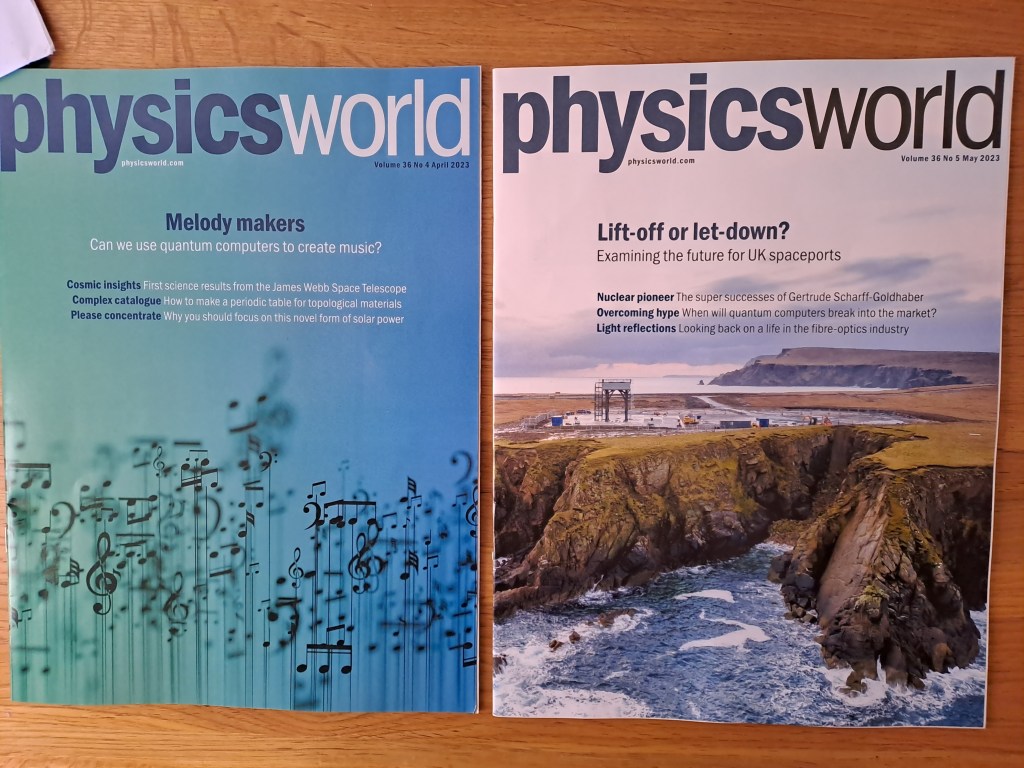
Now here’s a funny thing. The April and May 2023 editions of Physics World, shown above, published a month apart in the UK, arrived in the same day earlier this week in the post at my house in Maynooth. Both were correctly addressed. One took just over two weeks to cross the Irish Sea; the other took a whole month longer.
Can anyone provide a physical explanation for this phenomenon?
Fanciful “artist’s impression” of a Neutron Star – Black Hole merger (from last time).
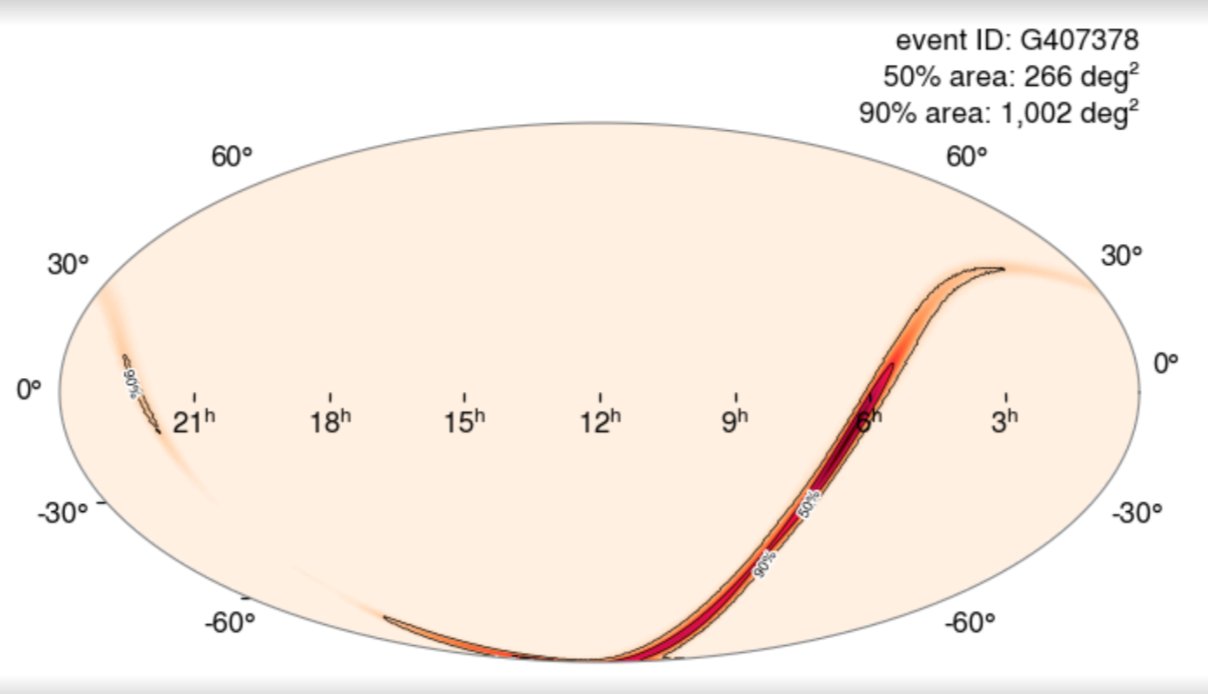
It seems that the engineering data ahead of the imminent observing run from the newly refurbished LIGO gravitational wave observatory has just triggered an alert for astronomers to look for an electromagnetic counterpart. The code number for this candidate event is S230518h. If confirmed this could very well be another Neutron-Star – Black Hole merger event. The search area is rather large, with the 90% probability region being about 1002 square degrees on the sky:
I’m reminded about the excitement surrounding the first Neutron Star merger way back in 2017. In fact, rumours started to spread via this blog as people outside the LIGO/transient source community used a comments thread here to share information of where telescopes were looking. Those were the days. Was that really 6 years ago?
It’s time to announce yet another new paper at the Open Journal of Astrophysics. This one was published yesterday (17th May).
The latest paper is the 17th paper so far in Volume 6 (2023) and the 82nd in all. With this one we have now published as many papers so far in 2023 as we did in all of last year. With significantly less than half the year gone, and a large number of papers in the pipeline, I think it’s quite likely we will exceed a total of 100 papers by the end of 2023. How’s that for cosmic acceleration?
The primary classification for this paper is Instrumentation and Methods for Astrophysics and its title is “Deep-field Metacalibration”. This article describes a technique that reduces the pixel noise in estimators of weak gravitational lensing shear signals by using a deeper imaging survey for calibration.
The authors are Zhuoqi (“Jackie”) Zhang (University of Chicago, IL, USA), Erin Sheldon (Brookhaven National Laboratory, NY, USA), and Matthew Becker (Argonne National Laborary, IL, USA).
Here is a screen grab of the overlay which includes the abstract:
You can click on the image of the overlay to make it larger should you wish to do so. You can find the officially accepted version of the paper, along with all other astrophysics and cosmology research papers worth reading, on the arXiv here.
As the launch of the European Space Agency’s Euclid mission approaches, though we don’t know official launch date yet, the associated publicity machines are ramping up for the big occasion. The latest bit of merch is the Euclid Launch Kit.
Sadly, this does not allow you to build your own Falcon 9 launcher which is what I inferred from the name. What it is is an interactive PDF file that allows you to navigate around and learn things about the satellite, its orbit, its instruments and the science case. I think it’s pretty good. You can download it here. It’s over 100 MB though, so beware if you have a very slow connection.
To whet your appetite, here some graphics extracted from the launch kit. You can click on the tiles to make them bigger.
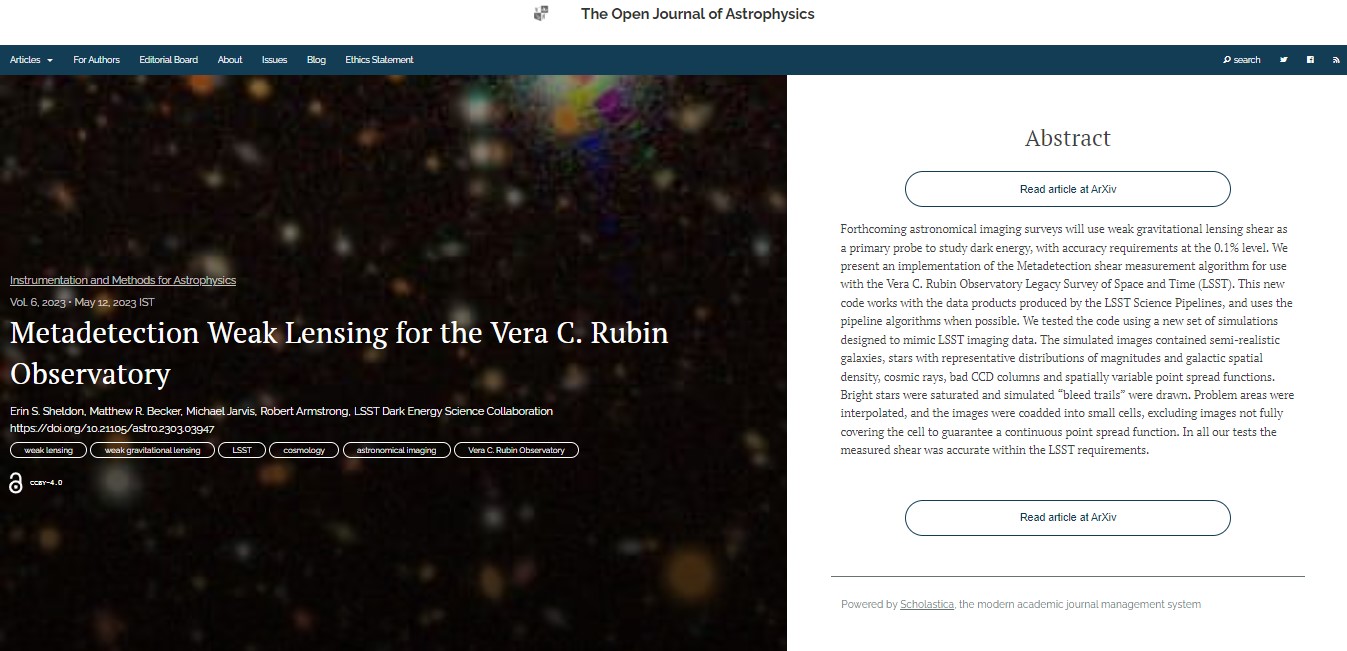
It’s time to announce yet another new paper at the Open Journal of Astrophysics. In fact it’s a little overdue, because we published this one on Friday 12th May, but I just got round to posting it on here.
The authors are Erin Sheldon (Brookhaven National Laboratory, NY, USA), Matthew Becker (Argonne National Laborary, IL, USA), Michael Jarvis (University of Pennsylvania, PA) and Robert Armstrong (Lawrence Livermore National Laboratory, CA) – all in the USA – and the LSST Dark Energy Science Collaboration, who have published a significant number of publications with OJAp. In fact, we’ll have another one in a day or two.
Here is a screen grab of the overlay which includes the abstract:
You can click on the image of the overlay to make it larger should you wish to do so. You can find the officially accepted version of the paper, along with all other astrophysics and cosmology research papers worth reading, on the arXiv here
It’s been too long since I last posted one of the cosmology talks curated on YouTube by Sean Hotchkiss so I will endeavour to put that right by posting one today.
In this video, Jeongin Moon, David Valcin and Christoph Saulder talk about the first cosmologically relevant results from DESI (the Dark Energy Spectroscopic Instrument), including the first detection of the BAOs (Baryon Acoustic Oscillations) therefrom. It’s pretty impressive for a first detection with only two months worth of data, so the final result with the full data set should be spectacular!
You can of course read the paper related to these results (by Moon et al.) on the arXiv here.
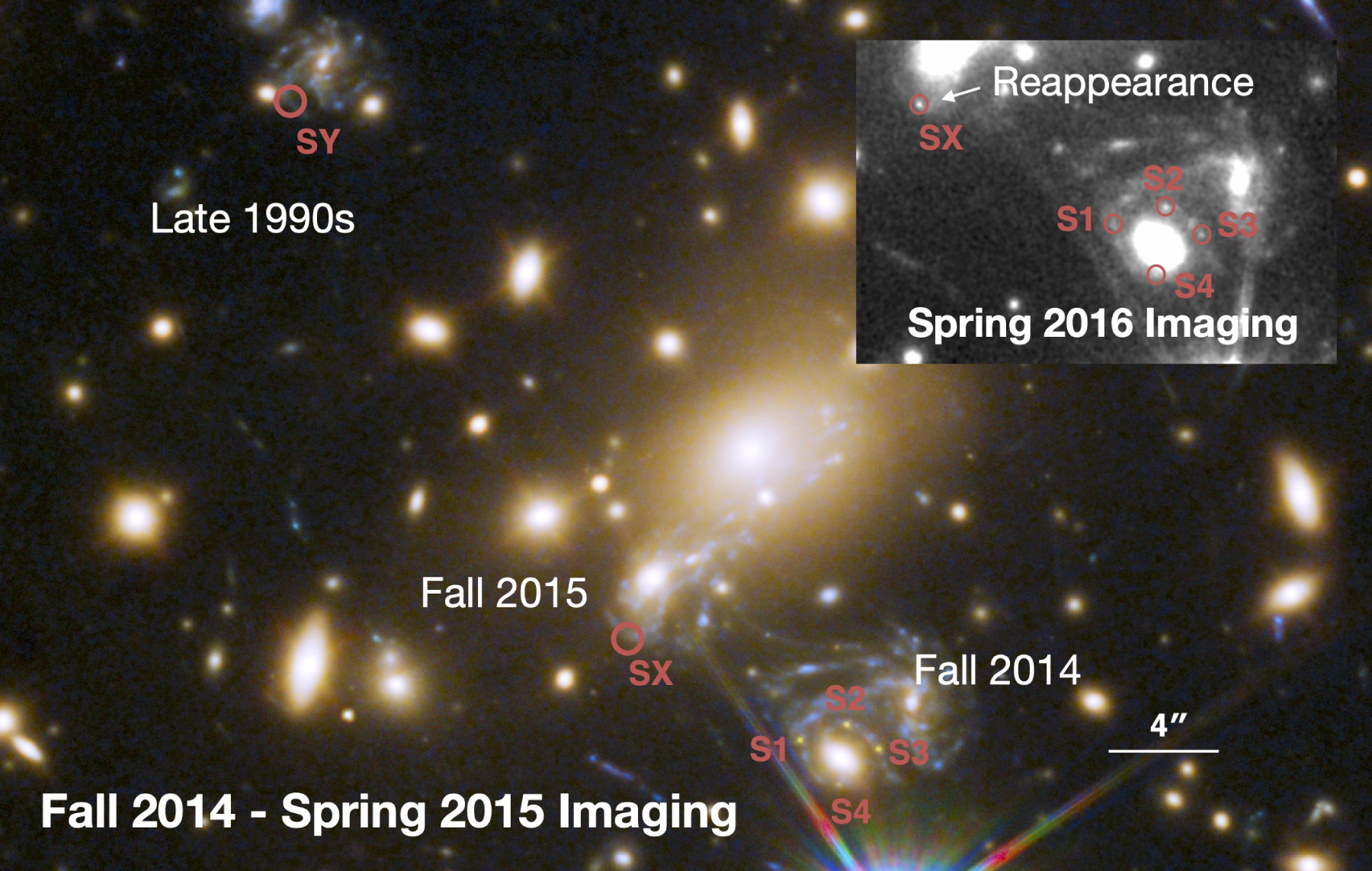
I haven’t had time to write much about astrophysics and cosmology recently, so this morning I back a few days through the arXiv – where every research paper worth reading in these fields can be found – and found a fascinating paper by Kelly et al. about the gravitational lensing of a supernova known as SN Refsdal after the pioneer of gravitational lensing, Sfur Refsdal. When first observed in 2014 this supernova was observed as four images produced by the gravitational lensing of light from the supernova through a massive cluster of galaxies, a phenomenon known as an Einstein Cross.
Lens modellers quickly got to work on this system and concluded that two further images should exist. Given the difference in light travel times for lensed paths and the relatively short lifetime of a supernova, neither would occur at the same time as the four original ones. One image would have been observed at some point in the 1990s, had anyone been looking, but that wasn’t the case. However, another was predicted to occur in 2015 and that was observed. I call it Refsdal’s Ghost because of the French word revenant, which means a ghost but also someone who returns after a long absence. Anyway, the revenant is marked SX in the image below (obtained from here). The unobserved image is SY and the four originals S1-S4.
Multiple images of a point source a in a system such as this, with measured time delays, provide theorists with a great deal of information they can use to model the distribution of mass inside the cluster, including its physical size. That in turn allows one to measure its distance. With a measurement of redshift, this allows one to determine the Hubble Constant.
The gravitationally lensed Supernova Refsdal appeared in multiple images, produced through gravitational lensing by a massive foreground galaxy cluster. After the supernova appeared in 2014, lens models of the galaxy cluster predicted an additional image of the supernova would appear in 2015, which was subsequently observed. We use the time delays between the images to perform a blinded measurement of the expansion rate of the Universe, quantified by the Hubble constant (H0). Using eight cluster lens models, we infer H0 = 64.8 +4.4-4.3 km / s / Mpc, where Mpc is the megaparsec. Using the two models most consistent with the observations, we find H0 = 66.6 +4.1-3.3 km / s / Mpc. The observations are best reproduced by models that assign dark-matter halos to individual galaxies and the overall cluster.
Anyone who has been following developments in cosmology knows that there is currently some “tension” over different measurements of the Hubble constant, as illustrated in this figure (which is slightly dated but which makes the point):
There is some uncertainty of course, but it is interesting that the Kelly et al. measurement aligns with most of what are called the “early” measurements in this plot. As I have mentioned before, though, there is another common factor in the “early” measurements, which is that they are based on geometrical distances obtained from angular distances whereas most of the others are based on luminosity. If the Hubble tension were to resolve into a differences between these two types of measure then it would be of fundamental importance to cosmology. At present, however, there is nowhere near enough evidence to be sure one way or the other.
This morning I did my last teaching session of the Academic Year 2022-3, a revision lecture/tutorial on Computational Physics. It was optional, as this is officially a study break, and was at 9am, but I had about 40% attendance which wasn’t bad in the circumstances. As is often the case with optional sessions, I think the students who came were the keenest and probably therefore those who least needed last-minute tips for the examination, but that’s always the way.
The Examination Period starts tomorrow, but most of the students who turned up this morning have their first examination on Monday. My paper is on Saturday next, 20th May.
Anyway, now that my teaching is over I thought I’d take the opportunity to wish all students the best for their examinations:
You shouldn’t really be relying on luck of course, so here are some tips (especially for physics students, but applicable elsewhere).
Try to get a good night’s sleep before the examination and arrive in plenty of time before the start. Spending all night cramming is unlikely to help you do well.
Prepare well in advance so you’re relaxed when the time comes.
Read the entire paper before starting to answer any questions. In particular, make sure you are aware of any supplementary information, formulae, etc, given in the rubric or at the end.
Start off by tackling the question you are most confident about answering, even if it’s not Question 1. This will help settle any nerves. You’re under no obligation to answer the questions in the order they are asked.
Don’t rush! Students often lose marks by making careless errors. In particular, check all your numerical results on your calculator at least twice
Please remember the units!
Don’t panic! You’re not expected to answer everything perfectly. A first-class mark is anything over 70%, so don’t worry if there are bits you can’t do. If you get stuck on a part of a question, don’t waste too much time on it (especially if it’s just a few marks). Just leave it and move on. You can always come back to it later.
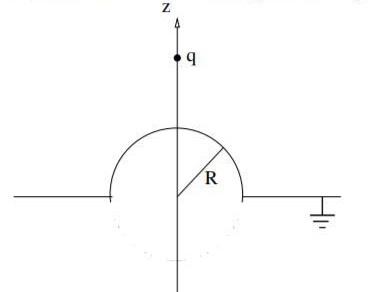
Today I gave a revision lecture/tutorial for my module Advanced Electromagnetism. With the Examination Period starting on Friday, that was the last class I will do for that. One of the topics I’ve been asked to cover in revision was the Method of Images for electrostatics. Preparing for the class I came across this cute problem which I thought I’d share here:
The question concerns a charge +q placed at a distance d as shown above an infinite earthed conducting plane distorted by the presence of a hemispherical bulge with radius R.
Using the method of images, or otherwise, calculate the potential at an arbitrary point above the conducting surface. (HINT: you need three image charges)
Find the magnitude and direction of the electrostatic force on the charge.
If you’re feeling keen you might also find what fraction of the total induced on the conductor is on the hemispherical part.
Answers through the comments box please!
Well, nobody posted an answer so here’s an outline solution.
To solve this problem you need three image charges: one is of charge – q at z=-d to make the plane an equipotential. For an isolated sphere you need a charge of -qR/d at z=-R^2/d (the inverse point of the sphere). But this charge also has an effect on the plane, which you need to correct by placing another image charge of +qR/d at z=-R^2/d. That is, the solution for the potential is due to the original charge plus three image charges. Then the potential is just the sum of four point charges.
You can differentiate the answer to the first bit to get the force, or you could work out the force on the original charge directly by adding the forces in the z-direction from the three image charges, it being obvious by symmetry that there is no other component of the force. For d>R this results in a force which is downward, so the charge is pulled towards the conductor. I’ll leave that as an exercise!
I just saw the announcement of this competition and thought I’d share it here to encourage people to enter:
The winner gets a trip to European Space Operations Centre (ESOC) in Darmstadt which will be Mission Control for Euclid, which will be launched from Florida in July.
You can find out more about the competition, including the rules and instructions on how to enter, here.
Here are some suggestions:
You could choose to bake a cake, cross stitch, design a fabric, paint, draw, dance or anything else that comes to mind that symbolizes these proportions 5-25-70 and helps others understand just how much of the Universe we know and don’t know.
Once you have created your creation you have to put an image or a video of it on social media. For more ideas see here.
P.S. The Universe’s vital statistics of 5-25-70 would seem to present quite a challenge if someone were to design an outfit!
The views presented here are personal and not necessarily those of my employer (or anyone else for that matter).
Feel free to comment on any of the posts on this blog but comments may be moderated; anonymous comments and any considered by me to be vexatious and/or abusive and/or defamatory will not be accepted. I do not necessarily endorse, support, sanction, encourage, verify or agree with the opinions or statements of any information or other content in the comments on this site and do not in any way guarantee their accuracy or reliability.







 In the Dark