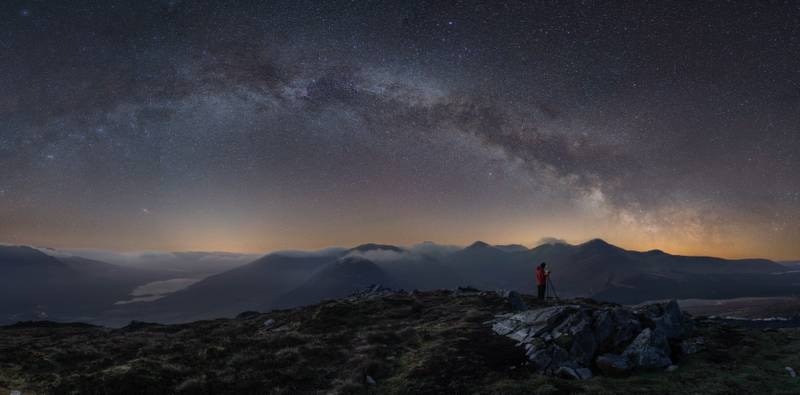
After all the nonsense in the past few days about ChorizoGate I thought I’d pass on news of some really wonderful and wonderfully real astronomical images featured in this year’s ‘Reach for the Stars’ astrophotography competition run by Dublin Institute for Advanced Studies (DIAS). You can find a full gallery and learn more about the competition here, but here is just one beautiful image as a taster. It was taken by Aisling McGuire and it shows the Twelve Bens mountain range in Connemara, with the Milky Way above.
My Twitter account is usually a quiet backwater of social media, and that’s the way I like it, but there was an unexpected burst of activity and interest in it over the weekend. To amuse myself on Saturday morning I decided to post this on Twitter:
(I deleted my Twitter account some time ago, so have replaced the link with a screenshot.)
I thought a few people might find it funny, but it took off beyond my expectations. By my standards over 5000 likes counts as “going viral” (as you young people say). Most people saw the joke immediately – if you don’t get it, the image is of a slice of chorizo not an astronomical object – and some even joined in with puns and other jokes. Even funnier, some respondents earnestly shared their devastating insight that it was chorizo (or some variant thereof). I honestly didn’t think anyone would think that I was seriously trying to pass it off as a JWST picture; it was just meant to be silly. But there you go. That’s Twitter. I should also report that some people looked at the rainbow flags in my profile and proceeded to indulge in some casual homophobia. That’s Twitter too. Those people all got blocked.
Anyway, the day after I posted the image it seems a prominent French physicist called Etienne Klein who has many times more Twitter followers than I do, posted this embellished version. TRIGGER WARNING – it’s in FRENCH:
Photo de Proxima du Centaure, l’étoile la plus proche du Soleil, située à 4,2 année-lumière de nous. Elle a été prise par le JWST. Ce niveau de détails… Un nouveau monde se dévoile jour après jour. pic.twitter.com/88UBbHDQ7Z
Notice the picture is exactly the same. What a coincidence! You might consider this plagiarism; I couldn’t possibly comment. I always regard anything I put on social media as being in the public domain so I’m not really bothered if other people “borrow” it. There’s quite a lot of plagiarism of stuff I’ve written on this blog out there, but life’s too short to get upset about it. Credit would be courteous, but one one learns that it isn’t generally to be expected.
As a matter of fact it’s not a new joke anyway. I didn’t make the picture and don’t remember where I got it from, though it was probably here.
Anyway, the funny thing is that this then got picked up by various other people:
and organisations:
⚡🇨🇵FLASH – L'éditorialiste politique internationale de BFMTV Ulysse Gosset s'est réjoui hier sur Twitter des prouesses du nouveau télescope James Webb en relayant une image de "l'étoile Proxima du Centaure". Loin de l'espace, il s'agissait en réalité d'une tranche de chorizo. pic.twitter.com/yBsWluiWcz
ChorizoGate all took off in a very surprising way. I’m not sure what the moral of this story is, other than if you make a joke no matter how obvious it is there will always be people who take it seriously…
I heard this week of the death, on his 103rd birthday, of scientist and writer James Lovelock. He started out as a chemist but became what is now called an “independent scientist” and “futurist”. These terms are often applied to people who are simply cranks, but he wasn’t just that. Unorthodox he was, certainly, but there was depth to his thinking that mere cranks never reach.
James Lovelock was best known to me – and I suspect to many others – for his work on the Gaia Hypothesis, which is roughly speaking the idea that the system of life on Earth functions as a single organism that defines and maintains the conditions necessary for its own survival.
I’ve just had a rummage around my bookshelves and found my copy of his famous book on this topic, which I bought and read back in the 80s. The first edition was published in 1979, but the one I bought was the version published in 1987 after the topic had been featured on the BBC TV programme, Horizon:
The Gaia hypothesis has been widely criticized by biologists and ecologists but I remember finding it a very thought-provoking book, though I interpreted more as a metaphor than a mechanism. At any rate it seems to me to be a useful counter to the extreme reductionism of many prominent life scientists. It’s also very well written and definitely worth reading over 40 years after it was written. James Lovelock was as inventive and ingenious a thinker as he was unorthodox.
Rest in peace, James Ephraim Lovelock (1919-2022).
In a state of not inconsiderable excitement, I showed the above picture (which appears in yesterday’s post) to a friend who shrugged and said “It doesn’t look like much..”. My response was “Well, you wouldn’t look like much at z=16.7…”
That reply was of course inspired by a famous exchange between Fred Hoyle and R.O. Redman recounted here:
Fred once started a talk by saying, ‘Oh, Ooh, basically a star is a pretty simple thing.’ And from the back of the room was heard the voice of R. O. Redman, saying, ‘Well, Fred, you’d look pretty simple too, from ten parsecs!
I’ve heard this story told by many people in different versions involving different characters, including Eddington, but I think it is generally accepted to have been between Hoyle and Redman, though this may well not have been the first comment of its type. If anyone knows any more please let me know!
As with the previous object the redshift of this one is not obtained via spectroscopy (which usually involves the identification of spectral lines) but via fitting a spectral profile to photometric imaging data seen in different bands. The process for this galaxy is illustrated by this diagram from the paper:
There are 7 images along the top showing the source through various broad band filters. Suitably calibrated these can be converted to the flux measurements shown on the graph. Notice the first three images are significantly fainter than the others, so the first three points on the left of the graph are lower.
If this is a galaxy its spectrum is expected to possess a Lyman Break resulting from the fact that radiation of shorter wavelength than the Lyman Limit (912 Å) is absorbed by neutral gas surrounding the regions where stars are formed in the galaxy. In the rest frame of a galaxy this break is the ultraviolet region of the spectrum but because of the cosmological redshift it is observed in the infrared part of the spectrum for very distant galaxies. In this case the best fit is obtained if the break is positioned as shown, with the first three fainter points to the left of the break and the rest to the right. The break itself is straddled by two observational bands. Employing a number of different estimates the authors conclude that the redshift of this galaxy is z=16.7 or thereabouts.
There is no direct evidence for the sharp edge associated with the Lyman Break – and no spectral lines are observed either – so this all depends on the object being correctly identified as a high-redshift galaxy and not some other object at lower redshift. You have to assume this to get a redshift, but then all inferences are based on assumed models so there’s nothing unusual about this approach. The authors discuss other possibilities and conclude that there is no plausible alternative source. Take away the green template spectrum and you just see a spectrum that rises to a peak and falls again. The authors claim that there is no plausible low-redshift source with such a spectrum.
So is this now the earliest galaxy ever observed? And what object will I be asking this question about next week? One thing I can predict is that there are going to be many more such objects in the very near future!
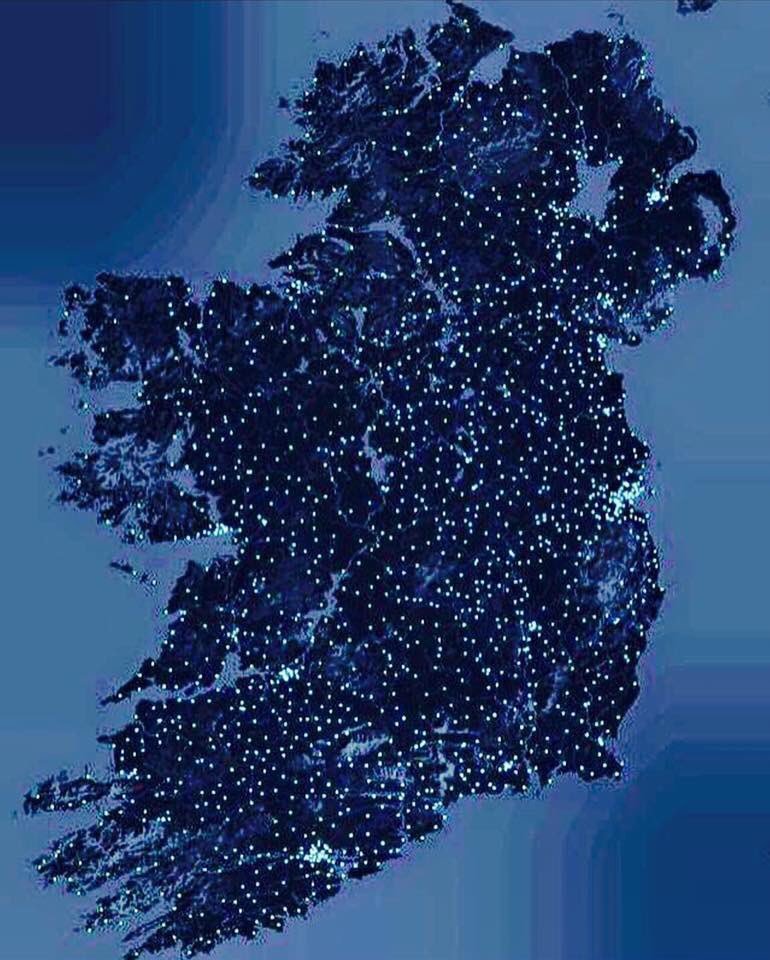
The above picture was doing the rounds on Twitter yesterday ahead of this year’s All-Ireland Football Final at Croke Park (won by favourites Kerry despite a valiant effort from Galway, who led for much of the game and didn’t play at all like underdogs).
The picture above shows the distribution of Gaelic Athletics Association (GAA) grounds around Ireland. In case you didn’t know, Hurling and Gaelic Football are played on the same pitch with the same goals and markings on the field. First thing you notice is that the grounds are plentiful! Obviously the distribution is clustered around major population centres – Dublin, Cork, Limerick and Galway are particularly clear – but other than that the distribution is quite uniform, though in less populated areas the grounds tend to be less densely packed.
The eye is also drawn to filamentary features, probably related to major arterial roads. People need to be able to get to the grounds, after all. Or am I reading too much into these apparent structures? The eye is notoriously keen to see patterns where none really exist, a point I’ve made repeatedly on this blog in the context of galaxy clustering.
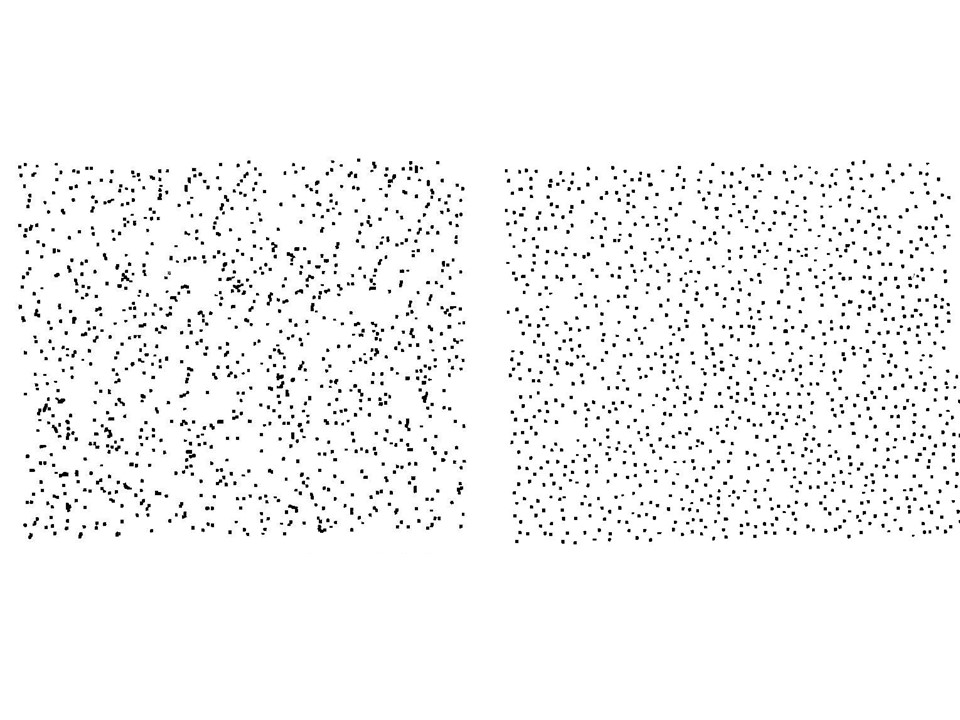
The statistical description of clustered point patterns is a fascinating subject, because it makes contact with the way in which our eyes and brain perceive pattern. I’ve spent a large part of my research career trying to figure out efficient ways of quantifying pattern in an objective way and I can tell you it’s not easy, especially when the data are prone to systematic errors and glitches. I can only touch on the subject here, but to see what I am talking about look at the two patterns below:
You will have to take my word for it that one of these is a realization of a two-dimensional Poisson point process and the other contains correlations between the points. One therefore has a real pattern to it, and one is a realization of a completely unstructured random process.
random or non-random?
I show this example in popular talks and get the audience to vote on which one is the random one. The vast majority usually think that the one on the right that is random and the one on the left is the one with structure to it. It is not hard to see why. The right-hand pattern is very smooth (what one would naively expect for a constant probability of finding a point at any position in the two-dimensional space) , whereas the left-hand one seems to offer a profusion of linear, filamentary features and densely concentrated clusters.
In fact, it’s the picture on the left that was generated by a Poisson process using a Monte Carlo random number generator. All the structure that is visually apparent is imposed by our own sensory apparatus, which has evolved to be so good at discerning patterns that it finds them when they’re not even there!
The right-hand process is also generated by a Monte Carlo technique, but the algorithm is more complicated. In this case the presence of a point at some location suppresses the probability of having other points in the vicinity. Each event has a zone of avoidance around it; the points are therefore anticorrelated. The result of this is that the pattern is much smoother than a truly random process should be. In fact, this simulation has nothing to do with galaxy clustering really. The algorithm used to generate it was meant to mimic the behaviour of glow-worms which tend to eat each other if they get too close. That’s why they spread themselves out in space more uniformly than in the random pattern.
Incidentally, I got both pictures from Stephen Jay Gould’s collection of essays Bully for Brontosaurus and used them, with appropriate credit and copyright permission, in my own book From Cosmos to Chaos.
The tendency to find things that are not there is quite well known to astronomers. The constellations which we all recognize so easily are not physical associations of stars, but are just chance alignments on the sky of things at vastly different distances in space. That is not to say that they are random, but the pattern they form is not caused by direct correlations between the stars. Galaxies form real three-dimensional physical associations through their direct gravitational effect on one another.
People are actually pretty hopeless at understanding what “really” random processes look like, probably because the word random is used so often in very imprecise ways and they don’t know what it means in a specific context like this. The point about random processes, even simpler ones like repeated tossing of a coin, is that coincidences happen much more frequently than one might suppose.
I suppose there is an evolutionary reason why our brains like to impose order on things in a general way. More specifically scientists often use perceived patterns in order to construct hypotheses. However these hypotheses must be tested objectively and often the initial impressions turn out to be figments of the imagination, like the canals on Mars.
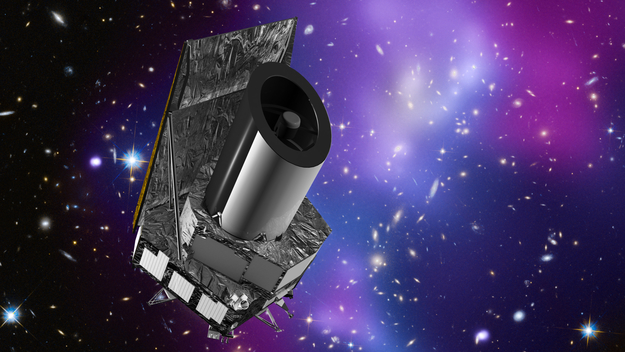
A little over a month ago I posted a piece about the European Space Agency’s Euclid Mission which had been due to be launched in 2023 on a Soyuz ST 2-1b rocket. That no longer being possible because of Russian’s invasion of Ukraine, it seemed there would be a lengthy delay in the launch of Euclid, with late 2024 seeming the earliest feasible date for launch on the obvious alternative, the new Ariane 6.
I ended that piece with this:
It seems to me that the best hope for a resolution of this problem would be for ESA to permit the launch of Euclid using something other than Ariane 6, which means using a vehicle supplied by an independent commercial operator. I sincerely hope ESA is able to come up with an imaginative solution to this very serious problem.
In the Dark, 17th June
I have heard various rumours since then but yesterday I saw a piece by Paris-based astronomer Henry Joy McCracken (a famous name in Ireland) that reveals that a proposal is being actively investigated to launch Euclid on a Falcon 9 rocket operated by Elon Musk’s outfit SpaceX. If all goes well it might be possible to launch Euclid by the end of 2023, and at a fraction of the cost of the alternative Ariane 6-2.
Setting aside any personal opinions about Elon Musk, the Falcon 9 has proved to be very reliable, with the latest version having 110 out of 110 successful launches. Euclid will not be in an Earth orbit, like most of the satellites so far launched by SpaceX, but has to be delivered to the 2nd Lagrange Point, L2. That should not pose to much of a difficulty.
As far as I understand it the decision whether or not this is feasible will be taken later this year after extensive engineering tests, especially to see how Euclid can cope with the spectrum of vibrations generated by Falcon 9. There’s no guarantee this will work out but it might just save a lot of money and a lot of careers.
It seems we’re on a bit of a roll at the Open Journal of Astrophysics as we have yet another new paper for me to announce. I think with the end of teaching quite a few authors are finding time to make their revised versions (which I should also be doing, come to think of it….)
Anyway the new paper, published yesterday, is the 11th paper in Volume 5 (2022) and the 59th in all. The latest publication is entitled “Bayesian error propagation for neural-net based parameter inference” and is written by Daniela Grandón of the University of Chile and Elena Sellentin of Leiden University.
It being mainly about the application of parameter inference to cosmology, this is another paper in the Instrumentation and Methods for Astrophysics folder.
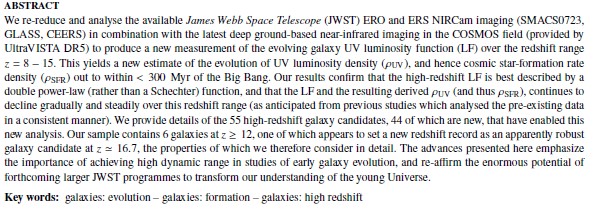
Here is a screen grab of the overlay which includes the abstract:
You can click on the image to make it larger should you wish to do so. You can find the arXiv version of the paper here.
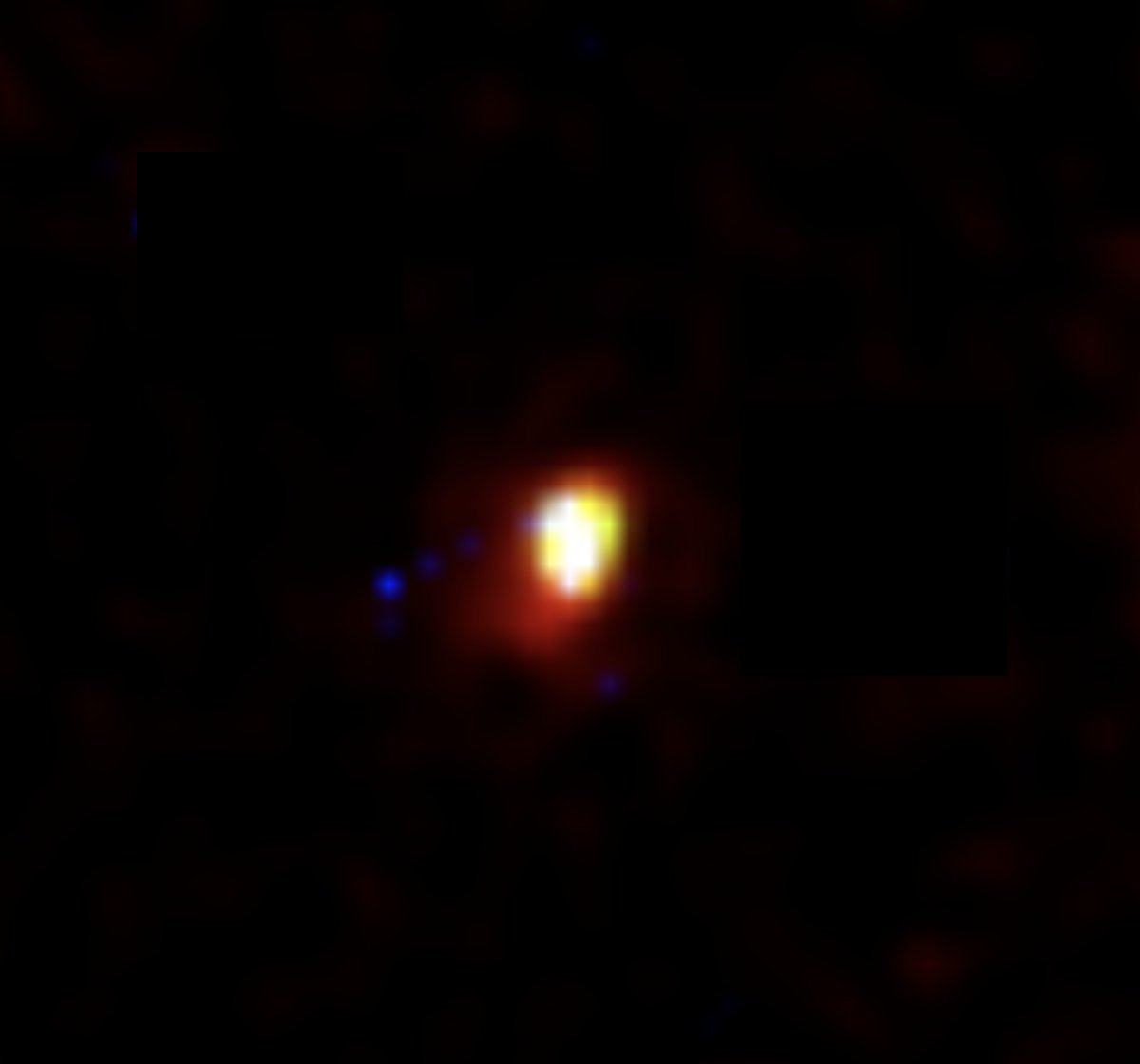
The red smudge in the centre of this image is thought to be a galaxy with a redshift of around z=13, as seen by the NIRCam instrument on the James Webb Space Telescope. This redshift estimate is based on photometry so the object remains a candidate rather than a confirmed high-redshift galaxy, but if confirmed spectroscopically this would be the highest-redshift galaxy yet observed.
For more details on the observations and their implications see the preprint on arXiv here. It’s interesting (and challenging) that there are such bright galaxies at such an early stage of cosmic evolution, assuming of course that the redshift is correct. Photometric redshift estimates have been wrong before.
If we take the estimated redshift at face value and adopt the standard cosmological model, the lookback time to this galaxy (GLASS-z13) is about 97.6% of the current age of the Universe so we’re seeing it as it was just 330 million years after the Big Bang. It could therefore be the earliest galaxy we have seen. It isn’t very accurate to say that it is the oldest galaxy we’ve seen, as we are probably seeing it as it was when it was very young.
These observations come from JWST Early Science Release Programmes so are just a taster of what is to come. No doubt we’ll hear much more about high-redshift galaxies from JWST in future and there’s every chance that they will change our view of the high-redshift Universe in dramatic ways.
I’ll just mention here that I’m old enough to remember going to conferences where “high redshift” meant z=0.5! In those days the highest redshift objects were quasars, but they have long since been overtaken.
It couldn’t have happened without enormous help from Arfon Smith, Chris Lintott, Adam Becker, Robert Simpson, Stuart Lynn and Mark Rohloff so many thanks to them for assistance in getting it off the ground. I also thank the staff at Maynooth University Library, especially Fiona Morley-Clarke, for their support and assistance. I also acknowledge financial support from the Gordon and Betty Moore Foundation.
I’d also like to thank the Editorial Team at OJAp, all unpaid volunteers, for their efforts and of course to all the authors who have trusted their research findings what was, at least at the start, an experimental venture.
Now seems an appropriate time to announce yet another new publication in the Open Journal of Astrophysics! This one, published last week, is the 10th paper in Volume 5 (2022) and the 58th in all.
The latest publication is entitled “V889 Her: abrupt changes in the magnetic field or differential rotation?”and is written by Teemu Willamo (Helsinki), Thomas Hackman (Helsinki), Jyri J. Lehtinen (Turku), Maarit Korpi-Lagg (Aalto) and Oleg Kochukhov (Uppsala). The first four of these are based in Finland and the last in Sweden.
This is another paper in the Solar and Stellar Astrophysics folder; the subject of the paper V889 Herculis is a young and very active dwarf star with some intriguing properties.
Here is a screen grab of the overlay which includes the (very short) abstract:
You can click on the image to make it larger should you wish to do so. You can find the arXiv version of the paper here.
The views presented here are personal and not necessarily those of my employer (or anyone else for that matter).
Feel free to comment on any of the posts on this blog but comments may be moderated; anonymous comments and any considered by me to be vexatious and/or abusive and/or defamatory will not be accepted. I do not necessarily endorse, support, sanction, encourage, verify or agree with the opinions or statements of any information or other content in the comments on this site and do not in any way guarantee their accuracy or reliability.





 In the Dark