Archive for the The Universe and Stuff Category

DIRAC Research Image Competition – The Winning Entries!

Posted in Art, The Universe and Stuff with tags , , , , , on November 9, 2022 by telescoper

DIRAC is a high-performance computing facility designed to serve the research community supported in the UK by the Science and Technology Facilities Council (STFC). Recently DIRAC ran a competition to select the best images produced using results obtained by this facility, and I was honoured to be asked to be one of the judges. Entries were divided into two Themes: Theme 1 (Particle and Nuclear Physics) and Theme 2 (Astronomy, Cosmology and Solar & Planetary Science) and scores were allocated by the judges based on visual impact and scientific interest. There were 41 entries altogether, all of a very high standard.

So, without further ado, I shall now show you the winning entries!

The winning image in Theme 1 was submitted by Ed Bennett and Biagio Lucini of Swansea University and called Let it (Wilson) flow. The description supplied by the creators reads:

A space-time slice of the topological charge density distribution of a 128 times 643 lattice field configuration (with periodic boundaries) from an ensemble of the SU(2) gauge theory with two flavours of Dirac fermion in the adjoint representation (also known as Minimal Walking Technicolor). Moving along the time direction from left to right, successive time-slices are also iterated using the gradient flow of the Wilson action, which removes the ultraviolet noise that would otherwise prevent computation of the configuration’s topological charge. This noise is clearly visible on the left, with the actual instantons (orange) and anti-instantons (blue) becoming visible at longer flow times to the right.

Here is the winning image for Theme 1:

Theme 1 winner: Let it (Wilson) flow by Ed Bennett and Biagio Lucini.

The winning entry of Theme 2 is entitled Immediate origin of the Moon as a post-impact satellite and was submitted by Jacob Kegerreis of Durham University who supplied the following description:

The Moon is thought to have formed following a giant impact, but the details are still hotly debated. New high-resolution simulations, like the one shown here, reveal that a Moon-like satellite can be immediately placed into a wide orbit around the Earth, in contrast with the traditional idea of later accretion from a debris disk. This opens up new possibilities for the Moon’s initial orbit and interior, which could help to solve mysteries like its tilted orbit, thin crust, and Earth-like isotopes. The 3D smoothed particle hydrodynamics (SPH) simulations were run using the SWIFT code on the DiRAC COSMA8 system with over 100 times higher resolution than the current standard. The SPH data from this mid-impact snapshot are rendered using Houdini and Redshift, with the colour, opacity, and emission controlled by the particle material, density, and internal energy.

Here is the winning image of Theme 2:

Theme 2 Winner: Immediate origin of the Moon as a post-impact satellite by Jacob Kegerreis

Congratulations to the winners!

It was a lot of fun being one of the judges for this competition and I learnt a lot about the science from the clever way in which many of the entries displayed their results. The field was very strong, and many more images were worthy of recognition, but we were only allowed to pick one winner from each Theme. I am however given to understand that it is planned to include the best of the rest alongside the winners in a 2023 calendar which will be distributed to the DIRAC user community.

Neutrinos from NGC 1068

Posted in The Universe and Stuff with tags , , , , , on November 7, 2022 by telescoper

I’m a bit late onto this as I was rather busy last week, but I couldn’t resist passing on the news that the IceCube Neutrino Observatory has detected high-energy neutrinos (Tev) from the active galaxy NGC1068 (also known as Messier 77). The result is published in Science whence I stole this figure showing the concentration neutrinos correlated with the position of NGC1068, along with a couple of other sources.

The hotspot associated with NGC 1068 is the most intense feature observed on the whole sky. I won’t write any more because there are two videos about this discovery, the first a quick summary for general viewers:

/

And the second is the full hour-long presentation as given last week.

New Publication at the Open Journal of Astrophysics

Posted in OJAp Papers, Open Access, The Universe and Stuff with tags , , , , , on November 4, 2022 by telescoper

It’s time once again for me to announce new paper at the Open Journal of Astrophysics. The new paper, published last week, is the 15th paper in Volume 5 (2022) and the 63rd in all. The latest publication is entitled “Two-photon amplitude interferometry for precision astrometry” and the authors are Paul Stankus, Andrei Nomerotski and Anže Slosar of Brookhaven National Laboratory (USA) and Stephen Vintskevich (Moscow Institute of Physics & Technology, Russia).

The paper presents a new method for doing interferometry with quantum-mechanically entangled photons and is thus is in the folder marked Instrumentation and Methods for Astrophysics. I don’t know much about this area – and there are many whose baseline opinion is that interferometry is a bit of a fringe topic that is rather complex perhaps needs more visibility in the current phase of its development  (geddit?) – but the physics looks fascinating to me. Amplitude interferometry should be contrasted with the intensity interferometry method of Hanbury Brown and Twiss which I remember learning about as an undergraduate.

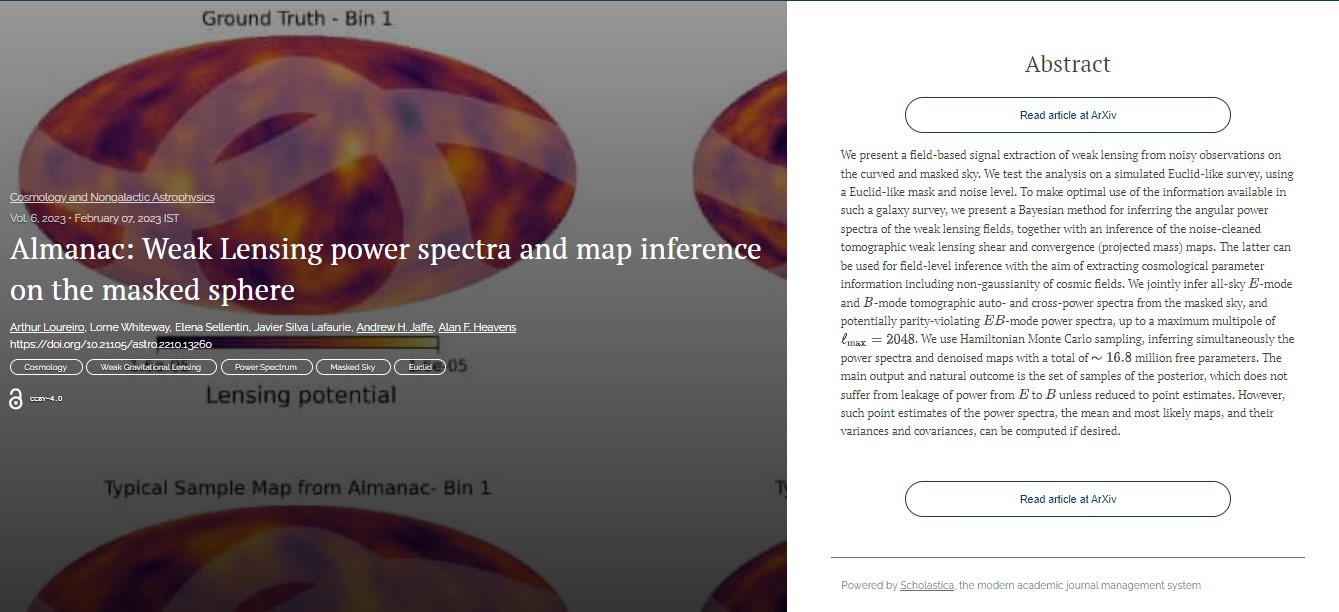
Anyway, here is a screen grab of the overlay which includes the  abstract:

You can click on the image to make it larger should you wish to do so. The full image used in the overlay is this:


You can find the officially accepted version of the paper on the arXiv here.

Astronomical Apocalypse Look-alike

Posted in Astronomy Lookalikes, Film, The Universe and Stuff with tags , , on November 1, 2022 by telescoper

I know it’s a bit late for Hallowe’en but have you noticed the similarity between the physical manifestation of the apocalyptic Sumerian deity Gozer as seen in the film Ghostbusters (left) and the pattern of dark coronal holes recently observed by NASA in the Sun’s atmosphere (right)? I wonder if, by any chance, they might be related?

Summer Programme for Undergraduate Research

Posted in Biographical, Maynooth, The Universe and Stuff with tags , , , on October 28, 2022 by telescoper

Not long ago I posted an item about the Summer Programme for Undergraduate Research (SPUR) at Maynooth University. This past summer I had two undergraduate students doing research projects with me funded under this scheme. They were both involved with making Monte Carlo simulations of galaxy clustering and using them to test various statistical analysis tools. The Department of Theoretical Physics actually had five students on three different projects, which is quite a lot for a small Department. The University as a whole had 57 SPUR students so we had almost ten percent of the total!

Well, earlier this week there was a Research Symposium at which all the summer’s research undergraduates presented posters on their work, with prizes being awarded for the best. I couldn’t attend the Symposium because of other commitments but I was delighted to find out that both my students won prizes – that’s two out of the five awarded. Here are the pictures of them being presented with their awards at the ceremony yesterday, flanked by the Vice-for Research and Innovation, Brian Donnellan and the President, Eeva Leinonen.

The awards ceremony was held in the foyer of the new TSI building yesterday afternoon, which wasn’t an ideal choice because the acoustic is very poor and lots of students were making their way to and from lectures. I didn’t hear a word of the speeches, actually. Nevertheless it was nice to see Pawel (top prize in the Science and Engineering category) and Lisa (audience choice prize winner) collect their awards. It was a pleasure to work with both of them this summer!

Incidentally, the SPUR students are paid for the projects, which last for (usually) six weeks but can be extended. I wish we could offer these projects to every student who wanted one, actually, but we just can’t afford to do that. I don’t agree with unpaid internships as these can only be taken up by students who have access to enough income to cover living expenses over the summer, so are discriminatory. We select students based on an application form and their academic performance.

The Leiden Sexual Harassment Case: Update

Posted in Harassment Bullying etc, The Universe and Stuff with tags , , on October 25, 2022 by telescoper

When I wrote less than a week ago about the case of an (unnamed) Professor at Leiden University being “removed for extremely unacceptable behaviour” I did not know the identify of the culprit but predicted that “it’s just a matter of time before the identity of the Professor concerned is revealed”.

Well, Leiden University still hasn’t officially revealed the Professor concerned but this article by Dutch news agency NRC gives a name: it is Tim de Zeeuw. The Wikipedia page I linked to there has already been updated with:

In 2022, Tim de Zeeuw was suspended from the University and barred from campus after being found to have violated professional conduct policy pertaining to harassment and sexual harassment of women employees. [10] This misconduct was found to have occurred repeatedly over many years. As of 18 October 2022 he is currently suspended (with pay) and allowed to use his university affiliation on his research papers but barred from campus, interaction with students, and all administrative and department responsibilities.

There may be some frantic editing of that page, but the cat is now well and truly out of the bag. I don’t know Tim de Zeeuw personally but he is indeed an eminent scientist in the fields of galactic dynamics and galaxy formation & evolution. For many years he was also Director of the European Southern Observatory, a position of great power and influence. If he has done what he is alleged to have done, however, this distinction counts for nothing and he should be removed from his post. Indeed that should have happened some time ago but I think there may be unresolved legal issues preventing his outright dismissal.

UPDATE: Tim de Zeeuw has now issued a statement, among other things confirming he is the person at the centre of this case but not showing very much in the way of contrition…

In the Name of JWST

Posted in LGBTQ+, Politics, The Universe and Stuff with tags , , , , , on October 25, 2022 by telescoper

JWST – nice telescope, shame about the name

I’ve blogged before about the problematic naming of the James Webb Space Telescope. Its name was changed in 2002 from the Next Generation Space Telescope to the James Webb Space Telescope after James E. Webb, a civil servant who was NASA’s chief administrator from 1961 to 1968.

It’s not uncommon for scientific space missions like this to be named after people once the proposal has moved off the drawing board and into serious planning. That happened with the European Space Agency’s Planck and Herschel to give two examples. In any case Next General Space Telescope was clearly never anything but a working title. Yet naming this important mission after a Government official always seemed a strange decision to me. Then news emerged that James Webb had enthusiastically cooperated in a McCarthyite purge of LGBT+ people working in government institutions, part of a wider moral panic referred to by historians as the Lavender Scare. There have been high-profile protests (see, e.g., here) and a petition that received over a thousand signatures, but NASA has ruled out any change of name.

The main reason NASA give is that they found no evidence that Webb himself was personally involved in discrimination or persecution. I find that very unconvincing. He was in charge, so had responsibility for what went on in his organization. If he didn’t know then why didn’t he know? Oh, and by the way, he didn’t have anything to do with infrared astronomy either…

I still think it’s a shame that this fantastic telescope should have its image so tarnished by the adoption of an inappropriate name.

Anyway, yesterday I saw that the Royal Astronomical Society has issued a statement about this issue, which I encourage you to read in full. It begins

At its meeting in July the governing council of the Royal Astronomical Society (RAS) took a decision to write to the UK Space Agency, the European Space Agency (ESA) and NASA to express its concerns about the original JWST naming process, the apparent failure to investigate James Webb’s background and the dismissal of requests to rename the telescope.

Until that investigation takes place and the results are made public, the RAS now expects authors submitting scientific papers to its journals to use the JWST acronym rather than the full name of the observatory. In this case, the previous requirement for the acronym to be spelled out at first mention will not be observed. This change will also be reflected in our communications more generally.

This does at least acknowledge the problematic nature of the name and the message it sends to LGBT+ scientists around the world and it the statement as a whole is to be welcome.

I think I’ll continue to use the name James Webb Space Telescope on this blog, though, as a reminder that the name should just be changed. Even in shorthand it’s an insult.


Astrophysics & Cosmology Masterclass at Maynooth

Posted in Education, Maynooth, The Universe and Stuff with tags , , , on October 24, 2022 by telescoper

Regular readers of the blog – both of them – may remember that we have twice previously presented a Masterclass in Astrophysics & Cosmology in Maynooth. Well, owing to popular demand, we’ve decided to do a re-run of the event on Wednesday 16th November 2022 during this year’s Science Week. Last year’s event was a big success, with over a hundred schools joining in, with probably over a thousand young people listening and asking questions.

Like last year’s event this year’s will be a half-day virtual event via Zoom. It’s meant for school students in their 5th or 6th year of the Irish system. There might be a few of them or their teachers who see this blog so I thought I’d share the news here. You can find more information, including instructions on how to book a place, here.

Here is the flyer for the event:

I’ll be talking about cosmology early on, and John Regan will talk about black holes later on. After the coffee break one of our students will talk about why they wanted to study astrophysics. Then I’ll say something about our degree programmes for those students who might be interested in studying astrophysics and/or cosmology as part of a science course. We’ll finish with questions either about the science or the studying!

Here is a more detailed programme:

Fortunately this year I don’t need to dash away at noon to do a lecture!

How to be good at Physics

Posted in Education, The Universe and Stuff with tags , , , on October 22, 2022 by telescoper

A couple of articles appeared recently that I encourage people to read who are studying physics, or interested in studying physics.

The first article by Carl Wieman is from Physics Today and is entitled How to become a successful physicist. It is aimed at graduate students, though most of what it says is relevant to those at an earlier stage of their studies. Here’s an excerpt from near the beginning:

The primary characteristic of a successful physicist is being a good problem solver.

The article goes on to say some very interesting and instructive things, and is well worth reading in its entirety. There are one or two things that I don’t agree with though. One is the statement that…

…textbook problems provide all the information needed and have a single well-defined path to a solution.

That’s true of many problems at an elementary level, but problems at undergraduate or graduate level often have more than one way of finding the solution. That’s certainly true of many that I set as assignments. Indeed, sometimes the students come up with better ways of approaching them than I did! The important difference between textbook and research problems is that you know the textbook problems have a solution. Research is scarier because you don’t know at the outset that an answer can be found!

The second article, by Ethan Siegel, is called The secret to becoming an excellent physicist. Here is a quote from that, revealing the “secret”:

It’s simplicity itself: you become good at physics by solving physics problems. That’s it: that’s the secret. If you want to become competent at physics, you will solve physics problems in the area you wish to learn.

I hope you get the message. It’s not about rote-learning facts and formulae. The brain is much more than a memory device. It’s all about problem-solving. The ability to do that effectively can only be learned through practice.

I’m currently teaching two modules on Mathematical Physics and I devote most of the time in lectures for both of them to doing worked examples rather than proving theorems or presenting facts, theorems, derivations, formulae, etc to learn. I spend quite a lot of time in lectures giving students things to work out, which makes classes more interactive, but students also have tutorials built around problem-solving tasks to complement this.

If you’re interested you can see my post on How to Solve Physics Problems; there is also a video version here.

I’d add one piece of advice. If you really want to develop as a physicist, don’t just solve a lot of easy problems; challenge yourself by tackling difficult ones too. Don’t be afraid to get “stuck” or make a mistake, as those are both necessary parts of the learning process. Above all, develop the confidence in your ability to take on a problem and back yourself to solve it and don’t be deterred if the answer doesn’t come quickly!

SpaceX for Euclid

Posted in The Universe and Stuff with tags , , , , , , , on October 20, 2022 by telescoper

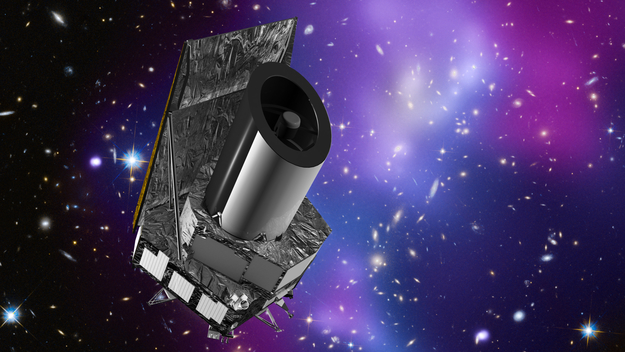
Aa few months ago I posted a piece about the European Space Agency’s Euclid Mission which had been due to be launched in 2023 on a Soyuz ST 2-1b rocket. That no longer being possible because of Russian’s invasion of Ukraine, it seemed there would be a lengthy delay in the launch of Euclid, with late 2024 seeming the earliest feasible date for launch on the obvious alternative, the new Ariane 6.

I ended that piece with this:

It seems to me that the best hope for a resolution of this problem would be for ESA to permit the launch of Euclid using something other than Ariane 6, which means using a vehicle supplied by an independent commercial operator. I sincerely hope ESA is able to come up with an imaginative solution to this very serious problem.

In the Dark, 17th June

Well I’ve just read official confirmation that a few hours ago ESA Council has approved the proposal to launch Euclid on a Falcon 9 rocket operated by SpaceX. If all goes well -specifically if the Euclid Consortium member states agree with this move – it might be possible to launch Euclid by the end of 2023. Although I don’t have any firm information about what date is being proposed I believe it could be as soon as July 2023.

Setting aside any personal opinions about Elon Musk, the Falcon 9 has proved to be very reliable, with the latest version having 110 out of 110 successful launches. Euclid will not be in an Earth orbit, like most of the satellites so far launched by SpaceX, but has to be delivered to the 2nd Lagrange Point, L2. That should not pose to much of a difficulty, however.