
by Max Ernst (1891-1976), painted in 1969, 92 x 73 cm, oil on canvas.
Follow @telescoperToday it’s Shrove Tuesday but unfortunately I forgot to buy shroves yesterday so will have to make do with pancakes instead, but not the usual kind. I’ve blogged before about the Zel’dovich Approximation (published in Zeldovich, Ya.B. 1970, A&A, 5, 84) but there’s no harm in describing this classic again. Here’s the first page of the original paper:
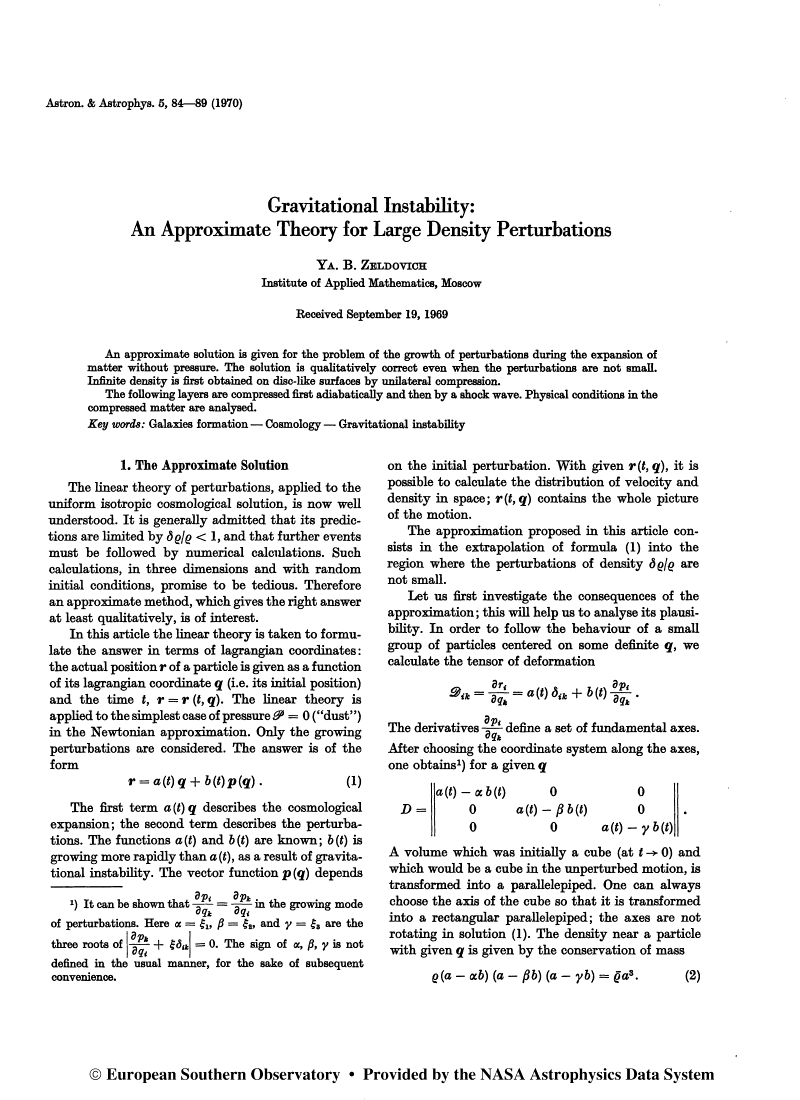
In a nutshell, this daringly simple approximation considers the evolution of particles in an expanding Universe from an early near-uniform state into the non-linear regime as a sort of ballistic, or kinematic, process. Imagine the matter particles are initial placed on a uniform grid, where they are labelled by Lagrangian coordinates 

Here the 


where 

This all means that the particles just get a small initial kick from the uniform Lagrangian grid and their subsequent motion carries on in the same direction. The approximation predicts the formation of caustics in the final density field when particles from two or more different initial locations arrive at the same final location, a condition known as shell-crossing. The caustics are identified with the main elements we find in large-scale structure. Because the initial collapse is usually along one direction the dominant structures are known as pancakes (or, as Zel’dovich himself might have called them, blini…).
Here’s a picture of a simulation showing these structures from the classic paper of Davis, Efstathiou, Frenk & White (1985):

Despite its simplicity this approximation is known to perform extremely well at reproducing the morphology of the cosmic web, although it breaks down after shell-crossing has occurred. In reality, bound structures are formed whereas the Zel’dovich approximation simply predicts that particles sail straight through the caustic which consequently evaporates.
Following on from yesterday’s post and inspired by this tweet
I thought I’d try a quick poll on what people think about the existent of intelligent life “out there”. In my experience, and in contrast to the tweet, most astronomers are actually quite open-minded about the possibility of extraterrestrial intelligence. My own view is that while it is entirely possible that there is intelligent life elsewhere in the Universe, scientific belief* should be based on evidence and we simply don’t have any evidence to support the idea. I would therefore say that I don’t “believe” but am agnostic. Sometimes “I don’t know” is the only rational answer.
You might ask me as a cosmologist whether I believe in the Big Bang theory. My answer would be “yes” because I think the evidence supports this description of the Universe. If evidence came along to change my opinion I might believe in it less or not at all. I might also change my mind if a different model came along that fits the observations better.
*In a Bayesian sense I would interpret “refusing to believe” as meaning setting a prior probability of zero, so that no amount of evidence would produce a non-zero posterior probability.
Anyway, setting aside the issue of whether there is even any evidence of intelligent life on Earth here is a poll:
Follow @telescoperA couple of days ago, on February 12th, there was a ‘Golden webinar in Astrophysics’ one of a series that seeks to bring forefront research in astronomy, astrophysics, and cosmology to the public in the English and Spanish languages. The speaker this time was Avi Loeb and the full title of his talk was Extraterrestrial Life: Are We the Sharpest Cookies in the Jar? A video of the entire event can be viewed here.
Avi Loeb is a very distinguished theoretical physicist, with broad interests in the fields of astrophysics and cosmology who has done excellent rather mainstream work on the formation and evolution of black holes, the first generation of stars in the universe and the epoch of reionization, as well as high-redshift gamma-ray bursts. He has also produced a large number of much more speculative articles in areas such as extra-terrestrial life (including SETI) some of which, in my opinion, is rather flaky. Loeb was a long-serving Chair of the Department of Astronomy at Harvard University and is the current Director of the Institute for Theory and Computation there.
The following is a short excerpt from the panel discussion following his talk. I was surprised to Avi Loeb adopt such a dismissive and confrontational attitude towards Jill Tarter (who has worked in the field of SETI for over 40 years). I’m also surprised that there was no intervention by the moderator of the discussion.
Many members of the astrophysics community have worked very hard to ensure that conference talks, seminars and panel discussions (whether in person or virtual) are conducted in a collegiate and cooperative manner. I don’t think Loeb is setting a good example in this clip, especially for someone who is an experienced former Department Chair. We all have strong feelings about certain things, but there’s no need to adopt such an aggressive tone. No wonder so many people find academia a toxic environment.
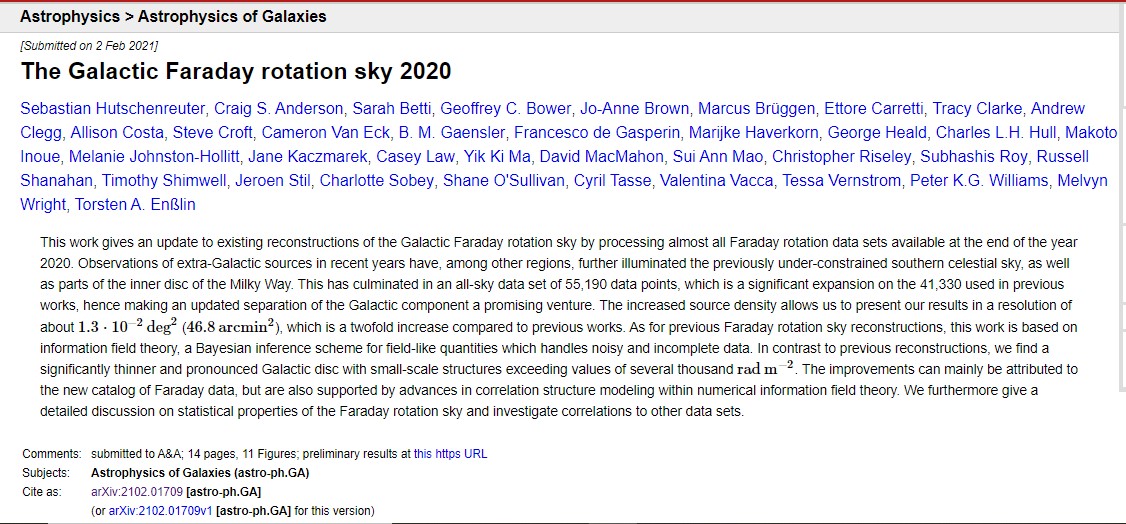
Follow @telescoperYesterday I came across a very interesting paper on the arXiv by Sebastian Hutschenreuter et al. entitled The Galactic Faraday rotation sky 2020 which contains this stunning map of Faraday Rotation across the sky (presented in Galactic coordinates, so the plane of the Milky Way appears across the middle of the map):

The abstract of the paper is here:
If you’ll pardon a short trip down memory lane, this reminds me of a little paper I did back in 2005 with a former PhD student of mine, Patrick Dineen (which is cited in the Hutschenreuter et al. paper).
What we had back in 2005 was a collection of Faraday Rotation measurements of extragalactic radio sources dotted around the sky. Their distribution is fairly uniform but I hasten to add that it was not a controlled sample so it would be not possible to take the sources as representative of anything for statistical purposes and there weren’t so many of them: we had three samples, with 540, 644 and 744 sources respectively.
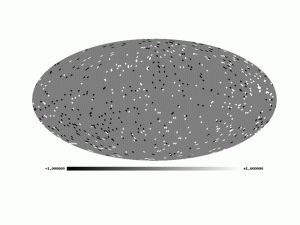
Faraday rotation occurs because left and right-handed polarizations of electromagnetic radiation travel at different speeds along a magnetic field line. The effect of this is for the polarization vector to be rotated as light waves travel and the net rotation angle (which can be either positive or negative) is related to the line integral of the component of the magnetic field along the line of sight travelled by the waves. The picture below shows the distribution of sources, plotted in Galactic coordinates and coded black for negative and white for positive.
Some radio galaxies have enormously large Faraday rotation measures because light reaches us through regions of the source that have strong magnetic fields. However, for most sources in our sample the rotation measures are smaller and are thought to be determined largely by the propagation of light not through the emitting galaxy, near the start of its journey towards us, but through our own Galaxy, the Milky Way, which is near the end of its path.
If this is true then the distribution of rotation measures across the sky should contain information about the magnetic field distribution inside our own Galaxy. Looking at the above picture doesn’t give much of a hint of what this structure might be, however.
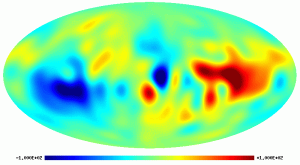
What Patrick and I decided to do was to try to make a map of the rotation measure distribution across the sky based only on the information given at the positions where we had radio sources. This is like looking at the sky through a mask full of little holes at the source positions. Using a nifty (but actually rather simple) trick of decomposing into spherical harmonics and transforming to a new set of functions that are orthogonal on the masked sky we obtained maps of the Faraday sky for the different samples. Here is one:
(The technical details are in the paper, if you’re interested.) You probably think it looks a bit ropey but, as far as I’m concerned, this turned out surprisingly well!
The most obvious features are a big blue blob to the left and a big red blob to the right, both in the Galactic plane. What you’re seeing in those regions is almost certainly the local spur (sometimes called the Orion Spur; see below), which is a small piece of spiral arm in which the local Galactic magnetic field is confined. The blobs show the field coming towards the observer on one side and receding on the other. The structure seen is relatively local, i.e. within a kiloparsec or so of the observer.

I was very pleased to see this come out so clearly from an apparently unpromising data set, although we had to confine ourselves to large-scale features because of instabilities in the reconstruction of high-frequency components.
Now, 15 years later we have the beautiful map produced by Hutschenreuter et al.


You’ll see the vastly bigger data set (almost a hundred times as many sources) and way more sophisticated analysis technique has produced much higher resolution and consequently more detail, especially near the Galactic plane, but we did at least do a fairly good job at capturing the large-scale distribution: the blue on the left and red on the right is clearly present in the new map.
There’s something very heartening about seeing scientific progress in action! This also illustrates how much astrophysics has changed over the last 15 years: from hundreds of data points to more than 50,000 and from two authors to 30!
Follow @telescoper
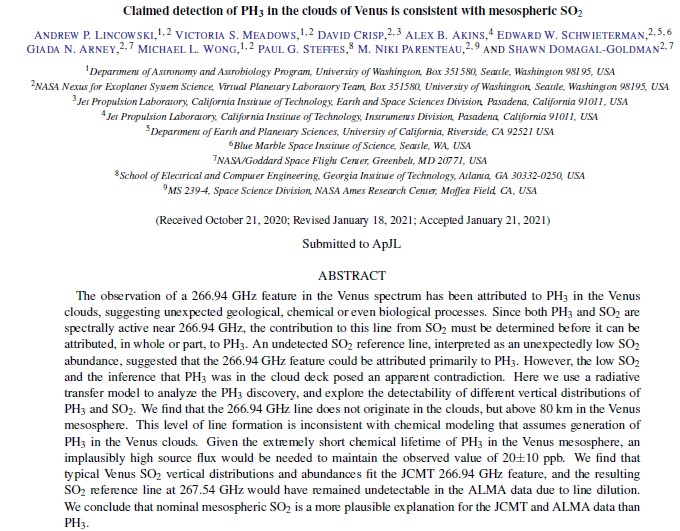
Remember all the excitement last September about the claimed detection of Phosphine in the atmosphere of Venus? If you do you will remember that the claim has been contested. Now there is another paper on this matter claiming that what was interpreted as a spectral feature due to Phosphine (PH3) could actually be due to Sulphur Dioxide (SO2)). Here is the abstract of the latest paper.
You can find the full paper on the arXiv here.
P.S. I bookmarked the arXiv paper about a week ago but was very busy and forgot about it until now!
Time to announce the first publication of 2021 in the Open Journal of Astrophysics. This one was actually published a few days ago but it took a bit of time to get the metadata and DOI registered so I held off announcing it until that was done.
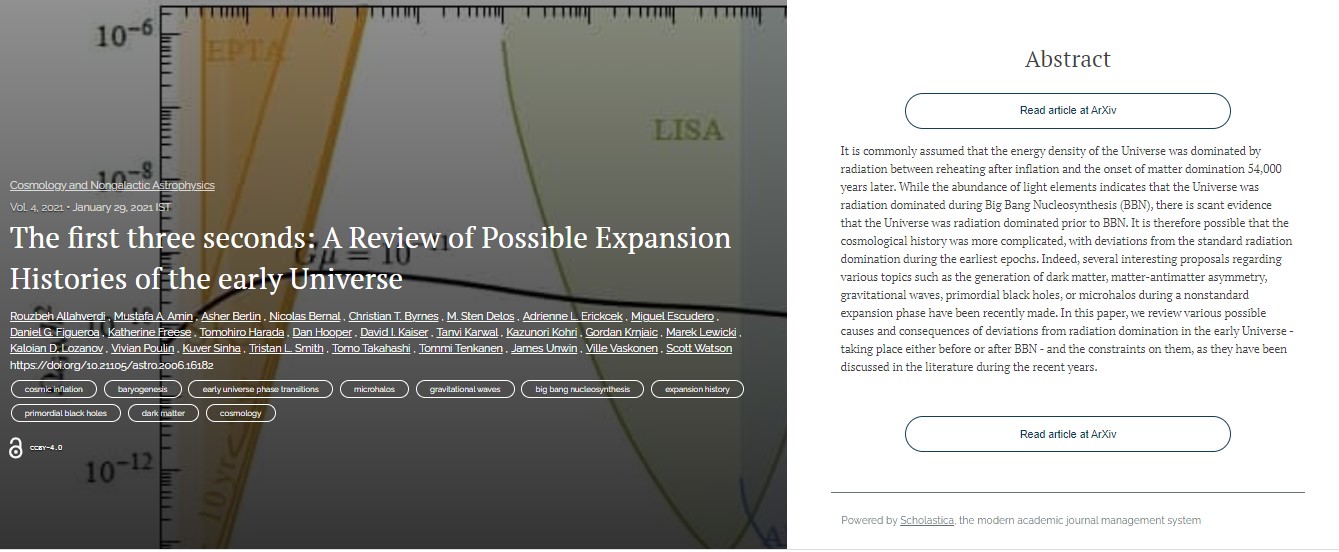
The latest publication is a lengthy and comprehensive review article (67 pages altogether) by Allahverdi et al. which has 26 authors from all round the world. It is entitled The First Three Seconds: a Review of Possible Expansion Histories of the Early Universe and is a study of the various possible evolutionary histories of cosmic expansion possible with a wide range of cosmological models with their implications for baryogenesis, nucleosynthesis, primordial gravitational wave production, and many other things besides.
Here is a screen grab of the overlay:
You can click on the image to make it larger should you wish to do so. You can find the arXiv version of the paper here. This is one for the Cosmology and Nongalactic Astrophysics folder.
And so Volume 4 begins. Volume 3 had 15 papers, Volume 2 had 12 , and Volume 1 just 4 so we’re growing slowly but surely! Let’s see how many we publish in 2021. I can tell you we have some very exciting papers in the pipeline…
Follow @telescoperIt’s a rainy Saturday afternoon in Maynooth and I don’t feel like taking my usual walk so I thought I’d post another bit of local history like I did last week. This is another thing I’ve just found out and thought I’d share. This is a view I took last spring of Maynooth Castle (or the ruins thereof):
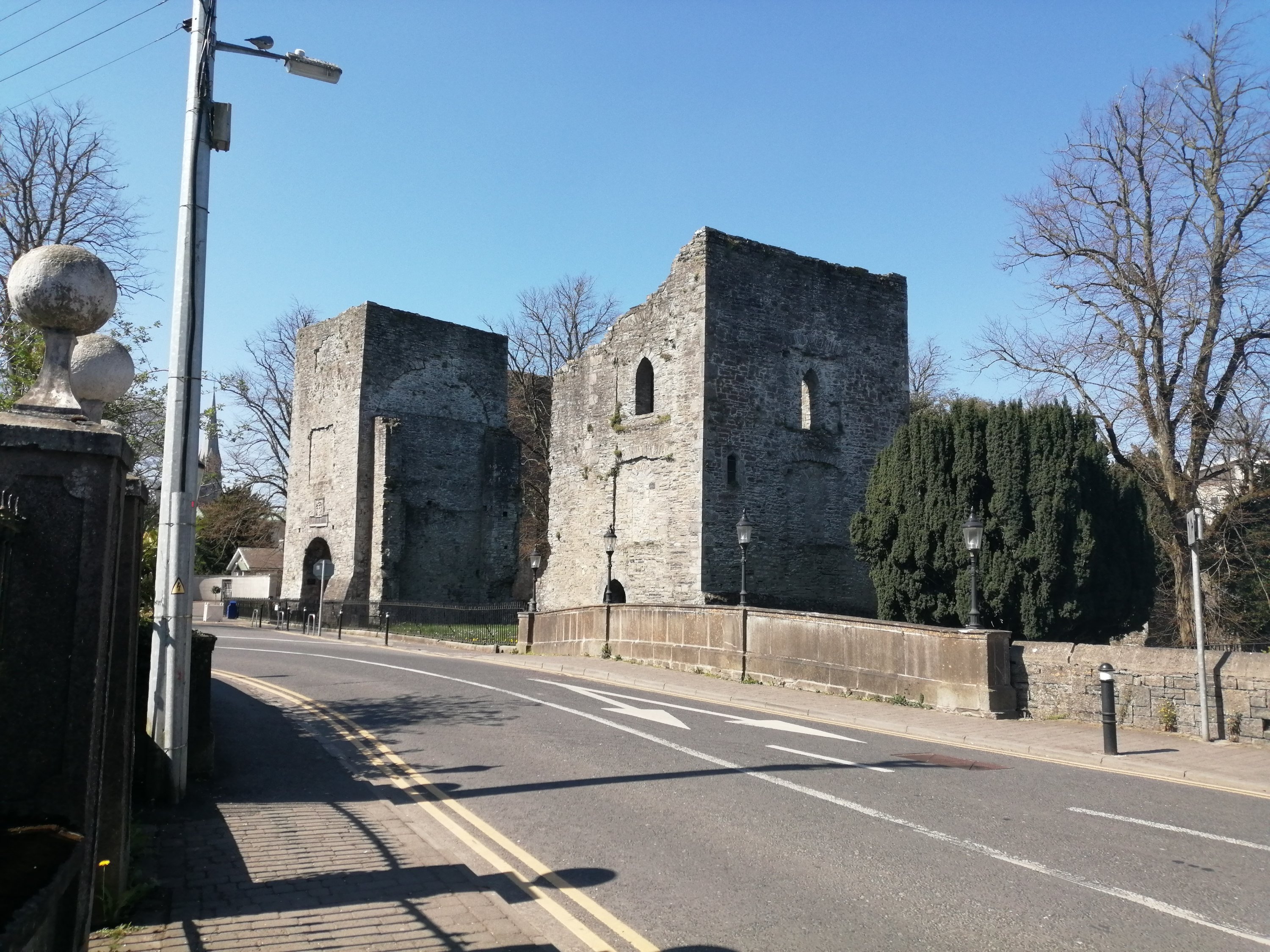
The Castle, together with a Manor House that was next to it, belonged to the Fitzgerald family, local aristocracy since the 13th Century. As I mentioned in a previous post, Thomas Fitzgerald, the 10th Earl of Kildare, led a rebellion against the English authorities during the time of Henry VIII. He acquired the nickname “Silken Thomas” because of the ribbons of silk worn by his supporters. The rebellion failed and his family castle was badly damaged. Thomas surrendered and was subsequently executed, along with several members of his family, in 1537. The family fortunes declined pretty drastically at that point but the family line did survive.
Now fast forward to 1630 when George Fitzgerald, the 16th Earl of Kildare married a Lady Joan Boyle. She was the daughter of a tremendously powerful figure by the name of Richard Boyle, the 1st Earl of Cork. Richard Boyle had been part of the Tudor plantation of Ireland and had acquired enormous amounts of land and personal wealth in the process. He spent some of his riches at the time of his daughter’s wedding doing up the ancestral home of his son-in-law, refurbishing the castle and building a new manor house next to it.
Unfortunately this didn’t last long. During the Irish Confederate Wars the Castle was attacked several times and badly damaged. It remained in occupation but by the end of the 17th Century it was derelict. The Fitzgerald family eventually moved to a new home at the other end of Maynooth, Carton House (now an upmarket golf resort). All Richard Boyle’s refurbishment work went to nothing and all that survives to the present day – the Gatehouse and Solar Tower – dates to the 13th Century, no doubt because it was more solidly built.
I’ve known about this for quite a while, but only this morning I discovered something else. Richard Boyle had a very large family – fifteen children altogether – and his seventh son (14th child altogether) was none other than the famous natural philosopher Robert Boyle, after whom Boyle’s Law is named. He was a particularly important figure in the development of chemistry, paid for the publication of a translation of the Bible into Irish, was a founder member of the Royal Society of London and, more importantly than any of those things, wrote the book whose cover I use when I post rambling from In The Dark on Twitter:
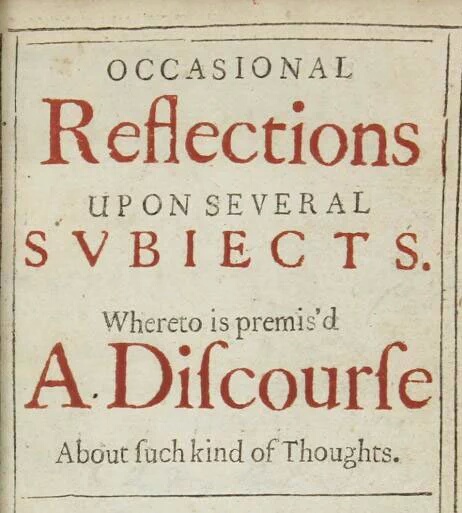
It’s a very descriptive title for this blog, but perhaps not so catchy.
Anyway, largely because he found it difficult to acquire materials and equipment in Ireland, Robert Boyle spent most his scientific career in England. He did however return to Ireland a number of times. He was born in Lismore, in County Waterford, so probably would have stayed near there on these visit. It is entirely possible – and indeed likely – that he may have visited his sister in Maynooth while in Ireland.
Follow @telescoperI found out yesterday that the National University of Ireland is commemorating the centenary of the election of Éamon de Valera as its Chancellor. To mark this occasion, NUI will offer a special NUI Dr Éamon De Valera Post-Doctoral Fellowship in Mathematical Sciences. This post is in addition to the regular NUI awards, which include a position for Science & Engineering.
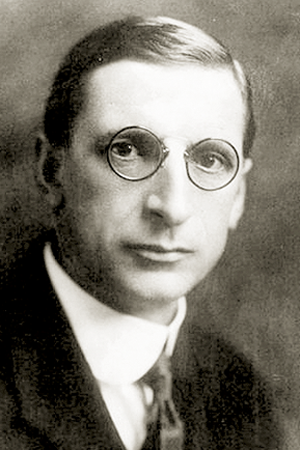
Éamon de Valera, photographed sometime during the 1920s.
Éamon de Valera, founder of Fianna Fáil (formerly one of the two largest political parties in Ireland) and architect of the Irish constitution. De Valera (nickname `Dev’) is an enigmatic figure, who was a Commandant in the Irish Republican Army during the 1916 Easter Rising, who subsequently became Taoiseach and then President of the Irish Republic.
You may or may not know that de Valera was a mathematics graduate, and for a short time (1912-13) he was Head of the Department of Mathematics and Mathematical Physics at St Patrick’s College, Maynooth, a recognized college of the National University of Ireland. The Department became incorporated in Maynooth University, when it was created in 1997.Mathematical Physics is no longer a part of the Mathematics Department at Maynooth, having become a Department in its own right and it recently changed its name to the Department of Theoretical Physics.
Anyway, the Fellowship will be awarded on the basis of a common competition open to NUI graduates in all branches of the Mathematical Sciences. All branches of the Mathematical Sciences will be deemed as including, but not limited to, all academic disciplines within Applied Mathematics, Pure Mathematics, Mathematical Physics and Statistics and Probability.
You can find more details of the position here. I should say however that it is open to NUI graduates only, though it can be held at any of the constituent colleges of the National University of Ireland. Given the de Valera connection with Maynooth, it would be fitting if it were held here!
The deadline for applications is February 9th.
![vec{r}(vec(q),t) = a(t) vec{x}(vec{q},t) = a(t) left[ vec{q} + b(t) vec{s}(vec{q},t) right].](https://s0.wp.com/latex.php?latex=vec%7Br%7D%28vec%28q%29%2Ct%29+%3D+a%28t%29+vec%7Bx%7D%28vec%7Bq%7D%2Ct%29+%3D+a%28t%29+left%5B+vec%7Bq%7D+%2B+b%28t%29+vec%7Bs%7D%28vec%7Bq%7D%2Ct%29+right%5D.&bg=000000&fg=B0B0B0&s=0&c=20201002)



 In the Dark