This morning’s arXiv announcement contained a number of papers related to the Dark Energy Survey Y6 analysis. There is also a Zoom webinar later today at 10.30 Central Time (16.30 GMT; 13.30 in Greenland). Details can be found here.
You can find links to and abstracts of all the papers here, but I thought it would be useful to provide arXiv links to the latest batch here.
arXiv:2601.14559 Dark Energy Survey Year 6 Results: Cosmological Constraints from Galaxy Clustering and Weak Lensing – this is the key summary paper.
arXiv:2601.14484 Dark Energy Survey Year 6 Results: MagLim++ Lens Sample Selection and Measurements of Galaxy Clustering
arXiv:2601.14864 Dark Energy Survey: DESI-Independent Angular BAO Measurement
arXiv:2601.15175 Dark Energy Survey Year 6 Results: Galaxy-galaxy lensing
arXiv:2601.14833 Dark Energy Survey Year 6 Results: Magnification modeling and its impact on galaxy clustering and galaxy-galaxy lensing cosmology
arXiv:2601.14859 Dark Energy Survey Year 6 Results: Weak Lensing and Galaxy Clustering Cosmological Analysis Framework
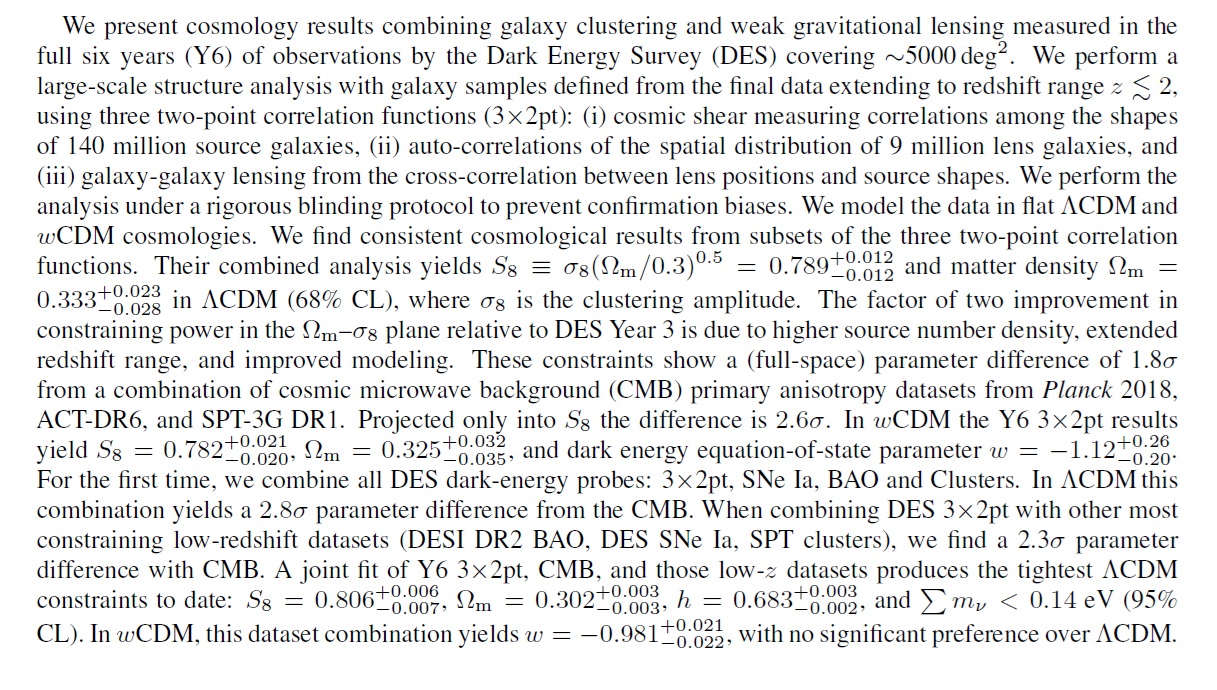
I’ll just highlight a couple of points from the first paper listed above, which uses the now standard “3x2pt” analysis, which combines three complementary two-point correlation functions: cosmic shear; galaxy-galaxy lensing and galaxy clustering. The abstract of this paper is as follows:
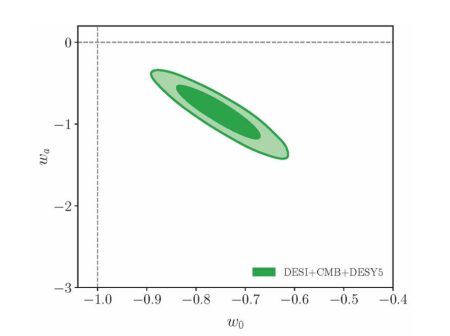
A notable result is contained in the last sentence. The simplest interpretation of dark energy is that it is a cosmological constant (usually called Λ) which – as explained here – corresponds to a perfect fluid with an equation-of-state p=wρc2 with w=-1. In this case the effective mass density ρ of the dark energy remains constant as the universe expands. To parametrise departures from this constant behaviour, cosmologists have replaced this form with the form w(a)=w0+wa(1-a) where a(t) is the cosmic scale factor. A cosmological constant Λ would correspond to a point (w0=-1, wa=0) in the plane defined by these parameters, but the only requirement for dark energy to result in cosmic acceleration is that w<-1/3, not that w=-1. Results last year from DESI suggested values of w0 ≠-1 and wa≠0 , but the current DES results are consistent with w=-1; they do not constrain w0 and wa jointly.
For reference on the left you can find the (w0, wa) plane from DESI.
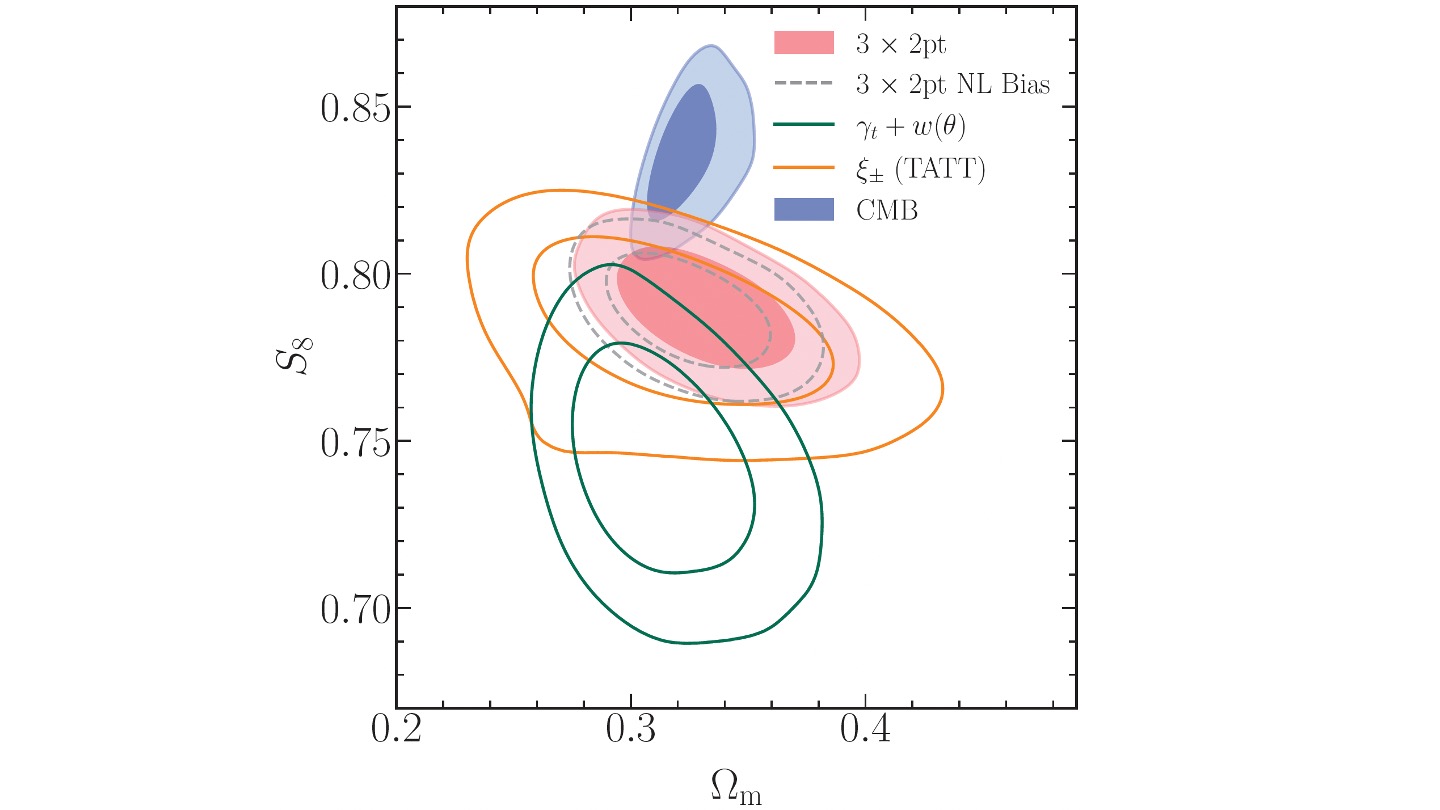
I thought I’d add one of the other cosmological contraint plots:
The results look qualitatively similar to previous plots but the contours have shifted a bit.
Meanwhile, back in the world of research, I see that Maynooth University has issued a news item about a new paper by colleagues in the Department of Physics, Daxal H. Mehta, John A. Regan and Lewis Prole. The story has also been picked up by the Irish media, e.g. here.
You may find the paper behind a paywall, as it is published in Nature Astronomy, in which case you will just have to make do with the abstract:
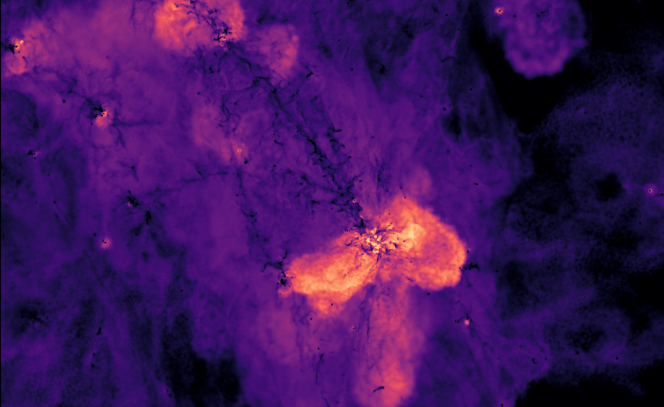
And here’s a pretty picture from one of the simulations used in the paper:
It’s Saturday once more so time for another update of activity at the Open Journal of Astrophysics. Since the last update we have published seven papers, bringing the number in Volume 9 (2026) to 11 and the total so far published by OJAp up to 459. This week has been quite busy; for only the second time in recorded history we published at least one paper each working day.
I will continue to include the announcements made on our Mastodon account (on Fediscience) to encourage you to visit it. Mastodon is a really excellent service, and a more than adequate replacement for X/Twitter which nobody should be using.
The first three papers this week were all published on Monday January 12th in the folder Astrophysics of Galaxies.
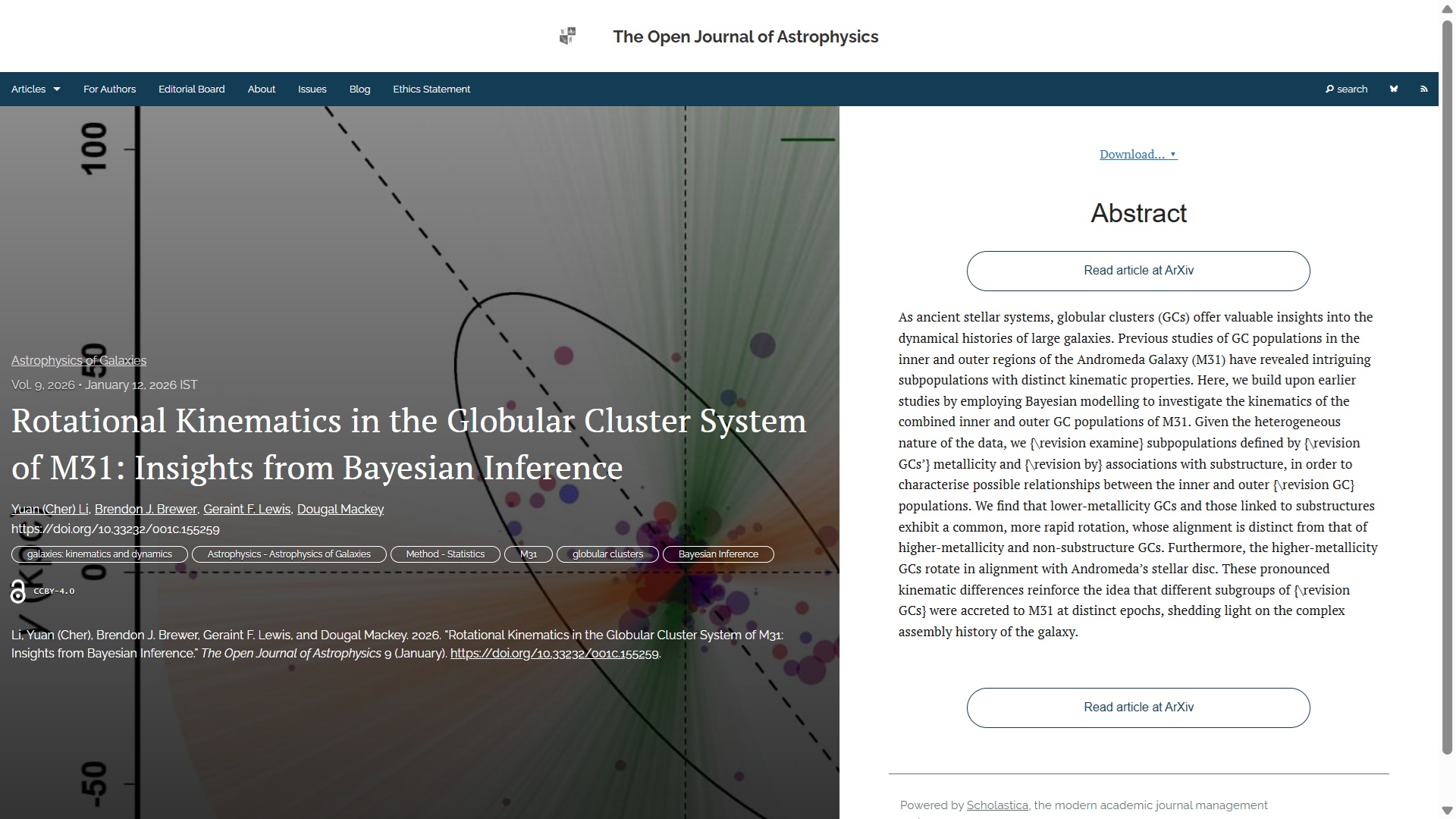
The first paper to report this week is “Rotational Kinematics in the Globular Cluster System of M31: Insights from Bayesian Inference” by Yuan (Cher) Li & Brendon J. Brewer (U. Auckland, New Zealand), Geraint F. Lewis (U. Sydney, Australia) and Dougal Mackey (independent researcher, Australia). This study uses Bayesian modelling to explore the kinematics of globular clusters in the Andromeda Galaxy, revealing distinct rotation patterns that suggest different subgroups were added at separate times.
The overlay is here:
You can find the officially accepted version on arXiv here and the announcement on Fediverse here:
New Publication at the Open Journal of Astrophysics: "Rotational Kinematics in the Globular Cluster System of M31: Insights from Bayesian Inference" by Yuan (Cher) Li & Brendon J. Brewer (U. Auckland, New Zealand), Geraint F. Lewis (U. Sydney, Australia) and Dougal Mackey
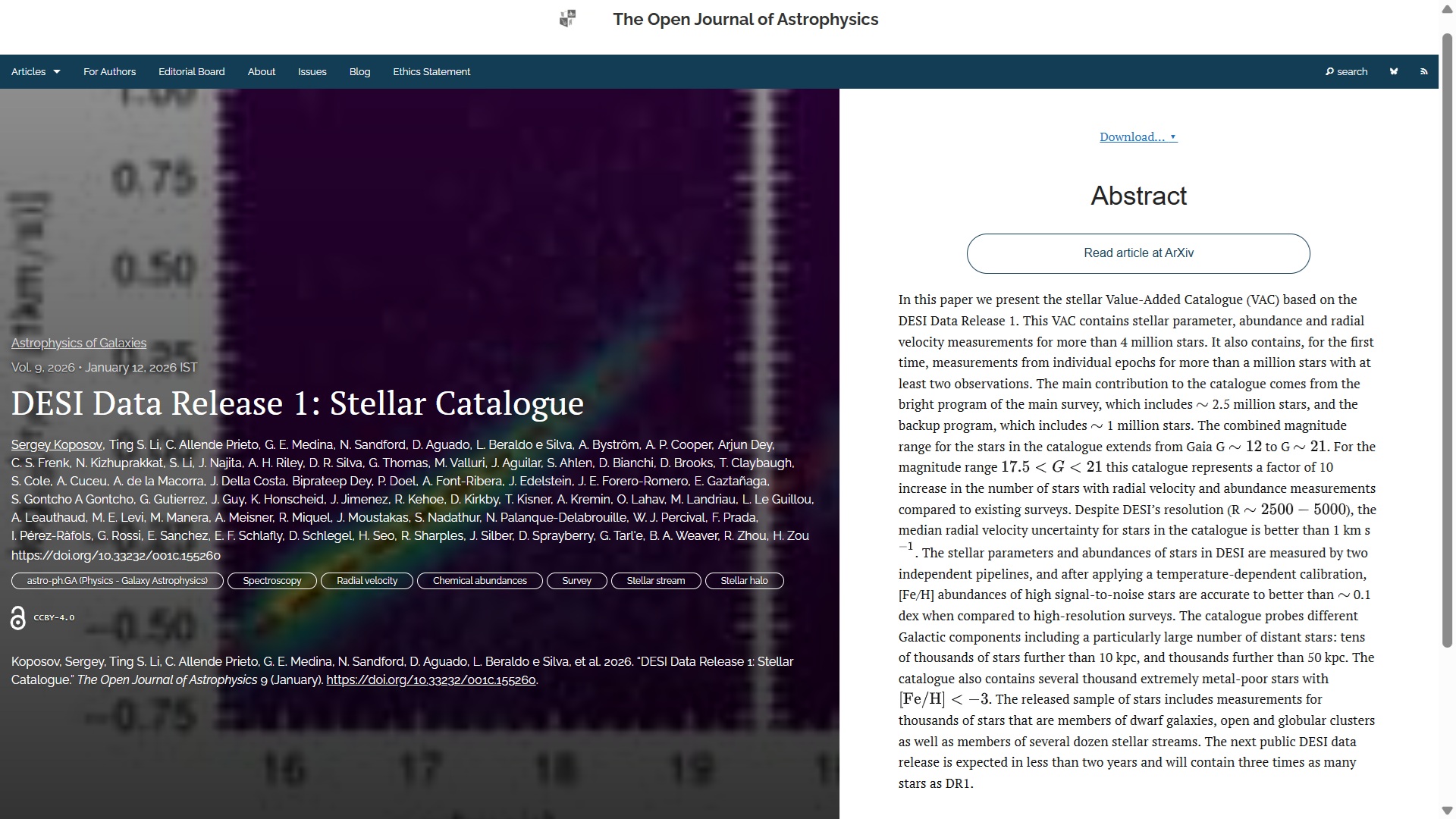
The second paper is “DESI Data Release 1: Stellar Catalogue” by Sergey Koposov (U. Edinburgh, UK) and an international cast of 67 other authors. This paper introduces and describes the stellar Value-Added Catalogue (VAC) based on DESI Data Release 1, providing measurements for over 4 million stars, including radial velocity, abundance, and stellar parameters.
The overlay for this one is here:
The official version of the paper can be found on arXiv here and the Fediverse announcement here:
New Publication at the Open Journal of Astrophysics: "DESI Data Release 1: Stellar Catalogue" by Sergey Koposov (U. Edinburgh, UK) and an international cast of 67 other authors.
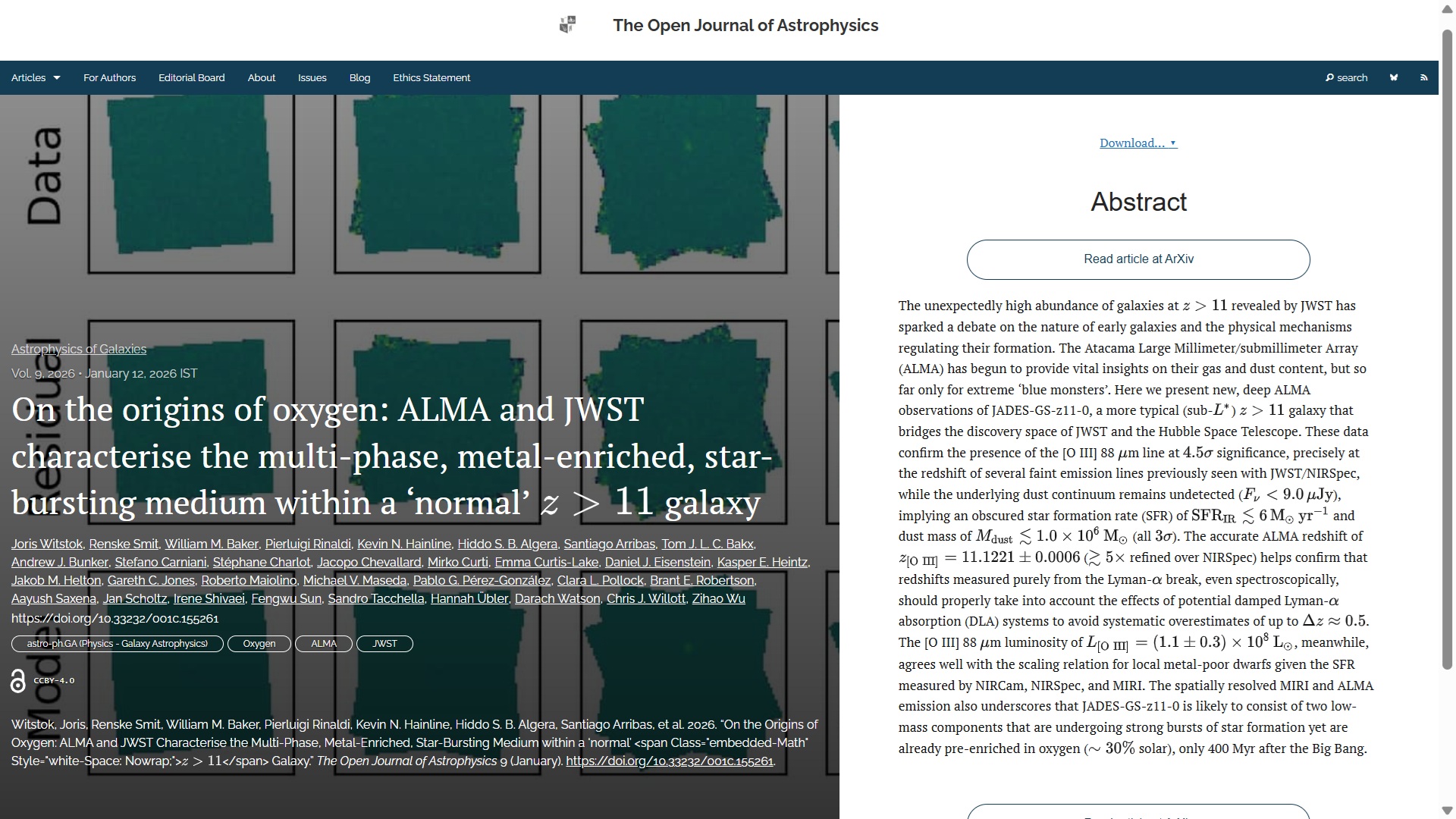
New Publication at the Open Journal of Astrophysics: "On the origins of oxygen: ALMA and JWST characterise the multi-phase, metal-enriched, star-bursting medium within a ‘normal’ z>11 galaxy" by Joris Witstok (Cosmic Dawn Centre, Copenhagen, Denmark) and 37 others dotted around the world
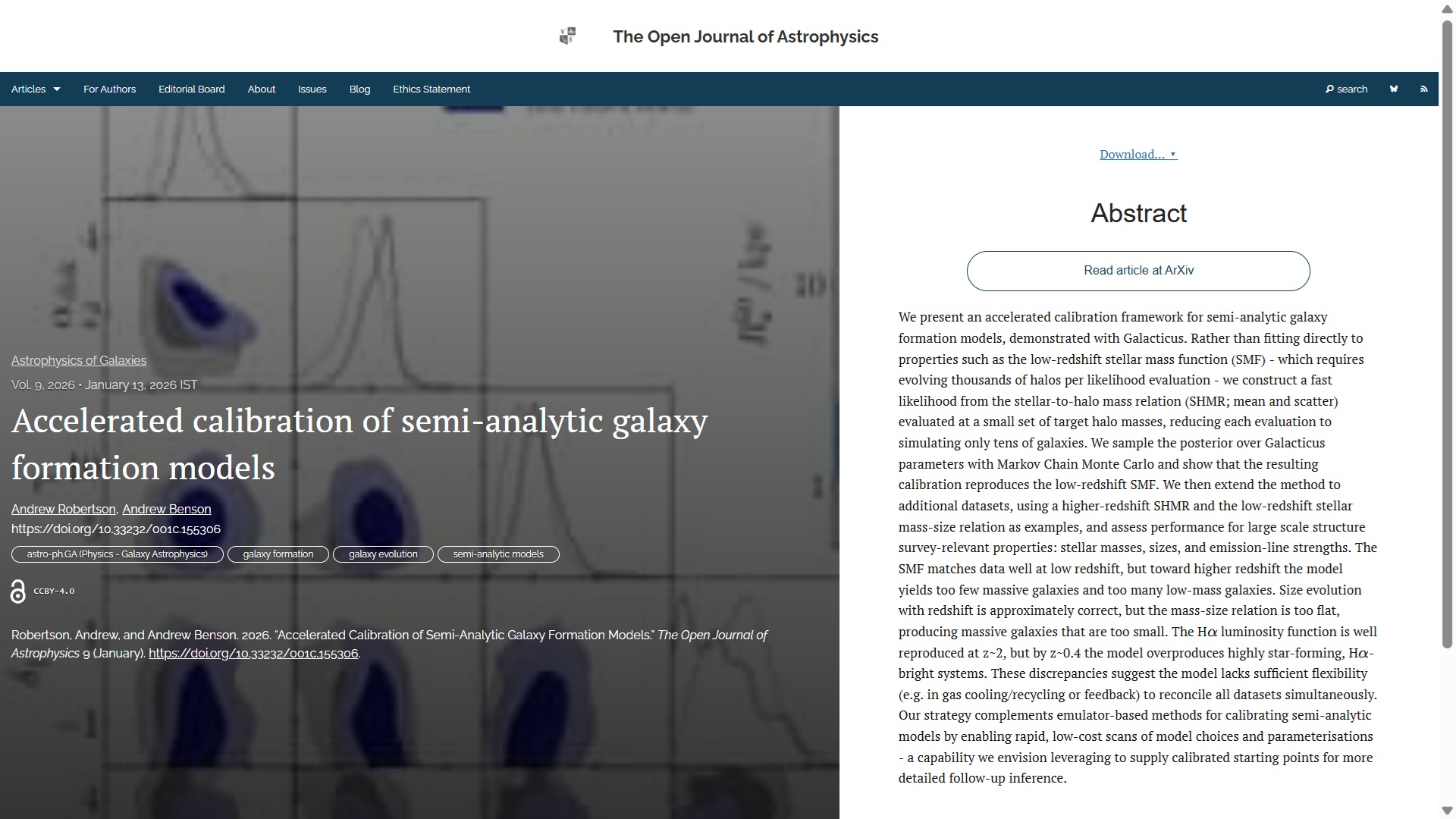
The fourth paper this week is also in the folder Astrophysics of Galaxies. but was published on Tuesday 13th January. It is entitled “Accelerated calibration of semi-analytic galaxy formation models” by Andrew Robertson and Andrew Benson (Carnegie Observatories, USA). This paper presents a faster calibration framework for galaxy formation models, using fewer simulations for each evaluation. However, the model shows discrepancies suggesting the model needs to be made more flexible.
The overlay is here:
You can find the officially accepted version on arXiv here and the Mastodon announcement here:
New Publication at the Open Journal of Astrophysics: "Accelerated calibration of semi-analytic galaxy formation models" by Andrew Robertson and Andrew Benson (Carnegie Observatories, USA)
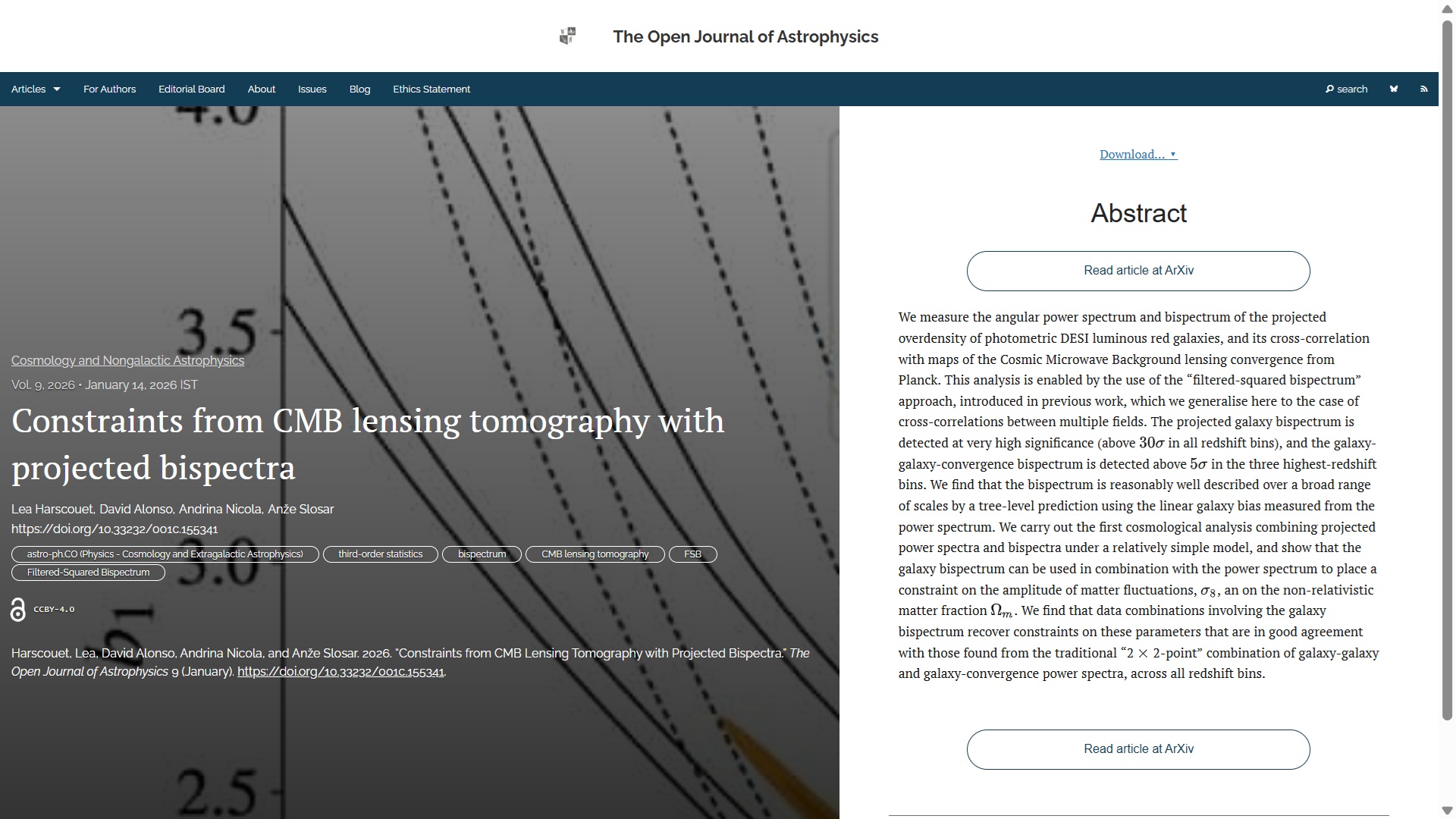
Next one up, published on Wednesday 14th January in the folder Cosmology and Nongalactic Astrophysics, is “Constraints from CMB lensing tomography with projected bispectra” by Lea Harscouet & David Alonso (U. Oxford), UK), Andrina Nicola (U. Manchester, UK) and Anže Slosar (Brookhaven National Laboratory, USA). This study presents angular power spectra and bispectra of DESI luminous red galaxies, finding that the galaxy bispectrum can constrain the amplitude of matter fluctuations and the non-relativistic matter fraction. The overlay is here:
You can find the officially accepted paper on arXiv here and the Mastodon announcement here:
New Publication at the Open Journal of Astrophysics: "Constraints from CMB lensing tomography with projected bispectra" by Lea Harscouet & David Alonso (U. Oxford, UK), Andrina Nicola (U. Manchester, UK) and Anže Slosar (Brookhaven National Laboratory, USA)
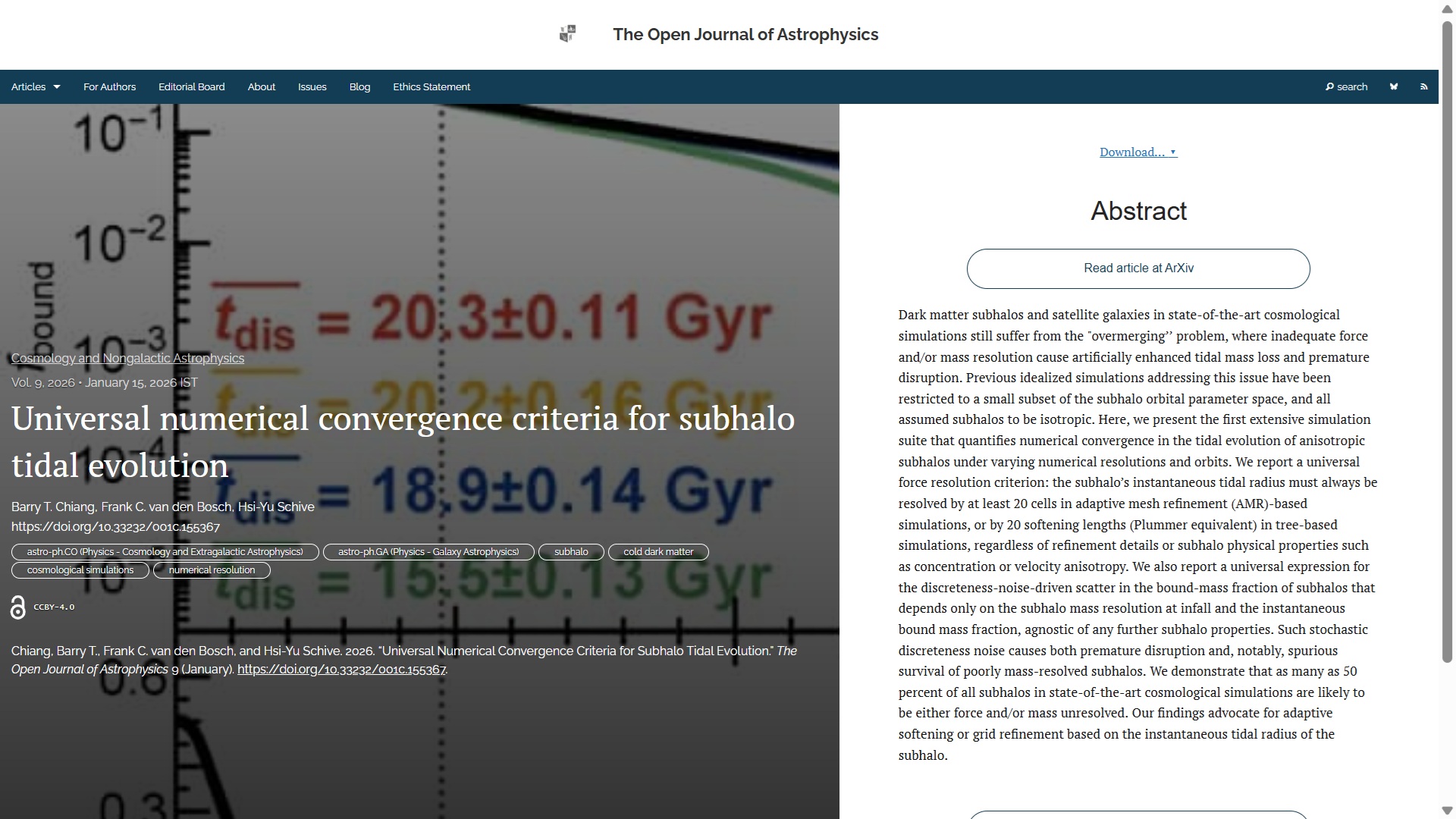
The sixth paper this week is “Universal numerical convergence criteria for subhalo tidal evolution” by Barry T. Chiang & Frank C. van den Bosch (Yale U., USA) and Hsi-Yu Schive (National Taiwan University, Taiwan). This was published on Thursday 15th January in the folder Cosmology and Nongalactic Astrophysics; it presents an analysis of a simulation suite that addresses the ‘overmerging’ problem in cosmological simulations of dark matter subhalos, showing that up to 50% of halos in state-of-the art simulations are unresolved. The overlay is here:
The final accepted version of this paper can be found on arXiv here. The Mastodon announcement follows:
New Publication at the Open Journal of Astrophysics: "Universal numerical convergence criteria for subhalo tidal evolution" by Barry T. Chiang & Frank C. van den Bosch (Yale U., USA) and Hsi-Yu Schive (National Taiwan University, Taiwan)
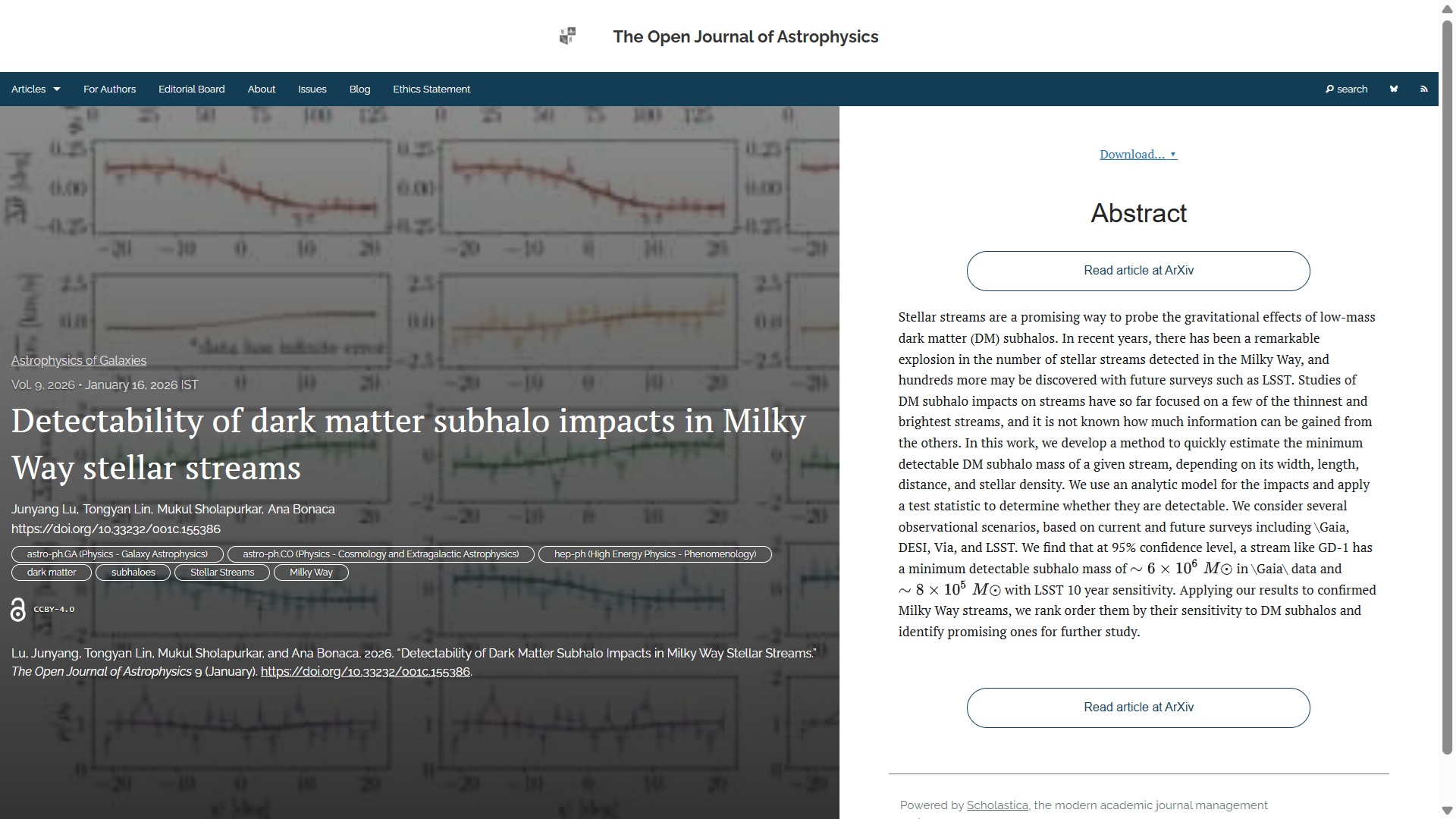
Finally for this week we have “Detectability of dark matter subhalo impacts in Milky Way stellar streams” by Junyang Lu , Tongyan Lin & Mukul Sholapurkar (UCSD, USA) and Ana Bonaca (Carnegie Observatories, USA). This was published on Friday 16th January (i.e. yesterday) in the folder Astrophysics of Galaxies. The study develops a method to estimate the minimum detectable dark matter subhalo mass in stellar streams, ranking them by sensitivity and identifying promising lines for further research.
The overlay is here:
The officially accepted version can be found on arXiv here and the Fediverse announcement here:
New Publication at the Open Journal of Astrophysics: "Detectability of dark matter subhalo impacts in Milky Way stellar streams" by Junyang Lu , Tongyan Lin & Mukul Sholapurkar (UCSD, USA) and Ana Bonaca (Carnegie Observatories, USA)
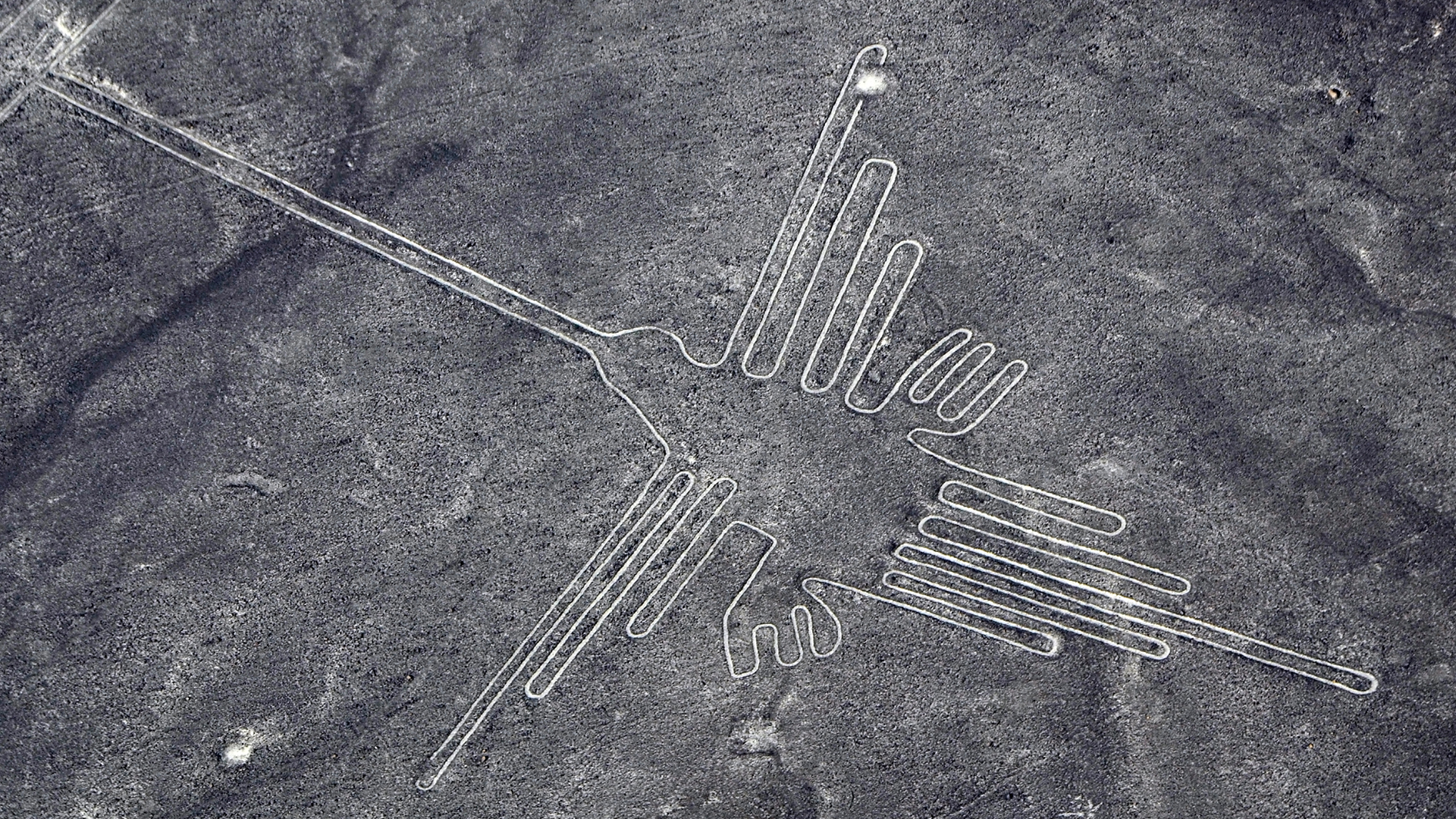
News of the death of the notorious charlatan Erich von Däniken reminded me that at one time, when I was about 11 years old, I borrowed his book Chariots of the Gods from the public library. Even at that age I thought it was a load of nonsense, but I have to admit that I was fascinated by the origin of the Nazca Lines in Southern Peru, most of which were created between 500 BC and 500 AD but were probably based on even older structures. An example, depicting a humming bird, is shown here:
Von Däniken claimed that these were landing strips for ancient spacecraft piloted by extraterrestrials, an explanation that can easily be refuted. The actual purpose of these structures is yet to be discerned. I thought it was likely that they had some astronomical significance, but if they do then it has yet to be elucidated. How they were made is less difficult to explain: almost certainly they were made by scaling up smaller drawings. This would have required some mathematical understanding, and perhaps the use of coordinates, but there’s no reason to suppose that the people who created them lacked such knowledge. What they mean is indeed an unsolved mystery.
The other unsolved mystery is why people fall for the sort of nonsense peddled by von Däniken. It seems to me that part of the answer is that modern humans have an almost irresistible tendency to assume that earlier human beings were much less intelligent than us. This is clearly not true. In fact human intelligence has evolved very little over the past few millennia. What has evolved is knowledge (passed on cumulatively through the generations) and the technology created using that knowledge. Erich von Däniken promoted the idea that only extraterrestrials could have created the Nazca lines; he and others have suggested that the pyramids of ancient Egypt were built by aliens too. It’s part of our desire to think of ourselves as being much smarter than our ancestors. You only have to look at the world today to realize that humans aren’t as clever as they think they are. In fact we’re just as dumb as humans have always been; we just have better gadgets (including, unfortunately, weapons).
Another book I got out of the public library at about the same time was Worlds in Collision by Immanuel Velikovsky. As far as I can remember, this book propounded a new theory of the solar system in which the planet Venus was ejected from Jupiter and then went rattling around encountering other planets and causing various catastrophes. This was supposed to have happened around 1500 BC which “explains” various historical events, including many described in the Bible. It is nonsense of course, but some people lapped it up, as some continue to believe that the Earth is flat.
I find it hard to understand why some people persist in denying scientific advances for which there is considerable empirical evidence and prefer instead to believe in nonsense peddled by the likes of Erich von Däniken. If anyone can solve that mystery they will be doing the human race a very big favour.
Welcome to the first proper update for 2026 from the Open Journal of Astrophysics. The New Year brings us to Volume 9. In many countries, especially in Europe, Christmas is celebrated on January 6th so this week was also affected by the holiday season. Nevertheless, since the last update we have published four papers, bringing the number in Volume 9 (2026) to 4 and the total so far published by OJAp up to 452.
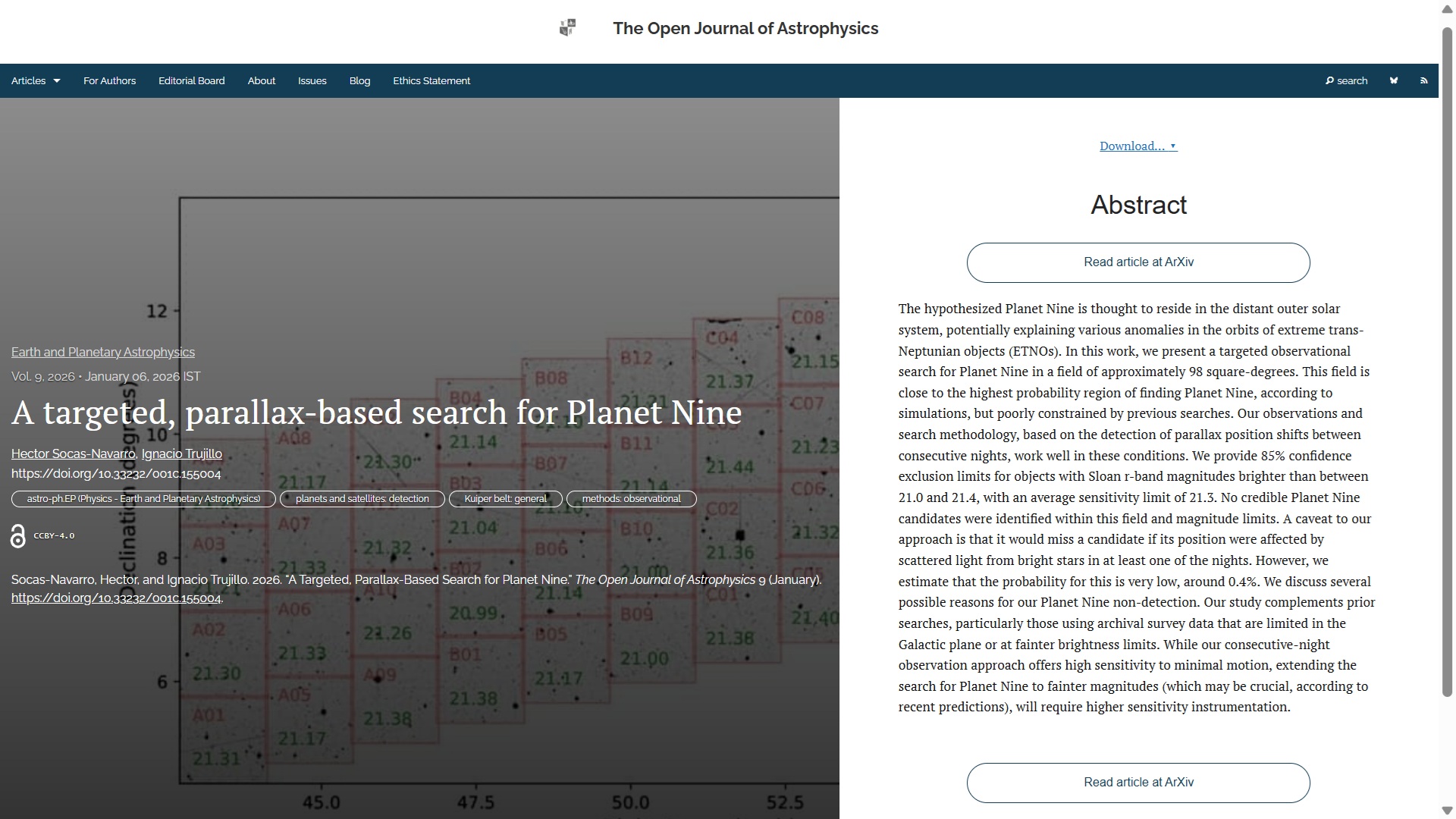
The first paper this week (and of course the first of 2026) is “A targeted, parallax-based search for Planet Nine” by Hector Socas-Navarro and Ignacio Trujillo (both of the Instituto de Astrofísica de Canaria, Spain). This article describes a targeted search for the hypothesized Planet Nine in the outer solar system, using parallax position shifts. No credible candidates were found within the observed field. It was published on Tuesday January 6th in the folder Earth and Planetary Astrophysics. The overlay is here:
You can find the officially accepted version on arXiv here and the announcement on Fediverse here:
New Publication at the Open Journal of Astrophysics: "A targeted, parallax-based search for Planet Nine" by Hector Socas-Navarro and Ignacio Trujillo (Instituto de Astrofísica de Canaria, Spain)
The second paper is “Going beyond S8: fast inference of the matter power spectrum from weak-lensing surveys” by Cyrille Doux (Université Grenoble Alpes, France) and Tanvi Karwal (U. Chicago, USA). This was published on Wednesday January 7th in the folder Cosmology and Nongalactic Astrophysics and it presents a new framework to extract the scale-dependent matter power spectrum from cosmic shear and CMB lensing measurements, revealing a consistent suppression in the matter power spectrum in galaxy-lensing. The overlay is here:
The official version of the paper can be found on arXiv here and the Fediverse announcement here:
New Publication at the Open Journal of Astrophysics: "Going beyond $S_{8}$: fast inference of the matter power spectrum from weak-lensing surveys" by Cyrille Doux (Université Grenoble Alpes, France) and Tanvi Karwal (U. Chicago, USA)
Next we have “Constraining the Stellar-to-Halo Mass Relation with Galaxy Clustering and Weak Lensing from DES Year 3 Data” which is led by G. Zacharegkas et al. (Argonne National Laboratory, USA) and has 102 other authors too numerous to list by name from many institutions around the world again too numerous to list by name. It presents a framework to analyze the relationship between a galaxy’s stellar mass and its dark matter halo mass, using data from the Dark Energy Survey. The findings align with previous results. This paper was published on Thursday January 8th in the folder Astrophysics of Galaxies. The overlay is here:
The official version can be found on arXiv here and the Fediverse announcement is here:
New Publication at the Open Journal of Astrophysics: "Constraining the Stellar-to-Halo Mass Relation with Galaxy Clustering and Weak Lensing from DES Year 3 Data" by G. Zacharegkas et al. (Argonne National Laboratory, USA) and 102 others based in numerous countries.
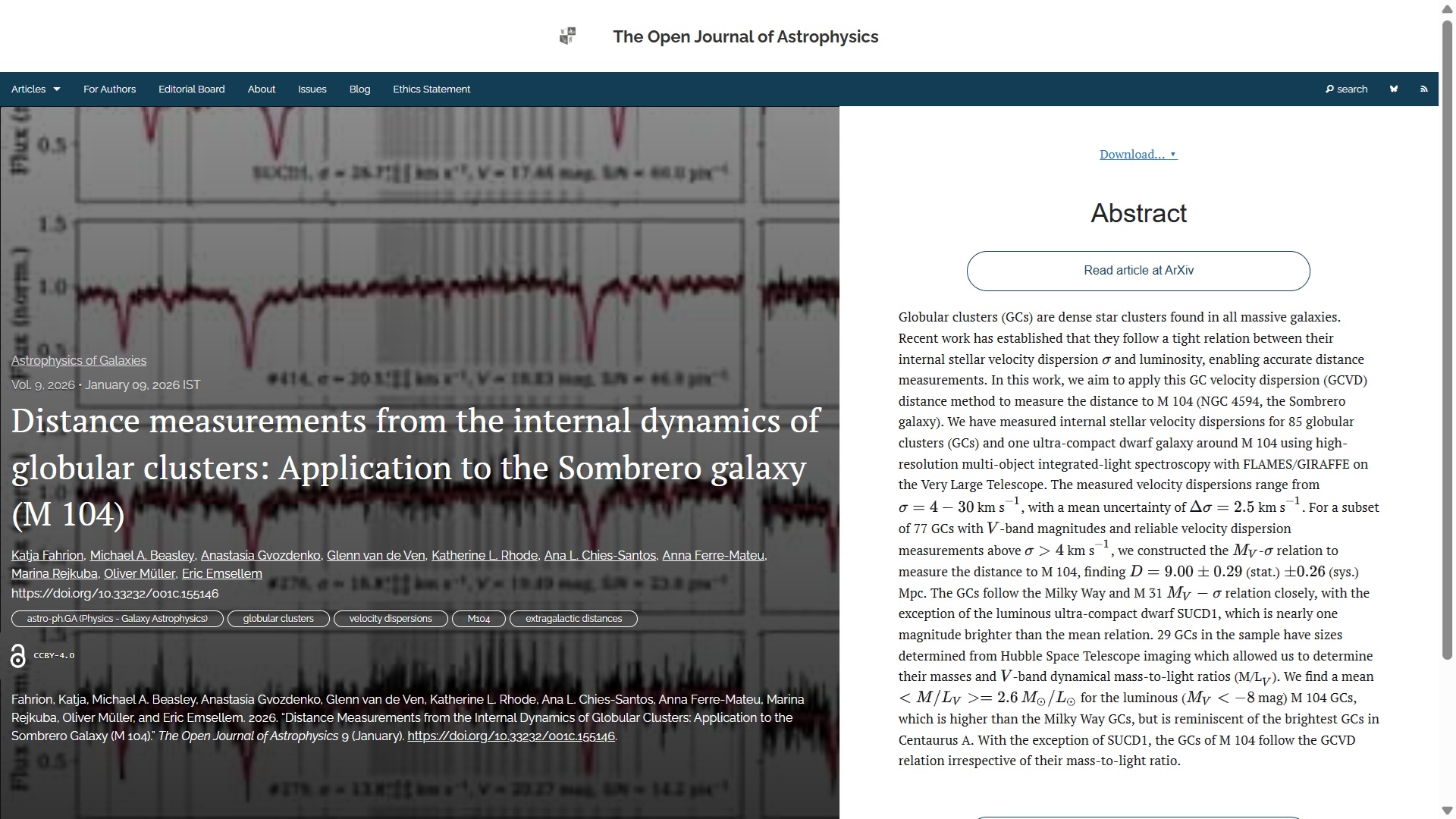
New Publication at the Open Journal of Astrophysics: "Distance measurements from the internal dynamics of globular clusters: Application to the Sombrero galaxy (M 104)" by Katja Fahrion (University of Vienna, Austria) and 9 others based in Spain, Australia, UK, USA, Brazil, Germany and Switzerland.
I was on the train earlier today when I remembered that we are getting close to the time when Earth reaches its perihelion, i.e. the point in its orbit when it is closest to the Sun. This occurs at 17.15 GMT tomorrow (Saturday 3rd January 2026), in fact. At this time the distance from the Sun’s centre to Earth’s centre will be 147,099,894 km This year, aphelion (the furthest distance from the Sun) is at 18.30 GMT on July 6th 2026 at which point the centre of the Earth will be 152,087,774 km from the centre of the Sun. You can find a list of times and dates of perihelion and aphelion for future years here.
Earth’s elliptical orbit viewed at an angle (which makes it look more eccentric than it is – in reality is very nearly circular).
Incidentally, although the Solstice took place on 21st December, it was not until the end of 2025 that we experienced the latest sunrise. The longest day means neither the latest sunrise nor the earliest sunset. The earliest sunset was actually on December 15th in Dublin.
It surprises me how many people think that the existence of the seasons has something to do with the variation of the Earth’s distance from the Sun, thinking that the closer to the Sun we get the warmer the weather will be. The fact that perihelion occurs in the depth of winter should convince anyone living in the Northern hemisphere that this just can’t be the case, as should the fact that it’s summer in the Southern hemisphere while it is winter in the North.
The real reason for the existence of seasons is the tilt of the Earth’s axis of rotation. I used to do a little demonstration with a torch – flashlight to American readers- to illustrate this when I taught first-year astrophysics. If you shine a torch horizontally at a piece of card it will illuminate a patch of the card. Keep the torch at the same distance but tilt the card and you will see the illuminated patch increase in size. The torch is radiating the same amount of energy but in the second case that energy is spread over a larger area than in the first. This means that the energy per unit area incident on the card is decreases when the card is tilted. It is that which is responsible for winter being colder than summer. In the summer the Sun is higher in the sky (on average) than in winter. From this argument you can infer that the winter solstice not the perihelion, is the relevant astronomical indicator of winter.
That is not to say that the shape of the Earth’s orbit has no effect on terrestrial temperatures. It may, for example, contribute to the summer in the Southern hemisphere being hotter than in the North, although it is not the only effect. The Earth’s surface possesses a significant North-South asymmetry: there is a much larger fraction of ocean in the Southern hemisphere, for example, which could be responsible for moderating any differences in temperature due to insolation. The climate is a non-linear system that involves circulating air and ocean currents that respond in complicated ways and on different timescales not just to insolation but to many other parameters, including atmospheric composition (especially the amount of water vapour).
The dates when Earth reaches the extreme points on its orbit (the apsides) are not fixed because of the variations in its orbital eccentricity so, in the short-term, the dates can vary up to 2 days from one year to another. The perihelion distance varies slightly from year to year too; it will be slightly larger next year than this year, for example. There is however a long-term trend for perihelion to occur later in the year. For example, in 1246, the December Solstice (Winter Solstice for the Northern Hemisphere) was on the same day as the Earth’s perihelion. Since then, the perihelion and aphelion dates have drifted by an average of one day every 58 years. This trend will continue, meaning that by the year 6430 the timing of the perihelion and the March Equinox will coincide, although I hope to have retired by then…
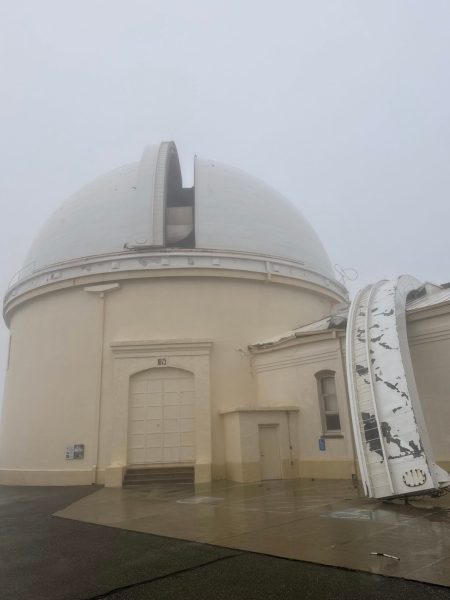
I missed, until now, the news that on Christmas Day, high winds accompanying a violent storm seriously damaged the historic Lick Observatory.
The gales were strong enough to rip one of the shutters from the dome of the 36″ refracting telescope and send it crashing onto the roof of the adjacent building.
The Observatory remains closed to the public while the structural damage is assessed and repairs made. Fortunately it seems nobody was hurt and no instruments were affected.
Here’s a video of the detached shutter being removed
The Lick Observatory is located on Mount Hamilton near San Jose in California. A donation by San Francisco millionaire James Lick enabled the construction of the 36” (diameter) refractor, the most powerful telescope in the world at the time. The Observatory was almost destroyed in 2020 by a wildfire, but the new incident is the most serious damage in its 137-year history.
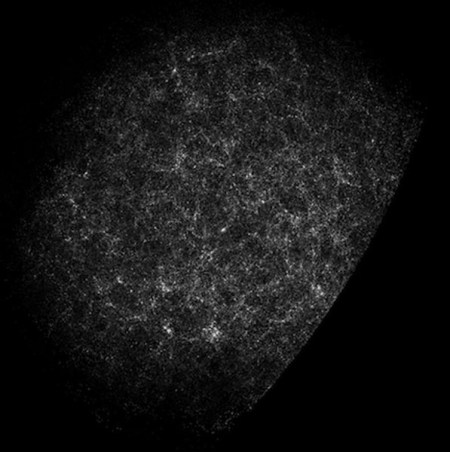
As I blogged about here, the Lick Observatory played an important role in the development of our understanding of the large-scale structure of the Universe, specifically with the creation of the Lick galaxy survey prepared by Charles Donald Shane and Carl Alvar Wirtanen and published in 1967 (Publ. Lick. Observatory 22, Part 1). In my more poetic moments, the image on the left puts me in mind of W.B. Yeats: Had I the heavens’ embroidered cloths.
That catalogue was still proving a useful resource well into the 1990s; I was part of various analyses of it myself, starting with this paper from 1991. It was eventually superceded by the arrival of large-scale galaxy redshift surveys, but it remaining an amazing achievement.
The Lick Galaxy survey was not performed with the 36″ refractor mentioned above, however, but by twin 20″ Carnegie astrographic telescopes housed in a different dome. As far as I know, these were not damaged in the storm.
The other night I watched the 2023 film Oppenheimer on TV. I had seen it before, on a plane flight, and enjoyed it, though I thought it was overlong. Fortunately it was a long flight. Watching it again a couple of days ago reminded me of something that struck me first time, and that was the cameo performance by Kenneth Branagh as Niels Bohr. You can see him at the start of the trailer here:
Niels Bohr was born in Copenhagen, a place I visited many times in the past and can recognize the local accent, though had never heard the speaking voice of Niels Bohr himself. I was a underwhelmed by Branagh’s rendition because he doesn’t sound very Danish to me. I assumed that because it was a relatively small part, Branagh didn’t put much effort into it. He doesn’t look like Niels Bohr, either.
But what did Niels Bohr actually sound like? Here is a lecture by him given in 1957 so you can decide for yourself.
Having heard this recording I think Kenneth Branagh’s version is not too far off, in fairness, though there are clear vocal mannerisms he did not capture.
The thing that strikes me most about the lecture, however, is that his delivery is very pedestrian, not to say rambling. People say he was like that in ordinary conversation too…
I wasn’t planning to do another update this week but I thought it would be best to complete the publications for 2025 at the Open Journal of Astrophysics, so that I don’t have to do a bigger update in the new year, and I have a bit of time this morning, so here we go.
Since the last update we have published four papers which brings the number in Volume 8 (2025) up to 201. Adding the 12 papers in the Supplement, this brings the final total for the year up to 213, and the total so far published by OJAp up to 448. In 2023 we published just 50 papers, so we have more than quadrupled in two years.
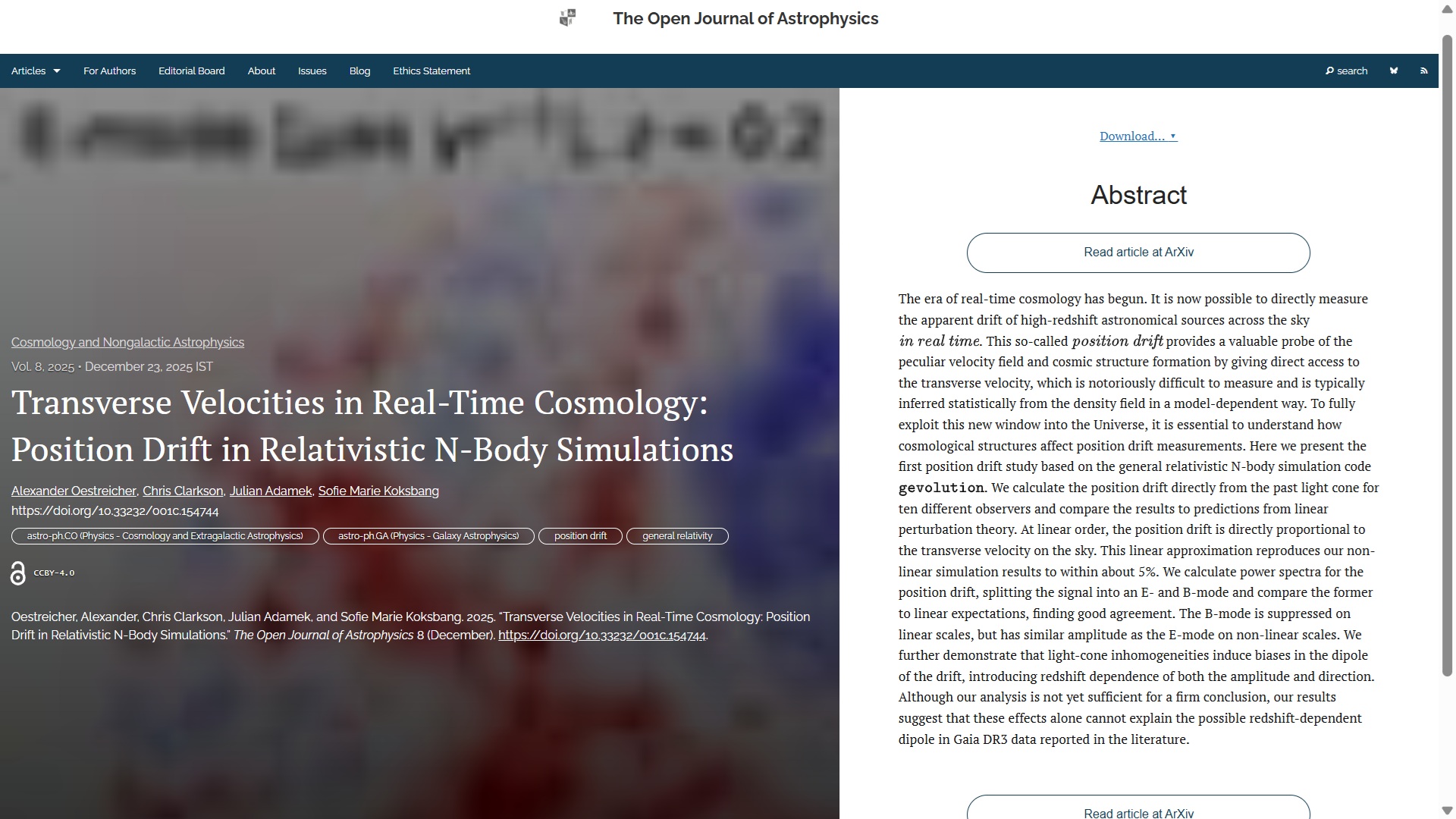
The first paper this week is “Transverse Velocities in Real-Time Cosmology: Position Drift in Relativistic N-Body Simulations” by Alexander Oestreicher (University of Southern Denmark), Chris Clarkson (QMUL, UK), Julian Adamek (Universität Zürich, CH) and Sofie Marie Koksbang (U. Southern Denmark). This study uses a general relativistic N-body simulation code to explore how cosmological structures affect position drift measurements, a new method for studying cosmic structure formation and velocity fields. This was published on Tuesday 23rd December 2025 in the folder Cosmology and Nongalactic Astrophysics.
The overlay is here:
You can find the officially accepted version on arXiv here and this is the announcement on Mastodon (Fediscience):
New Publication at the Open Journal of Astrophysics: "Transverse Velocities in Real-Time Cosmology: Position Drift in Relativistic N-Body Simulations" by Alexander Oestreicher (University of Southern Denmark), Chris Clarkson (QMUL, UK), Julian Adamek (Universität Zürich, CH) and Sofie Marie Koksbang (U. Southern Denmark)
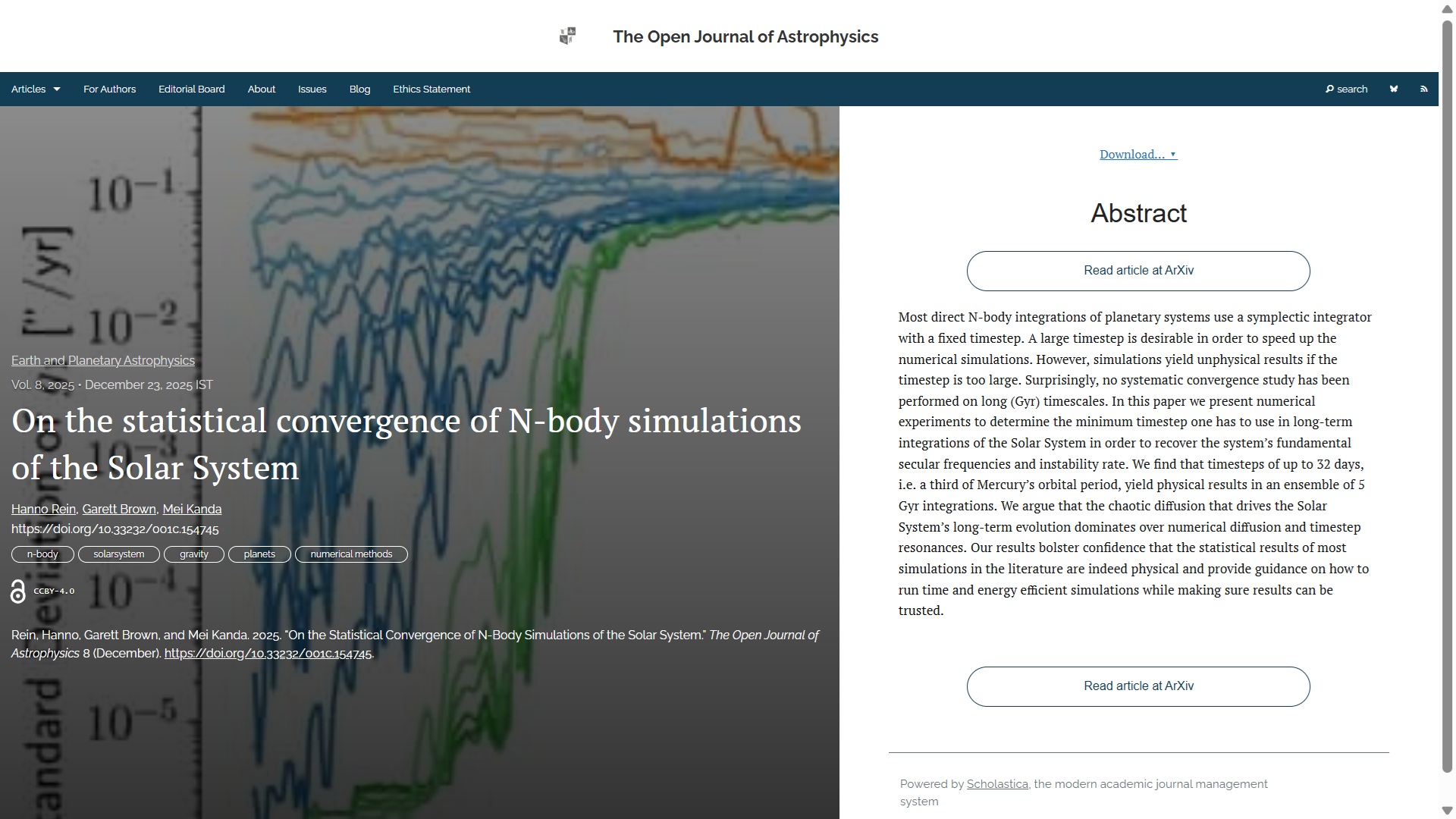
The second paper of the week is “On the statistical convergence of N-body simulations of the Solar System” by Hanno Rein, Garett Brown and Mei Kanda (U. Toronto, Canada). This study presents numerical experiments to determine the minimum timestep for long-term simulations of the Solar System, finding that timesteps up to 32 days yield physical results. It was published on Tuesday December 23rd in the folder Earth and Planetary Astrophysics.
The overlay is here:
You can find the official version of this one on arXiv here. The federated announcement on Mastodon is here:
New Publication at the Open Journal of Astrophysics: "On the statistical convergence of N-body simulations of the Solar System" by Hanno Rein, Garett Brown and Mei Kanda (U. Toronto, Canada)
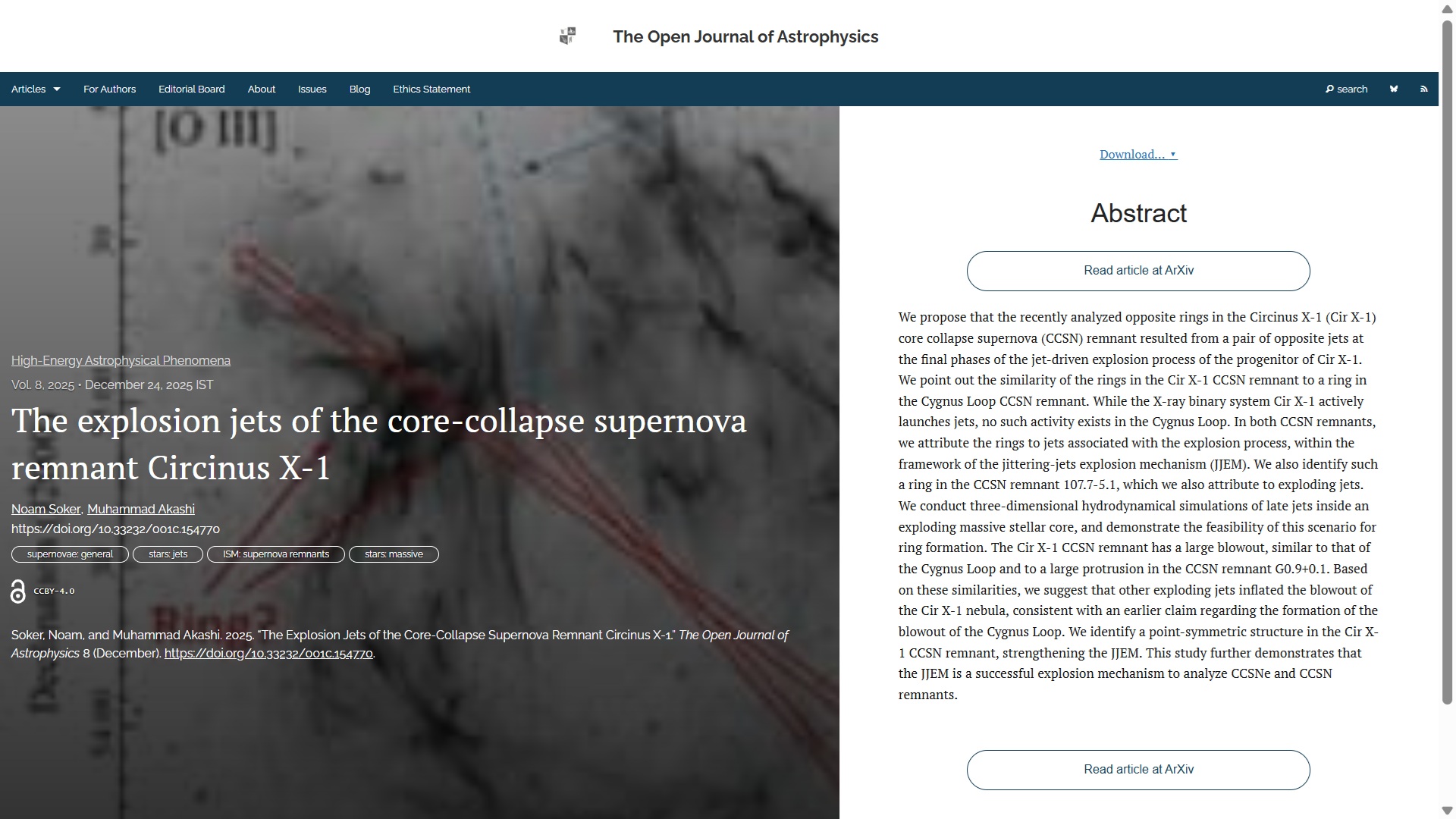
Next, published on 24th December 2025 in the folder High-Energy Astrophysical Phenomena, we have “The explosion jets of the core-collapse supernova remnant Circinus X-1” by Noam Soker and Muhammad Akashi (Technion, Haifa, Israel). This paper suggests that the rings in the Circinus X-1 supernova remnant resulted from jet-driven explosions, supporting the jittering-jets explosion mechanism theory for core collapse supernovae.
The overlay is here:
The officially accepted paper can be found on arXiv here and the announcement on Mastodon is here
New Publication at the Open Journal of Astrophysics: "The explosion jets of the core-collapse supernova remnant Circinus X-1" by Noam Soker and Muhammad Akashi (Technion, Haifa, Israel)
Finally for 2025 we have “Quantifying the Fermi paradox via passive SETI: a general framework” by Matthew Civiletti (City University of New York, USA). This was published on Wednesday 24th December in the folder Instrumentation and Methods for Astrophysics. The author uses SETI observations and the Drake Equation to calculate the probability of detecting at least one extraterrestrial signal, highlighting the model’s limitations and potential improvements. The overlay is here:
The officially accepted version can be found on arXiv here and the Mastodon announcement here:
New Publication at the Open Journal of Astrophysics: "Quantifying the Fermi paradox via passive SETI: a general framework" by Matthew Civiletti (City University of New York, USA)
And that concludes the updates for 2025. I’ll be back in a week with the first update of 2026, which will include the first paper(s) of Volume 9.
I’d like to thank everyone who has supported the Open Journal of Astrophysics this year – Editors, Reviewers, Authors and the excellent Library staff at Maynooth – and who have made it such a bumper year. In 2023 we published just 50 papers, so we have more than quadrupled in two years. How many will we publish in 2026?
Sunlight at dawn on the Winter Solstice at Newgrange
Just a quick note to point out that the Winter Solstice in the Northern hemisphere happens today, Sunday 21st December 2025, at 15.03 UT (GMT).
In Dublin, sunrise yesterday (20th December) was at 8.37 am and sunset at 4.07 pm, while today the sunrise was at 8.38 am and sunset at 4.08 pm. Both sunrise and sunset happen later tomorrow than today, so the Solstice marks neither the latest sunrise nor the earliest sunset. We have to wait until January for the latest sunrise (8.40am) and the earliest sunset (4.06pm) actually happened over a week ago. The interval between the two events will, however, be about 2 seconds longer tomorrow than today; and yesterday the gap was about 4 seconds longer than today. Taking a day to be the interval between sunrise and sunset, today is the shortest.
P.S. In the Southern Hemisphere this is of course the summer solstice. In Australia it was marked by the ritual of a victory in the Ashes against England.
The views presented here are personal and not necessarily those of my employer (or anyone else for that matter).
Feel free to comment on any of the posts on this blog but comments may be moderated; anonymous comments and any considered by me to be vexatious and/or abusive and/or defamatory will not be accepted. I do not necessarily endorse, support, sanction, encourage, verify or agree with the opinions or statements of any information or other content in the comments on this site and do not in any way guarantee their accuracy or reliability.







 In the Dark