The paper discusses a conceptually challenging issue in cosmology, which I’ll put simply as follows. Suppose we have two cosmological theories: A, which describes a very large universe in only a tiny part of which low-energy physics turns out like ours; and B in which we have a possibly much smaller universe in which low-energy physics is like ours with a high probability. Can we determine whether A or B is the “better” theory, and if so how?
The abstract of the paper is below:
Some cosmological theories propose that the observable universe is a small part of a much larger universe in which parameters describing the low-energy laws of physics vary from region to region. How can we reasonably assess a theory that describes such a mostly unobservable universe? We propose a Bayesian method based on theory-generated probability distributions for our observations. We focus on basic principles, leaving aside concerns about practicality. (We also leave aside the measure problem, to discuss other issues.) We argue that cosmological theories can be tested by standard Bayesian updating, but we need to use theoretical predictions for “first-person” probabilities — i.e., probabilities for our observations, accounting for all relevant selection effects. These selection effects can depend on the observer, and on time, so in principle first-person probabilities are defined for each observer-instant — an observer at an instant of time. First-person probabilities should take into account everything the observer believes about herself and her surroundings — i.e., her “subjective state”. We advocate a “Principle of Self-Locating Indifference” (PSLI), asserting that any real observer should make predictions as if she were chosen randomly from the theoretically predicted observer-instants that share her subjective state. We believe the PSLI is intuitively very reasonable, but also argue that it maximizes the expected fraction of observers who will make correct predictions. Cosmological theories will in general predict a set of possible universes, each with a probability. To calculate first-person probabilities, we argue that each possible universe should be weighted by the number of observer-instants in the specified subjective state that it contains. We also discuss Boltzmann brains, the humans/Jovians parable of Hartle and Srednicki, and the use of “old evidence”.
arXiv:2602.02667
I haven’t had time to read the paper in detail yet, and I don’t think I’m going to agree with all of it when I do, but I found it sufficiently stimulating to share here in the hope that others will find it interesting.
It’s Saturday once more so time for another update of activity at the Open Journal of Astrophysics. Since the last update we have published a further six papers, bringing the number in Volume 9 (2026) to 24 and the total so far published by OJAp up to 472.
I will continue to include the posts made on our Mastodon account (on Fediscience) to encourage you to visit it. Mastodon is a really excellent service, and a more than adequate replacement for X/Twitter which nobody should be using; these announcement also show the DOI for each paper.
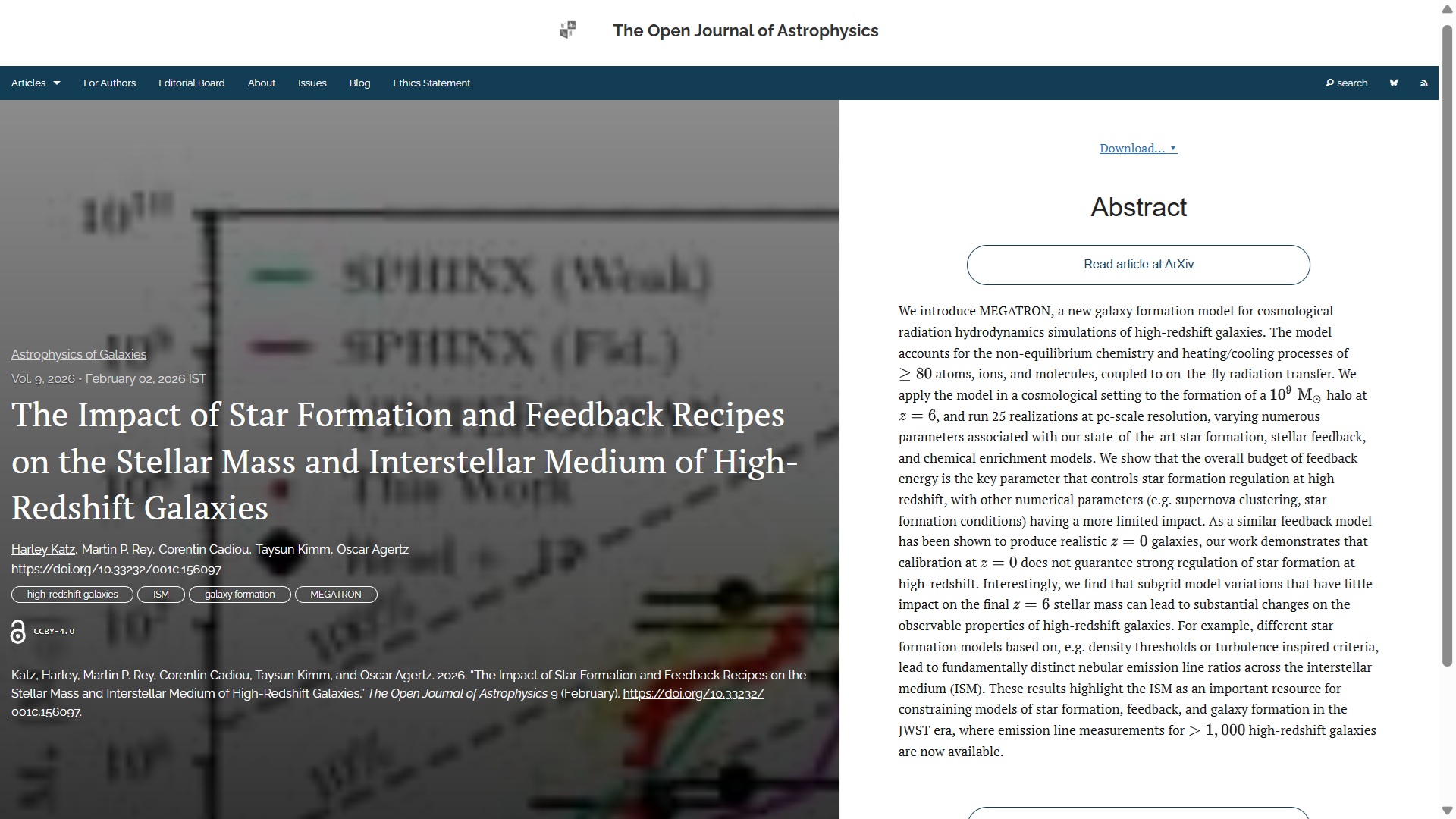
The first paper to report this week is “The Impact of Star Formation and Feedback Recipes on the Stellar Mass and Interstellar Medium of High-Redshift Galaxies” by Harley Katz (U. Chicago, USA), Martin P. Rey (U. Oxford, UK), Corentin Cadiou (Lund U., Sweden) Taysun Kimm (Yonsei U., Korea) and Oscar Agertz (Lund). This paper was published on Monday 2nd February 2026 in the folder Astrophysics of Galaxies. It introduces MEGATRON, a new model for galaxy formation simulations, highlighting that feedback energy controls star formation at high redshift and highlighting the importance of the interstellar medium.
The overlay is here:
You can find the officially accepted version on arXiv here and the announcement on Fediverse here:
New Publication at the Open Journal of Astrophysics: "The Impact of Star Formation and Feedback Recipes on the Stellar Mass and Interstellar Medium of High-Redshift Galaxies" by Harley Katz (U. Chicago, USA), Martin P. Rey (U. Oxford, UK), Corentin Cadiou (Lund U., Sweden) Taysun Kimm (Yonsei U., Korea) and Oscar Agertz (Lund)
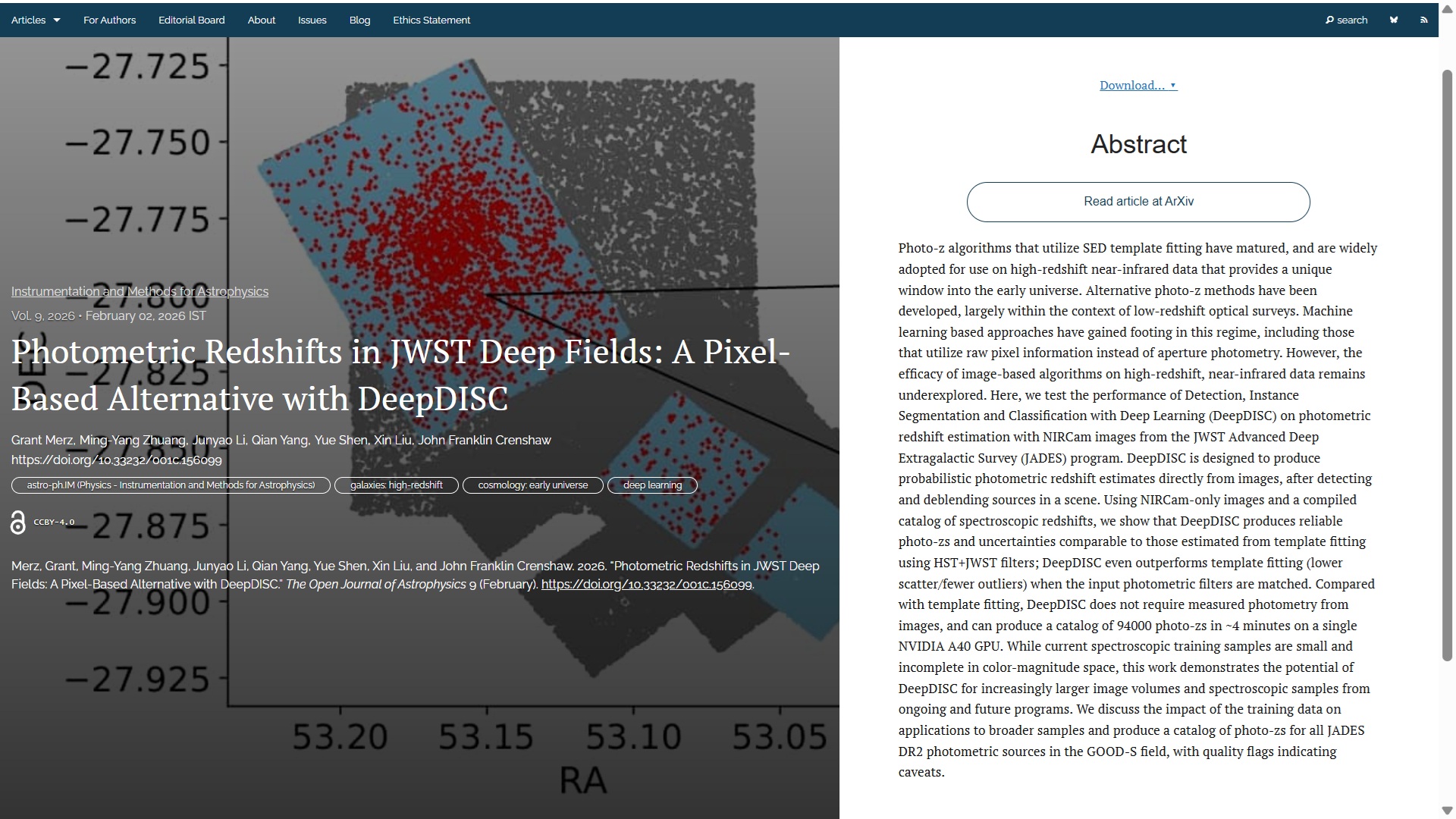
The second paper is “Photometric Redshifts in JWST Deep Fields: A Pixel-Based Alternative with DeepDISC” by Grant Merz (U. Illinois at Urbana-Champaign) and 6 others, all based in the USA. This paper was published on Monday February 2nd 2026 in the folder Instrumentation and Methods for Astrophysics. This paper explores the effectiveness of the DeepDISC machine learning algorithm in estimating photometric redshifts from near-infrared data, demonstrating its potential for larger image volumes and spectroscopic samples
The overlay for this one is here:
The official version of the paper can be found on arXiv here and the Fediverse announcement here:
New Publication at the Open Journal of Astrophysics: "Photometric Redshifts in JWST Deep Fields: A Pixel-Based Alternative with DeepDISC" by Grant Merz (U. Illinois at Urbana-Champaign) and 6 others, all based in the USA
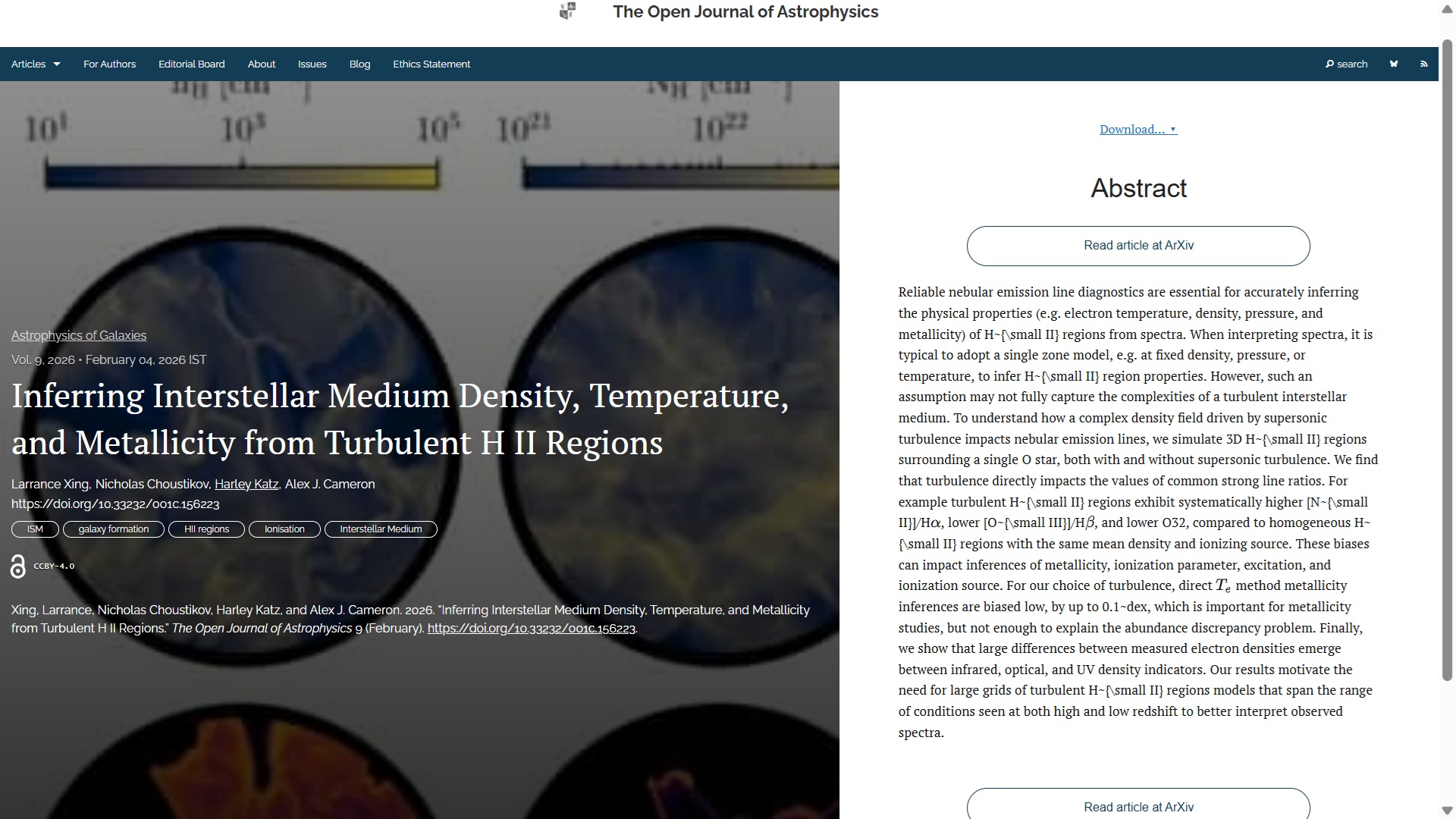
Next, published on Wednesday 4th February in the folder Astrophysics of Galaxies, is “Inferring Interstellar Medium Density, Temperature, and Metallicity from Turbulent H II Regions” by Larrance Xing (U. Chicago, USA), Nicholas Choustikov (U. Oxford, UK), Harley Katz (U. Chicago) and Alex J. Cameron (DAWN, Denmark). This paper argues that supersonic turbulenc affects the interpretation of H II region properties, potentially impacting inferred metallicity, ionization, and excitation from in nebular emission lines, motivating more extensive modelling.
The overlay is here:
The official version can be found on arXiv here and the Fediverse announcement is here:
New Publication at the Open Journal of Astrophysics: "Inferring Interstellar Medium Density, Temperature, and Metallicity from Turbulent H II Regions" by Larrance Xing (U. Chicago, USA), Nicholas Choustikov (U. Oxford, UK), Harley Katz (U. Chicago) and Alex J. Cameron (DAWN, Denmark)
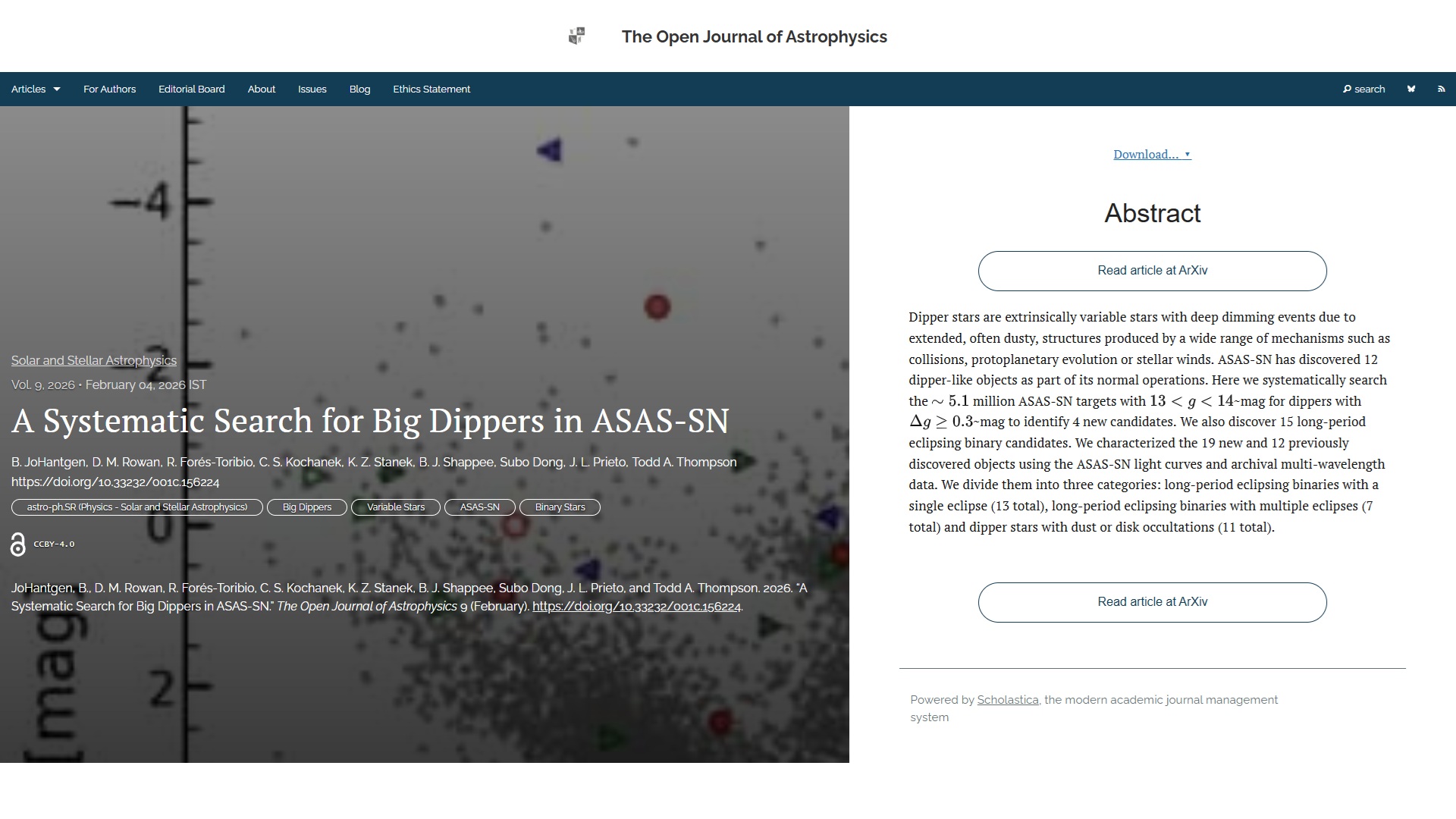
The fourth paper this week, also published on Wednesday 4th February, but in the folder Solar and Stellar Astrophysics, is “A Systematic Search for Big Dippers in ASAS-SN” by B. JoHantgen, D. M. Rowan, R. Forés-Toribio, C. S. Kochanek, & K. Z. Stanek (Ohio State University, USA), B. J. Shappee (U. Hawaii, USA), Subo Dong (Peking University), J. L. Prieto Universidad Diego Portales, Chile) and Todd A. Thompson (Ohio State). This study identifies 4 new dipper stars and 15 long-period eclipsing binary candidates using ASAS-SN light curves and multi-wavelength data, categorizing them based on their characteristics.
Here is the overlay:
The official version can be found on arXiv here and the Fediverse announcement is here:
New Publication at the Open Journal of Astrophysics: "A Systematic Search for Big Dippers in ASAS-SN" by B. JoHantgen , D. M. Rowan, R. Forés-Toribio, C. S. Kochanek, & K. Z. Stanek (Ohio State University, USA), B. J. Shappee (U. Hawaii, USA), Subo Dong (Peking University), J. L. Prieto Universidad Diego Portales, Chile) and Todd A. Thompson (Ohio State)
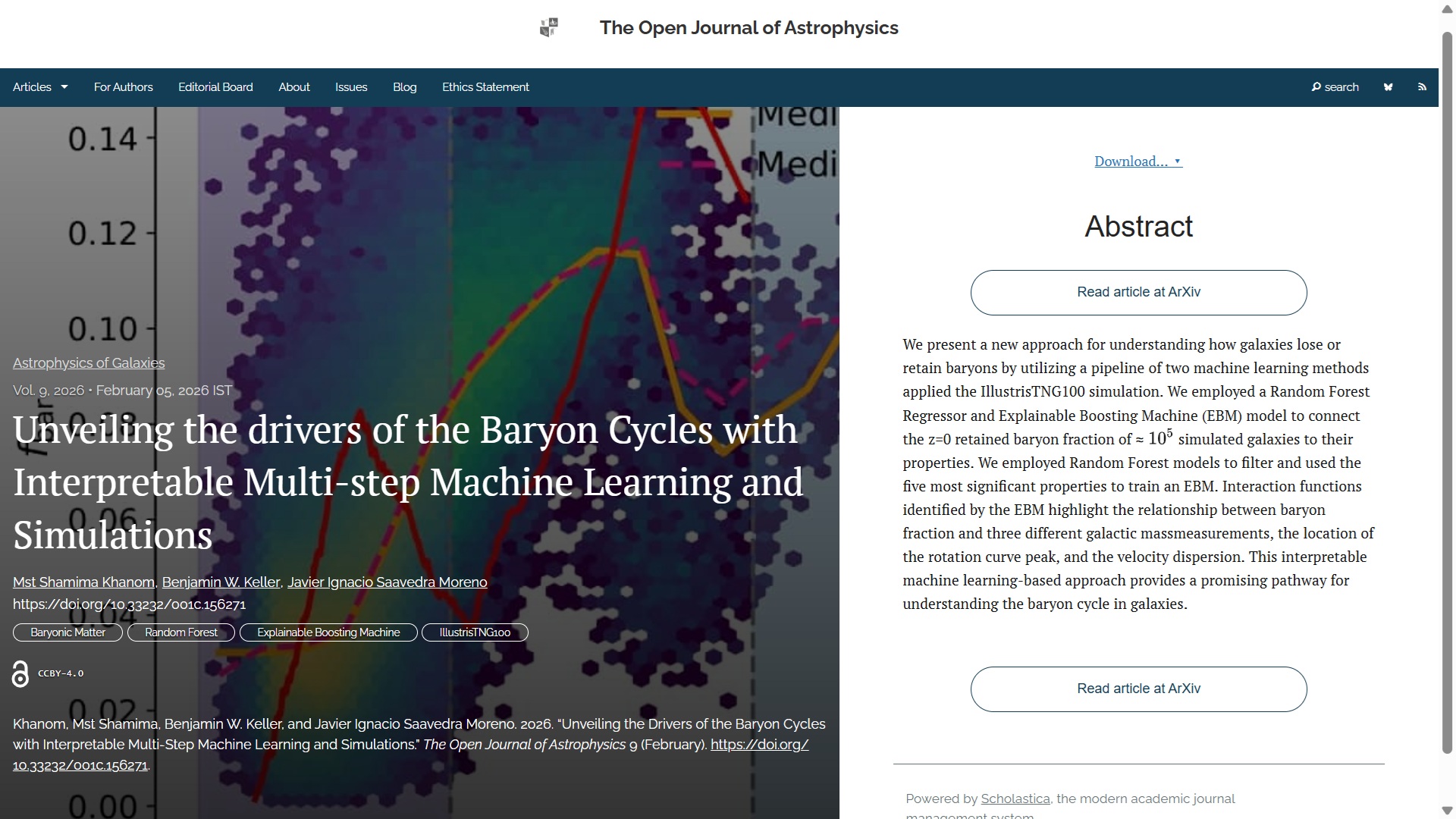
Fifth, and next to last this week we have “Unveiling the drivers of the Baryon Cycles with Interpretable Multi-step Machine Learning and Simulations” by Mst Shamima Khanom, Benjamin W. Keller and Javier Ignacio Saavedra Moreno (U. Memphis, USA). This paper was published on Thursday 5th February 2026 in the folder Astrophysics of Galaxies. This study uses machine learning methods to understand how galaxies lose or retain baryons, highlighting the relationship between baryon fraction and various galactic measurements.
The overlay is here:
The accepted version can be found on arXiv here, and the fediverse announcement is here:
New Publication at the Open Journal of Astrophysics: "Unveiling the drivers of the Baryon Cycles with Interpretable Multi-step Machine Learning and Simulations" by Mst Shamima Khanom, Benjamin W. Keller and Javier Ignacio Saavedra Moreno (U. Memphis, USA)
Finally for this week we have “The Bispectrum of Intrinsic Alignments: II. Precision Comparison Against Dark Matter Simulations” by Thomas Bakx (Utrecht U., Netherlands), Toshiki Kurita (MPA Garching, Germany), Alexander Eggemeier (U. Bonn, Germany), Nora Elisa Chisari (Utrecht) and Zvonimir Vlah (Ruđer Bošković Institute, Croatia). This paper was accepted in December, but publication got delayed by the Christmas effect so was published on February 6th 2026, in the folder Cosmology and Nongalactic Astrophysics. This study uses N-body simulations to accurately measure three-dimensional bispectra of halo intrinsic alignments and dark matter overdensities, providing a method to determine higher order shape bias parameters.
The overlay is here:
You can find the published version of the article here, and the Mastodon announcement is here:
New Publication at the Open Journal of Astrophysics: "The Bispectrum of Intrinsic Alignments: II. Precision Comparison Against Dark Matter Simulations" by Thomas Bakx (Utrecht U., Netherlands), Toshiki Kurita (MPA Garching, Germany), Alexander Eggemeier (U. Bonn, Germany), Nora Elisa Chisari (Utrecht) and Zvonimir Vlah (Ruđer Bošković Institute, Croatia)
It’s Saturday once more so time for another update of activity at the Open Journal of Astrophysics. Since the last update we have published a further four papers, bringing the number in Volume 9 (2026) to 18 and the total so far published by OJAp up to 466.
I will continue to include the posts made on our Mastodon account (on Fediscience) to encourage you to visit it. Mastodon is a really excellent service, and a more than adequate replacement for X/Twitter which nobody should be using; these announcement also show the DOI for each paper.
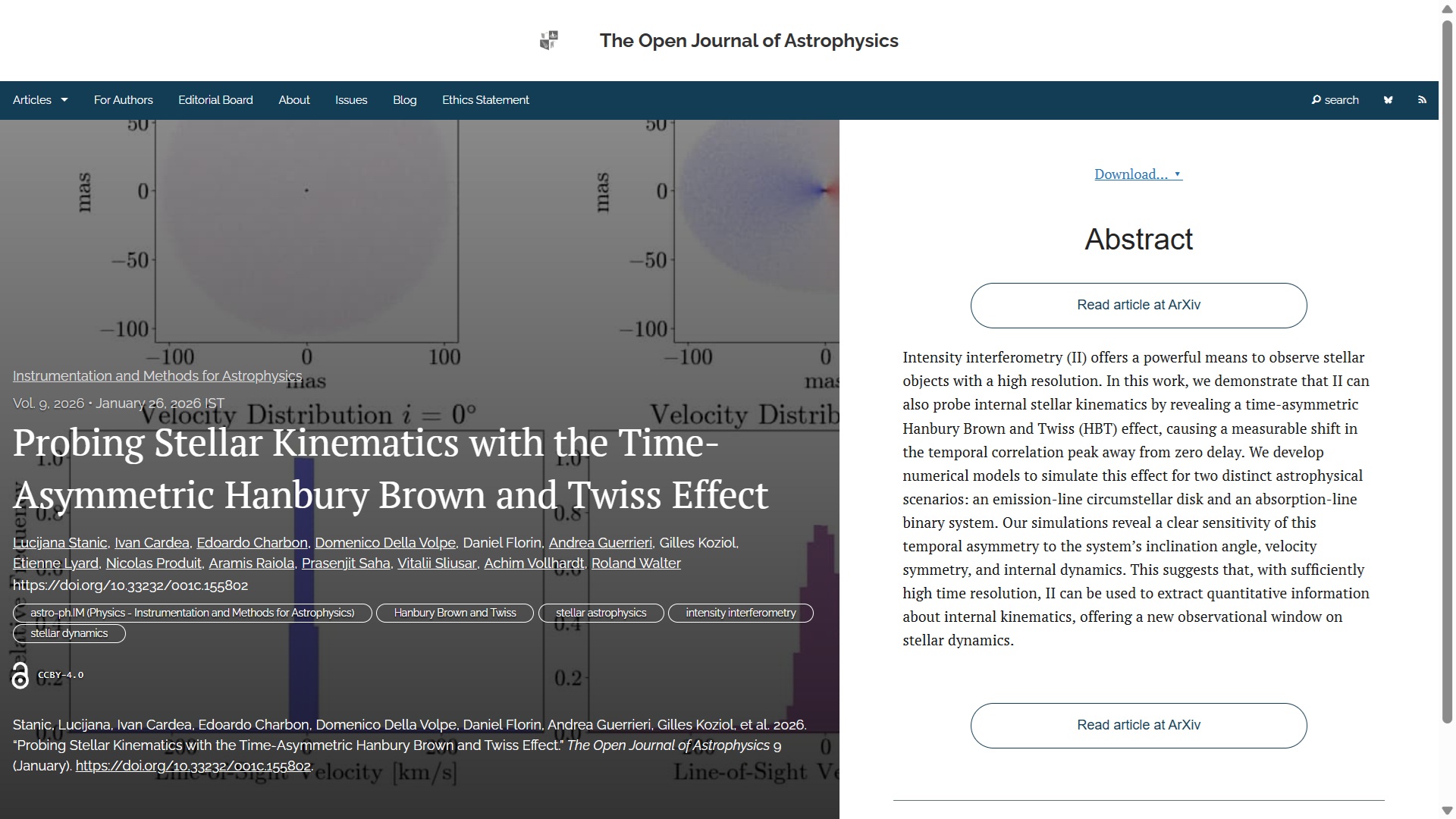
The first paper to report this week is “Probing Stellar Kinematics with the Time-Asymmetric Hanbury Brown and Twiss Effect” by Lucijana Stanic (University of Zurich, Switzerland) and 13 others based in Zurich, Lausanne and Geneva (all in Switzerland). This was published on Monday 26th January 2026 in the folder Instrumentation and Methods for Astrophysics. This research demonstrates that intensity interferometry can reveal internal stellar kinematics, providing a new way to observe stellar dynamics with high time resolution.
The overlay is here:
You can find the officially accepted version on arXiv here and the announcement on Fediverse here:
New Publication at the Open Journal of Astrophysics: "Probing Stellar Kinematics with the Time-Asymmetric Hanbury Brown and Twiss Effect" by Lucijana Stanic (University of Zurich, Switzerland) and 13 others based in Zurich, Lausanne and Geneva.
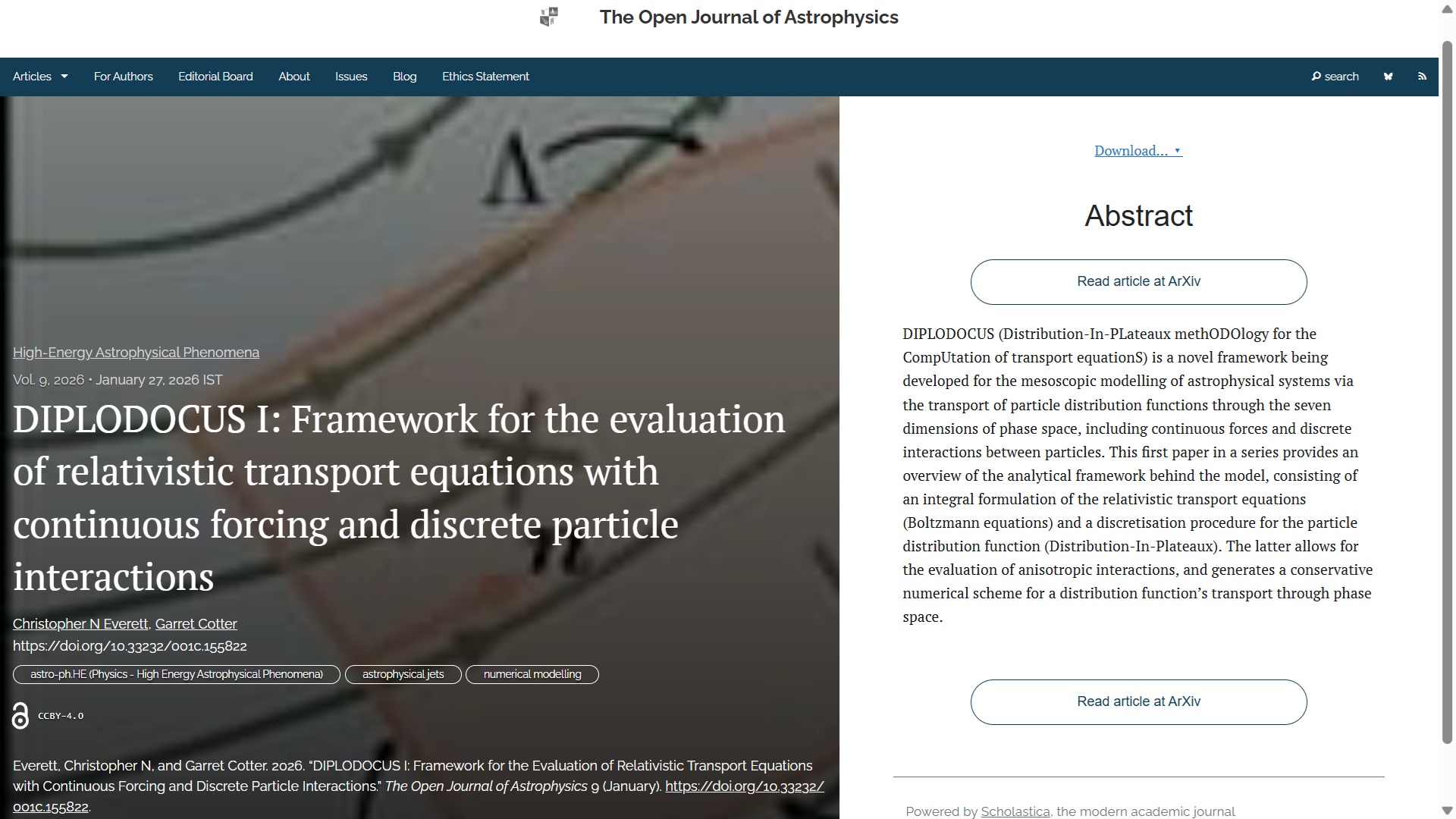
New Publication at the Open Journal of Astrophysics: "DIPLODOCUS I: Framework for the evaluation of relativistic transport equations with continuous forcing and discrete particle interactions" by Christopher N Everett & Garret Cotter (University of Oxford, UK)
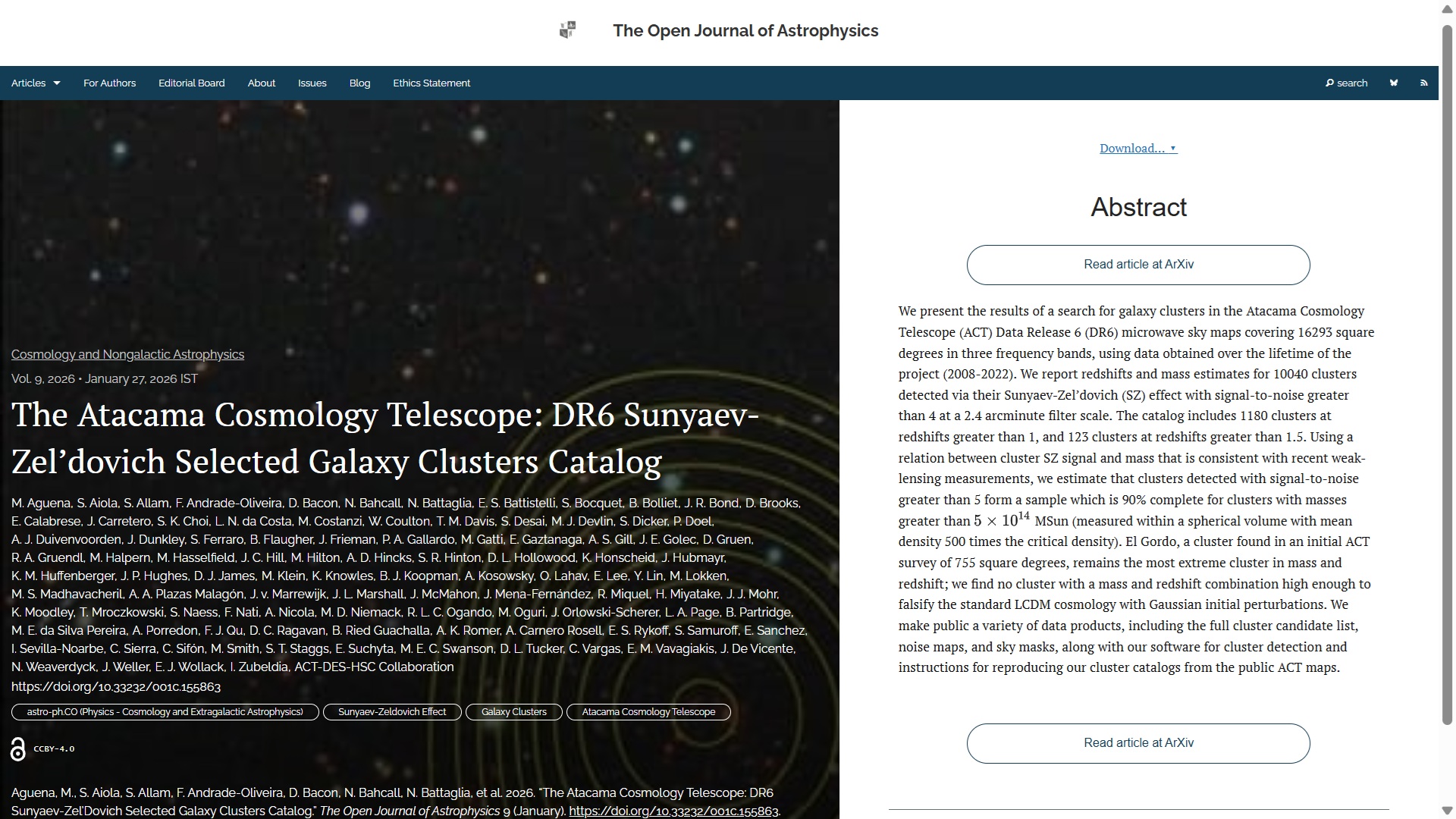
New Publication at the Open Journal of Astrophysics: "The Atacama Cosmology Telescope: DR6 Sunyaev-Zel’dovich Selected Galaxy Clusters Catalog" by M. Aguena et al. (101 authors altogether), on behalf of the ACT-DES-HSC Collaboration
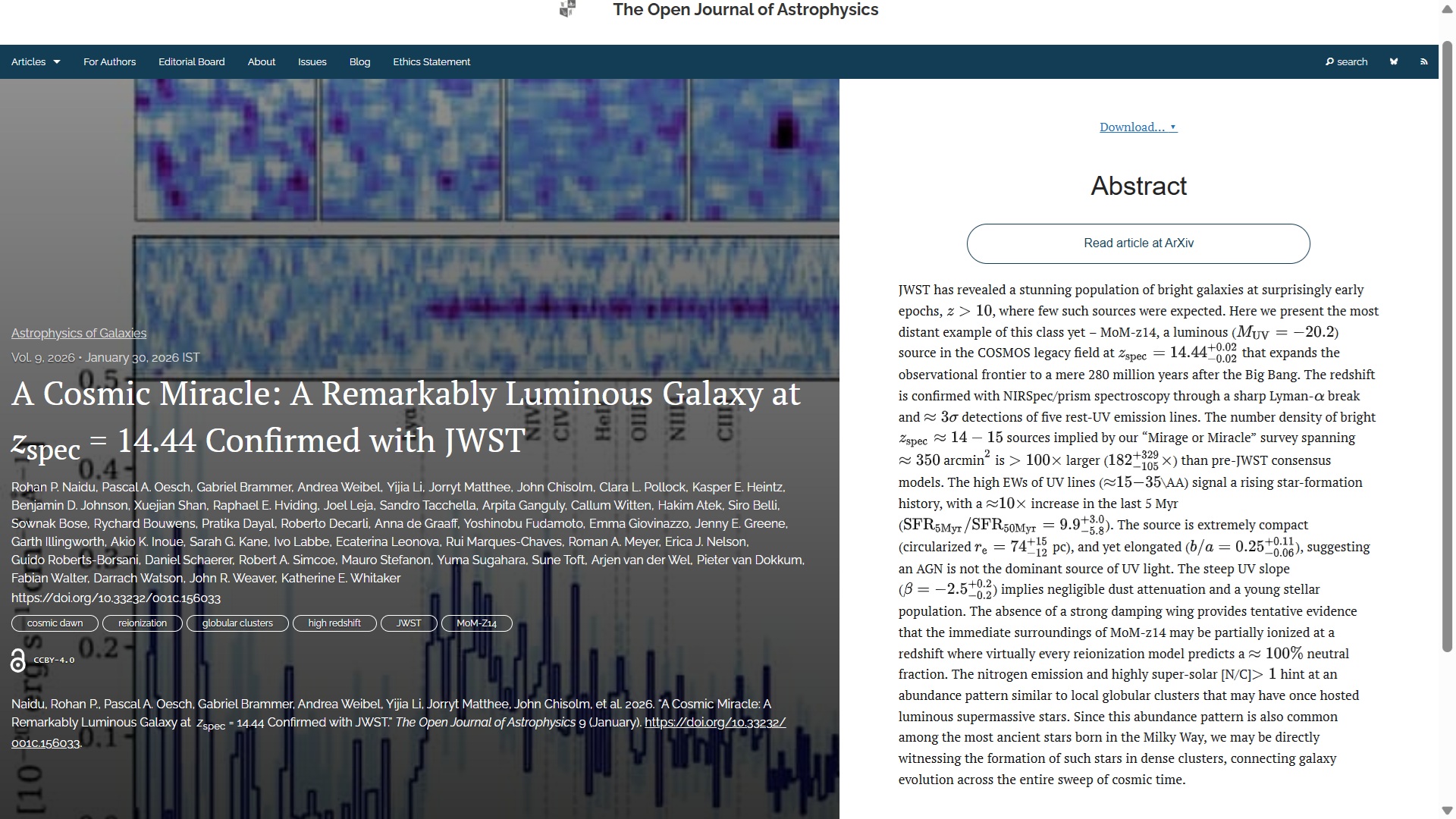
And finally for this week we have a paper published yesterday, Friday 30th January 2026, in the folder Astrophysics of Galaxies. This is the paper I blogged about yesterday: “A Cosmic Miracle: A Remarkably Luminous Galaxy at zspec = 14.44 Confirmed with JWST” by Rohan Naidu (MIT Kavli Institute) and an international cast of 45 others. This article reports on the discovery by the James Webb Space Telescope (JWST) of a bright galaxy, MoM-z14, located 280 million years post-Big Bang, that challenges models of galaxy formation and the star-formation history of early galaxies.
The overlay is here:
The accepted version can be found on arXiv here, and the fediverse announcement is here:
New Publication at the Open Journal of Astrophysics: "A Cosmic Miracle: A Remarkably Luminous Galaxy at $z_{rm spec} = 14.44$ Confirmed with JWST" by Rohan Naidu (MIT Kavli Institute) and 45 others.
A while ago (last May, in fact) I posted an article about a galaxy with an apparent spectroscopic redshift of 14.44. The paper to which that post related had been submitted to the Open Journal of Astrophysics and I haven’t mentioned that paper again until now as the paper was then, so to speak, sub judice. Well, as of today, the paper is now published and will feature in tomorrow’s traditional Saturday roundup of publications at the journal.
This paper was in fact accepted for publication before Christmas, but it took until this morning for the final accepted article to reach the arXiv. Rather awkwardly, the Space Telescope Science Institute issued a press release about this paper on 28th January 2026 stating that the paper was published in the Open Journal of Astrophysics, when that statement was not accurate. As Editor-in Chief of the Open Journal of Astrophysics, I was subsequently contacted by a number of journalists asking where they could find the paper on the OJAp platform. Since it hadn’t been published then I had to say they couldn’t, so a number of pieces (including, for example, this one in Scientific American) have appeared based on the STSCi press release without links to the final version of the paper. It would have been far better, in my opinion, to have delayed the press release until the paper was actually published. It’s better to wait until the ball is in the back of the net before you start celebrating!
Anyway, thanks to me getting up at 6am today, it’s now published so there’s no real harm done.
New Publication at the Open Journal of Astrophysics: "A Cosmic Miracle: A Remarkably Luminous Galaxy at $z_{rm spec} = 14.44$ Confirmed with JWST" by Rohan Naidu (MIT Kavli Institute) and 45 others.
For reference, here is the key plot showing the spectrum from which the galaxy’s redshift is determined. It is rather noisy, but the Lyman break seems convincing and there are some emission lines that offer corroborative evidence:
It’s Saturday once more so time for another update of activity at the Open Journal of Astrophysics. Since the last update we have published a further three papers, bringing the number in Volume 9 (2026) to 14 and the total so far published by OJAp up to 462. This week was slightly affected by a Federal holiday in the USA on January 19th; there were no arXiv announcements the following day.
I will continue to include the posts made on our Mastodon account (on Fediscience) to encourage you to visit it. Mastodon is a really excellent service, and a more than adequate replacement for X/Twitter which nobody should be using.
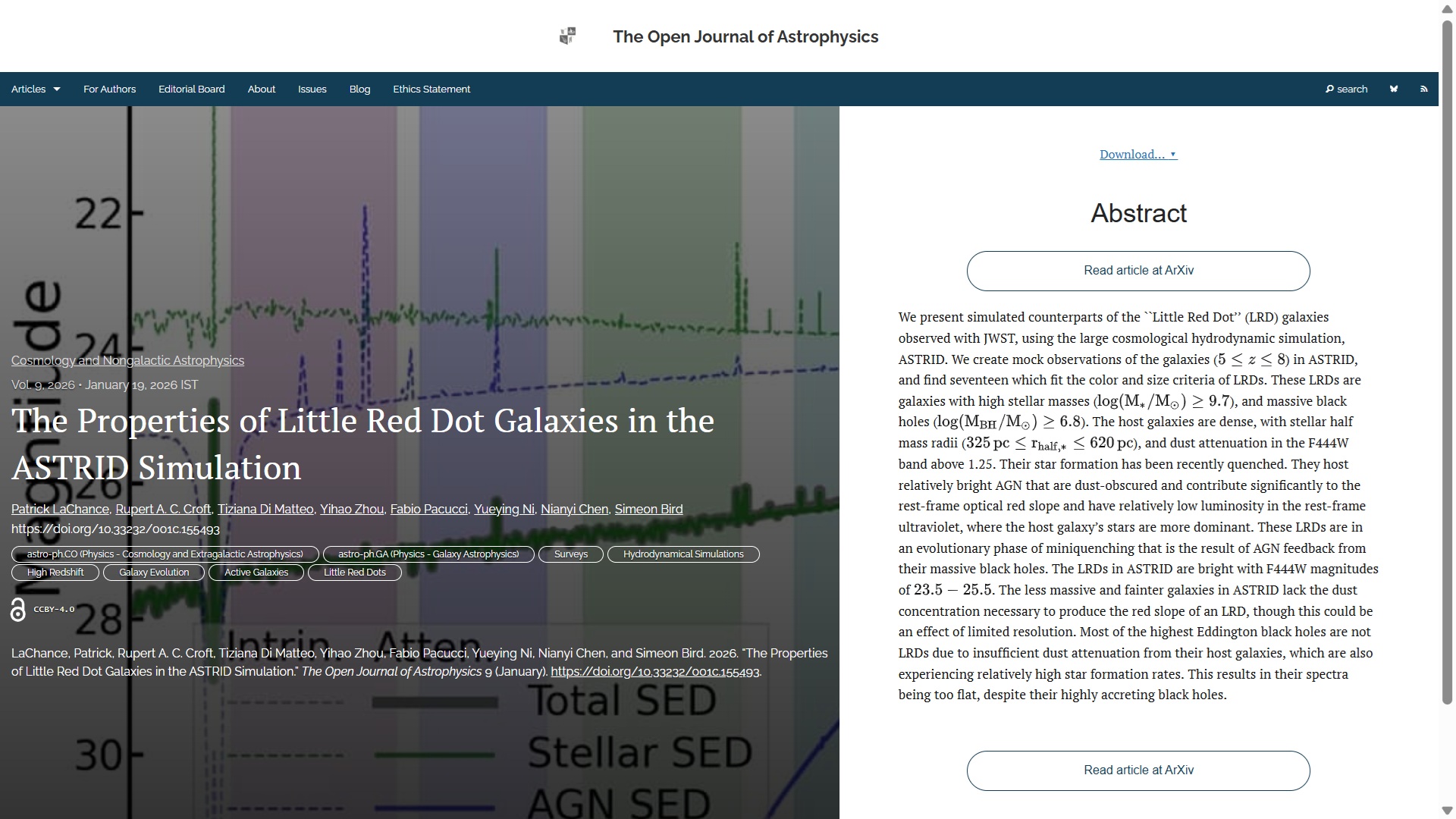
The first paper to report this week is “The Properties of Little Red Dot Galaxies in the ASTRID Simulation” by Patrick LaChance, Rupert A. C. Croft, Tiziana Di Matteo & Yihao Zhou (Carnegie Mellon U.), Fabio Pacucci (Harvard-Smithsonian CfA), Yueying Ni (U. Michigan Ann Arbor), Nianyi Chen (Princeton U.) and Simeon Bird (UC Riverside), all based in the USA. This paper was published on Monday 19th January 2026 in the folder Cosmology and Nongalactic Astrophysics; the study analyses mock observations of “Little Red Dot” galaxies created from the ASTRID simulation, having high stellar masses and containing massive black holes; not all features match real observations.
The overlay is here:
You can find the officially accepted version on arXiv here and the announcement on Fediverse here:
New Publication at the Open Journal of Astrophysics; "The Properties of Little Red Dot Galaxies in the ASTRID Simulation" by Patrick LaChance, Rupert A. C. Croft, Tiziana Di Matteo & Yihao Zhou (Carnegie Mellon U.), Fabio Pacucci (Harvard-Smithsonian CfA), Yueying Ni (U. Michigan Ann Arbor), Nianyi Chen (Princeton U.) and Simeon Bird (UC Riverside), all based in the USA
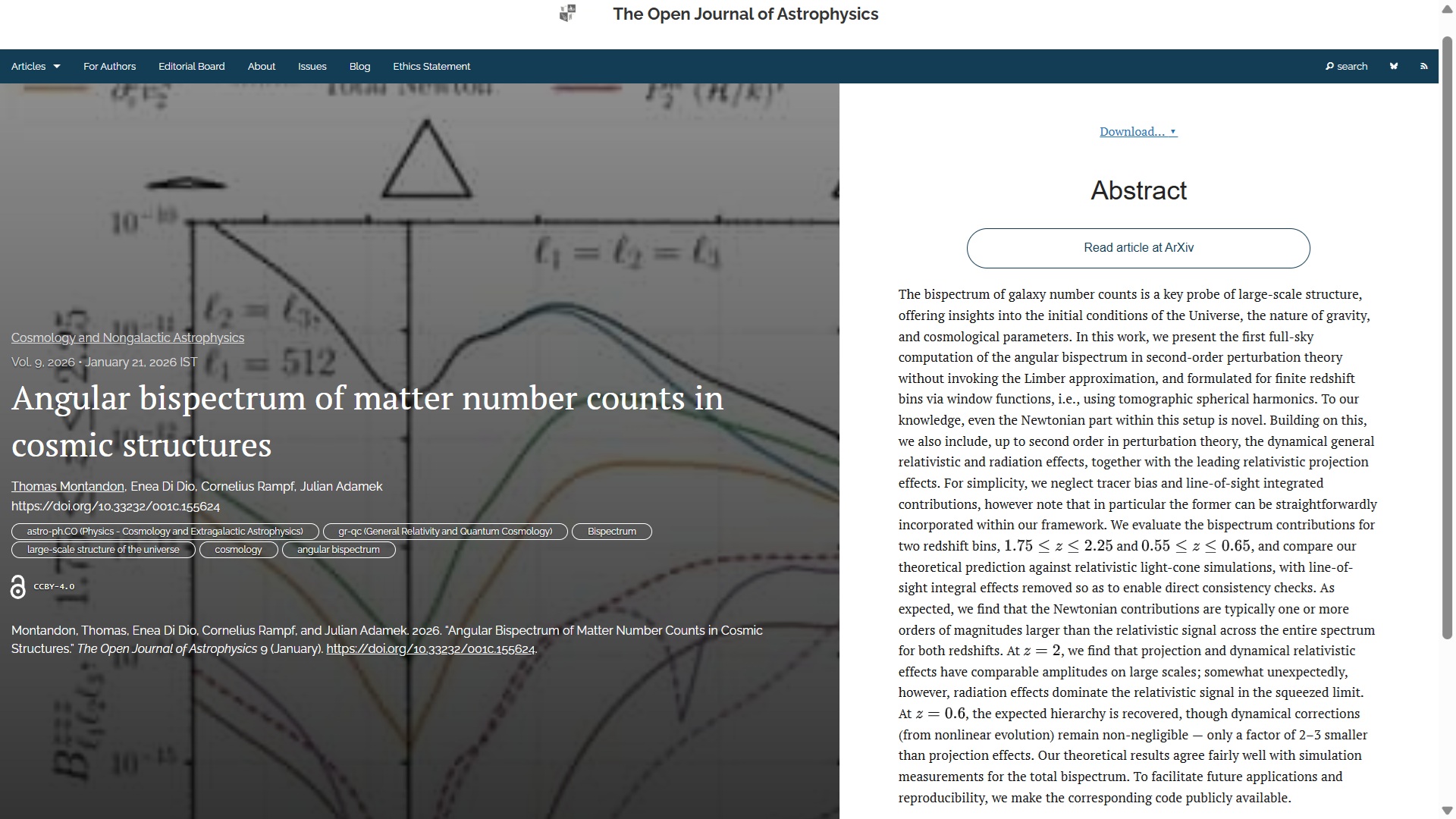
The second paper is “Angular bispectrum of matter number counts in cosmic structures” by Thomas Montandon (U. Montpellier, France), Enea Di Dio (U. Genève, Switzerland), Cornelius Rampf (Ruđer Bošković Institute, Croatia) and Julian Adamek (U. Zürich, Switzerland). This was published on Wednesday January 21st, also in the folder Cosmology and Nongalactic Astrophysics. This paper presents thee first full-sky computation of the angular bispectrum in second-order perturbation theory, offering insights into the Universe’s initial conditions, gravity, and cosmological parameters. The results align well with simulations.
The overlay for this one is here:
The official version of the paper can be found on arXiv here and the Fediverse announcement here:
New Publication at the Open Journal of Astrophysics: "Angular bispectrum of matter number counts in cosmic structures" by Thomas Montandon (U. Montpellier, France), Enea Di Dio (U. Genève, Switzerland), Cornelius Rampf (Ruđer Bošković Institute, Croatia) and Julian Adamek (U. Zürich, Switzerland)
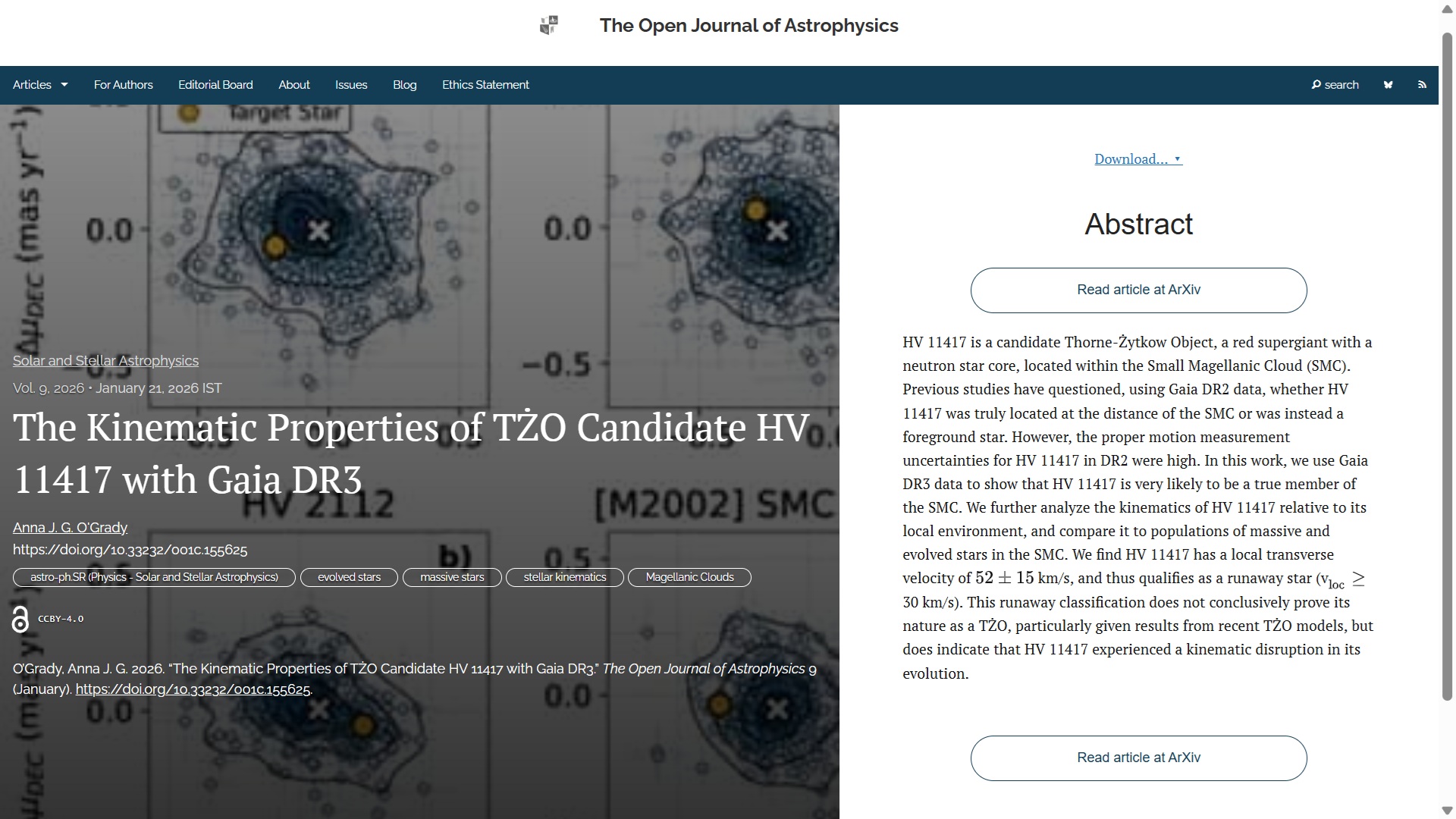
Next, and last for this week, we have “The Kinematic Properties of TŻO Candidate HV 11417 with Gaia DR3” by Anna J. G. O’Grady (Carnegie Mellon University, USA). This was published on Wednesday 21st January 2026 in the folder Solar and Stellar Astrophysics. This work uses updated data to confirm that HV 11417, a potential Thorne-Żytkow Object, is probably part of the Small Magellanic Cloud and qualifies as a runaway star.
The overlay is here:
The official version can be found on arXiv here and the Fediverse announcement is here:
New Publication at the Open Journal of Astrophysics: "The Kinematic Properties of TŻO Candidate HV 11417 with Gaia DR3" by Anna J. G. O'Grady (Carnegie Mellon University, USA)
This morning’s arXiv announcement contained a number of papers related to the Dark Energy Survey Y6 analysis. There is also a Zoom webinar later today at 10.30 Central Time (16.30 GMT; 13.30 in Greenland). Details can be found here.
You can find links to and abstracts of all the papers here, but I thought it would be useful to provide arXiv links to the latest batch here.
arXiv:2601.14559 Dark Energy Survey Year 6 Results: Cosmological Constraints from Galaxy Clustering and Weak Lensing – this is the key summary paper.
arXiv:2601.14484 Dark Energy Survey Year 6 Results: MagLim++ Lens Sample Selection and Measurements of Galaxy Clustering
arXiv:2601.14864 Dark Energy Survey: DESI-Independent Angular BAO Measurement
arXiv:2601.15175 Dark Energy Survey Year 6 Results: Galaxy-galaxy lensing
arXiv:2601.14833 Dark Energy Survey Year 6 Results: Magnification modeling and its impact on galaxy clustering and galaxy-galaxy lensing cosmology
arXiv:2601.14859 Dark Energy Survey Year 6 Results: Weak Lensing and Galaxy Clustering Cosmological Analysis Framework
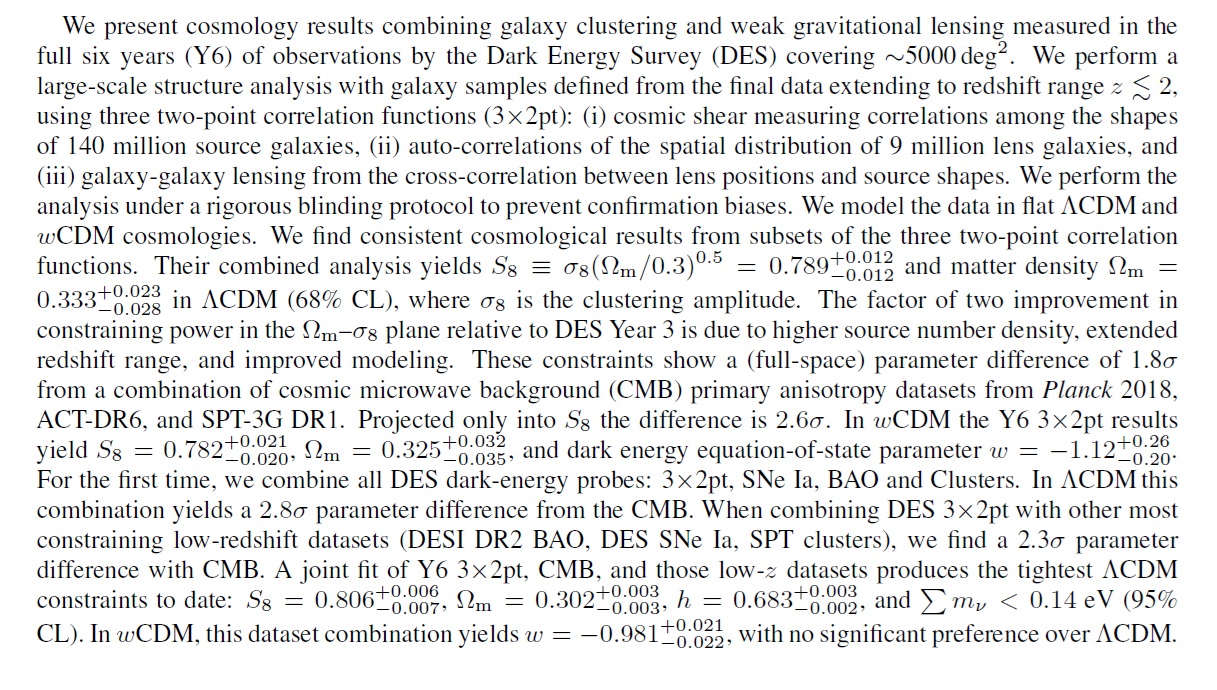
I’ll just highlight a couple of points from the first paper listed above, which uses the now standard “3x2pt” analysis, which combines three complementary two-point correlation functions: cosmic shear; galaxy-galaxy lensing and galaxy clustering. The abstract of this paper is as follows:
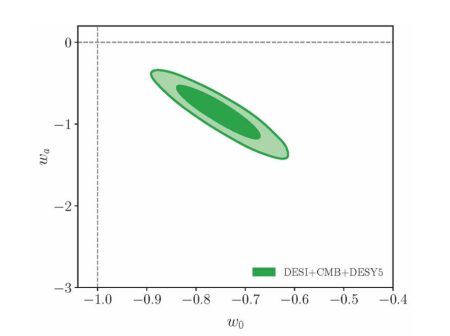
A notable result is contained in the last sentence. The simplest interpretation of dark energy is that it is a cosmological constant (usually called Λ) which – as explained here – corresponds to a perfect fluid with an equation-of-state p=wρc2 with w=-1. In this case the effective mass density ρ of the dark energy remains constant as the universe expands. To parametrise departures from this constant behaviour, cosmologists have replaced this form with the form w(a)=w0+wa(1-a) where a(t) is the cosmic scale factor. A cosmological constant Λ would correspond to a point (w0=-1, wa=0) in the plane defined by these parameters, but the only requirement for dark energy to result in cosmic acceleration is that w<-1/3, not that w=-1. Results last year from DESI suggested values of w0 ≠-1 and wa≠0 , but the current DES results are consistent with w=-1; they do not constrain w0 and wa jointly.
For reference on the left you can find the (w0, wa) plane from DESI.
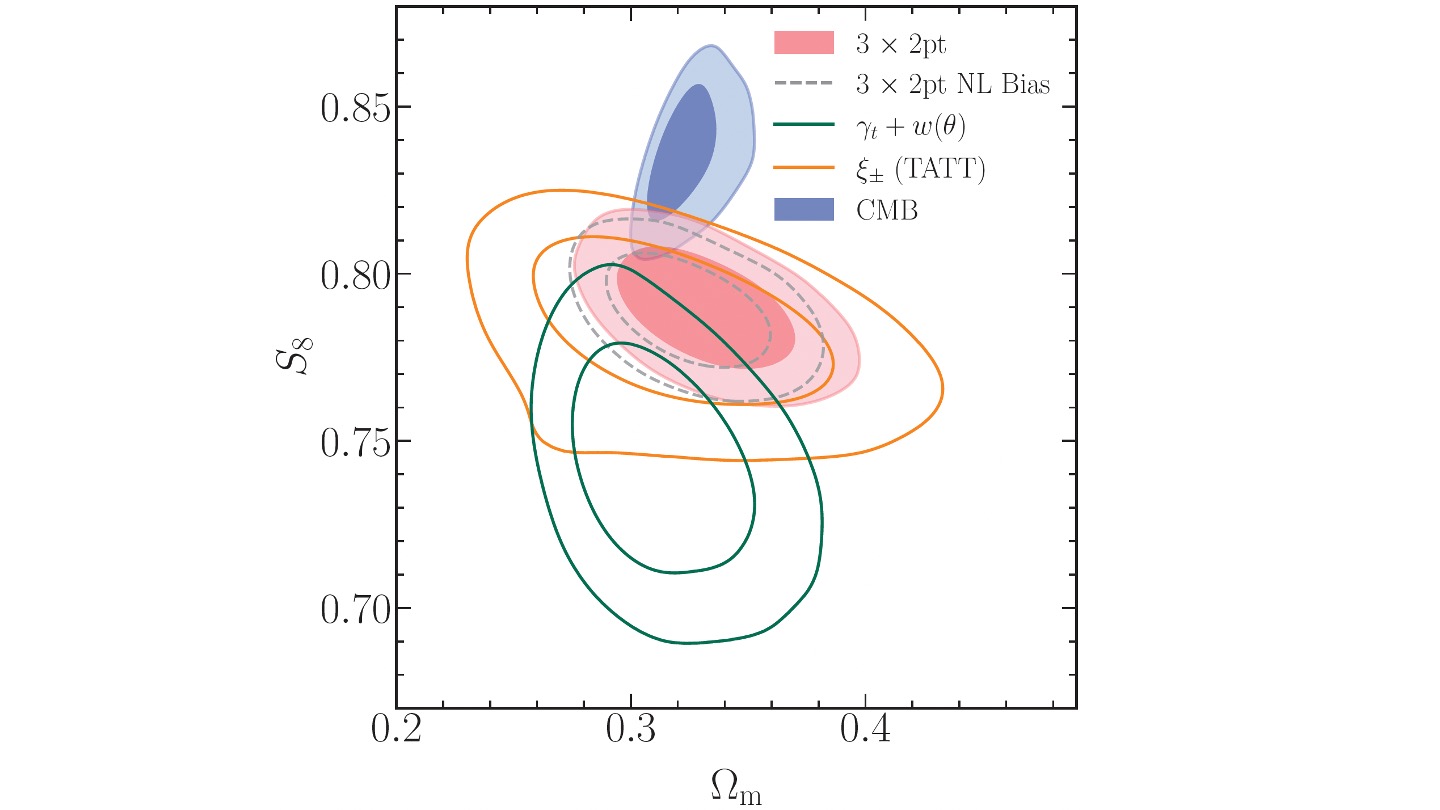
I thought I’d add one of the other cosmological contraint plots:
The results look qualitatively similar to previous plots but the contours have shifted a bit.
Meanwhile, back in the world of research, I see that Maynooth University has issued a news item about a new paper by colleagues in the Department of Physics, Daxal H. Mehta, John A. Regan and Lewis Prole. The story has also been picked up by the Irish media, e.g. here.
You may find the paper behind a paywall, as it is published in Nature Astronomy, in which case you will just have to make do with the abstract:
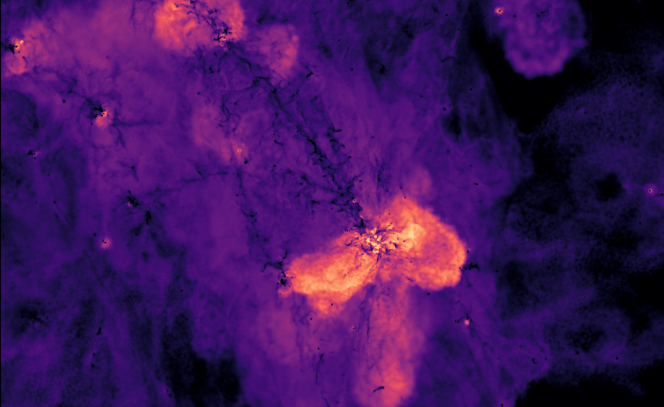
And here’s a pretty picture from one of the simulations used in the paper:
It’s Saturday once more so time for another update of activity at the Open Journal of Astrophysics. Since the last update we have published seven papers, bringing the number in Volume 9 (2026) to 11 and the total so far published by OJAp up to 459. This week has been quite busy; for only the second time in recorded history we published at least one paper each working day.
I will continue to include the announcements made on our Mastodon account (on Fediscience) to encourage you to visit it. Mastodon is a really excellent service, and a more than adequate replacement for X/Twitter which nobody should be using.
The first three papers this week were all published on Monday January 12th in the folder Astrophysics of Galaxies.
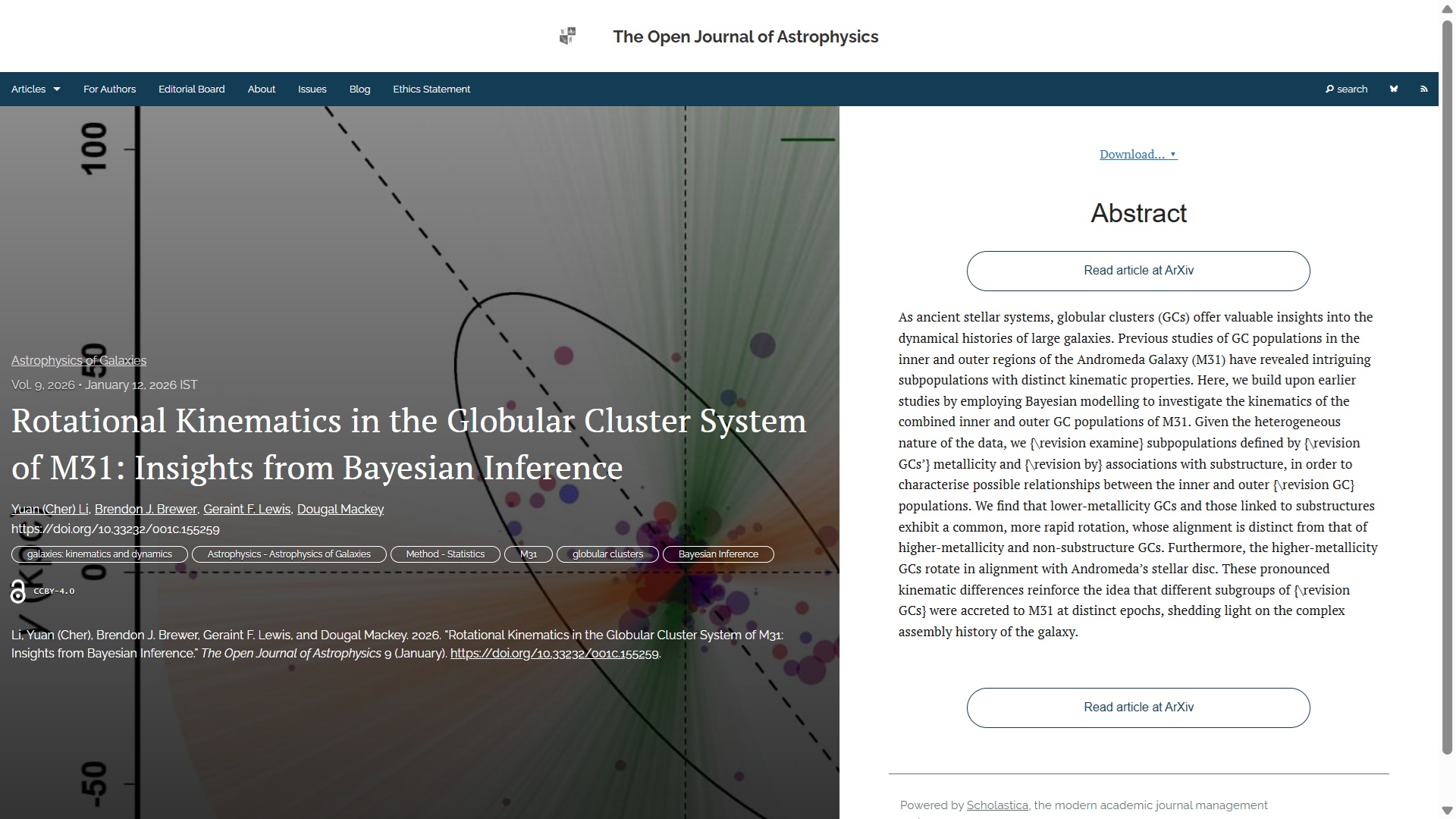
The first paper to report this week is “Rotational Kinematics in the Globular Cluster System of M31: Insights from Bayesian Inference” by Yuan (Cher) Li & Brendon J. Brewer (U. Auckland, New Zealand), Geraint F. Lewis (U. Sydney, Australia) and Dougal Mackey (independent researcher, Australia). This study uses Bayesian modelling to explore the kinematics of globular clusters in the Andromeda Galaxy, revealing distinct rotation patterns that suggest different subgroups were added at separate times.
The overlay is here:
You can find the officially accepted version on arXiv here and the announcement on Fediverse here:
New Publication at the Open Journal of Astrophysics: "Rotational Kinematics in the Globular Cluster System of M31: Insights from Bayesian Inference" by Yuan (Cher) Li & Brendon J. Brewer (U. Auckland, New Zealand), Geraint F. Lewis (U. Sydney, Australia) and Dougal Mackey
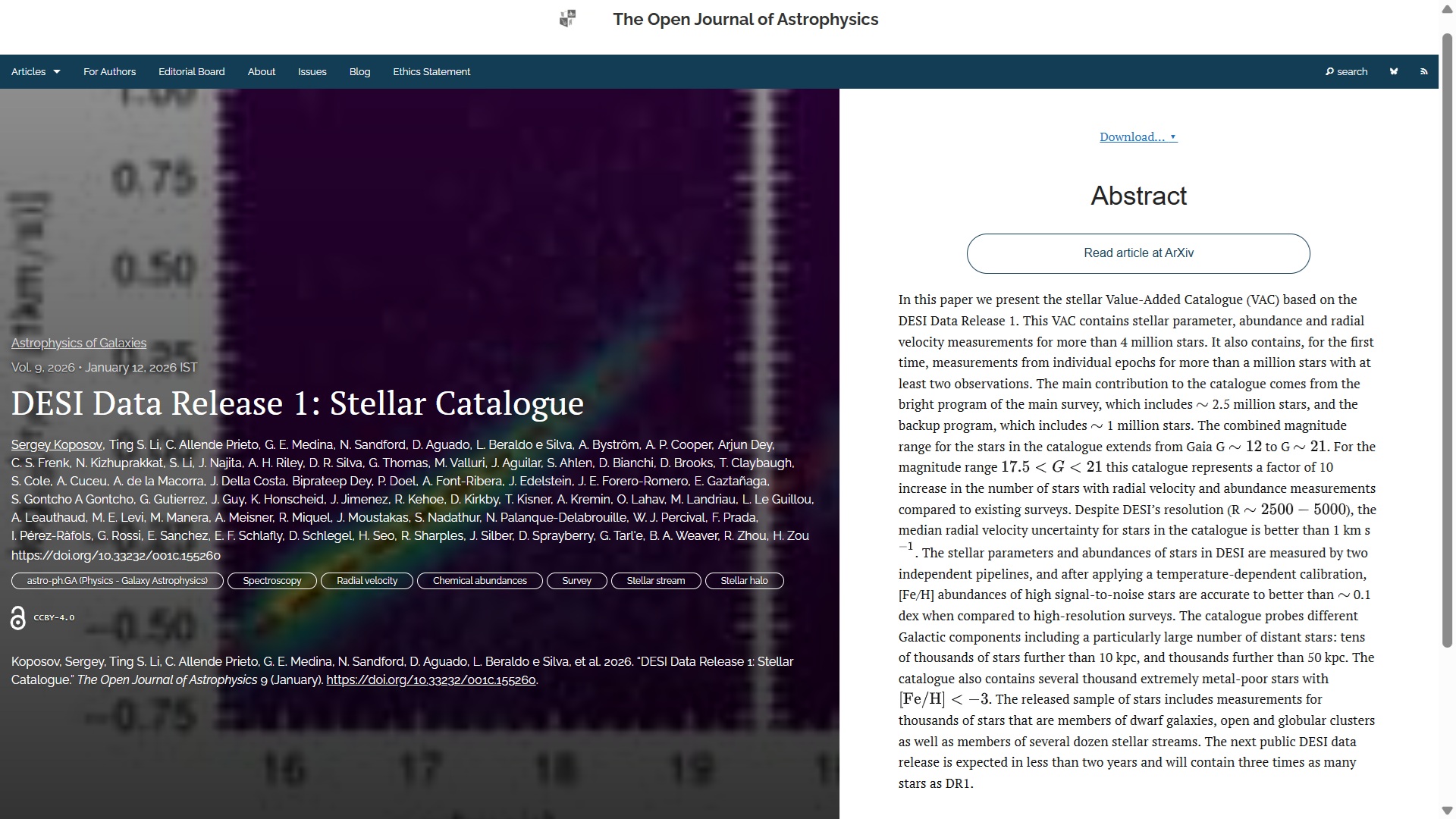
The second paper is “DESI Data Release 1: Stellar Catalogue” by Sergey Koposov (U. Edinburgh, UK) and an international cast of 67 other authors. This paper introduces and describes the stellar Value-Added Catalogue (VAC) based on DESI Data Release 1, providing measurements for over 4 million stars, including radial velocity, abundance, and stellar parameters.
The overlay for this one is here:
The official version of the paper can be found on arXiv here and the Fediverse announcement here:
New Publication at the Open Journal of Astrophysics: "DESI Data Release 1: Stellar Catalogue" by Sergey Koposov (U. Edinburgh, UK) and an international cast of 67 other authors.
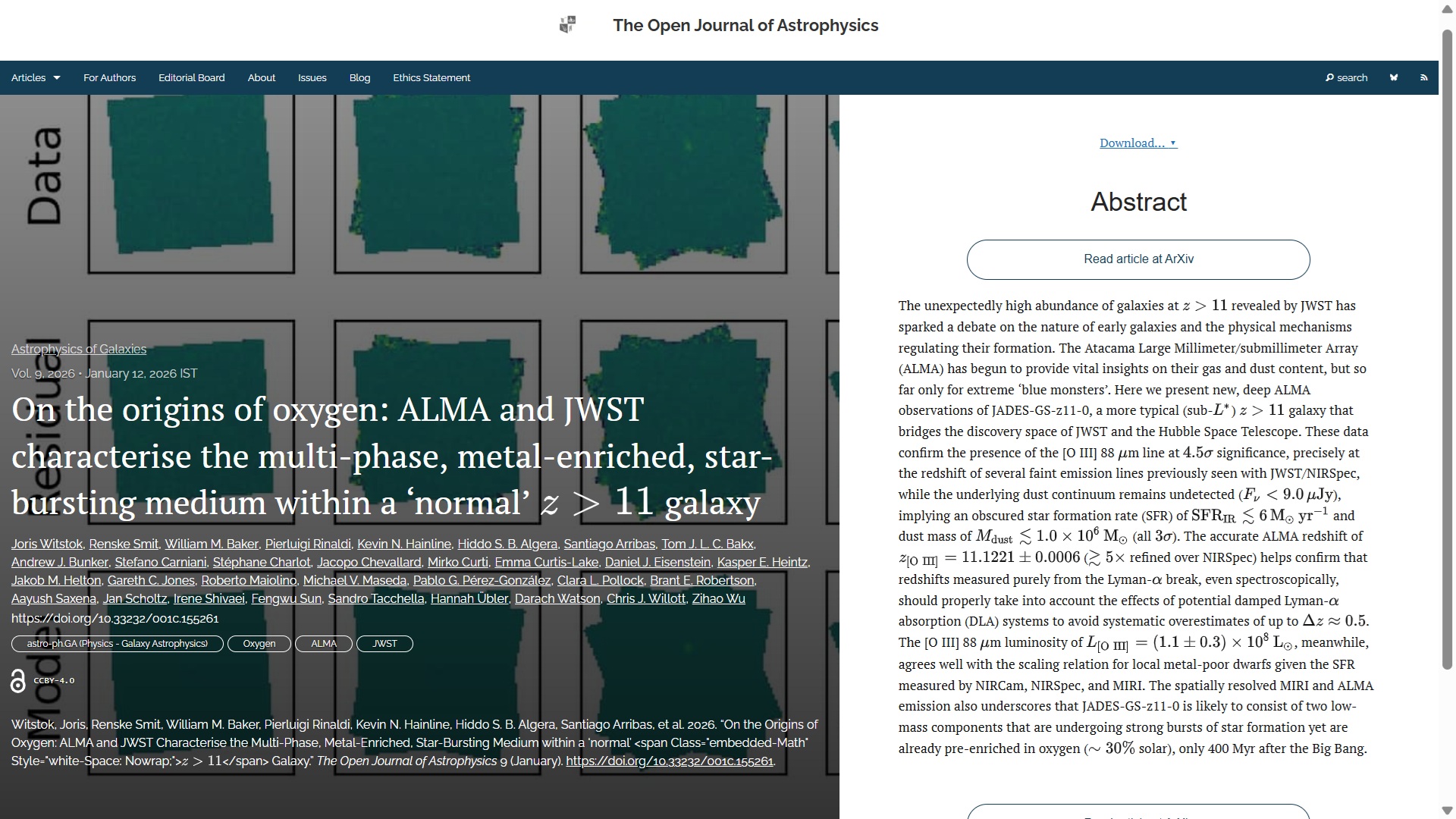
New Publication at the Open Journal of Astrophysics: "On the origins of oxygen: ALMA and JWST characterise the multi-phase, metal-enriched, star-bursting medium within a ‘normal’ z>11 galaxy" by Joris Witstok (Cosmic Dawn Centre, Copenhagen, Denmark) and 37 others dotted around the world
The fourth paper this week is also in the folder Astrophysics of Galaxies. but was published on Tuesday 13th January. It is entitled “Accelerated calibration of semi-analytic galaxy formation models” by Andrew Robertson and Andrew Benson (Carnegie Observatories, USA). This paper presents a faster calibration framework for galaxy formation models, using fewer simulations for each evaluation. However, the model shows discrepancies suggesting the model needs to be made more flexible.
The overlay is here:
You can find the officially accepted version on arXiv here and the Mastodon announcement here:
New Publication at the Open Journal of Astrophysics: "Accelerated calibration of semi-analytic galaxy formation models" by Andrew Robertson and Andrew Benson (Carnegie Observatories, USA)
Next one up, published on Wednesday 14th January in the folder Cosmology and Nongalactic Astrophysics, is “Constraints from CMB lensing tomography with projected bispectra” by Lea Harscouet & David Alonso (U. Oxford), UK), Andrina Nicola (U. Manchester, UK) and Anže Slosar (Brookhaven National Laboratory, USA). This study presents angular power spectra and bispectra of DESI luminous red galaxies, finding that the galaxy bispectrum can constrain the amplitude of matter fluctuations and the non-relativistic matter fraction. The overlay is here:
You can find the officially accepted paper on arXiv here and the Mastodon announcement here:
New Publication at the Open Journal of Astrophysics: "Constraints from CMB lensing tomography with projected bispectra" by Lea Harscouet & David Alonso (U. Oxford, UK), Andrina Nicola (U. Manchester, UK) and Anže Slosar (Brookhaven National Laboratory, USA)
The sixth paper this week is “Universal numerical convergence criteria for subhalo tidal evolution” by Barry T. Chiang & Frank C. van den Bosch (Yale U., USA) and Hsi-Yu Schive (National Taiwan University, Taiwan). This was published on Thursday 15th January in the folder Cosmology and Nongalactic Astrophysics; it presents an analysis of a simulation suite that addresses the ‘overmerging’ problem in cosmological simulations of dark matter subhalos, showing that up to 50% of halos in state-of-the art simulations are unresolved. The overlay is here:
The final accepted version of this paper can be found on arXiv here. The Mastodon announcement follows:
New Publication at the Open Journal of Astrophysics: "Universal numerical convergence criteria for subhalo tidal evolution" by Barry T. Chiang & Frank C. van den Bosch (Yale U., USA) and Hsi-Yu Schive (National Taiwan University, Taiwan)
Finally for this week we have “Detectability of dark matter subhalo impacts in Milky Way stellar streams” by Junyang Lu , Tongyan Lin & Mukul Sholapurkar (UCSD, USA) and Ana Bonaca (Carnegie Observatories, USA). This was published on Friday 16th January (i.e. yesterday) in the folder Astrophysics of Galaxies. The study develops a method to estimate the minimum detectable dark matter subhalo mass in stellar streams, ranking them by sensitivity and identifying promising lines for further research.
The overlay is here:
The officially accepted version can be found on arXiv here and the Fediverse announcement here:
New Publication at the Open Journal of Astrophysics: "Detectability of dark matter subhalo impacts in Milky Way stellar streams" by Junyang Lu , Tongyan Lin & Mukul Sholapurkar (UCSD, USA) and Ana Bonaca (Carnegie Observatories, USA)
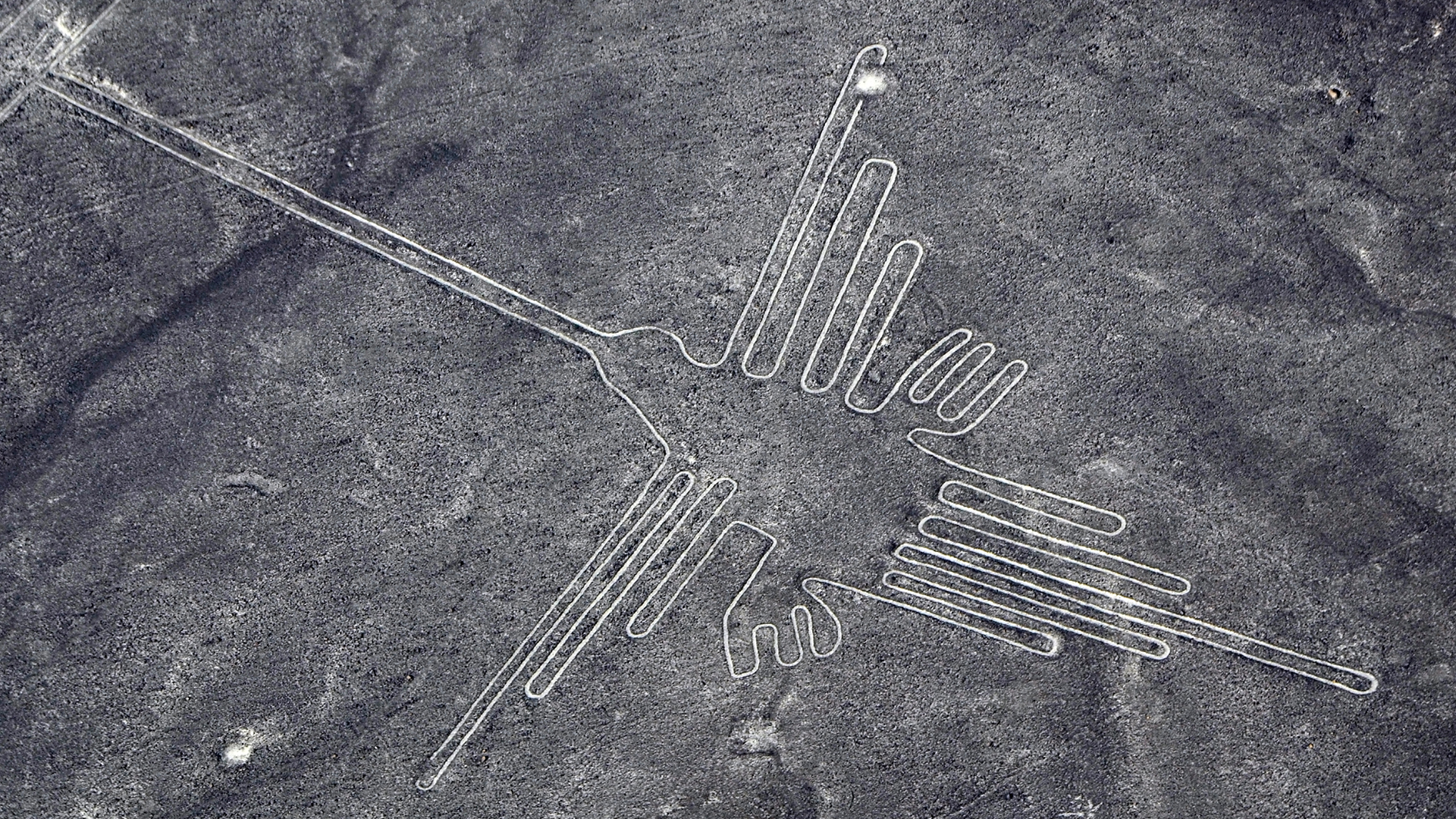
News of the death of the notorious charlatan Erich von Däniken reminded me that at one time, when I was about 11 years old, I borrowed his book Chariots of the Gods from the public library. Even at that age I thought it was a load of nonsense, but I have to admit that I was fascinated by the origin of the Nazca Lines in Southern Peru, most of which were created between 500 BC and 500 AD but were probably based on even older structures. An example, depicting a humming bird, is shown here:
Von Däniken claimed that these were landing strips for ancient spacecraft piloted by extraterrestrials, an explanation that can easily be refuted. The actual purpose of these structures is yet to be discerned. I thought it was likely that they had some astronomical significance, but if they do then it has yet to be elucidated. How they were made is less difficult to explain: almost certainly they were made by scaling up smaller drawings. This would have required some mathematical understanding, and perhaps the use of coordinates, but there’s no reason to suppose that the people who created them lacked such knowledge. What they mean is indeed an unsolved mystery.
The other unsolved mystery is why people fall for the sort of nonsense peddled by von Däniken. It seems to me that part of the answer is that modern humans have an almost irresistible tendency to assume that earlier human beings were much less intelligent than us. This is clearly not true. In fact human intelligence has evolved very little over the past few millennia. What has evolved is knowledge (passed on cumulatively through the generations) and the technology created using that knowledge. Erich von Däniken promoted the idea that only extraterrestrials could have created the Nazca lines; he and others have suggested that the pyramids of ancient Egypt were built by aliens too. It’s part of our desire to think of ourselves as being much smarter than our ancestors. You only have to look at the world today to realize that humans aren’t as clever as they think they are. In fact we’re just as dumb as humans have always been; we just have better gadgets (including, unfortunately, weapons).
Another book I got out of the public library at about the same time was Worlds in Collision by Immanuel Velikovsky. As far as I can remember, this book propounded a new theory of the solar system in which the planet Venus was ejected from Jupiter and then went rattling around encountering other planets and causing various catastrophes. This was supposed to have happened around 1500 BC which “explains” various historical events, including many described in the Bible. It is nonsense of course, but some people lapped it up, as some continue to believe that the Earth is flat.
I find it hard to understand why some people persist in denying scientific advances for which there is considerable empirical evidence and prefer instead to believe in nonsense peddled by the likes of Erich von Däniken. If anyone can solve that mystery they will be doing the human race a very big favour.
Welcome to the first proper update for 2026 from the Open Journal of Astrophysics. The New Year brings us to Volume 9. In many countries, especially in Europe, Christmas is celebrated on January 6th so this week was also affected by the holiday season. Nevertheless, since the last update we have published four papers, bringing the number in Volume 9 (2026) to 4 and the total so far published by OJAp up to 452.
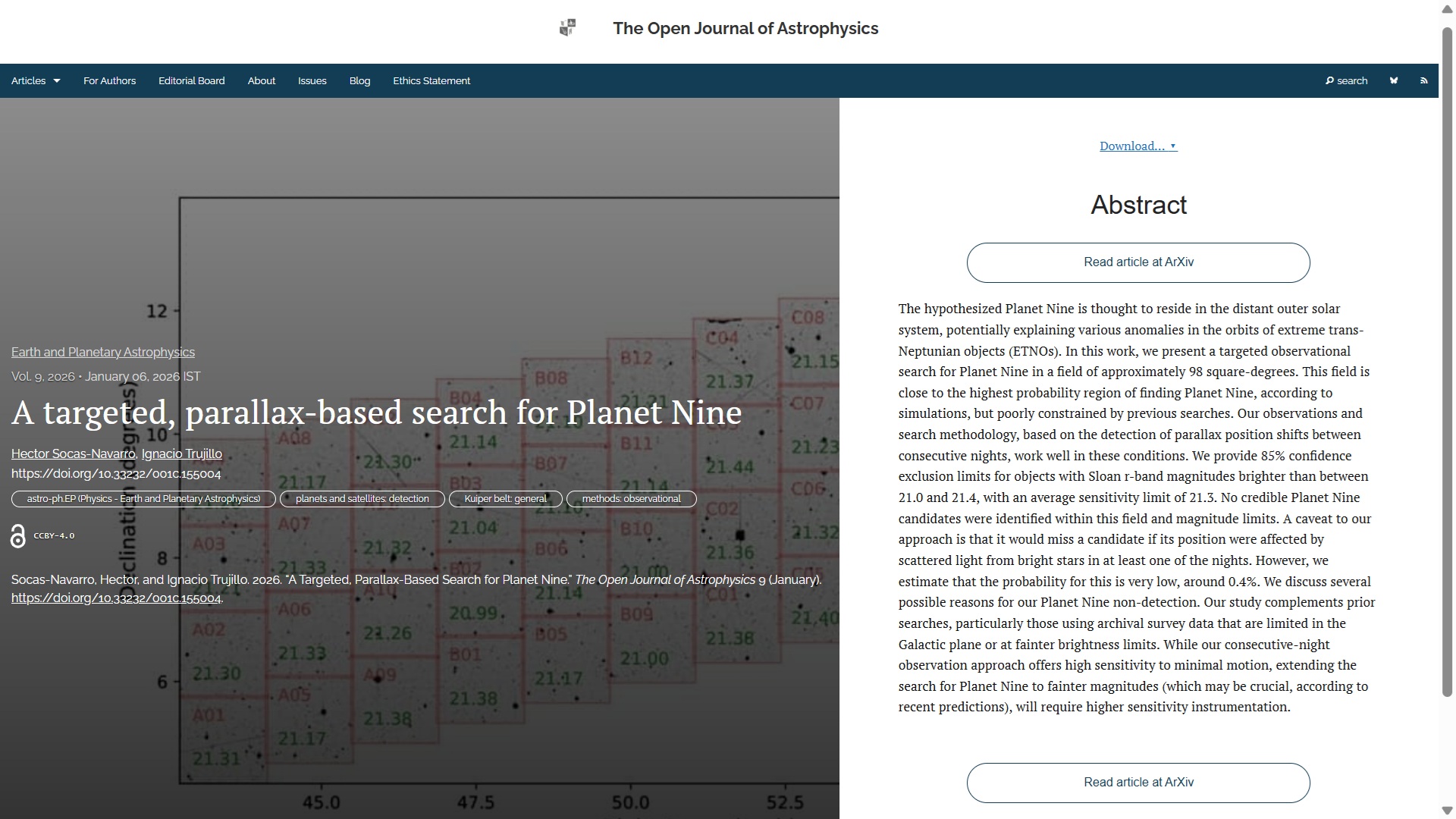
The first paper this week (and of course the first of 2026) is “A targeted, parallax-based search for Planet Nine” by Hector Socas-Navarro and Ignacio Trujillo (both of the Instituto de Astrofísica de Canaria, Spain). This article describes a targeted search for the hypothesized Planet Nine in the outer solar system, using parallax position shifts. No credible candidates were found within the observed field. It was published on Tuesday January 6th in the folder Earth and Planetary Astrophysics. The overlay is here:
You can find the officially accepted version on arXiv here and the announcement on Fediverse here:
New Publication at the Open Journal of Astrophysics: "A targeted, parallax-based search for Planet Nine" by Hector Socas-Navarro and Ignacio Trujillo (Instituto de Astrofísica de Canaria, Spain)
The second paper is “Going beyond S8: fast inference of the matter power spectrum from weak-lensing surveys” by Cyrille Doux (Université Grenoble Alpes, France) and Tanvi Karwal (U. Chicago, USA). This was published on Wednesday January 7th in the folder Cosmology and Nongalactic Astrophysics and it presents a new framework to extract the scale-dependent matter power spectrum from cosmic shear and CMB lensing measurements, revealing a consistent suppression in the matter power spectrum in galaxy-lensing. The overlay is here:
The official version of the paper can be found on arXiv here and the Fediverse announcement here:
New Publication at the Open Journal of Astrophysics: "Going beyond $S_{8}$: fast inference of the matter power spectrum from weak-lensing surveys" by Cyrille Doux (Université Grenoble Alpes, France) and Tanvi Karwal (U. Chicago, USA)
Next we have “Constraining the Stellar-to-Halo Mass Relation with Galaxy Clustering and Weak Lensing from DES Year 3 Data” which is led by G. Zacharegkas et al. (Argonne National Laboratory, USA) and has 102 other authors too numerous to list by name from many institutions around the world again too numerous to list by name. It presents a framework to analyze the relationship between a galaxy’s stellar mass and its dark matter halo mass, using data from the Dark Energy Survey. The findings align with previous results. This paper was published on Thursday January 8th in the folder Astrophysics of Galaxies. The overlay is here:
The official version can be found on arXiv here and the Fediverse announcement is here:
New Publication at the Open Journal of Astrophysics: "Constraining the Stellar-to-Halo Mass Relation with Galaxy Clustering and Weak Lensing from DES Year 3 Data" by G. Zacharegkas et al. (Argonne National Laboratory, USA) and 102 others based in numerous countries.
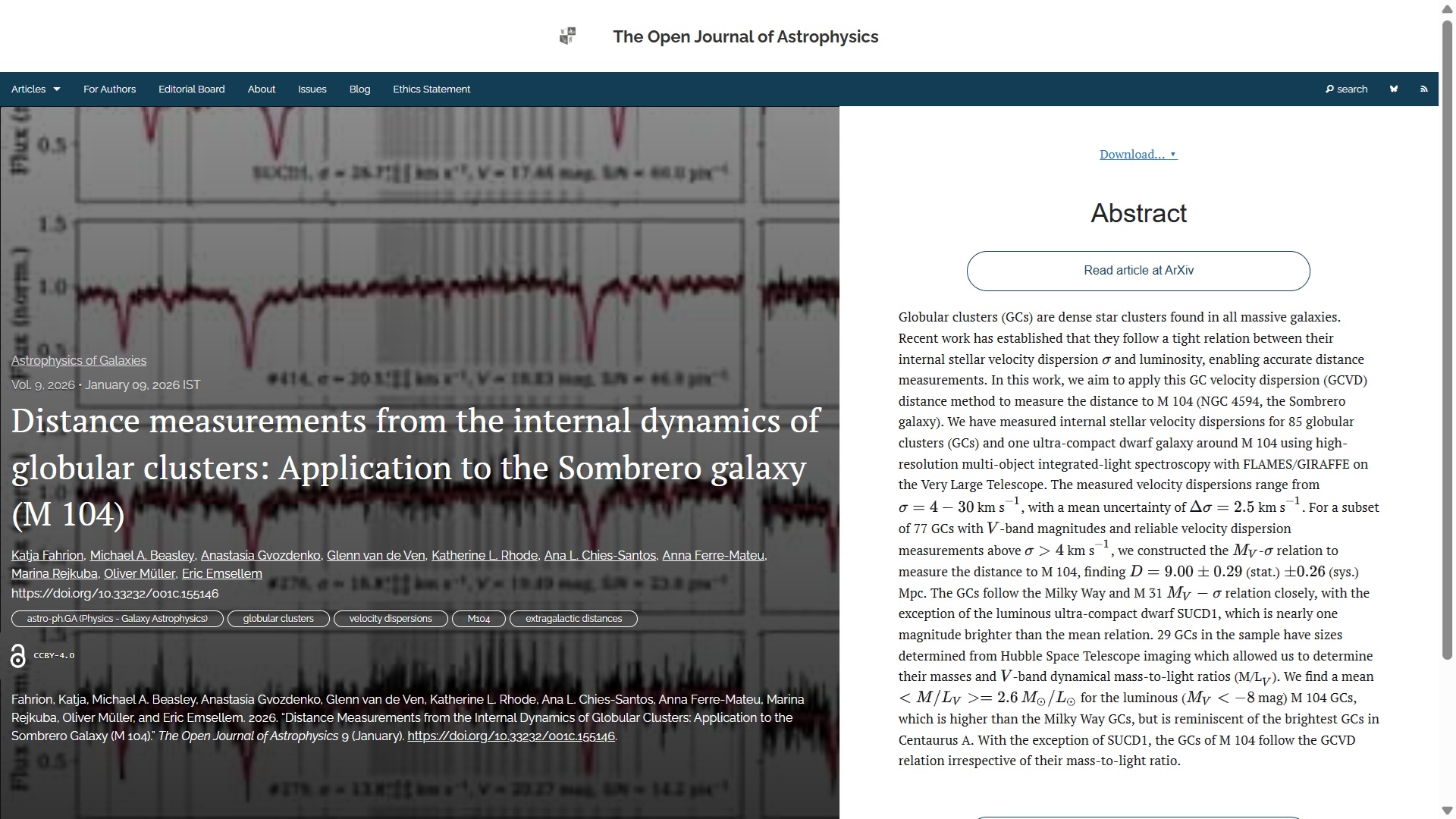
New Publication at the Open Journal of Astrophysics: "Distance measurements from the internal dynamics of globular clusters: Application to the Sombrero galaxy (M 104)" by Katja Fahrion (University of Vienna, Austria) and 9 others based in Spain, Australia, UK, USA, Brazil, Germany and Switzerland.
The views presented here are personal and not necessarily those of my employer (or anyone else for that matter).
Feel free to comment on any of the posts on this blog but comments may be moderated; anonymous comments and any considered by me to be vexatious and/or abusive and/or defamatory will not be accepted. I do not necessarily endorse, support, sanction, encourage, verify or agree with the opinions or statements of any information or other content in the comments on this site and do not in any way guarantee their accuracy or reliability.