Archive for the The Universe and Stuff Category

Marginalia

Posted in Cute Problems, Education, The Universe and Stuff with tags , , , , , on August 12, 2020 by telescoper

While this morning’s repeat exams were going on I was leafing through an old second-hand text book, one of many I have acquired over the years looking for nice problems and worked examples. The good thing about old books is that solutions to the problems are usually not available on the internet, unlike modern ones. The book concerned this morning is a classic: Statics by Horace Lamb, which you can still get via Cambridge University Press. I have the first edition, published in 1912.

Looking through I was somewhat alarmed to see what had been pencilled in some of the margins:

Of course anyone who has been to India knows that the swastika isn’t necessarily a Nazi symbol: you find it all over the place in the Indian sub-continent, where it is used as a symbol for good luck. I remember being given a very nice conference bag in Pune many years ago with a swastika on it. I didn’t use it back home, of course.

The first owner of the copy of Statics that I have was acquired in 1913 by a J.H.C (or G) Lindesay of Sidney Sussex College, Cambridge. I know because he/she inscribed their name in the front. That doesn’t look to me like an Indian name, but I think it’s a fair bet that the book passed through many hands before reaching me and that one of the past owners was Indian. I haven’t tried any of the problems marked with the swastika, but perhaps they are difficult – hence the `good luck’ symbol? I notice though that the symbol at the bottom of the page has a chirality different from the others. Is this significant, I wonder?

All of which irrelevance reminded me of an discussion I’ve had with a number of people about whether they like to scribble in the margins of their books, or whether they believe this practice to be a form of sacrilege.

I’ll put my cards on the table  straightaway. I like to annotate my books – especially the technical ones – and some of them have extensive commentaries written in them. I also like to mark up poems that I read; that helps me greatly to understand the structure. I don’t have a problem with scribbling in margins because I think that’s what margins are for. Why else would they be there?

This is a famous example – a page from Newton’s Principia, annotated by Leibniz:

dsc00469

Some of my friends and fellow academics, however, regard such actions as scandalous and seem to think books should be venerated in their pristine state.  Others probably find little use for printed books given the plethora of digitial resources now available online or via Kindles etc so this is not an issue..

I’m interested to see what the divergence of opinions is in with regard to the practice of writing in books, so here’s a poll for you to express your opinion:

Watch “The Eddington Eclipse Experiment of 1919” on YouTube

Posted in History, The Universe and Stuff, YouTube with tags , , , on August 6, 2020 by telescoper

I’d forgotten about this little video made after I appeared on the Pat Kenny show on NewsTalk radio last year. It was just me and the camera in a little room, but it turned out less like a hostage video than I’d feared..

New KiDS on the Blog!

Posted in The Universe and Stuff with tags , , , , , , , , , , on August 5, 2020 by telescoper

The above image is from the Kilo Degree Survey, performed using the OmegaCAM instrument on the European Southern Observatory’s VST Survey Telescope at Cerro Paranal in Northern Chile. I got it by googling `Pictures of KiDS’, which was probably unwise.

Here’s another picture, of part of the survey region.

A few people have asked me why I didn’t post about the new results from KiDs which came out last week. The answer is simply that I’ve been a bit busy, but here we go now with a post on the blog about the new KiDs papers. These appear as a bunch of five on the arXiv:

KiDS-1000 Methodology: Modelling and inference for joint weak gravitational lensing and spectroscopic galaxy clustering analysis

KiDS-1000 catalogue: weak gravitational lensing shear measurements

KiDS-1000 catalogue: Redshift distributions and their calibration

KiDS-1000 Cosmology: Cosmic shear constraints and comparison between two point statistics

KiDS-1000 Cosmology: Multi-probe weak gravitational lensing and spectroscopic galaxy clustering constraints

The result that stands out from the latest release is the suggestion that the Universe is about 8% less clumpy than the standard cosmological model suggests. The level of clumpiness is quantified by the parameter S8 which, according to Planck, has a value 0.832 ± 0.013 whereas KiDS gives 0.776 (+0.020/-0.014), a discrepancy of about 3σ. It’s not only the Hubble constant that is causing a bit of tension in cosmological circles!


New Publication at the Open Journal of Astrophysics!

Posted in OJAp Papers, Open Access, The Universe and Stuff with tags , , , , on August 4, 2020 by telescoper

Another new paper has been published in the Open Journal of Astrophysics! This one was actually published last Friday but it being the Bank Holiday weekend I just got round to blogging about it today. This is another one for the Cosmology and NonGalactic Astrophysics section. It’s called Cosmic event horizons and the light-speed limit for relative radial motion and is a sort of pedagogical review of the subject aimed at dispelling some common misconceptions about radial velocities and horizons. The author is Markus Pössel of the Max Planck Institute for Astronomy at Heidelberg.

Here is a screen grab of the overlay:

I’ve taken the liberty of adding the background teaser image in full here, as it is rather groovy:

You can click on the image to make it larger.

You can find the arXiv version of the paper here.

Two Hundred Years of Tyndall

Posted in Beards, History, The Universe and Stuff with tags , , on August 2, 2020 by telescoper

Just a short post to mark the fact that celebrated Irish physicist John Tyndall was born 200 years ago today, on 2nd August 1820.

Tyndall made his name initially for his research on diamagnetism but then worked on the scattering of light by atmospheric particles, and on the absorption of infrared radiation by gases. In the latter context he is generally credited with having discovered the Greenhouse Effect.

One should also mention his rather splendid beard.

John Tyndall was born at Leighlin Bridge, near Carlow in Ireland. After a little formal schooling, he gained a practical education by working as a surveyor and engineer. He entered the University of Marburg, Germany, in 1848 and earned his doctorate two years later. His dissertation research interested Michael Faraday, who later brought him to the Royal Institution of London. In 1867 Tyndall succeeded Faraday as superintendent there. He retired in 1887 and died in 1893.

The excellent Tyndall National Institute in Cork is named in his honour.

More Lockdown Perspectives on the Hubble Tension and thoughts on the future of scientific publications

Posted in Open Access, The Universe and Stuff with tags , , , , on July 28, 2020 by telescoper

This is interesting. Remember last week when I posted about a paper by George Efstathiou on the Hubble Constant controversy. This is the abstract.

Well, a new version of the paper has just appeared on the arXiv that includes some comments in response from the SH0ES team.

It is of course interesting in itself to see the cut and thrust of scientific debate on a live topic such as this, but in my mind at least it raises interesting questions about the nature of scientific publication. To repeat something I wrote a a while ago, it seems  to me that the scientific paper published in an academic journal is an anachronism. Digital technology enables us to communicate ideas far more rapidly than in the past and allows much greater levels of interaction between researchers. I agree with Daniel Shanahan that the future for many fields will be defined not in terms of “papers” which purport to represent “final” research outcomes, but by living documents continuously updated in response to open scrutiny by the research community.

The Open Journal of Astrophysics is innovative in some ways but remains wedded to the paper as its fundamental object, and the platform is not able to facilitate interaction with readers. Of course one of the worries is that the comment facilities on many websites tend to get clogged up with mindless abuse, but I think that is manageable. I have some ideas on this, but for the time being I’m afraid all my energies are taken up with other things so this is for the future.

I’ve long argued that the modern academic publishing industry is not facilitating but hindering the communication of research. The arXiv has already made academic journals virtually redundant in many of branches of  physics and astronomy; other disciplines will inevitably follow. The age of the academic journal is drawing to a close, and it is consequently time to rethink the concept of a paper.

A Lockdown Perspective on the Hubble Tension (plus Poll)

Posted in The Universe and Stuff with tags , , on July 22, 2020 by telescoper

These are busy days in cosmological circles, especially regarding the Hubble Constant controversy. The latest contribution to appear on the arXiv is by George Efstathiou of Cambridge. Here is the abstract:

I don’t know if George has voted in my ongoing poll relating to this issue, but I bet that if he did he would vote low – along with the majority (so far):

Incidentally, I have seen no evidence of Russian interference in the voting.

Cosmology Talks: Eva-Maria Mueller on the last (e)BOSS Data Release

Posted in The Universe and Stuff, YouTube with tags , , , , on July 20, 2020 by telescoper

Today is another big day for cosmology as the last and final – why do people say that? – data release from the Extended Baryon Oscillation Spectroscopic Survey (eBOSS) is now available. That is the culmination of 20 years of effort with the Sloan Digital Sky Survey. Here is a pretty picture showing the enormous scales probed by the survey:

There is an overview paper on the cosmological implications of the survey on the arXiv here. Fortunately, the latest Cosmology Talk on the YouTube channel of Shaun Hotchkiss features a very interesting presentation by Eva-Maria Mueller who is the first author of that paper:


Poll – The Hubble Constant: High or Low?

Posted in The Universe and Stuff with tags , on July 17, 2020 by telescoper

Given yesterday’s news from the Atacama Cosmology Telescope, among other things suggesting a low value of the Hubble constant of around 67.6 km s-1 Mpc-1, it might be fun to run another totally unscientific poll about which of the two Hubble constant camps has the most support in the community. The two camps are:

  • A `high’ value H0 ~ 73.5 ± 1.5 km s-1 Mpc-1 (as favoured by most stellar distance indicators, i.e. `local’ measurements).
  • A `low’ value H0 ~ 67.5 ± 0.5 km s-1 Mpc-1 (as favoured by most `cosmological’ estimates, e.g. cosmic microwave background fluctuations).

Of course you might also believe that both are wrong and the `true’ result lies outside both error regions but I’d like to focus on these two possibilities, so the question is posed assuming that one of them is right, which one is that most likely to be. In your opinion. Humble or otherwise.


New Results from the Atacama Cosmology Telescope!

Posted in The Universe and Stuff with tags , , , , on July 16, 2020 by telescoper

There’s some excitement in cosmological circles with the announcement of new results from the Atacama Cosmology Telescope, which is situated in the Atacama Desert in Chile. The two papers describing the new results can be found on the arXiv here and here and the data set will be made available here (it is Data Release 4; or DR4 for short).

If you want a laugh, the structure in the above map is on arc-minute scales – exactly the sort of thing I was trying to simulate way back in the 1980s. Here’s an ancient monochrome plot! The contours show 1σ, 2σ and 3σ fluctuations above the mean rather than the full distribution shown in the map above.

The full results will be discussed at a Zoom presentation at 11am Eastern Time (4pm Irish Time). I suspect it will be very busy so you will have to register in advance.

UPDATE: The Webinar is over but was recorded. I will post a link to the video when it is available. You can then guess which question was mine!

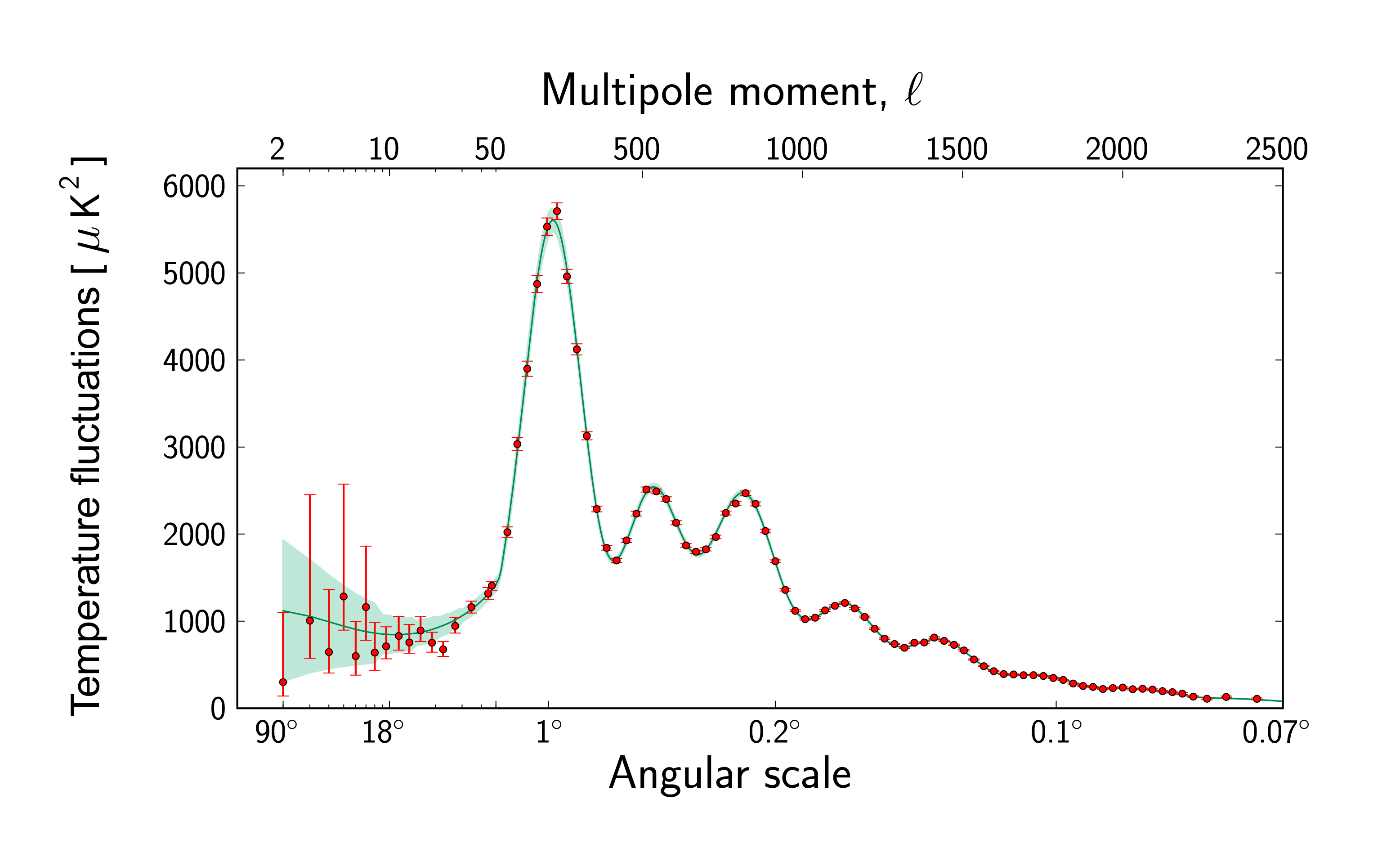
The new results from ACTPol are consistent with those from Planck, even down to the colour scheme used for the map, but the line taken by most media presentations I’ve seen (e.g. here and here) has been the issue of the Hubble Constant. The value of around 67.6 km s-1 Mpc-1 obtained by the Atacama Cosmology Telescope, though consistent with Planck measurements, is lower than most distance-scale measurements of H0. The dichotomy between `low’ estimates from cosmological observations and `high’ values persists.

This gives me an excuse to include my poll again:

There have been nearly a thousand responses so far, with opinion very divided.

The burning question however is when will face masks featuring the above map be made available for purchase? It could be a nice little earner…