Archive for the The Universe and Stuff Category

Hubble Tension: an “Alternative” View?

Posted in Bad Statistics, The Universe and Stuff with tags , , , , , on July 25, 2019 by telescoper

There was a new paper last week on the arXiv by Sunny Vagnozzi about the Hubble constant controversy (see this blog passim). I was going to refrain from commenting but I see that one of the bloggers I follow has posted about it so I guess a brief item would not be out of order.

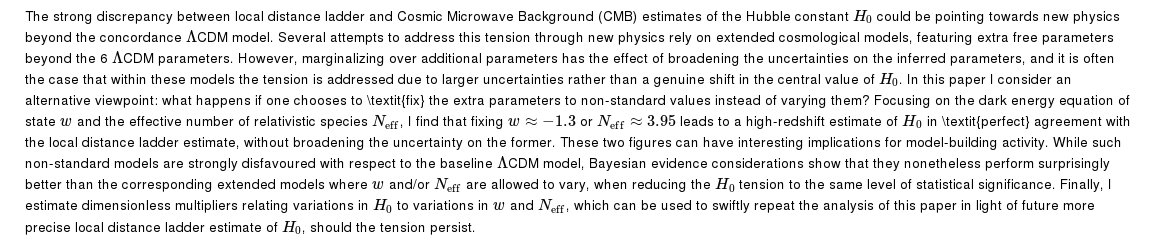
Here is the abstract of the Vagnozzi paper:

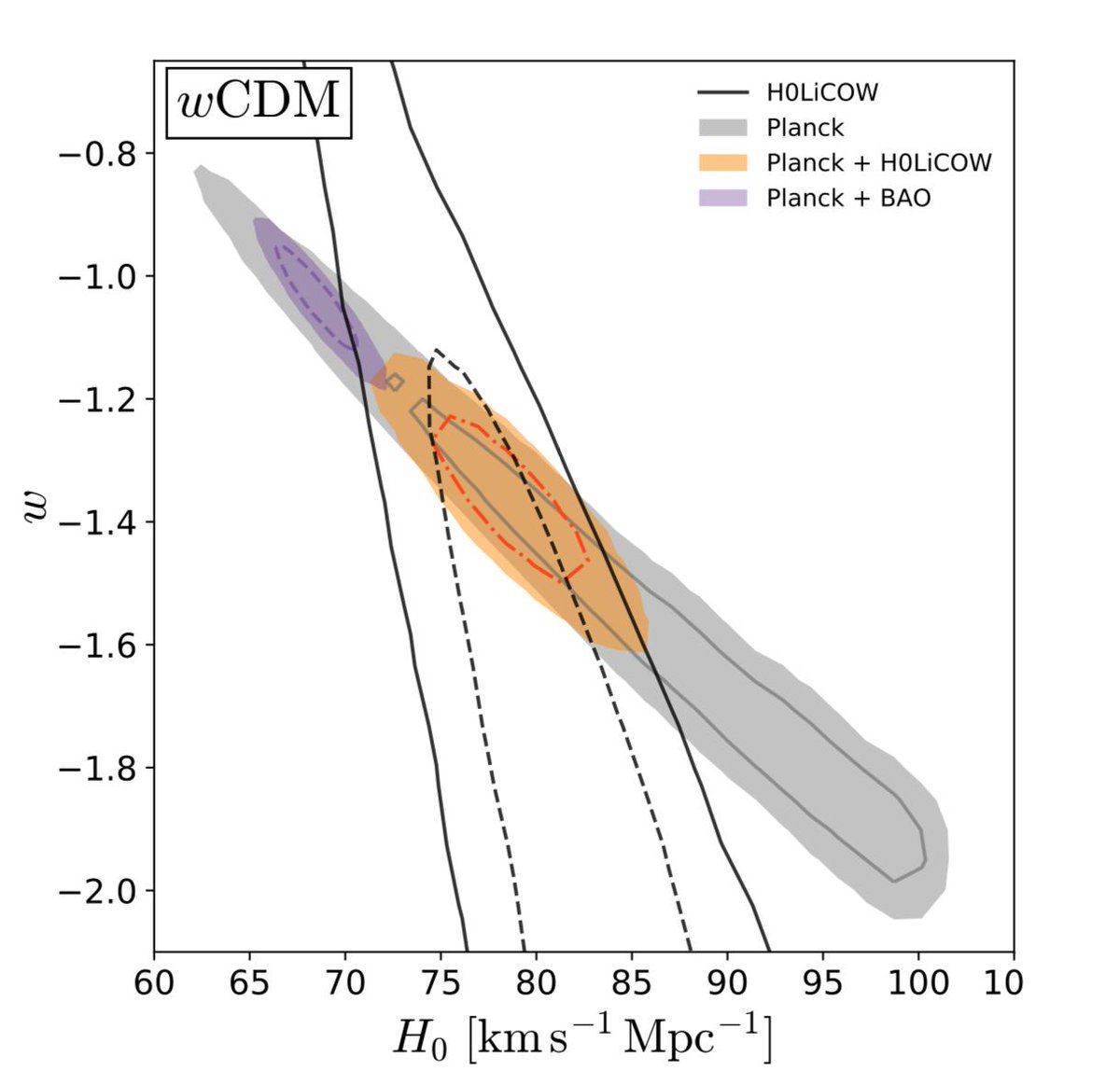
I posted this picture last week which is relevant to the discussion:

The point is that if you allow the equation of state parameter w to vary from the value of w=-1 that it has in the standard cosmology then you get a better fit. However, it is one of the features of Bayesian inference that if you introduce a new free parameter then you have to assign a prior probability over the space of values that parameter could hold. That prior penalty is carried through to the posterior probability. Unless the new model fits observational data significantly better than the old one, this prior penalty will lead to the new model being disfavoured. This is the Bayesian statement of Ockham’s Razor.

The Vagnozzi paper represents a statement of this in the context of the Hubble tension. If a new floating parameter w is introduced the data prefer a value less than -1 (as demonstrated in the figure) but on posterior probability grounds the resulting model is less probable than the standard cosmology for the reason stated above. Vagnozzi then argues that if a new fixed value of, say, w = -1.3 is introduced then the resulting model is not penalized by having to spread the prior probability out over a range of values but puts all its prior eggs in one basket labelled w = -1.3.

This is of course true. The problem is that the value of w = -1.3 does not derive from any ab initio principle of physics but by a posteriori of the inference described above. It’s no surprise that you can get a better answer if you know what outcome you want. I find that I am very good at forecasting the football results if I make my predictions after watching Final Score

Indeed, many cosmologists think any value of w < -1 should be ruled out ab initio because they don’t make physical sense anyway.


Also Sprach Zarathrustra: Einleitung, oder Sonnenaufgang

Posted in History, Music, The Universe and Stuff with tags , , on July 21, 2019 by telescoper

Here is a short video of the historic first manned landing on the Moon. I don’t know about you but I find the ghostly images are extremely affecting.

If there’s one piece of music indelibly associated with the Apollo missions, it’s the piece accompanying that clip: the introduction (or `Dawn’) from the orchestral tone poem Also Sprach Zarathrustra by Richard Strauss. Amazingly it was only a couple of years ago that I heard this piece performed live for the first time. I vividly remember how  the percussionists were clearly enjoying themselves during that performance. Not many orchestral pieces start with the percussion section front and centre. Whenever I’ve heard the piece since then I can’t help thinking how much I’d love to have a bash at the timpani part!

Anyway, here’s a clip from the Proms a few years ago to give you some idea of the tremendous impact this piece can have when you hear it in a concert hall.


Memories of the First Moon Landing

Posted in Biographical, Television, The Universe and Stuff with tags , , on July 20, 2019 by telescoper

Today is the 50th anniversary of the first moon landing, and I’m feeling very nostalgic as I recall my childhood memories of that historic event:

As a matter of fact I was six years old at the time which is easily old enough to have been aware of what was going on, but I don’t remember seeing anything to do with Apollo 11 and the Moon landings on 20th July 1969. I do recall bits and pieces of later Apollo missions but, unlike many colleagues of roughly my age who went into astronomy astrophysics or space science, I can’t really say that it was these events that inspired me to become a scientist. What did was something quite different!

But just because I wasn’t very aware of the significance of Apollo 11 at the time, doesn’t mean that I don’t think it was a spectacular achievement that is well worth commemorating fifty years on. Happy memories to all those who remember it, and enjoy the celebrations!

P. S. Interesting actuarial factoid: of all the people who were alive on 20th July 1969, only about 20% have not died yet.

Thoughts on Cosmological Distances

Posted in The Universe and Stuff with tags , , , , , on July 18, 2019 by telescoper

At the risk of giving the impression that I’m obsessed with the issue of the Hubble constant, I thought I’d do a quick post about something vaguely related to that which I happened to be thinking about the other night.

It has been remarked that the two allegedly discrepant sets of measures of the cosmological distance scale seen, for example, in the diagram below differ in that the low values are global measures (based on observations at high redshift) while the high values of are local (based on direct determinations using local sources, specifically stars of various types).

The above Figure is taken from the paper I blogged about a few days ago here.

That is basically true. There is, however, another difference in the two types of determination: the high values of the Hubble constant are generally related to interpretations of the measured brightness of observed sources (i.e. they are luminosity distances) while the lower values are generally based on trigonometry (specifically they are angular diameter distances). Observations of the cosmic microwave background temperature pattern, baryon acoustic oscillations in the matter power-spectum, and gravitational lensing studies all involve angular-diameter distances rather than luminosity distances.

Before going on let me point out that the global (cosmological) determinations of the Hubble constant are indirect in that they involve the simultaneous determination of a set of parameters based on a detailed model. The Hubble constant is not one of the basic parameters inferred from cosmological observations, it is derived from the others. One does not therefore derive the global estimates in the same way as the local ones, so I’m simplifying things a lot in the following discussion which I am not therefore claiming to be a resolution of the alleged discrepancy. I’m just thinking out loud, so to speak.

With that caveat in mind, and setting aside the possibility (or indeed probability) of observational systematics in some or all of the measurements, let us suppose that we did find that there was a real discrepancy between distances inferred using angular diameters and distances using luminosities in the framework of the standard cosmological model. What could we infer?

Well, if the Universe is described by a space-time with the Robertson-Walker Metric (which is the case if the Cosmological Principle applies in the framework of General Relativity) then angular diameter distances and luminosity distances differ only by a factor of (1+z)2 where z is the redshift: DL=DA(1+z)2.

I’ve included here some slides from undergraduate course notes to add more detail to this if you’re interested:

The result DL=DA(1+z)2 is an example of Etherington’s Reciprocity Theorem. If we did find that somehow this theorem were violated, how could we modify our cosmological theory to explain it?

Well, one thing we couldn’t do is change the evolutionary history of the scale factor a(t) within a Friedman model. The redshift just depends on the scale factor when light is emitted and the scale factor when it is received, not how it evolves in between. And because the evolution of the scale factor is determined by the Friedman equation that relates it to the energy contents of the Universe, changing the latter won’t help either no matter how exotic the stuff you introduce (as long as it only interacts with light rays via gravity).

In the light of the caveat I introduced above, I should say that changing the energy contents of the Universe might well shift the allowed parameter region which may reconcile the cosmological determination of the Hubble constant from cosmology with local values. I am just talking about a hypothetical simpler case.

In order to violate the reciprocity theorem one would have to tinker with something else. An obvious possibility is to abandon the Robertson-Walker metric. We know that the Universe is not exactly homogeneous and isotropic, so one could appeal to the gravitational lensing effect of lumpiness as the origin of the discrepancy. This must happen to some extent, but understanding it fully is very hard because we have far from perfect understanding of globally inhomogeneous cosmological models.

Etherington’s theorem requires light rays to be described by null geodesics which would not be the case if photons had mass, so introducing massive photons that’s another way out. It also requires photon numbers to be conserved, so some mysterious way of making photons disappear might do the trick, so adding some exotic field that interacts with light in a peculiar way is another possibility.

Anyway, my main point here is that if one could pin down the Hubble constant tension as a discrepancy between angular-diameter and luminosity based distances then the most obvious place to look for a resolution is in departures of the metric from the Robertson-Walker form.

Addendum: just to clarify one point, the reciprocity theorem applies to any GR-based metric theory, i.e. just about anything without torsion in the metric, so it applies to inhomogeneous cosmologies based on GR too. However, in such theories there is no way of defining a global scale factor a(t) so the reciprocity relation applies only locally, in a different form for each source and observer.

The Hubble Constant from the Tip of the Red Giant Branch

Posted in The Universe and Stuff with tags , , , , on July 16, 2019 by telescoper

At the risk of boring everyone again with Hubble constant news there’s yet another paper on the arXiv about the Hubble constant. This one is another `local’ measurement, in that it uses properties of nearby stars,  time based on a new calibration of the Red Giant Branch. This one is by Wendy Freedman et al. and its abstract reads:

We present a new and independent determination of the local value of the Hubble constant based on a calibration of the Tip of the Red Giant Branch (TRGB) applied to Type Ia supernovae (SNeIa). We find a value of Ho = 69.8 +/- 0.8 (+/-1.1\% stat) +/- 1.7 (+/-2.4\% sys) km/sec/Mpc. The TRGB method is both precise and accurate, and is parallel to, but independent of the Cepheid distance scale. Our value sits midway in the range defined by the current Hubble tension. It agrees at the 1.2-sigma level with that of the Planck 2018 estimate, and at the 1.7-sigma level with the SHoES measurement of Ho based on the Cepheid distance scale. The TRGB distances have been measured using deep Hubble Space Telescope (HST) Advanced Camera for Surveys (ACS) imaging of galaxy halos. The zero point of the TRGB calibration is set with a distance modulus to the Large Magellanic Cloud of 18.477 +/- 0.004 (stat) +/-0.020 (sys) mag, based on measurement of 20 late-type detached eclipsing binary (DEB) stars, combined with an HST parallax calibration of a 3.6 micron Cepheid Leavitt law based on Spitzer observations. We anchor the TRGB distances to galaxies that extend our measurement into the Hubble flow using the recently completed Carnegie Supernova Project I sample containing about 100 well-observed SNeIa. There are several advantages of halo TRGB distance measurements relative to Cepheid variables: these include low halo reddening, minimal effects of crowding or blending of the photometry, only a shallow (calibrated) sensitivity to metallicity in the I-band, and no need for multiple epochs of observations or concerns of different slopes with period. In addition, the host masses of our TRGB host-galaxy sample are higher on average than the Cepheid sample, better matching the range of host-galaxy masses in the CSP distant sample, and reducing potential systematic effects in the SNeIa measurements.

You can download a PDF of the paper here.

Note that the value obtained ising the TRGB here lies in between the two determinations using the cosmic microwave background and the Cepheid distance scale I discussed, for example, here. This is illustrated nicely by the following couple of Figures:

I know that this result – around 70 km s-1 Mpc-1 – has made some people a bit more relaxed about the apparent tension between the previous measurements, but what do you think? Here’s a poll so you can express your opinion.

My own opinion is that if there isn’t any tension at all at the one-sigma level then you should consider the possibility that you got sigma wrong!

Hubble’s Constant – A Postscript on w

Posted in The Universe and Stuff with tags , , , , , , , on July 15, 2019 by telescoper

Last week I posted about new paper on the arXiv (by Wong et al.) that adds further evidence to the argument about whether or not the standard cosmological model is consistent with different determinations of the Hubble Constant. You can download a PDF of the full paper here.

Reading the paper through over the weekend I was struck by Figure 6:

This shows the constraints on H0 and the parameter w which is used to describe the dark energy component. Bear in mind that these estimates of cosmological parameters actually involve the simultaneous estimation of several parameters, six in the case of the standard ΛCDM model. Incidentally, H0 is not one of the six basic parameters of the standard model – it is derived from the others – and some important cosmological observations are relatively insensitive to its value.

The parameter w is the equation of state parameter for the dark energy component so that the pressure p is related to the energy density ρc2 via p=wρc2. The fixed value w=-1 applies if the dark energy is of the form of a cosmological constant (or vacuum energy). I explained why here. Non-relativistic matter (dominated by rest-mass energy) has w=0 while ultra-relativistic matter has w=1/3.

Applying the cosmological version of the thermodynamic relation for adiabatic expansion  “dE=-pdV” one finds that ρ ∼ a-3(1+w) where a is the cosmic scale factor. Note that w=-1 gives a constant energy density as the Universe expands (the cosmological constant); w=0 gives ρ ∼ a-3, as expected for `ordinary’ matter.

As I already mentioned, in the standard cosmological model w is fixed at  w=-1 but if it is treated as a free parameter then it can be added to the usual six to produce the Figure shown above. I should add for Bayesians that this plot shows the posterior probability assuming a uniform prior on w.

What is striking is that the data seem to prefer a very low value of w. Indeed the peak of the likelihood (which determines the peak of the posterior probability if the prior is flat) appears to be off the bottom of the plot. It must be said that the size of the black contour lines (at one sigma and two sigma for dashed and solid lines respectively) suggests that these data aren’t really very informative; the case w=-1 is well within the 2σ contour. In other words, one might get a slightly better fit by allowing the equation of state parameter to float, but the quality of the fit might not improve sufficiently to justify the introduction of another parameter.

Nevertheless it is worth mentioning that if it did turn out, for example, that w=-2 that would imply ρ ∼ a+3, i.e. an energy density that increases steeply as a increases (i.e. as the Universe expands). That would be pretty wild!

On the other hand, there isn’t really any physical justification for cases with w<-1 (in terms of a plausible model) which, in turn, makes me doubt the reasonableness of imposing a flat prior. My own opinion is that if dark energy turns out not to be of the simple form of a cosmological constant then it is likely to be too complicated to be expressed in terms of a single number anyway.


Postscript to this postscript: take a look at this paper from 2002!

Hubble’s Constant – The Tension Mounts!

Posted in The Universe and Stuff with tags , , , , on July 12, 2019 by telescoper

There’s a new paper on the arXiv (by Wong et al.) that adds further evidence to the argument about whether or not the standard cosmological model is consistent with different determinations of the Hubble Constant. The abstract is here:

You can download a PDF of the full paper here.

You will that these measurements, based on observations of time delays in multiply imaged quasars that have been  gravitationally lensed, give higher values of the Hubble constant than determinations from, e.g., the Planck experiment.

Here’s a nice summary of the tension in pictorial form:

And here are some nice pictures of the lensed quasars involved in the latest paper:


It’s interesting that these determinations seem more consistent with local distance-scale approaches than with global cosmological measurements but the possibility remains of some unknown systematic.

Time, methinks, to resurrect my long-running poll on this!

Please feel free to vote. At the risk of inciting Mr Hine to clog up my filter with further gibberish,  you may also comment through the box below.


Thirty Years as a Doctor!

Posted in Biographical, The Universe and Stuff with tags , , , , , on July 11, 2019 by telescoper

A chance discovery while rummaging around in my filing cabinet reminded me that today is the anniversary of a momentous event. What I found was this:

It’s the programme of the summer Graduation Ceremony in 1989 at which I formally received my DPhil (Doctor of Philosophy). As you will see that was precisely thirty years ago today!

I actually submitted my thesis the previous summer (either at the end of August or start of September 1988) but had to wait a few months for the examination, which I think was in December.  By the time I had done my corrections (mainly typographical errors) the next available date for the degree to be formally conferred was in July 1989 so that’s when I officially got doctored. I was actually still in Brighton at the time, as had started work as a postdoctoral researcher soon after I had submitted my thesis.

Here’s my thesis:

In those days they actually printed the thesis title in the programme, alongside the graduand’s name in the case of DPhil degrees.

It’s normal practice for people to assume the title of Doctor as soon as they have passed the viva voce examination but although I’ve never objected to that,  I’ve always been a bit unsure of the legality. Probably one doesn’t actually have a doctorate until it is conferred (either at a ceremony or in absentia).

Anyway, here is a picture of me (aged 26!)  emerging from the Brighton Centre wearing the old-style Sussex doctoral gown just after I received my DPhil:

Graduation

Unfortunately the University of Sussex decided a while ago to change the style of its academic dress recently to something a bit more conventional and as far as I know it’s not possible to obtain the old-style gowns any more. They also changed the title DPhil to PhD because it confused potential students, especially those not from the UK.

My first degree came from Cambridge so I had to participate in an even more archaic ceremony for that institution. The whole thing is done in Latin there (or was when I graduated) and involves each graduand holding a finger held out by their College’s Praelector and then kneeling down in front of the presiding dignitary, who is either the Vice-Chancellor ot the Chancellor. I can’t remember which. It’s also worth mentioning that although I did Natural Sciences (specialising in Theoretical Physics), the degree I got was Bachelor of Arts. Other than that, and the fact that the graduands had to walk to the Senate House from their College through the streets of Cambridge,  I don’t remember much about the actual ceremony.

I was very nervous for that first graduation. The reason was that my parents had divorced some years before and my Mum had re-married. My Dad wouldn’t speak to her or her second husband. Immediately after the ceremony there was a garden party at my college, Magdalene, at which the two parts of my family occupied positions at opposite corners of the lawn and I scuttled between them trying to keep everyone happy. It was like that for the rest of the day and I have to say it was very stressful. A few years later I got my doctorate from the University of Sussex, at the Brighton Centre on the seafront. It was pretty much the same deal again with the warring family factions, but I enjoyed the whole day a lot more that time. And I got to wear the funny gown.

Father Callan and the Induction Coil

Posted in History, Maynooth, The Universe and Stuff with tags , , , , , on July 9, 2019 by telescoper

Historically speaking, Maynooth is more strongly associated with theology than with science but I thought I’d mention here one famous pioneering physicist, who happened also to be a Roman Catholic priest, who spent his working life in these parts.

Father Nicholas Callan (or, more formally, The Reverend Professor Nicholas Joseph Callan) was born in County Louth in 1799 went to the seminary of St Patrick’s College, Maynooth, in 1816 to train as a priest. During his time as a seminarian Callan studied ‘Natural Philosophy’ and became interested in experiments involving electricity. In 1823 Callan was ordained as a priest, and went to Rome in 1826 to obtain his doctorate in Divinity. At the time Italy was a centre for research into electricity and here Callan became familiar with the work of the Italian physicist Alessandro Volta who had developed the world’s first battery. Callan returned to Maynooth where he was made chair of Natural Philosophy, a post he would hold until his death in 1864.

Callan is most famous for inventing the induction coil (in 1836). By connecting two copper wire coils to a battery and electromagnet and then interrupting the current he was able to generate much larger voltages than could be obtained from batteries alone. His 1837 version that used a clock mechanism to interrupt the current 20 times a second is estimated to have produced 60,000 volts – the largest artificially generated charge at that time. It is said that his induction coil could produce sparks 15″ long, which must have been fun to watch.

Callan’s biggest induction coil, unfinished at the time of his death, can be found in the National Science Museum of Ireland (which is in Maynooth). This was one of the largest in the world at the time. The iron core is 109 cm long. The secondary windings are 53 cm in diameter and consist of about 50 km of iron wire insulated with beeswax. They were made in three separate rings separated by air gaps, so wires carrying large voltage differences would not lie adjacent to each other, reducing the risk of the insulation breaking down. At the left end is a vibrating mercury ‘contact breaker’ in the primary circuit, actuated by the magnetic field in the primary, which interrupted the primary current to generate potentials of over 200,000 volts.

Sadly Callan’s work was forgotten for quite a period after his death – experimental electromagnetism was not a priority for St Patrick’s College at this time – for which reason the invention of the induction coil has often been attributed to Heinrich Ruhmkorff who made his first device (independently) about 15 years after Callan. More recently, however, Callan’s achievements have been more widely recognized and in 2000 the Irish government issued a stamp in his honour.

The Callan Building

Nicholas Callan was laid to rest in the College Cemetery at Maynooth in 1864. The Callan Building (above) on the North Campus of the present-day Maynooth University is named in his honour.

Cosmology with the Minimal Spanning Tree

Posted in The Universe and Stuff with tags , , , , , , on July 8, 2019 by telescoper

There’s a nice paper on the arXiv (by Naidoo et al) with the abstract:

The code mentioned at the end can be found here.

The appearance of this paper gives me an excuse to mention that I actually wrote a paper (with Russell Pearson) on the use of the Minimal (or Minimum) Spanning Tree (MST) to analyze galaxy clustering way back in 1995.

Here’s how we described the Minimal Spanning Tree in that old paper:

Strictly speaking , we used the Euclidean Minimum Spanning Tree in which the total length of the lines connecting a set of points in a tree is minimized. In general cases a weight can be assigned to each link that is not necessarily defined simply by the length. Here is visual illustration (which I think we drew by hand!)

You can think of the MST as a sort of pre-processing technique which accentuates linear features in a point process that might otherwise get lost in shot noise. Once one has a tree (pruned and/or separated as necessary) one can then extract various statistical properties in order to quantify the pattern present.

Way back in 1995 there were far fewer datasets available to which to apply this method and it didn’t catch on at the time. Now, with  ever-increasing availability of spectroscopic redshift surveys maybe its time has come at last! I look forward to playing with the Python code in due course!