I haven’t used my Youtube channel very much recently so to avoid disappointing my subscribers, of whom there are several, I have today uploaded a video showcasing the work of colleagues in the Physics Department at Maynooth.
This zoom in from an optical Hubble Space Telescope (HST) image shows how infrared observations by the James Web Space Telescope reveal the surprising details of the structure at the heart of the Butterfly Nebula, NGC 6302
Here’s another video in the Cosmology Talks series curated by Shaun Hotchkiss. This one very timely after yesterday’s announcement. Here is the description on the YouTube page:
The Dark Energy Spectroscopic Instrument (DESI) has produced cosmological constraints! And it is living up to its name. Two researchers from DESI, Seshadri Nadathur and Andreu Font-Ribera, tell us about DESI’s measurements of the Baryon Acoustic Oscillations (BAO) released today. These results use one full year of DESI data and are the first cosmological constraints from the telescope that have been released. Mostly, it is what you might expect: tighter constraints. However, in the realm of the equation of state of dark energy, they find, even with BAO alone, that there is a hint of evidence for evolving dark energy. When they combine their data with CMB and Supernovae, who both also find small hints of evolving dark energy on their own, the evidence for dark energy not being a cosmological constant jumps as high as 3.9σ with one combination of the datasets. It seems there still is “concordance cosmology”, it’s just not ΛCDM for these datasets. The fact that all three probes are tentatively favouring this is intriguing, as it makes it unlikely to be due to systematic errors in one measurement pipeline.
My own take is that the results are very interesting but I think we need to know a lot more about possible systematics before jumping to conclusions about time-varying dark energy. Am I getting conservative in my old age? These results from DESI do of course further underline the motivation for Euclid (another Stage IV survey), which may have an even better capability to identify departures from the standard model.
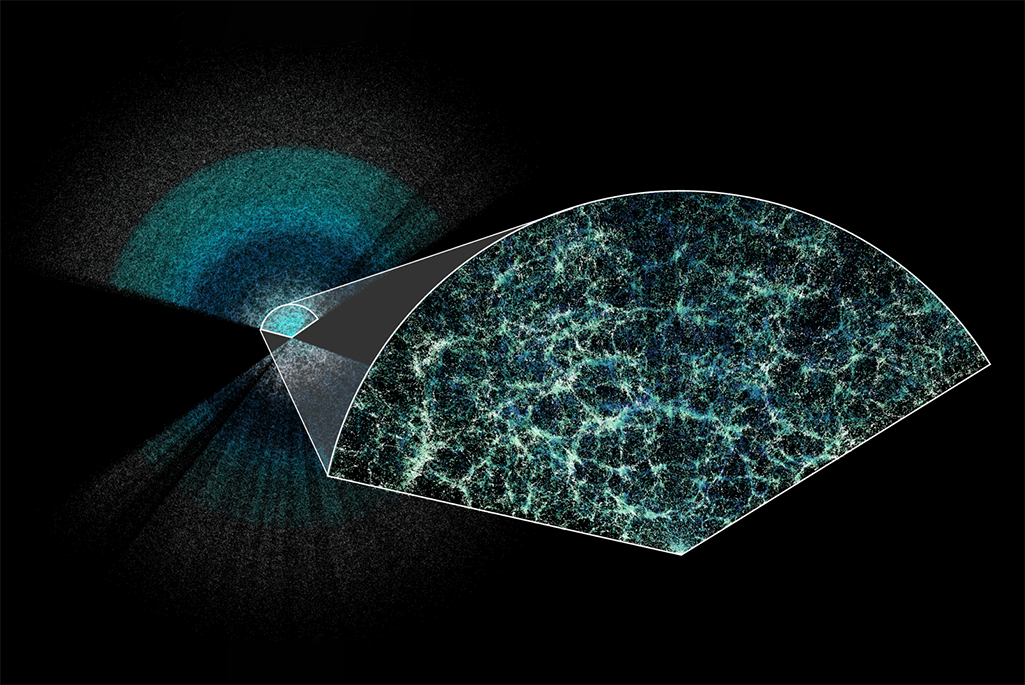
P.S. Here’s a nice graphic showing the cosmic web showing revealed by the DESI survey:
I was just thinking this afternoon that I haven’t posted recently any of the Cosmology Talks curated by Shaun Hotchkiss, then I looked and found that I had the perfect excuse for doing so. This particular talk is actually about one of the two new OJAp papers I announced in my previous post, i.e. “The IA Guide: A Breakdown of Intrinsic Alignment Formalisms” and the authors are: Claire Lamman (Harvard, USA); Eleni Tsaprazi (Stockholm, Sweden); Jingjing Shi (Tokyo, Japan); Nikolina Niko Šarčević (Newcastle, UK); Susan Pyne (UCL, UK); Elisa Legnani (Barcelona, Spain); and Tassia Ferreira (Oxford, UK).
Here is Shaun’s description of the video:
Claire Lamman, Jingjing Shi, Niko Šarčević, Susan Pyne, Elisa Legnani and Tassia Ferreira tell us about the intrinsic alignments guide they wrote (along with Eleni Tsaprazi, who couldn’t make the video recording).
They wanted to write something that wasn’t quite a review, but also wasn’t quite a set of lecture notes. Instead they aimed for what might be best framed as a “cheat sheet” for intrinsic alignments. Everything you need to know about the topic, compressed into one article. However, there’s still a lot about the topic, so the compression is still 33 pages and 10 figures big.
To construct the guide they broke the topic of intrinsic alignments into sub-fields and then asked questions like “what are the key equations for this sub-field?”, “what are the different notations people use?”, “what might be confusing to a newcomer?” They then wrote the guide to answer those questions, even including subsections with quick definitions of each common term, and short lists of common alternative notations.
Since I’m currently doing revision classes because the examination period here at Maynooth University begins shortly after Christmas, and some of our students haven’t done examinations for a while because of Covid-19 restrictions, I thought I would use my YouTube channel (which has several subscribers) to present a video version I made last spring of a post I did a few years ago about how to solve Physics problems. These are intended for the type of problems students might encounter at high school or undergraduate level in examinations or indeed in homework. I’ve tried to keep the advice as general as possible though so hopefully students in other fields might find this useful too.
Here is the video recording of the Invited Colloquium at the International School Daniel Chalonge – Hector de Vega I gave via Zoom on15th September 2021, introduced by Prof. Norma Sanchez.
In the talk I give a review about the absurdity of the current system of academic publishing, about what Open Access publishing means, and give a short introduction to the Open Journal of Astrophysics, an arXiv overlay journal.
I’m sorry if the recording is a bit choppy but that’s an occupational hazard with Zoom recordings and rather limited broadband!
The talk itself lasts about an hour, but was followed by an interesting discussion session so although the full video is rather long (2 1/2 hours) I’ve put it all there on Youtube.
You can download the video here. A PDF of the slides may be found here. You can also view the slides on slideshare:
In the talk I give a general review of the current state of cosmology, discussing the standard model of cosmology and some of the possible ways in which it might be revised or extended. It’s not a very technical talk but does assume some knowledge of cosmology. I hope a general audience will get something out of it.
I’m sorry if the recording is a bit choppy but that’s an occupational hazard with Zoom recordings and rather limited broadband!
This is an edited version of the session which in total lasted well over three hours including lengthy discussions and a trip down memory lane at the end. I cut out the introduction but kept a few of the questions and answers at the end, so it’s still rather long despite the rather brutal edits.
A video of the full event can be found here (1.6GB) and a PDF file of the slides can be found here. The slides are also available to be viewed here.
Back for Episode 7 of this series in which I explain how we can measure the strength of acoustic waves in early Universe using measurements of the cosmic microwave background, and how that leads to the conclusion that the Big Bang wasn’t as loud as you probably thought. You can read more about this here.
I’d forgotten about this little video made after I appeared on the Pat Kenny show on NewsTalk radio last year. It was just me and the camera in a little room, but it turned out less like a hostage video than I’d feared..
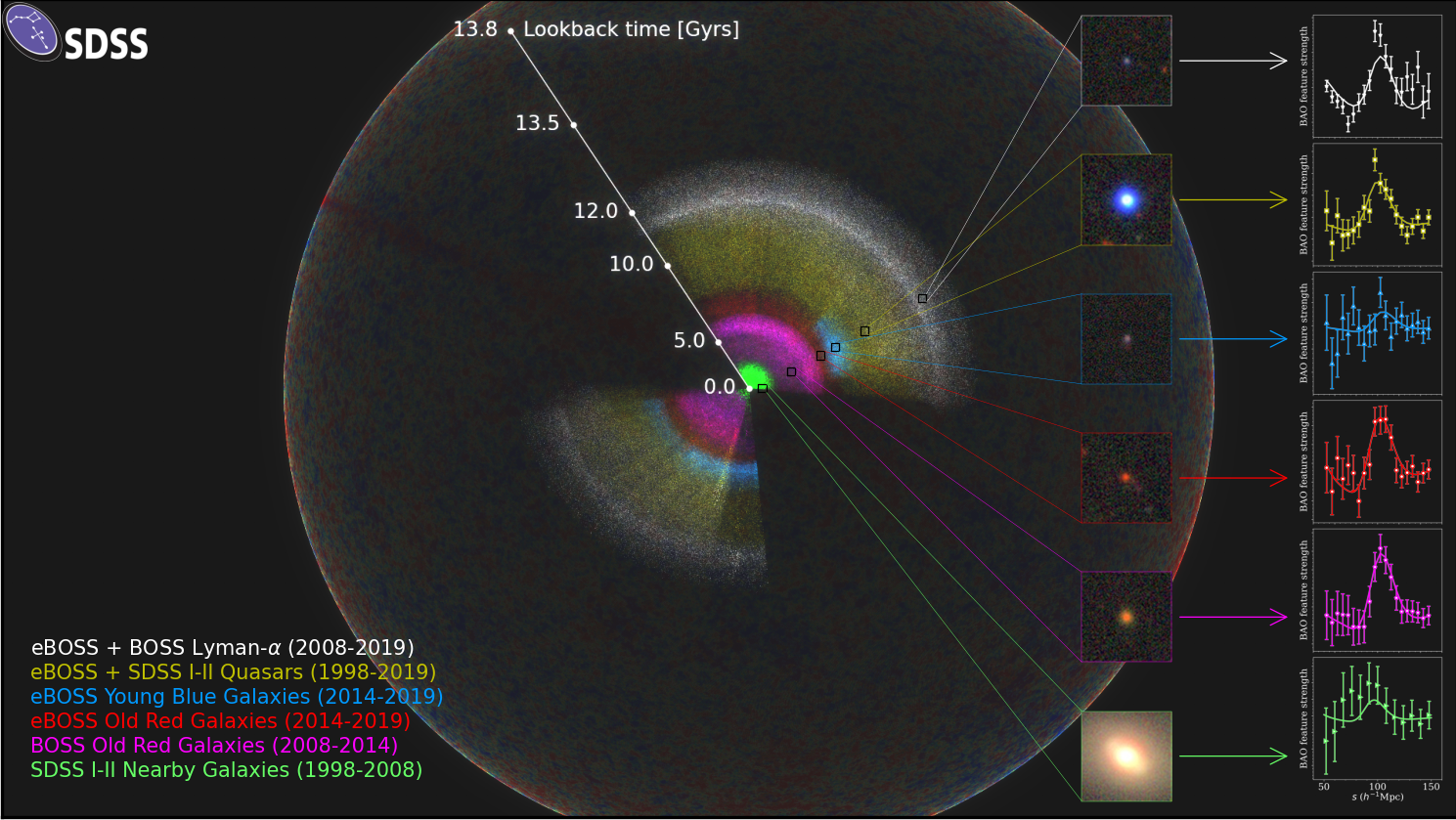
Today is another big day for cosmology as the last and final – why do people say that? – data release from the Extended Baryon Oscillation Spectroscopic Survey (eBOSS) is now available. That is the culmination of 20 years of effort with the Sloan Digital Sky Survey. Here is a pretty picture showing the enormous scales probed by the survey:
There is an overview paper on the cosmological implications of the survey on the arXiv here. Fortunately, the latest Cosmology Talk on the YouTube channel of Shaun Hotchkiss features a very interesting presentation by Eva-Maria Mueller who is the first author of that paper:
The views presented here are personal and not necessarily those of my employer (or anyone else for that matter).
Feel free to comment on any of the posts on this blog but comments may be moderated; anonymous comments and any considered by me to be vexatious and/or abusive and/or defamatory will not be accepted. I do not necessarily endorse, support, sanction, encourage, verify or agree with the opinions or statements of any information or other content in the comments on this site and do not in any way guarantee their accuracy or reliability.

 In the Dark