Research Matters

Posted in Science Politics, The Universe and Stuff with tags , , , , , on September 10, 2023 by telescoper

One of the things that happened last week while I was preoccupied with ITP2023 is that, finally, the UK Government has decided to re-join the European Union’s Horizon 2020 project. I’m very happy about this, and can’t understand why it has taken so long to reach an agreement. I know many researchers in the UK who will be mightily relieved too. Of course things won’t immediately get back to normal. It’s not just that the UK contributions will start in January 2024 so there will have to be some sort of transitional arrangement. More importantly it remains to be seen how long it takes to repair the damage done to goodwill by all the political shenanigans.

While I’m on about research I should also mention that there was a short talk at ITP2023 by a particle physicist by the name of Ronan McNulty who is based at University College Dublin. The topic of that talk was the history of Ireland’s non-membership of CERN; I have blogged about this before, for example here. Currently Ireland is in the anomalous position of not having any form of association agreement with CERN; the list of Full and Associate Member states can be found here. It does seem, however, that Ireland is at last about to lodge an application for Associate Membership, perhaps as early as January 2024.

Ronan made a particularly important point about membership, which I hope is not sidelined in the discussions. The case for joining CERN made at political levels is largely about the return in terms of the potential in contracts to technology companies based in Ireland from instrumentation and other infrastructure investments. This was also the case for Ireland’s membership of the European Southern Observatory, which Ireland joined about five years ago. The same thing is true for involvement in the European Space Agency, which Ireland joined in 1975. These benefits are of course real and valuable and it is entirely right that arguments should involve them.

Looking at CERN membership from a scientific point of view, however, the return to Ireland will be negligible unless there is a funding to support scientific exploitation of the facility. That would include funding for academic staff time, and for postgraduate and postdoctoral researchers to build up an active community as well as, e.g., computing facilities. This need not be expensive even relative to the modest cost of associate membership (approximately  €1.5M). I would estimate a figure of around half that would be needed to support CERN-based science.

The problem is that research funding for fundamental science (such as particle physics) in Ireland is so limited as to be virtually non-existent by a matter of policy at Science Foundation Ireland, which basically only funds applied research. Even if it were decided to target funding for CERN exploitation, unless there is extra funding that would just lead to the jam being spread even more thinly elsewhere.

As I have mentioned before, Ireland’s membership of ESO provides a cautionary tale. The Irish astronomical community was very happy about the decision to join ESO, but it was not accompanied by significant funding to exploit the telescopes. Few astronomers have therefore been able to benefit from ESO membership. While there are other benefits of course, the return to science has been extremely limited. The phrase “to spoil a ship for a ha’porth of tar” springs to mind.

Although Ireland joined ESA almost fifty years ago, the same issue applies there. ESA member countries pay into a mandatory science programme which includes, for example, Euclid. However, did not put any resources on the table to allow full participation in the Euclid Consortium. There is Irish involvement in other ESA projects (such as JWST) but this is somewhat piecemeal. There is no funding programme in Ireland dedicated to the scientific exploitation of ESA projects.

Under current arrangements the best bet in Ireland for funding for ESA, ESO or CERN exploitation is via the European Research Council but to get a grant from that one has to compete with much better developed communities in those areas.

A significant shake-up of research funding in Ireland is in view, with Science Foundation Ireland and the Irish Research Council set to merge into a single entity. If I had any say in the new structure I would set up a pot of money specifically for the purposes I’ve described above. Funding applications would have to be competitive, of course, and I would argue for a panel with significant international representation to make the decisions. But for this to work the overall level of public sector research funding will have to increase dramatically from its current level, well below the OECD average. Ireland is currently running a huge Government surplus which is projected to continue growing until at least 2026.

Only a small fraction of that surplus would be needed to build viable research communities not only in fundamental science but also across a much wider range of disciplines. Failure to invest now would be a wasted opportunity.

DolanFest

Posted in Maynooth, The Universe and Stuff with tags , , , on September 9, 2023 by telescoper

This morning found me in Renehan Hall in St Patrick’s House in Maynooth for ‘DonalFest’, a meeting to mark the retirement of former colleague (now Emeritus) Professor Brian P. Dolan, who retired a couple of years ago in the midst of the pandemic, which delayed his leaving do.

Today’s meeting involved a number of talks given by Brian’s past and present collaborators in the splendid surroundings of the old college (and, I might add, in glorious weather). Unfortunately I had to leave before the end in order to attend to some logistical matters to do with my impending departure on sabbatical, but I’m sure the rest of it was as enjoyable as the bit I was able to be at.

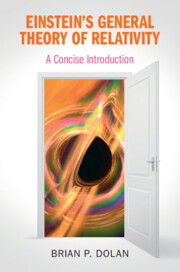
All of which gives me an excuse to plug again this textbook (left), based on the lecture notes Brian used to teach a final-year undergraduate course in General Relativity to Mathematical Physics students here in Maynooth.

The book’s description reads:

Einstein’s general theory of relativity can be a notoriously difficult subject for students approaching it for the first time, with arcane mathematical concepts such as connection coefficients and tensors adorned with a forest of indices. This book is an elementary introduction to Einstein’s theory and the physics of curved space-times that avoids these complications as much as possible. Its first half describes the physics of black holes, gravitational waves and the expanding Universe, without using tensors. Only in the second half are Einstein’s field equations derived and used to explain the dynamical evolution of the early Universe and the creation of the first elements. Each chapter concludes with problem sets and technical mathematical details are given in the appendices. This short text is intended for undergraduate physics students who have taken courses in special relativity and advanced mechanics.

You can order the book and/or recommend a copy to your library here.

Anyway, let me end with some personal wishes to Brian for a long and happy retirement!

Brahms, Byrne & Berlioz at the NCH

Posted in Biographical, Music with tags , , , , on September 9, 2023 by telescoper

Last night I went to the Opening Concert of the new season by the National Symphony Orchestra at the National Concert Hall in Dublin. I’ll be away for most of the year, so I thought I’d make the most of the time I’ve got before I depart to get a fix of culture.

This year is the 75th anniversary of the founding of the National Symphony Orchestra, and the very first piece they performed at their very first concert back in 1948 was Academic Festival Overture by Johannes Brahms. I found it an especially fitting piece because this week we have been having graduation (conferring) ceremonies all week in Maynooth. It’s a familiar work, but provided an enjoyably upbeat start to the show.

The next piece was a a world premiere of a special commission for the National Symphony Orchestra. I was looking forward to this because it was to be the first time I’ve ever heard the uilleann pipes on the concert stage. The piece is a lot of fun, full of great tunes and robust humour. The uilleann pipes are a rather quiet instrument, however, and I have to say I hardly heard a note from them over the rest of the orchestra. At the end a Scottish piper walked on stage to play the bagpipes during the finale. These pipes are a much louder instrument, and even they were hard to hear with the rest of the band on full throttle.

Anyway, after the wine break, we had the Symphonie Fantastique by Hector Berlioz. I was put off this piece at school by a teacher who was obsessed with it and spent nearly a whole term banging on about how wonderful it is. While it is undoubtedly very imaginative – and very innovative for a piece written as early as 1830 – I remain unconvinced by all the hype. It’s basically a fever dream resulting from the composer’s experiments on opium and I find it rather gimmicky. Nevertheless, there is much to enjoy in a live performance of the work. Conductor Jaime Martín began the performance with a genial introduction to some of the “crazy” elements which he got the relevant musicians to play snippets representing, for example, the bubbling cauldron in the last movement which represents witches doing their stuff.

After the full performance the National Symphony Orchestra got a standing ovation. I joined in only briefly because the conductor’s introduction to the Berlioz meant that the concert was longer than I expected and I had to leave to catch my train back to Maynooth. I needn’t have worried. The train was 20 minutes late.

Caption Competition!

Posted in Biographical, Talks and Reviews, The Universe and Stuff on September 8, 2023 by telescoper

Our roaming photographer took some pictures during my public talk on Wednesday night. This one seems ripe for a caption competition. Please submit your entries through the comments box below:

The Universe from Einstein to Euclid

Posted in Biographical, Talks and Reviews with tags , , on September 7, 2023 by telescoper

As we head into the Day 2 of the ITP2023 I thought I’d share the slides I used for the public talk I gave last night. We had an audience of around a hundred which wasn’t bad given that it is graduation week and the undergraduates aren’t back!

Here is the abstract used to advertise the talk:

Euclid is the name of a new scientific mission from the European Space Agency, launched on July 1st, designed to explore the composition and evolution of the Universe. The Euclid mission takes its name from the ancient Greek mathematician regarded by many as the Father of geometry. Until the last century, Euclid’s theorems were assumed not just to be mathematical notions, but to describe the geometrical structure of the physical Universe. Einstein’s general theory of relativity swept that idea aside and gave us new ways of describing space, by unifying it with time, and by allowing it to be affected by matter in a manner very different from that formulated by Euclid. Over the past century, this theory has proved to be very effective at describing the properties of the Universe as observed by modern astronomical telescopes, while also suggesting the existence of dark matter and dark energy.

The Euclid telescope will create an enormous map of the large-scale structure of the Universe across space and time by observing billions of galaxies out to 10 billion light-years, across more than a third of the sky. Euclid will explore how the Universe has expanded and how galaxies and clusters of galaxies have formed over cosmic history, and how space itself is distorted by these structures.

This talk will discuss our modern ideas of space and time, how the Euclid mission will try to test whether or not they are correct and shed light on the nature of dark matter and dark energy.

And here are the slides:

Obviously I cut a number of long stories very short, which probably contributed to why I had a lot of questions from the audience at the end of the talk. I always assume that’s a basically a good sign because it shows people are interested, but it also makes me worry that I didn’t explain things very well!

We didn’t finish until past 9 o’clock and it was a very warm evening, so I was very happy to have a few pints afterwards in O’Neills…

ITP 2023

Posted in Biographical, Education, Maynooth, The Universe and Stuff on September 6, 2023 by telescoper

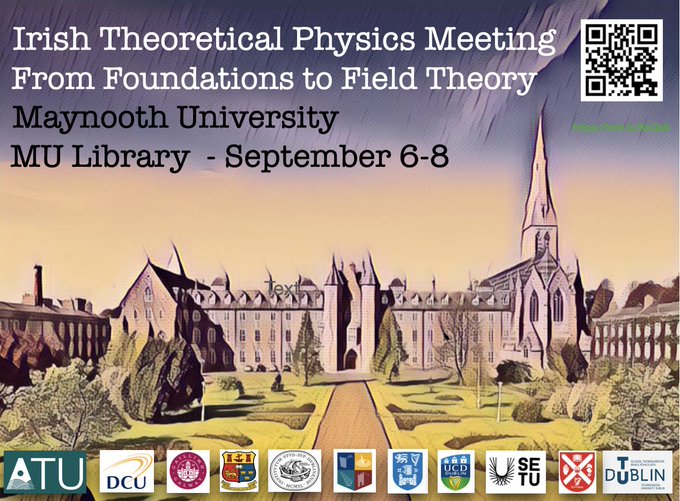
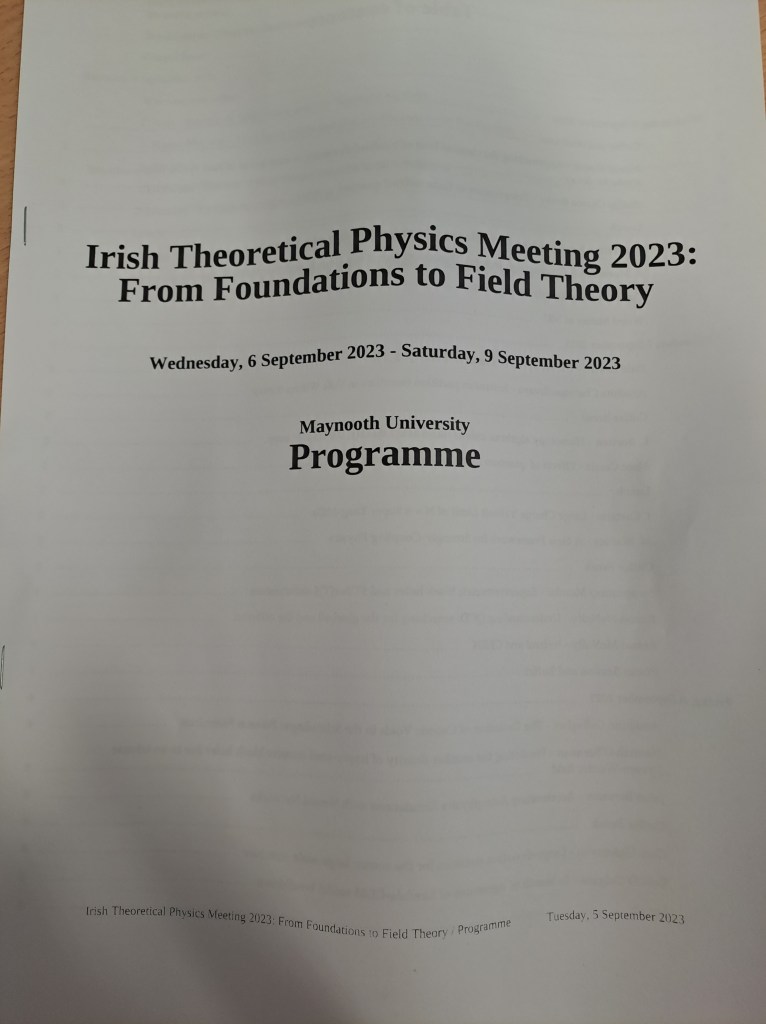
So here we are then, first day of the 2023 Irish Theoretical Physics meeting here in Maynooth. It’s a busy schedule for the three days, followed by a little meeting on Saturday to mark the retirement of Brian Dolan

It’s been a busy day for reasons other than the ITP2023 and I’ve left it a bit late to write my talk for this evening’s public lecture so I’d better get on with that this afternoon.

Updates to follow.

The Centre for Astrophysics and Space Science at Maynooth (CASM)

Posted in Maynooth, The Universe and Stuff with tags , , on September 5, 2023 by telescoper

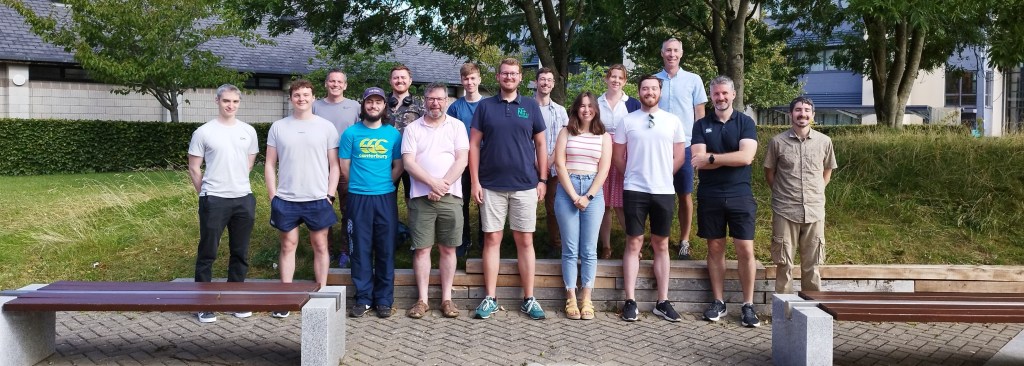
As part of effort to bring about closer interactions between members of the Departments of Theoretical Physics and Experimental Physics at MaynoothUniversity, we have formed a Centre for Astrophysics and Space Science which now has its own web pages.

The members of CASM have been meeting regularly together for coffee on Tuesdays for over a year, during which time more people have joined the Centre.

Today being a nice day we decided to make a team photograph showing staff, postgrads, and postdocs split roughly evenly between the two Departments. There’s also an undergraduate who has been working with us through the summer and helped to set up the web pages.

The People of CASM

Not everyone was able to be there this morning, but it’s lovely to see the group as big as this. I think it will be even bigger when I get back from my sabbatical next year…

September Heatwave

Posted in Biographical, Maynooth with tags on September 4, 2023 by telescoper

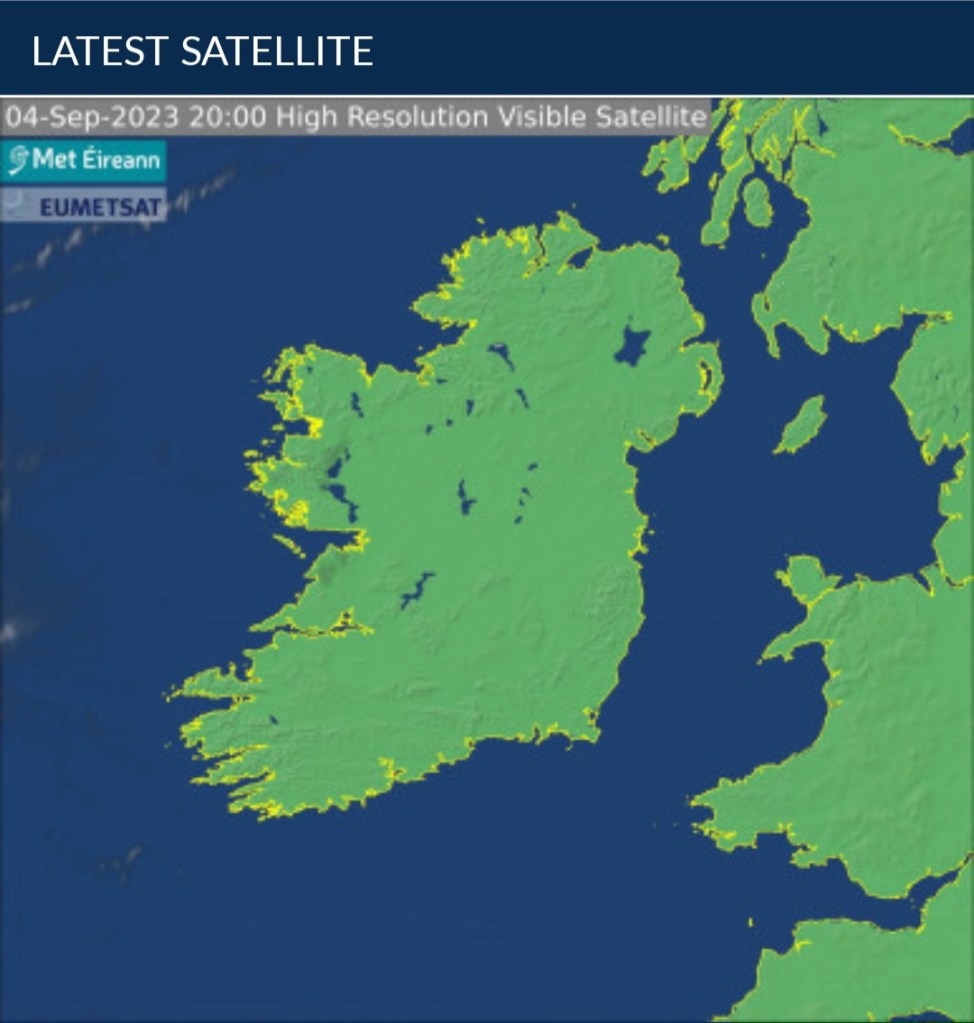
What a lovely day to be on sabbatical! It seems that the weather is set fair for a few more days too, which is nice. You don’t often see a satellite image with not a cloud in the sky over Ireland.

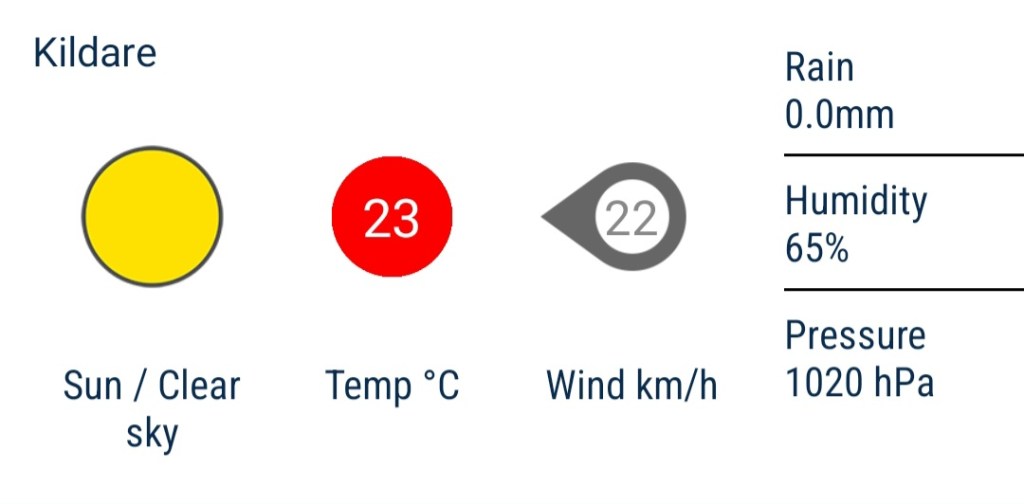
It’s cute that the Met Éireann weather map gives a red temperature warning when it’s just 23 °C.

Mind you, it has felt very warm today. So much so that I had a short nap this afternoon. I think of this as training for what I hope will be the regular siesta…

The Higher Education Market

Posted in Education, Maynooth with tags , , , on September 3, 2023 by telescoper
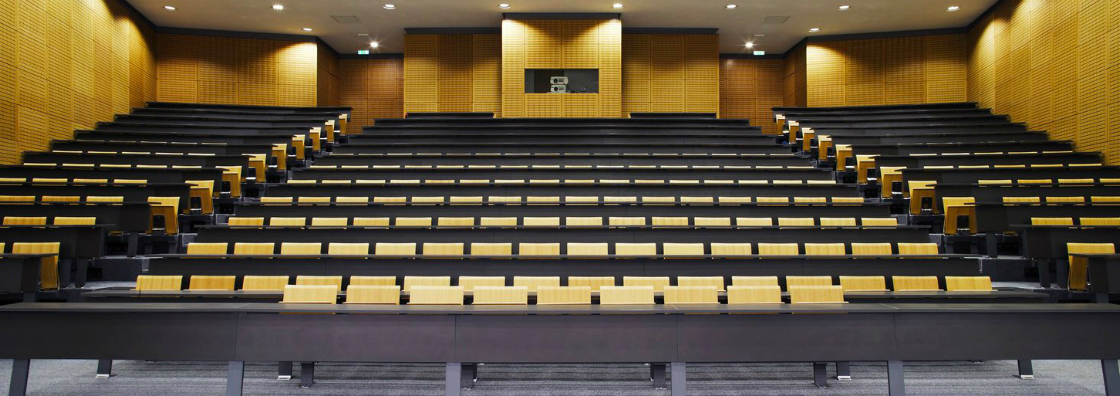
Iontas Lecture Theatre, Maynooth University

Last week I was talking to a current undergraduate student who has been working in the Department of Theoretical Physics over the summer. After a while the conversation turned to the possibilities for postgraduate education. I’ve had that sort of discussion many times over the years with many different students, but the curious thing is that I always find it quite difficult because I’m torn between competing motivations.

On the one hand, there is the wish to have the best undergraduates stay on for further study in the Department. That of course helps our research, but it is also good for our finances as postgraduate students bring income. I think we offer good opportunities at both Masters and Doctoral levels, so it’s not too difficult to point these out to students in a way that at least some find persuasive.

On the other hand, there is the fact that I am an academic not a salesman and I feel that it is my responsibility to give honest guidance. The fact is that a good undergraduate degree from the National University of Ireland will open a lot of doors elsewhere, and these should be considered. At Masters level in particular, there are excellent courses available in the EU which have the advantage of not charging fees at the level they are charged in Ireland. Add to that the cost of living and accommodation crises. It’s no surprise that many of our graduates seize opportunities to go to postgraduate study in Germany, Denmark or The Netherlands (to name just a few). I have no problem with explaining the advantages of options outside my own Department and no doubt some students find these points persuasive too.

There’s a wider context for this type of dichotomy, namely the progressive marketisation of higher education. When it comes to recruiting undergraduate students we academics are increasingly required to act as reps for the University, hawking our wares at Open Days, Recruitment Fairs, and a variety of online events. I’m reasonably happy to participate in these when asked to do so, but I always take the approach of describing what we do in our Department rather than trying to do down what happens elsewhere. I’m an academic not a salesman. And I work in a public university, not a private business. I see my job as giving advice in as objective a way as possible. If I feel that our courses would not be the right choice for a student, I’ll explain why. In the end, of course, the decision is up to the student, but I feel obliged to give them enough information to make an informed choice.

A couple of years ago, the (then) new President of Maynooth University walked up to the Theoretical Physics stand at a Maynooth Open Day when I was on duty. The first thing she said was “Sell your course to me”. I described what we had on offer, but I don’t think what I said impressed her at all. We can only hope to succeed in recruiting students who have some interest in science. An Open Day is a bit late to cultivate that: interest has to be nurtured from an early age.

Another problem I find, speaking as a physicist (though this is probably also true for people in many other disciplines), is that we see physicists in other institutions as colleagues rather than business rivals. This is particularly true for those of us working in large consortia that spread over many departments (and indeed many countries). I therefore see myself as a physicist who happens to work at Maynooth University rather than as an employee of Maynooth University who happens to do physics. It’s not that I am disloyal to my employer, it’s just that I have a greater loyalty to a larger community.

I do understand that the reality of the funding system here means that we have to be able to recruit students in order to pay our way, but I feel that the way to achieve that is by establishing a strong reputation in our core academic mission of teaching and research rather than through marketing gimmicks, corporate branding, or other forms of commercial flummery. No amount of propaganda will disguise a higher education institution that neglects those things that higher education is about.

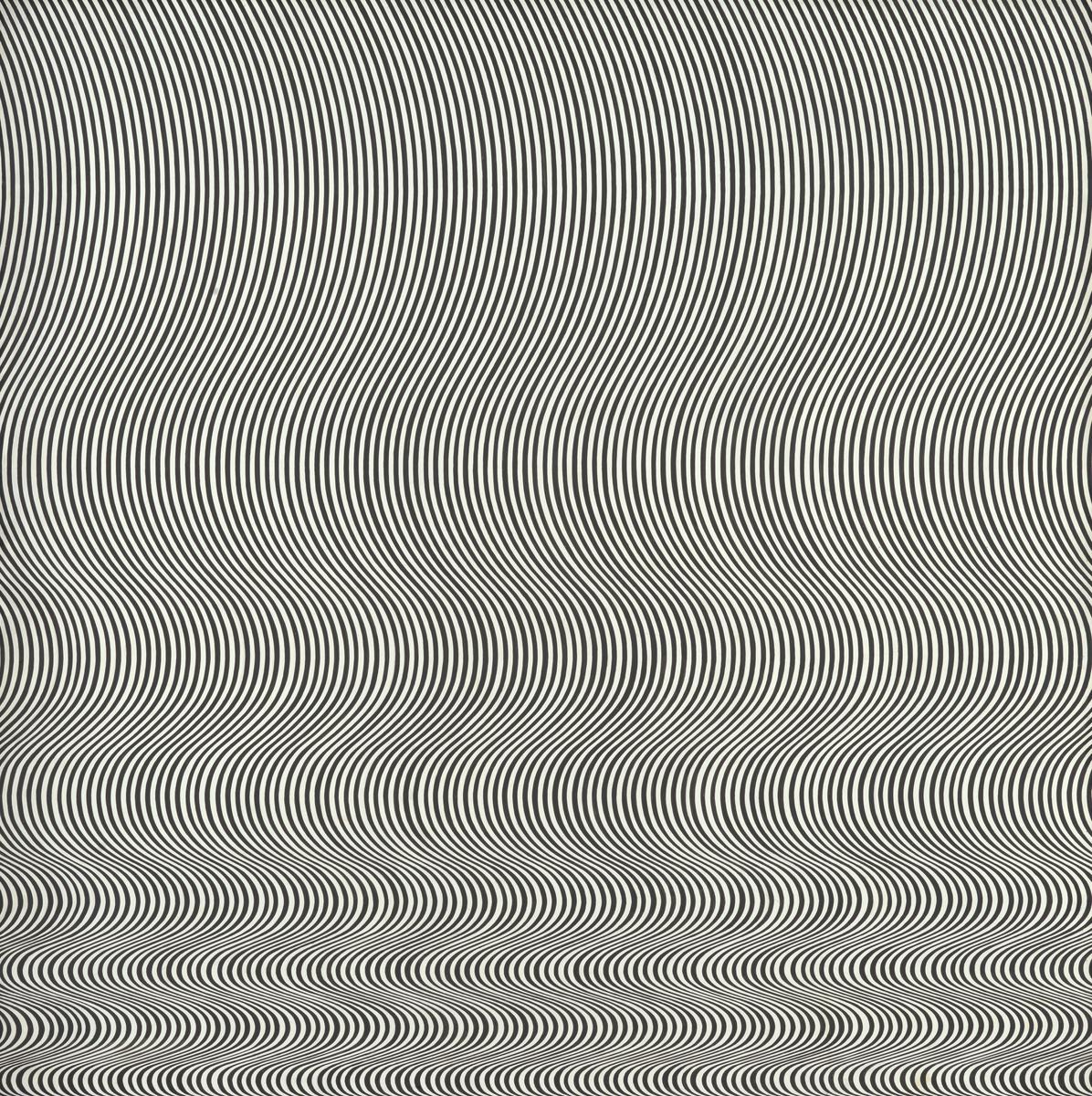
Fall – Bridget Riley

Posted in Art with tags , , on September 2, 2023 by telescoper
Fall 1963 Bridget Riley born 1931 Purchased 1963 http://www.tate.org.uk/art/work/T00616

by Bridget Riley (1963, 1410 × 1403 mm, polyvinyl acetate paint on hardboard, Tate Britain, London, UK)

The gallery label reads:

‘I try to organise a field of visual energy which accumulates until it reaches maximum tension’, Riley said of this work. From 1961 to 1964 she worked with the contrast of black and white, occasionally introducing tonal scales of grey. In Fall, a single perpendicular curve is repeated to create a field of varying optical frequencies. Though in the upper part a gentle relaxed swing prevails, the curve is rapidly compressed towards the bottom of the painting. The composition verges on the edge of disintegration without the structure ever breaking.