News came out yesterday of the results of the latest funding prioritization exercise by the UK Science and Technology Facilities Council (STFC). The total savings being made by cuts to astronomy and particle physics are less than the funds allocated to just one AI lab! It seems STFC has to bear the brunt of savings needed so that UKRI, the organization under which STFC sits, can gamble much more on Artificial Intelligence and Quantum Technology. It seems to me that these are two bubbles ready to burst and the decision to sink money into them is not only unwise, it places the UK science base at serious risk of collapse.
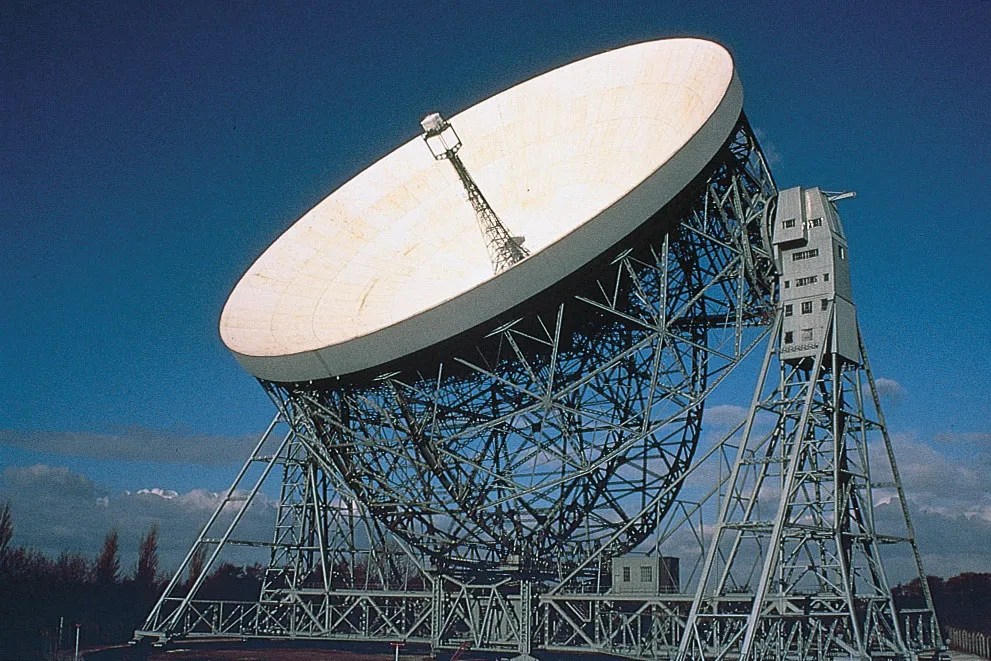
Anyway, you can find the list of specific cuts here. Radio astronomy is hit particularly hard. The interferometric network e-Merlin is not prioritized and its funding will run out in 2028. That puts Jodrell Bank Observatory in danger of complete closure unless an alternative source of funding can be found. The last time STFC had a financial crisis was in 2009 and e-Merlin might well have been cut then but survived thanks to political intervention at the highest level. I suppose that could happen again, but I wouldn’t bet on it. More bad news is that the UK Square Kilometre Array Regional Centre, with SKA itself already financially troubled, is also earmarked for cuts.
The 76m Lovell Telescope at Jodrell Bank, now under threat of closure
And that’s just radio astronomy and Jodrell Bank is one of the highest-profile casualties. There are cuts and cancellations in many other areas too; see here for a full list.
The Astronomer Royal for Scotland, Catherine Heymans, has used her platform to campaign against these damaging and short-sighted cuts to UK astronomy, including on social media:
Just off #BBCR4 World at One, arguing the importance of discovery science (like Jodrell) for long-term economic growth. I said I was heartbroken at the news: evidence just look at how exceptionally excited me & @mamaphysikerin.bsky.social were when we got to stand inside Lovell back in 2017 🥰 🔭🧪
The same can’t be said for the Astronomer Royal herself, Prof. Michele Dougherty. The reason for that is Prof. Dougherty is also Executive Chair of STFC and is therefore responsible for implementing the cuts. How it is possible for her to remain in both posts is nothing short of a scandal. Such a glaring conflict of interest cannot be allowed to stand. Indeed, Prof. Dougherty was elected to serve as President of the Institute of Physics from October 2025 but stepped down in January 2026 citing concerns of a conflict of interest with her role at STFC. It’s a slap in the face to the Astronomy community that it is not deemed worthy of such consideration.
I follow the hurling more than the Gaelic football, but I did watch yesterday’s memorable All-Ireland final between Kerry and Mayo which attracted a TV audience of over a million people. Bear in mind that the population of the Republic of Ireland is just 5 million.
Kerry were strong favourites ahead of the game, but it was underdogs Mayo (who played in all-white kit) that prevailed, deservedly, by 1-20 to 1-17.
This result is huge news because it is 75 years since Mayo won the All-Ireland title – they had been beaten finalists six times since 2012, including 2020 and 2021. The last time they won was in 1951. The Mayo colours were much in evidence in Maynooth last night as people celebrated their team lifting the Sam Maguire Cup along with the lifting of the Mayo Curse. I don’t think any members of the Mayo team will be buying their own drinks for a long time!
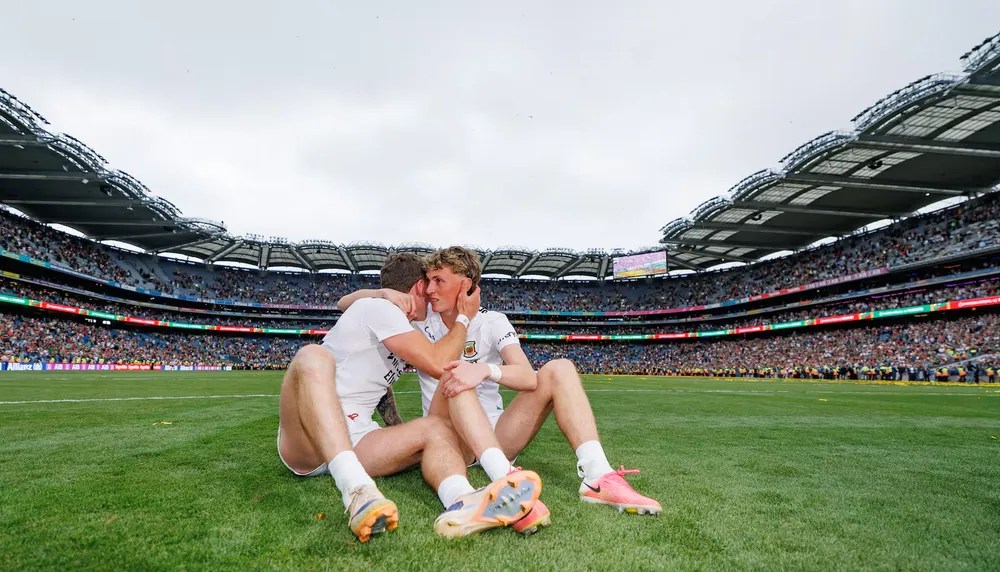
I like this very wholesome picture showing Mayo’s Jordan Flynn and Kobe McDonald on the pitch at Croke Park after the end of the game. That moment will stay with them for the rest of their lives.
Photo Credit: James Crombie/Inpho
Incidentally the Irish name for Mayo, Maigh Eo, means “Plain of the Yew Trees” and the Maigh is also responsible for the first bit of “Maynooth”.
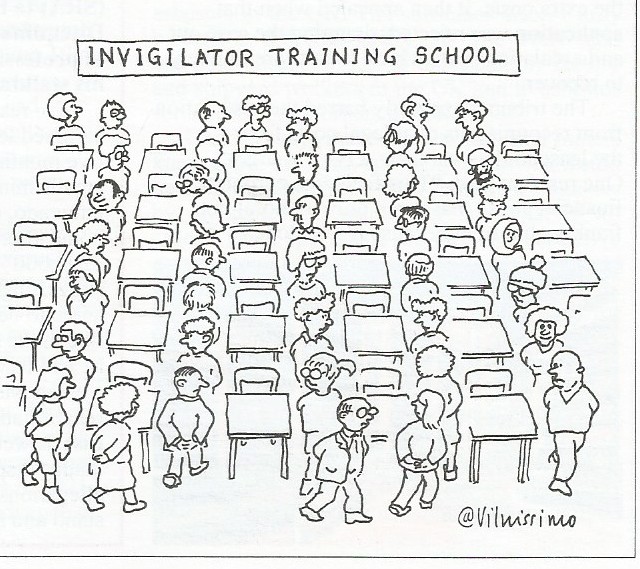
I saw the above cartoon in the latest Private Eye and, with Repeat Examinations rapdily approaching I thought I’d share it here without permission.
Years ago, academic staff had to invigilate their own examinations. I had to do this in my first teaching job at Queen Mary and, later, at Nottingham, but more recently the job has generally been done by support staff rather than academics. I moved from Nottingham to Cardiff in 2007 and don’t think I ever had to invigilate examinations there, so I haven’t done it for almost twenty years. Nowadays we are just expected to be “on call” to deal with any queries that arise in the Exam Hall by phone.
The cartoon reminded me of one of the funniest April Fool jokes I can recall. I think it was when I was at Queen Mary, but it’s so long ago I can’t remember who was responsible. Anyway, whichever colleague it was sent an email to all academic staff passing on what appeared to be a message from the University Management stating that all staff would be required to attend a compulsory day-long invigilator training workshop, including a “role play” session (the mind boggles). This message managed to trigger a significant number of staff members who made use of the “ReplyAll” on their email to vent their outrage at such a waste of time. It was a good April Fool, because the idea of it was quite plausible. Most April Fools are far too obvious.
Anyway, I’m not sorry that I no longer have to perform the task of exam invigilation, as it was always one of my least favourite jobs, and not only because I don’t enjoy seeing people under stress. Initially I thought supervising an examination might allow me time to do something useful, but there always seemed to be some interruption, such as students wanting an extra answer book, or asking about some issue with the examination paper, or wanting to leave to go to the toilet, etc.
The most dramatic interruption I can remember was when a student who suffered from epilepsy had a seizure in the examination hall. Fortunately we invigilators had been briefed as to what to do in such an eventuality, namely to move the furniture so the student didn’t hurt themselves but otherwise not to intervene until they went to sleep – which usually happens after a minute or two. This was done about 15 minutes before the exam started, not in a day-long training session. We were told that such an episode was unlikely as the student was taking medicine to prevent them occurring. It was quite when it actually happened, but happily the student recovered quickly and was perfectly OK afterwards. Apparently he had been so busy preparing for the examination that day he had forgotten to take his medication in the morning.
Having given up on the idea of doing some other work during an examination, I used to take a few crosswords to do. These are good for passing the time because you can solve a few clues then pause to look around the hall. Other things I used to do included walking around counting the number of right-handed and left-handed students, for example, though I never did any detailed statistical analysis of the results.
The primary purpose of invigilation is to prevent cheating or other misbehaviour, and I only ever saw a few examples of that – most of them involving calculators with, e.g., graph-plotting facilities which are not allowed.
Anyway, I’m glad I no longer have to invigilate examinations, and that makes me all the more grateful for the people who do. Here in Maynooth there are three examinations per day during the Examination Period, with a brief period between to put out the next set of papers, which means a long day for those who do this job. Hats off to the staff of the Exams Office at Maynooth who carry out this thankless task three times a year!
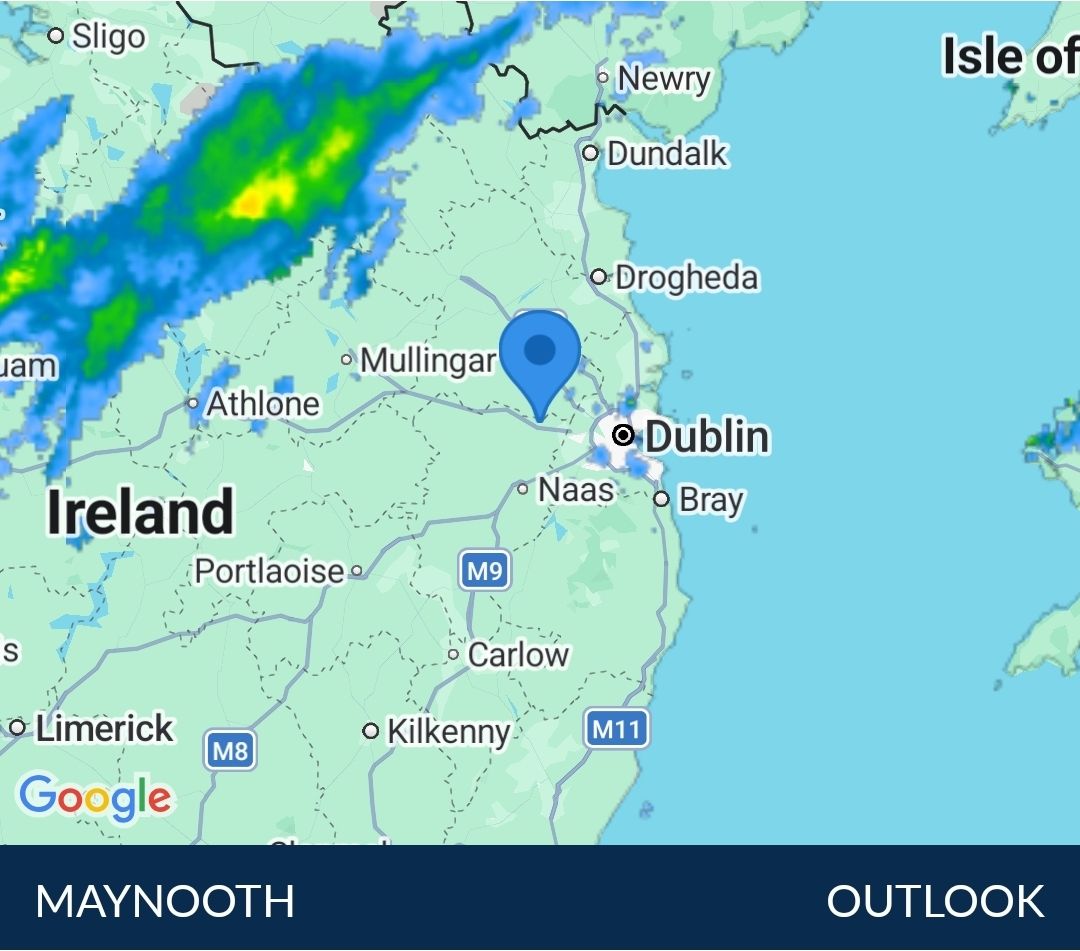
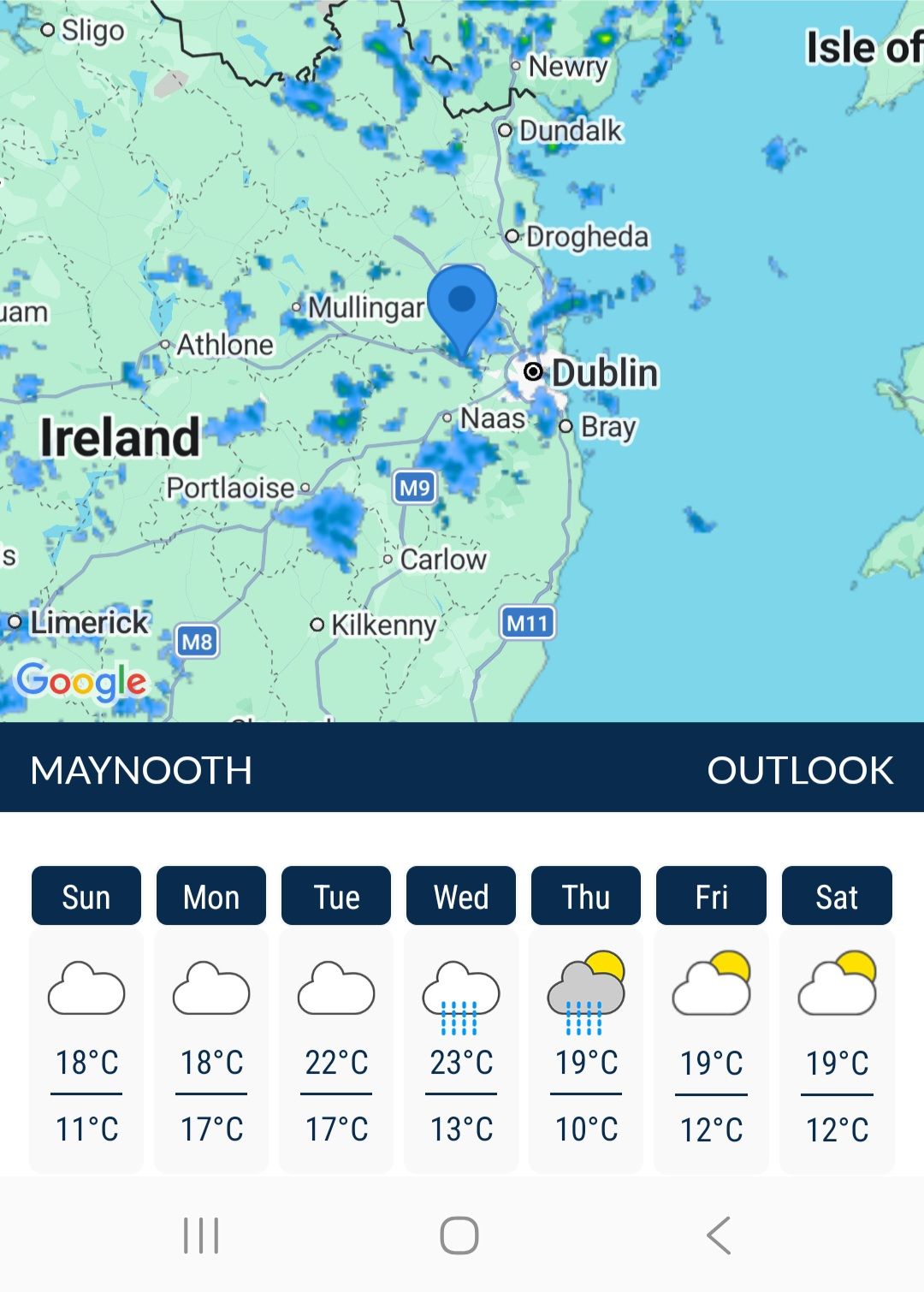
We got some rain at last. On Friday evening I checked the trusty Met Éireann app and saw this:
With a west/northwesterly wind I thought there was a good chance we would get a bit of rain, and so it turned out although to be honest there wasn’t that much. I think the greeny-yellowy blobs missed us. There was enough rain to give the garden a little light refreshment but not to make up for the ongoing hosepipe ban. We’ve had several weeks with next to no rain, which is highly unusual.
I look at the weather outlook quite regularly and have learned one thing in my time in Ireland. The forecast is usually fairly accurate up to about three days in the future but you shouldn’t rely on it beyond that. This week provided a good illustration. Last weekend the forecast predicted rain on Saturday (i.e. yesterday). As the week progressed the forecast changed and rain wasn’t forecast until next Wednesday. Then it rained on Friday evening. Saturday, by the way, was extremely humid: well over 90%.
Here’s the outlook from today:
You can see that rain is forecast for Wednesday and Thursday, but the rainfall radar map shows why it is so difficult to predict whether rain will fall at a specific location. The rain clouds are rather small and moving rather quickly; the winds are around 25km/h (westerly). At the time of taking that screen grab there had been some light rain, but will the other blobs hit us? The Met Éireann model says “no” but others may well say “yes”. It’s a tough problem to predict this level of detail.
One thing that I think could be improved is a more reasonable representation of the uncertainty. The outlook for today confidently asserts that the Chance of Preciptation for the rest of today is “0%”. To me that means that it is absolutely impossible that it will rain, and that seems unreasonable to me. Surely there is some chance of rain later today? It doesn’t do much for the credibility of a forecast to claim such certainty. A week or two ago there were no clouds anywhere and “0%” was reasonable, but not today. If it were up to me I’d probably put “<1%” or “<5%” to hedge my bets.
And then there is the question of what amount of rain we’re talking about. I was on campus on Thursday and a few spots of rain fell then. I only noticed because I was outside, coming back from lunch. That was too little to count as real rainfall, but I wonder what the threshold is?
It’s time once more for another Saturday update of activity at the Open Journal of Astrophysics. Since the last update we have published a further nine papers, bringing the number in Volume 9 (2026) to 160 and the total so far published by OJAp up to 608.
I will continue to include the posts made on our Mastodon account (on Fediscience); these announcements also show the DOI for each paper.
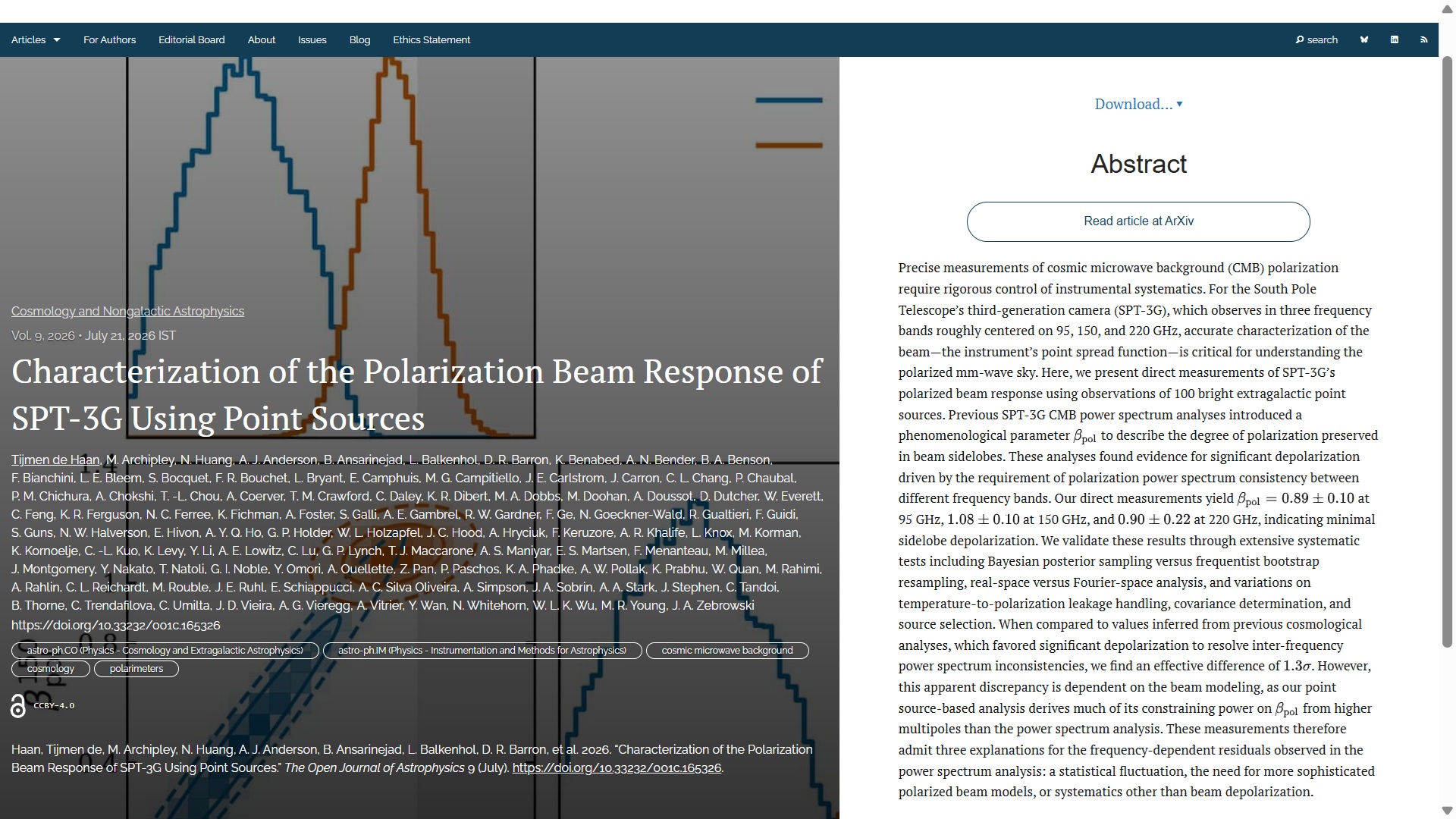
The first paper to report this week was published on Tuesday 21st July in the folder Cosmology and Nongalactic Astrophysics. The title is “Characterization of the Polarization Beam Response of SPT-3G Using Point Sources” by Tijmen de Haan (Institute of Particle and Nuclear Studies, Ibaraki, Japan) and an international cast of 101 others. This study presents measurements of the South Pole Telescope’s polarized beam response, indicating minimal sidelobe depolarization. The findings suggest potential explanations for frequency-dependent residuals in power spectrum analysis.
The overlay for this paper is here
You can find the officially accepted version on arXiv here and the announcement on Fediverse here:
New Publication at the Open Journal of Astrophysics: "Characterization of the Polarization Beam Response of SPT-3G Using Point Sources" by Tijmen de Haan (Institute of Particle and Nuclear Studies, Ibaraki, Japan) and 101 others from around the world
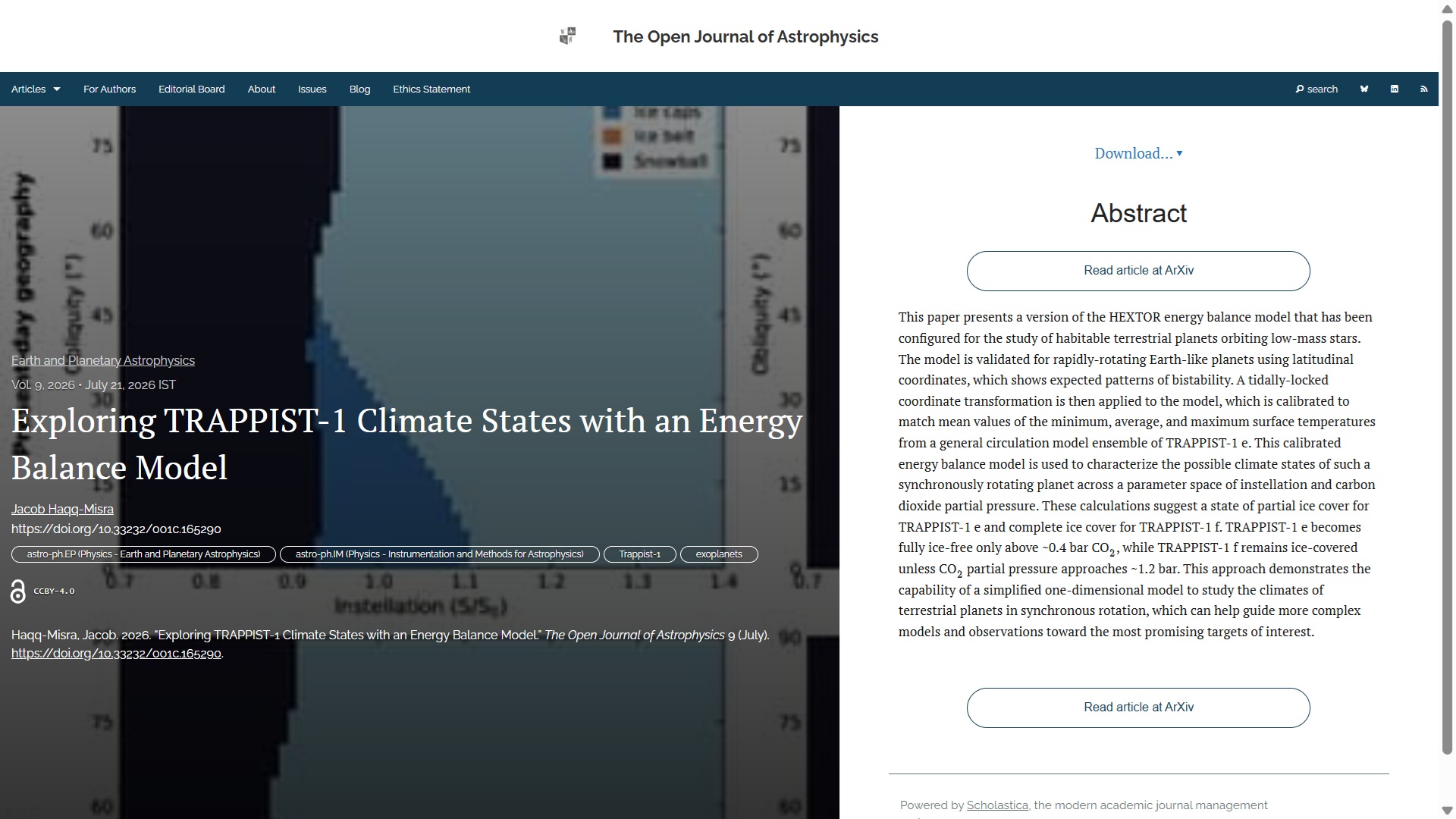
The second paper for this week, also published on Tuesday 21st July but in the folder Earth and Planetary Astrophysics is: “Exploring TRAPPIST-1 Climate States with an Energy Balance Model” by Jacob Haqq-Misra (Blue Marble Space, USA). The study uses a modified HEXTOR energy balance model to predict climate states of terrestrial planets orbiting low-mass stars, suggesting partial to complete ice cover for TRAPPIST-1 e and f.Abstractfor Exploring TRAPPIST-1 Climate States with an Energy Balance Model.
The overlay looks like this:
The official version of the paper can be found on arXiv here and the Fediverse announcement here:
New Publication at the Open Journal of Astrophysics: "Exploring TRAPPIST-1 Climate States with an Energy Balance Model" by Jacob Haqq-Misra (Blue Marble Space, USA)
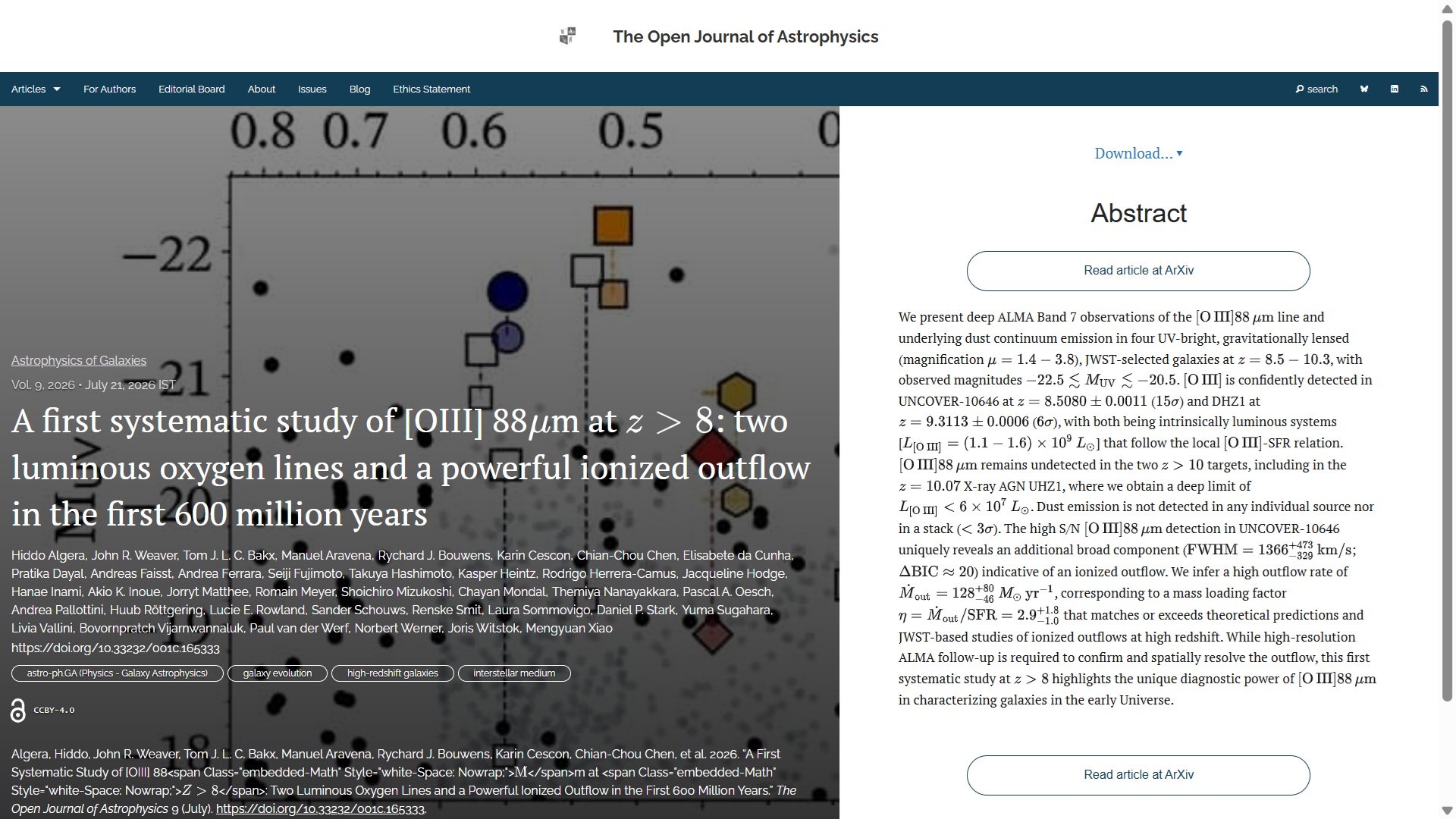
New Publication at the Open Journal of Astrophysics: "A first systematic study of [OIII] 88μm at z>8: two luminous oxygen lines and a powerful ionized outflow in the first 600 million years" by Hiddo Algera (Institute of Astronomy and Astrophysics, Taipei, Taiwan) and 37 others from all around the world.
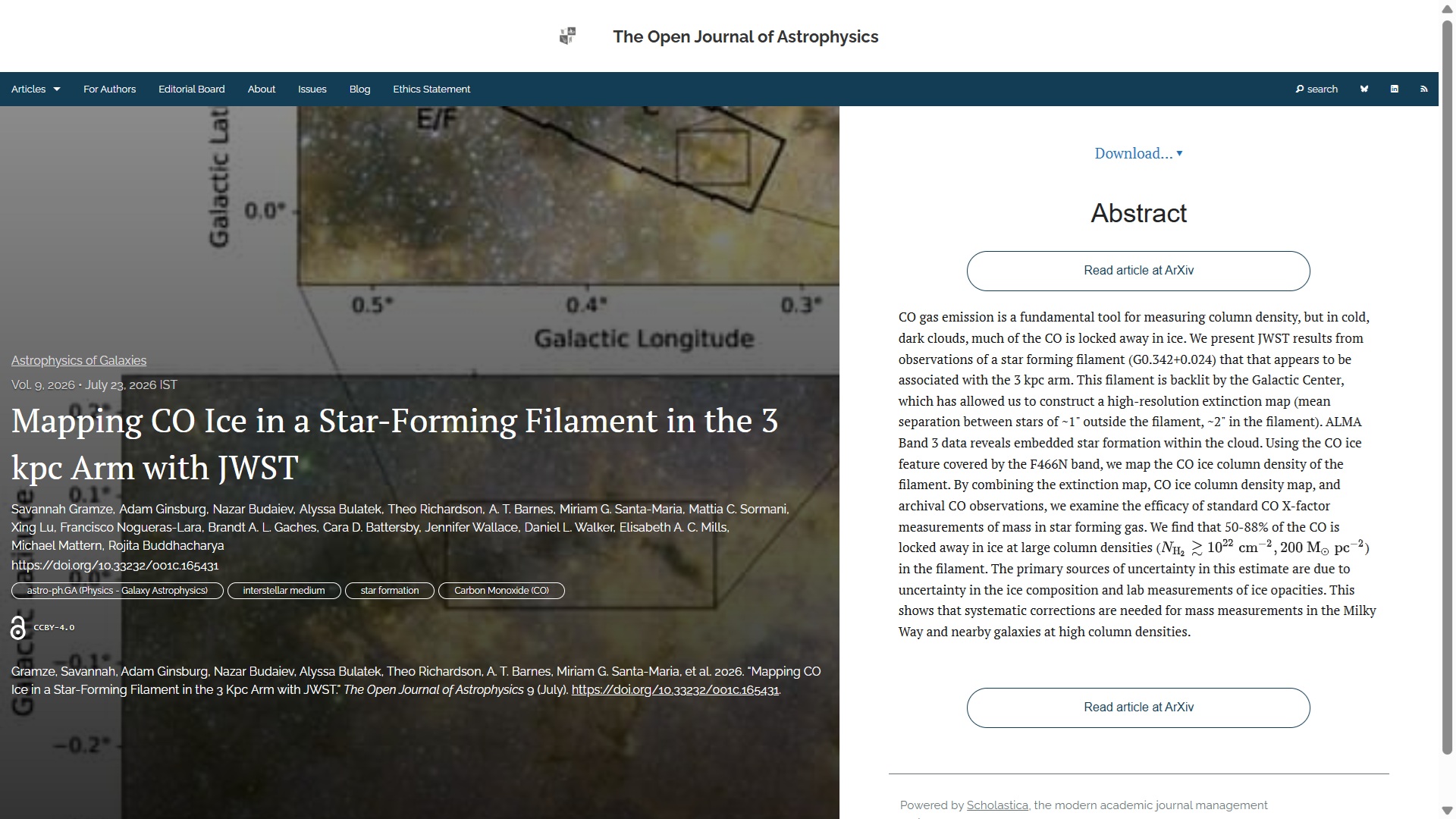
The fourth paper of the week, published on Thursday 23rd July in the folder Astrophysics of Galaxies, is “Mapping CO Ice in a Star-Forming Filament in the 3 kpc Arm with JWST” by Savannah Gramze (U. Florida, USA) and 16 others based all around the world. This paper shows that JWST observations and ALMA Band 3 data reveal that 50-88% of CO gas in a star-forming filament is locked in ice; corrections are needed for mass measurements in such systems.
The overlay for this one is here:
You can read the final version of this one on arXiv here and the Mastodon announcement is here:
New Publication at the Open Journal of Astrophysics: "Mapping CO Ice in a Star-Forming Filament in the 3 kpc Arm with JWST" by Savannah Gramze (U. Florida, USA) and 16 others based all around the world.
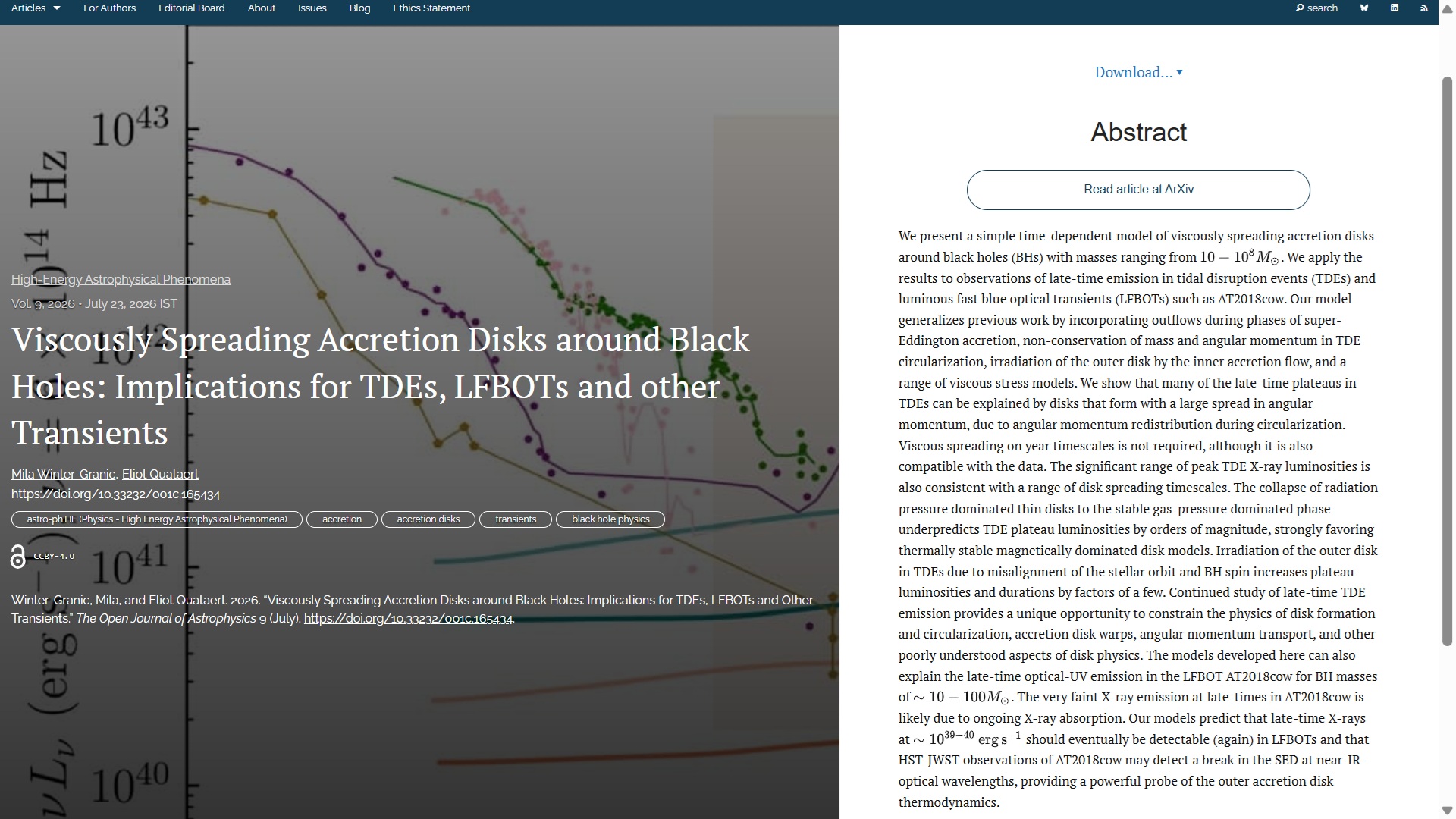
New Publication at the Open Journal of Astrophysics: "Viscously Spreading Accretion Disks around Black Holes: Implications for TDEs, LFBOTs and other Transients" by Mila Winter-Granic and Eliot Quataert (Princeton University, USA)
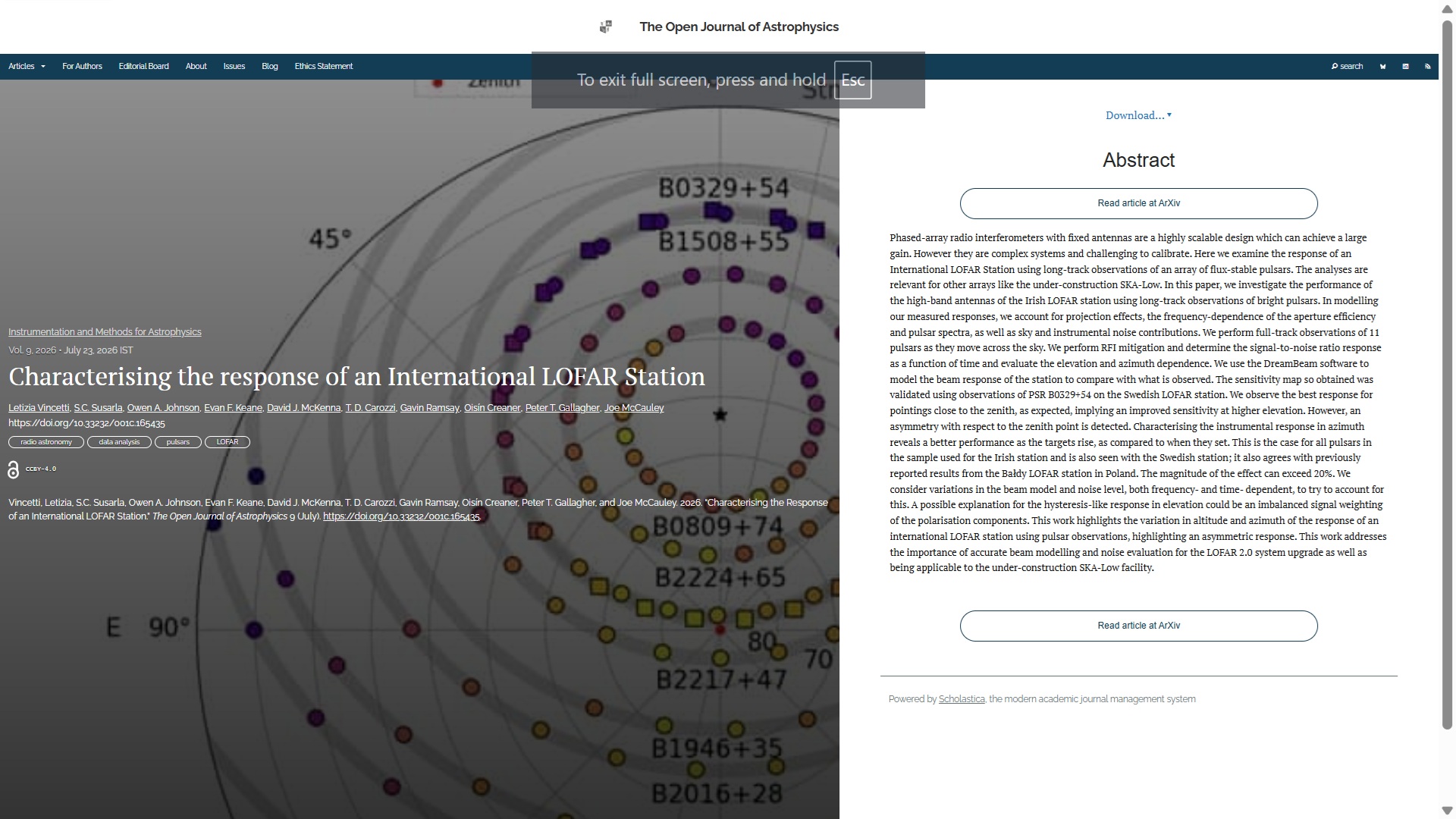
The sixth paper of this week is “Characterising the response of an International LOFAR Station” by Letizia Vincetti (Trinity Collge Dublin, Ireland) and 9 others based in Ireland, USA, The Netherlands and Sweden. This was also published on Thursday July 23rd and is in the folder Instrumentation and Methods for Astrophysics. The article presents an investigation of the performance and calibration challenges of phased-array radio interferometers, using the Irish LOFAR station as a case study, highlighting the importance of accurate beam modelling, etc.
The overlay for this one is here:
You can find the final accepted version on arXiv here and the Mastodon announcement is here:
New Publication at the Open Journal of Astrophysics: "Characterising the response of an International LOFAR Station" by Letizia Vincetti (Trinity Collge Dublin, Ireland) and 9 others based in Ireland, USA, The Netherlands and Sweden
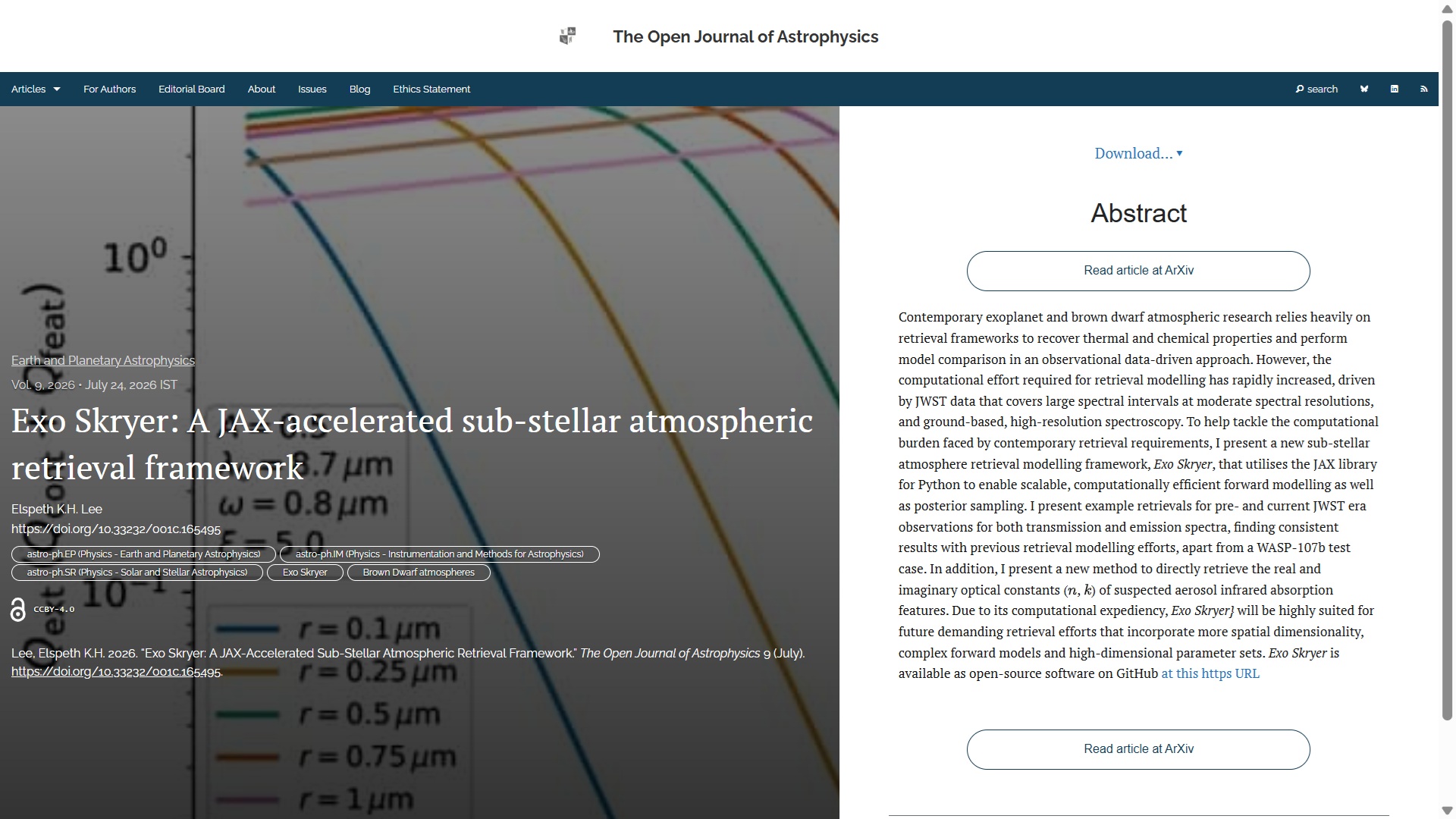
New Publication at the Open Journal of Astrophysics: "Exo Skryer: A JAX-accelerated sub-stellar atmospheric retrieval framework" by Elspeth K.H. Lee (U. Bern, Switzerland)
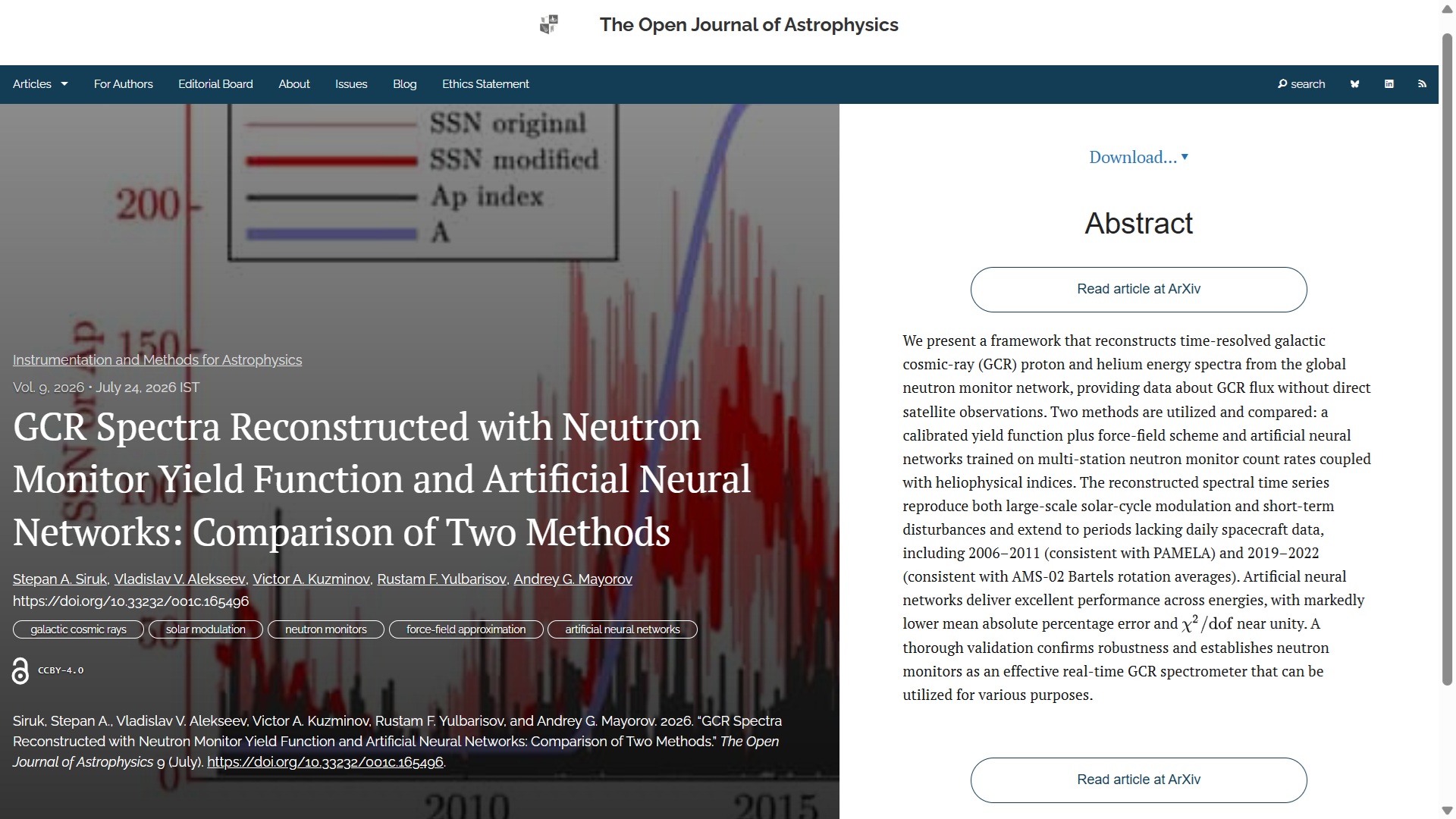
New Publication at the Open Journal of Astrophysics: "GCR Spectra Reconstructed with Neutron Monitor Yield Function and Artificial Neural Networks: Comparison of Two Methods" by Stepan A. Siruk (Moscow Engineering Physics Institute MEPhI, Russia) and four others based in Russia
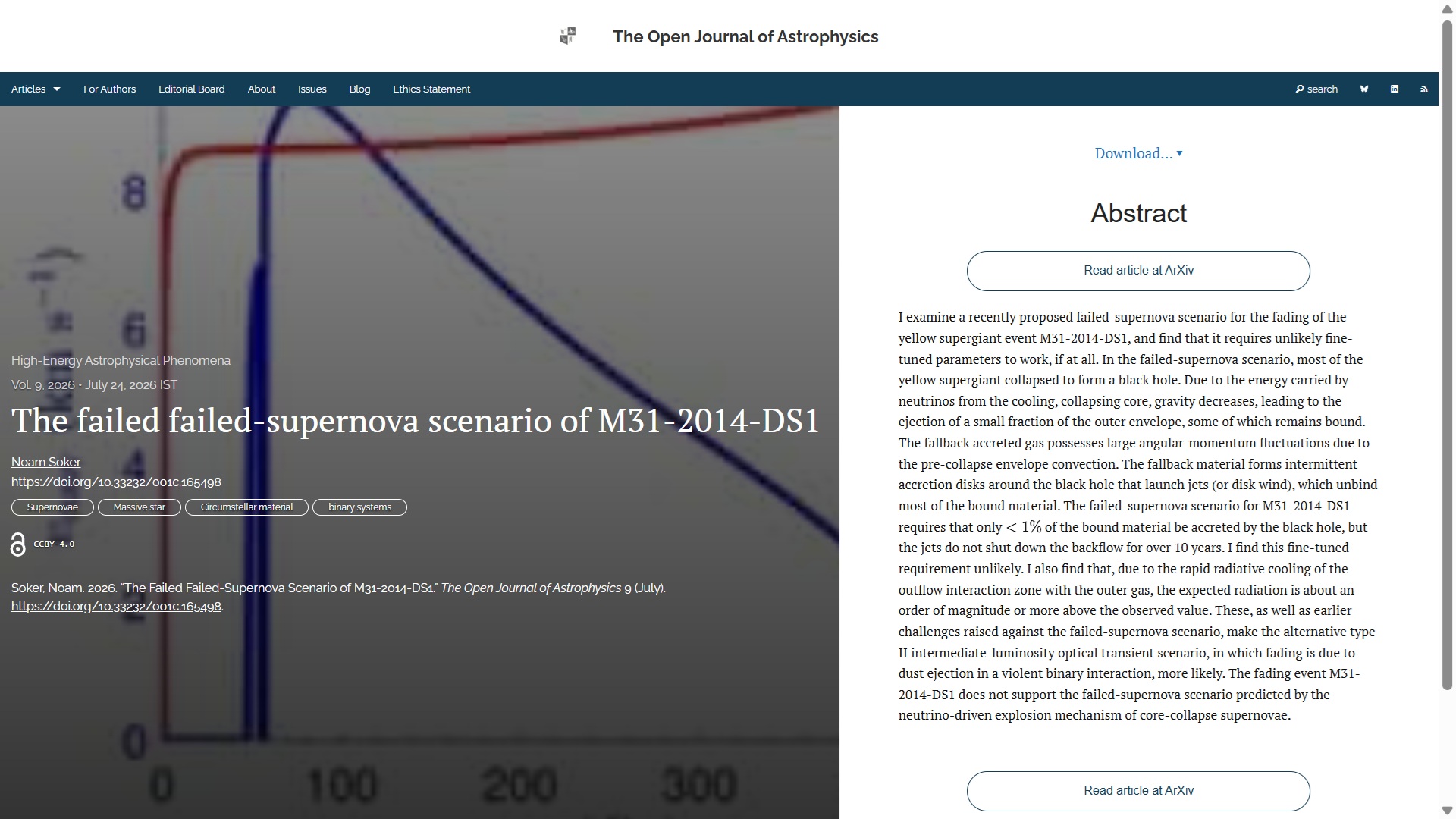
And finally for this week we have “The failed failed-supernova scenario of M31-2014-DS1” by Noam Soker (Technion, Israel), a paper which challenges the failed-supernova theory for the fading of the yellow supergiant event M31-2014-DS1, suggesting it requires unlikely parameters and supports an alternative scenario involving violent binary interaction. This was published on Friday 24th July in the folder High-Energy Astrophysical Phenomena.
The overlay for this one is here:
You can find the final accepted version on arXiv here and the Mastodon announcement is here:
And that concludes the update of this week’s business. As it was foretold, the total number of publications at OJAp has now passed the 600 mark, and the likely number for 2026 is around 300. We published a paper in five of the six astro-ph categories this week, but still haven’t had a week when we’ve published a full house with at least one in all six…
What the Times Higher doesn’t discuss (at all) is Latchman’s track-record of research misconduct. You can read a lengthy discussion of some of it in the following blog post. It is also discussed more briefly in Latchman’s Wikipedia page.
If you want a symptom of the pathological state of the current higher education system, you need look no further than this appointment. And if you want proof that the Times Higher doesn’t do proper journalism then this is an example of that too.
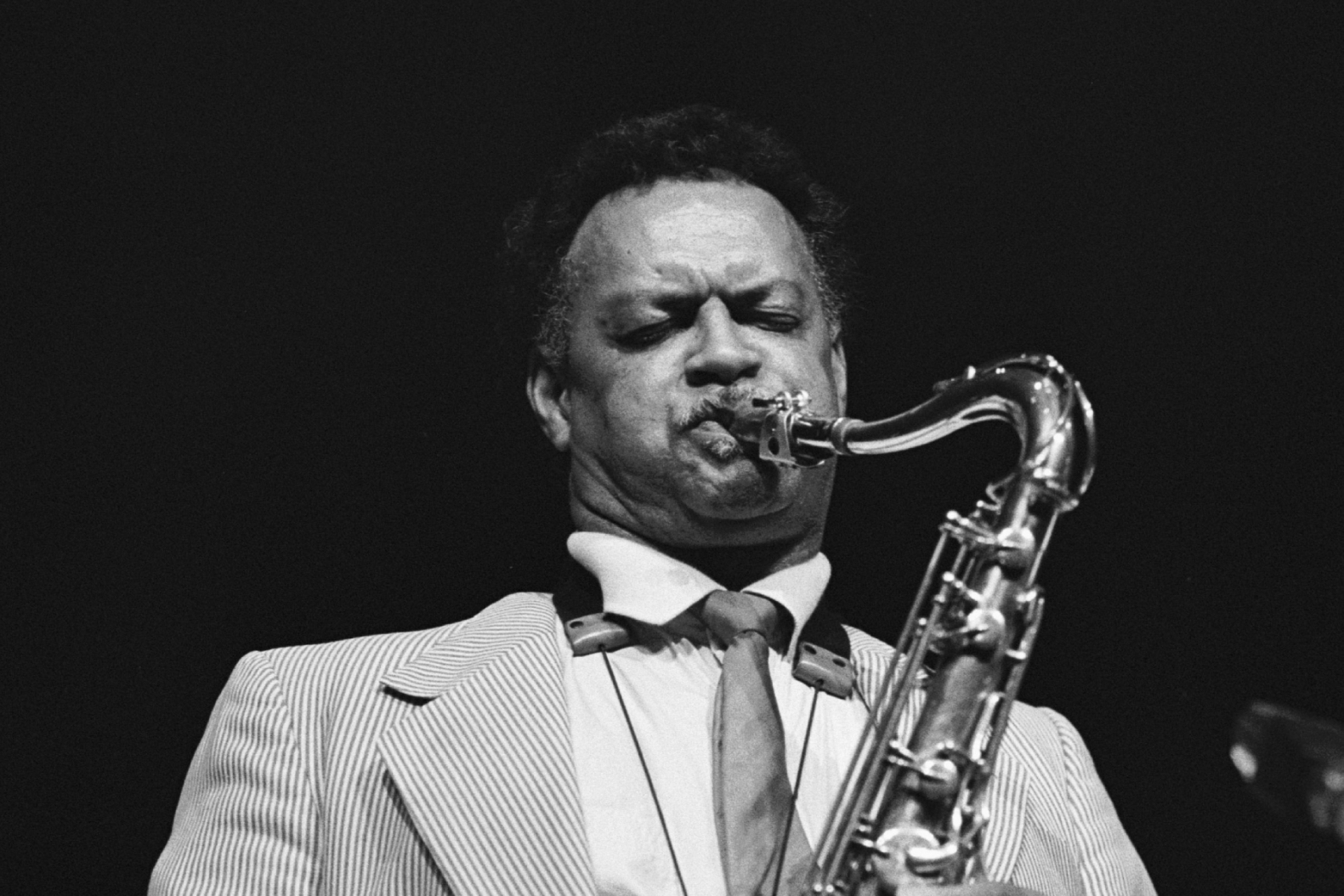
I first heard news of the death of tenor saxophonist Plas Johnson (left) a couple of days ago, and since then there have been numerous tributes including this one in the Irish Times. Almost without fail the obituaries introduce him as the man who played the saxophone part of the Pink Panther theme written by Henry Mancini. In fact, years ago, I won a tiebreak for my team in a pub quiz by knowing the name of the person who played that tune.
Even very good musicians struggled to make a decent living from jazz after the arrival of rock-and-roll as a popular musical phenomenon in the 1950s. Like many jazz performers, Johnson addressed this issue by moving to Los Angeles, where he found work as a session musician working to support such artists as Frank Sinatra and Marvin Gaye, or on film and TV music. Henry Mancini noticed Plas Johnson’s quality and it inspired him to write the Pink Panther film specifically for him. Most of these performances went uncredited, which is why his name isn’t more widely known despite him being a very fine saxophonist. Nonetheless, having the financial security of being much sought after session musician, Plas Johnson was able to continue to pursue his love of jazz. He made some fine albums as leader (I have Positively on vinyl). He also moonlighted as Johnny Beecher to evade contractual issues.
The reason I knew of Plas Johnson as a jazz musician before I found out he was the Pink Panther guy. That’s because I used to listen to Humphrey Lyttelton’s radio programme The Best of Jazz on Radio 2 on Monday evenings from 9pm when I was at school and Plas Johnson came up a few times, including on the track I’ve included below from one of the famous Hanna-Fontana sessions at the Concord Jazz Festival. The recording was made in 1975 but the record wasn’t available in the UK until a couple of years later. I used to tape Humph’s radio shows but no longer have any of the cassettes so I had to spend much of my spare time the last couple of days trying to find the track Humph played. This is it! It features Plas Johnson (ts), clearly enjoying himself in the company of Bill Berry (tpt), Carl Fontana (tb), Herb Ellis (g), Dave McKenna (p), Herb Mickman (b) and Jake Hanna (d). Not a bad line-up!
R.I.P. Plas Johnson (1931-2026), so much more than the Pink Panther guy!
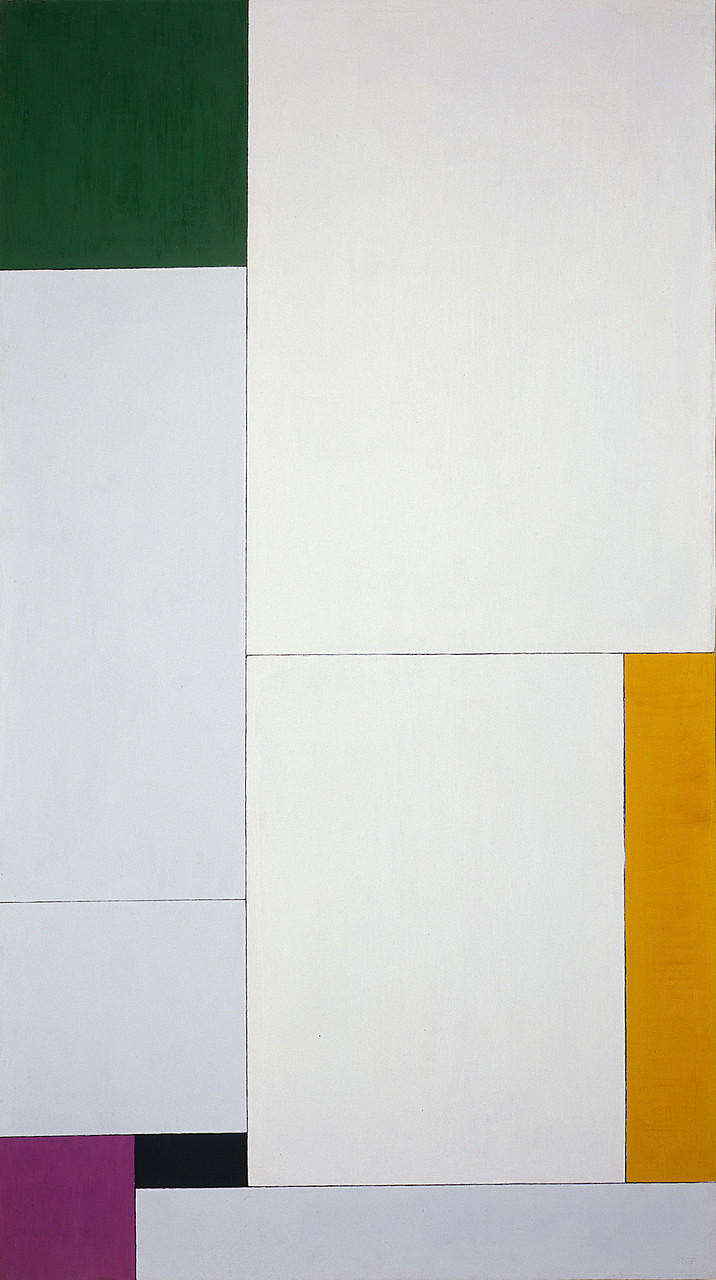
Composition Derived from the Equationwith Green, Orange, Violet (Black) by Georges Vantongerloo (1930, Oil on Canvas, 119.4 x 68.2 cm, Guggenheim Museum, New York)
I leave it as an exercise to the reader to determine how this painting is derived from the stated equation.
Yesterday I was going through the “onboarding” process via Zoom with two new Editors at the Open Journal of Astrophysics (OJAp) when one of them mentioned a recent policy decision at the USA which means we’ll probably get even more papers submitted from there. I wasn’t aware of the decision, but there’s an article in the Times Higher about it here.
In a nutshell:
Under proposed rule changes published by the Office of Management and Budget, all journal publication costs – “including page charges, article processing charges (APCs), or similar fees such as open access fees for professional journal publications and other peer-reviewed publications” – will become “unallowable under federal awards”.
It is important to stress that at this stage the change is proposed rather than actual and it remains to be seen whether it will stand. I think it should because publication fees, article processing charges or whatever you call them are a complete waste of money.
The Times Higher article frames this as “Trump’s ban on paying open access fees”. I was worried to be finding myself in agreement with Donald Trump on anything, but I very much doubt that Trump himself knows anything about scientific publishing or has had much of a hand in this decision. It seems to me to be eminently sensible to ensure that funds meant to be directed at research are not frittered away on page charges. If I were involved in running a research institution I would make it a disciplinary offence to spend money on publication fees.
Of course the academic publishing industry is upset about the proposal claiming that scientific publishing is “high cost”, which it is but only because the publishers rake in huge profits. The way forward, as I have argued many times (e.g. here), is Diamond Open Access, a exemplified by OJAp. The marginal cost per paper article published for OJAp is just $10 and we have at least as much impact as the other leading journals in astrophysics.
I have been surprised how many researchers from the USA are already using OJAp, including many from top institutions such as Harvard, Caltech, Princeton and Chicago. The surprise is basically that authors from the USA have for many years been used to paying page charges for publishing in the Astrophysical Journal and others from the AAS stable. This was the case even before digital journals came on the scene and well before the Open Access movement. I suppose American authors put up with page charges because they felt they had to, but that is no longer the case.
Will we get even more submissions from the USA as a result of this policy change? We’ll just have to wait and see…
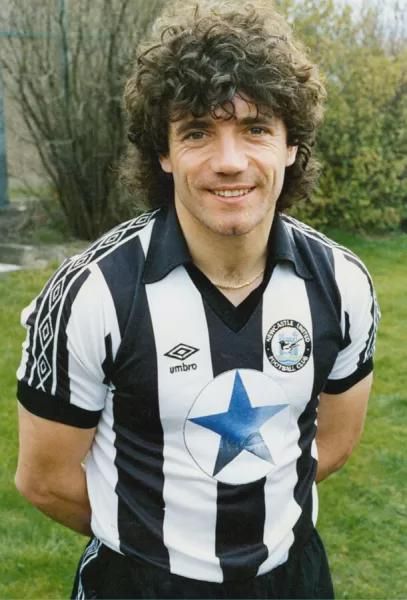
More very sad news. Kevin Keegan (left) has passed away from cancer at the age of 75. He made his reputation at Liverpool, and in Germany, but I remember him best as a player and captain of the Newcastle United team that got promotion to the (then) First Division in 1984. At that time I was a student at Cambridge and member of the local branch of the NUFC Supporters’ Club so I got to see him play quite a few times. Keegan retired from playing at the end of that season and bid an emotional farewell from St James’s Park after the final game against Brighton.
Kevin Keegan was an attacking midfielder who usually operated in the inside-right position. Very good on the ball and an excellent finisher, he was also surprisingly effective in the air. I say “surprisingly” because he wasn’t a very big man, around 5 foot 8 inches tall. After moving to Hamburg he was named European Footballer of Year for two successive years (1978 and 1979). It was quite unusual in those days for English footballers to play on the continent, but Keegan seems to have thrived there.
Later on, in 1992, he rejoined Newcastle United as manager and brought them to promotion to the Premier League. They team led for most of the 1995/6 season but ended up in second place. He had assembled a wonderful group of attacking players but the team’s defensive frailties cost them the title. Keegan had a rather fragile character, and the strain obviously got to him and thence to the players. He was never a great tactical manager – my Dad said Keegan was more of a mascot than a manager – but that team played some great football. Was that really 30 years ago?
On a more personal note, in the 1990s, my Mum was working at a school for physically handicapped children in Newcastle. One day they were visited by Kevin Keegan and some of the Newcastle players. Such PR trips were not uncommon and the staff didn’t think much of them. She didn’t care for footballers in general, but told me that Keegan was very different from most of the other visitors they got. He ignored the photographers aand the formal itinerary and just went to sit on the floor chatting with the kids around him. I never met him in person but it seems he was a genuinely nice man in private life.
P.S. Though he was born in Doncaster, “Keegan” is an Irish name. His paternal grandfather was born in Ireland and moved to Newcastle to work as a miner. He could therefore have played for Ireland rather than England.
The views presented here are personal and not necessarily those of my employer (or anyone else for that matter).
Feel free to comment on any of the posts on this blog but comments may be moderated; anonymous comments and any considered by me to be vexatious and/or abusive and/or defamatory will not be accepted. I do not necessarily endorse, support, sanction, encourage, verify or agree with the opinions or statements of any information or other content in the comments on this site and do not in any way guarantee their accuracy or reliability.