We come to it at last. Today is the day of the greatest sporting event of the year, the day we have been waiting for, the event that the eyes of the world will be trained upon. I refer of course to the All-Ireland Senior Hurling Championship Final which takes place this afternoon at Croke Park in Dublin. Throw-in is at 3.30pm.
I’d love to experience the atmosphere of an All-Ireland final in person but it’s an impossible task to get tickets so I’ll be watching the match on TV. Here in Maynooth we get a sample however as many supporters park their cars at the GAA ground in Maynooth and take the train to Drumcondra, which is close to Croke Park. The town will be filled with fans in the green of Limerick or the maroon-and-white of Galway. There will probably more of the latter, as Maynooth is on the direct route from Galway into Dublin. The All-Ireland Final is every bit as big as the FA Cup Final used to be when I was a kid.
I was a little concerned that the Final would be played in sweltering temperatures, but it is a bit cooler today though still sunny. No rain is forecast, but the temperature will be around 21ºC with light northerly winds of about 8km/h. Close to ideal conditions, I’d say.
The bookies have Limerick strong favourites at 1/2 with Galway 5/2, but you should bear in mind that last year Cork were strong favourites, but lost to Tipperary after a stunning second-half turnaround. Holders Tipperary had a poor season this time around and didn’t make it to the knockout stages. Cork were beaten by Galway in a semi-final this year. A peculiarity of the Hurling Championship is that Galway, which is in Connacht, play in the Leinster division (because there isn’t enough competition in Connacht). Just few years ago Limerick were invincible, winning four consecutive All-Ireland finals (2020-3) but faded a bit more recently. Can they return to winning ways? We’ll see. I’ll update at half-time and full-time.
Half-Time Update: Galway 0-08 Limerick 0-13. A low-scoring game so far, with Limerick starting to exert control as half-time approached. The bad news for Galway is that they have only 2 points from play and that Limerick were playing into the wind in the first half…
Full-Time Update: Galway 1-18 Limerick 1-29. Limerick are the All-Ireland Champions! A convincing win for Limerick, who pulled away in the second half and won comfortably. Galway’s goal was scored from a penalty right at the end so was a mere consolation. The result is a repeat of the 2018 final and Limerick have now won six of the last nine All-Ireland titles.
P.S. I believe there’s some football on later too.
Update: the World Cup final was truly dreadful but the better team won in the end. No credit to Argentina for their behaviour during and after the game either.
A couple of months ago I did a post about the Guardian’s list of what it deemed to be the 100 best novels of all time. One book on that list was Pedro Páramo by Juan Rulfo. I’d never heard of it before, and was delighted to receive a gift of it (and relieved that it was an English translation from the original Spanish). I’ve just finished reading it.
The story, set in Mexico, begins with a character called Juan Preciado, who promises to his mother on her deathbed that he will travel to a place called Comala to find his father, whom he has never met before. The book begins with a conventional first-person narrative by Preciado about his journey, but soon dissolves when he reaches his destination into complex fragments told in different voices. Thereafter the tale resolves itself into a series of conversations and encounters, but the precise sequence of these is difficult to discern. For instance, about halfway through the book we discover that everything that has happened is actually a flashback to much earlier events. We never find out whether the events depicted are memories or hallucinations nor whether the characters are alive or dead. It’s as if Preciado has wandered into two parallel versions of Comala, one populated by the living and one by ghosts. The original narrator himself dies but then carries on the narration as a ghost.
This is a highly original and deeply mysterious novel. Very little in this book is what it seems at first reading. It’s only 123 pages long (in the Edition I have), but it took me quite a while for me to find a path through the labyrinth, and even then I found much of it unfathomable, but I think that is precisely what it is supposed to be.
P.S. The Edition I have has a foreword by Gabriel García Márquez, who won the Nobel Prize for literature in 1982, who cites Rulfo as an inspiration. It’s been a long time since I read his masterpiece One Hundred Years of Solitude but I remember it well enough to see the influence.
It’s time once more for another Saturday update of activity at the Open Journal of Astrophysics. Since the last update we have published a further six papers, bringing the number in Volume 9 (2026) to 151 and the total so far published by OJAp up to 599.
I will continue to include the posts made on our Mastodon account (on Fediscience); these announcements also show the DOI for each paper.
The first paper to report this week, published on Tuesday 14th July, is “On combining estimated and analytic covariance matrices” by Alan Heavens (Imperial College London, UK), Lorne Whiteway (University College, London, UK) and Elena Sellentin (Leiden University, The Netherlands). This article, published in the folder Cosmology and Nongalactic Astrophysics, presents an accurate approximation for the combined likelihood function in cosmological data analysis, improving upon previous methods by better representing the heavy tails of the true distribution.
The overlay for this paper is here
You can find the officially accepted version on arXiv here and the announcement on Fediverse here:
New Publication at the Open Journal of Astrophysics: "On combining estimated and analytic covariance matrices" by Alan Heavens (Imperial College London, UK), Lorne Whiteway (University College, London, UK) and Elena Sellentin (Leiden University, The Netherlands)
The second paper for this week, also published on Tuesday 14th July in the folder Cosmology and Nongalactic Astrophysics is: “Line-of-sight shear in SLACS strong lenses II: validation tests with an extended sample” by Natalie B. Hogg (U. Cambridge, UK), Daniel P. Johnson (Université de Montpellier, France), Anowar J. Shajib (U. Chicago, USA) and Julien Larena (Montpellier). The study described in this paper models 27 additional gravitational lenses, finding a significant fraction with unexpectedly large line-of-sight shears. Factors like redshift, filter, and signal-to-noise ratio don’t significantly affect shear magnitudes.
The overlay looks like this:
The official version of the paper can be found on arXiv here and the Fediverse announcement here:
New Publication at the Open Journal of Astrophysics: "Line-of-sight shear in SLACS strong lenses II: validation tests with an extended sample" by Natalie B. Hogg (U. Cambridge, UK), Daniel P. Johnson (Université de Montpellier, France), Anowar J. Shajib (U. Chicago, USA) and Julien Larena (Montpellier)
New Publication at the Open Journal of Astrophysics: "Investigating the Dark Energy Constraint from Strongly Lensed AGN at LSST-Scale" by Sydney Erickson (Stanford University, USA) and 13 others on behalf of The LSST Dark Energy Science Collaboration
New Publication at the Open Journal of Astrophysics: "University of Hawaii 88-inch Telescope Observations of the Interstellar Comet 3I/ATLAS: Spectrophotometric Blue-Sensitive Spectral Time Series Spanning Two Months from Discovery" by W. B. Hoogendam (University of Hawaii, USA) and 24 others from around the world.
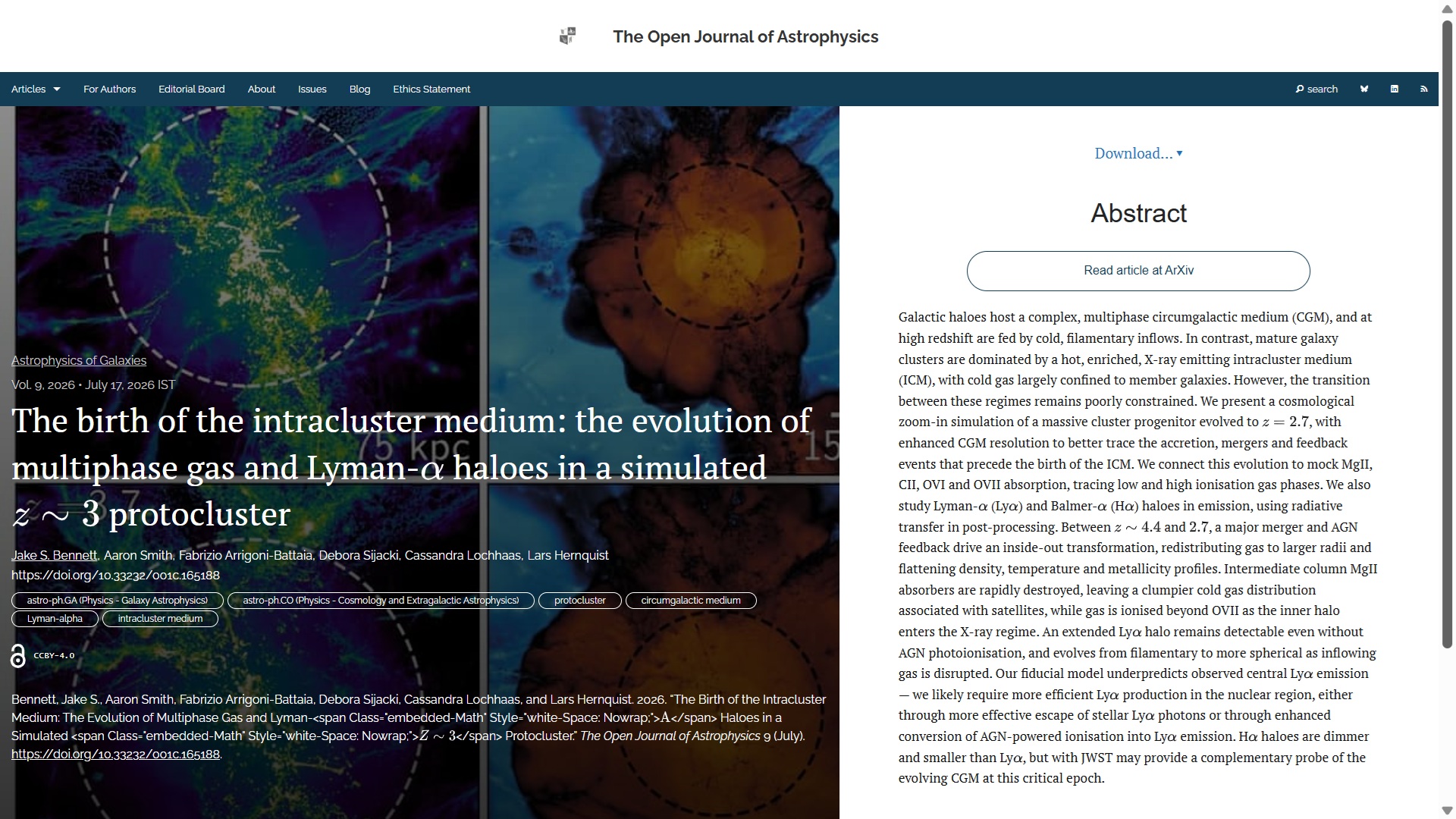
The fifth paper of the week, published on Friday 17th July in the folder Astrophysics of Galaxies, is “The birth of the intracluster medium: the evolution of multiphase gas and Lyman-α haloes in a z~3 simulated protocluster” by Jake S. Bennett (Harvard Smithsonian CfA, USA), Aaron Smith (U. Nottingham, UK), Fabrizio Arrigoni-Battaia (MPA Garching, Germany), Debora Sijacki (U. Cambridge, UK) , Cassandra Lochhaas (CfA) and Lars Hernquist (CfA). This study uses a cosmological simulation to explore the transition from complex galactic haloes to mature galaxy clusters, focusing on gas distribution, ionisation, and emission changes during this evolution.
The overlay for this one is here:
You can read the final version of this one on arXiv here and the Mastodon announcement is here:
New Publication at the Open Journal of Astrophysics: "The birth of the intracluster medium: the evolution of multiphase gas and Lyman-α haloes in a z~3 simulated protocluster" by Jake S. Bennett (Harvard Smithsonian CfA, USA), Aaron Smith (U. Nottingham, UK), Fabrizio Arrigoni-Battaia (MPA Garching, Germany), Debora Sijacki (U. Cambridge, UK) , Cassandra Lochhaas (CfA) and Lars Hernquist (CfA).
The sixth and final paper of this week is “Density reconstruction from biased tracers: Testing the equivalence principle through consistency relations” by Lawrence Dam and Omar Darwish (Université de Genève, Switzerland). This was published on Friday 17th July in the folder Cosmology and Nongalactic Astrophysics. It proposes using quadratic estimators to test the weak equivalence principle on cosmological scales, offering a practical alternative to the conventional bispectrum approach.
The overlay for this one is here:
You can find the final accepted version on arXiv here and the Mastodon announcement is here:
New Publication at the Open Journal of Astrophysics: "Density reconstruction from biased tracers: Testing the equivalence principle through consistency relations" by Lawrence Dam and Omar Darwish (Université de Genève, Switzerland)
As you can see we have now published over 150 papers this year and are just one shy of 600 in total. I expect we’ll pass that milestone next week. I’ll do another update next Saturday.
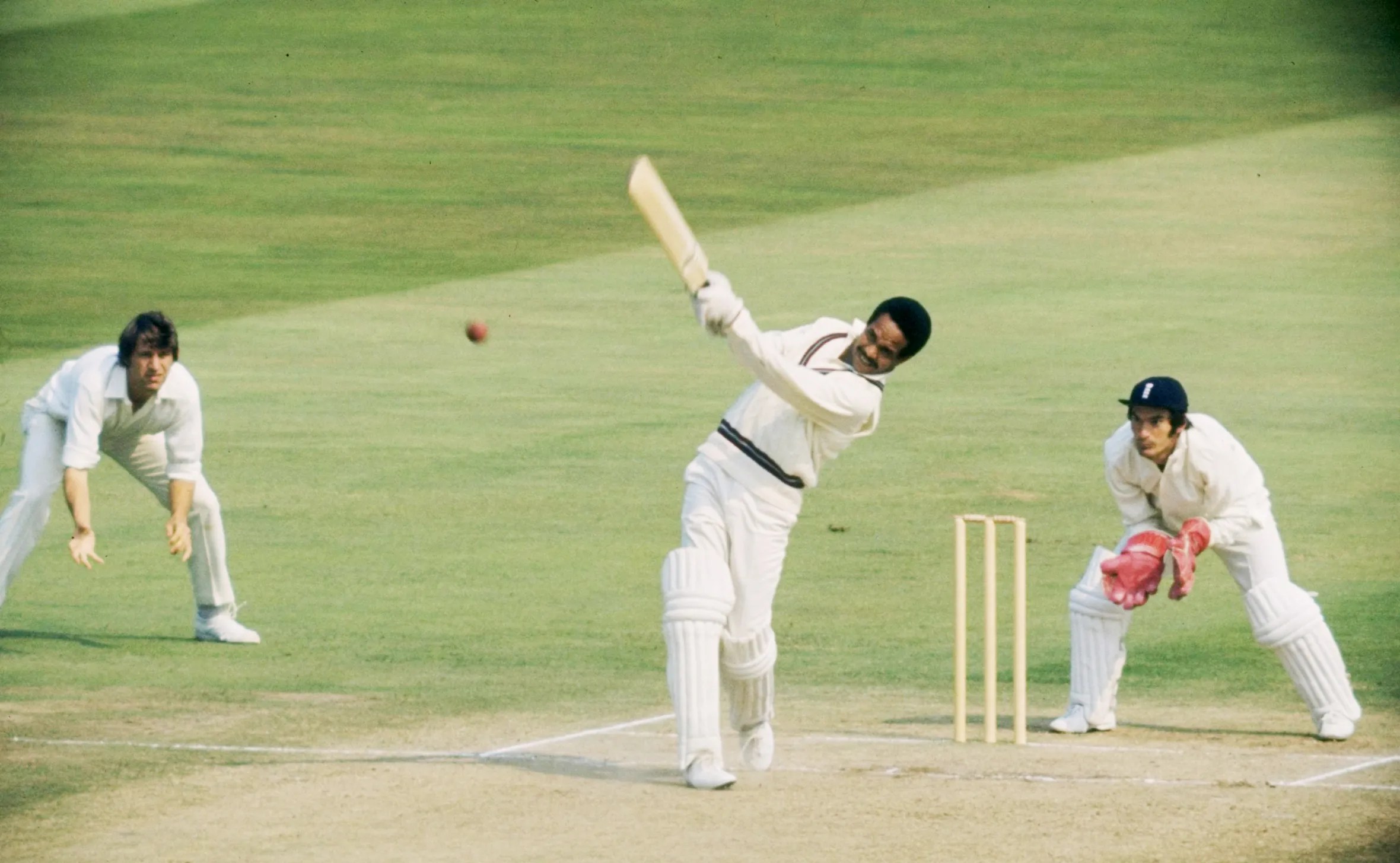
I just heard the very sad news of the death at the age of 89 of cricketing legend Sir Garfield (“Garry”) Sobers. He was a superb player, a genuine all-rounder. With the bat he was an extraordinary attacking strokeplayer, being the first to hit six sixes in an over (for his adopted county, Nottinghamshire, against Glamorgan in 1968.
I know there’s more than a suspicion that the dropped catch off the 5th ball might have been deliberate, but still…
When I lived in Nottingham my next door neighbour had many memories of Garry Sobers. He was fond of the nightlife, and also liked to bet on the horses. As a captain Sobers was also a bit of a gambler, often making very generous declarations. It didn’t always come off, but it sure made for exciting cricket.
Sobers’s maiden test century against Pakistan turned into a mammoth 365 not out. His batting average in 93 test matches was 57.78, a number that a specialist bat would be proud of. But he was also a superb bowler with the knack of getting good batsmen out, usually with his fast left-arm inswingers bowled over the wicket. Here is an example of him getting Geoffrey Boycott out. He always seemed to enjoy doing that. It’s a low resolution clip, but just look at the swing!
Of that delivery, which got him out lbw, Boycott later said “It was missing off, missing leg, and hitting middle halfway up”. You can tell he knew he was out. (When I played cricket at school I never figured out to bat aginst left-arm over the wicket bowlers even if they didn’t swing…). Sobers was also an adept left-arm spin bowler, who could bowl orthodox but was also adept at the Chinaman (a term for left-arm wrist spin that has fallen into disuse in recent years, but was common in my youth). I should also mention that he was an exceptional fielder too at a time before one-day cricket increased the general level of fielding.
I genuine all-rounder who reaches the level of international excellence at both batting and bowling is very rare in cricket. Most all-rounders are either bowlers who can bat a bit or batters who can bowl a bit. Sobers was the only one in his generation who was great at both. Cricket was fortunate later, from the late 70s to the 80s, to have three four at the same time: Ian Botham (England), Kapil Dev (India), Richard Hadlee (New Zealand) and Imran Kahn (Pakistan). But Sobers was probably the greatest of them all.
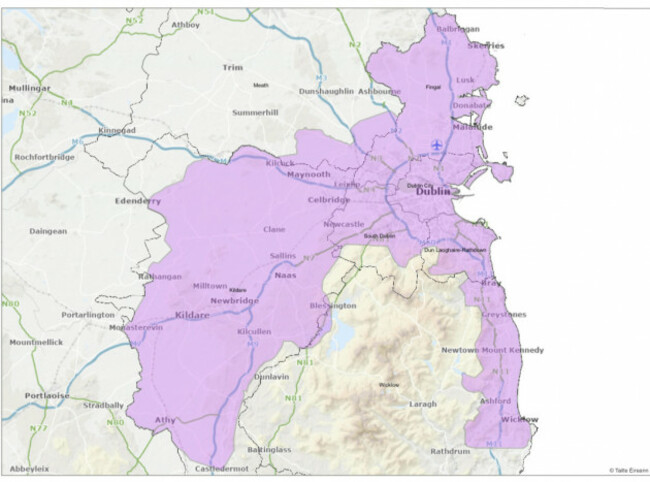
So a six-week hosepipe ban (covering all non-essential use of water) has just started in an area including Maynooth:
(I’m a little surprised that we haven’t been served with an official written notice about this but I’ll observe it anyway.)
Since we won’t be able to play with real water for a while, how about the next best thing in the form of this wonderful performance of Maurice Ravel‘s beautiful Jeux d’eauby Martha Argerich? This is the only version of this piece I have on CD, and I’d be happy to receive other suggestions through the comments box, but I think it must be hard to beat for the sheer fluidity of the playing.
I’ve been thinking for some time whether to renew my (expired) British passport, and finally decided to do so. No longer being resident in the UK I thought this would require a trip to the Embassy in Dublin, but that isn’t the case these days. One has to apply online, including supplying a digital photograph, send the old passport off by courier, then wait for the new one to arrive (by courier).
One problem with doing this is that the format of digital picture required for a British passport is not the same as for an Irish one, so most of the automatic machines (“Photo-Me”, etc) in Ireland are no use. I was able to take advantage of a recent trip to London, however, by using such a machine in Paddington station. I had plenty of time for that given the train delays. I got a few printed photos at the same time, in case I need them, but all you need for the passport is a photo code. The images are stored until used in the passport application.
And so it came to pass that today I completed the online application, paid the fees, and went to the local Post Office to send the old one to HM Passport Office. Now I have to wait and see how long it takes for my new passport to arrive. About a month, they say. We’ll see.
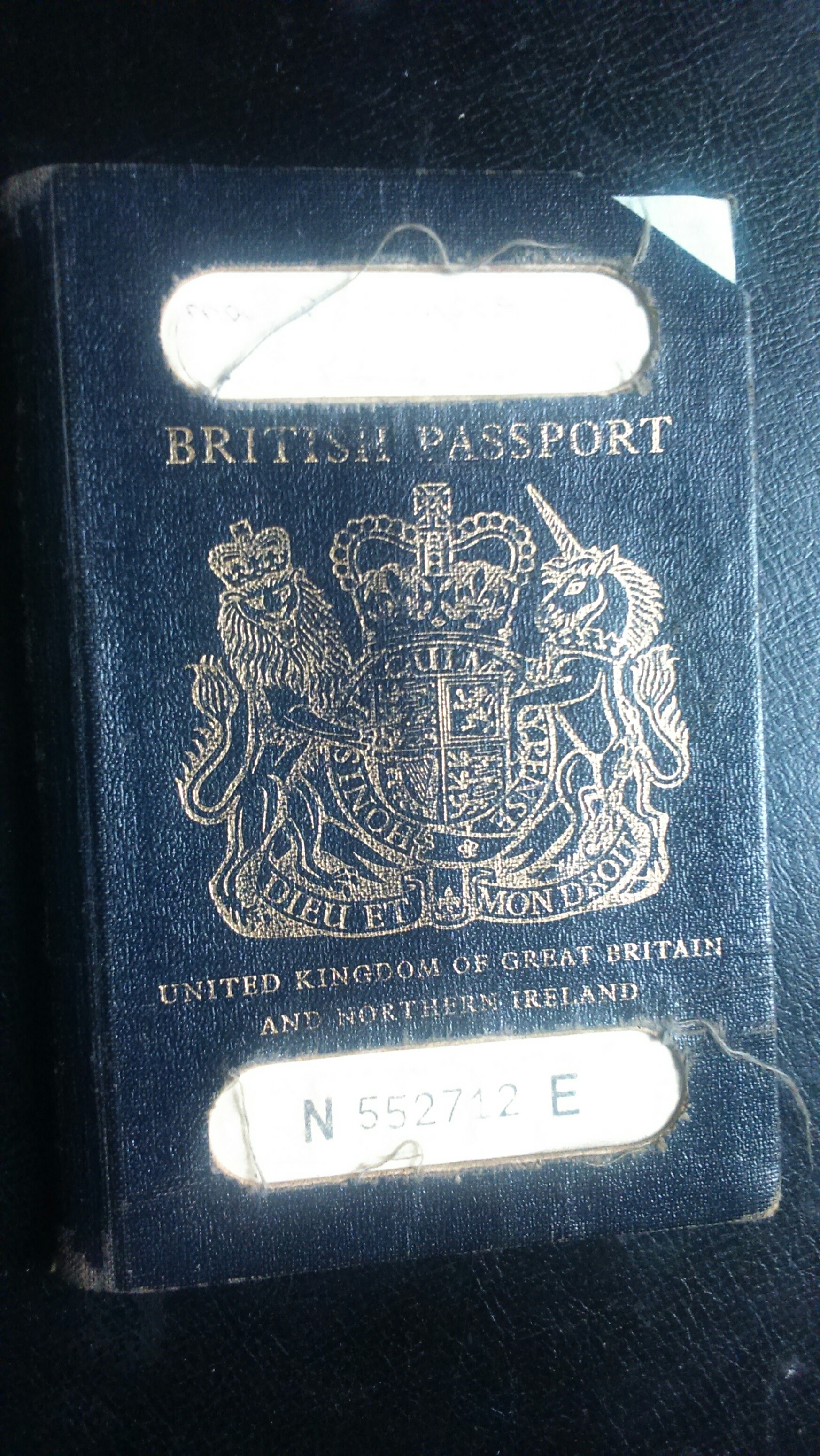
The new one will be dark-blue or black, like the very first one I ever had (left). That one was issued in 1986 and expired in 1996. I leave it as an exercise the reader to calculate how many I have had since then!
Whatever its design it will not allow me the right to live, work and retire freely within the European Union, so it will be of considerable less value than my Irish one.
I was for a time under the impression that having a British passport would make it easier should I ever want to enter the UK from somewhere other than Ireland, but I don’t think this is true. Unlike other EU citizens, according to the provisions of the Common Travel Area (CTA), Irish citizens do not require an ETA to enter the UK. They just need a valid Irish passport. Still, I think it will be useful to have a spare and I’m now used to having multiple identities!
I recently travelled to the UK and back by ferry. That journey being within the CTA a passport is not strictly required – other forms of photo-ID are acceptable – but I took mine anyway, as I don’t have a driver’s licence and we don’t have official government-issued ID cards in Ireland so I wasn’t sure whether they would accept any of the cards I have with my picture on it (e.g. my Maynooth staff card). As it happened the ID checks were very cursory. When I checked in at Dublin Ferry Port, the assitant there only wanted my ticket number and didn’t ask to see my ID at all. It was the same coming back from Holyhead. On arrival at Holyhead, there was a border post staffed by several officers, but they waved most passengers through (including me). On returning to Dublin the check was even more perfunctory: there was just one guy and he seemed more interested in welcoming everyone to Dublin than looking at any documents.
The CTA means that if you fly from Dublin to the UK you generally arrive at a place in the airport dedicated to such passengers. This is particularly convenient flying to Heathrow Terminal 2: on arrival you just walk through the Baggage Reclaim and out into the airport without passing any checks. You still need a passport, though, as airlines require this form of identification and it is scrutinized when you check in and when you board the plane. The only airport I know of that doesn’t have a simplified arrival system for CTA passengers is Dublin. They have no separate facilities, so you have to go through passport control with all the other passengers. That can be a bit inconvenient if lots of flights have arrived at the same time. I suppose the people who run Dublin Airport do not think it’s worth having a CTA arrivals facility.
Back into the swing of things in Maynooth, getting ready for the repeat examinations that start next month, I realized that I had forgotten to pass on an interesting paper that I found out about a few weeks ago but was reminded of while in London so I’m remedying my omission now. The title is The Coherence Principle: A Falsifiable Prior for Model Selection from the Grammar of Theories by Raul Jimenez, Carlos Peña Garay, Fergus Simpson, and Licia Verde. It addresses the issue of how to assign prior probabilities. We know how to do this in cases where the models concerned belong to a family differentiated by relatively simple parameters (as is the case in the standard cosmological framework), but for more complex differences the appropriate prior is difficult to choose. I see the paper as an attempt to extend the work of Ed Jaynes, though I’m not sure the authors see it quite in those terms!
Here is the abstract:
Bayesian model selection in cosmology and particle physics is often performed where posterior odds inherit a strong, often unacknowledged dependence on the prior assigned to competing models. Standard responses — reference priors, hierarchical priors, or appeals to naturalness — ignore relevant theoretical knowledge or rely on criteria hard to define operationally. We propose the Coherence Principle: a reproducible prescription for assigning model priors according to compatibility with the validated structure of an existing theory. This structure, grammar, includes symmetries, conservation laws, locality, Lorentz invariance, and universality patterns. Unmotivated violations of these rules incur a coherence cost, converted into a prior weight through a maximum-entropy exponential form controlled by one calibratable parameter α. The resulting prior is distinct from both the Bayesian Occam factor and naturalness: it penalizes not parameter volume or fine tuning, but departures from validated theoretical grammar. We illustrate the principle with examples from cosmology and fundamental physics: neutrino mass mechanisms, dark energy and modified gravity, inflation, beyond-Standard-Model sectors, and hierarchical astrophysical inference. We test it also on four historical cases — general relativity, Pauli’s neutrino, parity violation, and special relativity — where evidential and theoretical contexts can be reconstructed. These examples show that it favors the historically successful choice when the proper grammar is defined in the correct domain and time. The Coherence Principle makes explicit a common but usually tacit part of physical reasoning: trust in validated structural rules. It turns this judgment into a transparent, testable, and overrulable component of Bayesian inference, leaving empirical likelihoods free to dominate when data are sufficiently constraining.
I was very sad this morning to read the news that Sam Neill has passed away at the age of 78. He was a very fine and exceptionally versatile actor. Among many other roles I remember him well as the sadistic and corrupt Chief Inspector Chester Campbell in Peaky Blinders. I was impressed by his convincing Ulster accent but then found out he was actually born in Omagh, County Tyrone.
About 25 years ago (!) I made a very brief appearance in a BBC documentary series called Space for which Sam Neill (left) was the narrator. Apparently he only agreed to do the job on condition that they would film his segments at his home in New Zealand. I remember talking to the production team about Sam Neill and they all said he was not only very professional in his work but also a very nice man. These things don’t always go together…
After the episode I was in – the last of six – was broadcast, my Mam rang me. She didn’t mention my part at all, but asked “That Sam Neill, is he nice?”. I had to explain that I never met him, as they filmed his segments after all the other location sequences. “Oh well,” she said. “At least he knows your name”.
The following clip shows the item I took part in. Originally we were going to demonstrate wormholes using a snooker table, clever editing and reversed video. The producer, Jeremy Turner, decided that wouldn’t look spectacular enough so instead we went to St Anton in Austria: I was flown over the Alps in a helicopter and then driven through the Arlberg tunnel in an impressively fast car. Well worth the cost to license fee payers, I’m sure, even if the three-day trip to Austria by me and a crew of six as well as the hire of the helicopter ended up as a mere three minutes of screen time.
The item is daft, I know, and I don’t really believe any of that stuff about wormholes. It was great fun doing it, but hard work. I remember after the shoot we had a few drinks to wrap it up then left on a very early flight the next morning to the UK. I got back to Nottingham University just in time for a 10am lecture.
Anyway, the episode I was in was called To Boldly Go. I remember suggesting to the producer that the only way to travel faster than light in the manner required was with a split infinitive drive, but they didn’t use that in the final script.
Notice how, in the helicopter sequence, I give the appearance of being completely terrified. A fine piece of acting by me, I thought. *Cough*
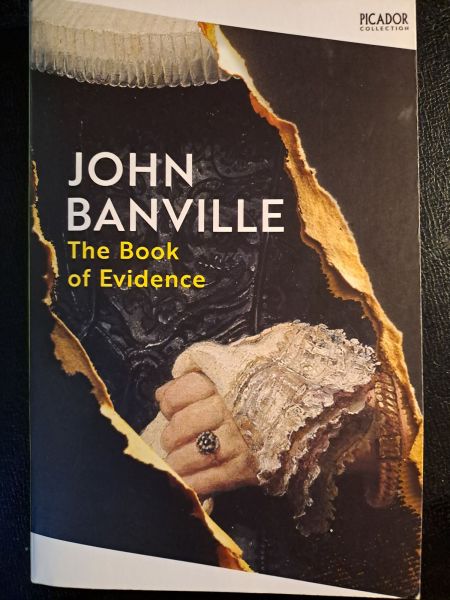
The Book of Evidence, by Irish author John Banville, isn’t a new novel – it was published in 1989 – but it was recommended to me a couple of years ago by an Irish friend and was in my pile of books to read until I took it with me on a recent trip.
I wasn’t sure what to expect of this book, but found it an intriguing and unsettling read. Shortlisted for the Booker Prize in 1989, The Book of Evidence is the tale of a dark journey into the mind of a murderer.
The story revolves around Freddie Montgomery who is an educated man – a scientist – but an unsympathetic and unsavoury character. I’d say he is a borderline sociopath, actually. He is the (evidently unreliable) narrator of the story, which is essentially that he tries to steal a painting in order to sell it and settle a debt, but in the course of the attempted robbery he kills a young servant girl in a very brutal way. He is eventually arrested and tells his story on remand awaiting trial. The plot is apparently based on a true story.
This isn’t a whodunnit at all, as the killer tells us what he did. There is a puzzle, though, which is why he killed the girl. The reader never finds out, but that’s probably because Freddie Montgomery himself doesn’t know. In his account he looks back over his entire life, he comes across as an aimless drifter who seems confused by many of the things he has done. It’s only at the very end that he shows any remorse for the murder he committed. At least he realises that he can’t blame his actions on anyone but himself (although he would obviously like to).
We never find out what happens at his trial, as the account finished before it starts. So it’s not a courtroom drama.
In some ways this book echoes The Outsider by Albert Camus as well as Crime and Punishment and Notes from the Underground by Fyodor Dostoevsky. The confessional nature of the account in this book is given authenticity by Banville by making the narration dense and loquacious, with frequent detours and peppered with long words. Montgomery seem to be trying to impress the reader with his erudition but he just comes across as a narcissist. The cumbersome prose style is essential for conveying Montgomery’s inner voice, but it doesn’t make for easy reading. It’s not supposed to. I was intrigued enough to want to read more by Banville, including a sequel to this novel, Ghosts.
P.S. For non-Irish readers it is perhaps worth spelling out that, in Irish criminal law, the “Book of Evidence” is a mandatory set of documents the prosecution must serve to the defence before a trial in a higher court. It’s a term one finds quite often in media reporting of court cases in Ireland.
I took another ferry back from Holyhead to Dublin last night. The outbound journey was via Irish Ferries but I returned on the Stena Line. I left Holyhead at 22.15 and arrived at the Ferry Terminal at Dublin Port at 1.45am. I was a bit unsure what it would be like on such a late-night trip but the trip was uneventful. I’d had a very tiring day getting to Holyhead so I toyed with the idea of sitting in the bar and having a few drinks, but I thought better of that. Instead I found a quiet corner in one of the lounges where there was a bench seat, and managed to stretch out enough to get about an hour’s sleep.
I think quite a few passengers had booked cabins for the crossing. I didn’t think it was worth doing that for less than four hours aboard, but I will consider that next time I take a late-night ferry. There’s not much to see out of the window in the dark!
The disadvantage of being a foot passenger on these ferries is that you have to wait until all the people with vehicles have disembarked before getting a bus back to the terminal building, which adds about 30 minutes to the time. Anticipating the probability that I would be knackered topo fed up to try getting home by public transport with all my luggage in the early hours of the morning, I had booked a taxi to meet me at 1.45, the scheduled arrival time, but I didn’t actually meet the driver until after 2am. Sitll, I got home to Maynooth quickly and was tucked up in bed by 3am. I had to open all the windows as the house was very stuffy, but other than that all was well.
While I was staying in London I took a few trips by train here and there, most of them very shambolic. All the direct trains from London Paddington to Oxford were cancelled, so passengers had to get on very overcrowded trains that went through Oxford to other destinations. To get back to London I used a train to Marylebone which I didn’t know existed. It was slow, but got me back.
With these problems in mind I took an earlier train from Euston to Holyhead than I originally intended. I’m glad I decided that because even the earlier train was delayed by > 45 minutes leaving Euston. Worse, some other trains goint to Manchester and beyond were cancelled so passengers were advised to get on the train I was on and change at Crewe or Chester. The seat reservations weren’t working so the result was a very sweaty overcrowded train with standing room only, at least until Chester where many people got off. The uncomfortable journey made me break a 195-day blogging streak as I just couldn’t be bothered even when I got a seat. Instead I just relaxed and looked out of the window as we travelled along the coast of North Waves.
My train from Holyhead to London was delayed by over an hour as was the train back yesterday. The upshot of all that is that I get a 100% refund of the fare for the entire journey so it was effectively free (if you don’t count the cost of the stress and discomfort).
Anyway, this trip was my first experience of ferry+train to the UK and back. My summary of the experience is “Ferry Good, Train Bad”.
The views presented here are personal and not necessarily those of my employer (or anyone else for that matter).
Feel free to comment on any of the posts on this blog but comments may be moderated; anonymous comments and any considered by me to be vexatious and/or abusive and/or defamatory will not be accepted. I do not necessarily endorse, support, sanction, encourage, verify or agree with the opinions or statements of any information or other content in the comments on this site and do not in any way guarantee their accuracy or reliability.