New Publication at the Open Journal of Astrophysics

Posted in OJAp Papers, The Universe and Stuff with tags , , , , on April 28, 2023 by telescoper

Time for the announcement of yet another new paper at the Open Journal of Astrophysics. The latest paper is the 14th paper so far in Volume 6 (2023) and the 79th in all. This one is in the folder marked Astrophysics of Galaxies and its title is “Massive Star Formation in Overdense Regions of the Early Universe”. The early Universe aspect does of course imply considerable overlap with cosmology.

The (sole) author is our very own John Regan of the Department of Theoretical Physics at Maynooth University.

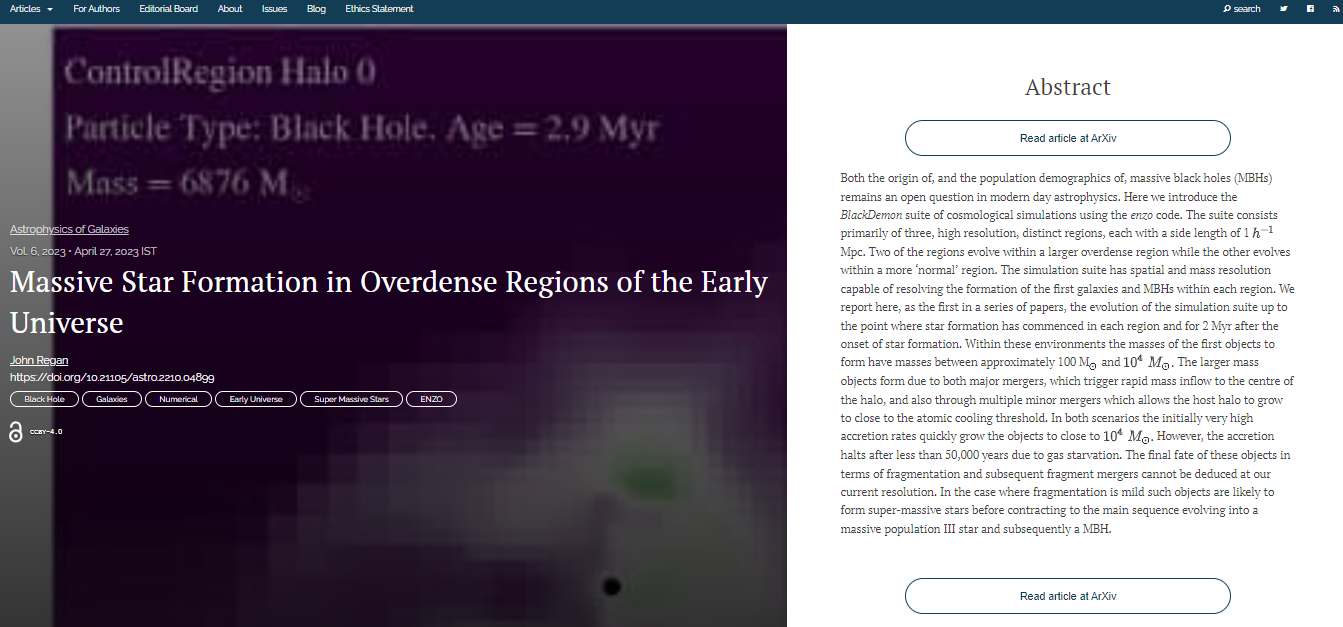
Here is a screen grab of the overlay which includes the  abstract:

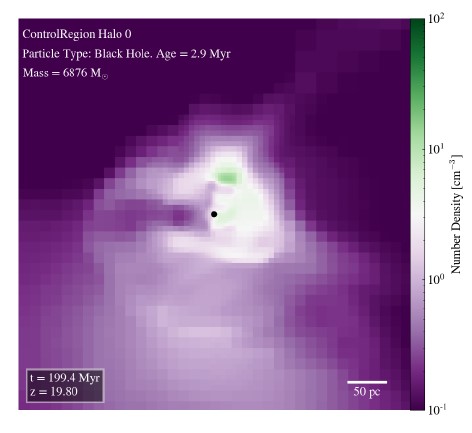
Here’s a bigger version of the image I chose for the overlay:


You can click on the image of the overlay to make it larger should you wish to do so. You can find the officially accepted version of the paper on the arXiv here.

Progress on Open Access?

Posted in Open Access with tags , , , , , , , on April 27, 2023 by telescoper

The current state of play with regard to Open Access publishing is very disappointing. The academic publishing industry seems to have persuaded the powers that be to allow them to charge exorbitant article processing charges (APCs) to replace revenues lost from subscriptions when they publish a paper free to readers. This simply transfers the cost from reader to author, and excludes those authors who can’t afford to pay.

This current system of ‘Gold’ Open Access is a scam, and it’s a terrible shame we have ended up having it foisted upon us. Fortunately, being forced to pay APCs of many thousands of euros to publish their papers, researchers are at last starting to realize that they are being ripped off. Recently, the entire Editorial Board of Neuroimage and its sister journal Neuroimage: Reports resigned in protest at the `extreme’ APC levels imposed by the publisher, Elsevier. I’m sure other academics will follow this example, as it becomes more and more obvious that the current arrangements are unsustainable. Previously the profits of the big publishers were hidden in library budgets. Now they are hitting researchers and their grants directly, as authors now have to pay, and people who previously hadn’t thought much about the absurdity of it all are now realizing what a racket academic publishing really is.

The people at the top have been slow to grasp this reality, but there are signs that this is at last happening, In the USA there has been the Nelson Memorandum (see discussion here). Now there is movement in the European Union, with member states apparently set on agreeing a  text to be published next month (May 2023) that calls for immediate open access the default, with no author fees. This is clearly how Open Access should be, though I am still worried that the sizeable publishing lobby will try to persuade research agencies and institutions to pay the existing fees on behalf of authors, which does not solve the problem but merely hides it.

I know I’m not alone in thinking that the current publishing ecosystem is doomed and will die a natural death soon enough. The replacement should be a worldwide network of institutional and/or subject-based repositories that share research literature freely for the common good. Universities and research centres should simply bypass the grotesque parasite that is the publishing industry. Indeed, I would be in favour of hastening the demise of the Academic Journal Racket by having institutions make it a disciplinary offence for any researcher to pay an APC.

We are lucky in physics and astronomy because arXiv has already done the hard work for us. Indeed, it is now a truth universally acknowledged* that every new research paper worth reading in these disciplines can be found on arXiv. Old-style journals are no longer necessary. It is great that arXiv is being joined by similar ventures in other fields, such as BiorXiv and EarthArxiv. A list of existing repositories can be found here. I’m sure many more will follow. What is needed is a global effort to link these repositories to each other and to peer review mechanisms. One way is through overlays as demonstrated by the Open Journal of Astrophysics, there being no reason why the idea can’t be extended beyond arXiv. Other routes are possible, of course, and I would love to see different models developed. I think the next few years are going to be very exciting.

*It is also a truth universally acknowledged that anyone who doesn’t understand the reference to “a truth university acknowledged” has not read Pride and Prejudice by Jane Austen…

A proto-cluster at z ~ 8!

Posted in The Universe and Stuff with tags , , , , on April 26, 2023 by telescoper
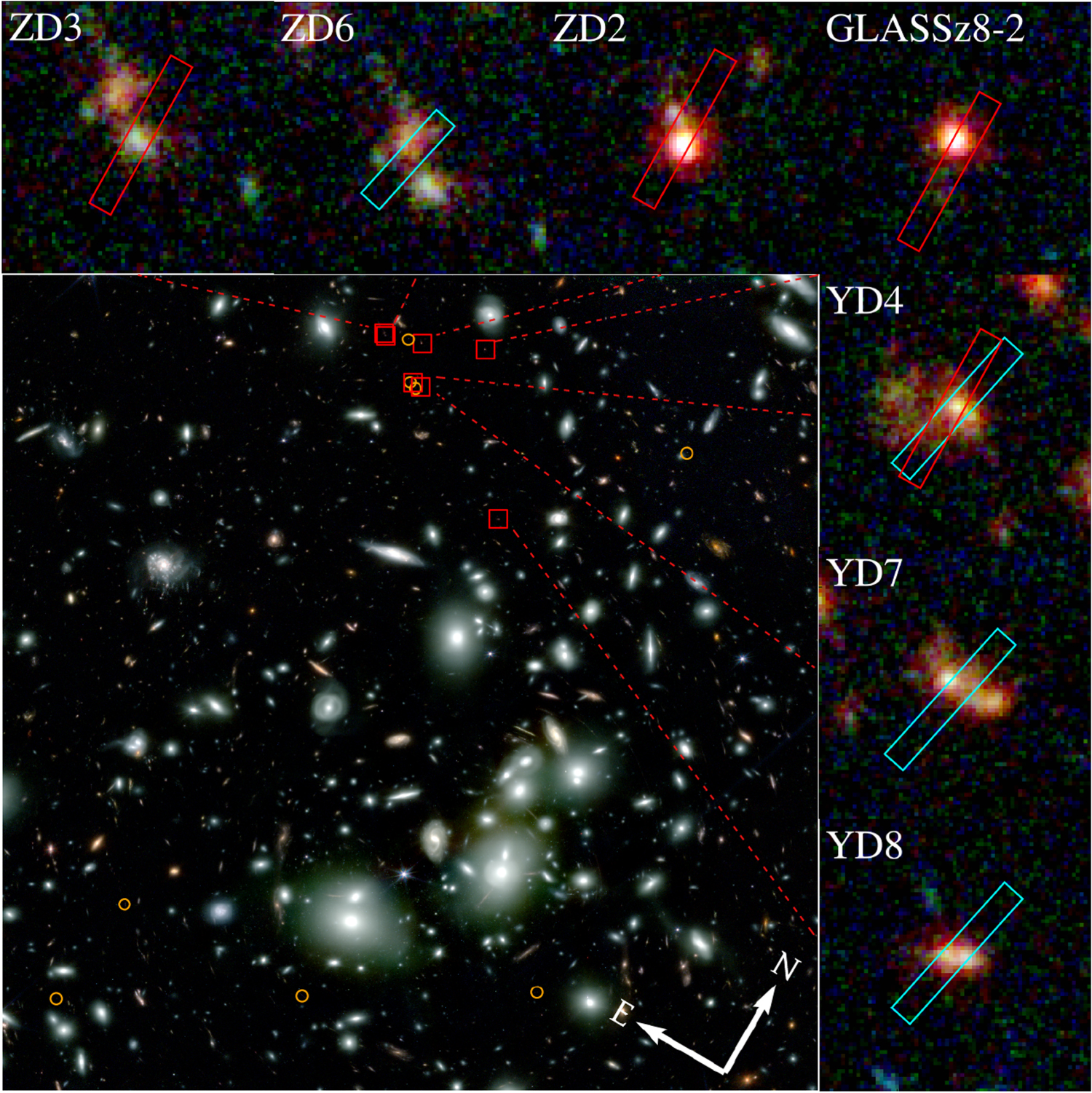
Blow-ups of the seven galaxies with spectroscopic redshifts, shown together with their positions near the line of sight to a foreground cluster.

I missed the paper containing this impressive picture when it first appeared on the arXiv, the primary source for astrophysics and cosmology research, but fortunately it has now been published on a secondary site, Astrophysical Journal Letters, with an accompanying press release so I can now do a quick post about it.

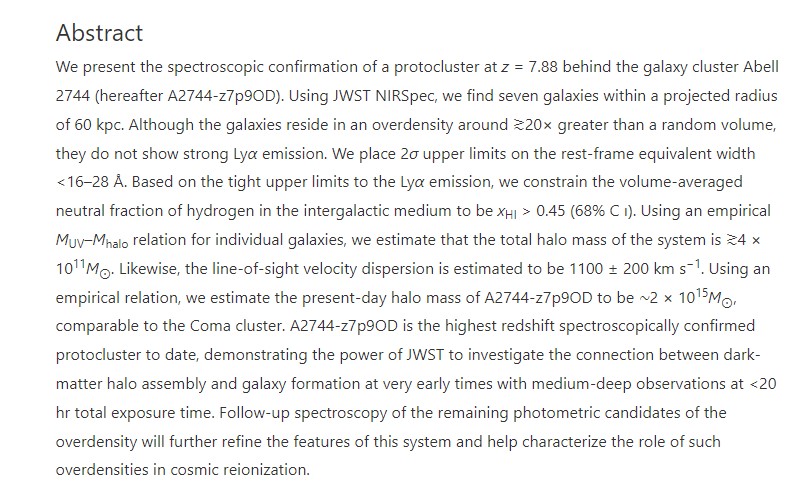
The article concerned, with lead author Takahiro Morishita of the California Institute of Technology (Caltech) et al. describes the detection using JWST of an apparent proto-cluster – seven galaxies in close proximity – at redshift z = 7.88. Here is the abstract:

Although only seven galaxies are identified, this does look like the very early stages of formation of an object that will grow into a giant galaxy cluster by the present epoch. The redshift of this progenitor corresponds to a stage of the Universe just 650 million years or so after the Big Bang, compared with the current age of about 14 billion years. As the abstract says, we would need to know more about other possible constituent galaxies and their motions to be sure, but it looks like a baby destined to grow into a monster…

Euclid Launch Window Update!

Posted in Euclid, The Universe and Stuff with tags on April 26, 2023 by telescoper

(The Euclid spacecraft will be launched via SpaceX on a Falcon 9 rocket from Cape Canaveral in July 2023, but no further details are publicly available right now.)

New Publication at the Open Journal of Astrophysics

Posted in OJAp Papers, The Universe and Stuff with tags , , , , , , , on April 25, 2023 by telescoper

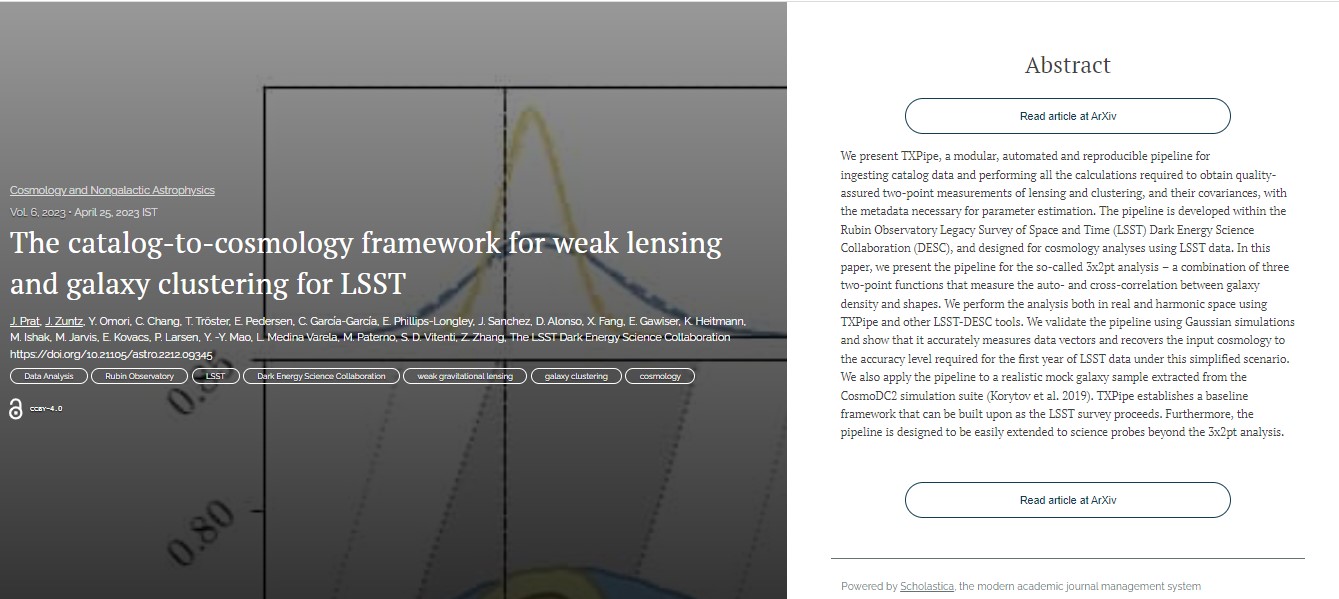
It’s time once more to announce a new paper at the Open Journal of Astrophysics. The latest paper is the 13th paper so far in Volume 6 (2023) and the 78th in all. This one is another for the folder marked Cosmology and NonGalactic Astrophysics and its title is “The catalog-to-cosmology framework for weak lensing and galaxy clustering for LSST”.

The lead author is Judit Prat of the University of Chicago (Illinois, USA) and there are 21 co-authors from elsewhere in the USA and in the UK. The paper is written on behalf of the LSST Dark Energy Science Collaboration (LSST DESC), which is the international science collaboration that will make high accuracy measurements of fundamental cosmological parameters using data from the Rubin Observatory Legacy Survey of Space and Time (LSST). The OJAp has published a number of papers involving LSST DESC, and I’m very happy that such an important consortium has chosen to publish with us.

Here is a screen grab of the overlay which includes the  abstract:

You can click on the image of the overlay to make it larger should you wish to do so. You can find the officially accepted version of the paper on the arXiv here.

The Swans of Maynooth

Posted in Maynooth with tags , on April 25, 2023 by telescoper
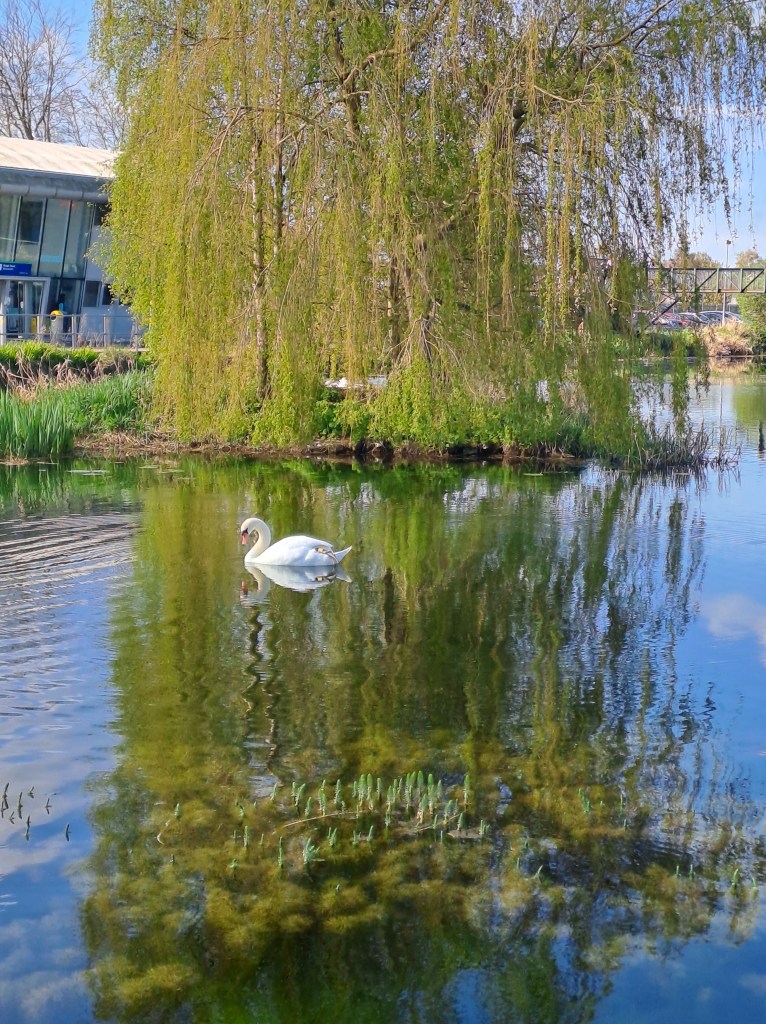
The Royal Canal near Maynooth, with Maynooth railway station in the background to the left.

Most mornings I walk to work at Maynooth University along a route that includes a short section of the towpath of the Royal Canal, roughly from the Mullen Bridge to Maynooth Harbour. There is a small island there which plays home to a pair of mute swans who have been nesting there at least as long as I’ve lived in Maynooth (more than five years). Swans mate for life and they’ve found a great spot there on the little island and have no reason to move.

I took the above picture as I walked in this morning. In the foreground, you can see the male swan (the cob) who is on patrol. If you look carefully you can see a splash of white on the island which is his partner, the pen, sitting on their nest. As you can see, the water in the canal is very clear, which made for an interesting combination of reflection and transmission. I don’t know the name of the plants that grow on the bottom of the canal, and would be grateful if anyone could enlighten me.

This time of year is particularly interesting on the canal because it is about now that the annual brood of cygnets will appear. The young will stay with their parents for the best part of a year then, suddenly, around March, they’re off to find their own way in the world and make room for the next generation.

Swans are bad-tempered at the best of times but when the eggs hatch and the chicks appear, the pen will become extremely aggressive. For most of the year, the swans tolerate other birds on their island, but when they have very young cygnets they are very protective, and regularly have a go at the other birds. Crows, herons and seagulls are a particular danger.

Anyway, they should hatch very soon now, and there’s always an overload of cuteness when they go for their first trip on the water on their mother’s back, like passengers on a stately galleon.

On SciPost…

Posted in Maynooth, Open Access with tags , , , on April 24, 2023 by telescoper

On of my colleagues this morning passed on details of a recent publication to put on the Twitter feed of the Department of Theoretical Physics at Maynooth. As far as I’m aware this is the first paper authored by a member of the Department to be published on SciPost, a Diamond Open Access journal.

I’ve known about SciPost for quite a while, but have been preoccupied with the Open Journal of Astrophysics (OJAp) and have not tracked its progress very closely, but I’m glad to see it going well. Its business model is very different from the Open Journal of Astrophysics but its commitment to publishing high-quality scientific papers free of charge for authors and readers alike is most commendable. Looking at the physics section I see that there are quite a few highly-cited papers among them, over a wide spread of topics, including high-energy physics. There are only a few papers in Astronomy, however- only three when I looked.

I’ve heard it said that one of the advantages of SciPost is that, because it allows authors to keep the copyright on their publications, they can post articles freely on arXiv for wider distribution without embargo or other restriction. That is true and laudable. The logic of the Open Journal of Astrophysics, however, is that most astrophysicists use arXiv as their primary source of research literature, so if you’re going to read it on arXiv why not dispense with the separate journal and just use an overlay?

Not all research areas are so wedded to the arXiv, however, and it is great that there’s a free alternative. I’m a little surprised that nobody has set up a particle physics overlay journal (yet), as the HEP community seems to use arXiv a lot. When I asked a particle physicist about this they said it had been discussed, but they decided that they were happy enough with SciPost as an OA platform. Fair enough. The important thing to me is to avoid the excessive Article Processing Charges (APCs) imposed by mainstream journals for OA publishing.

I note that the HEP community has SCOAP3, which pays for articles to appear in Open Access form in traditional journals. In other words it hides the cost from the scientists and effectively subsidizes the academic publishing industry. It is important that there are alternatives to traditional journals so that authors to have a choice whether to adopt the SCOAP3 route.

One final comment. On the Finance page for SciPost it states that the estimated average cost per paper published is €400. That’s at 2019 rates. It’s probably higher now. That cost is a lot less than a typical APC but is still about a factor of ten higher than the cost per paper for OJAp. SciPost has a large network of sponsors so it can cover this cost. The overlay model used by arXiv is much cheaper to run.

A Draft Strategic Plan for Maynooth (via ChatGPT)

Posted in Education, Maynooth with tags , , on April 23, 2023 by telescoper

Senior managers at Maynooth University are currently engaged in the expensive and time-consuming process of compiling a new “Strategic Plan“. All universities seem to feel the need to have one of these, although I’ve never understood what purpose is served by such a document. They are all remarkably similar to one another in any case. Anyway, this is what ChatGPT produced for free in a matter of seconds in response to the query “please write a first draft strategic plan for Maynooth University”:

Introduction:

Maynooth University is a leading university in Ireland founded in 1795. The University aims to provide high-quality education to its students and prepare them for successful careers and to contribute positively to society as a whole. As a forward-thinking institution, Maynooth University recognizes the need for strategic planning to continue its legacy of excellence and ensure that it remains at the forefront of education and research.to conduct innovative research that address the challenges of the 21st century. In order to achieve its goals, the university needs to develop a strategic plan that outlines its priorities and the steps it needs to take to achieve them.

Vision:

The vision for Maynooth University is to become a world-class institution of higher education that promotes excellence in teaching, research and community engagement. The university will strive to provide a stimulating and inclusive environment that inspires its students, faculty and staff to achieve their full potential.

Mission:

The mission of Maynooth University is to provide a transformative student experience that prepares graduates to be leaders in their fields. The university will contribute to the creation and dissemination of new knowledge through its research and scholarship. It will engage with local, national and international communities to promote social and economic development.

Goals:

The following are the key goals of Maynooth University:

1. To enhance the quality of teaching and learning:

Maynooth University will provide its students with a challenging and engaging learning experience that equips them with the knowledge and skills required to succeed in their chosen fields. The university will invest in innovative teaching methods, modern teaching equipment, and professional development opportunities for its faculty to enhance their teaching skills and delivery.

2. To advance research and scholarship:

Maynooth University aims to become a leading research institution known for its excellence in research, innovation, and scholarship. The university will prioritize research funding and support for its faculty, students, and research teams. It will also invest in research infrastructure, facilities and equipment to support cutting-edge research across a range of disciplines.

3. To foster community engagement:

Maynooth University will strive to promote social and economic development through community engagement, public service, and outreach. The university will work with communities, government, and other stakeholders to address societal challenges and create positive social impact. Maynooth University will also prioritize outreach and engagement with schools, businesses, and cultural organizations in the region.

Strategies:

The following are the strategies that Maynooth University will use to achieve its goals:

  1. Develop innovative and relevant degree programs that meet the needs of employers and society.
  2. Support faculty development, recruitment, and retention to ensure that Maynooth University maintains its position as a leading research institution.
  3. Expand research partnerships, collaborations and funding through strategic alliances with other universities, government and industry.
  4. Foster a culture of interdisciplinary research, linking research with teaching and learning, and research with community engagement.
  5. Promote a sense of community and belonging among the Maynooth University community through effective communication and engagement strategies.

Conclusion:

Maynooth University is committed to providing a world-class education, conducting innovative research, and contributing to the social and economic development of communities. The strategic plan outlines the goals and strategies that the university will undertake to achieve its vision and mission. The university will continually review and update its strategies to ensure they are aligned with changes in the higher education landscape to maintain its standing as a leading institution of higher learning.
Meanwhile, in an Arts & Humanities Faculty near you…

Posted in Education with tags on April 22, 2023 by telescoper
From Private Eye Magazine

P.S. I can’t wait to see what ChatGPT produces for Maynooth University’s new Strategic Plan…

Maynooth Open Day Admissions

Posted in Education, Maynooth with tags , , on April 22, 2023 by telescoper
The Day Before The Open Day

Well, it’s Saturday 22nd April and it’s another Open Day at Maynooth University. I was there for the similar event at this time last year, and many others before that, but others are doing it this year so I’m sitting at home drinking coffee and writing this blog. I hope it’s going well (though it is raining quite heavily as I write this).

This year’s event is in the new TSI building on the North Campus, a change of venue since last year when it was in the Iontas building. I went in there last night on my way home to have a look at the setup. Our stand was pretty bare then but it will be a bit more exciting now (I hope).

In previous years I taught the first-year module in Mathematical Physics taken by new students, some of whom recognized me from an Open Day. I won’t be teaching the first-years this September, though. I won’t be teaching anyone else this September, either, as I’ll be away on sabbatical for the whole academic year.

The real problem facing first-years, however, is that it seems that yet again this year’s Leaving Certificate results will be late. Last year, new students started a week later than returning students, meaning their teaching term was truncated. The shift from August release to September was excusable during the Covid-19 pandemic, but its continuation is a farcical and is causing huge stress for new students, arising from difficulties in finding accommodation and no time for proper induction events on top of the delayed start to lectures. Well have to wait until June to see how much all this has affected progression rates.

There was an opinion piece about this in the Irish Times last week, from an academic at Trinity, which I agree with and I think is well worth reading. Here’s a quote:

This may all have once felt like an inevitable consequence of the pandemic, but the novelty has long since worn off. Students and universities alike have been left frustrated and hugely discommoded.

The word “discommoded” is a considerable understatement. Let’s just hope that the start of next year is less chaotic than the last three. The academic year at Maynooth starts and ends a bit later than other Irish third-level institutions, so our students have only lost a week at the beginning. Elsewhere more time has been lost: two weeks at Trinity, for example. I wonder if this particular selling-point will be mentioned to prospective students at the Open Day?