How do we make accessible research papers a reality?

Posted in Open Access with tags , , , , on March 21, 2023 by telescoper

I wanted to advertise an event – an accessibility forum – organized by arXiv that looks interesting to anyone interested in open access publishing understood in the widest possible sense. It’s advertised as a practical forum, free for all:

Hosted by arXiv, this half-day online forum will center the experiences of academic researchers with disabilities who face barriers to accessing and reading papers. The forum will be useful for people across the academic authoring and publishing ecosystem who are committed to making accessible research papers a reality. Together, we can chart a path towards fully accessible research papers, and leave with practical next steps for our own organizations.

It’s on April 17th, from 1pm to 5pm Eastern Time (USA), which is 6pm to 10pm Dublin Time. You can find more details including information on how to register, here.

We usually focus on open access publishing in terms of the costs involved, but there is much more we can do in other respects to make scientific research as accessible as possible to as wide a community as possible. Having said that, this announcement did inspire me to go off

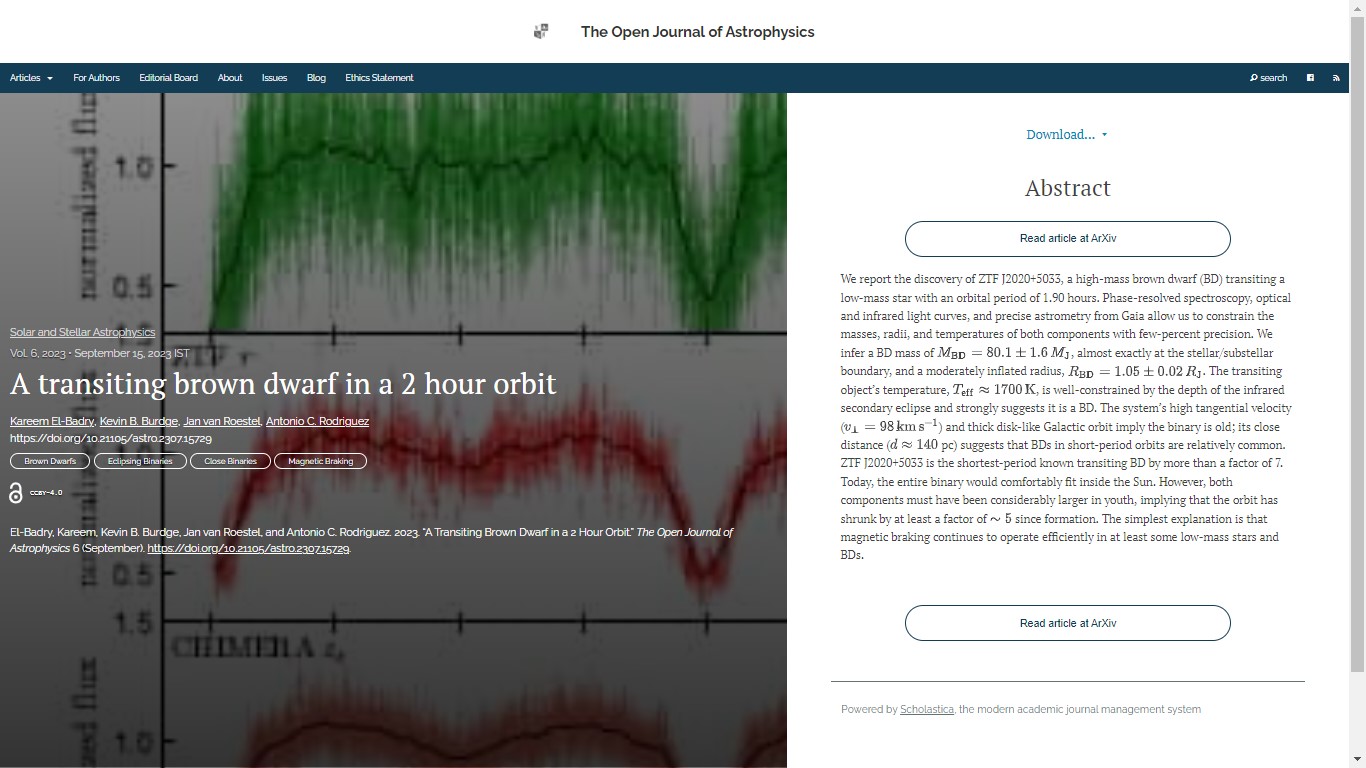
When I saw the word “ecosystem” in the description above, it reminded me of a brief discussion I had recently with a colleague who asked what I hoped to achieve with the Open Journal of Astrophysics (other than “world domination”). My answer was that I just wanted to show that there is a practical way to bypass the enormous expense of the traditional journal industry. Instead of just sitting around complaining about the state of things I wanted to demonstrate that it doesn’t have to be the way it is. The way the number of submissions to OJAp is increasing, it seems more and more people are becoming convinced.

It seems to me that the switch from subscription charges to the dreaded Article Processing Charge has help generate momentum in this direction, by making it even more explicit that the current arrangements are unsustainable. Previously the profits of the big publishers were hidden in library budgets. Now they are hitting researchers and their grants directly, as authors now have to pay, and people who previously hadn’t thought much about the absurdity of it all are now realizing what a racket academic publishing really is.

Increasing numbers of researchers think that the current ecosystem is doomed. I am convinced that it will die a natural death soon enough. But a question I am often asked is what will replace it? I think the answer to that is very clear: a worldwide network of institutional and/or subject-based repositories that share research literature freely for the common good. Universities and research centres should simply bypass the grotesque parasite that is the publishing industry. Indeed, I would be in favour of hastening the demise of the Academic Journal Racket by having institutions make it a disciplinary offence for any researcher to pay an APC.

We’re lucky in physics and astronomy because arXiv has already done the hard work for us. Indeed, it is now a fact universally acknowledged that every research paper worth reading in these disciplines can be found on arXiv. Old-style journals are no longer necessary. It is great that arXiv is being joined by similar ventures in other fields, such as BiorXiv and EarthArxiv. I’m sure many more will follow. What is needed is a global effort to link these repositories to each other and to peer review mechanisms. One way is through overlays as demonstrated by the Open Journal of Astrophysics, there being no reason why the idea can’t be extended beyond arXiv. Other routes are possible, of course, and I would love to see different models developed. I think the next few years are going to be very exciting.

The Vernal Equinox 2023

Posted in Biographical, The Universe and Stuff with tags , , , , , on March 20, 2023 by telescoper

The Vernal Equinox, or Spring Equinox, (in the Northern hemisphere) takes place on Monday 20th March 2023, at 21.24 UTC (which is this evening at 9.24pm local Irish Time). I’m posting this 12 hours in advance of the big event to give you plenty of notice.

Many people regard the Vernal Equinox as the first day of spring; of course in the Southern hemisphere this is the Autumnal Equinox. The date of the Vernal Equinox is usually given as 21st March, but in fact it has only been on 21st March twice this century so far (2003 and 2007); it was on 20th March in 2008, has been on 20th March every spring from then until now, and will be until 2044 (when it will be on March 19th). This year, however, the Sun will already have set in Ireland before the Equinox, so sunrise tomorrow 21st March could reasonably be taken to be the first dawn of Spring.

People sometimes ask me how one can define the `equinox’ so precisely when surely it just refers to a day on which day and night are of equal length, implying that it’s a day not a specific time?

The answer is that the equinox is defined by a specific event, the event in question being when the plane defined by Earth’s equator passes through the centre of the Sun’s disk (or, if you prefer, when the centre of the Sun passes through the plane defined by Earth’s equator). Day and night are not necessarily exactly equal on the equinox, but they’re the closest they get. From now until the Autumnal Equinox, days in the Northern hemisphere will be longer than nights, and they’ll get longer until the Summer Solstice before beginning to shorten again.

Loughcrew (County Meath), near Newgrange, an ancient burial site and a traditional place to observe the sunrise at the Equinox

There’s usually a lot of neo-Pagan nonsense going around at the Solstices and Equinoxes, which reminded me of the following clipping related to an even more significant astronomical event, a total eclipse. I found it in The Times, in 1999, just before the total eclipse that was visible from parts of the United Kingdom on August 11th of that year. It was a feature about the concerns raised by certain residents of Cornwall about the possible effects of the sudden influx of visitors on the local community. Here is a scan  of a big chunk of the story, which you probably can’t read…

.and here is a blow-up of the section shown in the red box, which places cosmologists such as myself in rather strange company:

In protest, I wrote a letter to the The Times saying that, as a cosmologist, I thought this piece was very insulting … to Druids. They didn’t publish it.

Over the Break

Posted in Biographical, Maynooth on March 19, 2023 by telescoper

After last week’s study break, the St Patrick’s Day holiday, and all the excitement of Ireland’s Grand Slam, I woke up this morning with a shudder at the realization that I have to start teaching again next week and I had a lot to do to prepare. As a consequence, I’ve been busy all afternoon getting lectures and coursework ready, as well as writing examination papers, the deadline for which is tomorrow. These deadlines seem to happen earlier every year!

Among the things I had to do last week was make a trip to the rheumatology clinic where I have steroid injections in my knees for arthritis. It’s not a pleasant procedure, but I have been struggling for the last few weeks and was glad when my appointment came up. It’s not really painful, but the lack of mobility does get me down a bit. For one thing, I suspended my Friday concert-going. For another, a couple of weeks ago, I had to kneel down in the computer lab to fix a cable and could hardly get up again!

It usually takes just a day or two after the jabs to feel some improvement, and so it is this time. I’m moving a lot more freely now, which is a relief, and this should last for 9 months or so.

Anyway, we now have almost three weeks of teaching before another break. I say almost three weeks because Good Friday is a holiday here, as is the following week. I hope to be able to get through my remaining lectures on Computational Physics before then so all that will remain of that module will be labs and project work for the students. And, of course, marking…

The draft exam timetable has been issued, and it looks like I have yet another Saturday paper. Ho hum. Still, after the end of May, I can hopefully start thinking ahead for what is coming over the summer and next academic year…

The Grand Slam

Posted in Rugby with tags , , , , on March 18, 2023 by telescoper

Just time for a quick post to mark the occasion of the end of the 2023 Six Nations competition, Ireland’s victory over England in Dublin this evening making it a triumphant Grand Slam for the men in green. It wasn’t a great game, to be honest. I think the weight of expectation on the Irish players got to them a bit in the first half, and they made too many handling errors. Ireland also missed a couple of key players after the bruising game against Scotland last week. I half-wondered whether they might fall at the last fence. England couldn’t possibly have played as badly as they did against France last weekend, when they lost 53-10. I dread to think what the mood would have been like around town if Ireland hadn’t won.

In the end, though it was a relatively comfortable victory, with England’s only try, coming very late, was little more than a consolation and was quickly followed by a reply at the other end. In the closing stages The Fields of Athenry was ringing out around the stadium at Lansdowne Road, a celebration only marred by Johnny Sexton having to go off injured in his last-ever Six Nations match. What a career he has had!

Congratulations to Ireland on a magnificent achievement, thoroughly well deserved. This is an excellent team. Bring on the World Cup! (Though with home advantage, the excellent French side who came second in this year’s Six Nations, will be hard to beat.)

I remember Ireland doing the Grand Slam in 2009 by winning their last game against Wales in Cardiff. Judging by the celebrations after that, Dublin will be buzzing tonight, with relief as well as joy!

R.I.P. Tony Coe (1934-2023)

Posted in Jazz, R.I.P. with tags , , , on March 18, 2023 by telescoper

It’s a very sad coincidence that just the day after I had reason to blog about the death of Wally Fawkes, I have to mention the death of another superb jazz musician also associated with the clarinet, Tony Coe, who has passed away at the age of 88. In a prolific career and leader and sideman, Tony Coe also played with Humphrey Lyttelton’s band (from 1957-61) but he is best known for his work in more modern forms of jazz. He was known for the virtuosity and originality of his style, not only on clarinet but on tenor, alto and soprano saxophone. I read yesterday that he was also the first music teacher of Tim Garland who, on his Facebook page, mentions that he found Coe’s tenor playing rather reminiscent of that of the great Paul Gonsalves, which I’d never thought of before but is true.

My first encounter with Tony Coe was on an album I bought round about 1981 called The Crompton Suite by the Stan Tracey Sextet. It’s a rare find on vinyl these days but I still have my copy:

I haven’t heard this for ages because I no longer have a turntable and as far as I’m aware it hasn’t been re-released on any digital format, but I remember it very well and would have picked a track from this album as a tribute if it were on YouTube but instead here’s a lovely recording he made just a couple of years ago with John Horler on piano, the title track of the very nice album Dancing in the Dark:

R.I.P. Tony Coe (1934-2023)

Lá Fhéile Pádraig sona daoibh go léir!

Posted in Beards, History, Maynooth with tags , on March 17, 2023 by telescoper

So it’s St Patrick’s Day, a bank holiday here in Ireland. I shall probably observe the festivities in Maynooth later on, though it is pouring down at the moment and very likely to rain on the parade, which starts at 11am. That would be disappointing, as it hardly ever rains in Ireland.

I came second in the Beard of Ireland poll, by the way. Thanks to everyone who voted for me and congratulations to the winner, Aodhan Connolly. A few people have asked for an up-to-date picture of me and my beard, so here goes:


Not many facts are known about the life of St Patrick, but it seems he was born in Britain, probably in the late 4th Century AD, probably somewhere around the Severn Estuary and probably in Wales and according to virtually all artistic depictions of him he had a fine beard. It also appears that he didn’t know any Latin. When a young man, it seems he was captured by Celtic marauders coming up the River Severn and taken as a slave to Ireland. He eventually escaped back to Britain, but returned to Ireland as a missionary and succeeded somehow in converting the Irish people to Christianity.

Ireland was the first country to be converted to Christianity that had never been part of the Roman Empire. That made a big difference to the form of the early Irish Church. The local Celtic culture was very loose and decentralized. There were no cities, large buildings, roads or other infrastructure. Life revolved around small settlements and farms. When wars were fought they were generally over livestock or grazing land. The early Irish Church that grew in this environment was quite different from that of continental Europe. It was not centralized, revolved around small churches and monasteries, and lacked the hierarchical structure of the Roman Church. Despite these differences, Ireland was quite well connected with the rest of the Christian world.

Irish monks – and the wonderful illuminated manuscripts they created – spread across the continent, starting with Scotland and Britain. Thanks to the attentions of the Vikings few of these works survive but the wonderful Lindisfarne Gospels, dating from somewhere in the 8th Century were almost certainly created by Irish monks. The Book of Kells was probably created in Scotland by Irish Monks.

Saint Patrick’s Day is celebrated on March 17th, the reputed date of his death in 461 AD. Nobody really knows where St Patrick was born, though, so it would be surprising if the when were any better known.

In any case, it wasn’t until the 17th Century that Saint Patrick’s feast day was placed on the universal liturgical calendar in the Catholic Church. Indeed, St Patrick has never been formally canonized. In the thousand years that passed any memory of the actual date of his birth was probably lost, so the choice of date was probably influenced by other factors, specifically the proximity of the Spring Equinox (which is this year on Monday, March 20th).

The early Christian church in Ireland incorporated many pre-Christian traditions that survived until roughly the 12th century, including the ancient festival of Ēostre (or Ostara), the goddess of spring associated with the spring equinox after whom Easter is named. During this festival, eggs were used a symbol of rebirth and the beginning of new life and a hare or rabbit was the symbol of the goddess and fertility. In turn the Celtic people of Ireland probably adapted their own beliefs to absorb much older influences dating back to the stone age. St Patrick’s Day and Easter therefore probably both have their roots in prehistoric traditions around the Spring Equinox, although the direct connection has long been lost.

Lá Fhéile Pádraig sona daoibh go léir!

Update. I waited until it stopped raining before leaving the house, which meant that I missed the start of the Maynooth parade but there seemed to be a very good turnout. Here are some snaps of the bit I saw:

R.I.P. Wally Fawkes (1924-2023)

Posted in Art, Jazz, R.I.P. with tags , , , , on March 16, 2023 by telescoper

I just heard today – via the latest Private Eye – of the passing of Wally Fawkes on 1st March at the age of 98. His name won’t be familiar to many of the readers of this blog, but it is a name that I grew up with in a jazz-loving family. Wally Fawkes played clarinet with Humphrey Lyttelton’s band in its heyday in the late 40s and early 50s and was the last surviving member of that group. That band may have had a rhythm section that always sounded like its members were wearing diving boots, but the front line of Humphrey Lyttelton (trumpet), Wally Fawkes (clarinet) and Keith Christie (trombone) was truly outstanding.

Wally Fawkes wasn’t just a musician, though. He was also the acclaimed cartoonist known by the pseudonym Trog, and contributed a variety of cartoons to a variety of magazines and newspapers, including the long-running comic strip Flook. He was also an occasional contributor to Private Eye. He had to give up drawing in 2005 because of failing eyesight, after 62 years in the business.

I’ve already drawn attention to Wally Fawke’s excellence as a clarinet soloist with the Lyttelton band on The Onions at the famous 1954 Festival Hall Concert so it seems apt to pay tribute to his skills as both a cartoonist and a musician by returning to that concert for him playing his own composition Trog’s Blues. Wally Fawkes was a huge admirer of Sidney Bechet, and this tune clearly pays homage to Bechet’s monumental Blue Horizon (which I think is the finest instrumental blues ever recorded) but while Bechet’s blues performances were hewn from granite, Wally’s were wrought from finest porcelain.

R.I.P. Wally Fawkes (1924-2023)

Beard of Ireland 2023.Four Face Off in Beard Off Final

Posted in Uncategorized on March 15, 2023 by telescoper

Well, I got through the first round by a whisker but I’m up against stiff competition in the final. Please consider giving me a vote if you can stand interacting with the Bird site!

kmflett's avatarKmflett's Blog

Beard Liberation Front

15th March

Contact Keith Flett 07803 167266

BEARD OF IRELAND 2023 FOUR FACE OFF IN BEARD OFF FINAL

The Beard Liberation Front, the informal network of beard wearers, has said that competition for the Irish Beard of the Year 2023 has reached the Beard Off Final.

William Crawley and Peter Coles won the first Trim Off round and Aodhan Connolly and Shane Lowry won the second Trim Off

The 2017 winner was politician Colum Eastwood who bearded broadcaster William Crawley for the annual Award.

In 2018 the DUP’s Lee Reynolds shaved writer Dominic O’Reilly for the honour with Colum Eastwood in a steady third place.

In 2019 Lee Reynolds retained the title

The 2020 winner was Maynooth academic Peter Coles

In 2021 Aodhan Connolly shaved opponents to win the coveted title and he retained it in 2022

The BLF says that while traditionally a land of predominantly…

View original post 176 more words

Cavete Quod Idibus Martiis

Posted in Film, History with tags , , on March 15, 2023 by telescoper

Today is the Ides of March so I thought I’d keep post this priceless bit of British cultural history relevant to such a fateful day.
This is from the First Folio Edition of Carry On Cleo, and stars the sublime Kenneth Williams as Julius Caesar delivering one of the funniest lines in the whole Carry On series. The joke may be nearly as old as me, but it’s still a cracker…

And if one old joke isn’t enough for you, here is a Caesar Salad:

Essays and (Computational) Physics

Posted in Biographical, Education, Maynooth with tags , , , , , on March 14, 2023 by telescoper

There have been more news stories about ChatGPT and assessment in universities going around. There’s one here from The Journal and another here from The Conversation to give just two examples.

I wrote about this myself a couple of months ago in a post that included this:

I have to admit that I’ve never really understood the obsession in some parts of academia with “the student Essay” as a form of assessment. I agree that writing skills are extremely important but they’re not the only skills it is important for students to acquire during the course of a degree. Of course I’m biased because I work in Theoretical Physics, an area in which student essays play a negligible role in assessment. Our students do have to write project reports, etc, but writing about something you yourself have done seems to me to be different from writing about what other people have done. While forms of assessment in science subjects have evolved considerably over the last 50 years, other domains still seem to concentrate almost exclusively on “The Essay”.

Whatever you think about the intrinsic value of The Essay (or lack thereof) it is clear that if it is not done in isolation (and under supervision) it is extremely vulnerable to cheating.

A few people have retorted that communication skills are very important in higher education. I agree with that wholeheartedly, but it seems to me that (a) there are other ways of communicating than via formal essays and (b) there are, should be, more to academic study than  writing about things.

That said, I do think we could be doing more in some disciplines, including my own, to cultivate communication skills in general and writing skills in particular. In Theoretical Physics we certainly don’t do this as much as we should. I do have a project report in my 3rd Year computational physics module, but that is a relatively short document and the report itself counts only one-third of the marks (and the project is only 40% of the module mark).

These thoughts somehow reminded me of this. You can click on it to make it bigger if it’s difficult to read. It was the first paper (called colloquially Paper Zero) of my finals examination at the University of Cambridge way back in 1985, getting on for 40 years ago:

wpid-wp-1425648226410.jpeg

As you can probably infer from the little circle around number 4, I decided to write an Essay about topic 4. I’ve always been interested in detective stories so this was an easy choice for me, but I have absolutely no idea what I wrote about for three hours. Nor do I recall actually ever getting a mark for the essay, so I never really knew whether it really counted for anything. I do remember, however, that I had another 3-hour examination in the afternoon of the same day, two three-hour examinations the following day, and would have had two the day after that had I not elected to do a theory project which let me off one paper at the end and for which I got a good mark.

Anyway, to get back to the essay paper, we certainly don’t set essay examinations like that here in the the Department of Theoretical Physics at Maynooth University and I suspect they no longer do so in the Department of Physics at Cambridge either. At the time I didn’t really see the point of making students write such things under examination conditions but then we didn’t have ChatGPT way back then. No doubt it could generate a reasonable essay on any of the topics given.

I am skeptical about whether any of my 3rd year computational physicists would use ChatGPT to write their reports, but they might. But ChatGPT can write Python code too. Am I worried about that? Not greatly. I’ve asked it to write scripts for the various class exercises I’ve set so far and the code it has produced has usually failed. It will get better though….