Into the Study Break

Posted in Biographical, Education, Maynooth with tags , , , , on March 11, 2023 by telescoper

So here we are, then. We’ve arrived at the half-term Study Break at Maynooth University. Six weeks of Semester 2 down, six to go. There are no lectures, labs or tutorials next week. It’s not actually a holiday, but the lack of teaching duties will enable me to catch up quite a few things I’ve let slip during term. It will also give me the chance to regroup and prepare for final assault on the second half of term.

The spell of freezing weather we’ve had recently has morphed into something a little warmer and a lot wetter. The light dusting of snow we had yesterday has dissolved in the torrential rain stotting against the windows as I write this piece. I’m waiting for a lull in the downpour so I can make a quick dash to the shops before returning to the comfort of my house for the rest of the day. The weather is coming in from the West today, and I spy a little gap heading my way:

Next Friday, March 17th, is of course, St Patrick’s Day, a national holiday in Ireland. I certainly hope the weather is better for the traditional parades on that day!

I’m glad of the arrival of this break, as I’ve been running on empty for the last several days, the fatigue exacerbated by a flare-up of the arthritis in my knees. On Thursday I had to kneel down next to one of the machines in the computer lab to fix something and I had considerable difficulty getting up again. Doctors say that there’s no reliable evidence that arthritis pain correlates with the weather, but in my case it does seem to come on when the weather changes, especially when it suddenly becomes cold or damp. I’ll be due for another steroid shot soon, which should help, and hopefully the weather will improve over the next few weeks. Possibly.

Anyway, the second half of term should be a lot easier than the first. For one thing, we have another break coming up three weeks in. Good Friday is on April 7th, so that is a holiday, as is the following week. Moreover, I usually only give lectures in Computational Physics for 9 of the 12 teaching weeks in the Semester, after which the students will be working on the mini-projects which form part of the assessment for this module.

P.S. It was on 11th March 2020 that the World Health Organization officially announced the Covid-19 pandemic and it was just before the corresponding Study Break that year that the University was closed and we went into lockdown. Can that really have been three years ago?

New Publication at the Open Journal of Astrophysics

Posted in OJAp Papers, Open Access, The Universe and Stuff with tags , , , , on March 10, 2023 by telescoper

It’s time to announce yet another new paper at the Open Journal of Astrophysics.

The latest paper is the 9th paper in Volume 6 (2023) and the 74th in all. This one is another one for the folder marked Instrumentation and Methods for Astrophysics. The title is “panco2: a Python library to measure intracluster medium pressure profiles from Sunyaev-Zeldovich observations”. The code described in the paper The Python code is available on GitHub and there isextensive technical documentation to complement this paper.

The authors are Florian Kéruzoré (Argonne National Laboratory, USA, and the University of University of Grenoble, France), Frédéric Mayet, Emmanuel Artis, Juan-Francisco Macías-Pérez, Miren Muñoz-Echeverría and Laurence Perotto (all of the University of Grenoble, France) and Florian Ruppin (of the University of Lyon, also in France).

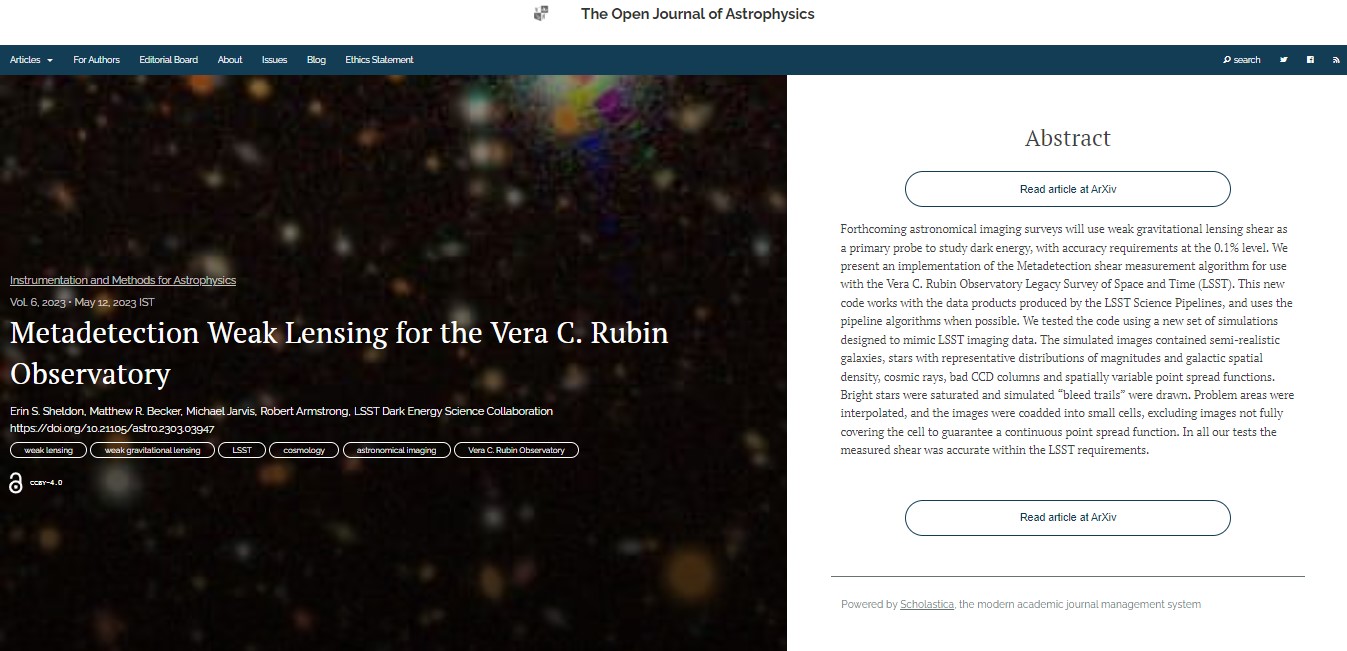
Here is a screen grab of the overlay which includes the  abstract:


You can click on the image of the overlay to make it larger should you wish to do so. You can find the officially accepted version of the paper on the arXiv here.

Product Placement

Posted in Uncategorized on March 9, 2023 by telescoper

I’m grateful to Franco Vazza for pointing out this superb bit of product placement in the advertisements on yesterday’s blog post:

I wonder what advert it will place under this one? Will it cause an infinite regress?

The Cost of Elsevier

Posted in Uncategorized with tags , , , on March 8, 2023 by telescoper

I’ve just seen the annual report of RELX, the parent company of academic publishing house Elsevier. This annual report for RELX contains the accounts for Elsevier for 2022 in which I found the following headline figures:

  • Revenue: €3.26 billion
  • Profit: €1.2 billion
  • Margin: 37.8%

A couple of points of reference are worth mentioning.

One is that the entire annual budget for the European Research Council is €2.4 billion, so Elsevier’s profits on their own represent about half this budget. I don’t know about you, but I’d much rather it were spent on actual research. People talk about a windfall tax on profiteering energy companies. Why not apply the same logic in this case?

The other is that Elsevier’s profit margin (37.8%) can be compared with that of, Google (21.2%) or Apple (24.56%). It’s easy money being an academic publisher.

I cannot understand why the academic community allows this parasitic industry to flourish by continuing to throw taxpayers’ money at it. I draw your attention to the Cost of Knowledge campaign and, when it comes to publishing in Elsevier journals, acting as Editor, or doing refereeing for them, just say no.

Maynooth University Library Cat Update

Posted in Maynooth with tags , on March 8, 2023 by telescoper

It has been very cold in Maynooth for the last couple of days and the forecast is for sioc, oighear, sneachta agus flichshneachta. In inclement conditions I tend to worry about our resident feline, but have been reassured by various social media posts showing him fit and well:

Better still, this afternoon on my way back to the office from lunch I spotted him, oriented North-South on the wall next to the library. Judging by the empty feeding bowls behind him seems likely he was having a post-prandial snooze so I didn’t disturb him, though I was jealous that I don’t get to take a nap after lunch…

A Question of Electrostatic Repulsion

Posted in Cute Problems, The Universe and Stuff with tags , on March 7, 2023 by telescoper

It’s been a while since I posted a question in the Cute Physics Problems folder so I thought I’d offer this one. It’s not particularly hard, but I think it’s quite instructive.

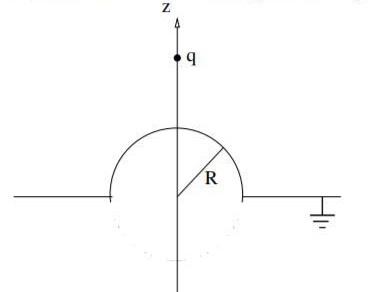
A thin spherical shell of radius r carrying a charge Q spread uniformly with constant surface density is split into two equal halves by a narrow planar cut passing through the centre as shown in the detailed diagram below:


Calculate the force arising from electrostatic repulsion between the two hemispherical shells, expressing your answer in terms of Q and r in SI units.

Answers through the Comments Box please. First correct answer wins a tomato*

*subject to availability

Cosmology Talks: Keir Rogers on Ultralight Dark Matter and the S₈ tension

Posted in The Universe and Stuff with tags , , , , on March 6, 2023 by telescoper

It’s been far too long since I last shared another one of those interesting cosmology talks on the Youtube channel curated by Shaun Hotchkiss. This channel features technical talks rather than popular expositions so it won’t be everyone’s cup of tea but for those seriously interested in cosmology at a research level find them seriously informative.

In this one, Keir Rogers talks about Ultra-Light Dark Matter (ULDM; for a detailed review of this idea, see here). To summarize the argument, it seems that  ULDM consisting of a single particle can’t be responsible for all the dark matter, but this doesn’t mean it can’t exist. Keir Rogers discusses how much of the dark matter could be of ULDM form.

Another issue discussed here relates to the parameter S8 quantifies the matter-density fluctuations on a scale of 8 h-1 Mpc. There is a Cosmology Talk discussing the state of play with this parameter here. The structure-suppressing properties of ULDM could also have implications for the S8 tension, i.e. maybe a small sub-component of ULDM is what is causing the apparently low S8 in local measurements?

The paper describing this work can be found on the arXiv here and here is the video:

Examinations and Memory

Posted in Biographical, Education with tags , , on March 5, 2023 by telescoper

This Sunday evening I take the text for my sermon from a piece about examinations by Katie Stripe in the Times Higher about examinations:

Testing students’ ability to show their learning in a closed context is not preparing them for a future in which technology is ubiquitous. There are few professional contexts that require you to recall information in a specific time frame.

I agree to some extent with the conclusion of the article but for different reasons. In particular, I don’t think this conclusion has much to do with the arrival of new technologies such as ChatGPT. Exams that simply require the students to “recall information” and nothing else seem to me to be of limited value from an educational point of view and should indeed be scrapped, but I think exams can play a role in testing other, more important, skills such as problem-solving.

Over my lifetime the ratio of assessment to education in universities has risen sharply, with the undeniable result that academic standards have fallen especially in my own discipline of physics. The modular system encourages students to think of modules as little bit-sized bits of education to be consumed and then forgotten. Instead of learning to rely on their brains to solve problems, students tend to approach learning by memorizing chunks of their notes and regurgitating them in the exam. I find it very sad when students ask me what derivations they should memorize to prepare for examinations because that seems to imply that they think their brain is no more than a device for storing information. It became clear to me over the years that school education in the UK does not do enough to encourage students to develop their all-round intellectual potential, which means that very few have confidence in their ability to do anything other than remember things. It seems the same malaise affects the Irish system too.

On the other hand, a good memory is undoubtedly an extremely important asset in its own right.

I went to a traditional Grammar school that I feel provided me with a very good education in which rote learning played a significant part. Learning vocabulary and grammar was an essential part of their approach to foreign languages, for example. How can one learn Latin without knowing the correct declensions for nouns and conjugations for verbs? But although these basic elements are necessary, however, they are not sufficient. You need other aspects of your mental capacity to comprehend, translate or compose meaningful pieces of text.

The same considerations apply to STEM disciplines. It is important to have a basic knowledge of the essential elements of mathematics and physics as a grounding, but you also need to develop the skill to apply these in unusual settings. I also think it’s simplistic to think of memory and creative intelligence as entirely separate things. I seems to me that the latter feeds off the former in a very complex way. A good memory does give you rapid access to information, which means you can do many things more quickly than if you had to keep looking stuff up, but I think there’s a lot more to it than that. Our memories are an essential part of the overall functioning of our brain, which is not  compartmentalized in such a simple way.  For example, one aspect of problem-solving skill relies on the ability to see hidden connections; the brain’s own filing system plays a key role in this.

In recognizing the importance of memory I don’t mean that rote learning is necessarily the best way to develop the relevant skills. My own powers of recall are not great – and are certainly not improving with age – but I find I can remember things much better if I find them interesting and/or if I can see the point of remembering them and/or if I use them a lot. Remembering things because they’re memorable is far easier than remembering because you need to remember them to pass an examination!

Anyway, my point is that a good memory can help you learn, but is not in itself what should be assessed in an examination. I wish universities made more effort to educate students to understand that their brain can be much more than a memory device.

Here endeth the lesson.

Internazionale – Camille Souter

Posted in Art with tags , , , on March 4, 2023 by telescoper

Internazionale by Camille Souter (1965, 76.2 x 63.5 cm, oil on newsprint, private collection).

Posted in tribute to the artist, who has passed away at the age of 93.

R.I.P. Camille Souter (1929-2023).

Academic Publishing as Exploitation

Posted in Open Access, Politics with tags , , , , on March 3, 2023 by telescoper

In yesterday’s post I asked the question whether anyone actually believes that it costs it costs £2310 to publish a scientific article online? I also posted the question on the Open Journal of Astrophysics Twitter account:

https://twitter.com/OJ_Astro/status/1631022314169987077?s=20

Only a few people responded to that question with a “yes”. Coincidentally all of them appear to be employed by the academic publishing industry. These people insist that the big publishers bring value to scientific papers. They don’t. Authors and referees do all the things that add value. What publishers do is take that value and turn it into its own profits. The fact that enormous profits are made out of this process in itself demonstrates that what the scientific community is being charged is nothing whatever to do with cost.

This reminds me of many discussions I had in my commie student days about surplus value, a concept explored in great detail by Karl Marx, in Das Kapital. According to the wikipedia page, the term “refers roughly to the new value created by workers that is in excess of their own labour-cost and which is therefore available to be appropriated by the capitalist, according to Marx; it allows then for profit and in so doing is the basis of capital accumulation.”

Engels is quoted there as follows:

Whence comes this surplus-value? It cannot come either from the buyer buying the commodities under their value, or from the seller selling them above their value. For in both cases the gains and the losses of each individual cancel each other, as each individual is in turn buyer and seller. Nor can it come from cheating, for though cheating can enrich one person at the expense of another, it cannot increase the total sum possessed by both, and therefore cannot augment the sum of the values in circulation. (…) This problem must be solved, and it must be solved in a purely economic way, excluding all cheating and the intervention of any force — the problem being: how is it possible constantly to sell dearer than one has bought, even on the hypothesis that equal values are always exchanged for equal values?

Marx’s solution of this economical conundrum was central to his theory of exploitation:

…living labour at an adequate level of productivity is able to create and conserve more value than it costs the employer to buy; which is exactly the economic reason why the employer buys it, i.e. to preserve and augment the value of the capital at his command. Thus, the surplus-labour is unpaid labour appropriated by employers in the form of work-time and outputs.

In the context of academic publishing, the workers are scientific researchers and the employers are the publishers. The workers not only produce the science in the first place, but also carry out virtually all of the actions that the employers claim add value. The latter are simply appropriating the labour of the former, which is exploitation. It needs to stop.