Following yesterday’s excitement about the new images from the James Webb Space Telescope I thought I’d share this video documentary that explains why the choice of name for this facility is highly inappropriate and should be changed. This is a matter I’ve blogged about previously, in fact, but the video is new.
James Webb: the wrong name for a Space Telescope
Posted in History, LGBTQ+, The Universe and Stuff with tags astronomy, James Webb, James Webb Space Telescope, NASA on July 13, 2022 by telescoperThose First Results from JWST
Posted in The Universe and Stuff with tags Carina Nebula, James Webb Space Telescope, JWST, Southern Ring Nebula, Stephan's Quintet, WASP-96b on July 12, 2022 by telescoperAs promised in my post earlier today, we gathered in a small lecture theatre in Maynooth to watch the “reveal” of various new images and other data from the James Webb Space Telescope. The images are indeed wonderful and spectacular, but the video stream was excruciatingly bad to watch, with more technical glitches than I’ve had hot dinners. It was like an astronomical version of Acorn Antiques!
Anyway, you can find them all the new results together with explanations and descriptions here so Ill just put up a gallery here:


Those are the four results released today. This image was previewed last night and appeared in my post earlier today:
I couldn’t resist, however, adding this spectrum of a faint reddish galaxy in the above image:
This spectrum is taken using the NIRSpec instrument on JWST. The observed wavelength along the horizontal axis is measured in microns. If I’ve got the line identifications correct I think this galaxy is at an amazing redshift of about z=8.5. Amazing. High redshift galaxy spectra obtained are usually a lot rattier than this. I think this demonstrates that JWST is going to revolutionize the field of galaxy formation.
The First Deep Field from JWST
Posted in Astronomy Lookalikes, The Universe and Stuff with tags Cosmology, ESA, Gravitational Lensing, James Webb Space Telescope, NASA, NIRCAM on July 12, 2022 by telescoperI have to say that I didn’t stay up to watch the live stream of last night’s preview of this afternoon’s release of the first images from the James Webb Space Telescope. It started very late and I got sick of listening to the dreary music on the feed so went to bed. Nevertheless here is the first picture:
This is a deep field image taken using JWST’s NIRCAM (Near-Infrared Camera). Note that the artifacts you see around some objects are diffraction spikes which occur around bright sources; their six-fold symmetry reflects the hexagonal structure built into the JWST’s mirror assembly. Sources sufficiently bright and compact enough to cause these spikes in deep field images are foreground stars: the extended, fainter objects are all much more distant galaxies.
The description from the NASA page is:
NASA’s James Webb Space Telescope has produced the deepest and sharpest infrared image of the distant universe to date. Known as Webb’s First Deep Field, this image of galaxy cluster SMACS 0723 is overflowing with detail.
Thousands of galaxies – including the faintest objects ever observed in the infrared – have appeared in Webb’s view for the first time. This slice of the vast universe is approximately the size of a grain of sand held at arm’s length by someone on the ground.
This deep field, taken by Webb’s Near-Infrared Camera (NIRCam), is a composite made from images at different wavelengths, totaling 12.5 hours – achieving depths at infrared wavelengths beyond the Hubble Space Telescope’s deepest fields, which took weeks.
The image shows the galaxy cluster SMACS 0723 as it appeared 4.6 billion years ago. The combined mass of this galaxy cluster acts as a gravitational lens, magnifying much more distant galaxies behind it. Webb’s NIRCam has brought those distant galaxies into sharp focus – they have tiny, faint structures that have never been seen before, including star clusters and diffuse features. Researchers will soon begin to learn more about the galaxies’ masses, ages, histories, and compositions, as Webb seeks the earliest galaxies in the universe
Here is a close-up of one of the distorted galaxy images and othe features produced by gravitational lensing:
We’re having a special viewing in Maynooth this afternoon of the press conference which will unveil more new images from JWST – nice telescope, shame about the name. I may add comments on here if anything particularly exciting turns up. You can watch it here:
Let’s hope this one starts on time!
The Consequences of Decoupling
Posted in Politics, The Universe and Stuff with tags BrExit, Cosmology, decoupling, Uk Exports on July 11, 2022 by telescoper

I was struck by the similarity between the UK’s export performance post-Brexit (left) and the behaviour of radiative perturbations in the post-recombination Universe (right). It seems that, in different ways, they are both consequences of some form of decoupling…
New Publication at the Open Journal of Astrophysics
Posted in Open Access, The Universe and Stuff with tags arXv:2202.07678, Coronal Mass Ejections, SECCHI, Solar and Stellar Physics, STEREO, Sun-Earth Connection Coronal and Heliospheric Investigation on July 10, 2022 by telescoperTime to announce another new publication in the Open Journal of Astrophysics! This one, published last week, is the 9th paper in Volume 5 (2022) and the 57th in all.
The latest publication is entitled “Coronal Mass Ejection Image Edge Detection In Heliospheric Imager STEREO SECCHI Data” and is written by Marc Nichitiu of the Stony Brook School (NY, USA). If you want to know more about the Solar observatory STEREO you can look here. SECCHI stands for “Sun-Earth Connection Coronal and Heliospheric Investigation”, which is a camera array on the STEREO spacecraft.
This paper is in the Solar and Stellar Astrophysics folder. It’s a slightly unusual paper because it is mainly software, so could have been in the Instrumentation and Methods for Astrophysics section.
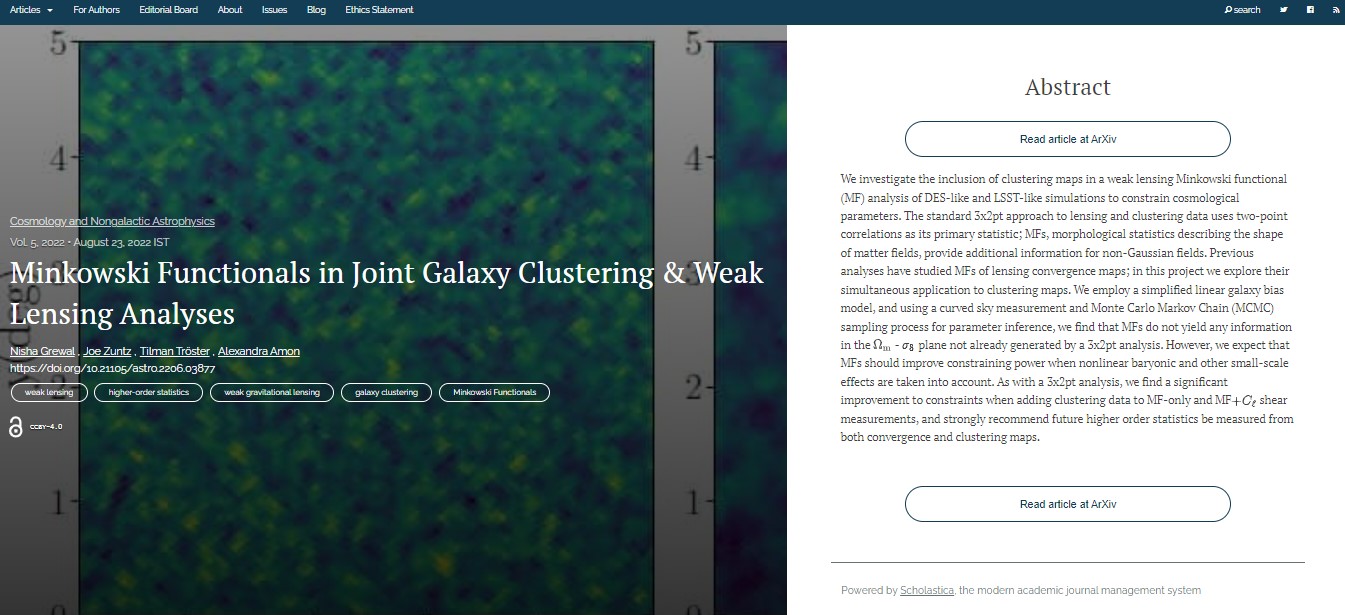
Here is a screen grab of the overlay which includes the (very short) abstract:
You can click on the image to make it larger should you wish to do so. You can find the arXiv version of the paper here.
Phase Correlations and Cosmic Structure
Posted in Biographical, The Universe and Stuff with tags arXiv:2206.11005, Cosmology, large-scale structure of the Universe, phase correlations on July 9, 2022 by telescoperI’m indebted to a friend for tipping me off about a nice paper that appeared recently on the arXiv by Franco et al. with the title First measurement of projected phase correlations and large-scale structure constraints. The abstract is here:
Phase correlations are an efficient way to extract astrophysical information that is largely independent from the power spectrum. We develop an estimator for the line correlation function (LCF) of projected fields, given by the correlation between the harmonic-space phases at three equidistant points on a great circle. We make a first, 6.5σ measurement of phase correlations on data from the 2MPZ survey. Finally, we show that the LCF can significantly improve constraints on parameters describing the galaxy-halo connection that are typically degenerate using only two-point data.
I’ve worked on phase correlations myself (with a range of collaborators) – you can see a few of the papers here. Indeed I think it is fair to say I was one of the first people to explore ways of quantifying phase information in cosmology. Although I haven’t done anything on this recently (by which I mean in the last decade or so), other people have been developing very promising looking approaches (including the Line Correlation Function (LCF) explored in the above paper. In my view there is a lot of potential in this approach and as we await even more cosmological data and hopefully more people will look at this in future. In my opinion we still haven’t found the optimal way to exploit phase information statistically so there’s a lot of work to be done in this field.
Anyway, I thought I’d try to explain what phase correlations are and why they are important.
One of the challenges we cosmologists face is how to quantify the patterns we see in, for example, galaxy redshift surveys. In the relatively recent past the small size of the available data sets meant that only relatively crude descriptors could be used; anything sophisticated would be rendered useless by noise. For that reason, statistical analysis of galaxy clustering tended to be limited to the measurement of autocorrelation functions, usually constructed in Fourier space in the form of power spectra; you can find a nice review here.
Because it is so robust and contains a great deal of important information, the power spectrum has become ubiquitous in cosmology. But I think it’s important to realize its limitations.
Take a look at these two N-body computer simulations of large-scale structure:
The one on the left is a proper simulation of the “cosmic web” which is at least qualitatively realistic, in that in contains filaments, clusters and voids pretty much like what is observed in galaxy surveys.
To make the picture on the right I first took the Fourier transform of the original simulation. This approach follows the best advice I ever got from my thesis supervisor: “if you can’t think of anything else to do, try Fourier-transforming everything.”
Anyway each Fourier mode is complex and can therefore be characterized by an amplitude and a phase (the modulus and argument of the complex quantity). What I did next was to randomly reshuffle all the phases while leaving the amplitudes alone. I then performed the inverse Fourier transform to construct the image shown on the right.
What this procedure does is to produce a new image which has exactly the same power spectrum as the first. You might be surprised by how little the pattern on the right resembles that on the left, given that they share this property; the distribution on the right is much fuzzier. In fact, the sharply delineated features are produced by mode-mode correlations and are therefore not well described by the power spectrum, which involves only the amplitude of each separate mode.
If you’re confused by this, consider the Fourier transforms of (a) white noise and (b) a Dirac delta-function. Both produce flat power-spectra, but they look very different in real space because in (b) all the Fourier modes are correlated in such away that they are in phase at the one location where the pattern is not zero; everywhere else they interfere destructively. In (a) the phases are distributed randomly.
The moral of this is that there is much more to the pattern of galaxy clustering than meets the power spectrum…
Epilogue, by Oliver Tearle
Posted in Poetry with tags Epilogue, Oliver Tearle on July 8, 2022 by telescoperYesterday I was looking around for a poem on the subject of goodbyes to post facetiously about the departure of Boris Johnson when I stumbled accidentally on this gem which I’m posting now, not facetiously and definitely not in any way about Boris Johnson…
Maybe our paths will cross
when this universe folds in and makes another.
Maybe, at the point
when all that is, and all that’s ever been,
collapses into everything else and is remade,
our paths will cross, however briefly, and
our terminus become a junction.
It may be a long shot. I will take it
and hope and trust our paths will cross again.