It’s a Sin – Review

Posted in Biographical, History, LGBTQ+, Television with tags , , , , , , , on January 28, 2021 by telescoper

Left to Right: Omari Douglas (Roscoe), Nathaniel Curtis (Ash), Olly Alexander (Ritchie), Callum Scott Howells (Colin) and Lydia West (Jill)

Since I posted a kind of prelude a few days ago I decided that I would bite the bullet and watch the entire Channel 4 drama series It’s a Sin. Although only the first episode (of five) has been broadcast all the episodes were released on the Channel 4 app so I decided to binge on it. Part of the reason for doing that was that I wanted to finish it before term starts next week. I’ve waited for a couple of days before writing a sort of review of it, or more a reaction, really to get over the impact enough to write something even vaguely sensible.

Because a lot of people won’t have seen the whole series yet I won’t give away any of the plot, but it won’t come as any surprise to discover that it is steeped in tragedy and at times a very difficult watch. Before you ask if I cried, the answer is yes, I did a lot, in every single episode, partly because of the actual drama but also partly because of the memories it brought back. The catharsis wasn’t unwelcome, however. You don’t deal with the past by hiding from it.

The word tragedy is frequently misused but I think it is very apt for It’s A Sin. People often refer to unpredictable or accidental events as tragic but the power of a theatrical tragedy comes from the sense of remorseless inevitability. From Episode 1 you feel the threat approaching and you know what is going to happen because you know the historical context. It still hits very hard though. If you can get through Episode 3 without crumbling you’re a stronger person than me. It reminded me of a paraphrased quote from Herodotus I first heard in 1986:

Call no man happy until he knows the manner of his death.

So what can I say about it as a piece of television drama? Well, first of all, it’s beautifully written and produced. Writer Russel T. Davies is just a month or so older than me so would also have been 18 in 1981 when the first episode is set and it clearly is a very personal piece. That gives it great authenticity, and the production goes to a lot of trouble to get the atmosphere and detail right. I moved to London in 1990 and the last episode, set in 1991, depicts that time very accurately indeed. While I was living in Brighton (for the five years before moving to London) I did travel up quite a few times to sample the gay scene either alone or with friends. The music, the design and the clothing is all very much on the mark. The one thing you can’t do on television is recreate the smell. Gay clubs in my memory were awash with poppers and sweat. I had also almost forgotten the ubiquitous clones (gay men in tight jeans, checked shirts, cropped hair and moustaches), a look that was de rigueur in the late Seventies to mid Eighties. The lingo was generally quite different, actually. There weren’t any twinks in those days, for example, and far fewer gym bunnies. I also remember that for me in those days the London scene revolved more around Earls Court than Soho. I particularly remember a place called Bromptons.

But I digress.

The acting in the series is also very good. I have to pick out Olly Alexander‘s stellar performance as Ritchie Tozer. Being an old fogey I didn’t know about his musical career and I’ve only seen him a little as an actor, including in an old episode of the detective series Lewis but to be honest he didn’t really register. I was much more aware of him as an activist and advocate for LGBT+ rights, work for which I admire him enormously. The role of Ritchie is clearly one that means a lot to him and which is no doubt why he gives so much of himself. The result is one of the most generous and commited performances I have ever seen on television, as funny and charming as it is, in the end, heartbreaking. He has a presence in this series that is utterly compelling.

Among other qualities, Olly Alexander has remarkably expressive eyes. That’s always a great asset for a screen actor, because so much is done in closeup and, in this series, he does quite a lot of work directly to camera which are intensely moving. Although the whole cast is very strong – and it is really an ensemble piece – Olly Alexander steals the show more than once. He deserves every bit of the praise that is being heaped on him right now.

Russel T. Davies was very clear that he wanted the gay roles in this series to be played by gay actors. I think he was absolutely right in that, for two reasons. One is personal. I don’t think I would have responded in anything like the same way as I did to, e.g., Ritchie Tozer if I hadn’t known that the actor playing him was gay. It made the character immediately real to me. More importantly I think playing a gay role must be liberating for a gay actor too. The actor does not have to pretend to be gay so they can concentrate their energy on other aspects of their performance, which can only grow as a consequence.

I was amused to see some comments on social media after Episode 1 complaining about the “graphic” sex scenes. I think they were done very honestly, showing things as they are. HIV is sexually transmitted so why tiptoe around the reality of gay sex. I thought some of the scenes were rather nice, actually. Anyway I wonder what the people complaining think gay men do in bed, play tiddlywinks perhaps? I’ve never understood why it is acceptable to portray shocking levels of violence on television, but showing two cute guys getting it on is considered anathema. Straight people can be weird.

I suppose one of things I was a bit worried about before I watched It’s A Sin was that it might have been mawkish or preachy, a trap some AIDS dramas have fallen into. Davies avoids that by ensuring that all his characters are very human. Richie, for example, may be cute and sexy but he is also at times a bit dim and rather annoying.

The other characters are similarly human. They all have their faults, but who doesn’t? You don’t have to be an angel to deserve respect. All are very real, presumably because they are partly based on people Russell T. Davies knew back then.

I’ve described some of my own experiences during the Eighties elsewhere on this blog. I don’t propose to repeat them at length here, but will say that I grew up in the 1970s at a time when the only portrayals of gay characters on screen were camp stereotypes to be mocked. That mockery extended into everyday life for gay people, with the added possibility of real physical violence. My reaction to that was to assume that straight people would never be really accepting of us and would never be our friends, so it was a waste of time trying. When I wasn’t at work I avoided straight society, shopping in gay shops, eating in gay restaurants, and generally being a scene Queen. That may seem a bit extreme – and it probably was – but one positive I felt at the time was a sense of belonging that I had never felt before and haven’t felt much since. That sense pervades It’s A Sin: the characters suffer family rejection and discrimination as society turns its back on them but they have each other, at least for a time.

Curiously it was because I got involved a little bit in the battle against AIDS that I changed my view about gay separatism. After doing some training I got involved as a volunteer in doing sexual health workshops, phone counselling, giving out information leaflets and fundraising. As a matter of fact it was the AIDS crisis that led me to take up long-distance running. I did my first half-marathon in 1988 to raise money for the Terence Higgins Trust.

To my surprise a number of straight people were involved in these activities too, and I began to realize that there was such a thing as a a straight ally. If someone had told me in 1991 that in less than 30 years same-sex marriage would have been legal I would have laughed my head off. But there you are. We wouldn’t have got that without building alliances. I was wrong, and am happy to admit it.

One of the people I worked with at that time was a nurse called Gill. The character Jill Baxter (wonderfully played by Lydia West) made my jaw drop not just because of the similarity in name but also because some of the things she says (warning the risks from AIDS) which were almost word for word some like expressions Gill used. I’m sure* that must be a coincidence!

*I’ve now read an interview that explains that Jill is indeed based on a real character called Jill (not Gill) who was a nurse who cared for people with AIDS, as Gill did but was not her. I hope this clarifies the situation.

The hostility and misrepresentation I mentioned above got even worse during the AIDS crisis, with the occasional added flourish that AIDS was sent by God to punish sinful behaviour. The best that most dramas achieved was to create a sense that gay men were victims to be pitied, rather than perverts to be despised. That seemed to me to be hardly an improvement. At least now we’re on a path towards equality and acceptance, although there is still a long way to go: there are some who don’t seem to have learned very much at all from this terrible period, judging by their attitudes towards transgender people.

I think that’s enough rambling. I’ll just make one last admission. This series made me feel very old! The first episode is set in 1981, which is “only” forty years ago, but it struck me in Episode 2 that it was a bit like watching one of those historical costume dramas that appear so often on the telly and then realising that you were alive at the time being depicted! But I can cope with being old. At least I made it this far. This series is a testament to those who didn’t.

The Term Ahead

Posted in Covid-19, Education, Maynooth with tags , , , , on January 28, 2021 by telescoper

After a recent Government announcement that current Covid-19 restrictions would be extended until at least March 5th, this morning we received the expected communication from the University authorities that almost all our teaching at Maynooth University would be online until March 22nd at the earliest. This is because the half-term “study break” is from 15th to 19th March (to include St Patrick’s Day) and there would be no point in trying to get students back for one week (8th-12th March) before breaking up for the following week. In fact, if I had to bet money on it I would say we’ll probably be online all the way through to the summer, and possibly beyond, but that decision has not been made yet.

To nobody’s surprise we’re also going to have online examinations in the summer again. We’ve done two rounds of these already so are getting used to them now so that’s not a problem.

The St Patrick’s Day break was basically when we flipped – by which I mean “changed teaching methods” rather than “went mad” – last year so at least we’ve already got teaching prepared for the second half of the forthcoming semester if Level 5 restrictions do continue.

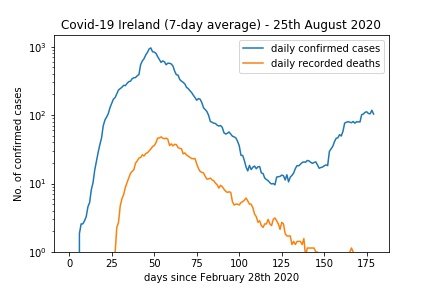
I am actually a bit annoyed at the politicians for making hints about when the restrictions might end. It is clearly far too early to be talking about that. Here are yesterday’s numbers:

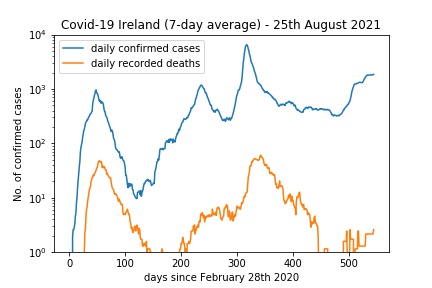
If you prefer them on a linear scale here they are:

New cases have fallen significantly since the latest peak but at least part of that is due to the fact that automatic close contact tracing couldn’t cope and was abandoned. Testing positivity rate has fallen to around 8.2% (from over 20%) , hospital admissions admissions are falling, and deaths may have peaked, so the evidence suggests there is a is a reduction, but the numbers are still way too high. They need to come down to much less than a 100 before any lifting of restrictions can be contemplated. At the current rate of decline that will take many weeks.  Suggesting opening up is going to happen soon will only make people impatient and reduce compliance.

Teaching term at Maynooth starts on Monday (1st February) and I have three modules to deliver, one of them a module I’ve never given before. Because there has been so much to do behind the scenes since Christmas I don’t think I’ll ever have started a term feeling so exhausted. The cycle of academic life carries on remorselessly despite the fact that everything takes longer to do under Covid-19 restrictions. It is an effort just to keep up.

Still at least we’ve all still got jobs to do and are still getting paid. It’s time to knuckle down and focus on reaching the mid-term break in one piece and then seeing where we go thereafter.


Pianissimo!

Posted in Biographical, Music with tags , , on January 27, 2021 by telescoper

Not a lot of people know that I acquired a second-hand piano when I bought my house in Maynooth. I’ve been having a go on it from time since then. Fortunately it’s a detached house so that doesn’t cause the neighbours to suffer too much. I wish I’d got it tuned before the lockdown though. It’s a little bit flat in the middle range and gets worse as the notes get lower. Still, I’m such a terrible player that doesn’t make too much difference!

I can read music but am used to single note instruments and find piano parts difficult to read especially if there are complicated chords – or even simple ones, for that matter. I find having the notes squashed together like in the bass part here makes it difficult to disentangle them.

Fortunately I have a basic knowledge of harmony and can cope with chord symbols so I generally don’t try to read the bass parts but instead fill in chords according to the symbols. If the chords aren’t written on the music like the above example I add them myself.

Even for an oldie like me it’s quite easy to get used to playing basic chordal accompaninents. Most standard progressions involve only three or four chords. You can start playing block triads like in the example above just to get the idea. Adding, for example, the odd 7th here and there helps to explore the sound produced by different harmonic ingredients. After that you can play left-hand figures based on the chords to make it more interesting.

I know you’re all thinking that I’m way too old to be trying to teach myself how to play the piano. One of these days I think I’ll put up a YouTube video to prove that you are right.

Teaching after Covid

Posted in Covid-19, Education, Maynooth with tags , , , on January 26, 2021 by telescoper

I know it’s a Business lecture, but at least there is a periodic table on the wall to remind students of the time when Universities used to care about science.

Near the end of a planning meeting this morning I was asked to give my thoughts about any long-term impacts of the Covid-19 pandemic on teaching and/or research. That also echoed a discussion I had with staff in the Department of Theoretical Physics on Teams a while ago, which touched on the same question.

My own view in general is that although we find ourselves constantly saying things like “When we get back to normal…” I think we have to accept that the pandemic is going to change many things irreversibly. We’re going to have to get used to new ways of working in both teaching and research. Some changes will be made to make financial savings owing to loss of income over however long the pandemic lasts, and some of those will no doubt be painful and sad. Others will be opportunities created by us learning how to do things differently and a number of these could be very positive, if we seize the initiative and make the most of them.

One specific thing in the latter category is that Maynooth University installed a system of lecture capture to help deliver teaching when access to campus was restricted (as it is now). The hardware and software installed is fairly basic and isn’t by any means perfect, but it has worked pretty well. The main problem is that the cameras that have been installed are very limited webcams and are not capable of capturing, e.g. a blackboard.

One thing I hope will happen in the long term is that we include lecture capture as a routine way of augment students’ learning. That will require additional investment in infrastructure, but I think it would be well worth it.

Some years ago I blogged about this at another institution, which had facilities allow lecturers to record videos of their own lectures which are then made available for students to view online.

This is of course very beneficial for students with special learning requirements, but in the spirit of inclusive teaching I think it’s good that all students can access such material. Some faculty are apparently a little nervous that having recordings of lectures available online would result in falling attendances at lectures, but in fact there is evidence that indicates precisely the opposite effect. Students find the recorded version adds quite a lot of value to the “live” event by allowing them to clarify things they might not have not noted down clearly. In my experience they rarely watch the whole video, instead focusing on things they didn’t get first time around. And if a few students decide that it’s good enough for them just to watch the video, then so what? That’s their choice. They are adults, after all.

I’ll add that I do feel we should still make the effort to return to doing live lectures in some form and not rely entirely on recordings. I think that what you can do in a lecture is fairly limited part of the overall educational package, but that’s not the same as saying that they should be scrapped. Many students do enjoy lectures and find them very helpful. I just think we should make the best of the available technology to offer as wide a range of teaching methods as possible. No two students are the same and no two students learn precisely the same way. Let us offer them a variety of resources and they can choose which serves them best.

Another important, but perhaps less tangible, aspect of this is that I think education is or should be a shared experience for students. Just having everyone sit in the same room “enjoying” the same teaching session is a great benefit compared with having them sit in their room watching things on a laptop screen. I think that’s one of the worst issues with remote teaching, and wish we had found better ways of dealing with that over the past year.

There is a benefit for the lecturer of having a live audience too, in that actually seeing the people you’re trying to teach helps you gauge how well you’re getting it across.

Anyway, I started a poll on lecture capture a while ago before the pandemic. Feel free to add your opinion. It will be interesting to see if opinions have changed!

Imagining an Eighties Coronavirus Pandemic

Posted in Biographical, Covid-19, History, Television on January 25, 2021 by telescoper

Thinking about the TV series It’s A Sin I blogged about on Saturday a couple of things struck me in relation to our current situation trying to cope with the Covid-19 pandemic.

In the early 1980s we had no access to the internet – it only really get going until 1983 and most households didn’t get connected until much later. There wasn’t even email either. And nobody had mobile phones – smart or otherwise, so there were no text messages.

Had the Covid-19 pandemic occurred forty years ago we would have had to face it in very different ways. Working from home for most people would have been impossible so any kind of lockdown would have had dire economic consequences.

In the education sector, in which I work, the existence of the internet has allowed us to switch to remote teaching and learning (and assessment). Although it has been very far from ideal, at least we have been able to do something. What would we have done in the 1980s? I really don’t know.

One possibility is to have used the TV to broadcast some form of educational service. But until 1982 (when Channel 4 arrived) there were only three channels in the UK so it would not have been easy to devote a lot of time for live broadcasts. On the other hand people did have video recorders, so programmes could have been transmitted during the night for later consumption. I guess also that some materials, assignments, etc could have been delivered using the regular mail rather like old-fashioned correspondence courses. The Open University was already doing that, of course, but expanding it to include every student at every level in the country at very short notice would have been very difficult indeed.

The number of people in other sectors who would be able to work from home would also have been very small, so the economic cost of a lockdown would have been even higher than at present. I suspect that Governments wouldn’t even have tried, with the resulting increase in mortality.

And there is also the social dimension. During this pandemic people have been able to use software such as Zoom to stay in touch, including with elderly relatives who might otherwise be completely isolated. That would have been impossible in the Eighties.

In any case socializing for young people during the 1980s – which is what I was then – was very different. We didn’t (because we couldn’t) use texts or mobile phone calls to arrange nights out or other things. I didn’t get my
first (very basic) mobile phone until the 1990s – and I think I was an early adopter. I kept in touch with my friends in normal times by frequenting the same bars and clubs as my friends. We’d often meet up without arranging anything specifically.

There were no dating apps then either, so people used to hook up in bars and clubs (and frequently elsewhere). I suppose that has changed a lot over the past couple of decades (although I don’t go to such places any more, being an oldie).

Suffice to say that compared to today the impact on social lives and wellbeing would have been even more drastic had we had lockdowns in the 1980s.

A Little Local History

Posted in Biographical, History, Maynooth with tags , , , , , , , , on January 24, 2021 by telescoper

I’ve lived in Maynooth for over three years now and for a large part of that time my home was a flat on Straffan Road near Court House Square. Across the road from where I lived is Lyreen House (sometimes called Larine House). The Lyreen, incidentally, is the name of the small river that runs through Maynooth, on which the old mill was built.

The house was built in the 1780s and is now used as a day care centre. Towards the rear it has a very pleasant walled garden; from the side looking across Straffan Road it looks like this:

The car is not always there. Note the rather unattractive grey pebbledash rendering which is I’m afraid rather ubiquitous on old buildings in this area. I think this is because many of these buildings are made from limestone which needs to be protected from weathering. There is a lot of this rendering on the South Campus at Maynooth University too.

Anyway, I walked past Lyreen/Larine House every time I went to work without ever really thinking about its history. Then, yesterday, I saw this:

The picture at the bottom shows Lyreen House as seen looking South from Court House Square, with Straffan Road to the right. The article in the local paper explains that during the War of Independence a hundred years ago, it was for a time used as a barracks for the Black and Tans! I had absolutely no idea about that until yesterday!

Nowadays the view looking North through Court House Square towards Main Street is this:

The white building to the right is Brady’s pub. The structure you see is a monument to the victims of the Great Hunger in a pleasant seating area that is often used for craft fairs, musical performances and other gatherings. Or at least it was in the pre-Covid era.

What you don’t see is any sign of a Court House. That is because it was destroyed by the IRA in 1920. This is what it looked like after the attack.

The War of Independence in County Kildare didn’t see anything like as much violence as other parts of Ireland, abut that didn’t mean there wasn’t a strong Republican presence here. When rumours circulated that the British were going to use the Court House as a garrison the local IRA decided to deny them that opportunity by setting it on fire (though they first ensured that everyone inside was taken to safety).

The Old Court House lay derelict for many years and was eventually demolished. Then a public convenience was built on the site. This was not only an eyesore but also a smelly and unpleasant place that people generally avoided. It  was then demolished and the monument was constructed in 1993.

I walked through Court House Square last night on a rare trip out of my house to collect a takeaway for my dinner. I noticed that the Christmas lights and nativity scene were still there, almost a month after Christmas. I wonder when they’ll take them down?


It’s a Sin

Posted in Biographical, History, LGBTQ+, Television with tags , , , , , on January 23, 2021 by telescoper

My Twitter feed was on fire last night with reactions to the first episode of the new Channel 4 drama series It’s a Sin. The title is taken from the 1987 hit of the same name by the Pet Shop Boys.

I didn’t watch it. I told a friend that I would find it impossible to watch. He asked “Why, would the memories be uncomfortable?”. I said “No. I can’t get Channel 4 on my television”.

I only have the minimum Saorview you see.

Now I’ve been informed that it is possible to stream Channel 4 for free in Ireland I will definitely watch it, so consider this a prelude to the inevitable commentary when I’ve actually seen it.

The reason why my friend thought I’d find it uncomfortable is that the story of the first episode is set in 1981 and revolves around five characters who were eighteen years old at that time. As it happens I was also 18 in 1981. On the other hand the story involves the protagonists all moving to London in 1981, which I didn’t. I was living in Newcastle in 1981, doing my A-levels and then taking the entrance exam for Cambridge where I went the following year (1982).

Before going on I’ll just mention that 1981 was – yikes – 40 years ago and – double yikes – is closer in time to the end of World War 2 than to today.

Anyway, a major theme running through the 5-part series is the AIDS epidemic that was only just starting to appear on the horizon in 1981. I recall reading an article in a magazine about GRIDS (Gay Related Immune Deficiency Syndrome), which it was what AIDS was called in the very early days. I remember it only vaguely though and didn’t think much about AIDS during the time I was an undergraduate student, although became terrifyingly relevant when I moved to Sussex in 1985 to start my graduate studies.

Although I had been (secretly) sexually active at school and definitely knew I was gay when I was an undergraduate at Cambridge, I wasn’t very open about it except to my closest friends. I also didn’t do much about it either, apart from developing a number of crushes that were doomed to be unrequited.

In my final year at Cambridge I decided that I would try to get a place to do a PhD (or, as it turned out, a DPhil). I applied to a few places around the country, and was very happy to get an offer from Sussex and started my postgraduate studies there in 1985. The reputation of Brighton as being a very `gay’ place to live was definitely part of the decision to go there.

Having been very repressed at Cambridge and mostly unhappy as a consequence I decided that I couldn’t continue to live that way. One of the first things I did during `Freshers Week’ at Sussex was join the GaySoc (as it was called) and I gradually became more involved in it as time went on. To begin with I found it helped to pluck up the nerve to go into gay bars and clubs, which I was a bit scared to do on my own having never really experienced anything like them in Newcastle or Cambridge.

It didn’t take me long to acquire an exciting sex life, picking up guys here and there and having (mostly unprotected) sex with strangers several times a week (or more). I then met an undergraduate student through the GaySoc. Although younger than me he was more experienced and more confident about sex. The relationship I had with him was a real awakening for me. We had a lot of sex. I would often sneak off form my office to his room on campus during the day for a quickie. We never even talked about wearing condoms or avoiding ‘risky’ behaviour. This was in 1986. The infamous government advertising campaign began in 1987.

Then one evening we went together to a GaySoc meeting about AIDS during which a health expert explained what was dangerous and what wasn’t, and exactly how serious AIDS really was. Most of us students were disinclined to follow instructions from the Thatcher government but gradually came round to the idea that it wasn’t the attempt at social control that we suspected but a genuine health crisis. That day my partner and I exchanged sheepish glances all the way through the talk. Afterwards we discussed it and decided that it was probably a good idea for us both to get tested for HIV, though obviously if one of us had it then both of us would.

Having been told what the riskiest sexual practices were, and knowing that I had been engaging very frequently precisely in those behaviours, I just assumed that I would be found HIV+. When I did eventually have a test I was quite shocked to find I was negative, so much so that I had another test to make sure. It was negative again. We were both negative, in fact, so we carried on as before.

It was in the next few years that people I knew started to get HIV, and then AIDS, from which many died. I imagine, therefore, that It’s a Sin will have a considerable personal resonance for me. Even without watching it (yet) a question that often troubles me returned once again to my mind: why am I still alive, when so many people I knew back then are not?

Delivery Notes

Posted in Biographical, Politics with tags , , on January 22, 2021 by telescoper

I was a bit surprised to see the latest issue of Private Eye was delivered this morning. The Eye is published every fortnight on a Wednesday but, until recently, it normally took about a week to arrive in Ireland. Since the New Year however it has been taking much less time to get here. In fact this one arrived on the nominal issue date (22nd January):

I’m not sure why it’s suddenly got much faster, but I wonder if it might be related to a reduction in other items being sent to Ireland from the UK because of difficulties that kicked in as a result of Boris Johnson’s Trade Reduction Treaty on January 1st? (Perhaps not, though, because my 1st January Physics World still hasn’t arrived and that presumably comes via a similar route…)

Anyway, I’ve been reading quite a lot of stories about the changes that have occurred in receiving goods from the UK: long delays, vastly increased delivery charges, VAT and customs payments due on arrival, and sometimes orders cancelled entirely. I think items only worth a few euro are exempt from these new charges but I know of a few people who have been handed large bills when goods they have ordered over the internet have been delivered. I think it’s going to be very important in future that firms advertising in Ireland make it clear if the goods they are selling are going to be delivered from the UK.

These developments have at least provided some possible explanations of the reasons why so many people voted for Brexit. One might be that they enjoy filling in forms and wrestling with other kinds of red tape. Another, more likely, is “sovereignty” which I interpret as meaning “not having to deal with nasty foreigners”.

As regular readers of this blog will know I voted Remain and now live in the EU as a nasty foreigner. I do however think we nasty foreigners should accept the reality of this situation and respect British sovereignty.

Indeed I have seen many interviews with British business leaders who voted for Brexit complaining about all the difficulties that now exist to trade with nasty foreigners. I think there’s only one way for decent folk to react to this and that is to help these people in their hour of need by saving them the effort of form-filling, the extra expense of delivery, along with all the other headaches, and at the same time fully respecting their sovereignty, by simply not buying goods from them any more. It’s the honorable thing to do.

Fortunately it is increasingly possible for people in Ireland to do what Brexiters want by avoiding buying British goods. There are now 30 weekly sailings from Ireland to France, operated by 4 different companies. From tomorrow there will also be a new route from Dublin to Cherbourg by Stena Line.

But now I’m in a quandary. Am I disrespecting British sovereignty by continuing to subscribe to Private Eye?

Physics versus Astrophysics

Posted in The Universe and Stuff with tags , on January 21, 2021 by telescoper

I don’t often post memes on here, but I couldn’t resist this one. Credit here.

NUI Dr Éamon De Valera Post-Doctoral Fellowship in Mathematical Sciences

Posted in History, mathematics, Maynooth, The Universe and Stuff with tags , , , on January 21, 2021 by telescoper

I found out yesterday that the National University of Ireland is commemorating the centenary of the election of Éamon de Valera as its Chancellor. To mark this occasion, NUI will offer a special NUI Dr Éamon De Valera Post-Doctoral Fellowship in Mathematical Sciences. This post is in addition to the regular NUI awards, which include a position for Science & Engineering.

Éamon de Valera, photographed sometime during the 1920s.

Éamon de Valera, founder of Fianna Fáil (formerly one of the two largest political parties in Ireland) and architect of the Irish constitution. De Valera (nickname `Dev’) is an enigmatic figure, who was a Commandant in the Irish Republican Army during the 1916 Easter Rising, who subsequently became Taoiseach  and then President of the Irish Republic.

You may or may not know that de Valera was a mathematics graduate, and for a short time (1912-13) he was Head of the Department of Mathematics and Mathematical Physics at St Patrick’s College, Maynooth,  a recognized college of the National University of Ireland. The Department became incorporated in Maynooth University, when it was created in 1997.Mathematical Physics is no longer a part of the Mathematics Department at Maynooth, having become a Department in its own right and it recently changed its name to the Department of Theoretical Physics.

Anyway, the Fellowship will be awarded on the basis of a common competition open to NUI graduates in all branches of the Mathematical Sciences. All branches of the Mathematical Sciences will be deemed as including, but not limited to, all academic disciplines within Applied Mathematics, Pure Mathematics, Mathematical Physics and Statistics and Probability.

You can find more details of the position here. I should say however that it is open to NUI graduates only, though it can be held at any of the constituent colleges of the National University of Ireland. Given the de Valera connection with Maynooth, it would be fitting if it were held here!
The deadline for applications is February 9th.