The Ghost Room in Maynooth

Posted in History, Maynooth, Poetry with tags , , , on September 9, 2020 by telescoper

I stumbled across this rather macabre post about Maynooth University and thought I’d share it….don’t have nightmares!

That reminds me of this poem by Emily Dickinson:

One need not be a chamber to be haunted,
One need not be a house;
The brain has corridors surpassing
Material place.

Far safer, of a midnight meeting
External ghost,
Than an interior confronting
That whiter host.

Far safer through an Abbey gallop,
The stones achase,
Than, moonless, one’s own self encounter
In lonesome place.

Ourself, behind ourself concealed,
Should startle most;
Assassin, hid in our apartment,
Be horror’s least.

The prudent carries a revolver,
He bolts the door,
O’erlooking a superior spectre
More near.

Sam's avatarCome Here To Me!

Path leading down to the College Graveyard at Saint Patrick’s College. (Carax)

Just on the outskirts of Dublin lies the historic university town of Maynooth. It is the home of Ireland’s main Roman Catholic seminary, St Patrick’s College, which has been churning out priests since 1795.

One particular room in the college has been associated with demonic apparitions, suicide and paranormal activity for over 150 years.

In the mid 19th century in Room Two of Rhetoric House, two young seminarists took their own lives, nineteen years apart, and the room has been the source of many tales ever since.

Rhetoric House in the South Campus, built in 1834, was formerly a residential house for trainee priests. It now hosts the Department of History.

Rhetoric House, Maynooth (http://bogwarrior.com)

On 1 March 1841, a young student from Limerick by the name of Sean O’Grady (b. 1820) jumped out of room and fell…

View original post 525 more words

R.I.P. Gary Peacock (1935-2020)

Posted in Jazz with tags , , , , , , on September 8, 2020 by telescoper

I heard on Saturday via social media that the great bass player Gary Peacock had passed away on 4th September, only to see other posts claiming that the rumours of his death were a hoax. I was relieved about that but then it turns out that the hoax reports were themselves a hoax and Gary Peacock had indeed died. He was 85 years old.

Gary Peacock is probably best known for his work with the likes of Keith Jarrett, Bill Evans and Jack DeJohnette but as a tribute I thought I would post an example of his earlier work with Albert Ayler. I think the album Spiritual Unity with Gary Peacock on bass and Sonny Murray on drums is one of the highlights of 1960s free jazz.

This tune, the shorter of two versions on Spiritual Unity of an original composition by Albert Ayler called Ghosts, is a great example how he could make coherent what at first hearing sounds like disassociated bursts of sound. It involves remarkable improvised melodies based on short thematic lines designed to evoke unsophisticated  folk music or nursery tunes. It may sound primitive on the surface, but it’s very complex underneath and creating this extraordinary sound world clearly required great technical mastery from Ayler and his supporting musicians, especially Gary Peacock, who plays wonderfully on this track.

Rest in peace, Gary Peacock (1935-2020)


R.I.P. Govind Swarup (1929-2020)

Posted in The Universe and Stuff with tags , , , on September 8, 2020 by telescoper

This morning I learnt the sad news of the passing of Professor Govind Swarup who died yesterday at the age of 91. Govind Swarup was a pioneer in radio astronomy, especially in India, and in particular was a driving force behind the construction of the Giant Metrewave Radio Telescope, and the establishment of a world-leading radioastronomy group, which is located about 80km North of Pune in Maharashtra. I remember meeting with him a couple of times during visits to Pune and was struck by his friendliness and unbounded enthusiasm for astrophysics.

I send my condolences to his family, friends and colleagues in India who I know will miss him enormously.

R. I. P. Govind Swarup (1929-2020).

Leaving Out

Posted in Covid-19, Education, Maynooth with tags , , on September 7, 2020 by telescoper

This morning students across Ireland have been receiving their Leaving Certificate grades. First of all let me congratulate the 2020 Leaving Certificate Class for their success in what has been a very difficult year!

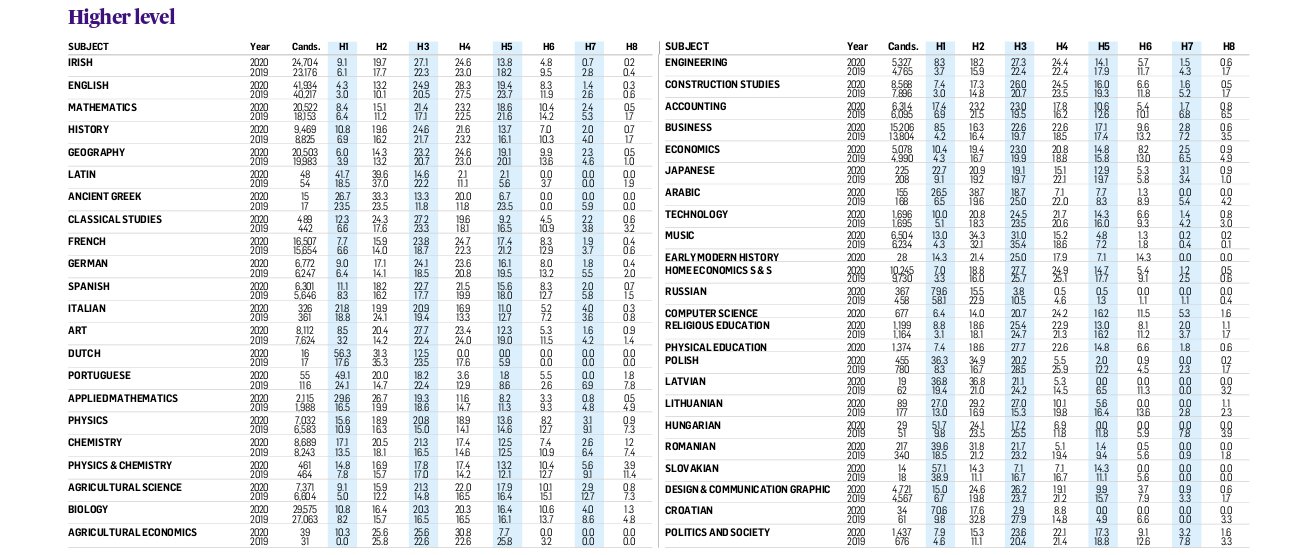
The release of Leaving Certificate results will trigger even more of a scramble than usual for university places through the CAO process. This year things are likely to be very different from previous years as (a) the process is much shorter in duration (students who get into university will be having their first lectures just three weeks from today) and (b) the distribution of grades is unlike previous years because they are based on “calculated grades” rather than examination results. This has led to an increase in top grades across many subjects. Here is a useful summary from the Irish Times:

(I know it looks small but you can click on it to make it legible…)

Note the number of top grades in Mathematics, Applied Mathematics and Physics has gone up because of the general grade inflation and because the number of students taking them has gone up. This is potentially good news for our recruitment here in Maynooth but it’s probably not so simple. For example, it may be that bigger departments elsewhere try to offset the lack of international students this year by recruiting more home students. We’ll just have to wait and see. By the start of next week the picture will probably be clearer.

At any rate, a certain local celebrity is looking forward to welcoming the new students onto campus shortly…

The Year Ahead

Posted in Biographical, Covid-19, Education, Maynooth with tags , , on September 6, 2020 by telescoper

Tomorrow sees the release of the 2020 Leaving Certificate results which this year are based on “calculated grades” rather than examination results. It seems that for about 79% of students these grades will be the same as the teacher’s assessment, about 17% will be lower than the teacher assessment and in about 4% of cases it will be higher. It remains to be seen whether the results will create the sort of stir that this year’s A-level results did.

That seems to imply that CAO points will be a bit higher on average than previous years so more students will make the grade for their first choice of course, which may have a significant impact on recruitment.

We’ll find out all about that next week when the details come in. Teaching term starts on Monday 28th September so there’s very little time to get things organised for the new cohort, especially on the Omnibus Science course on which students have a wide range of alternatives from which to pick their first-year subjects.

Next week at Maynooth University we also have our repeat Examination Board (a week later than usual). After that we will have a good idea of how many students will be returning for Years 2, 3 and 4 and how many will not progress.

So soon we will have enough information to fine-tune our teaching plans. These are challenging this year because of the reduced capacity of the rooms we use for lectures and tutorials due to physical distancing. Some rooms are affected more than others – it’s far worse for large lecture theatres than for tutorial rooms – so we have to look at each module separately.

We had a (virtual) meeting of teaching staff in the Department of Theoretical Physics to coordinate the approaches to different modules. Among other things, that showed how very sensitive everything is to numbers of students taking. If a room can take N students then if the actual number taking the class is less than or equal to N then the class can proceed as usual but if it exceeds N, even by just one, then we have to split the class somehow.

Having detailed numbers is essential to sorting all this out but students can change modules during the first few weeks of teaching, we’re likely to be reorganising as we go along.

All this causes multiple headaches but, despite the extra complications this year, I’m looking forward to seeing the students on campus again. I haven’t given a ‘proper’ lecture since March 12th.

I was so busy last week, grappling with these and other matters, that I missed the fact that I took over as Head of Department on 1st September 2019, a year ago last Tuesday. Little did I know what I was letting myself in for…

World Beard Day

Posted in Beards with tags , , , on September 5, 2020 by telescoper

Today is the first Saturday in September which means that it is World Beard Day.

I quote from official guidance:

On World Beard Day, it is customary for the bearded members of a family to relax and partake in no jobs or chores. The beardless members of the family traditionally show their support by waiting on the bearded hand and foot. World Beard Day is all about promoting and elevating the global status of the the beard. Whilst many countries and cities practice World Beard Day customs specific to their own region, shaving on World Beard Day is universally considered to be highly disrespectful.

See here for a celebratory blog post by Beard Liberation Front Organiser, Keith Flett.

Littlewood on `the real point’ of lectures

Posted in Education, mathematics, The Universe and Stuff with tags , , , on September 3, 2020 by telescoper

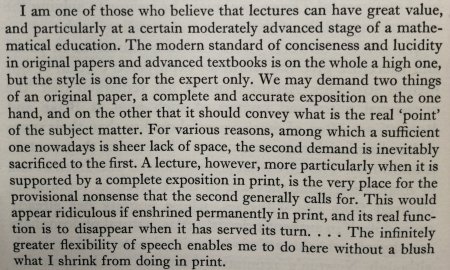
We’re often challenged these days to defend the educational value of the lecture as opposed to other forms of delivery, especially with the restrictions on large lectures imposed by Covid-19. But this is not a new debate. The mathematician J.E. Littlewood felt necessary to defend the lecture as a medium of instruction (in the context of advanced mathematics) way back in 1926 in the Introduction to his book The Elements of the Theory of Real Functions.

(as quoted by G. Temple in his Inaugural Lecture as Sedleian Professor of Natural Philosophy at the University of Oxford in 1954 “The Classic and Romantic in Natural Philosophy”.)

Temple concluded his lecture with:

Classic perfection should be reserved for the monograph: the successful lecture is almost inevitably a romantic adventure. It is at once the grandeur and misery of a scientific classic that it says the last word: it is the charm of a scientific romance that it utters the first word, and thus opens the windows on a new world.

Modern textbooks do try to be more user-friendly than perhaps they were in Littlewood’s day, and they aren’t always “complete and accurate” either, but I think Littlewood is right in pointing out that they do often hide `the real point’ so students sometimes can’t see the wood for the trees. The value of lectures is not in trying to deliver masses of detail but to point out the important bits.

It seems apt to mention that the things I remember best from my undergraduate lectures at Cambridge are not what’s in my lecture notes – most of which I still have, incidentally – but some of the asides made by the lectures. In particular I remember Peter Scheuer who taught Electrodynamics & Relativity talking about his first experience of radio astronomy. He didn’t like electronics at all and wasn’t sure radio astronomy was for him, but someone – possibly Martin Ryle – reassured him by saying “All you need to know in order to do this is Ohm’s Law. But you need to know it bloody well.”

Watch “Why the Universe is quite disappointing really – Episode 7” on YouTube

Posted in The Universe and Stuff, YouTube with tags , , , , on September 3, 2020 by telescoper

Back for Episode 7 of this series in which I explain how we can measure the strength of acoustic waves in early Universe using measurements of the cosmic microwave background, and how that leads to the conclusion that the Big Bang wasn’t as loud as you probably thought. You can read more about this here.

The Virtue of Signalling

Posted in Covid-19, Education, Maynooth, Politics with tags , , on September 3, 2020 by telescoper
I was in a supermarket in Maynooth yesterday morning when a bloke was refused entry for not wearing a mask. That’s the first time I’ve seen that happen, though I’ve heard various people mentioning similar stories elsewhere. There is a big sign near the entrance to the store saying that face masks are mandatory, which they have been for some time in Ireland, so he could not make the excuse that he didn’t know. I rather think he was trying to make a point.
The person concerned didn’t get violent, but was extremely loud and abusive to the staff, who shouldn’t have to put up with that sort of behaviour. He stood there for a while shouting expletive in between which his message was that he didn’t care whether he got Covid-19 as it was “just the flu”. I did wonder whether someone might call that Gardaí but after a few minutes, afer which he either felt he had done what he wanted to do or that he was wasting his time, he left.
I have to admit I completely fail to see why certain people find wearing a face mask such an ordeal. It’s really nothing. I understand that some people, with e.g. asthma, might have good reasons for finding it difficult but I’m talking here about people without such reasons who seem to think they’re being asked to bear some intolerable burden, rather than just wearing a piece of light material over their nose and mouth. I’ve got quite used to it and think nothing of it. As winter comes on I even think wearing a mask might help keep my face warm and, more importantly, protect my beard from inclement weather.
The only thing that bothers me slightly is that I have very boring face masks when others seem to have invested in colourful stylish affairs. It makes me feel a bit drab. Perhaps I should invest in some more glamorous masks.
But back to our friend in the supermarket. He of course may not care whether or not he gets Covid-19, but that’s not the main point of wearing a mask. Face masks are far more effective at protecting other people from your germs than protect you from other people’s germs. I suspect, however, that trying to explain this to the person concerned would simply make matters worse. To be happy wearing a face mask you have to be the sort of person who cares about what happens to other people and there are some – regrettably many these days – who just don’t. I’m sure that extreme selfishness translates into their political attitudes too.
When we return to on-campus teaching at the end of this month, students will be asked to wear face coverings in lectures. I’m not sure how that will work out. In particular I don’t know who is supposed to police it. Supermarkets have people on the door to turn away the unmasked. Are we to have that at the entrance to lecture theatres?
Lecturing with a face mask on will be difficult, but in a big theatre the lecturer is sufficiently far from the front of the audience that won’t be necessary.
I’m not sure how effective face masks will be at slowing the spread of Covid-19 – we’ll have to wait and see – but my attitude is that they are just a part of a bundle of measures, including frequent washing of hands, wiping surfaces regularly, maintaining social distancing, etc that all contribute. The great value of a face mask in all this is that it is visible. Wearing a mask is a signal to others that they should remember the danger of the situation and act accordingly. It’s a way of showing leadership.
It has become fashionable (at least among those who possess no virtues) to use the phrase virtue signalling as pejorative term for doing or saying something good in a way that is conspicuous. To the person ejected from the supermarket, the wearing of a face mask is probably an example of virtue signalling. I think it is too, literally, and I’m all in favour of it.

The Open Journal at INAM

Posted in Open Access with tags , , , on September 2, 2020 by telescoper

This afternoon I took part in a panel discussion on Academic Writing and Publishing that was held as part of this year’s Irish National Astronomy Meeting (INAM2020). For reasons related to Covid-19 this years meeting is all online so the panel was virtual. Each of the three panellists gave short (10 minute) presentations and then there was a discussion. My contribution was mainly about the Open Journal of Astrophysics but I also included some comments about academic writing generally.

Anyway, in the interest of Open Access here are the few slides I used. Many of you will have seen some or all of them before, but here they are anyway: