Thoughts on Mortality

Posted in Covid-19 with tags , , , on September 2, 2020 by telescoper

I was updating my Covid-19 statistics page yesterday after the daily announcement and I noticed that it has now been ten consecutive days since the last Covid-19 related death in Ireland. As of yesterday there were only 40 people with Covid-19 in hospitals in the Republic, six of whom were in intensive care.

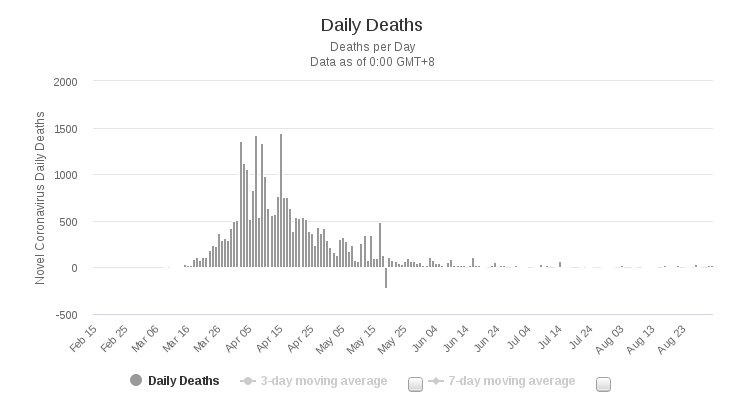
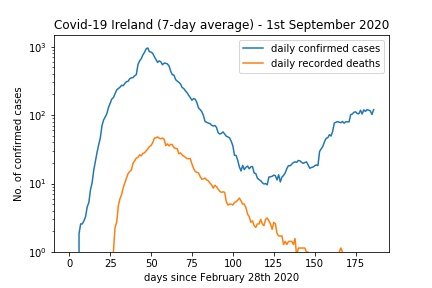
These low numbers are of course very good news indeed, but it got me wondering why. As you can see from the above graph, new cases started to increase about two months ago. In the first wave the mortality figures started to grow with a much shorter lag, although it is difficult to be too precise about it because of delays in testing and reporting that shifted the blue curve to the right.

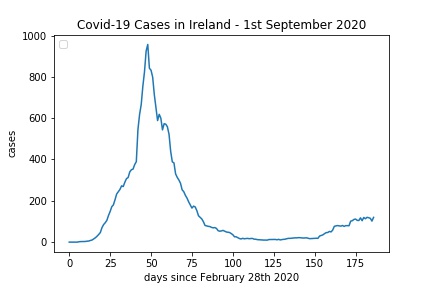
With new cases in the Republic now appearing at an average rate of around 100 per day and assuming a mortality rate of a few percent, one might have expected to see the mortality figures rising, but this has not happened. It must be said though that the current level of new cases is much lower than the initial peak, as this linear plot (also smoothed on a 7-day window) makes clear:

An even more remarkable case is that of France (data from here):

The blue curve is a 7-day moving average. You can see that the level of new cases in France is about the same as it was in late March. The daily mortality figure however looks like this:

So the mortality rate among recent cases is much lower in France than in Ireland.

I’m not going to discuss mortality data in the United Kingdom as these are being fiddled by the Government who have arbitrarily decided not to count anyone who dies more than 4 weeks after testing positive for Covid-19 in the figures. It’s a blatant con intended to make people think that the situation in the UK is better than it actually is.

I suppose the main factor for this is that the more recent cases are not happening in hospitals or care homes and they are affecting mainly younger people who have no underlying health conditions; over 70% of the recent cases in Ireland are people under the age of 45. It may also be that the treatment of patients is more effective now that it was in March and April.

Some people are arguing on social media are saying that data such as these prove that the Coronavirus has lost its potency and is no longer a threat. In order to provide evidence in support of such a claim one would have to take account of the differences in demographic and health history of new cases versus older ones, and I have not seen such a study.

Update: I had a terrible feeling that this would happen, but the same day I wrote this a further Covid-19 related death was reported. This was however a late notification of a death that occurred in June. For the latest figures see here.

Back to Returning to Campus Again

Posted in Covid-19, Education, Maynooth with tags , , , , on September 1, 2020 by telescoper

Three weeks ago I was writing about our plans for returning to campus at Maynooth University only to be rudely interrupted the very next day by new restrictions that forced us to put those plans on ice. Now we have about four weeks to get everything in place so we have to crack on.

Today the University wrote to all students outlining the general approach we are taking at Maynooth, but the details vary enormously from subject to subject. That is because the capacity of lecture theatres and laboratories and seminar rooms is reduced considerably to maintain the proper distancing between students. Classes will inevitably be smaller but we haven’t got any more rooms, so the number of face-to-face sessions will have to decrease. This affects every subject but hits very large courses much harder than smaller ones.

I will be in at the deep end on September 28th as I am teaching our first-year Mathematical Physics module, MP110. That is in Physical Hall, which has a normal capacity of 90 reduced to 27 by physical distancing requirements. Last year I had about 85 students in the class so it was full every time. This term I can fit only about one-third of that number in any session. There are three lectures per week in that module which means that if I have up to 81 students then each will be able to attend one lecture. Those unable to attend a lecture will be able to view recordings. Over the summer the University has been installing Panopto, a lecture-capture system we used to have when I was in Cardiff, so recordings of each session can be made. I also intend to record offline supplementary material for the class.

In addition to lectures each student on MP110 previously had a weekly tutorial. For the tutorials the students were split into 4 groups, but this year the reduced room capacities will probably require us to have more, smaller groups or to move to bi-weekly tutorials.

All of this is very sensitive to numbers, and we won’t know those until very close to the start of term. If we get more students than last year we will to revise the plans. The start of term is likely require quite a lot of last-minute adjustment.

For returning students on more specialist modules the classes are smaller and the impact less severe. I will also be teaching a second-year module MP201 Vector Calculus and Fourier Series next term. Not everyone who does Mathematical Physics in Year 1 continues with it to the second year so we expect roughly 50 on MP201. With that number we may be able to run lectures as normal (which means two a week) but may have to switch to bi-weekly tutorials. We expect third and fourth year classes to run quite close to normal. At least we will know the numbers of returning students fairly soon and can lock those plans in, leaving the 1st year to be dealt with last.

On top of all this we do have to have contingency plans in case the local or national Covid-19 situation deteriorates so far that we have to close the campus again. We will be in a better position to deal with that than we were back in March, as we have learned a lot very quickly and now have better equipment.

This afternoon the President of Maynooth University, Professor Philip Nolan, sent a message to all students that included the following:

Most of the large modules will use streaming of lectures so that you will receive some of the lectures on-line, and will be invited to attend less frequently than usual. Tutorials and practicals will also have reduced capacity, and in some cases the frequency will be reduced. The content of each module will remain largely unchanged, so you will be introduced to the same ideas, concepts and challenges. What will change is the format of delivery, and you will learn through a combination of live classes and on-screen material. We will publish more information, and details of the contact time in sample modules on the COVID page of the university website.

This reduced time on campus will mean that you will need to take more responsibility for your own learning, and ensure that you keep up with both the on-campus and on-line teaching.

Some of you are wondering if you need to attend at all, and whether you could complete your studies remotely. We are not a distance teaching university, and most of our courses are designed for on-campus delivery. So there will be times when you need to be on campus, and you will need to make sure that you can get to the campus when you need to.

I’ve seen some of the draft plans for other departments and it seems that the Department of Theoretical Physics is probably going to be one of the departments whose students will spend the most time on campus, with about 50% of the normal contact time. That’s primarily because we are small(ish) so can be a little more flexible. I also think that mathematical physics is a subject that needs students to take responsibility for their own learning anyway because much of it is problem-based. You can do physics problems at home or on the bus just as well as sitting in a room on campus.

I know some students are questioning the need to come on campus at all if they have so few contact hours and material is made available via recordings anyway. I can only speak for my own Department when I say that we think there is a huge value attached to in-person teaching, which is why we are trying so hard to maximize the on-campus experience for our students. It won’t quite be business as usual but will be the very best we can do under the constraints we have imposed on us. We’re doing the best we can but we do need students to play their part too!

P.S. I note that, for example, Waterford Institute of Technology is taking a quite different approach, with all lectures and tutorials going online for the whole academic year 2020/21.
Kildare Unlocked!

Posted in Covid-19, Maynooth with tags , on August 31, 2020 by telescoper

I just heard that the powers that be have decided to lift the restrictions on County Kildare that have been in place since August 8th. That means we can get on with the business of planning for return to campus at the end of September. I’m not sure how much of today’s decision has to do with the actual Covid-19 situation and how much to with the pressure from Kildare businesses, or the fact that many people were ignoring the restrictions anyway, but at least there’s now clarity. With just a month to go before we return to teaching, this is welcome news.

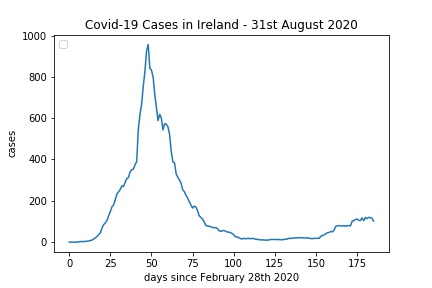
The latest national data on new cases do indeed show a bit of a decline. This graph shows a 7-day moving average

The downturn looks very small but is significant – from 115.3 to 101.9 since yesterday – but the more important thing for Kildare is that cases in the county are no longer many times above the national average. You can find the complete daily record of deaths and new cases here.

It seems strange to me the way that some people from County Kildare interpreted the local restrictions as some sort of punishment rather than as an attempt to prevent outbreaks spreading into the community. Anyway, if we’re no longer in lockdown does that mean we’re now locked up?

Further in Summer than the Birds – Emily Dickinson

Posted in Poetry with tags , , , on August 31, 2020 by telescoper

Further in Summer than the Birds –
Pathetic from the Grass –
A minor Nation celebrates
It’s unobtrusive Mass.

No Ordinance be seen –
So gradual the Grace
A gentle Custom it becomes –
Enlarging Loneliness –

Antiquest felt at Noon –
When August burning low
Arise this spectral Canticle
Repose to typify –

Remit as yet no Grace –
No furrow on the Glow,
But a Druidic Difference
Enhances Nature now –

by Emily Dickinson (1830-1886)


Sunday Morning at Home

Posted in Biographical, Maynooth on August 30, 2020 by telescoper

In between posts about Charlie Parker yesterday I moved quite a lot of my stuff from the flat to my house. With enough of the essential elements in place, I slept here for the first time last night.

I was planning to cook my first dinner here but was running late and couldn’t be bothered so instead ordered a very nice takeaway from the excellent Croatian bistro in town, which has just reopened after summer vacations. I can pretend that I wasn’t just being lazy but doing my bit to support local businesses.

I thought it might feel a bit strange sleeping in a new place. Not that I thought it would haunted or anything, it’s that when sleeping in an unfamiliar location (such as a hotel) I sometimes wake up in the middle of the night not knowing where the hell I am. Sometimes also there are strange noises that make it difficult to get to sleep in the first place.

When I first moved into the flat, I found the traffic noise from the busy main road quite difficult and for the last almost three years I’ve used earplugs almost every night I’ve slept there.

Last night though the remarkable and slightly unnerving thing is just how quiet the new place is: no traffic noise at all, no earplugs needed. It I did however still wake up at 4am not remembering where I was. I guess that will pass.

Anyway I rose late this morning and, as the weather is lovely, had some coffee in the garden, which has a definite look of late summer about it, the Crocosmia already fading…

I still have some other items to move here from the flat, but should be able to finish doing that today. I don’t have to hand over the keys until Monday evening but, unlike the UK, that’s not a Bank Holiday in Ireland so I’ll have to work.

Anyway I’ve got a lot of things to do today so I had better make a start – by which I mean have another cup of coffee.

Bird 100: Bird of Paradise

Posted in Uncategorized with tags , , on August 29, 2020 by telescoper

And so we come to the final post of the day in honour of the centenary of the birth of Charlie Parker, also known as `Bird’. I know a lot of people don’t really `get’ Bird’s way of playing, but for me he created some of the most beautiful and exciting sounds not only in jazz, but in any musical genre. Here is a piece called Bird of Paradise (a thinly disguised version of the Jerome Kern standard All The Things You Are) recorded in 1947 for the Dial label with a quintet that included a young (21 year-old) Miles Davis on trumpet. Miles Davis was still finding his way musically at the time of the Dial sessions, but Bird had already established himself as a powerful creative force and his solo on this number is absolutely exquisite.

Anyway, that’s it for Bird 100 from me. I hope you enjoyed the posts. Normal service will be resumed tomorrow!

Bird 100: Kim

Posted in Jazz with tags , , , , on August 29, 2020 by telescoper

Still going with posts to celebrate the centenary of the birth of Charlie Parker, aka Bird, a musical genius on the saxophone whose influence not only on jazz but on twentieth century music is incalculable. I’ve posted quite a few tracks by Bird over the years and one thing I’ve learned from doing that is that he’s by no means everyone’s cup of tea. I can’t do anything about that, of course, but I can at least point out the existence of his wonderful legacy to those (regrettably many) people who’ve never heard of him or his music I still remember the mixture of astonishment and exhilaration I felt when I first heard him on record and if I can give that sense of joy to just one person via the blogosphere then it’s worth a hundred posts.

Here’s Kim, another one of Bird’s tunes based on the rhythm changes, with an alto sax solo improvised at breakneck speed and with incredible virtuosity. The other day I was talking to a friend of mine who only has a passing interest in jazz and he asked me whether Charlie Parker really was that good. Well, if you’re asking that question to yourself, listen to this and then you’ll have the answer. As far as I’m concerned this is three minutes of pure awesome….

Bird 100: Now’s The Time

Posted in Jazz with tags , , on August 29, 2020 by telescoper

The next item in my homage to Charlie Parker on the occasion of the centenary of his birth is one of his variations on the blues in F, called Now’s the Time. It’s definitely one of the bluesiest of Bird’s blues, and indeed it’s quite close to the usual 12-bar chord progression:

| F7| F7| F7 |F7 | B♭7| B♭7| F7| F 7|C7| B♭7| F7| F7|

In fact this goes something like

F7|B♭7|F7|Cm7 F7|B♭7|B♭7|

F7 D7#9| Gm7|C7|F7 D7|Gm7 F7|

Bird 100: Bloomdido

Posted in Jazz with tags , , , , , , on August 29, 2020 by telescoper

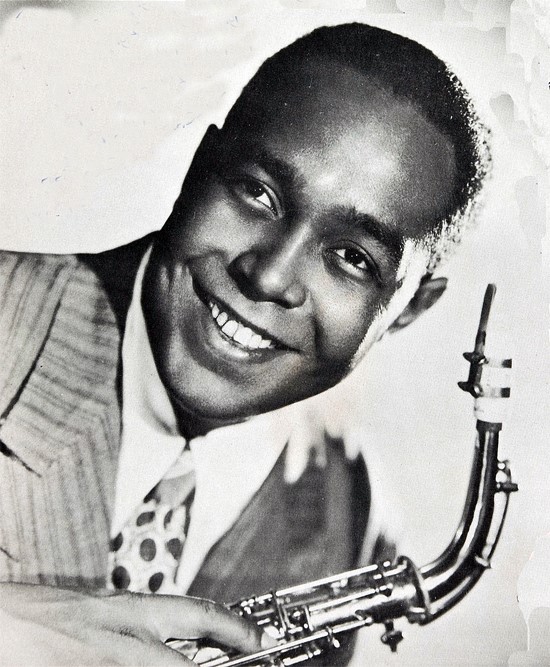
Here is another bit of music to celebrate the 100th anniversary of the birth of the great saxophonist Charlie Parker (“Bird”) on 29th August 1920.

bird

I’ve written quite a few posts relating to Charlie Parker over the years but today has provided a good excuse to spend my lunchtime writing another one, this time featuring one of my favourite tracks from one of my favourite albums. First released in 1952 but in fact recorded in two separate sessions in 1949 and 1950, the album Bird and Diz was actually the last studio album made under the joint leadership of Charlie Parker and Dizzy Gillespie, the two main architects of the bebop revolution; the track I’ve picked has the added advantage of featuring another great musical genius on piano, Thelonious Monk.

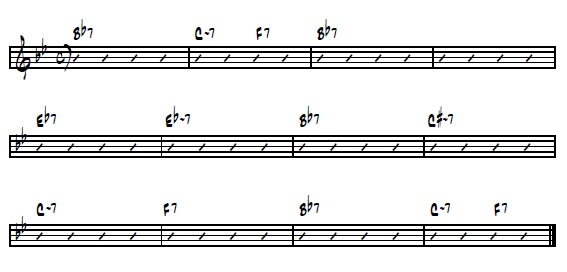
The Charlie Parker composition Bloomdido is yet another of his variations on the blues, though this one is a bit less intricate than some of the others he wrote. Here are the chords for Bloomdido:

Bloomdido

You can see that the progression is based around the standard three chords of a blues in B♭. The foundation is a “tonic” chord (T) based on the root note of whatever key it’s played in, in this case B♭. This sometimes a basic triad consisting of the first, third and five notes of a major scale starting on that note or, as in this example, including the dominant 7th so it’s B♭7. The next chord is the subdominant chord (S), shifting things up by a perfect fourth relative to the tonic, in this case an E♭7 and then finally we have the dominant (D) which brings us up by a fifth from the original root note, in this case F7.

The basic blues sequence in B♭ would be four bars of B♭7 (T), two of E♭7 (S), back to B♭7 (T) for two, then the characteristic bluesy cadence returning to two bars of B♭7 (T) via one bar each of F7 (D) and E♭7 (S). The sequence for Bloomdido has a few alterations, including a characteristic turnaround at the end, but is otherwise fairly recognizable. I guess the first part of the title is a play on the blues origin too, though I wonder if the second part suggests that some of the alterations are inspired by the A-section of the Juan Tizol standard Perdido?

Some people tell me they find Charlie Parker’s music “too technical” and that somehow if music “needs to be explained” it’s not good music. I don’t understand that attitude at all. I find this music so fascinating and exciting to listen to that I want to try to dig a little bit into it and find out what’s going underneath the surface. It’s particularly striking what a difference a few substitutions and passing chords can make to the overall harmonic “feel” of a piece like this compared to a standard blues sequence, for example. But you don’t need to study the chords to appreciate the sheer beauty of the music that Charlie Parker built on these harmonic foundations; his solo on this track, as on so many others he recorded in his short life, is just sublime even if you don’t realise how hard it is to play! I guess it all depends whether your way of enjoying a thing is to sit back and let it wash over you, or for it to inspire you to find out more. Many of the physicists I know are deeply interested in music. Perhaps that’s because they’re the sort of people who don’t just think “wow that’s beautiful”, they tend to think “wow that’s beautiful – how does it work?”.

Charlie Parker and Albert Einstein died in the same year, just over a month apart, the former in March 1955 and the latter in April. They were two very different geniuses but it’s as difficult to imagine physics without Einstein as jazz without Bird.

Bird 100: Bird’s Nest

Posted in Jazz with tags , , , , , on August 29, 2020 by telescoper

Here’s another track to celebrate the centenary of the birth of the great Charlie Parker.

When I was at school most of my friends seemed to be into heavy metal, which I found completely tedious, so while they were out buying LPs by Hawkwind or Iron Maiden I was acquiring a secret collection of classic jazz records. Among my most prized purchases was a boxed set of six vinyl discs entitled The Legendary Dial Masters; they’re now available on CD, of course. I listened to these records over and over again and can easily understand why they’re regarded as some of the greatest musical performances of the twentieth century, not only in Jazz but in all music.

There’s a curious story about the Dial sessions, in that they took place in Hollywood California as part of an “exclusive” one-year contract (signed in 1946) between Dial records and Charlie Parker, who just happened to have signed another exclusive contract with the Savoy label based in New York. By this time in his life, Parker was already seriously addicted to heroin and this example of duplicity is consistent with other aspects of his behaviour: he regularly cheated and scrounged off friends and strangers in order to feed his habit and probably gave relatively little thought to the consequences of being found out. In this case, the clear breach of contract was pretty quickly rumbled, which could have led to a lawsuit, but it seems to have been settled amicably by the record labels, who agreed that both sets of recordings could be made commercially available.

It would take scores of blog posts to do justice to these great tracks, so I’ll just make a few comments now. First thing to mention is that the LPs forming the boxed set don’t just include the final versions as released, but usually a number of incomplete or discarded takes. At the session in question, recorded on February 19th 1947, there are 13 takes in all for just four tunes. It’s fascinating listening to these alternative versions (which are often, in my view, just as good if not better than the “final” version), not least because they demonstrate the wonderful spontaneity of Charlie Parker’s playing. They also have an experimental feel to them. The track I heard last night, Bird’s Nest, is, on one level, yet another bebop composition based on the chord changes of the George Gershwin standard “I got rhythm”, but what’s very special about it is just how free his improvisation is, both rhythmically and harmonically. It is, of course, well known that Charlie Parker’s nickname was “Bird” (originally Yardbird), and this track in particularly demonstrates that his playing really was very like birdsong – agile, quirky and above all intensely beautiful. The main difference is that most birdsong is actually atonal, which Bird’s music was not.

Another thing worth mentioning about this track is the identity of the piano player. When I heard it last night it triggered a vague memory that Errol Garner made some records with Charlie Parker. Was this one of them? I honestly couldn’t remember, but became increasingly convinced when I heard the piano solo. Later on, a quick search through my discography revealed that I was right. It is indeed a young Errol Garner. Although he doesn’t play badly, he doesn’t sound to me either comfortable or convincing playing bebop. Nevertheless, this session gives an important glimpse into the musical development of a major artist. You could say the same thing about the other tracks made around the same time by Bird and the young Miles Davis.

But that’s enough words. The whole point about music is that it says something that can’t be said with words. Birds manage perfectly well without them too.