A Statistical Solution to the Chaotic, Non-Hierarchical Three-Body Problem

Posted in The Universe and Stuff with tags , , , on February 24, 2020 by telescoper

I’m a bit late passing this on but I think some of my readers might find this interesting, as I did when I came across it a week or so ago. There’s a paper on the arXiv by Nicholas Stone and Nathan Leigh with the title A Statistical Solution to the Chaotic, Non-Hierarchical Three-Body Problem and the following abstract:

The three-body problem is arguably the oldest open question in astrophysics, and has resisted a general analytic solution for centuries. Various implementations of perturbation theory provide solutions in portions of parameter space, but only where hierarchies of masses or separations exist. Numerical integrations show that bound, non-hierarchical triples of Newtonian point particles will almost always disintegrate into a single escaping star and a stable, bound binary, but the chaotic nature of the three-body problem prevents the derivation of tractable analytic formulae deterministically mapping initial conditions to final outcomes. However, chaos also motivates the assumption of ergodicity, suggesting that the distribution of outcomes is uniform across the accessible phase volume. Here, we use the ergodic hypothesis to derive a complete statistical solution to the non-hierarchical three-body problem, one which provides closed-form distributions of outcomes (e.g. binary orbital elements) given the conserved integrals of motion. We compare our outcome distributions to large ensembles of numerical three-body integrations, and find good agreement, so long as we restrict ourselves to “resonant” encounters (the ~50% of scatterings that undergo chaotic evolution). In analyzing our scattering experiments, we identify “scrambles” (periods in time where no pairwise binaries exist) as the key dynamical state that ergodicizes a non-hierarchical triple. The generally super-thermal distributions of survivor binary eccentricity that we predict have notable applications to many astrophysical scenarios. For example, non-hierarchical triples produced dynamically in globular clusters are a primary formation channel for black hole mergers, but the rates and properties of the resulting gravitational waves depend on the distribution of post-disintegration eccentricities.

The full paper can be downloaded here. The abstract is very clear but you might want to read the wikipedia entry for the three-body problem for general background. Here’s a fun figure from the paper:

Let me just add a note of explanation of the word `hierarchical’ as applied here: it means when the mass of one body is very different from the other two, or that two of the bodies have a much smaller separation from each other than they do from the third.

This paper does not present an analytic solution of the unrestricted three-body problem (which is known to be intractable) but does provide some very useful statistical insights into the long-term evolution of three-body systems, for example confirming the generally held opinion that most such systems evolve into a state in which one body is ejected and the other two form a tight binary.

Fidelio in Dublin

Posted in Opera with tags , , , , , , on February 23, 2020 by telescoper

Yesterday evening found me once again at the National Concert Hall in Dublin for a performance of Beethoven’s only Opera, Fidelio, performed by Lyric Opera Ireland together with the young musicians of Sinfonua conducted by Tony Purser. The event was, of course, part of the Beethoven 250 celebrations that will be taking place all this year in concert halls around the world. The National Concert Hall isn’t really designed for opera, so the orchestra had to squeeze into the space between the front row of the stalls and the stage. I was a few rows back, but I could still read the scores on the desks!

A synopsis of the Opera is as follows.

Leonore (Sínead Campbell-Wallace) has disguised herself as a man, Fidelio, and has gained employment as assistant to the chief gaole, Rocco (Mikhail Svetlov), of the state prison in the hope of finding and freeing her imprisoned husband Florestan (Samuel Sakker). To complicate matters, Rocco’s daughter, Marzelline (Rachel Croash), has fallen in love with Fidelio, which annoys her suitor Jaquino (Patrick Hyland) even though he doesn’t know Fidelio is actually a woman. Leonore persuades Rocco to let her help him in the underground cells where the political prisoners are held in inhuman conditions. The prison governor, the villainous Don Pizarro (Gyula Nagy), learns of an impending inspection by the minister and decides that Florestan – who has been particularly cruelly treated – must be killed to hide the evidence of his abuse. Leonore hears of the plan to murder her husband and, as the prisoners are briefly allowed out into the sunlight, she searches in vain for Florestan among them. He is still in chains below ground. Eventually Leonore and Rocco descend into the darkness of the dungeon and find Florestan, near death, having a vision of an angel that has come to rescue him. Leonore looks on as Pizarro arrives and tries to kill her husband, but she stops him and reveals her true identity. In the nick of time (geddit?), the Minister, Don Fernando (Felix Kemp), arrives and, appalled by what he sees, commands that all the prisoners be released. Leonore sets her husband free.

Much of Beethoven’s music from his “middle period” – Fidelio was first performed in 1805 – is about the struggle for political liberty and social justice that was taking place throughout Europe at the time so it’s not difficult to see why he was attracted to this story. Although originally written in three acts, it is now performed in a version with only two. This gives the opera a fascinating structure. The music in Act I is clearly a nod back in the direction of Mozart, while Act II is dramatically different, specifically with a much wider range of orchestral colour, and is clearly a look forward towards Romanticism. There are no less than four published versions of the overture. Last night we heard the standard one often called Leonore No. 3, but more often simply known as Fidelio.

Fidelio is really a singspiel (a form of opera in which the recitative is spoken or declaimed rather than sung). In this performance the spoken dialogue was in English while the sung part was in the original German. There were surtitles too, so the plot was easy to follow. Given the constraints of the National Concert Hall the set was simple but nonetheless effective, and the a mixture of 19th century and modern dress. Part of the chorus performed from the choir stalls behind the stage. In the first act they were dressed as prisoners but during the interval they changed into ordinary everday clothes, a device I found very effective. A story of wrongful imprisonment is as relevant today as it was in Beethoven’s time. This point was emphasized near the end of Act I when the prisoners are briefly allowed out from their cells: children in modern dress mingled with them, holding photographs of people of all races and generations who have been unjustly taken away.

I thought the principals were outstanding. Sínead Campbell-Wallace (soprano) was a superb Leonore, both vocally and dramatically, Samuel Sakker (tenor) impressed, Mikhail Svetlov (bass) was in fine voice throughout, and (perhaps the pick of them all) Hungarian baritone Gyula Nagy was a wonderfully sinister Don Pizarro.

So far so good, but there were some less than ideal things about this production, chiefly the intonation. For many people the highlight of this Opera is the wonderful Prisoners’ Chorus (“O welche Lust….”) when the inmates of the gaol are temporally released to get some fresh air. They staggered onto the stage, eyes blinking at the light, but their incarceration had obviously robbed some of  them of a sense of pitch and the started horrifically out of tune. From time to time the orchestra – especially the brass – also struggled to find the correct pitch, producing some painfully jarring moments.

It’s hard to believe that it has been the best part of a decade since I first saw Fidelio, in a production by Welsh National Opera. Both that one and this one offered much to enjoy, but I still have to see a production that really does this work justice.

Wagner & Bruckner at the National Concert Hall

Posted in Music with tags , , , , , , , on February 22, 2020 by telescoper

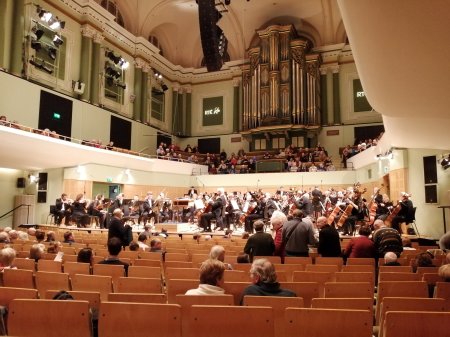
I had to brave some very inclement weather on the way to last night’s performance at the National Concert Hall in Dublin for a performance by the RTÉ National Symphony Orchestra, under the direction of Mihhail Gerts (deputising for Natalie Stutzmann who had to withdraw “due to unforeseen circumstances”). The concert consisted of the Prelude to Act I and the Good Friday Music from the Opera Parsifal by Richard Wagner followed by Symphony No. 7 by Anton Bruckner. To my surprise these pieces were performed without a wine break interval.

As was the case a couple of weeks ago for Bruckner 8, a big orchestra was required, including a quartet of Wagnertuben.

While not everyone likes Wagnerian Opera performed in entirety there must be very few people who don’t enjoy the overtures. A programme consisting entirely of Richard Wagner’s Preludes would make for a wonderful concert, and the Prelude to Act I of Parsifal, although very familiar, is so beautiful that it bears repeated listening. Whenever I hear it I can’t help thinking of the poignant last scene of the very last episode of Inspector Morse: `Goodbye Sir’, says Lewis and kisses the dead Morse on the forehead to the accompaniment of this music from Parsifal.

The Good Friday Music occurs at the start of the Third Act of Parsifal so is in a sense also a Prelude. Even out of the context of the Opera, it provides a wonderful opportunity for reflection and contemplation because it is so subtle and understated, somewhat uncharacteristically for Wagner.

These two pieces last about half an hour, and normally one would expect an interval after them, especially since the Symphony is over an hour in duration. I’m not sure what the reason was for playing the Bruckner straight after the Wagner, but it seems to have been a last minute decision. The printed programme contains the usual `INTERVAL_ 20 minutes’ so I had ordered a drink for the interval; nobody had told the bar staff there wouldn’t be one. I got my money back, though.

One positive aspect of the lack of a pause was that it made the connection between Bruckner’s composition and Wagner even more obvious. The radiant first movement of Bruckner’s Seventh Symphony, with its noble melody soaring over shimmering violin tremolos is very reminiscent of Wagner, as is much of the rest of the Symphony (including the orchestration). Bruckner famously idolized Wagner and this composition is at least partly a tribute to his musical hero. It is said that Bruckner had a premonition of Wagner’s death in 1883 and the cymbal crash during the second (slow) movement symbolizes the moment that he found out that his premonition had come true. That whole movement (marked Sehr feierlich und sehr langsam; very solemn and very slow) is very moving: sombre though not excessively mournful. The third movement Scherzo is marked Sehr Schnell (very fast) but I found the tempo last night rather restrained. I was expecting something a bit wilder. The last movement actually sounded to me more like Mahler than Wagner.

The Seventh is probably Bruckner’s best known and most performed Symphony. It was certainly a big hit for him when it was first performed in 1884. I enjoyed last night’s performance. Usually videos of these concerts are put on the Lyric FM Youtube channel shortly after the performance, but when I looked just now last night’s wasn’t there yet. I’ll put a link up as soon as it appears.

UPDATE: Here, as promised, is the recording:


The picture above was taken a while before the performance and, although quite a few more people came in before it started, there were still quite a few empty seats. The National Concert Hall posted a (small) financial loss last year. I do the best I can to support it by attending as frequently as I can, but I am always saddened a bit to see so many empty seats. Anyway, I shall be back there this evening for a special event which is part of the Beethoven 250 celebrations, so watch this space!

When is an External Examiner not an External Examiner?

Posted in Education with tags , , , , on February 21, 2020 by telescoper

The other day I was at a training session about Finance and Governance for new Heads of Department at Maynooth University. During the course of that there was a briefing about payroll arrangements, tax rules and so on. Among the pieces of information I learned is that all external examiners at the University have to receive their payment through the payroll system, which means that, as well as other bureaucracy, they will have to get a PPS number (the equivalent of a National Insurance number) before they start work. This goes for undergraduate and postgraduate programmes, including individual PhD examinations.

The payment for an external examiner is really just a token honorarium – nobody becomes an external examiner for the money! – so this imposes quite a big administrative overheard but the Revenue people are adamant that it has to be done so we’ll have to cope.

There is another difficulty here. Technically any payment you get to compensate for travel to your `normal place of work’ is not tax-free. If you’re employed even for just one day as an external examiner at University X then University X is your employer and its campus is your normal place of work for that employment. Your travel expenses should therefore be taxed. I understand that in Ireland an exemption has been negotiated for this so in practice this issue won’t arise, unless (as is possible) the authorities change their mind about the exemption.

Aside from the additional paperwork and muddle there’s an important conceptual issue here. The new arrangements mean that an external examiner (who is meant to be independent) will now be an employee of the University. In effect, the external examiner is no longer external. This makes me very uncomfortable.

I was already a bit uncomfortable about the system of external examiners anyway, as they are usually appointed on the recommendation of a department based on personal knowledge. In principle a department could recommend someone they know would be a soft touch or who owes them a favour in some way. I think such abuses of the system are probably rather rare, and most externals do the job as objectively and as diligently as they can.  I have  always tried to be fair when called upon to do such tasks, although it’s not for me to say whether I have always succeeded.

The point I want to make, however, is that It is important not only that the system is fair and rigorous but that it be seen to be fair and I don’t think that is the case the way things are currently run either in Ireland or in the United Kingdom. For the reasons described above the present arrangements certainly do not look incorruptible.

I’ve always felt that a better system could be created by setting up an agency of some sort, completely independent of the universities that would maintain a panel of external examiners who would be paid by the agency rather than by higher education institutes themselves . The agency will also pay travel expenses. When a university needs an external examiner, it would make a request and be allocated one with the necessary expertise in such a way that no personal conflicts of interest could arise.

This would be quite a simple thing to set up in the United Kingdom, as UK universities usually have externals from other UK universities. It would be more difficult in Ireland, however, because the university sector is quite small and many of our external examiners are overseas (especially from the UK). I don’t see this as an insuperable problem, however, as the body overseeing the appointments should be set up in such a way as to deal with the administration.

I think the system I advocate would solve the issues I have raised, principally by assuring that external examiners are actually external.

Comments are, of course, welcome through the box below.


Solidarity with the UCU Strike!

Posted in Education, Politics with tags , , on February 20, 2020 by telescoper

So the latest round of strikes by members of the University and College Union (UCU) began today. There will be fourteen days of strikes spread over four weeks between now and 13th March. The cause of the long-running dispute is twofold: (1) the long-running saga of the Universities pension scheme (about which there were strikes in 2018); and (2) over pay, equality, workloads and the ever-increasing casualization of lecturing and other work.

Among the UK institutions to be involved in the industrial action are Cardiff, Sussex and Nottingham where I have worked at various times in the past. Nobody likes going on strike but the UK higher education system is a very poor state right now, and many of my former colleagues feel that they have no alternative. It will be tough out there on the picket lines in the cold weather, and losing 14 days’ pay is no fun either, but that’s what it means to go on strike.

I’m no longer involved in the UK university system so can’t do much directly to support those taking industrial action but thought the least I could do is wear my union badge* for the duration of the strike. The Irish Federation of University Teachers (IFUT) will no doubt be expressing their support for comrades on strike. It’s not as if higher education in Ireland is immune from casualisation and workload issues.

*On reflection, I should have taken the picture a different way…

Evidence for a Spatially Flat Universe?

Posted in The Universe and Stuff with tags , , , , , , on February 19, 2020 by telescoper

Yesterday I saw a paper by George Efstathiou and Steve Gratton on the arXiv with the title The Evidence for a Spatially Flat Universe. The abstract reads:

We revisit the observational constraints on spatial curvature following recent claims that the Planck data favour a closed Universe. We use a new and statistically powerful Planck likelihood to show that the Planck temperature and polarization spectra are consistent with a spatially flat Universe, though because of a geometrical degeneracy cosmic microwave background spectra on their own do not lead to tight constraints on the curvature density parameter ΩK. When combined with other astrophysical data, particularly geometrical measurements of baryon acoustic oscillations, the Universe is constrained to be spatially flat to extremely high precision, with ΩK = 0.0004 ±0.0018 in agreement with the 2018 results of the Planck team. In the context of inflationary cosmology, the observations offer strong support for models of inflation with a large number of e-foldings and disfavour models of incomplete inflation.

You can download a PDF of the paper here. Here is the crucial figure:

This paper is in part a response to a paper I blogged about here and some other related work with the same general thrust. I thought I’d mention the paper here, however, because it contains some interesting comments about the appropriate choice of priors in the problem of inference in reference to cosmological parameters. I feel quite strongly that insufficient thought is given generally about how this should be done, often with nonsensical consequences. It’s quite frustrating to see researchers embracing the conceptual framework of Bayesian inference but then choosing an inappropriate prior. The prior is not an optional extra – it’s one of the key ingredients. This isn’t a problem limited to the inflationary scenarios discussed in the above paper, by the way, it arises in a much wider set of cosmological models. The real cosmological flatness problem is that too many cosmologists use  flat priors everywhere!


What’s the Vector, Victor?

Posted in Film, mathematics, The Universe and Stuff with tags , , , on February 18, 2020 by telescoper

Following on from Sunday’s post about the trials and tribulations caused by Storm Dennis, here is a clip of a plane (an Airbus 380)  landing at Heathrow airport on Saturday.

There are other clips of this same event on Youtube and some of them describe this landing as `dangerous’. Although it undoubtedly involved skill and concentration by the pilot it’s not actually dangerous. Aircrew are trained to land in windy weather like this, and it’s fairly routine. My plane to Dublin (an Airbus 320) landed like this on Saturday evening and, although the pilot got a well-deserved round of applause on landing, nobody was ever really at risk.

As it happens, this week I start teaching vector algebra to my first-year Engineering students, so the weekend’s weather events have  given me a good illustration of vector addition. The plane has to have a velocity vector relative to the air such that the sum of it and the wind vector adds to a resultant vector directed along the runway. Lots of people seem to think this is just guesswork but it isn’t. It’s applied mathematics.

This is in principle simple as long as the crosswind is steady, but obviously the pilot needs to be alert to gusting and make adjustments along the way. When the plane has slowed down enough to land in normal conditions, the wind over the wings is still causing a bit of extra lift. You can see that in the last moments before touchdown this aircraft is gliding because of this effect. I’m told that because of this, in windy conditions planes usually descend at a steeper angle than usual.

The interesting bit for me is that the plane touches down in such a way that its body is at an angle to the runway. As soon as it has landed it has to correct this and point along the runway. I think this is done with the rudder rather than the undercarriage, but I don’t know. Perhaps any experienced pilots that happen to be reading this could give more details through the comments box?

P.S. The title of this post is a reference to the film Airplane!


Thelonious Monk plays Duke Ellington

Posted in Jazz with tags , , , , on February 17, 2020 by telescoper

This morning there was a reminder on the radio that today is the anniversary of the death of the great Thelonious Monk, who died on 17th February 1982. I went to a concert by British pianist Stan Tracey the day after the sad news broke and he threw away his intended play list and played nothing but Monk tunes for the whole evening. It was a wonderful concert and a moving tribute from one musician to another who had clearly influenced him deeply.

Last week I was asked by a young man to recommend some albums because he wanted to find out more about Monk’s music. Among those I suggested was Thelonious Monk plays Duke Ellington which was recorded in 1956 for the Riverside Label, and features a trio of Thelonious Monk (piano), Oscar Pettiford (bass) and Kenny Clarke (drums).

This is an unusual album because it finds Monk doing what the recording executives asked, namely to play standard tunes rather than his original compositions. The most performed jazz composer of all time* is Duke Ellington so he was a natural source of material to choose, and the album that resulted is absolutely fascinating not least because Monk clearly relates very well to Ellington’s music. In fact it’s one of my all-time favourites. Here is just one track from it, I let a Song go out of my Heart. Enjoy!

*The second most performed jazz composer of all time is none other than Monk himself!

LGBTQ+ STEMinar 2020 – The Conference Photograph!

Posted in Biographical, LGBTQ+ with tags , , , on February 17, 2020 by telescoper

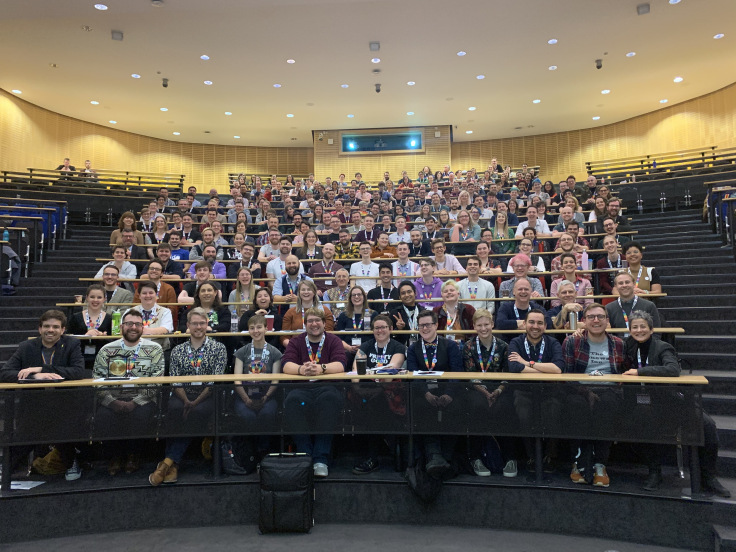
Regular readers of this blog – both of them – will be aware that last month I attended the 2020 LGBTQ+ STEMinar at the University of Birmingham. This was fifth of these and the largest one of these do far, with around 250 participants. Anyway, I’ve just received delivery of the conference photo!

You’ll see me on the extreme left about half way up. Of course there are fewer than 250 in the photograph: not everyone wanted to be in it (for a variety of reasons).

Anyway, the next one of these will be in 2021 in Oxford where, I am told, there is also a university.

The Growing Inaccessibility of Science

Posted in Open Access on February 16, 2020 by telescoper

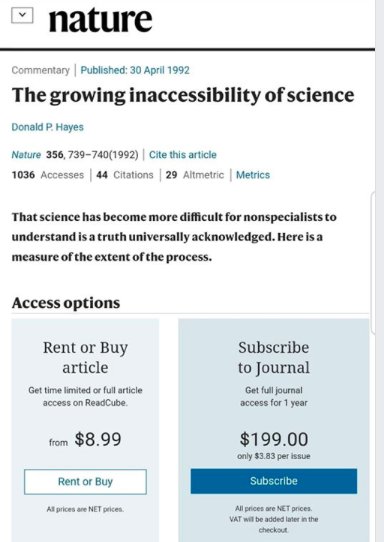
No comment necessary, except to thank Brendan O’Brien for sending this to me via Twitter.