Bethnal Green Memories

Posted in Biographical with tags , on February 15, 2020 by telescoper

In London yesterday for a couple of things, including the RAS Discussion Meeting in the afternoon, but on my way to that I thought I’d wander through the part of London where I lived many years ago, so got off the tube at Bethnal Green and went for a short walk.

Bethnal Green doesn’t seem to have changed very much and the street I used to live in looks very much the same as it did in the 90s. I couldn’t resist taking a quick snap of the front door that leads to my old flat as I walked past. I wonder who lives there now?

So much has happened since then it’s hard to believe I lived here for the best part of 9 years! I feel a complete stranger in London nowadays. The past is a foreign country.

Visiting places you used to live isn’t really a good idea. It’s likely to make you feel a bit strange. There are always ghosts hidden among the memories. Perhaps that’s why I keep having dreams that feature former residences. Only in the dreams those places are never quite the same as they actually were.

I remember having a weekend break in Newcastle with an old friend just after my Father died in 2007. At one point we walked past my old school and went in the grounds to have a look. That experience affected me rather a lot and I still don’t know why. The past is the past and it’s not comfortable when it intrudes on the present.

Yesterday, as I carried on walking towards Whitechapel, I suddenly remembered that when I moved in to that flat my Mam gave my a microwave oven. Thirty years on, I still have it and it still works well. It’s in the house in Cardiff. I suppose I’ll have to throw it away at some point. But not yet.

When I lived in Bethnal Green if I wanted to go into Town I would take the tube from either Bethnal Green on Whitechapel, depending on where exactly I wanted to go. This time I found that Whitechapel tube station was closed for refurbishment, so I had to walk on to Aldgate East.

It’s all a question of angles.

Posted in History, mathematics on February 14, 2020 by telescoper

I couldn’t resist reblogging this fascinating post on the origins of trigonometry by the inestimable Thony Christie..

thonyc's avatarThe Renaissance Mathematicus

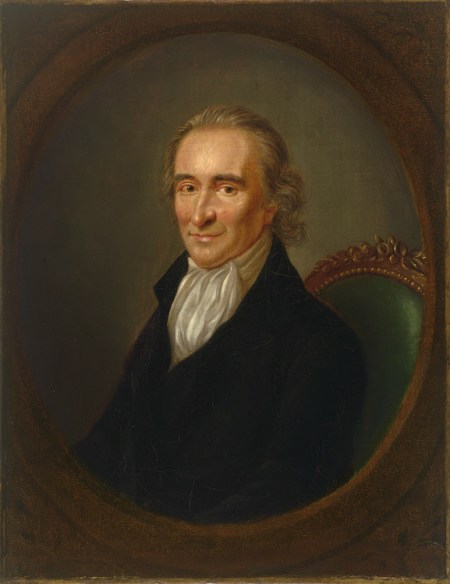
Thomas Paine (1736–1809) was an eighteenth-century political radical famous, or perhaps that should be infamous, for two political pamphlets, Common Sense (1776) and Rights of Man (1791) (he also wrote many others) and for being hounded out of England for his political views and taking part in both the French and American Revolutions.

Portrait_of_Thomas_Paine Thomas Paine portrait of Laurent Dabos c. 1792 Source: Wikimedia Commons

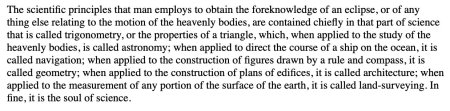
So I was more than somewhat surprised when Michael Brooks, author of the excellent The Quantum Astrologer’s Handbook, posted the following excerpt from Paine’s The Age of Reason, praising trigonometry as the soul of science:

EO_QsU2WkAIDGol

My first reaction to this beautiful quote was that he could be describing this blog, as the activities he names, astronomy, navigation, geometry, land surveying make up the core of the writings on here. This is not surprising as Ivor Grattan-Guinness in his single volume survey of the history…

View original post 1,567 more words

The Journal of Military History and Defence Studies

Posted in History, Maynooth, Open Access with tags , , , on February 13, 2020 by telescoper

I’ve been a bit busy with Computational Physics lectures and labs today so I couldn’t make it to the launch event of a new online Open Access Journal by Maynooth Academic Publishing, who also publish the Open Journal of Astrophysics. The new publication is the Journal of Military History and Defence Studies and its website is here.

Here is the description of the journal:

The Journal of Military History and Defence Studies is a bi-annual peer-reviewed open access online journal that publishers original research and contributions in military history and defence studies. In addition to publishing work by established authors and scholars, the journal has the particular aim of making available to a wide audience the best work completed by postgraduate students studying within these fields at Maynooth University, the Irish Military College and other similar institutions. The journal also aims to publish special editions that make available original research presented at conferences, research seminars etc. As the title suggests, the journal focuses on military history and defence studies, taking a broad view of these subject areas to include the history of war and of militaries, and also of the impact of these on wider society, in addition to the study of war, strategy, security and military organisation today and into the future.

You will see from the website that, as well as catering for a different discipline, this one has a look and feel that is quite different from that of the Open Journal of Astrophysics , but the ultimate aim of both journals is the same, to make high quality research available free of charge to the largest possible audience.

How are things in Glocca Morra? – Sonny Rollins

Posted in Jazz with tags , , on February 12, 2020 by telescoper

À propos de rien, but to chill for a few minutes while I have a cup of tea after this afternoon’s Engineering Mathematics lecture, I thought I’d post a piece of music. As regular readers of this blog (both of them) will know, I listen to quite a lot of jazz. In the course of doing that it has often struck me that there can hardly be a tune that’s ever been written – however unpromising – that some jazz musician somewhere hasn’t taken a fancy to and done their own version. Louis Armstrong turned any amount of base metal into gold during his long career, but here’s an example from a more modern legend, Sonny Rollins, who is still going strong at the age of 89.

The full personnel listing is Sonny Rollins (tenor saxophone); Donald Byrd (trumpet); Wynton Kelly (piano); Gene Ramey (bass); and Max Roach (drums). The track was recorded in 1956. The band is playing a tune called How are thing in Glocca Morra? and it was written for the 1947 musical Finian’s Rainbow (which I hate). This version, though is absolutely gorgeous.  It clearly doesn’t take much to inspire a genius…

PhD Studentship in Gravitational Wave Astrophysics at Maynooth University!

Posted in Uncategorized with tags , , , , on February 11, 2020 by telescoper

With the arrival of Dr John Regan in the Department of Theoretical Physics at Maynooth University we are delighted to announce a fully-funded PhD studentship. In order to boost the circulation, here’s a copy of the advert you can find on John’s own website.

–o–


Project Description. Recent detections of gravitational waves from stellar mass sized black holes with the LIGO observatory has opened up a new window for black hole astrophysics as well as heralding the dawn of multimessenger astrophysics. LIGO is sensitive to the mergers of black holes in the range 10 solar masses up to approximately 100 solar masses out to a few Megaparsecs.

LISA is the planned, next generation, space-based gravitational wave observatory due for launch in 2034. LISA will be sensitive to gravitational waves at a much lower frequency compared to LIGO and as a result will be able to detect the mergers of both much larger and much more distant black holes. Planning for LISA is now well underway and the science base and objectives are being determined.

This PhD project will involve computing gravitational wave forms from mergers of massive black holes from the early Universe – which will be detectable by LISA. The origin of massive black holes is currently unknown and hence being able to detect their mergers from the early Universe is seen as a critical aspect in understanding their formation pathways. In this project the student will use the state-of-the-art Enzo-E code to model the mergers of black holes. In doing so the student will be able to accurately compute the gravitational wave signal from black holes which are merging in the distant Universe thus making predictions for LISA.

Student fees and a full stipend (€18k per annum) are available as part of this studentship.

Candidate Criteria. Applicants should have (or be about to complete) an undergraduate degree and/or taught postgraduate degree in (applied) mathematics, (theoretical) physics, computer science or a related discipline. Past experience shows that successful applicants usually have a very good first class degree (or equivalent). Applicants with computational experience are particularly encouraged to apply. In addition, the applicants must have excellent communication, planning and team working skills.

Application Procedure

Application Deadline: Friday May 1st 2020

Students who wish to apply for this studentship should apply in writing to john.regan@mu.ie. Please put “PhD Studentship Position” in the subject of the email. The application must comprise:

  • A full CV
  • A covering letter outlining why you wish to pursue this PhD program
  • Two references, preferably from your current academic institution, outlining your suitability for the position

Shortlisted candidates will be notified of the outcome of the selection process in early May with interviews in mid-late May. The start date for the PhD is expected to be September 2020.

Please direct any questions or queries on the above position to Dr. John Regan (john.regan@mu.ie)


Not the Open Journal of Astrophysics Impact Factor – Update

Posted in Open Access, The Universe and Stuff with tags , , , , on February 11, 2020 by telescoper

 I thought I would give an update with some bibliometric information about the 12 papers published by the Open Journal of Astrophysics in 2019. The NASA/ADS system has been struggling to tally the citations to a couple of our papers but this issue has now been resolved.  According to this source the total number of citations for these papers is 532 (as of today). This number is dominated by one particular paper which has 443 citations according to NASA/ADS. Excluding this paper gives an average number of citations for the remaining 11 of 7.4.

I’ll take this opportunity to re-iterate some comments about the Journal Impact Factor. When asked about this my usual response is (a) to repeat the arguments why the impact factor is daft and (b) point out that we have to have been running continuously for at least two years to have an official impact factor anyway.

For those of you who can’t be bothered to look up the definition of an impact factor , for a given year it is basically the sum of the citations for all papers published in the journal over the previous two-year period divided by the total number of papers published in that journal over the same period. It’s therefore the average citations per paper published in a two-year window. The impact factor for 2019 would be defined using data from 2017 and 2018, etc.

The impact factor is prone to the same issue as the simple average I quoted above in that citation statistics are generally heavily skewed  and the average can therefore be dragged upwards by a small number of papers with lots of citations (in our case just one).

I stress again we don’t have an Impact Factor as such for the Open Journal. However, for reference (but obviously not comparison) the latest actual impact factors (2018, i.e. based on 2016 and 2017 numbers) for some leading astronomy journals are: Monthly Notices of the Royal Astronomical Society 5.23; Astrophysical Journal 5.58; and Astronomy and Astrophysics 6.21.

My main point, though, is that with so much bibliometric information available at the article level there is no reason whatsoever to pay any attention to crudely aggregated statistics at the journal level. Judge the contents, not the packaging.

This post is based on an article at the OJA blog.


A Day of Results

Posted in History, Politics with tags , , , on February 10, 2020 by telescoper

The results of Saturday’s election are not all in yet, but it is clear that Sinn Féin have come top of the popular vote, with 24.5% of first preferences. As I write this they have 36 TDs compared to 22 altogether in the last Dáil Éireann. They are unlikely to win more than 2-3 more so won’t be the biggest party in terms of seats, but the chances are they will be part of the next Government.

In my own constituency of Kildare North, Sinn Féin’s Réada Cronin won a seat, dislodging one of the Fianna Fáil incumbents, Frank O’Rourke:

As news came in yesterday evening of the strong showing by Sinn Féin, quite a few old friends from the UK emailed me to ask about my opinion. Some for some reason were under the impression that this result is something to do with Brexit. It simply isn’t. The campaign was totally dominated by domestic issues, especially housing and health, on both of which the existing coalition has clearly failed. The so-called `Irexit’ party (funded and promoted by Nigel Farage stooges) flopped in spectacular, as did sundry other far-right parties who tried to whip up anti-immigrant sentiment.

Others asked whether the success of Sinn Féin makes a United Ireland more likely in the short term. Although I would love to see that outcome achieved by democratic means, I’m not sure that this election result automatically brings it closer. For one thing, the Border Poll that would be needed to achieve unification is not in the gift of the Dublin Government, whatever its complexion. For another. a successful vote for Irish unity would require a majority in favour on both sides of the border. The hard-line unionists in the North would not vote `yes’ under any circumstances so a majority would require a significant number of more moderate or more pragmatic unionists to swing towards unity. That may well happen as the negative effects of Brexit begin to bite on Northern Ireland, but it’s also possible that Sinn Féin’s past association with violence may scare some of them off. We’ll have to wait and see. A lot will depend on what happens in the next few months.

There are also some here in the Republic who regard Sinn Féin as pretty toxic, but I see the fact that it is now a major mainstream political party as a very positive development for Ireland’s democracy. For one thing, they offer a radical alternative to the two `establishment’ centre-right parties that have run Ireland for decades. These parties, Fine Gael and Fianna Fáil, came into existence as a result of the Irish Civil War, the latter party splitting from Sinn Féin on the issue of abstentionism. After the Civil War it was not until 1997 that the first Sinn Fein TD actually took a seat in the Dáil. Way back in 1919, however, the First Dail was essentially created by Sinn Féin. It seems to me only right that this party that played such a key role in Irish history should return from the wilderness. In some sense this General Election could mark the end of the beginning of Ireland as an independent nation.

Update: here is a summary of the final results.

R.I.P. Mirella Freni (1935-2020)

Posted in Opera with tags , , on February 10, 2020 by telescoper

I was deeply saddened last night to hear of the death at the age of 84 of legendary operatic soprano Mirella Freni who belonged to the generation of stars that included Joan Sutherland, Renata Tebaldi, Renata Scotto and Maria Callas. Freni’s light and elegant voice was perfectly suited to lyric roles, especially Mozart and Puccini, although in the later years of her long career she did broaden her repertoire considerably. For me (and I guess many others) her signature role was as Mimi in La Bohème to which she brought not only lovely singing, but a wonderful tenderness and warmth to the character. As a small tribute here she is in that role with the great Luciano Pavarotti (who was born in the same town as Freni, Modena).

R.I.P. Mirella Freni (1935-2020)

In for the Count

Posted in Biographical, Politics with tags , , , , , , , on February 9, 2020 by telescoper

I voted in the 2020 General Election yesterday morning before Storm Cíara arrived in Maynooth, which it did in the early afternoon.I don’t know if the weather or the switch to a Saturday polling day affected the turnout, but it looks to have been about 60% nationally*. One factor in the Dublin area was that a couple of big sporting fixtures took place in the city on Saturday, the Six Nations Rugby between Ireland and Wales at the Aviva Stadium and a Gaelic Football match between Dublin and Monaghan at Croke Park.

Whatever the effect of these things on the overall turnout I’d imagine that a larger fraction of voters turned out earlier in the day than in other elections as few people would want to interrupt their Saturday night pleasures by visiting a polling station!

The worst of Storm Cíara seems to have passed, but it’s still rather windy with the odd heavy rain shower, which is enough to keep me indoors for the count. As the meteorological storm subsides, an electoral storm seems to be brewing – last night’s exit polls the three largest parties tied on about 22% of the vote (with a margin of error around 1.5%).

Taking a look at the preceding opinion polls you will see that outcome is well within the ±3% uncertainty of the last few:

  • Sunday Times/Behaviour & Attitude: FF 32%; FG 20%; SF 19%
  • Irish Times/IPSOS-MRBI: FF 25%; FG 21%; SF 21%
  • BusinessPost/Red C: FF 26%; FG 23%; SF 19%
  • Daily Mail/Ireland Elects: FF 27%; FG 22%; SF 22%
  • Sunday Times/Panelbase: FF 23%; SF 21%; FG 19%
  • Business Post/Red C: FF 24%; SF 24%: FG 21%.
  • Irish Times/IPSOS-MRBI: FF 23%; FG 20%; SF 25%

If this pattern is borne out it will be a bitter disappointment for Fianna Fáil who have had four years in opposition to make inroads but have apparently failed to do so.

The main story however is the remarkable rise of Sinn Féin, which looks likely to shatter the two-party dominance that has held sway in Ireland more or less since its inception as an independent state. Early indications are that they will do very well and return TDs in constituencies where they have never previously won a seat.

My constituency is Kildare North which elected 1 Social democrat, 1 Fine Gael and 2 Fianna Fáil TDs last time. based on early tallies it seems that Catherine Murphy (the Social Democrat), who is a very good candidate with a strong local following, will get re-elected on the first round but the Sinn Féin candidate Réada Cronin looks likely to win a seat too. That is remarkable because she only polled 6.55% of the votes in the last General Election and also lost her County Council seat in the Local Elections last year. It’s been a remarkable turnaround for her and for Sinn Féin generally. If SF do win a seat that means at least one of the incumbents will lose theirs. But who? We’ll have to wait and see!

Counting has really only just started so I won’t comment much until the real results are available, except to say that it is very difficult to see what kind of Government will emerge from all this, which looks essentially like a three-way tie in terms of popular vote, because that will not translate directly into seats owing to the way the Single Transferable Vote works.

For example, take Dublin Central, the constituency of Sinn Féin President Mary Lou McDonald. The STV system involves a quota for automatic election which is N/(m+1) votes, where N is the number of valid ballots cast and m is the number of seats in the constituency. Dublin Central is a four-seater and it seems that Mary Lou got about 36% of the first-preference votes, which is way past the quota of 20%. This surplus (16% of the valid ballots) will be re-distributed among the 2nd preference votes of those who put her first which could make a huge difference to the fortunes of those lower-ranked candidates. But where will they go?

One might imagine that Sinn Féin voters would rank other leftish parties, but there is a fraction who don’t use the whole ballot paper, but just put a 1 next to the SF candidate. Some of the SF surplus may be wasted in this way. Moreover, during the European Elections last summer I noticed some very strange transfers that went from SF to right-wing rather than left-wing alternatives. It’s all very hard to predict, but we’ll know soon enough.

It took several days to get the full results of the European Parliament Elections last year, but in that case the constituencies were much larger (both geographically and in terms of number of voters). There were also many more candidates on each ballot paper. Hopefully there will be a clear picture of the outcome of this General Election later this evening…

*the official turnout figure is 62.9%

Bruckner: Symphony No. 8

Posted in Music with tags , , , , , on February 8, 2020 by telescoper

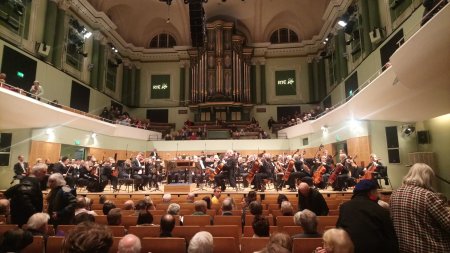
Last night I once again found myself settling into a seat at the National Concert Hall in Dublin for a performance by the RTÉ National Symphony Orchestra, this time under the direction of Mihhail Gerts. There was only one item on the menu – the Symphony No. 8 by Anton Bruckner – but what a feast it turned out to be!

Bruckner had a habit of making multiple revisions to his scores, and the Eighth Symphony is no exception to this. There are two major versions (usually referred to as the 1887 and 1890 versions) but also numerous edited variations of these two. For the record last night we heard the edition made by Robert Haas, based mainly on the 1890 version, but replacing some pieces which had been edited out of the 1887, perhaps most notably a quiet passage in the Third (Adagio) Movement.

This is a colossal work, lasting about 90 minutes in performance and requiring a huge orchestra so the stage was very crowded when the concert got under way.

As well as larger than usual string sections, the brass section comprises no less than eight horns, three trumpets, three trombones and a tuba as well as a quartet of Wagnertuben which you don’t often see in a symphony orchestra. These instruments have a sound somewhere between that of the horns and the trombones and they add an immense solidity to the section that produces a wall of sound that has an extraordinary effect when heard live, especially during the fortissimo passages (of which there are several in this work).

Woodwinds include a bass clarinet and a contrabassoon alongside the more usual clarinets and flutes, and there are three harps and percussion. A special mention must be made of the timpanist (Grahame King) who was given a huge amount to do, and did it all exceptionally well.

The work is structured in four movements, each of which involves a shift from minor to major (the piece opens in C minor) but each covers a very varied musical landscape. The overall atmosphere of the work varies too. At times it is tranquil (or perhaps merely resigned) but it often evokes a sense of conflict and sometimes even terror. It does, however, end in a glorious crescendo that gives a sense of triumph. Along the way there is some truly memorable passages: a gorgeous dialogue between flutes and clarinets in the 2nd Movement (Scherzo) comes to mind, and the Adagio as a whole is just magnificent.

I have never heard this work performed live, and have to admit I got completely lost in the performance. Despite the length of the concert, I never looked at my watch once during the whole thing. Congratulations to Mihhail Gerts and the entire orchestra for taking us on such an epic journey. I enjoyed every second of it, and so I think did the rest of the audience, because the end was greeted with a standing ovation.

But you don’t need to rely on my opinion. You can’t beat live music, but the entire concert is here for you to enjoy as live on the Lyric FM stream. Enjoy!