ADS and the Open Journal of Astrophysics

Posted in Open Access with tags , , , , , on January 19, 2020 by telescoper

Most if not all of the authors of papers published in the Open Journal of Astrophysics, along with a majority of astrophysicists in general, use the NASA/SAO Astrophysics Data System (ADS) as an important route to the research literature in their domain, including bibliometric statistics and other information. Indeed this is the most important source of such data for most working astrophysicists. In light of this we have been taking steps to facilitate better interaction between the Open Journal of Astrophysics and the ADS.

First, note that journals indexed by ADS are assigned a short code that makes it easier to retrieve a publication. For reference, the short code for the Open Journal of Astrophysics is OJAp. For example, the 12 papers published by the Open Journal of Astrophysics can be found on ADS here.

If you click the above link you will find that the papers published more recently have not got their citations assigned yet. When we publish a paper at the Open Journal of Astrophysics we assign a DOI and deposit it and related metadata to a system called CrossRef which is accessed by ADS to populate bibliographic fields in its own database. ADS also assigns a unique bibliometric code it generates itself (based on the metadata it obtains from Crossref). This process can take a little while, however, as both Crossref and ADS update using batch processes, the latter usually running only at weekends. This introduces a significant delay in aggregating the citations acquired via different sources.

To complicate things further, papers submitted to the arXiv as preprints are indexed on ADS as preprints and only appear as journal articles when they are published. Among other things, citations from the preprint version are then aggregated on the system with those of the published article, but it can take a while before this process is completed, particularly if an author does not update the journal reference on arXiv.

For a combination of reasons, therefore, the papers we have published in the past have sometimes appeared on ADS out of order. On top of this, of the 12 papers published in 2019, there is one assigned a bibliometric code ending in 13 by ADS and none numbered 6! This is not too much a problem as the ADS identifiers are unique, but the result is not as tidy as it might be.

To further improve our service to the community, we have decided at the Open Journal of Astrophysics that from now on we will speed up this interaction with ADS by depositing information directly at the same time as we lodge it with Crossref. This means that (a) ADS does not have to rely on authors updating the arXiv field and (b) we can give ADS directly information that is not lodged at Crossref.

I hope this clarifies the situation.

The Dvořák Requiem at the National Concert Hall in Dublin

Posted in Music with tags , , , , , on January 18, 2020 by telescoper

Following my decision to see more live music in 2020, last night found me taking my seat at the National Concert Hall in Dublin for a performance of the Requiem in Bminor by Antonín Dvořák (Op. 89) featuring the RTÉ National Symphony Orchestra and the RTÉ Philharmonia Choir conducted by Patrik Ringborg with solo vocalists Adrienn Miksch (soprano), Patricia Bardon (alto-, Julian Hubbard (tenor) and William Thomas (bass). The members of the choir were just taking their places as I sat down (as were other members of the audience).

I hadn’t heard Dvořák’s Requiem before last night’s concert. Indeed before I saw the advert for the concert I didn’t even know it existed. It just doesn’t seem to be performed vary often. Heaven knows why, because it’s actually rather wonderful. It does involve large orchestral forces, a full choir and a concert organ, but then so do many other works that are performed very frequently in concert halls around the world.

The Dvořák Requiem consists of thirteen sections divided into two Parts (with an interval between them) and is based on settings of the traditional Latin mass for the dead. The music lasts about 95 minutes altogether. The prevailing mood for Part 1 is at times mysterious, restless, questioning and reflective while Part 2 is much more affirmative, even at times joyous, with some uplifting (and wonderfully loud) tutti passages. Although ostensibly in a minor key, there’s much more of the feeling of a major key tonality during the later stages. Overall the piece ends up seeming more of a celebration of life rather than a lament for the dead. Throughout the piece there’s interesting interplay between choir, orchestra and soloists and it’s also very tuneful, as you would probably expect from Dvořák.

After a slightly hesitant start, both choir and orchestra soon got into the swing of things and produced a superb concert that ended up drawing a standing ovation from the audience in the National Concert Hall. Last night’s concert was, I’m glad to say, sold out.

Anyway, you don’t have to take my word for it: the whole concert is on Youtube (it starts about 3 minutes in).

P.S. You will soon see that the presenter last night was not the usual Paul Herriott, but Aedín Gormley.

Farewell to Spitzer

Posted in The Universe and Stuff with tags , , on January 17, 2020 by telescoper

Just a quick post to advertise the fact that NASA’s Spitzer Space Telescope, which was launched in 2003, is due to be `retired’ at the end of January 2020. Spitzer is an infrared telescope that has done a great number of wonderful things over the past 16 years or so. Here’s a short video giving an overview of the mission.

There will be a live-streamed event next week, on January 22nd 2020, featuring mission members and NASA leadership, at 10am PST (6pm GMT/Irish Time) during which members of the public can ask questions. For more details of this event see here.

Although it’s sad to see the end of one `Great Observatory’, hopefully it would be long before the launch of the James Webb Space Telescope which should be even greater. It certainly has a much bigger budget anyway! JWST is due to be launched in March 2021.

January, by R.S. Thomas

Posted in Poetry with tags , , , on January 16, 2020 by telescoper

The fox drags its wounded belly
Over the snow, the crimson seeds
Of blood burst with a mild explosion,
Soft as excrement, bold as roses.

Over the snow that feels no pity,
Whose white hands can give no healing,
The fox drags its wounded belly.

by R.S. Thomas (1913-2000)


My Life in Physical Cosmology – Jim Peebles

Posted in The Universe and Stuff with tags , , , on January 16, 2020 by telescoper

This is very nice, a talk by Nobel Laureate Jim Peebles given at the Oska Klein Centre in Stockholm. Well worth watching if you want to learn about the evolution of the field of physical cosmology over the last 50 years or so.

Election Time in Ireland!

Posted in Maynooth, Politics with tags , , , , on January 15, 2020 by telescoper

Yesterday, in response to a request from the Taioseach Leo Varadkar, the Uachtarán na hÉireann Michael D. Higgins dissolved the 32nd Dáil Éireann. There will be a General Election on 8th February (unusually, on a Saturday) to determine the composition of the 33rd Dáil. So we now have three and a half weeks of electioneering. Sigh.

The previous administration, headed by Mr Varadkar, was a minority Government led by his Fine Gael party supported in a `confidence-and-supply’ arrangement by Fianna Fáil. These two parties have more-or-less alternated in running Ireland since Independence, and both could be characterized as centre-right, Neoliberal parties. Fine Gael MEPs sit with the EPP group in the European Parliament while Fianna Fáil’s sit with RE (formerly ALDE). In terms of UK politics FG is closer to the Conservative Party (though not as far to the right) and FF to the Liberal Democrats. There’s therefore even less of a gap between FG and FF than their closest UK equivalents. Incidentally Fine Gael and Fianna Fáil have their roots in the chaos of the Irish civil war in response to the Anglo-Irish Treaty: FG was pro-Treaty and FF anti-Treaty.

The real question to be answered in this election is whether anything might happen to break the right-wing hegemony that has held sway for so long in the Republic. I would to believe so but, frankly, I doubt it. Despite the Varadkar administration’s abject failures on housing and health (led by two spectacularly useless Ministers), and the fact that these two issues are likely to prove extremely important during the campaigns, I feel the innate conservatism of the Irish electorate will led yet again to another FG/FF combination. One of the worries that comes with that is a continuation of the present chronic underfunding of Irish universities.

I am not sure at this point who I’ll be voting for – I don’t yet know who’s standing in my constituency of Kildare North – but it won’t certainly be either Fianna Fáil or Fine Gael. The strongest left-wing party in Ireland is Sinn Féin and I like many of their progressive policies. My main reservation about voting for them is that I’m not a nationalist. Although I would love to see a United Ireland, I consider myself to be an internationalist and find some of the rhetoric of Irish nationalism very uncomfortable. Nevertheless, I believe it would be good for Ireland to have a strong representation from Sinn Féin in the 33rd Dáil Éireann. Other possible leftish parties include the Green Party, Labour and the Social Democrats.

Incidentally, the voting system for General Elections in Ireland is basically the same as that for the European Parliamentary Elections last year, but with a larger number of constituencies (40 instead of 3). Between them these constituencies elect 159 Teachtaí Dála (TDs) (the equivalent of MPs), an average of about 4 per constituency. There are actually 160 seats, but the Speaker is re-elected automatically. The Single Transferable Vote system is used, meaning that voters have a single ballot paper on which they rank the candidates in order of preference. The candidate with the lowest number of first-preference votes is eliminated and their second preference votes redistributed. Candidates are thus progressively eliminated until the requisite number of TDs is selected.

My constituency is Kildare North which elected 1 Social democrat, 1 Fine Gael and 2 Fianna Fáil TDs last time. This is a primarily rural constituency which is, on the whole, rather affluent, as is reflected in the above result.

Luminosity Evolution in Type 1a Supernovae?

Posted in The Universe and Stuff with tags , , , , on January 14, 2020 by telescoper

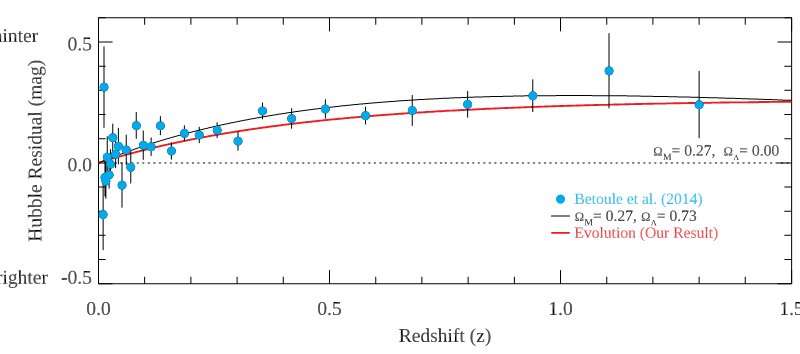
Figure 1 of Kang et al.

During this afternoon’s very exciting Meeting of the Faculty of Science and Engineering at Maynooth University I suddenly remembered a paper I became aware of over Christmas but then forgot about. There’s an article here describing the paper that makes some pretty strong claims, which was what alerted me to it. The actual paper, by Kang et al., which has apparently been refereed and accepted for publication by the Astrophysical Journal, can be found on the arXiv here. The abstract reads:

The most direct and strongest evidence for the presence of dark energy is provided by the measurement of galaxy distances using type Ia supernovae (SNe Ia). This result is based on the assumption that the corrected brightness of SN Ia through the empirical standardization would not evolve with look-back time. Recent studies have shown, however, that the standardized brightness of SN Ia is correlated with host morphology, host mass, and local star formation rate, suggesting a possible correlation with stellar population property. In order to understand the origin of these correlations, we have continued our spectroscopic observations to cover most of the reported nearby early-type host galaxies. From high-quality (signal-to-noise ratio ~175) spectra, we obtained the most direct and reliable estimates of population age and metallicity for these host galaxies. We find a significant correlation between SN luminosity (after the standardization) and stellar population age at a 99.5% confidence level. As such, this is the most direct and stringent test ever made for the luminosity evolution of SN Ia. Based on this result, we further show that the previously reported correlations with host morphology, host mass, and local star formation rate are most likely originated from the difference in population age. This indicates that the light-curve fitters used by the SNe Ia community are not quite capable of correcting for the population age effect, which would inevitably cause a serious systematic bias with look-back time. Notably, taken at face values, a significant fraction of the Hubble residual used in the discovery of the dark energy appears to be affected by the luminosity evolution. We argue, therefore, that this systematic bias must be considered in detail in SN cosmology before proceeding to the details of the dark energy.

Of course evidence for significant luminosity evolution of Type Ia supernovae would throw a big spanner in the works involved in using these objects to probe cosmology (specifically dark energy), but having skimmed the paper I’m a bit skeptical about the results, largely because they seem to use only a very small number of supernovae to reach their conclusions and I’m not convinced about selection effects. I have an open mind, though, so I’d be very interested to hear through the comments box the views of any experts in this field.

Maynooth University Library Cat Update

Posted in Maynooth with tags , on January 14, 2020 by telescoper

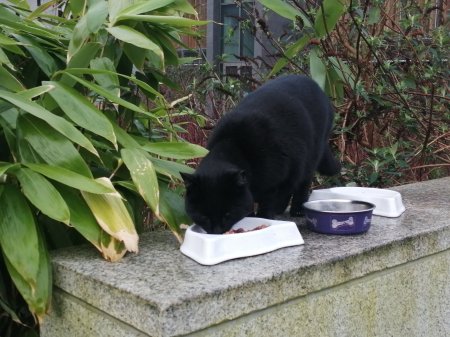
It’s high time for the first update about the famous Maynooth University Library Cat for 2020. I gave him some breakfast on the way in to work yesterday morning, before Storm Brendan arrived. He scoffed it rapidly, even though I strongly suspect I wasn’t the first person to give him food!

I was a bit worried about said feline before the Christmas break because he had a problem with one of his front legs which gave him a limp. I couldn’t see any cuts or anything but it was clearly causing him some bother. Fortunately he seemed to shake it off and there’s no sign of the limp any more.  You can often tell if a cat is poorly because that’s the one situation when they lose their appetite, and there’s no sign of that! Indeed he was quite skittish yesterday when I said hello.

Although the rain hadn’t arrived with Storm Brendan when I fed him yesterday it was already quite windy.  There’s something about windy weather that makes cats freak out a bit. I don’t know what it is. Perhaps the it’s noise? Cats have very sensitive hearing and maybe the sound of the wind causes a kind of sensory overload? My old cat Columbo used to run around like a mad thing when it was windy outside. It’s not that he was unhappy about it – it just got him very excited.

Anyway, today it’s raining quite heavily so I expect Maynooth University Library Cat is tucked up in his little box or somewhere else that’s cosy.


Storm Damage

Posted in Biographical, Maynooth with tags , on January 13, 2020 by telescoper

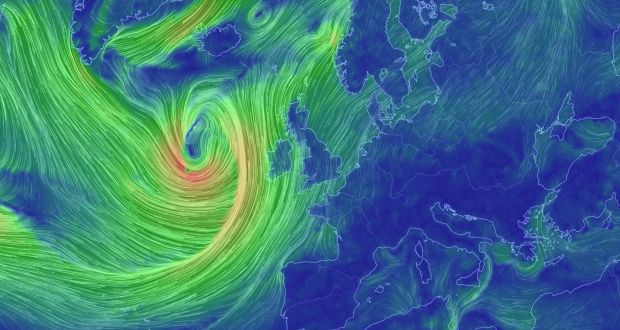
We’ve had an eventful day in Maynooth so far with the arrival of Storm Brendan in Ireland. It was already rather windy when I set out for work about 9.00 this morning and the storm grew in intensity throughout the morning. We’re quite a long way inland, though, and conditions were nowhere near as wild as coastal areas, especially County Cork, where winds reached 140 km/h in places. Other areas badly affected include Galway, Limerick, Kerry and Donegal.

I was just thinking about taking my lunch break at around 12.30 when all the power went off in the Science Building. I had a quick look around inside the Department to check there weren’t any serious issues (e.g. damage to computers) then ventured outside, where I found the entire campus, both South and North, was affected plus the traffic lights on Kilcock Road.

Since it was a widespread power failure I was a bit worried that it might take some time to fix. This, however, wasn’t the case and as I returned from my scouting expedition I saw power had already been restored to some campus buildings. Power outages have happened before at Maynooth and the usual practice is to power up gradually zone by zone, presumably to avoid any surges. Eventually, about an hour after the original interruption to service, everything came back online.

I had just written the end of that paragraph (at about 3.20pm) when the power went off again. That apparently was a scheduled outage in order to fix a `wider network problem’. The electricity supply was only off for about ten minutes this time. Unfortunately, this second power cut seems to have taken out our internet connections so I had to complete this via a wireless connection. Fortunately, WordPress has an autosave facility so I didn’t lose anything. Now let’s see if we can fix the server…

Another Cosmologist for Maynooth!

Posted in Maynooth, The Universe and Stuff with tags , , on January 13, 2020 by telescoper

A few people have contacted me to ask what happened with the research position in cosmology at Maynooth University advertised a few months ago. Well, I am now in a position to provide the answer.

I’m very happy to announce that as of January 2nd 2020, Dr John Regan has joined the staff of the Department of Theoretical Physics, bringing with him an SFI – Royal Society University Research Fellowship (URF) which will fund his research for five years.

Dr John Regan

John’s primary area of research is in trying to understand the formation of black holes in the early Universe and their subsequent growth and evolution. He is interested in trying to determine how the first massive black holes in the Universe formed and the conditions required to form them. The problem is well posed since at early times the Universe was a comparatively simple place compared to the Universe today. Recent observations have indicated that Supermassive Black Holes existed less than 1 billion years after the big bang (the Universe is approximately 14 billion years old). A current open problem in Cosmology is how did black holes form and grow quickly enough in order to become super-massive so early in the Universe?

In answering this question John uses high resolution numerical simulations to study the environments in which the first massive black hole seeds may have formed and then grown to become the super-massive ones we can still observe today.

I’m delighted that John has joined the Department and look forward to many years of fruitful collaborations and discussions. He will be joined by a PDRA and a research student in due course.

You can follow John on Twitter here: