Exam Time

Posted in Education, Maynooth with tags , , , on January 12, 2020 by telescoper

Back in Maynooth into the January examination period, I await the arrival tomorrow of the first batch of examination scripts I have to mark, so I thought I’d do a quick post on the topic of examinations.

First, for readers elsewhere, full-time undergraduate students at Maynooth what is called 60 “credits” in a year, usually split into two semesters of thirty credits each. This is usually split into 5-credit modules with an examination in each module at the end of each semester. Projects, and other continuously-assessed work do not involve a written examination, but the system means that a typical student will have at least 5 written examination papers in January and at least another 5 in May. Each examination is usually of two hours’ duration.

This is very similar to the system in most UK universities that I am aware of except that a full year’s work over there is 120 credits so there’s a conversion factor of 2:1. A 5-credit module in Ireland would be a 10-credit module in the United Kingdom, for example, but otherwise the system is similar.

One big difference between our examinations in Theoretical Physics in Maynooth and those at other institutions I’ve taught at in the UK is that the papers here – at least at a reasonably advanced level, say Years 3 and 4 – offer no choice of questions to be answered.  A typical format for a two-hour paper is that there are two long questions, each of which counts for 50 marks. Elsewhere  one normally finds students have a choice of two or three questions from four or five on the paper.

One  advantage of our system is that it makes it much harder for students to question-spot in the hope that they can get a good grade by only revising a fraction of the syllabus. If they’re well designed, two long questions can cover quite a lot of the syllabus for a module, which they have to in order to test all the learning outcomes. To accomplish this, questions can be split into parts that may be linked to each other to a greater or lesser extent to explore the connections between different ideas, but also sufficiently separate that a student who can’t do one part can still have a go at others. With such a paper, however, it is a  dangerous strategy for a student to focus only on selected parts of the material in order to pass.

As an examiner, the Maynooth style of examination also has the advantage that you don’t have to worry too much if one question turns out to be harder than the others. That can matter if different students attempt different questions, but not if everyone has to do everything.

But it’s not just the number of questions that’s important, it’s the duration. I’ve never felt that it was even remotely sensible for undergraduate physics examinations to be a speed test, which was often the case when I was a student. Why the need for time pressure? It’s better to be correct than to be fast, I think. I always try to set examination questions that could be done inside two hours by a student who knew the material, including plenty of time for checking so that even a student who made a mistake would have time to correct it and get the right answer. If a student does poorly in this style of examination it will be because they haven’t prepared well enough rather than because they weren’t fast enough.

The structure of the Maynooth examinations at more introductory level is rather different, with some choice. In my first year module on Mechanics & Special Relativity, for example, there is a compulsory first question worth 50 marks (split into several pieces) and then the students can pick two out of three shorter questions worth 25 marks each. This is a somewhat gentler approach than with the more advanced papers, partly adopted because we have quite a few students doing the General Science degree who taking Mathematical Physics as one of their 4 first-year subjects but will not be taking it further.

As their examination is not until Wednesday, I’ll have to wait until later this week to find out how my first-years have done. This will be the examination taken at University level for most of my class, so let me take this opportunity to pass on a few quick tips.

  1. Try to get a good night’s sleep before the examination and arrive in plenty of time before the start.
  2. Read the entire paper before starting to answer any questions. In particular, make sure you are aware of any supplementary information, formulae, etc, given in the rubric or at the end.
  3. Start off by tackling the question you are most confident about answering, even if it’s not Question 1. This will help settle any nerves.
  4. Don’t rush! Students often lose marks by making careless errors. Check all your numerical results on your calculator at least twice and – PLEASE – remember to put the units!
  5. Don’t panic! You’re not expected to answer everything perfectly. A first-class mark is anything over 70%, so don’t worry if there are bits you can’t do. If you get stuck on a part of a question, don’t waste too much time on it (especially if it’s just a few marks). Just leave it and move on. You can always come back to it later.

Readers of this blog are welcome to add other tips through the comments box below!

Oh, and good luck to anyone at Maynooth or elsewhere taking examinations in the next few weeks!


200 Years of the RAS Club

Posted in History, The Universe and Stuff with tags , , on January 11, 2020 by telescoper

Here I am in Heathrow Terminal 2 waiting for flight back to Dublin. I managed to get to London from Birmingham in time for a special dinner to mark the 200th anniversary of the RAS Club. As I have mentioned in previous posts, according to the brief history published on the RAS website:

The ‘Astronomical Society of London’ was conceived on 12 January 1820 when 14 gentlemen sat down to dinner at the Freemason’s Tavern, in Lincoln’s Inn Fields, London. After an unusually short gestation the new Society was born on 10 March 1820 with the first meeting of the Council and the Society as a whole. An early setback, when Sir Joseph Banks induced the Duke of Somerset to withdraw his agreement to be the first President, was overcome when Sir William Herschel agreed to be the titular first President, though he never actually took the Chair at a meeting.

Since the RAS Club always dines on the second Friday of the month after Ordinary Meetings of the Royal Astronomical Society itself, January 10th was the closest date to that first dinner. As expected for such a special occasion, there was a very big turnout with more than double the usual number of diners (and many more guests than usual). It was very nice to see some people I haven’t seen for ages! The food and wine were excellent and we ended with champagne and a slice of a cake baked and decorated for the occasion. Unfortunately it was so crowded in the Gallery Room that I couldn’t get close enough to take a photo of it before it was whisked away to be cut into slices.

After dinner we had some speeches, including one really brilliant one by my former colleague from Cardiff days, Mike Edmunds who had researched the `14 gentlemen’ who attended that first dinner. I had known previously that Charles Babbage and John Herschel were there but here (thanks to Mike) is a complete list:

Charles Babbage, Esq. M.A. F.R.S. L. & E. No. 5 Devonshire Street Portland Place
Arthur Baily, Esq, Gray’s Inn
Francis Baily, Esq. F.R.S. & L.S. Gray’s Inn
Major Thomas Colby, of the Royal Engineers, LL.D. F.R.S. L. & E. Tower
Henry T. Colebrooke, Esq. F.R.S. & L.S. Albany, Piccadilly
Olinthus G. Gregory, LL.D. Professor of Mathematics Royal Military Academy, Woolwich
Stephen Groombridge, Esq. F.R.S. S.R.A.Nap. Blackheath
J.F.W. Herschel, LL.D. F.R.S. Slough
Patrick Kelly, LL.D. Finsbury Square
Daniel Moore, Esq. F.R.S. S.A. & L.S. Lincoln’s Inn
Rev. William Pearson, LL.D. F.R.S. East Sheen, Surrey
James South, Esq. F.R.S. and L.S. No. 11 Blackman Street Southwark
Charles Stokes, Esq. F.R.S. S.A. & L.S. Gray’s Inn
Peter Slawinski D.P. Proff. University Wilna

P.S. Because I was attending the LGBTQ+ STEMinar I couldn’t get to the ordinary meeting of the Royal Astronomical Society earlier in the day, which was a shame because it was there that the winners of this year’s awards were announced. You can find a full list here. Congratulations to all!

LGBTQ+ STEMinar 2020

Posted in LGBTQ+, The Universe and Stuff with tags , , , on January 10, 2020 by telescoper

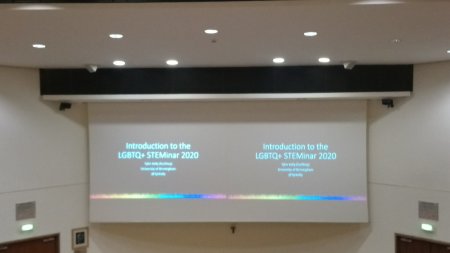
Well I made it to Birmingham (after getting up at 3.30am!) and to the Leonard Deacon Lecture Theatre in the School of Medicine at the University thereof for this year’s LGBT+ STEMinar (the 5th of a series that started in 2016).

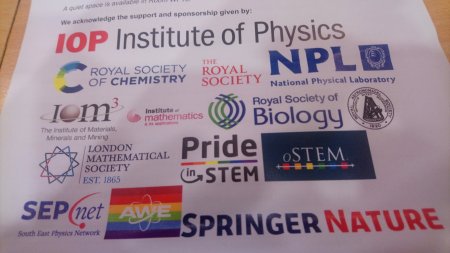
This is the largest one of these do far, with around 250 participants, and an impressive array of sponsors:

One of the great things about the LGBTSTEMeminar (apart from the feeling of being amongst ‘family’) is the opportunity to hear talks about fields other than your own, which I am enjoying very much.

Ooh. I forgot to mention that next year’s event will also be in the Midlands, at Oxford University.

Exams and Anniversaries

Posted in Biographical, Education, Maynooth with tags , , , on January 9, 2020 by telescoper

Tomorrow (10th January)  is the start of our mid-year examination period here at Maynooth University. It’s therefore a good opportunity to send a hearty “good luck” message to all students about to take examinations, especially those who are further on in their courses for whom these papers have greater importance. In particular I’d like to send my best wishes to students on my fourth-year module on Astrology Astrophysics and Cosmetics Cosmology, whose paper is tomorrow.

On the equivalent day last year I reflected on examinations and in particularly on the fact that the system of education both here in Ireland and in the United Kingdom places such a great emphasis on examination and assessment compared to learning and understanding.

Also on the equivalent day yesterday I was about to travel to London to attend my first LGBT+STEMinar at the Institute of Physics in London. Tomorrow I’ll be doing a similar thing, getting up at stupid o’clock
to travel to Birmingham for the 2020 event. The main difference this year (apart from the change of venue) is that I’m not giving a talk this time. This is good news for me (because it means I can relax a bit more) and for the attendees (because they don’t have to listen to me rambling on like they did last year).

I won’t be able to stay to the end of the LGBT+STEMinar, however, as I have to get to London. As I have mentioned previously here, 2020 marks the bicentenary of the Royal Astronomical Society:

According to the brief history published on the RAS website:

The ‘Astronomical Society of London’ was conceived on 12 January 1820 when 14 gentlemen sat down to dinner at the Freemason’s Tavern, in Lincoln’s Inn Fields, London. After an unusually short gestation the new Society was born on 10 March 1820 with the first meeting of the Council and the Society as a whole. An early setback, when Sir Joseph Banks induced the Duke of Somerset to withdraw his agreement to be the first President, was overcome when Sir William Herschel agreed to be the titular first President, though he never actually took the Chair at a meeting.

To be precise, the Society only became the `Royal Astronomical Society’ in 1831 when it was granted a Royal Charter by William IV, but its roots go back to 1820.

It’s not only the Royal Astronomical Society that has survived and prospered for two hundred years. The group of `gentlemen’ who met for dinner in January 1820 has also carried on in the form of the RAS Club which is, of course, older than the RAS itself. The Dining Club always meet on the second Friday of the month, which means that tomorrow is the closest date to that very first meeting. There will therefore be a special club dinner tomorrow night, with more guests than usual. I’m looking forward to it a lot, actually, although I’m slightly apprehensive about the fact that I’ll be relying on the train to get me there in time!

Classics in the Russell Library

Posted in History, Literature, Maynooth, Uncategorized with tags on January 9, 2020 by telescoper

Here’s a taster of the wonderful collection of books and manuscripts in the Russell Library at Maynooth University..

Special Collections's avatarMU Library Treasures

Ruth O’Hara, Collections and Content

Ruth pic 1

Study of the classical world has been a staple of this University for centuries. The Russell Library’s classic’s collection, which was amassed largely by the early professors of St. Patrick’s College, is eclectic covering all areas of the ancient world and indeed it transcends disciplines. So, besides Homer and Virgil, for example, sit the poems of Catullus, the theological tracts of Ambrose of Milan, and the philosophical musings of Aristotle. One blog can’t hope to capture the extent and range of such a collection so, instead, I just want to look at some of the ways that we in the Russell Library continue to foster interest in this diverse subject area by integrating it into the research, teaching and life of the University.

We have found our classics collection to be a really useful resource for postgraduate students, for example, who engage with primary source…

View original post 426 more words

New Publication at the Open Journal of Astrophysics!

Posted in OJAp Papers, Open Access, The Universe and Stuff with tags , , , , , , on January 8, 2020 by telescoper

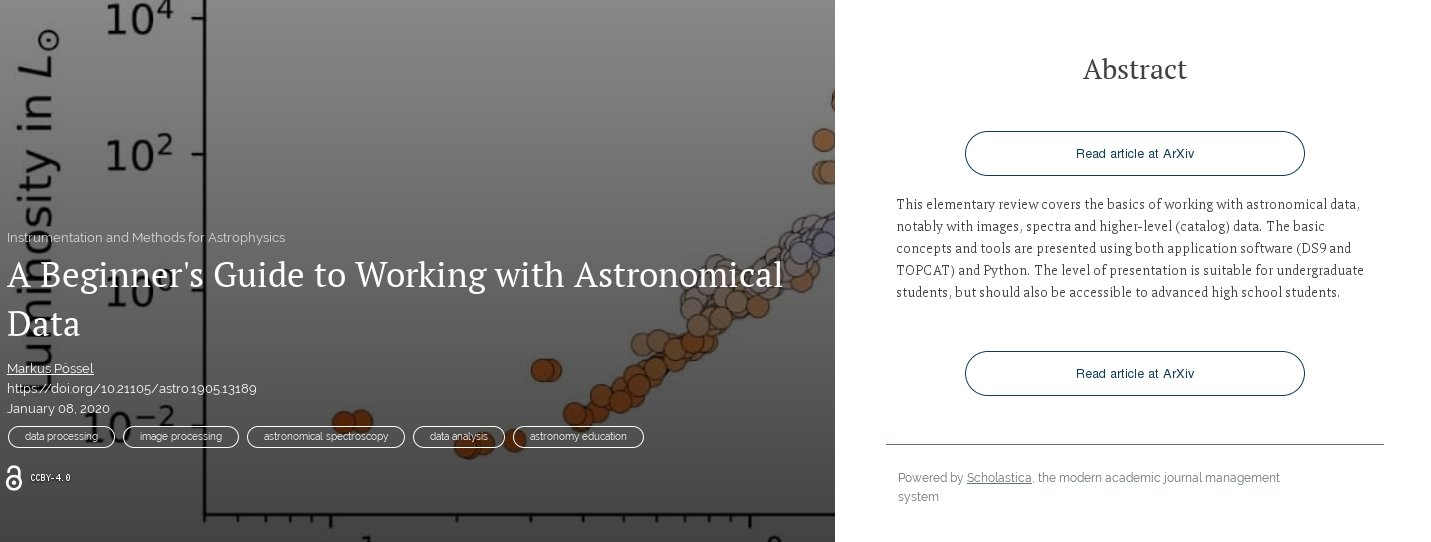
It’s two in two days because we have published another new paper at The Open Journal of Astrophysics. The title is A Beginner’s Guide to working with Astronomical Data. Here is a grab of the overlay:

You can find the arXiv version of the paper here.

The author is Markus Pössel of the Haus der Astronomie at the Max Planck Institute for Astronomy in Heidelberg (Germany). This is a long paper – 71 pages with over a hundred figures – that gives a comprehensive introduction to the various kinds of astronomical data and techniques for working with such data. I think this paper will attract a lot of interest from many different kinds of people but it will be particularly interesting to students doing undergraduate projects involving astronomical data (and their supervisors).

Another point worth noting is that there’s a small addition to the overlay for this paper, which will apply to all future papers (and retrospectively once we have worked through the back catalogue) and that is in the bottom left of the image above. It shows that the article is published with the latest form of Creative Commons License (CC-BY-4.0). It has always been our policy to publish under a CC-BY licence but Scholastica have very helpfully set up a new facility to make this explicit on each page. This is part of our efforts to ensure that we are compliant with Plan S which makes CC-BY licenses mandatory.

UPDATE: the CC-BY-4.0 license has now been applied retrospectively to all our publications.

New Publication at the Open Journal of Astrophysics!

Posted in OJAp Papers, Open Access, The Universe and Stuff with tags , , , on January 7, 2020 by telescoper

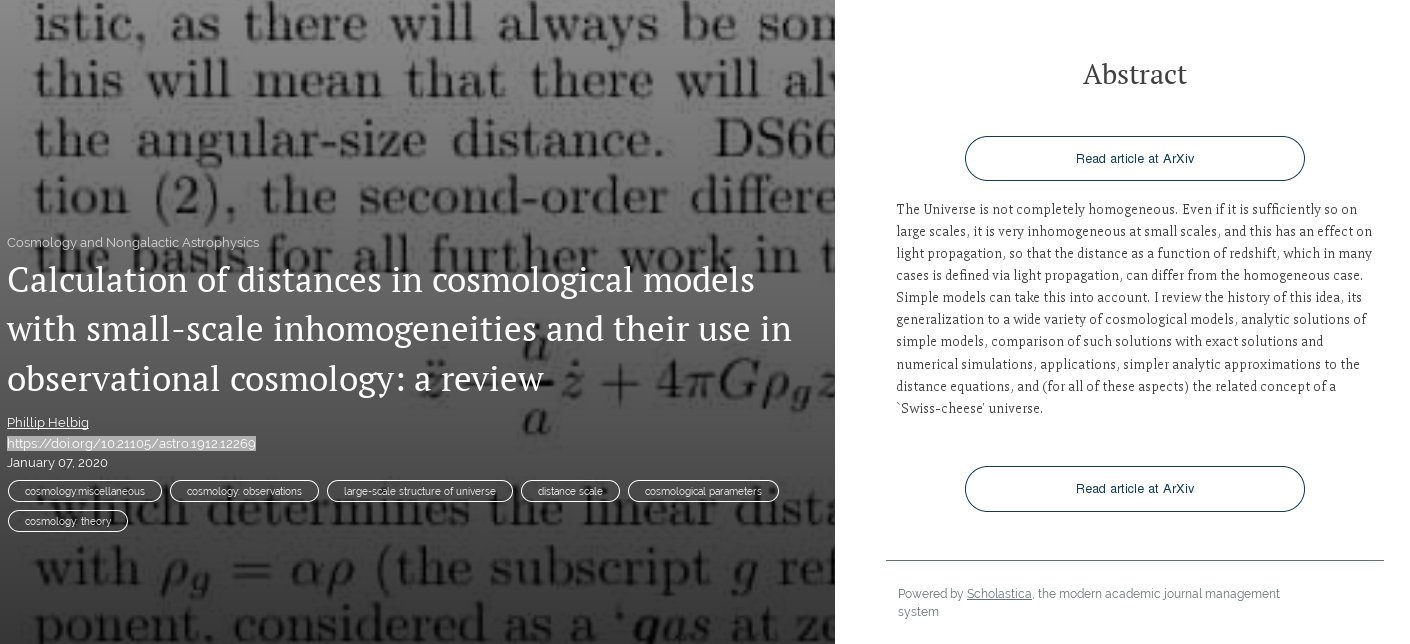
Back after the New Year break we have published another new paper at The Open Journal of Astrophysics, our first of 2020!

Here is a grab of the overlay:

The author is Phillip Helbig (Who? Ed). This is a review article. Our `For Authors‘ page includes the following:

We may accept review articles on appropriate subjects if the Editorial Board considers them a useful contribution to the literature.

You can find the accepted version on the arXiv here. This is another one for the `Cosmology and Nongalactic Astrophysics’ section . We would be very happy to get more submissions from other areas, especially Stellar and Planetary astrophysics. Hint! Hint!

P.S. Just another reminder that we now have an Open Journal of Astrophysics Facebook page where you can follow updates from the Journal should you so wish..

A Blog on Nollaig na mBan

Posted in Biographical, Maynooth on January 6, 2020 by telescoper

In the Liturgical Calendar today (6th January) is the date of Epiphany, the tradition arrival date of the Wise Men from the East bearing gifts. Like them I also travelled from the East today and gave arrived at my destination in Maynooth. Not sure about the gifts though.

In Ireland today is also Nollaig na mBan (Women’s Christmas), a day on which it is traditional for women to get together and enjoy their own Christmas, while the menfolk stay at home and handle the chores. Although an old tradition, emanating from the West of Ireland, the traditional Nollaig na mBan has apparently had a bit of a resurgence in recent years.

Anyway it’s been a very quiet Christmas for me, not least in terms of the weather which has been mild and largely rain-free. Except, that is, for the precise time that I walked to the bus stop to get the bus to Cardiff Airport during which I got drenched. I’ve been away from Ireland for a couple of weeks so don’t know what it has been like here but it’s a lot chillier here. My flat is particularly cold as the heating has been off all the time I’ve been away.

I was supposed to be in the office today but I only realised on Saturday that I’d booked my return flight on 6th (today) not 5th (yesterday). Not a great start to a year in which I am supposed to be improving my time management! I probably didn’t miss anything vital as there are no lectures this week; the January examination period starts on Friday and the days before that are meant for private study.

I do have quite a few things to do tomorrow though – including answering a ton of emails – so I think an early night followed by an early start tomorrow morning might be in order!

The Largest Known Spiral Galaxy – UGC 2885

Posted in The Universe and Stuff with tags , , , , , on January 6, 2020 by telescoper

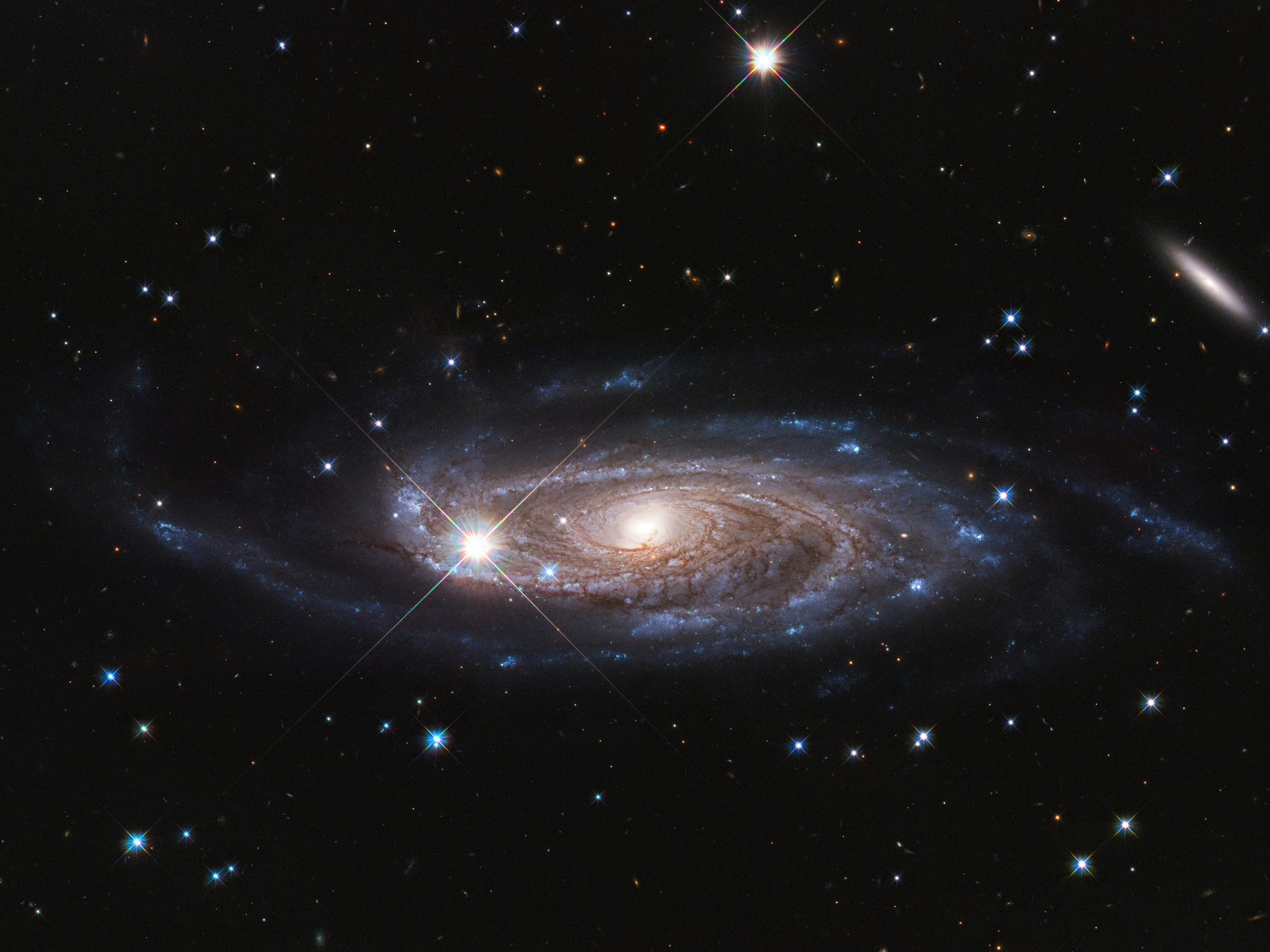
So here I am, Christmas break over, waiting in Cardiff Airport for my flight back to civilization. I thought I’d take the opportunity to share this wonderful picture, courtesy of the Hubble Space Telescope, of the galaxy UGC 2885 – the largest known spiral galaxy. You can click on the picture to make it bigger or if you really are a size queen you can download an ultra-high=resolution version here.

UGC 2885 is located about 71 Mpc (232 million light-years) from us, in the direction of the constellation Perseus. The galaxy is 2.5 times wider than our own Milky Way and contains approximately 10 times as many stars. A number of foreground stars (in our Galaxy), identified by the diffraction crosses produced by unresolved point sources, can be seen in the image, including one superimposed on the disk of the galaxy, to the left of its centre. The galaxy UGC 2885 has been nicknamed “Rubin’s galaxy” after Vera Rubin, the astronomer who studied the rotation of the galaxy and found evidence for dark matter therein.

There is a very interesting and informative thread on Twitter by Benne Holwerda covering the background to this latest image of the galaxy:

If you click on the above it will take you to Twitter where you can read the series of linked tweets on this subject by clicking on `show this thread’.

Call for support for Carrick McClean school student barred from A-Levels due to having a beard

Posted in Beards on January 5, 2020 by telescoper

Mr Carrick Mcclean has been barred from his A-level* classes at St Columb’s College in Derry because of his facial hair. Please sign the petition to have him reinstated. I’m sure such blatant pogonophobic discrimination would not be tolerated in a United Ireland.

*for readers in the Republic, the A-level is the Protestant Leaving Certificate.

kmflett's avatarKmflett's Blog


Beard Liberation Front

Press Release 4th January Contact Keith Flett 07803 167266

Call for support for Carrick McClean, school student barred from A-Levels due to having a beard

The Beard Liberation Front, the informal network of beard wearers, has called for support for a Derry Sixth Form student Carrick McClean.

Mr McClean has been banned from sitting for his A Level at St Columbs in Derry because he has a beard.

The pogonophobic rules of the school do not allow students to have a beard

BLF Organiser Keith Flett said, this is not the 1950s and we fully support Mr McClean. There is a petition that can be signed and we expect a change of mind by the school

https://www.change.org/p/principal-abolish-st-columb-s-college-clean-shaven-policy

View original post