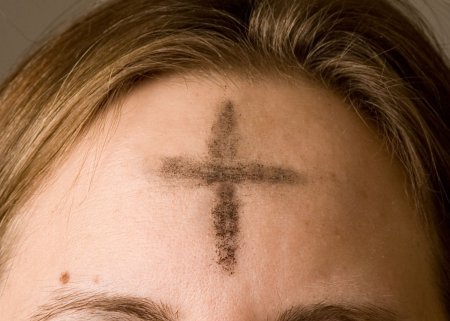
Yesterday was Ash Wednesday. I remember this time eight years ago when I was very much a newcomer to Maynooth being quite surprised to see some folk wearing a cross marked in ash on their forehead as in the picture above. I think this practice is a tradition within the Roman Catholic Church, with which Maynooth has long historical associations, so it’s not really surprising to see it here. Having been brought up in Protestant England I had never seen this before moving to Ireland, but it doesn’t surprise me any more to see people with crosses on their foreheads. That said, I noticed very few around the place yesterday. The numbers observing this ritual seem to be declining every year. Perhaps if they want to increase its popularity they could zhuzh it up a bit: how about some glitter in the ash? Just a thought.
Apparently the tradition used to be for ashes to be sprinkled on the top of the head of a male worshipper but a cross to be made on the forehead of a woman because she would be expected to be wearing a hat. Based on a small sample of those I have observed it seems both genders wear the cross on the forehead nowadays.
Anyway, although I’m not a Christian myself, respect to all those observing the season of Lent (Quadragesima), whether that means fasting, devotional prayer, or just giving up luxuries, such as reading this blog perhaps.
P.S. I’m told that the normal rule for Lent is `One meal and two collations’. The word collation, in the sense of ‘light meal,’ comes from the title of John Cassian‘s early fifth-century work Collationes patrum in scetica eremo (Conferences with the Egyptian hermits), which was read in Benedictine communities before a light meal. I haven’t heard that English word for a while, but it has the same origin as the Italian colazione, used in prima colazione (breakfast).
An interesting paper has appeared on the arXiv by Lewis, Shah & Alfred with the title Astrophysics Wrapped 2025: Year-in-Review of Every Astrophysics arXiv Paper from 2025 and abstract as follows:
Over the past few years, Astrophysics has experienced an unprecedented increase in research output, as is evident from the year-over-year increase in the number of research papers put onto the arXiv. As a result, keeping up with progress happening outside our respective sub-fields can be exhausting. While it is impossible to be informed on every single aspect of every sub-field, this paper aims to be the next best thing. We present a summary of statistics for every paper uploaded onto the Astrophysics arXiv over the past year – 2025. We analyse a host of metadata ranging from simple metrics like the number of pages and the most used keywords, as well as deeper, more interesting statistics like the distribution of journals to which papers are submitted, the most used telescopes, the most studied astrophysical objects including GW, GRB, FRB events, exoplanets and much more. We also indexed the authors’ affiliations to put into context the global distribution of research and collaboration. Combining this data with the citation information of each paper allows us to understand how influential different papers have been on the progress of the field this year. Overall, these statistics highlight the general current state of the field, the hot topics people are working on and the different research communities across the globe and how they function. We also delve into the costs involved in publications and what it means for the community. We hope that this is helpful for both students and professionals alike to adapt their current trajectories to better benefit the field.
The paper does what is says in the abstract and is well worth reading because it gives some fascinating insights into what’s hot in astrophysics, at least in terms of arXiv submissions which is probably a very good measure of activity because it is a truth universally acknowledged that every paper of interest in astrophysics is on ar|Xiv. I don’t intend to duplicate the whole paper here, as I think you should go and read it yourselves, but will pick out a couple of points.
One, near the start of the paper, is the following:
We begin with some general, overarching statistics from the year. As mentioned before, there were 18660 research papers published this year on the arXiv under the Astrophysics category in comparison to 16333 articles published in 2024. On average, there were 1555 papers per month, or about 72 papers per day, excluding weekends and accounting for the fact that arXiv uploads 5 days a week.
This is a huge level of activity by any standard, especially as it does not include replacements or cross-submissions. As Editor of the Open Journal of Astrophysics it comes as no surprise to learn that the section `Astrophysics of Galaxies’ is the highest submitted primary subject category with 4761 papers submitted over the year and an average of 397 papers per month under this category. Interestingly, ‘Cosmology and Nongalactic Astrophysics’ papers have the highest number of citations across all indices, by some margin, despite having a lower number of papers submitted under this category. This tells us that while there might be fewer papers under this category, these papers are cited more on average, than the papers from any of the other categories. These are the two most popular categories for submissions at OJAp too.
For more interesting data on geographical distribution, citation rates, etc, read the text!
I also want to pick up on an issue mentioned near the end of the abstract, namely the absurd system of funding “Gold” Open Access by Article Processing Charges. Here is a quote:
We estimate the total amount of money spent in publishing to paid journals, assuming every paper is published under Gold Open Access. Our calculation takes into account the publishing fees for different journals, the cost per page where applicable, as well as discounted rates for authors from certain ‘member’ countries for specific journals. In total, we estimate the community spent 17 million USD on publishing fees this year. Counting only the papers that were published and ignoring the zero cost of open source journals, this rounds out to an absolutely ridiculous 2,400 USD per publication. If every astrophysics paper published on the arXiv in 2025 were to be published under the same standards (average cost from the previous calculation applied to every paper), that would mean a total cost of 45 million USD on publishing. These numbers are similar to those obtained in Coles (2025). Astrophysics is, according to our calculations, a multi-million dollar business, but for whom? Certainly not for the people who make it possible. Definitely not for the scientists and not for the general public.
(I added the link to my own post at the OJAp blog which is referred to in the article).
I agree wholeheartedly with the conclusion. The figure of 45 million dollars for the money wasted on APCs is nothing short of a scandal. Why does the astrophysics community put up with being fleeced in this way?
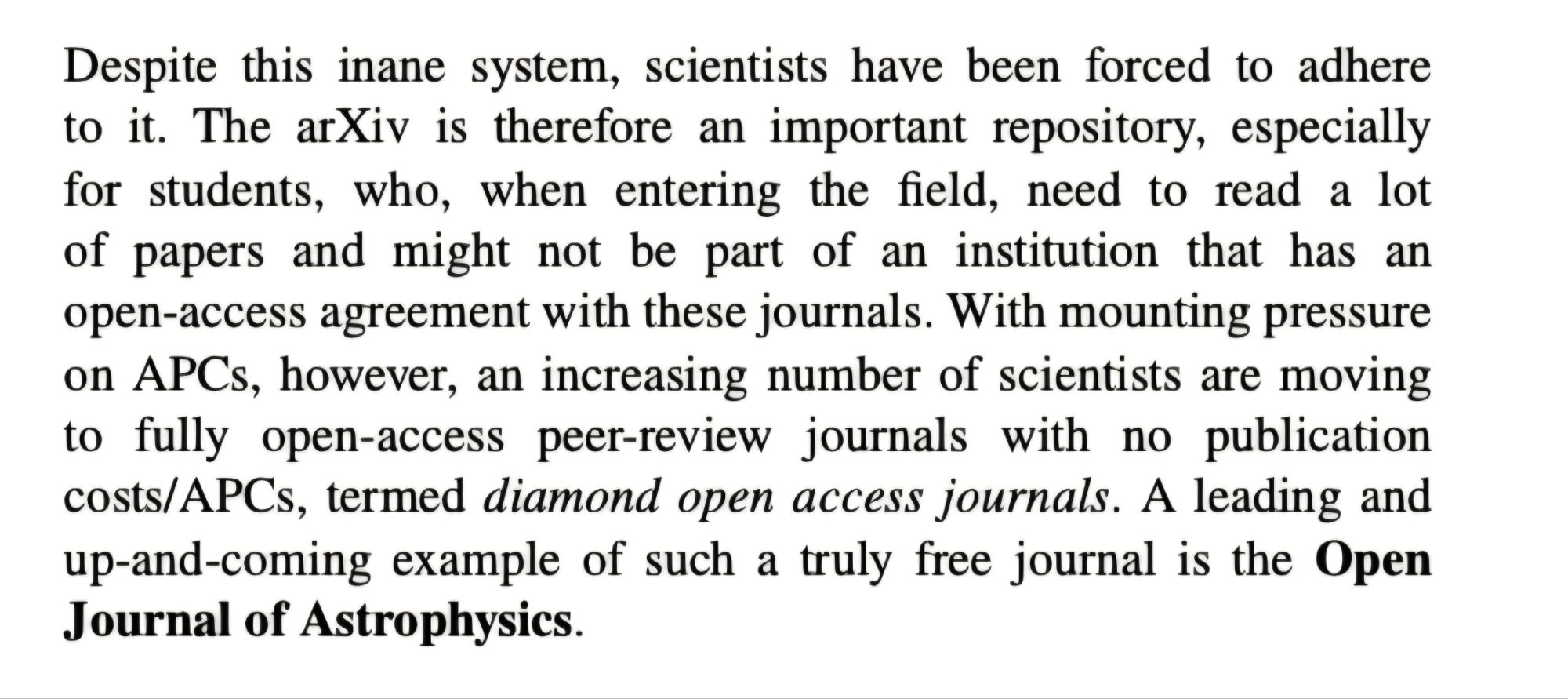
Here is another excerpt:
While it is nice to have the Open Journal of Astrophysics singled out for praise, the earlier statistics do put the situation in perspective. In 2025 OJAp published 213 papers using our arXiv overlay model. That’s only just over 1% of the overall arXiv submissions on astro-ph! As a community we need to be publishing via a Diamond Open Acess model by default. Given the scale of the problem The Open Journal of Astrophysics can’t achieve that goal on its own, but at least we’re showing that there is a way forward.
Today’s the day folk in England Shrove Tuesday, when one is supposed to get “shriven” by doing a penance before Lent. Another name for the occasion – favoured in Ireland – is Pancake Day, although I’m not sure what sort of penance it is to be forced to eat pancakes. Further afield the name for this day is a bit more glamorous. Mardi Gras, which I translated for the title of this post as Fat Tuesday using my schoolboy French, doesn’t make me think of pancakes but of carnivals. And being brought up in a house surrounded by Jazz, it makes me think of New Orleans and the wonderful marching bands that played not just during the Mardi Gras parades but at just about every occasion for which they could find an excuse, including funerals.
The Mardi Gras parades gave rise to many of the great tunes of New Orleans Jazz, many of them named after the streets through which the parade would travel, mainly in the famous French Quarter. Basin Street, South Rampart Street, and Bourbon Street are among the names redolent with history for Jazz fans and musicians around the world. The New Orleans Mardi Gras has on recent occasions sometimes got a bit out of hand, and you probably wouldn’t want to take kids into the French Quarter for fear they would see things they shouldn’t. Personally, though, I’d love the chance to savour the atmosphere and watch the parades.
Anyway, the clip I’ve chosen to mark the occasion of Fat Tuesday is Bourbon Street Parade. The one and only time I went to New Orleans I felt a real thrill walking along this Bourbon Street, just because I’ve heard the tune so many times on old records. I didn’t go in Mardi Gras time, however, but in the middle of summer. The heat was sweltering and the humidity almost unbearable, but the air was filled with music as well as moisture. It was impossible to sleep in the heat, so I stayed up moving from bar to bar, drinking and listening to music until I was completely exhausted.
The tune was written by the late Paul Barbarin, who died in 1969 during a street parade in New Orleans. What a way to go! He also plays on the clip I included here. I picked this particular version because it features a much underrated British musician, Sammy Rimington. My Dad once played with Sammy Rimmngton and I remember the unqualified admiration with which he (my Dad) spoke of his (Sammy’s) playing.
P.S. This year Pancake Day coincides with both the Lunar New Year and the start of Ramadan. Best wishes to all who celebrate any of these!
This “shitty WordPress blog” (to use someone’s memorable phrase) has been going for over 17 years now. I have occasionally thought about breaking the habit but having gone this far I think I might as well keep going until I retire, by which time in it will have reached the grand old age of 20.
In recent years the traffic here has settled down to a level about 40% lower than it was in its heyday. There are about 2,000 people recceiving posts by email and a few hundred who read it on the fediverse; these are not counted in the web traffic statistics unless they click through to the website.
The most popular year ever for web traffic was 2012, in which In The Dark attracted 464k visitors, whereas for the last few years it has been more like 260k per annum. Part of the reason for the drop will have been my move to Ireland and not posting so much of relevance to people in the UK, which was my main audience. I prefer not to think that the decline is because I’m now older and my posts more boring, but that may well the case. Twitter used to be the source of a considerable number of clicks too, but the changes introduced by Elon Musk put a stop to that even before I left that platform. In any case the blog numbers are far higher than I thought I would attract when I started blogging way back in 2008.
Anyway, I have noticed that in recent weeks the levels of traffic have been closer to those of a decade or more ago, with several notifications like this popping up:
In the first two weeks of February, for example, there have been over 30k views, i.e. over 2000 per day. The drivers of this increase have been two posts about the STFC funding crisis, first mine at the end of January and then a Guest Post by George Efstathiou which has been shared very widely.
I suppose the recent increase in traffic is a new manifestation of the old adage that “bad news sells newspapers”…
It seems an appropriate evening for a romantic love song. Lyrics by Sammy Cahn, music by Jule Styne, vocals and trumpet by Chet Baker. Baker’s singing is quite unlike most jazz singers, and many jazz fans don’t like it very much, but I think his intimate, tender, and somewhat melancholic vocal performance together with his spare yet lyrical trumpet playing combine make this a classic.
It’s Saturday once more so time for another update of activity at the Open Journal of Astrophysics. Since the last update we have published a further six papers, bringing the number in Volume 9 (2026) to 30 and the total so far published by OJAp up to 478.
I will continue to include the posts made on our Mastodon account (on Fediscience) to encourage you to visit it. Mastodon is a really excellent service, and a more than adequate replacement for X/Twitter (which nobody should be using); these announcements also show the DOI for each paper.
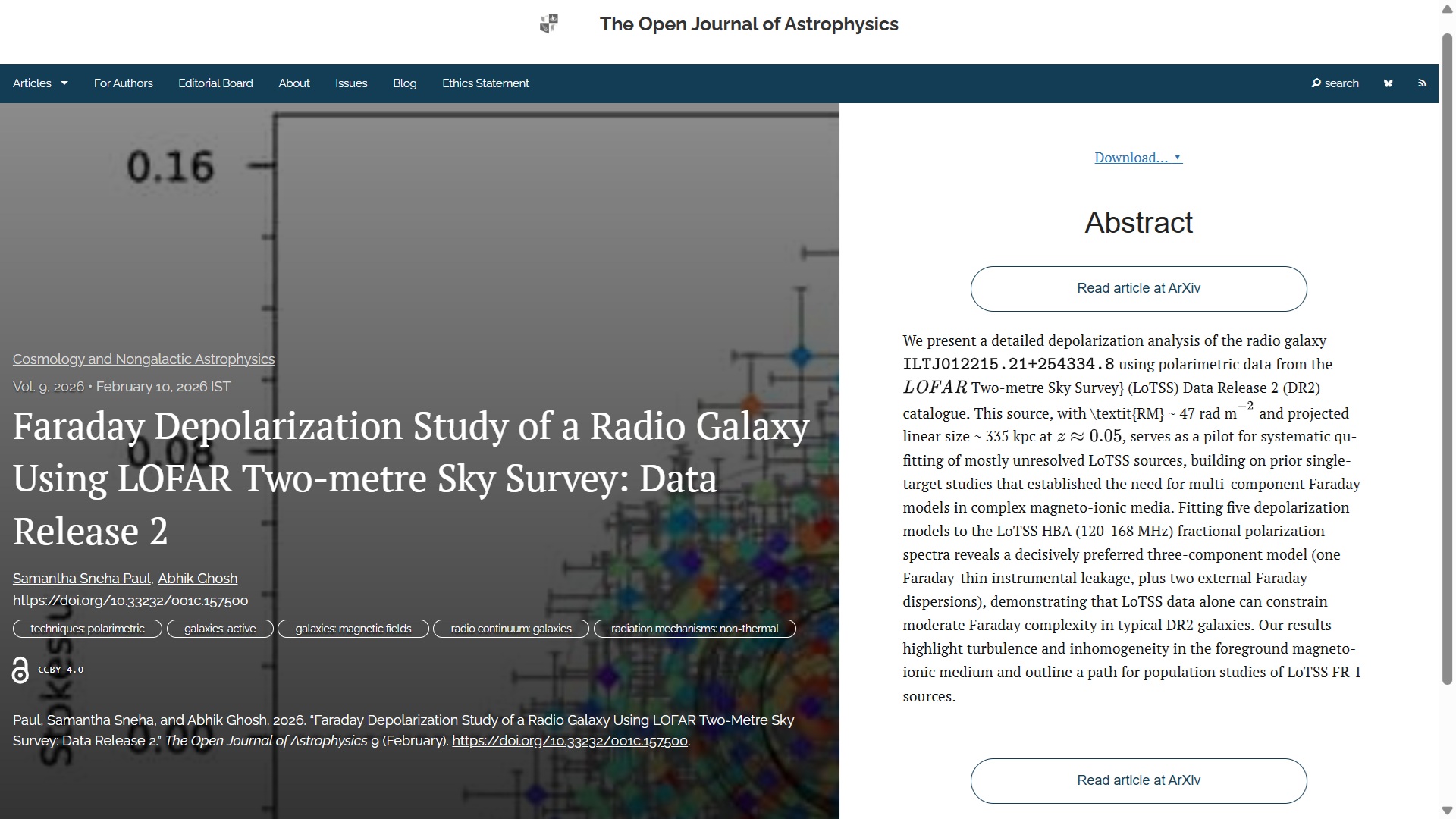
New Publication at the Open Journal of Astrophysics: "Faraday Depolarization Study of a Radio Galaxy Using LOFAR Two-metre Sky Survey: Data Release 2" by Samantha Sneha Paul and Abhik Ghosh (Banwarilal Bhalotia College, India)
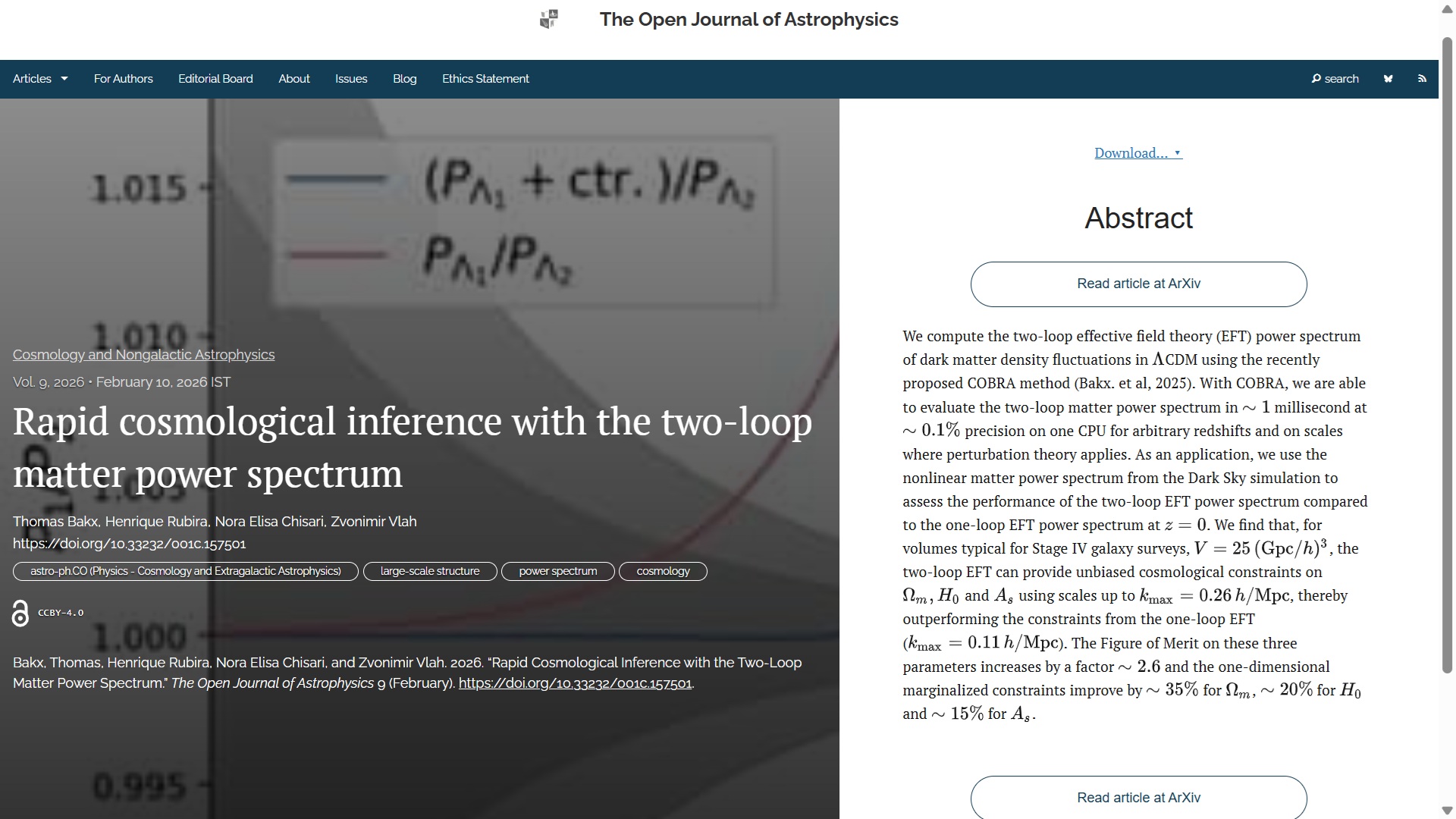
The second paper is “Rapid cosmological inference with the two-loop matter power spectrum” by Thomas Bakx (Utrecht U., NL), Henrique Rubira (Ludwig-Maximilians-Universität, DE), Nora Elisa Chisari (Utrecht) and Zvonimir Vlah (Ruđer Bošković Institute, Croatia). This was also published on Tuesday February 10th in the folder Cosmology and Nongalactic Astrophysics. This paper uses the COBRA method to compute the two-loop effective field theory power spectrum of dark matter density fluctuations, providing more precise cosmological constraints than the one-loop EFT.
The overlay for this one is here:
The official version of the paper can be found on arXiv here and the Fediverse announcement here:
New Publication at the Open Journal of Astrophysics: "Rapid cosmological inference with the two-loop matter power spectrum" by Thomas Bakx (Utrecht U., NL), Henrique Rubira (Ludwig-Maximilians-Universität, DE), Nora Elisa Chisari (Utrecht) and Zvonimir Vlah (Ruđer Bošković Institute, Croatia)
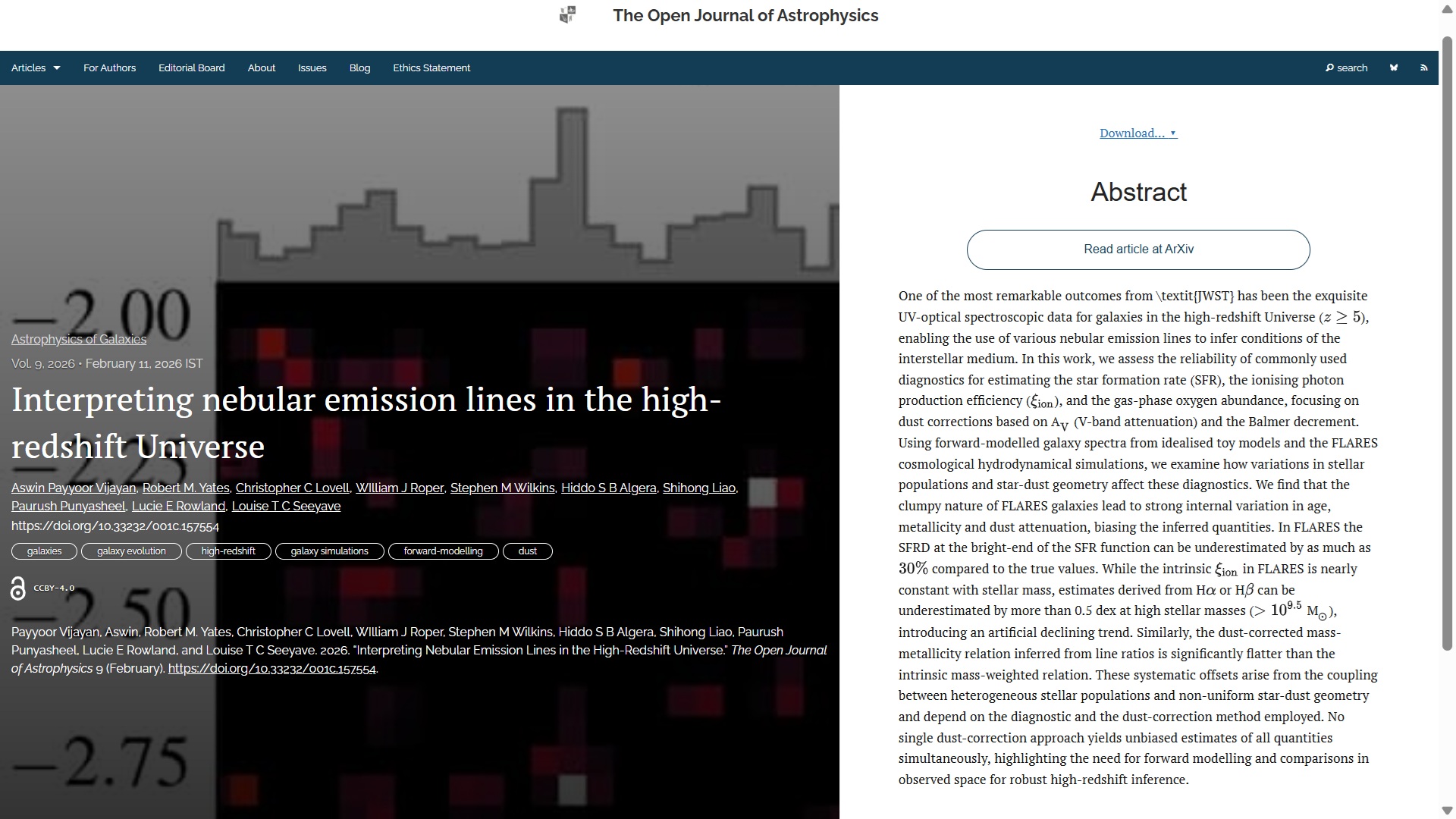
Next, published on Wednesday 11th February in the folder Astrophysics of Galaxies, is “Interpreting nebular emission lines in the high-redshift Universe” by Aswin P. Vijayan (U. Sussex, UK) and 9 others based in the UK, Taiwan, China and The Netherlands. This article examines the reliability of diagnostics used to estimate star formation rate and gas-phase oxygen abundance in high-redshift galaxies. It finds that variations in stellar populations and star-dust geometry. The overlay is here:
The official version can be found on arXiv here and the Fediverse announcement is here:
New Publication at the Open Journal of Astrophysics: "Interpreting nebular emission lines in the high-redshift Universe" by Aswin P. Vijayan (U. Sussex, UK) and 9 others based in the UK, Taiwan, China and The Netherlands
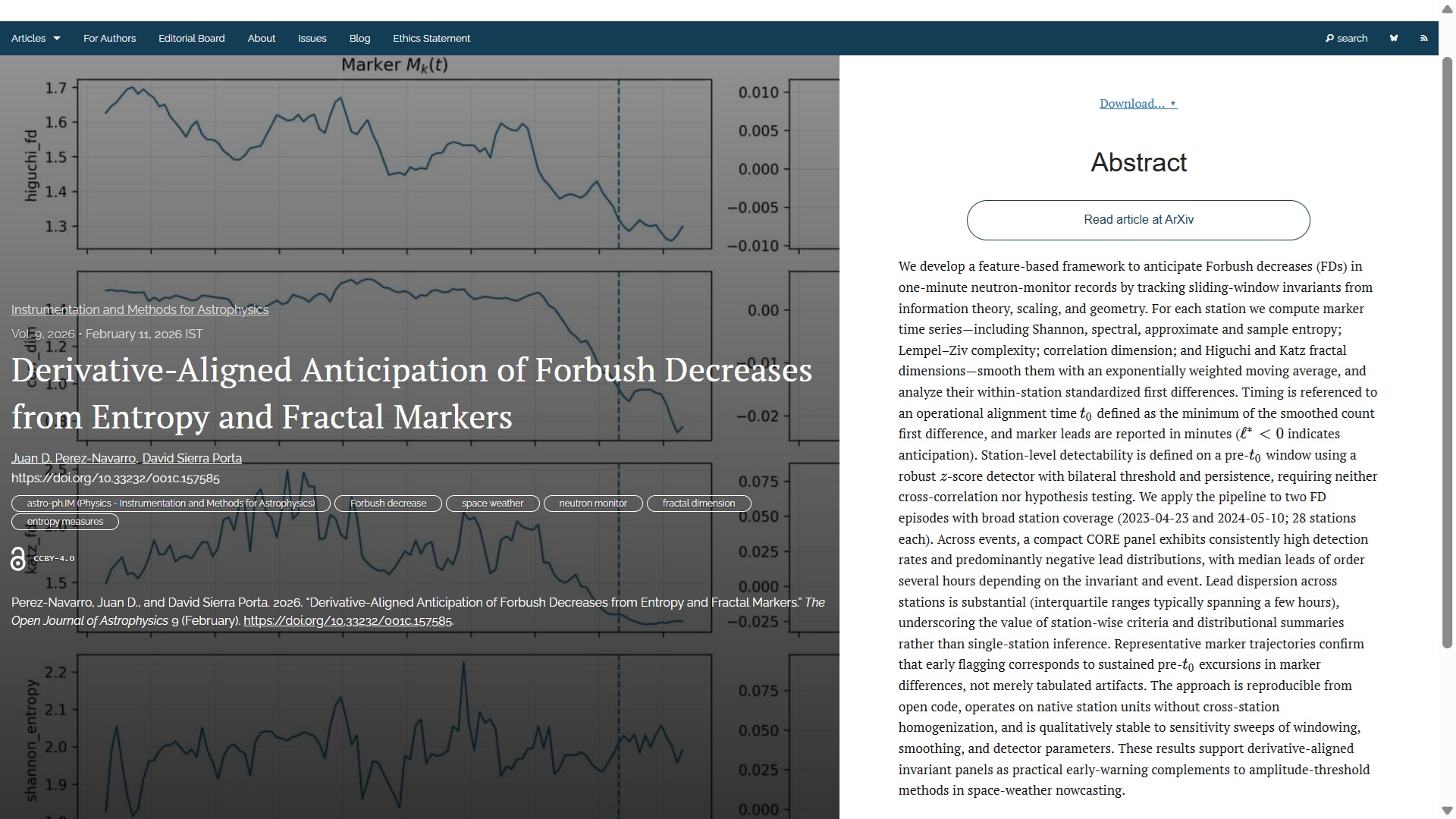
The fourth paper this week, also published on Wednesday 11th February, but in the folder Instrumentation and Methods for Astrophysics is “Derivative-Aligned Anticipation of Forbush Decreases from Entropy and Fractal Markers” by Juan D. Perez-Navarro & David Sierra Porta (Universidad Tecnológica de Bolívar, Colombia). The paper presents a feature-based framework for predicting Forbush decreases, i.e. rapid, temporary drops in galactic cosmic ray (GCR) intensity (up to tens of percent) caused by solar wind disturbances, typically Coronal Mass Ejections (CMEs) or high-speed streams from coronal holes, in neutron-monitor records using various computational methods. The approach is reproducible, operates on native station units, and is stable.
Here is the overlay:
The official version can be found on arXiv here and the Fediverse announcement is here:
New Publication at the Open Journal of Astrophysics: "Derivative-Aligned Anticipation of Forbush Decreases from Entropy and Fractal Markers" by Juan D. Perez-Navarro & David Sierra Porta (Universidad Tecnológica de Bolívar, Colombia)
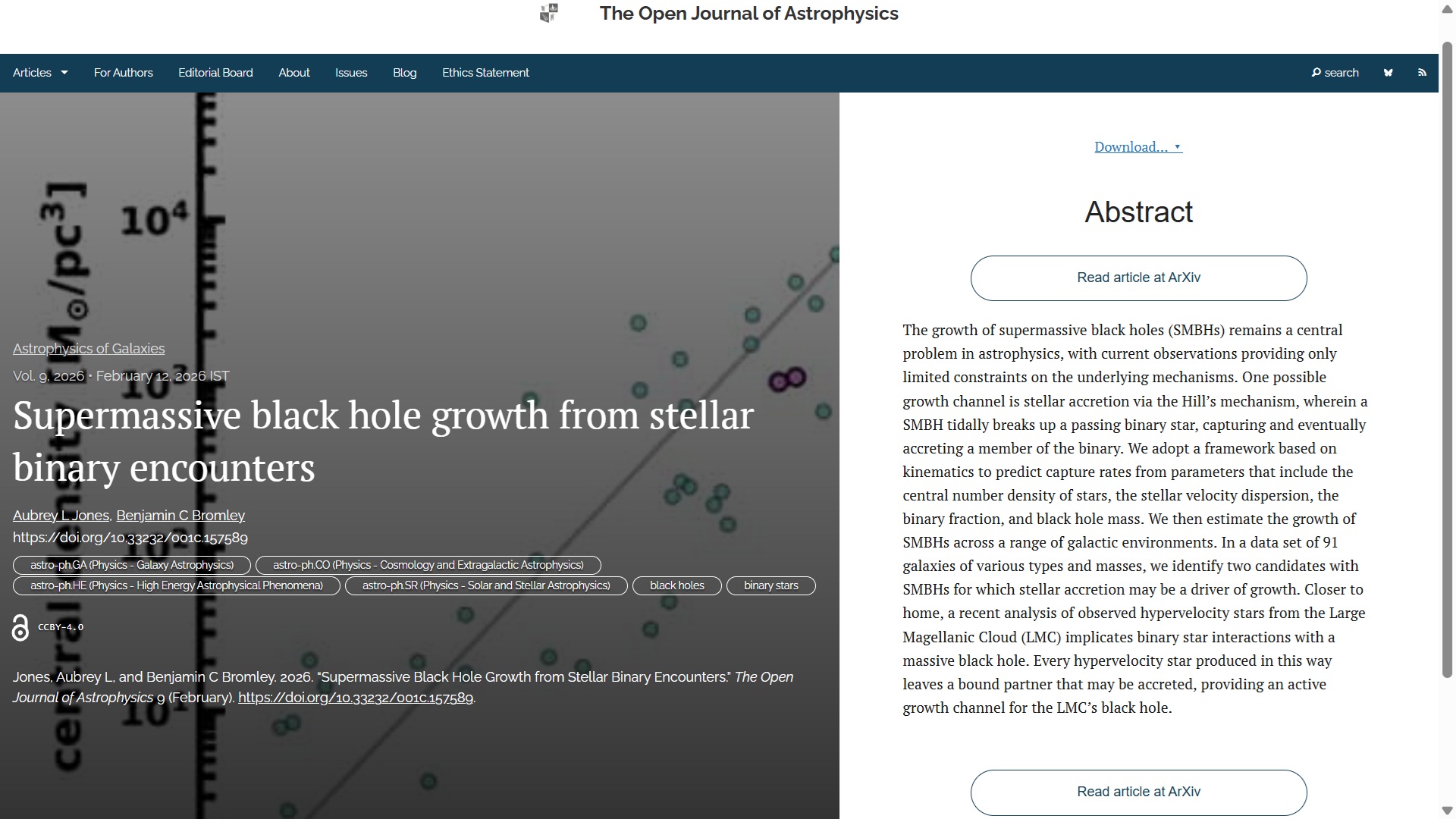
The fifth paper, the penultimate for this week, is “Supermassive black hole growth from stellar binary encounters” by Aubrey L Jones and Benjamin C Bromley (University of Utah, USA). This paper explores the growth of supermassive black holes (SMBHs) through stellar accretion via the Hill’s mechanism, predicting capture rates and identifying potential growth drivers in 91 galaxies. It was published on Thursday 11th February 2026 in the folder Astrophysics of Galaxies.
The overlay is here:
The accepted version can be found on arXiv here, and the fediverse announcement is here:
New Publication at the Open Journal of Astrophysics: "Supermassive black hole growth from stellar binary encounters" by Aubrey L Jones and Benjamin C Bromley (University of Utah, USA)
Finally for this week we have “Dynamics in the Cores of Self-Interacting Dark Matter Halos: Reduced Stalling and Accelerated Core Collapse” by Frank C. van den Bosch and Shashank Dattathri (Yale University, USA). This study uses simulations to explore core dynamics in self-interacting dark matter (SIDM) halos. Findings suggest strong self-interactions prevent core stalling and buoyancy, leading to accelerated core collapse. This was published yesterday, on Friday 13th February 2026, in the folder Astrophysics of Galaxies.
The overlay is here:
You can find the published version of the article here, and the Mastodon announcement is here:
New Publication at the Open Journal of Astrophysics: "Dynamics in the Cores of Self-Interacting Dark Matter Halos: Reduced Stalling and Accelerated Core Collapse" by Frank C. van den Bosch and Shashank Dattathri (Yale University, USA)
The National Hurling League – not to be confused with the All-Ireland Senior Hurling Championship (which follows it and ends in the All-Ireland Final) – started a couple of weeks ago so inter-county hurling has been on the telly recently once more. The League is organized in 5 divisions (1a, 1b, 2, 3 and 4) and the TV coverage usually focusses on higher-division teams . Last week for example, there was a televised game between Cork and Tipperary, last year’s Championship finalists, in Div 1a. Cork won a feisty contest in front of a crowd of over 40,000 that exploded into a huge brawl near half-time . Anyway, I was looking through the lower divisions on the web and did a bit of a double-take when I reached Division 4 as I thought I’d got muddled up with the cricket!
Yes, there are two English counties in the Hurling League. There’s also a team from London in Division 3. None of them are doing very well, but if you want to see some live hurling in England you could check out Lancashire GAA, Warwickshire GAA or London GAA.
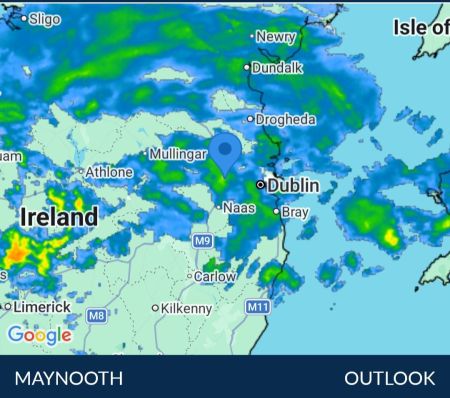
There’s been a lot of rain recently, combined with an unusual easterly wind; the usual prevailing wind in Ireland is from a westerly direction. I’ve managed to avoid the worst of the wet until today. On the way home from work this evening I got absolutely drenched. A lot of water had pooled on the paths and pavements on campus too; I hadn’t put sufficiently sturdy footwear on so my feet got wet too. It seems set to be similar weather tomorrow, so I’ll make sure I’m better prepared. Was it Billy Connolly who said that there’s not really such a thing as bad weather, just the wrong clothes?
We are approaching the end of Week 2 of Semester 2 at Maynooth. I’ve been busy with the usual start-of-term things as well as some other jobs of the sort that crop up from time to time. I started teaching Computational Physics again last week for the first time in a different computer lab, and there were numerous problems with logins, etc, which caused quite a lot of stress. The second cycle of labs started today and everything went much better. I hope this continues. My lecture course on Particle Physics seems to be going reasonably well too, although it’s early days. Hopefully things will settle down and I won’t feel so exhausted for the rest of term. Thursdays are busy for me this term, with a 9am lecture as well as a lab and, today, several other things in between. Combined with the drenching on the way home I feel in need of refreshment, so I think I’ll have a hot bath followed by a glass of brandy and an early night…
P.S. Anniversaries often give me ideas for blog posts but I forgot one yesterday, which was ten years to the day since the announcement of the discovery of gravitational waves. Here’s the blog I did on that day. Was it really a decade ago?
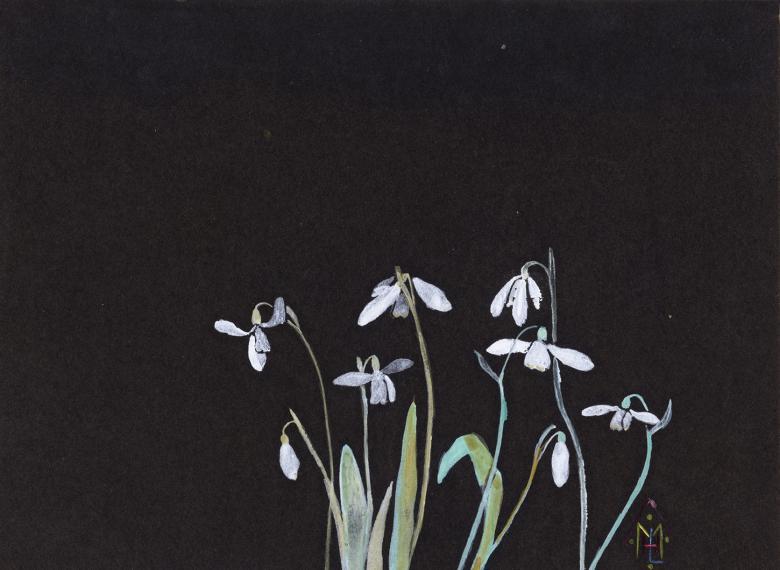
Snowdrops by Lillias Mitchell (1929, watercolour on paper, 29 x 34 cm, National Gallery of Ireland); painted when the artist, who lived from 1915 to 2000, was 14 years old.
The views presented here are personal and not necessarily those of my employer (or anyone else for that matter).
Feel free to comment on any of the posts on this blog but comments may be moderated; anonymous comments and any considered by me to be vexatious and/or abusive and/or defamatory will not be accepted. I do not necessarily endorse, support, sanction, encourage, verify or agree with the opinions or statements of any information or other content in the comments on this site and do not in any way guarantee their accuracy or reliability.




 In the Dark