40 Years a Graduate

Posted in Biographical, Education, Maynooth with tags , on July 4, 2025 by telescoper

The summer examinations at Maynooth being over and the finalists having received their degree results I was reminded that I’d missed the anniversary of my own graduation. The main reason for that is that I couldn’t remember the date. I thought it was in July, actually, but rummaging through my files reminded me that it was on Saturday 22nd June 1985. Maynooth graduands will have to wait until September at the earliest for their conferring ceremony.

The degree certificate, incidentally, is not at all fancy. The only thing that surprised me about it was that it’s not in Latin!

The Stiff Ticket for my Degree

The one I got when I collected my DPhil from Sussex University is far more elaborate. It’s also worth mentioning that although I did Natural Sciences (specialising in Theoretical Physics), the degree I got was Bachelor of Arts.

I don’t remember much about the Cambridge graduation, perhaps because the previous evening (Friday 21st June) we were plied with alcohol at the MacFarlarne-Grieve Dinner (a special event for graduands), then finished up in The Pickerel, the closest pub to the College. Our ceremony started at 9.15am and I wasn’t the only person graduating with a hangover.

The whole ceremony was dpme in Latin (or was when I graduated) and involved each graduand holding a finger held out by their College’s Praelector and then kneeling down in front of the presiding dignitary, i.e. either the Vice-Chancellor or Deputy Vice-Chancellor. I can’t remember which.  The magic formula that turns a graduand into a graduate is:

Auctoritate mihi commissa admitto te ad gradum Baccalaurei in Artibus, in nomine Patris et Filii at Spiritus Sanctii

Other than that, and the fact that the graduands had to walk to the Senate House from their College through the streets of Cambridge,  I don’t remember much about the actual ceremony.

After the ceremony we returned to Magdalene College for a garden party. I found this quite stressful, because my parents had divorced some years before and my Mum had re-married. My Dad wouldn’t speak to her or her second husband. At the garden party, the two parts of my family occupied positions at opposite corners of the lawn and I scuttled between them trying to keep everyone happy. It was like that for the rest of the day and I was glad when it was all over.

Anyway, the following October I started as a research student at the University of Sussex doing a Doctorate in Philosophy. I finished my thesis in 1988. Those three years were hard work but, on the whole, very enjoyable. I have a similar length of time in front of me before I retire. By the end I’ll have had 40 years in higher education (29 in the UK and 11 in Ireland). Hopefully, by then I’ll have figured out what to do when I leave University.

A Trip to Trim

Posted in Biographical, Maynooth with tags , , , on July 3, 2025 by telescoper

This morning I took an impromptu trip to Trim, which is situated in the Boyne Valley in County Meath. There has been a small astrophysics workshop going on there this week, attended by some people I know including a couple of old friends from Nottingham, Frazer and Meghan. Trim is less than 30km from Maynooth as the crow flies. Unfortunately I couldn’t find a crow willing to offer me a lift, public transport from Maynooth to Trim is difficult, and I don’t drive, so it wasn’t easy to arrange to meet up. Fortunately this morning one of our postdocs was driving up for the morning session of the meeting so I cadged a lift and and stayed until lunch before getting a lift back to Maynooth.

It was a nice trip. An added bonus was that the workshop venue was just a few metres away from the historic Trim Castle, which was built in the early 13th Century. We had time for a quick walk around before leaving to return to Maynooth.

As you can see, it’s a standard model Norman castle. The Keep, though not entirely intact is pretty well preserved; there’s certainly a lot more left than in the case of Maynooth castle. Quite a lot of the curtain wall and the gates have survived quite well too. In order to get inside the Keep (and climb to the top) you have to take an official tour, but we didn’t have time for that.

A Stiff Ticket

Posted in Biographical with tags , , on July 2, 2025 by telescoper

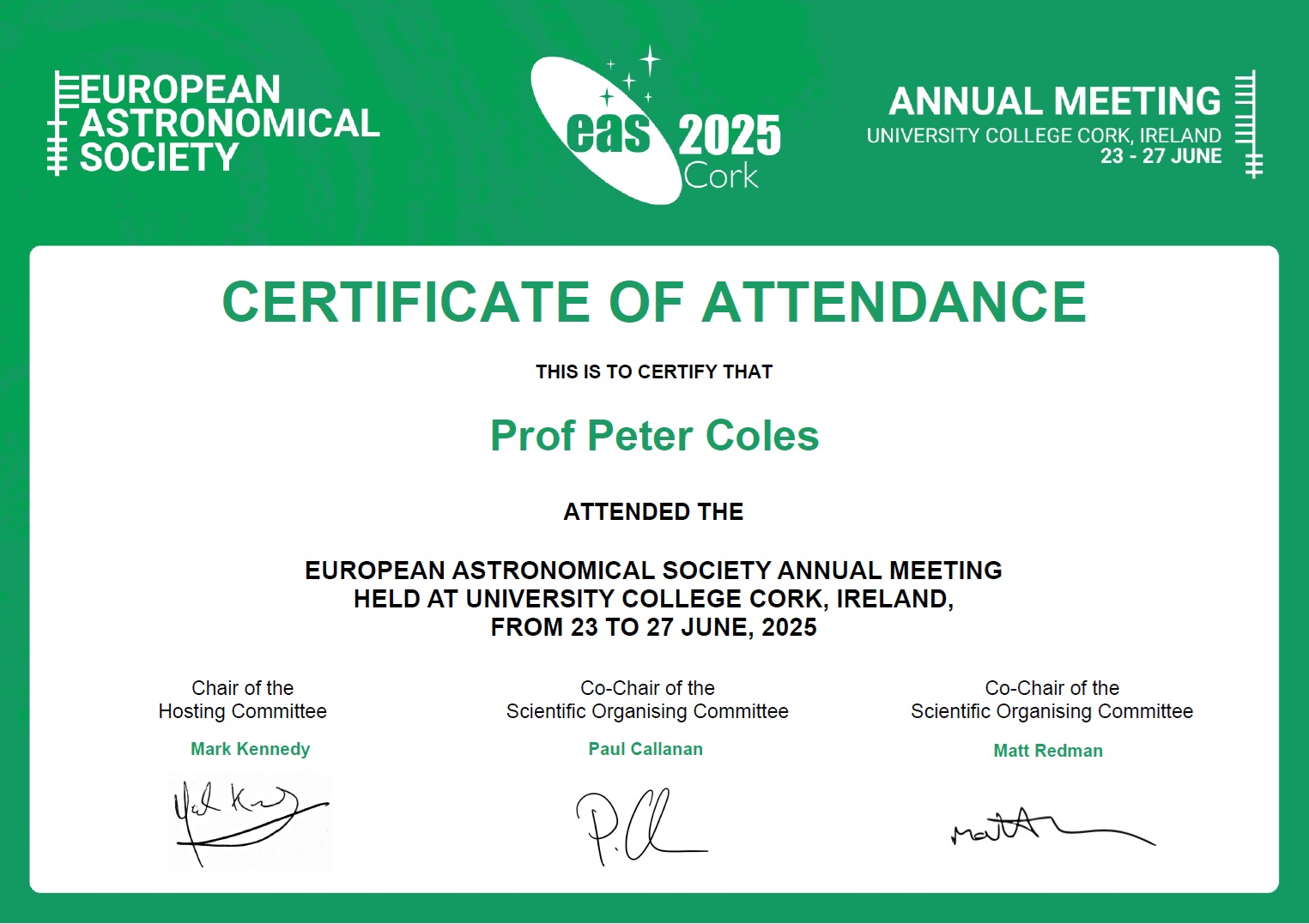
I got this – an example of what my Dad used to call a “Stiff Ticket” – via email today.

I suppose I’m supposed to show it to my superiors to prove that I wasn’t just on holiday in Cork last week. I think I’ll print it out and put in on the wall of my office, alongside the certificate for my Cycling Proficiency Award (Bronze).

MSc in Theoretical Physics & Mathematics at Maynooth

Posted in Education, Maynooth, The Universe and Stuff with tags , , on July 1, 2025 by telescoper

Today is Consultation Day here at Maynooth University and, in the course of being consulted, I was reminded that this period, being immediately after undergraduate final results are released to students, is a potentially a good time to advertise our local postgraduate course to prospective applicants.

I therefore decided o use the medium of this blog to advertise the fact that the MSc in Theoretical Physics & Mathematics at Maynooth University is open to applications for entry in September 2025.

This postgraduate course is run jointly between the Departments of Physics and Mathematics & Statistics, with each contributing about half the material. The duration is one calendar year (full-time) or two years (part-time) and consists of 90 credits in the European Credit Transfer System (ECTS). This is split into 60 credits of taught material (split roughly 50-50 between Theoretical Physics and Mathematics) and a research project of 30 credits, supervised by a member of staff in a relevant area from either Department.

This course is a kind of follow-up to the existing undergraduate BSc Theoretical Physics & Mathematics at Maynooth, also run jointly. We think the postgraduate course will appeal to many of the students on that programme who wish to continue their education to postgraduate level, though applications are very welcome from suitably qualified candidates who did their first degree elsewhere.

You can register your interest by scanning the QR code above or, if you prefer, simply following the link here. You can apply directly to the postgraduate application portal here.

The Mystery Mushroom

Posted in Maynooth with tags , , , , on July 1, 2025 by telescoper

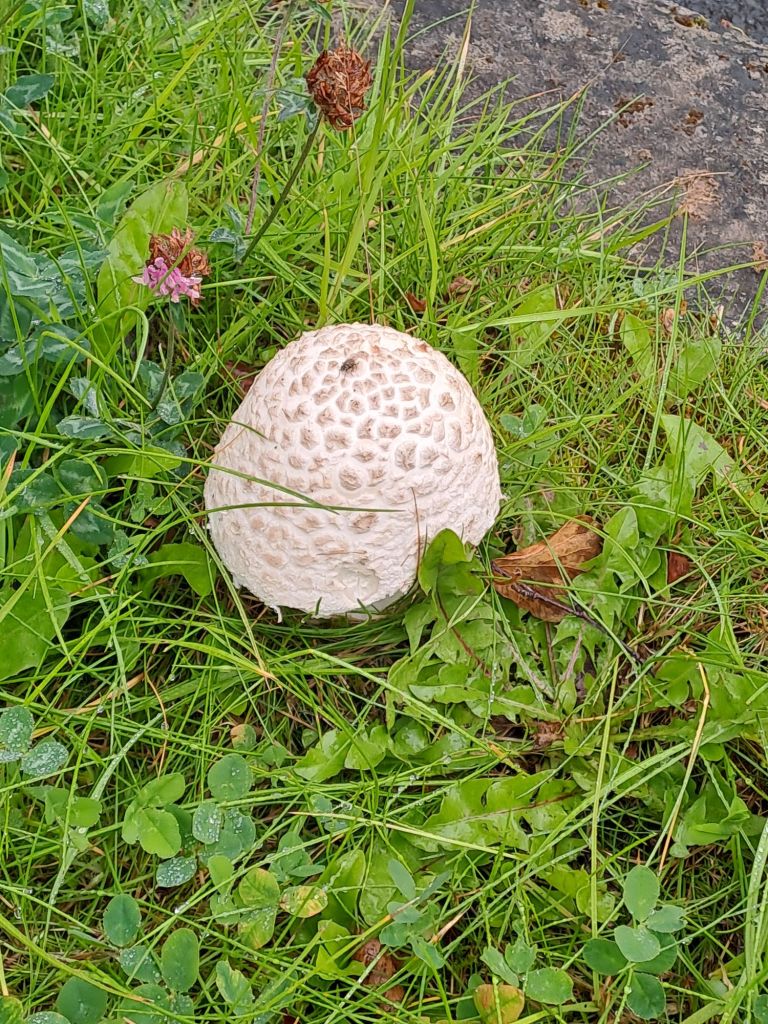
I saw this on my way into work this morning. I wonder if anyone can identify it? I don’t know fungi.

My PictureThis app could only identify it as some form of Agaricus, i.e. one of the Agaricaceae. I know it has a fly on it, but that doesn’t mean it is Fly Agaricbut it has also been suggested to me that it might be Amanita Strobiliformis. I’m not convinced by either of these. Does anyone have any suggestions?

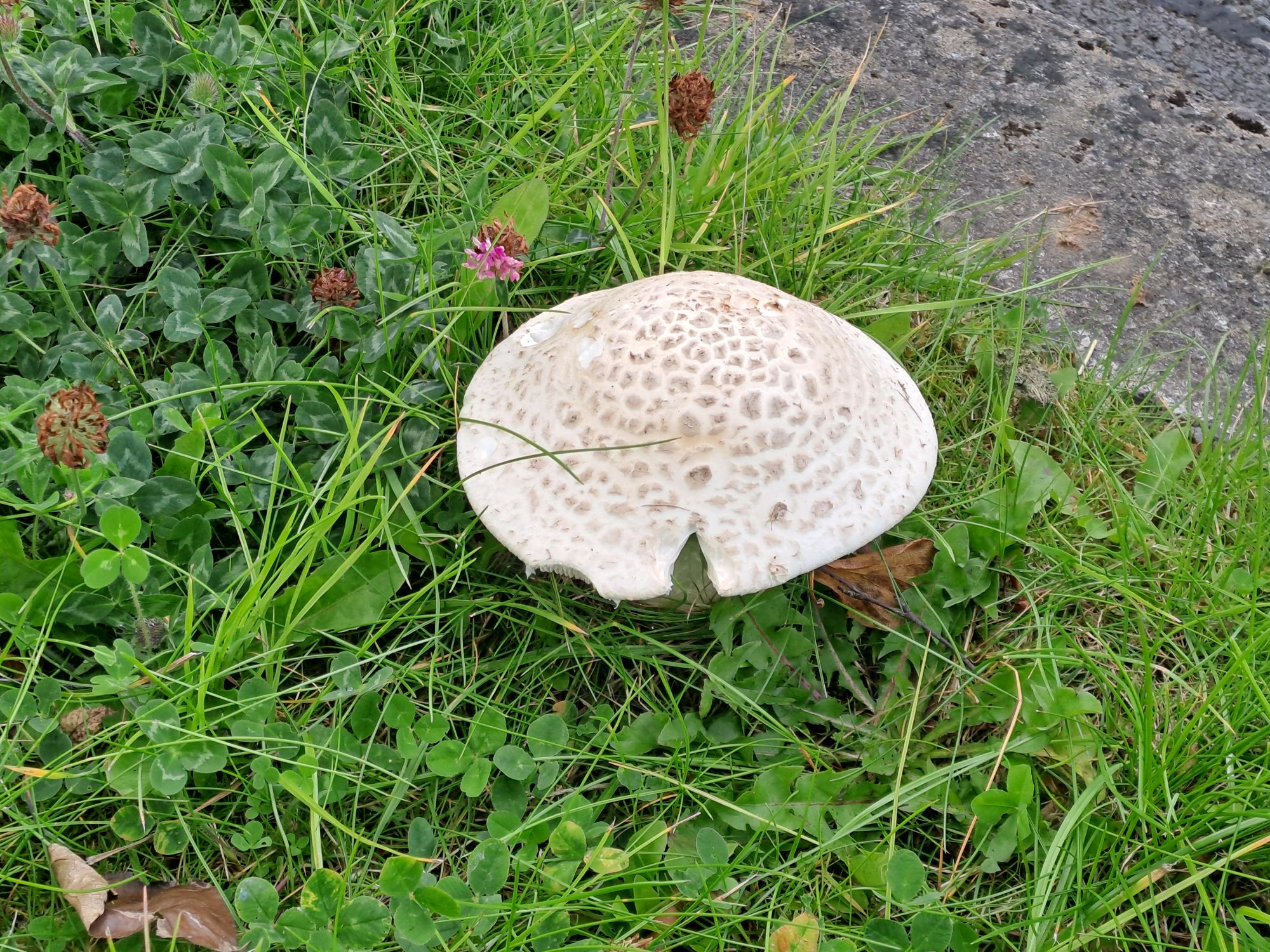
Update: a day later, it has evolved!

It’s now starting to look very much like it is indeed Macrolepiota Procera (the Parasol Mushroom), and it is now opening its parasol. I expect tomorrow it will be even flatter.

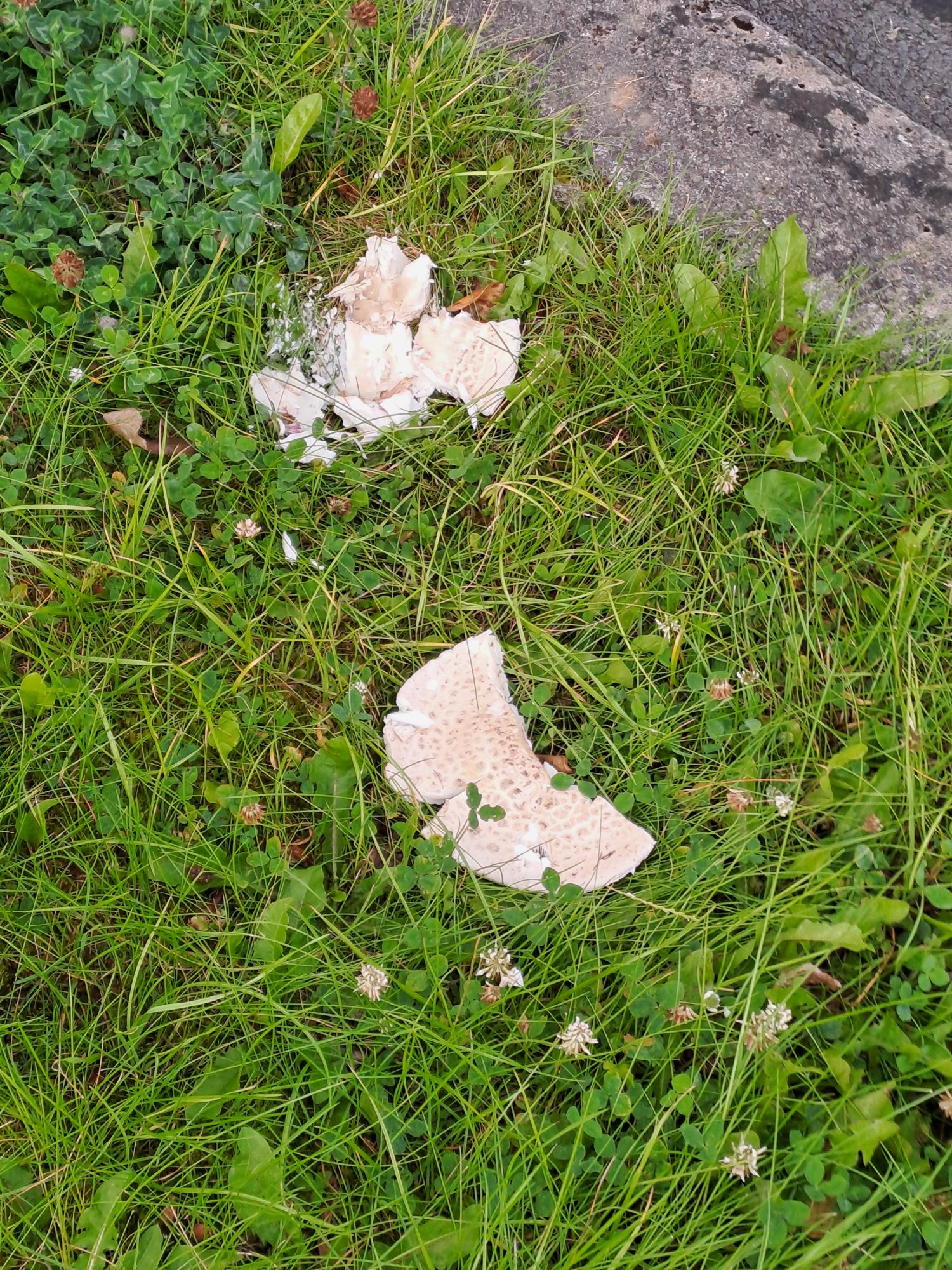
Update: it is indeed looking flatter, but not in the way I imagined. Somebody squished it.

R.I.P. Lalo Schifrin (1932-2025)

Posted in Jazz, R.I.P. with tags , , on June 30, 2025 by telescoper

I’ve just caught up with the news of the death last week of composer, arranger and pianist Lalo Schifrin. He was 93. Most of the media coverage of his passing concentrates on his many excellent TV and movie scores, such as Mission Impossible*, Dirty Harry and Bullitt, but he was first and foremost a Jazz musician so I thought I’d pay tribute by posting a relatively early work by him.

Lalo Schifrin was a huge fan of trumpeter Dizzy Gillespie whom he met when Gillespie toured Schifrin’s home country of Argentina in 1956. This long piece, Gillespiana was written for Gillespie’s big band in 1958. You can here in it many of the musical ideas that Schifrin was later to include in his film scores. In 1960, Lalo Schifrin moved to York and joined Gillespie’s band as a pianist after the departure of Junior Mance. He only stayed with the band for a couple of years but together they made some great records, especially Dizzy on the French Riviera (which I have blogged about here).

Anyway, Gillespiana is suite in five movements (Prelude, Blues, Panamerica, Africana, and Toccata) that takes up an entire album that was released in 1960. It’s not so well known nowadays but I think it’s great. It gives ample opportunity not only to listen to Dizzy’s trumpet and Lalo Schifrin’s piano – as well as the enormously underrated alto saxophonist and flautist Leo Wright – but also to enjoy the wonderful arrangements.

*The original theme for Mission Impossible is written in 5/4 time. Not a lot of people know that the resulting rhythmic pattern (dash dash dot dot) is Morse code for the letters M I…

Back to the Office

Posted in Barcelona, Biographical, Maynooth, The Universe and Stuff on June 30, 2025 by telescoper

After a week away in Cork, I’m back in the office at Maynooth University. I have quite a lot of things to do before my next trip away which will be next week.

On Friday (27th) Maynooth students got their examination results. For this year’s finalists that means they also received news of their final degree classification. I’ve seen quite a few celebratory messages flying around on social media so let me add my own congratulations here: Congratulations!

We’ve had an outstanding group of students in Theoretical Physics this year and that is reflected in some excellent degree results. Well done to them all, and best wishes for the further studies on which many of them are about to embark.

Tomorrow (Tuesday 1st July), we have a consultation day during which students can ask about their examinations and request advice on next steps, including repeat examinations in August, the papers for which have to be readied for printing in the next two weeks.

Campus is quiet at this time of year, as most of the undergraduate students have left for the summer (or permanently for the graduands). A few will remain to do summer projects. The postgraduates are still around, of course. I have a Masters student doing their project this summer, from which I hope a paper will emerge, and a PhD student doing post-viva corrections to her thesis. I’ve also got a couple of other papers to finish.

I’m hearing a lot about sweltering temperatures across Europe. Fortunately it is more temperate here in Ireland, with maximum of 23 degrees forecast in Maynooth. All of this reminds me that it was a year ago today that I returned from a spell in Barcelona on sabbatical. As it happens, I met my hosts Licia and Raul at EAS last week. It seems things are going well at ICCUB. I would have stayed longer there, but my laptop had died which left me unable to work effectively. I’m looking forward to visiting there again next year for the 2026 Euclid Consortium meeting (if I can find the time).

Primordial Black Holes in Cosmological Simulations

Posted in Maynooth, The Universe and Stuff with tags , , on June 29, 2025 by telescoper

Being so busy for the last couple of weeks I omitted to engage in the gratuitous self-promotion that one would expect from a blogger, so I’m remedying that today by pointing out that I’m co-author of a new paper that is now on arXiv. This has already gained a bit of traction in the media, e.g. here.

Here is the abstract, which also shows the author list:

(I’ve just noticed that it says “The Netherland”, instead of “The Netherlands”. Oops!)

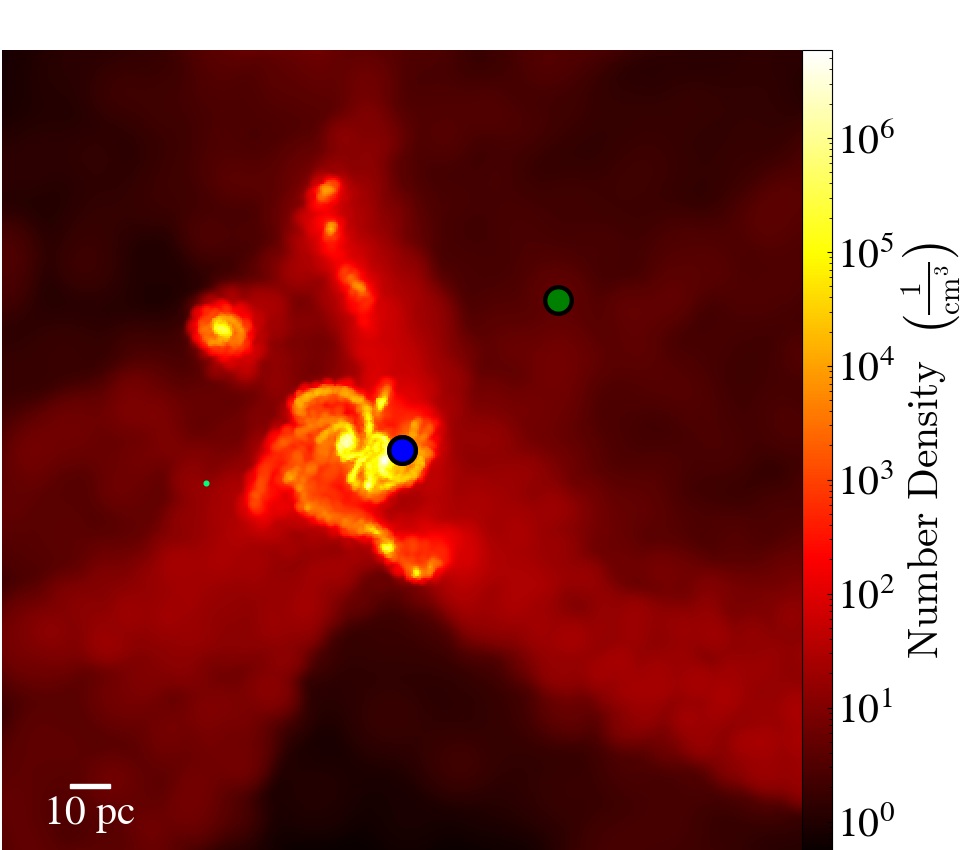
For those of you not in the field, there is currently a big mystery about how galaxies we have found at high redshift with JWST managed to acquire massive black holes so early in the Universe’s evolution. Black holes can grow quickly in a dense environment by accreting mass onto an initial seed, but what are the seeds? In this paper we investigate the possibility that they were primordial black holes. These form directly from fluctuations in the early Universe, as opposed to astrophysical black holes which form from stellar collapse. We don’t know exactly what mass primordial black holes would have nor how numerous they would be, but this paper uses high-resolution numerical experiments to investigate their effects if they do exist.

Here’s a pretty picture which is a zoom into 200 pc of the full simulation. I think 10pc counts as high resolution for a cosmological simulation! The blue circle shows the most massive PBH in the simulation, the green circle shows its nearest neighbour. The colour scale represents the number-density of dark matter particles.

For more details, read the paper!

P.S. This article has been submitted to the Open Journal of Astrophysics and is currently under review. As an author I am not involved in the editorial process.

Dublin Pride 2025

Posted in Biographical, LGBTQ+ with tags , on June 28, 2025 by telescoper

Today’s the day for Dublin Pride 2025. It’s thought that over 100,000 are attending! Best wishes to everyone taking part from one of The Olds. Although the weather’s not the greatest, I hope everyone has a grand time. Bród Sona Daoibh!

I’m wearing my GCN T-shirt for the occasion!

Weekly Update from the Open Journal of Astrophysics – 28/06/2025

Posted in OJAp Papers, Open Access, The Universe and Stuff with tags , , , , , , , , , , , , , , , , , , , , , , , , on June 28, 2025 by telescoper

It’s Saturday morning again so time for an update of papers published at the Open Journal of Astrophysics. Since the last update we have published eight new papers, which brings the number in Volume 8 (2025) up to 82, and the total so far published by OJAp  up to 317. With about half the year gone, we’re on target to published around 160 papers this year.

The papers published this week, with their overlays, are as follows.  You can click on the images of the overlays to make them larger should you wish to do so.

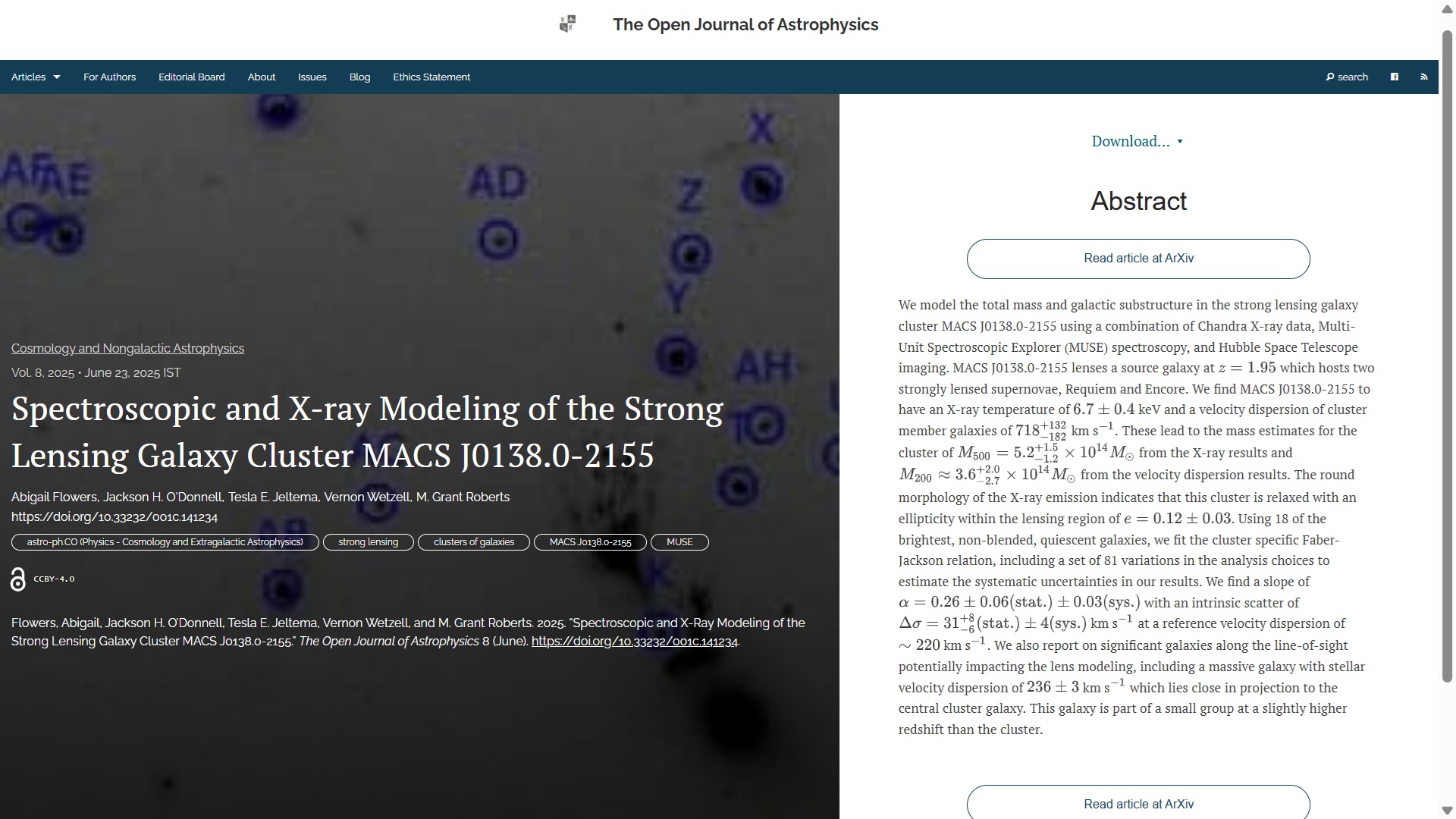
The first paper to report is “Spectroscopic and X-ray Modeling of the Strong Lensing Galaxy Cluster MACS J0138.0-2155” by Abigail Flowers (University of California at Santa Cruz; UCSZ), Jackson H. O’Donnell (UCSZ), Tesla E. Jeltema (UCSZ), Vernon Wetzell (U. Pennsylvania) & M. Grant Roberts (UCSZ). This artticle, which is in the folder marked Cosmology and NonGalactic Astrophysics, presents a study of the mass distribution and substructure of a galaxy cluster that acts as a gravitational lens for a source galaxy at z=1.95 that contains two supernovae. It was published on 23rd June 2025. The overlay is here:

The officially-accepted version can be found on arXiv here.

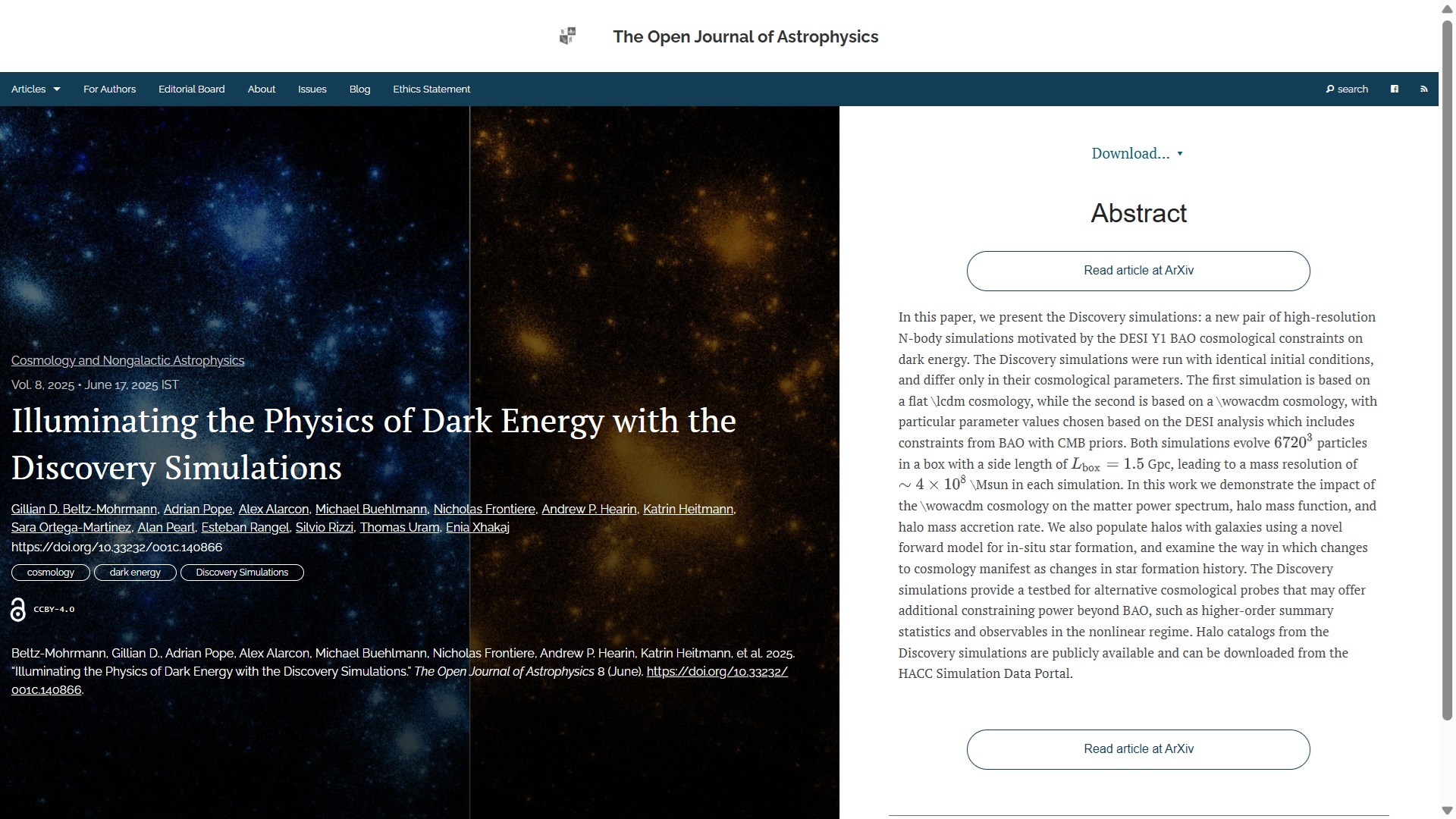
Illuminating the Physics of Dark Energy with the Discovery Simulations” by Gillian D. Beltz-Mohrmann (Argonne National Laboratory, USA) and 12 others based in the USA and Spain. This describes new high-resolution cosmological simulations providing a testbed for alternative cosmological probes that may offer additional constraining power beyond Baryon Accoustic Oscillations. It is filed in the folder marked Cosmology and NonGalactic Astrophysics.

The overlay is here:
You can read the final accepted version on arXiv here.

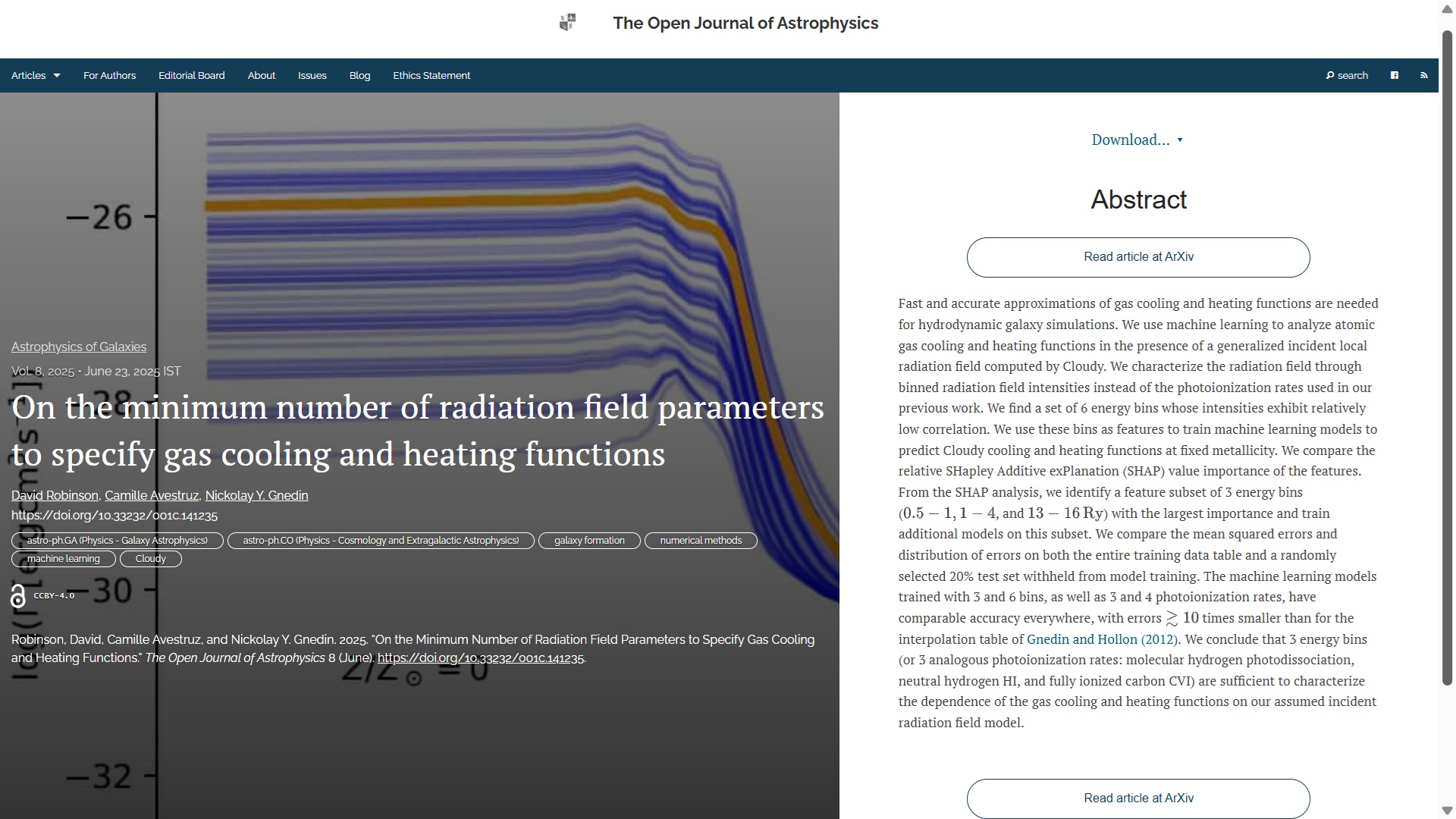
Next one up is in the folder marked Astrophysics of Galaxies. The title is “On the minimum number of radiation field parameters to specify gas cooling and heating functions” and it is by David Robinson & Camille Avestruz (U. Michigan) and Nickolay Y. Gnedin (U.Chicago) and was published on 23rd June 2025. It presents an analysis using machine learning of atomic gas cooling and heating functions computed by the spectral synthesis code Cloudy.

The overlay is here:
 

You can find the officially-accepted version of the paper on arXiv here.

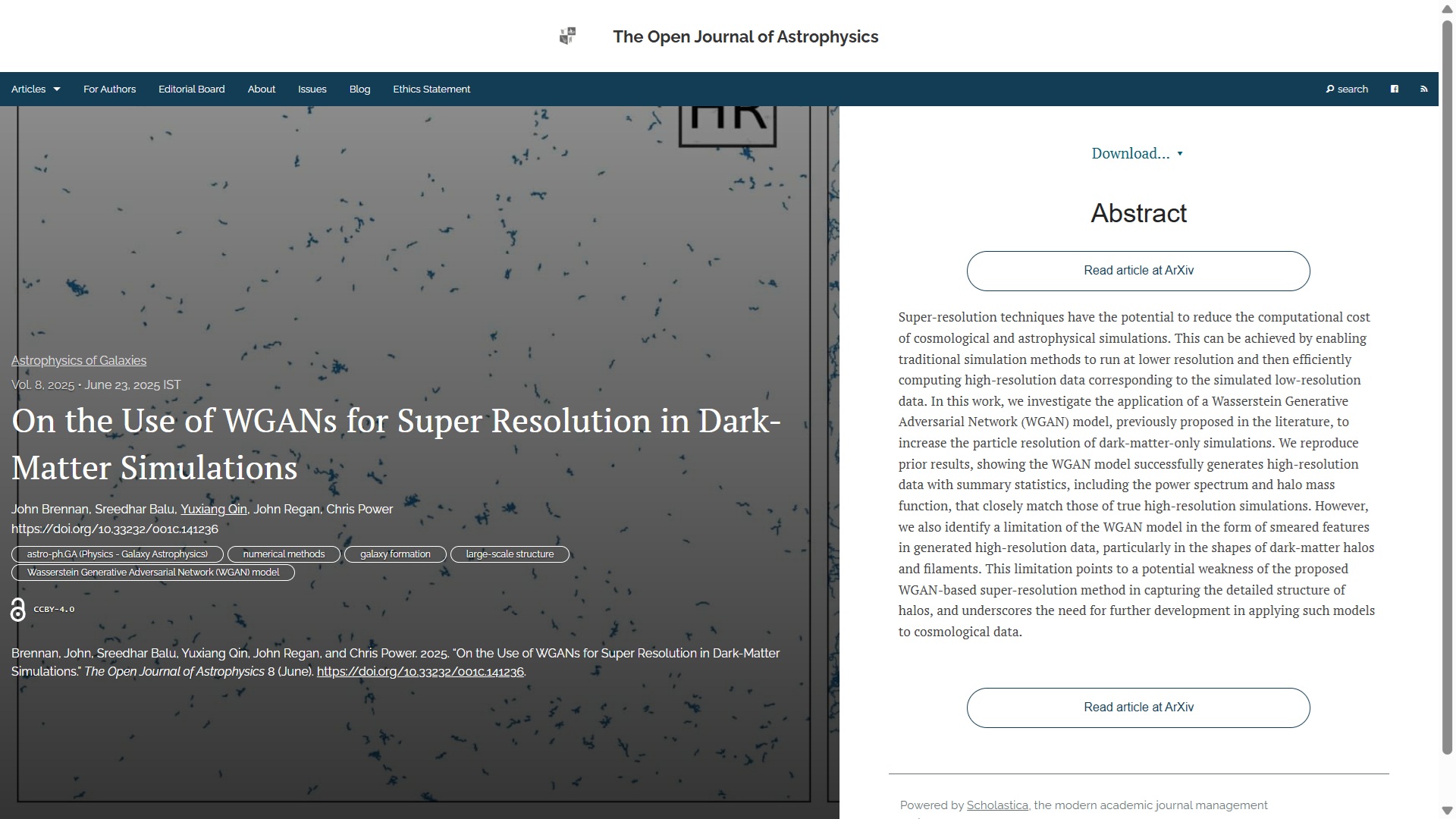
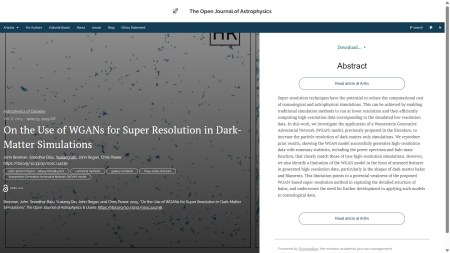
The thirtd paper is “On the Use of WGANs for Super Resolution in Dark-Matter Simulations” by John Brennan (Maynooth), Sreedhar Balu (U. Melbourne), Yuxiang Qin (ANU), John Regan (Maynooth) and Chris Power (U. Western Australia). This one is also in the folder marked Astrophysics of Galaxies and was also published on Monday 23rd June. It is about using the Wasserstein Generative Adversarial Network (WGAN) model to increase the particle resolution of dark-matter-only simulations of galaxy formation. The overlay is here:
You can find the officially-accepted version of the paper on arXiv here.

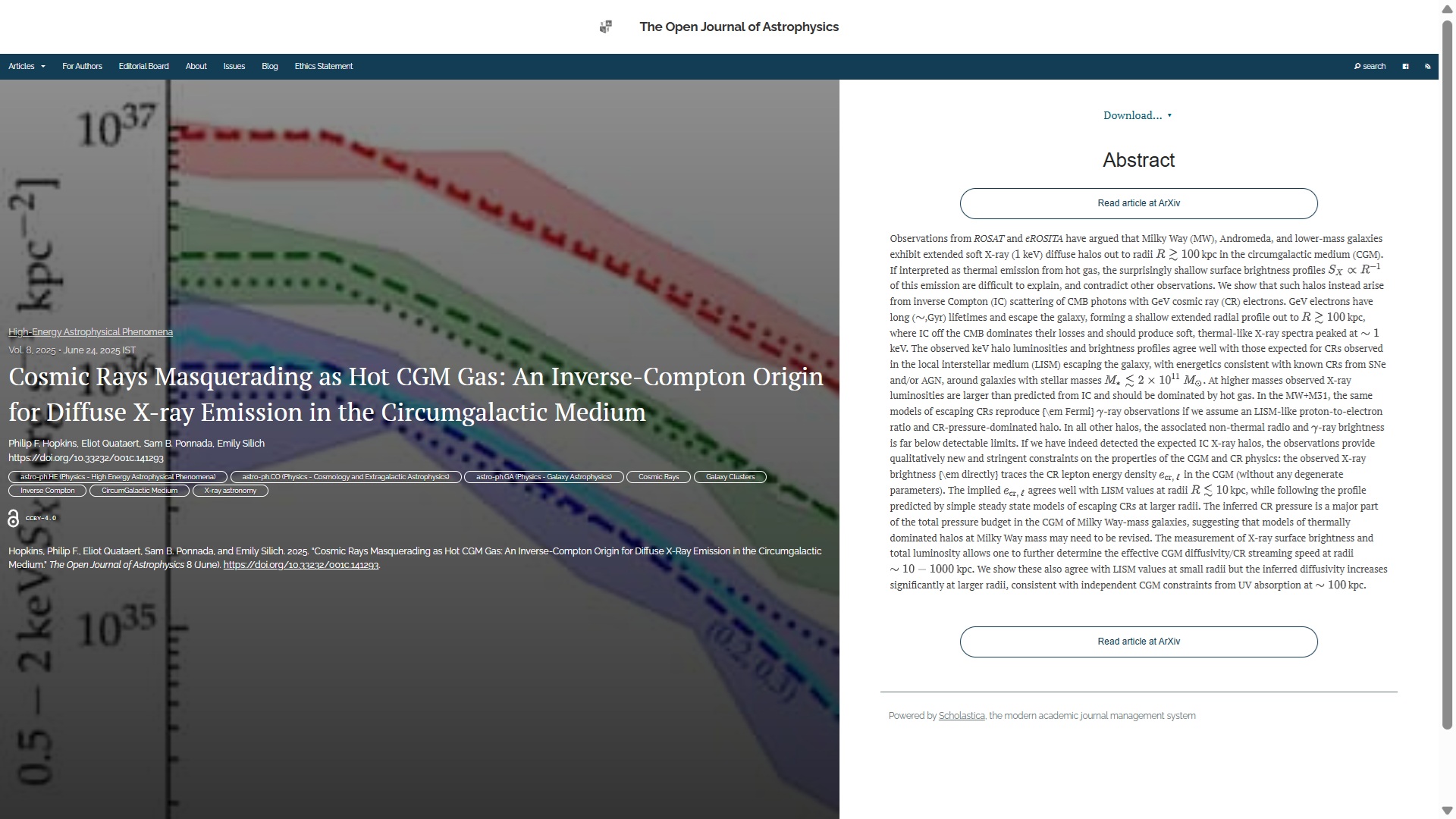
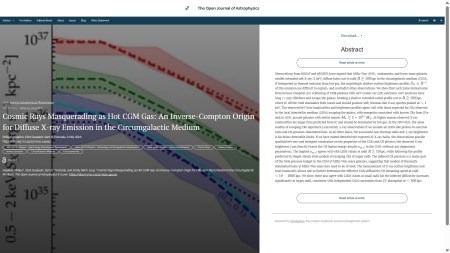
Next we have “Cosmic Rays Masquerading as Hot CGM Gas: An Inverse-Compton Origin for Diffuse X-ray Emission in the Circumgalactic Medium” by Philip F. Hopkins (Caltech), Eliot Quataert (Princeton), Sam B. Ponnada (Caltech) and Emily Silich (Caltech), all based in the USA.  This one was published on 24th June 2025 in the folder High-Energy Astrophysical Phenomena
You can find the officially-accepted version on arXiv here.

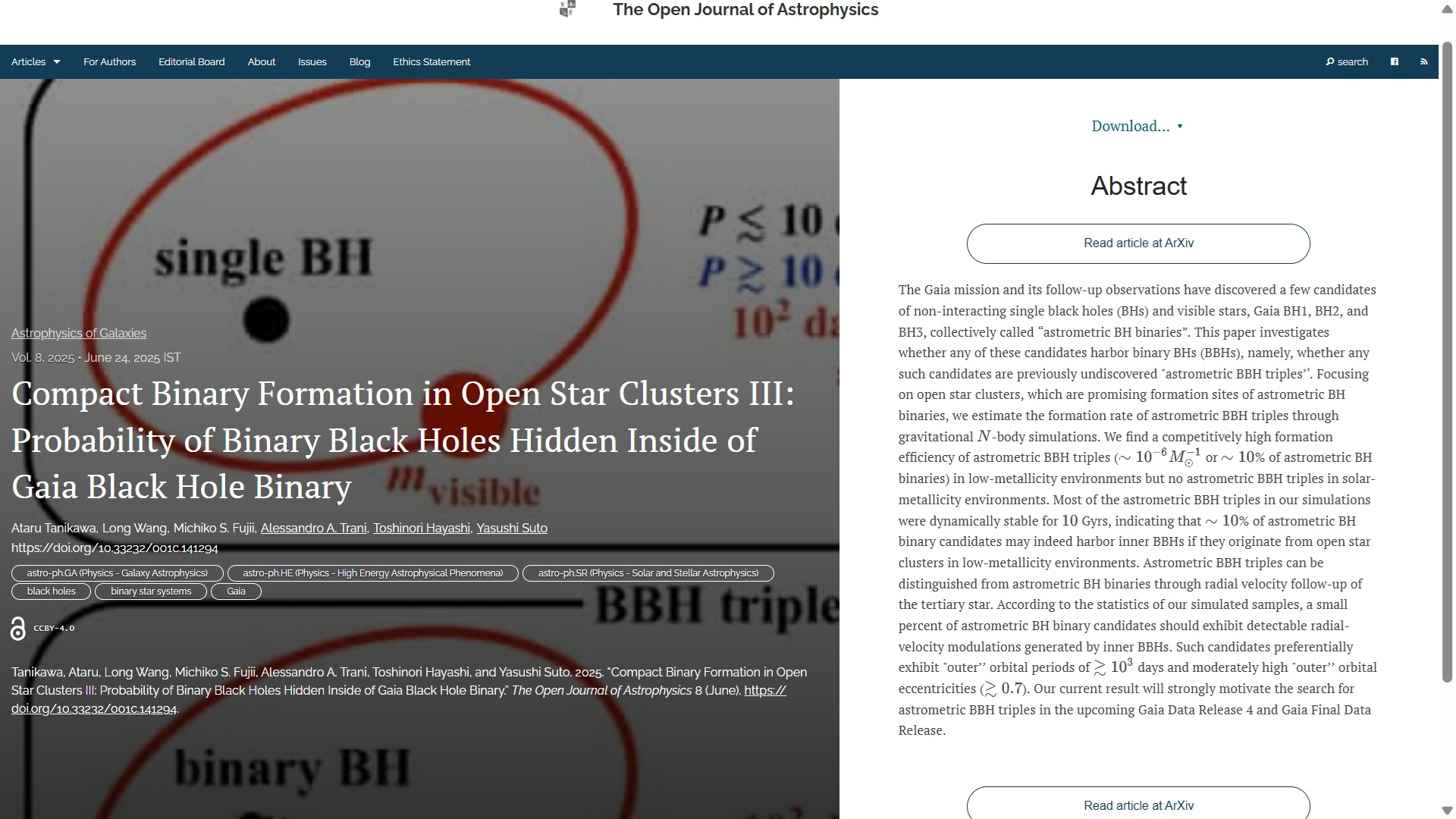
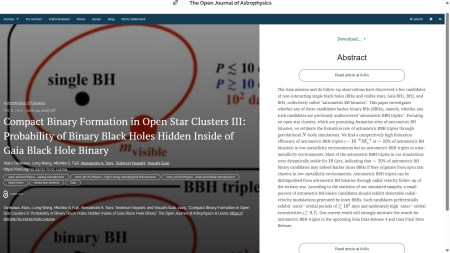
The fifth paper this week is “Compact Binary Formation in Open Star Clusters III: Probability of Binary Black Holes Hidden Inside of Gaia Black Hole Binary” by Ataru Tanikawa (Fukui Prefectural University, Japan), Long Wang (Sun Yat-sen University, China), Michiko S. Fujii (University of Tokyo, Japan), Alessandro A. Trani (Niels Bohr Institute, Denmark), Toshinori Hayashi (Kyoto University, Japan) and Yasushi Suto (Kochi University of Technology, Japan).  This one is in the folder marked Astrophysics of Galaxies and was published on Tuesday 24th June. It presents an investigation into whether some Gaia black hole binary systems may in fact involve three black holes, including a pair too compact to be resolved astrometrically. Here is the overlay:
You can find the officially-accepted paper on arXiv here.

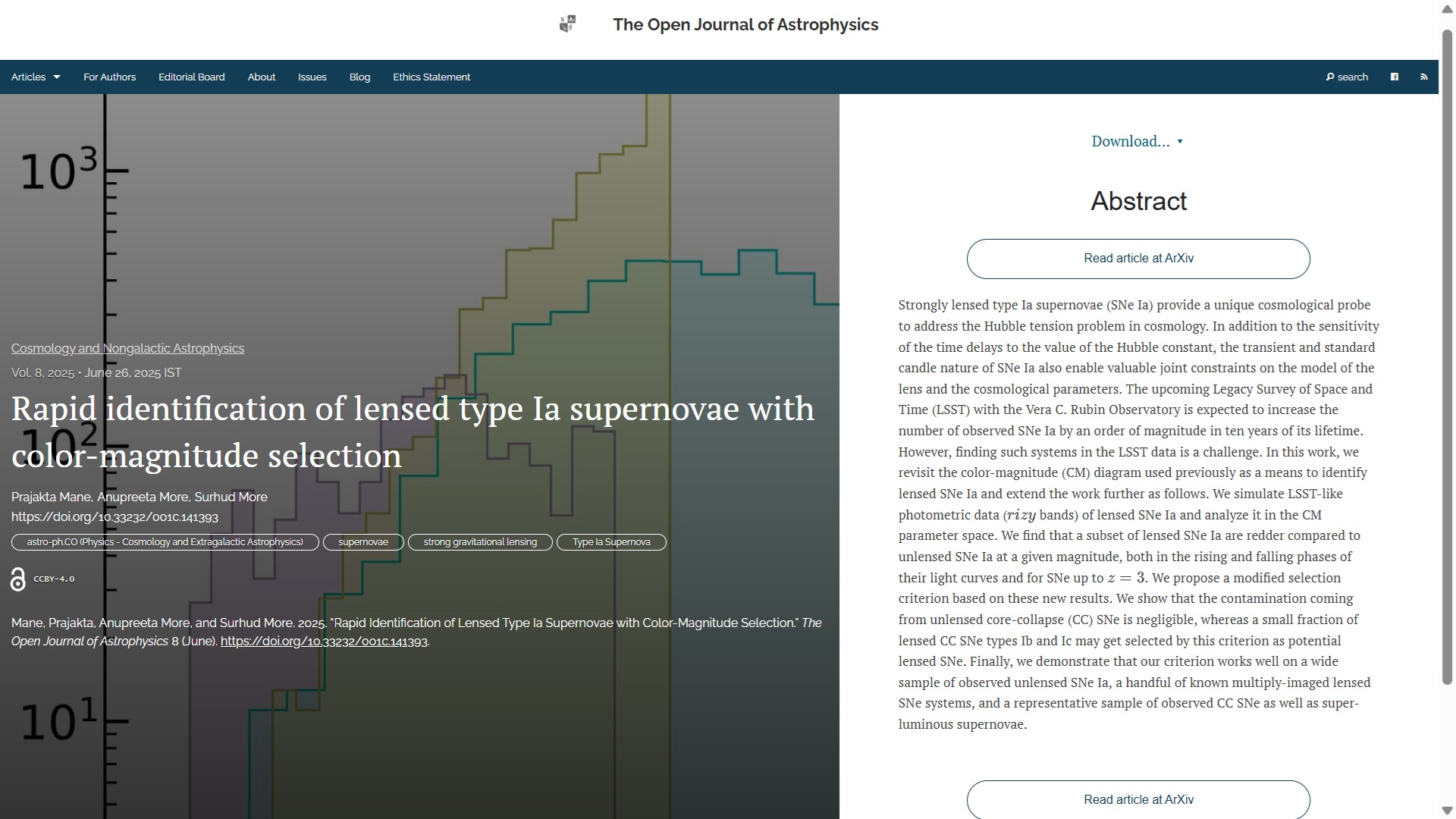
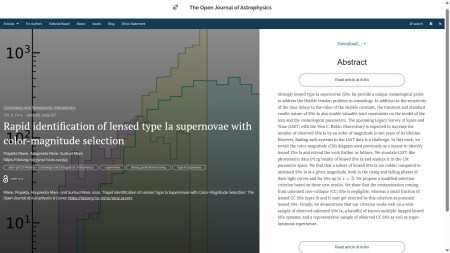
Next we have “Rapid identification of lensed type Ia supernovae with color-magnitude selection” by Prajakta Mane (IISER) and Anupreeta More & Surhud More (IUCAA), all based in India. This paper presents an  extension of the use of color-magnitude diagrams, used previously as a means to identify lensed supernovae, with applications to LSST-like photometric data. It is in the folder marked Astrophysics of Galaxies and was published on Thursday 26th June.
The officially-accepted version of the article can be found on arXiv here.

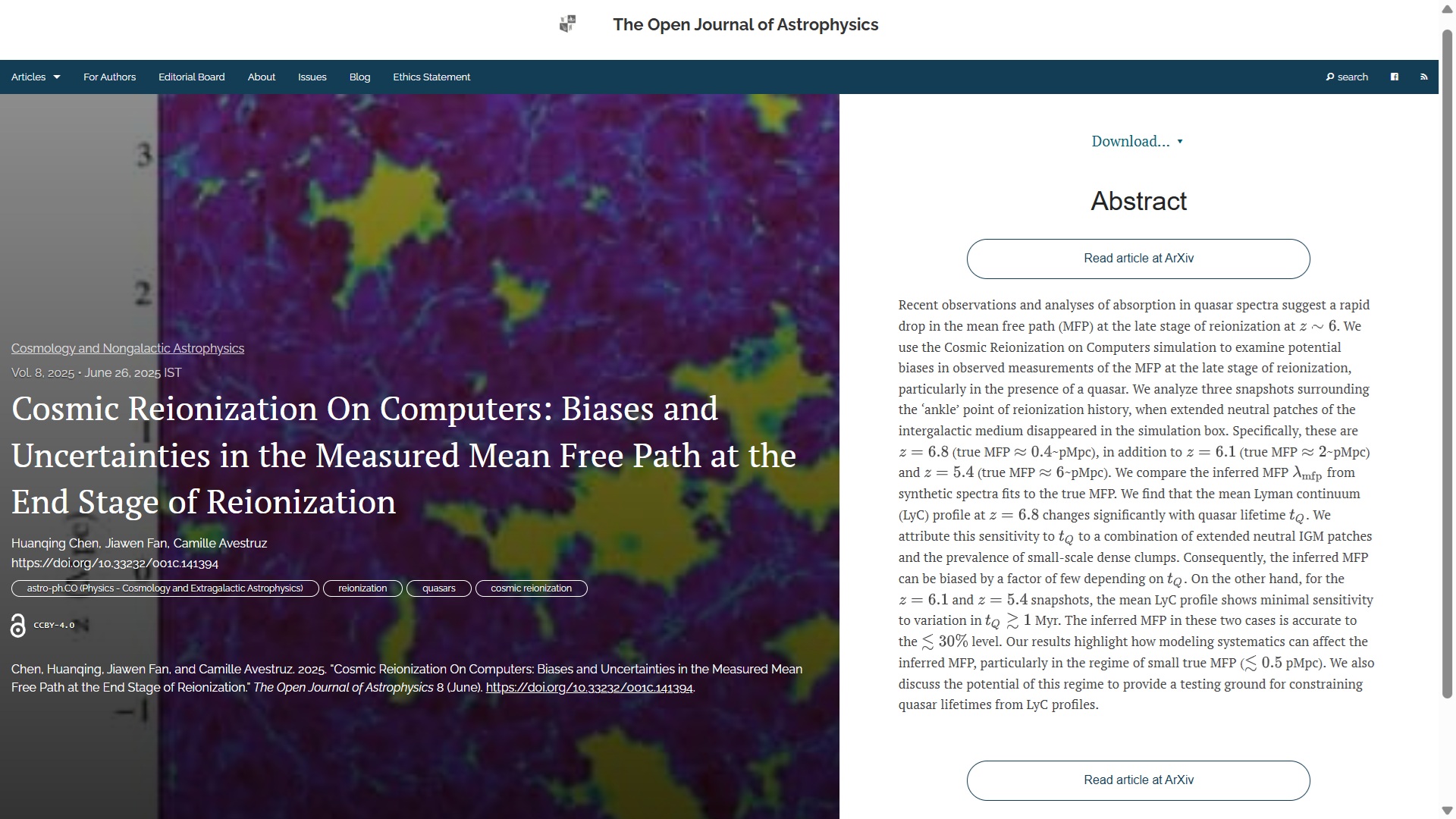
The penultimate article this week is: “Cosmic Reionization On Computers: Biases and Uncertainties in the Measured Mean Free Path at the End Stage of Reionization” by Huanqing Chen (U. Alberta, Canada), and Jiawen Fan & Camille Avestruz (U. Michigan, USA). This one is in the folder Cosmology and Nongalactic Astrophysics and was published on 26th June 2025.  This paper studies possible systematic effects in computer simulations of cosmic reionization especially when it results from quasar radiation.

The overlay is here:

You can find the officially-accepted version on arXiv here.

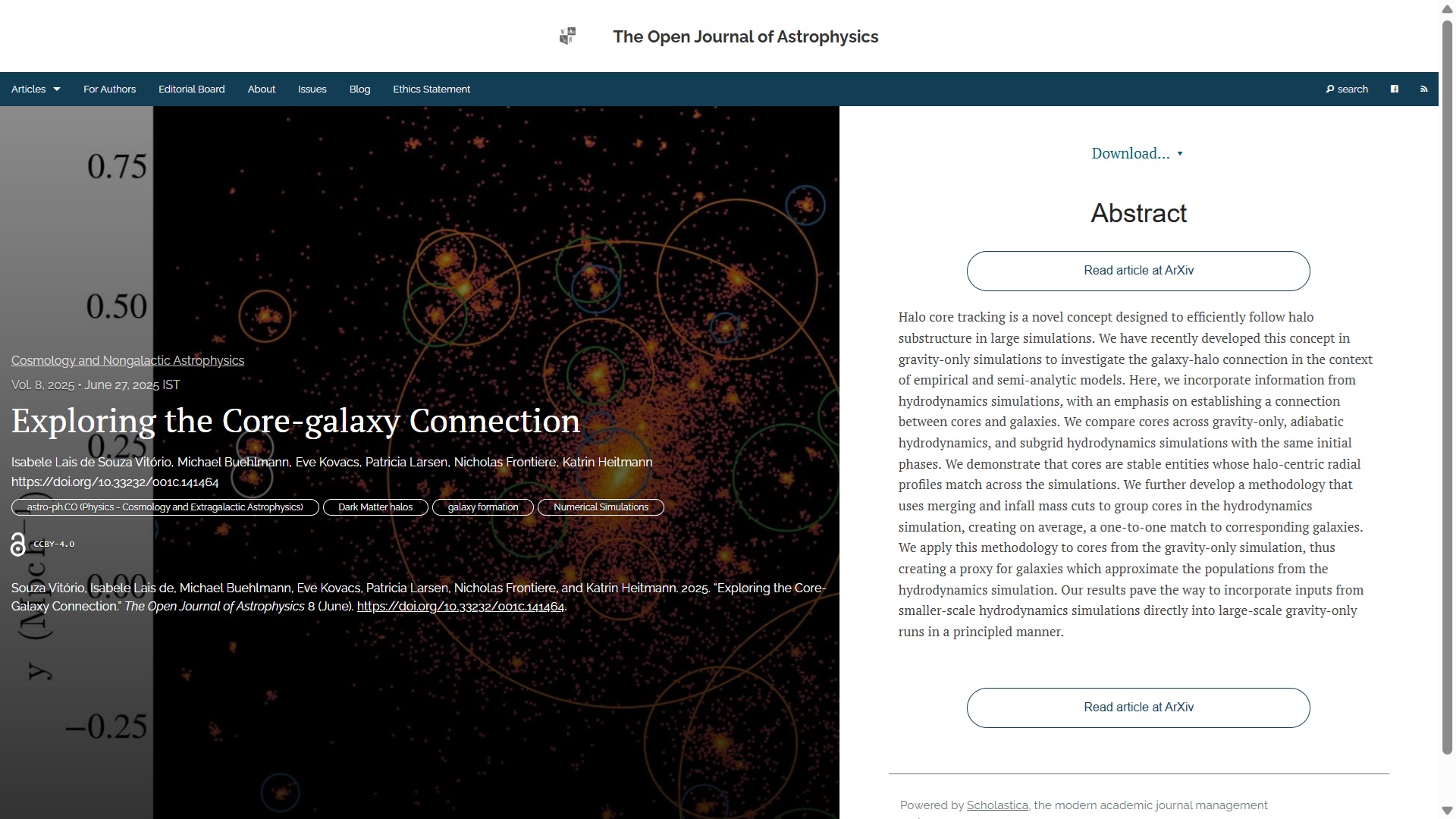
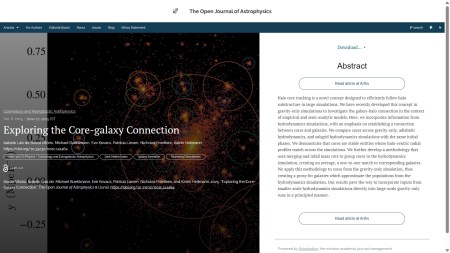
Eighth and last paper this week is “Exploring the Core-galaxy Connection” by Isabele Lais de Souza Vitório (U. Michigan) and Michael Buehlmann, Eve Kovacs, Patricia Larsen, Nicholas Frontiere & Katrin Heitmann (Argonne National Laboratory, USA).  This one is in the folder Cosmology and Nongalactic Astrophysics and was published on Friday 27th June 2025 (i.e. yesterday).

The overlay is here:
 

You can find the officially-accepted version on arXiv here.

And that’s all the papers for this week. I do, however, have some more news to pass on. We are delighted to welcome two new recruits to our Editorial Board,  Dr Foteini Oikonomou of the Norwegian University of Science and Technology, who specializes in the application of particle physics theories to  high-energy astrophysical phenomena, and Dr Heloise Stevance of Oxford University (UK), who specializes in the interface between Machine Learning and Astrophysics.