Star of the Sea, by Joseph O’Connor

Posted in History, Literature with tags , on July 20, 2025 by telescoper

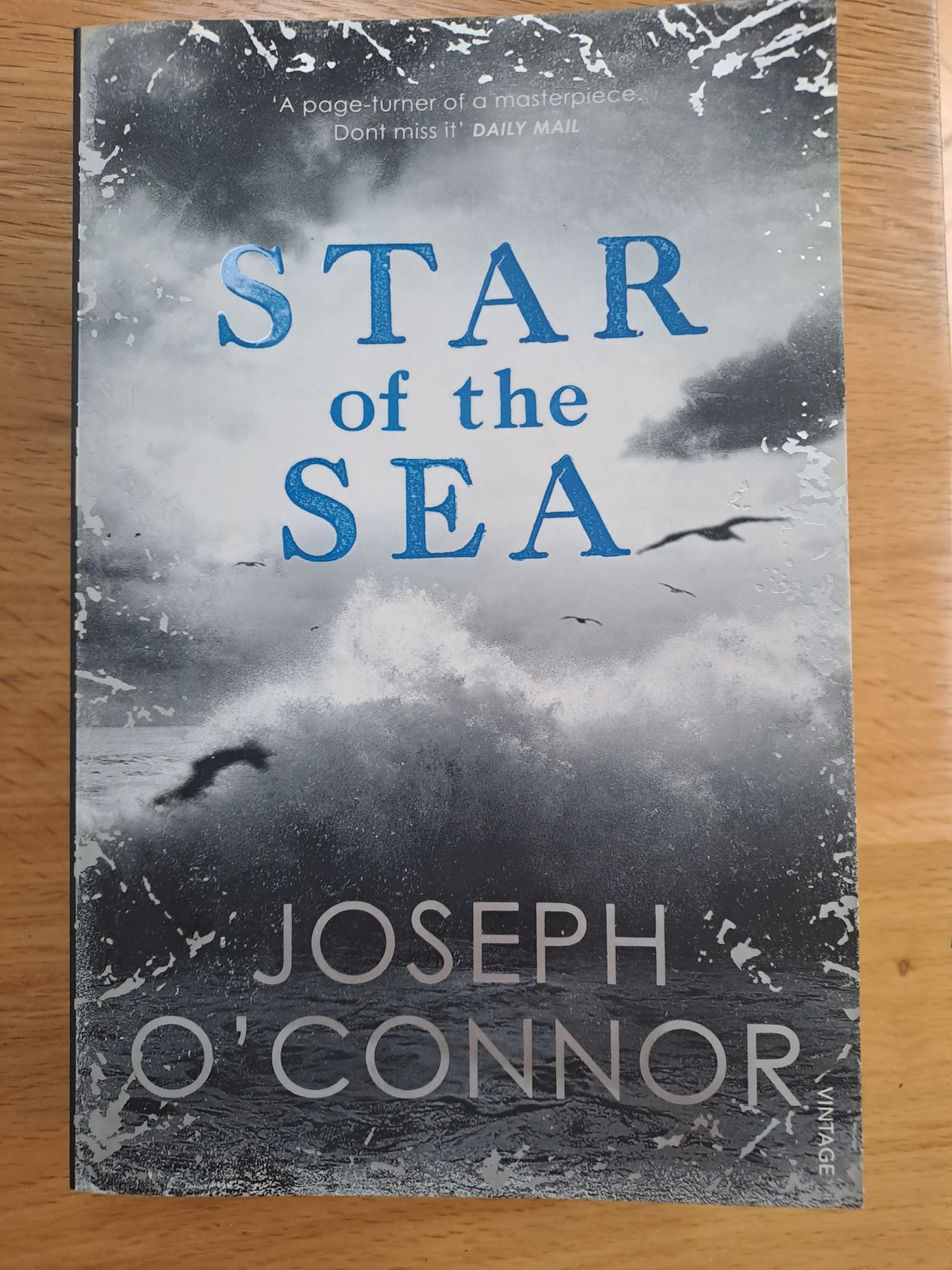
After the excitement of today’s Hurling Final, I finished the second of the six novels I bought earlier this year. Star of the Sea by Joseph O’Connor is set in 1847 and onboard the ship that gives the novel its name, bound for New York from Ireland, carrying desperate passengers fleeing the Great Famine, which provides the overall context for the story.

It’s worth quoting a couple of paragraphs from the author’s introduction to the novel:

We tourists take pleasure in the emptiness of Connemara. There are reasons why such a silence exists. You would not think, as you amble the sleepy lanes, as you are stilled by the twilight descending on the mountain, that you are walking through a space that was once a disaster zone: the Ground Zero, perhaps, of Victorian Europe. These meadows, those pebbled fields, saw astonishing suffering. There was heroism too; there was extraordinary courage and love. But these wine-dark boglands and rutted boreens witnessed tragedy so immense that those that witnessed it, like Grantley Dixon in my novel, would never forget the sight.

All this happened in the 1840s , that decade in which a million of the Irish underclass died as a consequence of famine. residents of the richest kingdom on earth, they lived only a few hundred miles from the empire’s capital, London. But that did not save them; nothing saved them. Abandoned by the dominant of Ireland and Britain, perhaps two million of the desperate became refugees. We might call them `asylum seekers’ or `economic migrants’. They fled their homeland by any means possible, often on ships like the Star of the Sea. Their language, Gaelic, already in decline virtually disappeared overnight. `Mharbh an gorta achanrud‘, one Gaelic speaker remembered. ‘The famine killed everything’.

O’Connor writes unflinchingly about the effects of famine, the poverty, deprivation and starvation, as well as the squalid rqat-infested conditions the `economic migrants’ were forced to endure on their month-long voyage to America. This in itself is interesting, as it has always seemed to me quite surprising that so few Irish authors have written books about An Gorta Mór. But while the Great Hunger is always present, and is what precipitates most of the action, this book is about many other things besides.

The story begins on Star of the Sea with a mysterious character who is taken to walking the decks at night. We learn very early on that his name is Pius Mulvey and his intention is to commit murder. But who is he to kill, and how, and why? The answer to the last of these questions is revealed through a series of flashbacks that reveal connections between him and several passengers in First Class, including a bankrupt Lord Merridith attempting to escape his creditors, Merridith’s wife and family, an aspiring novelist (the Grantley Dixon mentioned above), and a maidservant (Mary Duane) whose connection to them and to Mulvey is deeply tragic. The narrative is interspersed with excerpts from the log of the ship’s Captain, sundry clippings from contemporary newspapers and magazines, including examples of vile anti-Irish racism from the satirical magazine, Punch, and folk songs of the time. It’s all very carefully and cleverly plotted.

It’s partly a mystery novel, partly a suspense thriller, and partly a social commentary worthy of Dickens (who actually appears in the book, in chapters describing Pius Mulvey’s past life in London). It takes a master story-teller to bring all these elements together convincingly, and that is what Joseph O’Connor clearly is. It is not exactly a whodunnit, but I will nevertheless refrain from posting any spoilers as the ending is very clever (as indeed is the whole book). I’ll just say that I found the whole book immensely satisfying and I recommend it highly, as a novel that has real depth as well as being a true page-turner.

Star of the Sea was published in 2002, and was a best-seller then. It’s taken me too long to discover it. I must read more by Joseph O’Connor, but I have four others on my list to finish first!

All-Ireland Senior Hurling Championship Final

Posted in GAA with tags , , on July 20, 2025 by telescoper

As it was foretold, today sees the All-Ireland Senior Hurling Championship Final at Croke Park in Dublin. Unfortunately the weather isn’t great: there’s been quite a lot of rain already today, and the forecast is for more. It’s also extremely humid (93%).

I will however be watching on TV from the comfort of my living room. For those of you in the UK, there is live coverage on BBC2 from 3pm.

This year’s final is between Cork and Tipperary and takes place this afternoon, Sunday 20th July, with the throw-in at 3.30pm. Cork are strong favourites, with bookies quoting odds of 3-1 on (or even shorter). That’s not surprising because they put seven goals past Dublin in their semi-final a couple of weeks ago.

I’ll update this post with the final score (for the files) when it’s all over.

HALF-TIME: Cork 1-16 Tipperary 0-13. A breathless first half with Tipperary playing with just one man up the field and packing the defence to avoid conceding goals, which they did until the very end of the first half when Shane Barrett scored the first. Tipperary actually had the sliotar in the net earlier on, but the goal was disallowed for a square ball: an attacking player cannot be inside the small rectangle (also known as the “6-yard box”) before the ball enters it. Very noticeable that Croke Park is a sea of red – clearly Cork supporters did better at getting tickets!

FULL-TIME: Cork 1-18 Tipperary 3-27. What an amazing turnaround, and a superb second-half performance from Tipperary! Cork completely disintegrated after half-time, scoring only two points in the half to Tipperary’s 23, including three goals (one of them a penalty that also resulted in Cork going down to 14 men). Nothing went right for Cork, who hit the woodwork 4 times even and even missed a penalty, but by then the game was already lost.

Tippperary are the 2025 All-Ireland Senior Hurling Champions!

Weekly Update from the Open Journal of Astrophysics – 19/07/2025

Posted in OJAp Papers, Open Access, The Universe and Stuff with tags , , , , , , , , , , , , , , , , , , , , , , , , , , on July 19, 2025 by telescoper

It’s Saturday morning again, so it’s time again for an update of papers published at the Open Journal of Astrophysics. Since the last update we have published six new papers, which brings the number in Volume 8 (2025) up to 98, and the total so far published by OJAp  up to 333. I expect we’ll pass the century for this year sometime next week.

The papers published this week, with their overlays, are as follows.  You can click on the images of the overlays to make them larger should you wish to do so.

The first paper to report is “Reconstructing Galaxy Cluster Mass Maps using Score-based Generative Modeling” by Alan Hsu (Harvard), Matthew Ho (CMU), Joyce Lin (U. Wisconsin-Madison), Carleen Markey (CMU), Michelle Ntampaka (STScI), Hy Trac (CMU) & Barnabás Póczos (CMU), all based in the USA. This paper was published on 14th July 2025 in the folder Cosmology and NonGalactic Astrophysics. It presents a diffusion-based generativbe AI model for reconstructing density profiles for galaxy clusters from observational data.

The overlay is here:

The officially-accepted version can be found on arXiv here.

The second and third papers are related. They were both published on 14th July in the folder Cosmology and NonGalactic Astrophysics.

The first of the pair is “J-PLUS: Tomographic analysis of galaxy angular density and redshift fluctuations in Data Release 3. Constraints on photo-z errors, linear bias, and peculiar velocities” by Carlos Hernández-Monteagudo (IAC, Tenerife, Spain) and 21 others. This presents an analysis of the Javalambre Photometric Local Universe Survey (J-PLUS) in redshift slices with a discussion of prospects for extracting cosmological information. The overlay is here:


You can find the final version of the manuscript on arXiv here.

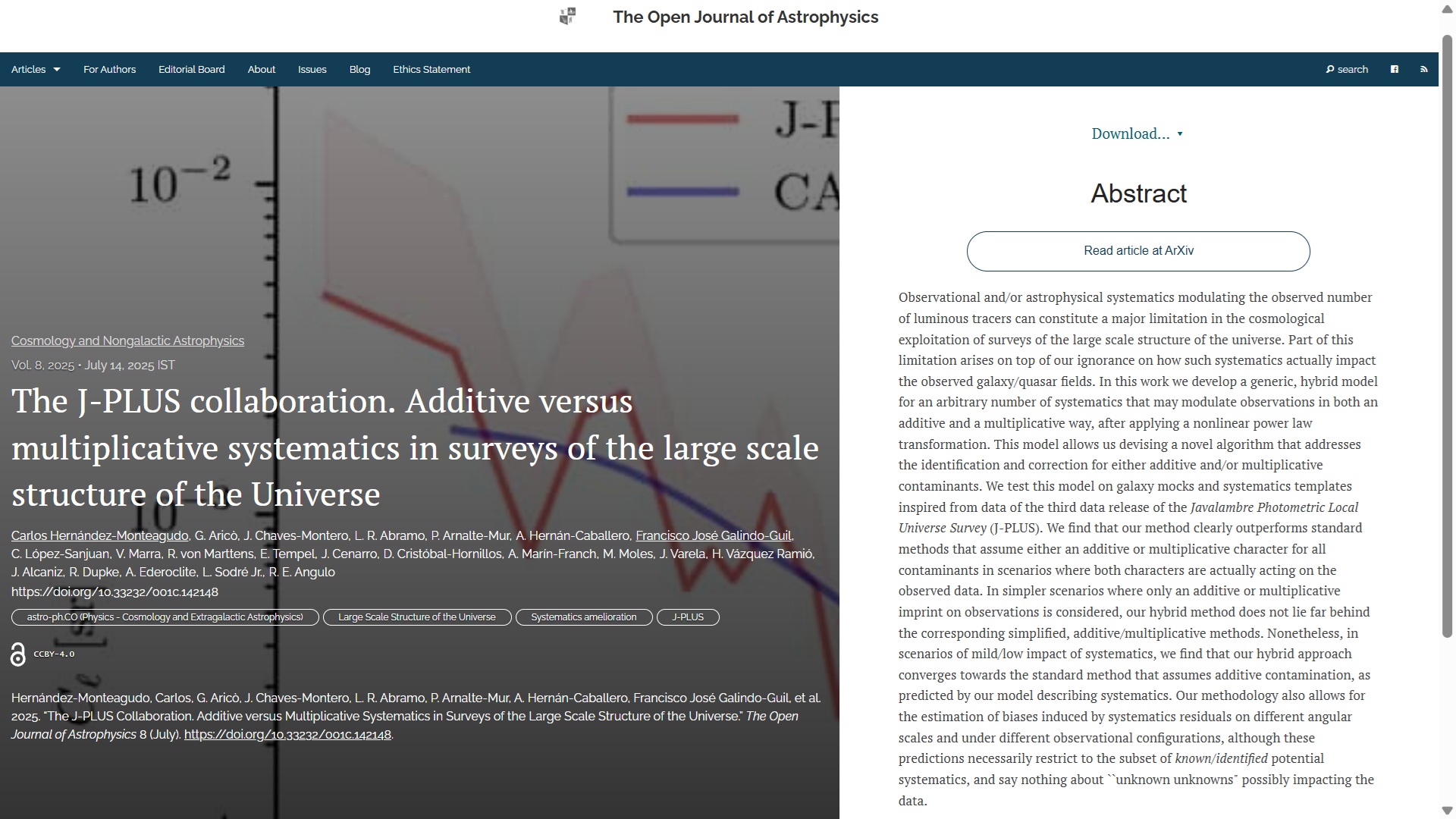
The second of this pair is “The J-PLUS collaboration. Additive versus multiplicative systematics in surveys of the large scale structure of the Universe” by Carlos Hernández-Monteagudo (IAC) and 21 others (the same authors as the previous paper).  This paper presents an analysis of systematic effects in the Javalambre Photometric Local Universe Survey (J-PLUS), and a new model for handling such errors in this and other cosmological surveys. The overlay for this paper is here:

You can find the officially accepted version of this paper on arXiv here.

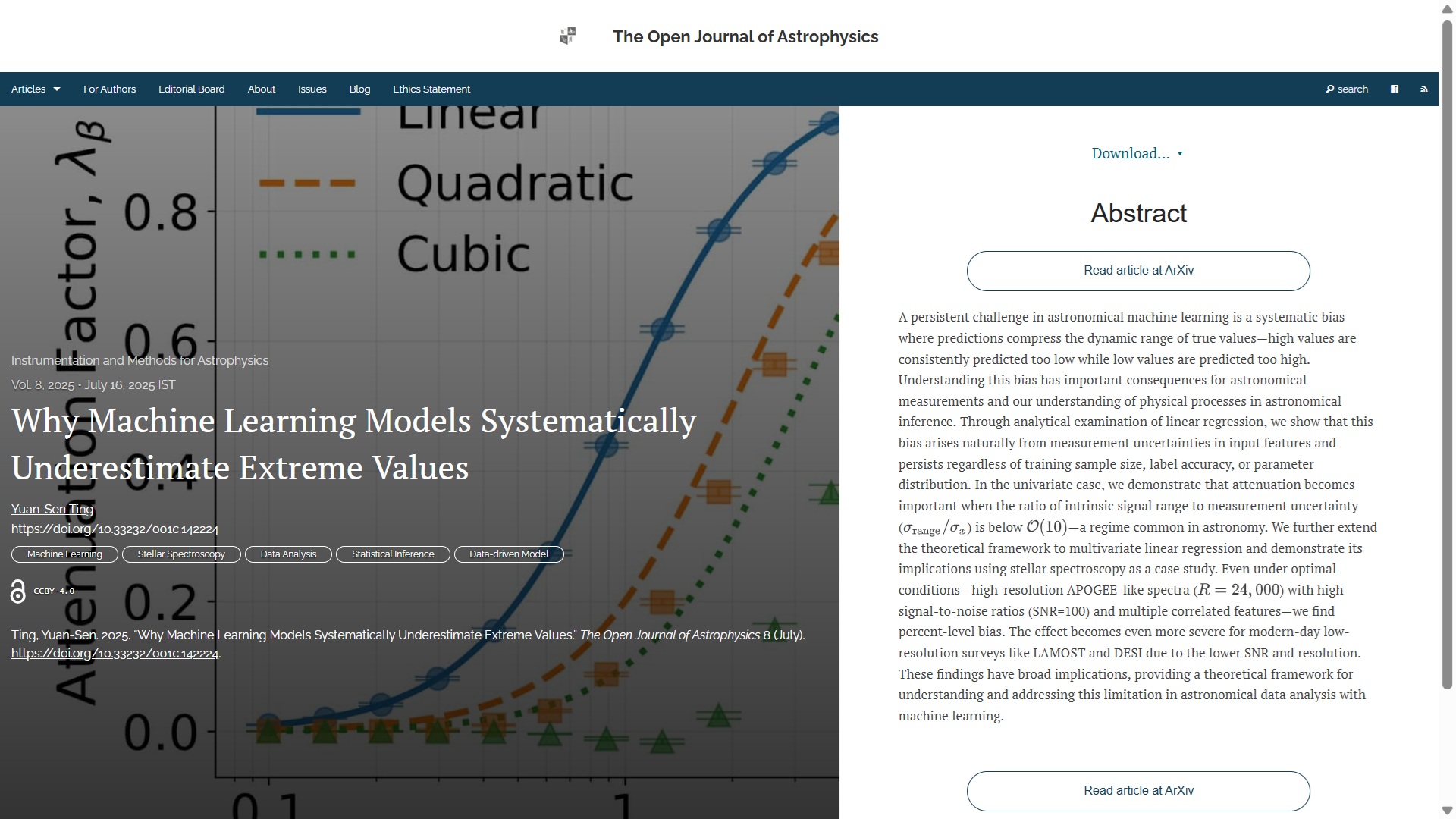
The fourth paper this week is “Why Machine Learning Models Systematically Underestimate Extreme Values” by Yuan-Sen Ting (Ohio State University). This one was published on July 16th in the folder marked Instrumentation and Methods for Astrophysics.  This paper presents a theoretical framework for understanding and addressing a bias that suppresses the dynamic range of variables in applications of machine learning to astronomical data analysis. Here is the overlay:

You can find the officially accepted version of this paper on arXiv here.

The penultimate article for this week is “Bridging Machine Learning and Cosmological Simulations: Using Neural Operators to emulate Chemical Evolution” by Pelle van de Bor, John Brennan & John A. Regan (Maynooth University) and Jonathan Mackey (Dublin Institute for Advanced Studies), all based in Ireland. This paper uses machine learning, in the form of neural operators, to emulate the Grackle method of solving non-equilibrium chemistry equations in cosmological hydrodynamic simulations and was published on 16th July also in the folder Instrumentation and Methods for Astrophysics. The overlay is here:

The final, accepted version of the paper is on arXiv here.

The last article published this week is “Astronomical Cardiology: A Search For Heartbeat Stars Using Gaia and TESS” by Jowen Callahan, D. M. Rowan, C. S. Kochanek and K. Z. Stanek (all of Ohio State University, USA). This paper presents a study of a sample of 112 new spectroscopic binaries called hearbeat stars (because their light curves resemble electrocardiagrams). It was published on 16th July 2025 in the folder marked Solar and Stellar Astrophysics. The overlay is here:

You can find the officially-accepted version on arXiv here.

And that’s all the papers for this week. I’ll do another update next Saturday.

All-Ireland Hurling Final Weekend

Posted in GAA with tags , , on July 18, 2025 by telescoper

Just a quick note, primarily for those of you not in Ireland, to point out that this weekend sees the All-Ireland Senior Hurling Championship Final at Croke Park. There’s always a fantastic atmosphere for this event and I’m looking forward to it enormously. It’s every bit as big as the FA Cup Final used to be when I was a kid.

This year’s final is between Cork and Tipperary and takes place on Sunday 20th July, with the throw-in at 3.30pm.

For those of you in the UK, there is live coverage on BBC2 from 3pm.

Global Talent Ireland

Posted in Maynooth, The Universe and Stuff with tags , , on July 18, 2025 by telescoper

The Government of Ireland has just announced details of a scheme called Global Talent Ireland. Full details of the scheme can be found here but, in a nutshell, the scheme aims to attract exceptional mid-career and established researchers from across the globe to Ireland. Researchers funded through this programme are required to transfer their research activities from their current location to any Eligible Research Body in Ireland. Given its commitment to equality, diversity and inclusion, Research Ireland welcomes applications from women and those from historically underserved communities.

The programme budget includes the resources to build a research team (e.g., staff, consumables and travel) to carry out high-impact, world-class research, and additional start-up costs to support the researcher’s move to Ireland. These positions are available for any area of research supported by Research Ireland.

The programme comprises two streams: Rising Stars and Research Leaders. High level details are outlined in the table below: 

The timescale for this is very short (as the window lies in the vacations for people likely to be recruited). In the case of Maynooth, which I assume is an Eligible Research Body, there is a first-stage internal process for Expressions of Interest to be completed by 29th July (i.e. less than two weeks away). There is then a selection for submissions to be forwarded to the Government by August 28th 2025.

As the timescale is so short I would ask anyone interested in taking up such a position in the Department of Physics at Maynooth University to contact me as soon as possible, as both the Head of Department and Dean of the Faculty of Science and Engineering are away at the moment. Ireland’s recent decision to join CERN as well as membership of the European Southern Observatory and the European Space Agency might be good strategic grounds for an application.

Those interested in other areas of research would be advised to contact the relevant Departments as soon as possible. The selection process is bound to be very competitive, but you can’t win the prize if you don’t buy a ticket!

A Reminder to Vote for Wyn Evans as Chancellor of Cambridge University

Posted in Education, Harassment Bullying etc with tags , , , on July 17, 2025 by telescoper

Here’s a message for Alumni of Cambridge University!

Tomorrow (18th July) is the last day registered electors can vote online for Prof. Wyn Evans as Chancellor of the University. If you’ve registered then please don’t forget to vote! You have until 5pm tomorrow.

Here’s a post outlining the reasons why you should vote for Wyn.

In-person voting in Cambridge has already closed.

The word on the street in Cambridge is that the election will be won by Lord Browne. The Masters of many of the richest Colleges (Trinity, St Johns) have come out in his favour despite his tarnished reputation. The likelihood that the post of Chancellor of the University of Cambridge will be filled by someone so eminently unsuitable has prompted an open letter by academics (any academic can sign, not just Cambridge).

Why anyone would think that Lord Browne is an appropriate choice is completely beyond me. The letter clearly identifies the main reason why he would be a terrible choice; he is one of the key individuals associated with ushering in the present funding regime, which has led to students graduating with huge debts and many UK universities currently facing financial ruin.

Update: Unfortunately, Wyn didn’t win. Lord Browne didn’t either. The new Chancellor of Cambridge University is Chris Smith (currently Master of Pembroke College, Cambridge). It seems the electorate went with the tradition of electing a political has-been.

Classical Fluid Analogies for Schrödinger-Newton Systems

Posted in The Universe and Stuff with tags , , , , on July 16, 2025 by telescoper
Stock viscosity image: Photo by Fernando Serrano on Pexels.com

I thought I’d mention here a paper now on arXiv that I co-wrote with my PhD student Aoibhinn Gallagher. Here is the abstract:

The Schrödinger-Poisson formalism has found a number of applications in cosmology, particularly in describing the growth by gravitational instability of large-scale structure in a universe dominated by ultra-light scalar particles. Here we investigate the extent to which the behaviour of this and the more general case of a Schrödinger-Newton system, can be described in terms of classical fluid concepts such as viscosity and pressure. We also explore whether such systems can be described by a pseudo-Reynolds number as for classical viscous fluids. The conclusion we reach is that this is indeed possible, but with important restrictions to ensure physical consistency.

arXiv:2507.08583

It is based on work that his in her now-completed PhD thesis, along with another paper mentioned here. I have been interested for many years in the Schrödinger-Newton system (or, more specifically, the Schrödinger-Poisson system in the case where self-gravitational forces are involved). In its simplest form this involves a wave-mechanical representation, in the form of an effective Schrödinger equation, of potential flow described classically by an Euler equation. More recently we got interested in the extent to which such an approach could be used to model viscous fluids represented by a Navier-Stokes equation rather than an Euler equation. That was largely because the effective Planck constant that arises in this representation has the same dimensions as kinematic viscosity (but there’s more to it than that).

In the paper we explored a limited aspect of this, by looking at situations where there is no vorticity (so still a potential flow) but there is viscosity. There aren’t many examples of fluid flow in which there is viscosity but no vorticity, and most of those that do exist are about one-dimensional flow along channels or pipes with boundary conditions that don’t really apply to astrophysics, but one example we did look at in detail was the dissipiation of longitudinal waves in such a fluid.

One upshot of this work is that one can indeed describe some aspects of quantum-mechnical fluids such as ultra-light scalar matter in terms of classical fluid properties, such as viscosity, but you have to be careful. For more information, read the paper!

No More CMB-S4…

Posted in The Universe and Stuff with tags , , , , , , on July 15, 2025 by telescoper

There was some sad news for cosmologists last week in that the Government of the United States of America – specifically the National Science Foundation (NSF) and the Department of Energy (DOE) – has cancelled the next generation of ground-based cosmic microwave background experiments, called CMB-S4. This would have been the fourth generation This would have consisted of several dedicated telescopes equipped with highly sensitive superconducting cameras.

The plan was that these telescopes would spend about seven years listening to the microwave sky at two locations already recognized for their suitability: the South Pole, which was to host several telescopes of varying sizes to observe across a wide range of microwave frequencies; and the Atacama Plateau in Chile, a high-desert site which would have hosted two large telescopes that can also observe several different frequencies. The South Pole telescopes were to conduct an ultra-deep survey of 3% of the sky, while the Atacama telescopes would conduct a complementary ultra-wide and deep survey of 70% of the sky. Together, the two sites promised to provide a dramatic leap forward in our understanding of the fundamental nature of space and time and the evolution of the Universe.

Longstanding readers of this blog will remember that in 2014 the BICEP2 experiment at the South Pole was claimed to have detected the B-mode polarization signal that would be a diagnostic of primordial gravitational waves generated during a burst of cosmic inflation. That result was later shown to be dominated by Galactic dust emission which could not be identified from its spectral properties, as BICEP2 operated at only one frequency. With an order of magnitude more detectors than previous ground-based CMB experiments, wider frequency coverage, and better control of systematic errors, CMB-S4 would have reduced the limits on earlier observations by a factor of five, enabling either the direct detection of primordial gravitational waves or ruling out large classes of inflationary models and dramatically impacting current thought on cosmic inflation.

For more technical information about CMB-S4 see the 2021 White Paper here.

Despite its very strong science case, and the fact that it was ranked as second-highest priority in the 2020 Decadal Survey, it seems that CMB-S4 is no more. Sad.

Maynooth University Library Cat Update

Posted in Maynooth with tags , , on July 14, 2025 by telescoper

Though not as warm as it has been over the last few days, today still found Maynooth University Library Cat in need of a siesta. There aren’t many students around these days so he’s not disturbed by so many people wanting to pet him, and was sound asleep in a shady spot when I passed by this afternoon.

Non-Disclosure Agreements in the UK

Posted in Harassment Bullying etc with tags , , , , , , , on July 13, 2025 by telescoper

About a year ago, I posted an item about a change to Employment Law in Ireland that effectively bans the use of Non-Disclosure Agreements (NDAs) in situations involving allegations of discrimination, victimisation, harassment and sexual harassment. When I posted this, the change had not come into force, but it has now. I think this is a very good move.

There aren’t many reasons to praise the current UK Government, but it seems they are proposing something similar, through an Amendment to the Employment Rights Bill, although the change has not yet come into effect and will not do so until the Bill becomes an Act.

The legislation will state that an employer shall not enter an NDA with an employee where the employee has made allegations of discrimination, harassment or sexual harassment. In my experience, NDAs are currently the default in such cases. I know of many examples in the UK where such legal instruments have been used to prevent victims of harassment from speaking publicly about their experiences, thus enabling harassers to move elsewhere without anyone knowing what they had done. This ploy is also seen by Management as a way of preventing reputational damage, although it does not seem to me to be a good way of doing that, as the truth has a way of coming out anyway and the effect of hiding the misconduct when it does causes more reputational damage than the harassment itself.

This reminds me of things I wrote a while ago in connection with a case at Leiden University where the Management decided not to name a professor involved in such a case (who was subsequently identified as Tim de Zeeuw). I thought this was a nonsense, for at least two reasons. The first is that I think people who have behaved in such a way should be named as a matter of principle, so that potential collaborators and future employers know what they have done. In previous posts on this topic I had defended confidentiality (e.g. hereduring an investigation, but I still think that once it has been decided that a disciplinary offences have been committed there should be full disclosure.

The second is that failing to identify the individual concerned led to a proliferation of rumours inside and outside Leiden (none of which I am prepared to repeat here). As a result, the finger of suspicion was pointed at the wrong people until the name of the abusive Professor was revealed. That made for a very difficult working environment for everyone concerned.

Of course the new law, when passed, will only apply to cases in the United Kingdom. In Astronomy, as in many other parts of academia, there is a great deal of international mobility. The new legislation would not prevent someone who has engaged in such misconduct in, for example, The Netherlands, applying for a job in the UK without this coming to light. One could hope that other countries follow suit, but the wheels of the legislature are not known to turn quickly in any country that I know of.

I can sense many Human Resources departments getting very nervous, as the proposed change will render a major component of their modus operandi unlawful. Who knows, it may even encourage them to start tackling the culture of harassment that they have so far been content to hide.

Finally, I think it’s an important question whether or not this legislation is retroactive. If it is, and past NDAs are declared null and void then it will blow open many cases. I can imagine rather a lot of institutions and individuals getting rather nervous at the prospect of their previously concealed misconduct coming out in the open.

P.S. In related news, online voting for the Chancellorship of Cambridge University opened last week. It’s a transferable vote system. I put my first choice for Wyn Evans.