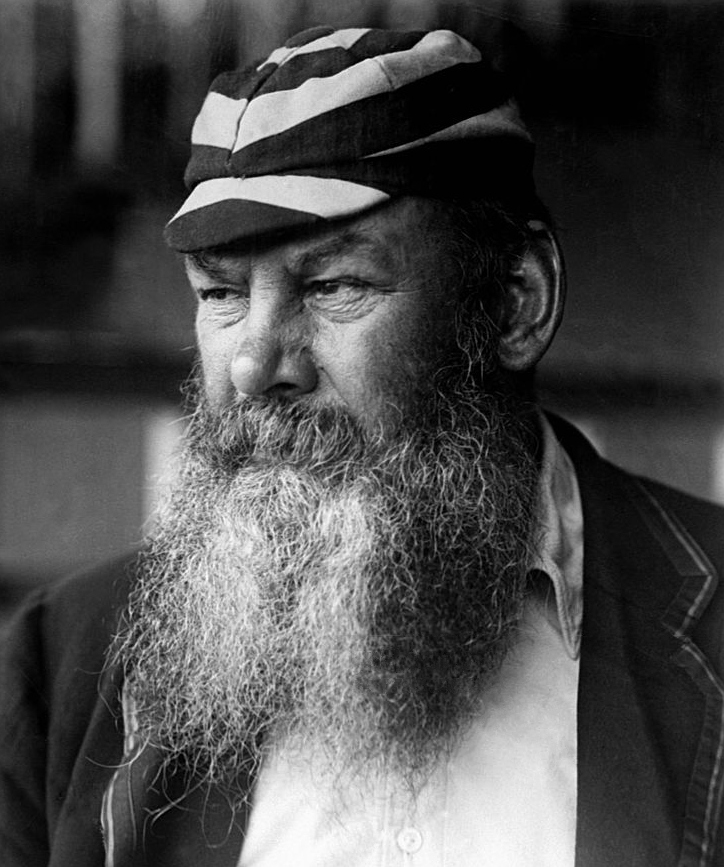
Not a lot of people know that Sir Arthur Conan Doyle, the creator of Sherlock Holmes, was a keen amateur cricketer who played ten first-class matches (for the MCC). He was an occasional bowler who only took one wicket in a first-class game, that of W.G. Grace, which was such a momentous event for him that he wrote this poem about it:
Once in my heyday of cricket, One day I shall ever recall! I captured that glorious wicket, The greatest, the grandest of all.
Before me he stands like a vision, Bearded and burly and brown, A smile of good humoured derision As he waits for the first to come down.
A statue from Thebes or from Knossos, A Hercules shrouded in white, Assyrian bull-like colossus, He stands in his might.
With the beard of a Goth or a Vandal, His bat hanging ready and free, His great hairy hands on the handle, And his menacing eyes upon me.
And I – I had tricks for the rabbits, The feeble of mind or eye, I could see all the duffer’s bad habits And where his ruin might lie.
The capture of such might elate one, But it seemed like one horrible jest That I should serve tosh to the great one, Who had broken the hearts of the best.
Well, here goes! Good Lord, what a rotter! Such a sitter as never was dreamt; It was clay in the hands of the potter, But he tapped it with quiet contempt.
The second was better – a leetle; It was low, but was nearly long-hop; As the housemaid comes down on the beetle So down came the bat with a chop.
He was sizing me up with some wonder, My broken-kneed action and ways; I could see the grim menace from under The striped peak that shaded his gaze.
The third was a gift or it looked it- A foot off the wicket or so; His huge figure swooped as he hooked it, His great body swung to the blow.
Still when my dreams are night-marish, I picture that terrible smite, It was meant for a neighboring parish, Or any place out of sight.
But – yes, there’s a but to the story – The blade swished a trifle too low; Oh wonder, and vision of glory! It was up like a shaft from a bow.
Up, up like a towering game bird, Up, up to a speck in the blue, And then coming down like the same bird, Dead straight on the line that it flew.
Good Lord, it was mine! Such a soarer Would call for a safe pair of hands; None safer than Derbyshire Storer, And there, face uplifted, he stands
Wicket keep Storer, the knowing, Wary and steady of nerve, Watching it falling and growing Marking the pace and curve.
I stood with my two eyes fixed on it, Paralysed, helpless, inert; There was ‘plunk’ as the gloves shut upon it, And he cuddled it up to his shirt.
Out – beyond question or wrangle! Homeward he lurched to his lunch! His bat was tucked up at an angle, His great shoulders curved to a hunch.
Walking he rumbled and grumbled, Scolding himself and not me; One glove was off, and he fumbled, Twisting the other hand free
Did I give Storer the credit The thanks he so splendidly earned? It was mere empty talk if I said it, For Grace had already returned.
I didn’t remember until late last night that yesterday was the 60th anniversary of the release, on 17th August 1959, of the classic jazz album Kind of Blue by a band led by trumpeter Miles Davis featuring John Coltrane (ts), Cannonball Adderley (as), Bill Evans (p, replaced by Wynton Kelly on one track), Paul Chambers (b) and Jimmy Cobb on drums. I bought the album on vinyl way back in the 1970s when I was still at school and have listened to it probably thousands of times since then. It still sounds fresh and exciting sixty years after its first release. But you don’t have to listen to me, you can listen to the whole album here:
When it first appeared, Kind of Blue seemed to represent all that Miles Davis stood for from a musical point of view, with its modal and scalar themes and such passages as the fourth section of Flamenco Sketches which hints at a Spanish influence. Whether the actual performances were typical of the way this band sounded live is less clear, but there’s no question that the album has worn so well as to be now universally regarded as a timeless masterpiece.
So why is it such an important album?
I can only speak for myself, of course, but I’d say a big part of this was that the music is on the cusp of the evolution of modern jazz. It’s music from a time of transition, pointing the way forward to exciting developments while also acknowledging past traditions. You only have to look at the various directions Miles Davis, John Coltrane and Bill Evans explored after this album to see what I mean.
A few words about each of the tracks:
The opening number So What? established the practice of constructing themes based on scales instead of chords. After an introduction that keeps you guessing for a while, it turns out to be a straightforward 32-bar melody with a simple modulation serving as the bridge. At a medium tempo, the pure-toned and rather spare solo by Miles Davis provides a delicious contracts with the flurry of notes produced by Coltrane, who also plays between the beats. It might be just my imagination but the rhythm section seems to tighten up behind him, only to relax again with Cannonball Adderley’s more laid-back, bluesy approach.
The next track is All Blues, which is in a gentle 6/8 time. I discovered by accident a while ago this composition found its way onto the GCSE Music syllabus. In fact there’s a recording of the track, produced and distributed as “set work” for that purpose:
As an aside, I should mention that I never took any qualifications in music at School – although I did get music lessons, I didn’t find them at all inspiring and it took me years to develop a taste for anything other than Jazz, which I knew about mainly from home, because my father was a (part-time) Jazz drummer. There wasn’t much mention of Jazz at School from teachers, and none of my friends were into it, so it became a very private passion, although I’m glad to say it never faded.
Anyway, what little I know about music I picked up by studying on my own, and trying to figure out what was going on by listening to records. All Blues is a really interesting composition to unpick in this way, as it tells you a lot about how Jazz was evolving in the late 1950s (it was released in 1959). Musicians like Miles Davis were experimenting with ways of breaking away from the standard approach to Jazz improvisation based on chord progressions, and one of the routes that developed was modal Jazz. All Blues is particularly interesting because it teeters on the edge between the old approach and the new; it’s clearly based on the traditional 12-bar blues progression but diverges from it in several respects.
A standard blues progression in G might go like this (although there are many variations):
|G|G|G|G|
|C|C|G|G|
|D|C|G|G|
It’s based on just three chords: the tonic (in this case G): the sub-dominant IV (C) and the dominant V (D); the V-IV-I progression in the last four bars is usually called the turnaround.
While the addition of a major 7th note to the basic triad G isn’t unusual, the two G minor 7th chords are more interesting, because they involve adding a blue note (a flattened third) to the basic chord . But it’s in the last four bars that the harmonies move dramatically away from the standard turnaround. Chromatic chords are included and the usual resolution back to G is subtly changed by the addition of a 6th note (E) to the basic G chord (GBD) at the end; that trick became a bit of a trademark for Jazz of this period.
However, it’s the two F chords that represent the strongest connection with modal harmony. The scale of G major involves F-sharp, so the F is a flattened note (a flattened VIIth). In fact, all the Fs in the piece are natural rather than sharp. For this reason you could argue that this is a piece not played in the key of G major but in the corresponding Mixolydian mode (the white notes on the piano from G to G).
So it’s a blues that’s not quite a blues, but is (appropriately enough) Kind of Blue. There’s so much going on harmonically that the fact that it’s played in 6/8 rhythm (rather than the more usual 4/4 for the Blues) seems almost irrelevant.
Those are just the bare bones, but the improvisations of Miles Davis, Bill Evans, Cannonball Adderley and John Coltrane et al breathe life into them and create a living Jazz masterpiece. Although it seems like a complicated tune, apparently what happened at the recording session was that Miles Davis talked the band through the piece, they played it once to get a feel for it, and then recorded the entire track that was released on the album in one go.
On Freddie Freeloader , Bill Evans was replaced with Wynton Kelly. I suppose that Miles Davis thought that Kelly would be more convincing on this relatively straight-ahead blues, and his crisp, direct opening solo suggests that Miles was probably right. Miles Davis’s solo that follows is superbly structured in terms of timing and dynamics. Coltrane plays more-or-less entirely in double-time and then Adderley enjoys himself hugely in a good-humoured final solo.
Blue in Green, which was mainly written by Bill Evans, is based on a ten-bar melody featuring an eloquent solo Miles on muted trumpet and some sensitive playing by Coltrane and Evans. The same mood prevails in the following track.
Flamenco Sketches involves a series of solos each improvised on a set of five scales; it’s the fourth section that hints at the Spanish influence alluded to in the title. The tempo is very slow, which contributes the air of solemnity as does the absolute perfection of the solos. In that respect it has clear parallels with some of Duke Ellington’s work. Miles Davis, who opens and closes the track on muted trumpet, and Bill Evans on piano are absolutely faultless but I particularly enjoy John Coltrane’s playing on tenor saxophone: his tone is as bleak and austere as an Arctic sunrise, and just as wonderful and he conjures up an absolutely beautiful improvised melody.
Kind of Blue isn’t merely an artistic highlight for Miles Davis, it’s an album that towers above its peers, a record generally considered as the definitive jazz album, a universally acknowledged standard of excellence. Why does Kind of Blue posses such a mystique? Perhaps because this music never flaunts its genius… It’s the pinnacle of modal jazz — tonality and solos build from the overall key, not chord changes, giving the music a subtly shifting quality… It may be a stretch to say that if you don’t like Kind of Blue, you don’t like jazz — but it’s hard to imagine it as anything other than a cornerstone of any jazz collection.
People sometimes ask me why I post about music on here. The answer has two parts and they’re both simple. One is that I enjoy writing about music because it gives me the opportunity to explore my own thoughts about why I like it so much. The other reason is to share something I love very much, in the hope that other people might find as much joy from the music I love. For example, if just one person listens to Kind of Blue for the first time as a result of reading this piece, then it will definitely be worth the 40 minutes it took me to write!
Apparently today, August 17th, is Black Cat Appreciation Day, so I couldn’t resist acknowledging the contributions of Maynooth University Library Cat who I think is largely responsible for increase in the number of students coming to this University.
Unfortunately he hasn’t been appreciating the rainy weather over the past few days..
Well I’ve had a busy week here in Maynooth marking and checking repeat examinations (just finished this morning) during which from time to time I’ve been keeping an eye on things to do with students admissions for the forthcoming year, both here and in other institutions across Ireland. Universities and students received their Leaving Certificate results earlier in the week, but institutions then had a couple of days to decide on the basis of course capacity and the results obtained which students would receive offers of a place on which courses. This is usually expressed in terms of a points total: the more popular the course, and the better the results for applicants to that course, the higher the points required would be. Yesterday first-round offers went out from CAO across the country – there’s a summary in the Irish Times. Students who don’t get an offer from their first choice course can try in subsequent rounds to get a place at another institute.
As of yesterday afternoon, Maynooth University is expecting to admit 3,225 new first year students this year. This is the largest ever intake for the university and represents an increase of 3% from last year. This growth reflects a strong demand for places: more than 4,200 students chose Maynooth University as their first preference, an increase of 7% from last year (which I mentioned earlier this year).
At the moment it looks like being a particularly good year for our BSc Course in Theoretical Physics and Mathematics, but I’d rather wait until the process is over and numbers are confirmed before commenting further.
Anyway, as the CAO process is ongoing, I thought I’d include this little video about what Maynooth has to offer undergraduate students with particular emphasis on the flexibility of its programmes whether they be in Arts & Humanities or Sciences. I wrote about the advantages of the `Omnibus Science’ programme here. If you are reading this and didn’t happen to get the points for your first-choice course then you could do a lot worse than consider Maynooth!
I’ve always been a not-so-secret admirer of American songwriter and record producer Burt Bacharach, but when someone told me the other day that there’s an album called Blue Note Plays Burt Bacharach I assumed it was a wind up because Blue Note Records has for many years been an uncompromising voice at the cutting edge of modern jazz rather than the lighter and more popular form of music exemplified by Mr B.
There’s no reason why two forms of excellence can’t exist together, however, and the album is definitely real and is a very nice compilation of Bacharach numbers from Blue Note albums featuring various musicians over the years. Here’s an example featuring Stanley Turrentine on tenor sax, with McCoy Tyner on piano, Bob Cranshaw on bass and Micky Roker on drums. The tune is What The World Needs Now Is Love. Doesn’t it just?
I saw a news item last night that revealed the grade boundaries for some of this year’s A-level examinations in the United Kingdom. Among the surprises were that for one board an A-grade in Mathematics corresponded to a mark of 55% and an A-grade in Physics was 59%. I’m sure I’m not the only one to find these results a bit disturbing.
The explanation given for these figures is basically that there’s a new style of A-level examination this year and the boundaries were adjusted so as not to penalize the current set of students with respect to previous years. In other words, students did much worse than expected on the new examinations so the grade boundaries were lowered.
Most assessments of academic performance such as A-levels can be classified into two broad types: criterion-referenced and norm-referenced. In the former performance is measured relative to defined goals, whereas in the latter it is defined relative to the performance of others taking the same test.
University assessments in the UK and Ireland (especially in the sciences) are usually criterion-based, meaning that the % score (and hence the grade) is determined by comparing the marks with a pre-prepared marking scheme based on the expected learning outcomes of the course. It is possible for all students taking an examination to get A-grades if they all meet the criteria. On a norm-referenced system one allocates the grades based on the distribution of scores and not on the absolute level of performance attained. In reality when marking examinations under a criterion-based system, one has a bit of discretion in how to award partial credit when a question is not done completely, so this is a bit of a simplification but those are the two approaches in a nutshell.
Some universities allow marks for a component of assessment to be scaled up (for example if there is a problem with an examination paper), which has the same effect as lowering the grade boundary, but this does not usually apply to the entire mark. Some universities don’t allow scaling at all in any circumstances.
In the universities with which I am familiar, an A-grade (corresponding to First-class performance) is fixed at a mark >70%, a B (2.1) is 60-69%, a C (2.2) is 50-59%, and so on. The pass mark at undergraduate level is 40%; it might be 50% at Masters level.
This is why the figure of 55% being an A-grade at mathematics comes as a such a shock to university-based academics: that score would be in the middle of the lower-second class range in a university examination.
This episode demonstrates one of the serious issues with A-levels as preparation for university entrance. On the one hand, especially in the sciences, we want students to be equipped with certain basic skills and knowledge to enable them to cope with their course. That calls for a criterion-based system of assessment. On the other hand, in any one year, the `top’ universities want to recruit the `top’ students (in many cases because they want to have a high position the league tables because their entry tariff is high). It’s hardly surprising that the system is dysfunctional when it is being pulled in two mutually incompatible directions.
The upshot of this year’s mathematics and physics A-levels is that universities that take in students with an A-grade in Mathematics -can’t really have much confidence in what they have learned. To make matters worse, the grade boundaries differ from one Examination Board to the next. It’s a mess. At least here in Ireland there is a truly national examination system: there is a single Leaving Certificate examination in each subject that all students take.
While I am on about A-levels I’ll just mention another disadvantage that they have compared to the Leaving Certificate (and, for that matter, the International Baccalaureate) which is that they force students to choose a very narrow post-16 curriculum. Most students take three A-levels (not counting the useless `General Studies’) which for science students often means three science subjects (e.g. Maths, Physics & Chemistry). In the Leaving Certificate students take six or seven subjects and in the IB they take six. I’ve been in Ireland for less than two years so I’m not so familiar with the system here, but my experience with the IB over about 30 years in UK higher education, is that students are certainly no less prepared for university study if they took that than if they did A-levels.
There is currently a major review of the Irish Leaving Certificate going on. One of the things that surprises me about Ireland is that, despite its hard-won independence from the United Kingdom, it has a tendency to copy slavishly many of the silly things that the UK introduces, especially in higher education. I sincerely hope that the review of the Leaving Certificate does not fall into the trap of making it more like A-levels.
I couldn’t resist sharing this remarkable video about the rendezvous and subsequent landing of the European Space Agency’s Rosetta spacecraft on the comet Churyumov-Gerasimenko 67P. You can find a few posts I did about this at the time (2014) here. Here’s one of the memorable from one of those posts:
Anyway, after the end of the mission, in 2017, the European Space Agency released over 400,000 images from Rosetta, based on which Christian Stangl and Wolfgang Stangl worked together to create this short film. The sequences are digitally-enhanced versions of real pictures taken by the Rosetta Probe and they’re stunning!
This is a lengthy but important post about the recent episodes of harassment at Caltech centred around Christian Ott. I’ve blogged in relation to this myself a few times; see here. It’s not a comfortable read, which is precisely why you should read it.
One of the worst things about the way institutions handle investigations into harassment and related disciplinary matters is that the system does not include any provisions to bring closure to the victims. Indeed, victims are sometimes not even informed as to the outcome of the investigation.
You can make your own mind up about the behaviour of Caltech as an institution. All I’ll say is that far more people were affected than I was previously aware of.
Caltech astrophysics and harassment: Lessons learned
Casey Handmer 2019
What is this?
In the wake of major catastrophes, it is common practice for organizations to publish a “Lessons Learned” report to help prevent future occurrences. The largest public catastrophe in which I’ve ever been involved occurred in the Caltech astrophysics department between 2010 and 2019. Former Caltech professor and internationally disgraced astrophysicist Christian Ott harmed, harassed, and abused numerous students, postdocs, and research fellows. Despite thousands of hours of investigation, no public “findings” or “lessons learned” report has ever been made available. This document is my attempt to fill this need.
Why?
It has been historically conventional to conceal this sort of institutional malpractice, with the effect that the hard-learned lessons are forgotten and that harassment, particularly of underrepresented minorities, is still common. The intent of this document is to undermine the traditional assumption that abused students will graduate or…
I was reminded by Twitter just now that today is the 100th birthday of Margaret Burbidge, who was born on August 12th 1919. Happy Birthday Margaret!
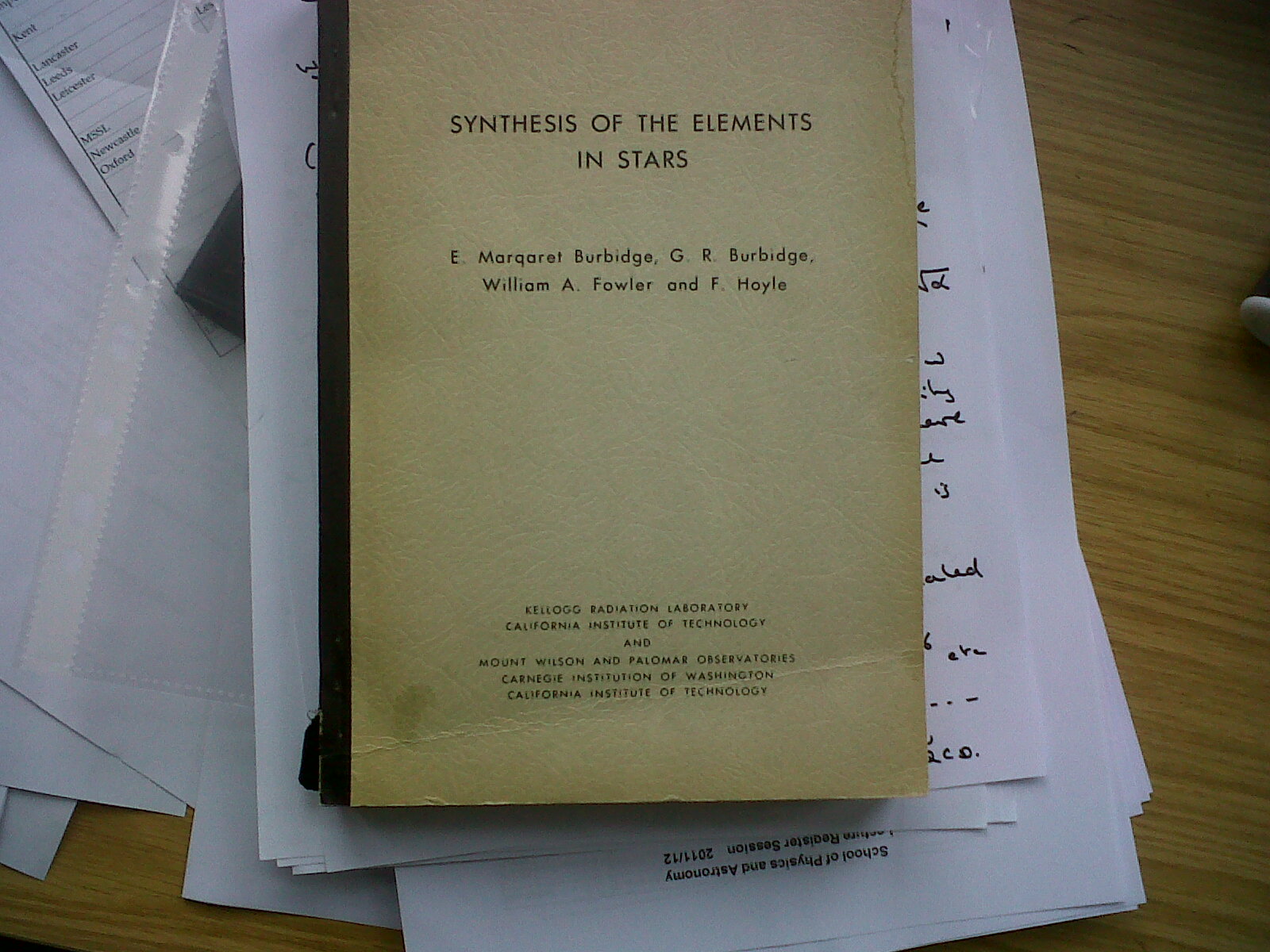
This anniversary of her birth gives me an excuse to mention the classic work of Burbidge, Burbidge, Fowler and Hoyle in 1957 (a paper usually referred to as B2FH after the initials of its authors). It’s such an important contribution, in fact, that it has its own wikipedia page. One of the interesting astronomical things I’ve acquired over the years is a preprint of the B2FH paper. Younger readers will probably not realize that preprints were not always produced in the electronic form they are today. We all used to make large numbers of these and post them at great expense to (potentially) interested colleagues before publication in order to get comments. In the age of the internet people don’t really bother to make hard copies of preprints for distribution any more.
Anyway, here’s a snap of it.
It’s a hefty piece of work, and an important piece of astronomical history. One thing I’ve never done, however, is check whether the preprint differs significantly from the published version..
Well, the wait is almost over. Tomorrow is the day that students in Ireland get their Leaving Certificate results. Tomorrow’s date is Tuesday 13th August, so I hope that’s not a bad omen! A couple of days later this week, on Thursday, UK students get their A-level results.
Here in Ireland, University admissions are dealt with through the Central Applications Office (CAO) which, for UK readers, is roughly equivalent to UCAS. Earlier this year we heard Maynooth University received its highest-ever number of first_preference applications, which is a very positive sign, but we don’t know yet exactly how many of those actually made the grade needed to start here next month.
As is the case in the UK with A-level results, Irish institutions receive the Leaving Certificate results a bit before the students do, which means that on both sides of the Irish sea higher education institutions will be very busy sorting through their applications to see who has made it onto what course. This is a very stressful time for all concerned, not only the prospective students but also the university staff involved in processing the results and academics wondering how many students they will have to teach next year.
From time to time one hears suggestions that the system could be made much fairer and less stressful if students could remove some of the uncertainty by applying to university after getting their Leaving Cert (or A-level) results rather than, as is the case now, before. UPDATE: here’s a piece in the Guardian by Angela Rayner arguing this.
The problem is that there are only two ways that I can see to achieve this:
have the final school examinations earlier;
start the university academic year later.
The unavoidable consequence of the first option would be the removal of large quantities of material from the syllabus so the exams could be held several months earlier, which would be a disaster in terms of preparing students for university.
The second option would mean starting the academic year in, say, January instead of late Septembe. This would in my opinion be preferable to 1, but would still be difficult because it would interfere with all the other things a university does as well as teaching, especially research. The summer recess (July-September), wherein much research is currently done, could be changed to an autumn one (October-December) but there would be a great deal of resistance, especially from the older establishments; I can’t see Oxbridge being willing to abandon its definitions of teaching term! And what would the students do between July and January?
The views presented here are personal and not necessarily those of my employer (or anyone else for that matter).
Feel free to comment on any of the posts on this blog but comments may be moderated; anonymous comments and any considered by me to be vexatious and/or abusive and/or defamatory will not be accepted. I do not necessarily endorse, support, sanction, encourage, verify or agree with the opinions or statements of any information or other content in the comments on this site and do not in any way guarantee their accuracy or reliability.