Bax, Vaughan Williams & Potter at the NCH.

Posted in Music with tags , , , , , , , , on October 13, 2018 by telescoper

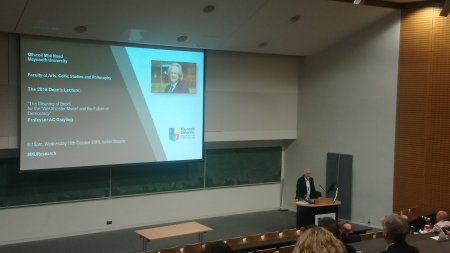
Last night I was once again at the National Concert Hall in Dublin for a concert by the RTÉ National Symphony Orchestra, this time conducted by Kenneth Montgomery. I took the above picture about five minutes before the start of the concert and, although a few more people arrived before the music began, it was a very low attendance. I don’t think the hall was more than 20% full. I’m not sure why. Perhaps Storm Callum made it difficult for some to make the journey to Dublin? I was delayed a bit on the way there from Maynooth, but I’m glad I made it because it was a fine concert.

I always appreciate it when unfamiliar works are programmed alongside more standard repertoire, and last night provided a good example of that. One piece was an established favourite among concert-goers, another I have on CD but have never heard live, and one I had never heard before at all.

The opening piece was In Memoriam by Arnold Bax. Although considered by many to be an archetypal English composer, Bax had a strong affinity for Ireland and indeed lived here from 1911 until the outbreak of war in 1914. I’ve always felt Bax’s music was greatly influenced by Sibelius, but he was very interested in Celtic culture and that comes across in his In Memoriam, which is built around a very folk-like melody. The work was composed to honour Pádraig Pearse, one of the leaders of the 1916 uprising, who was subsequently executed by the British authorities, and was written in the immediate aftermath of the rebellion in 1916. It is a very fine piece, in my opinion, starting in a rather elegiac mood, but with passages that celebrate of Pearce’s life than mourn his death, and the ending is very moving, like a beautiful sunset.

There was then a short delay while various rearrangements were made on stage. Off went the wind instruments and percussion, and into the space vacated by their departure moved a subset of the string instruments, creating a second (smaller) string orchestra separated from the remaining musicians. In addition, the principals of the relevant sections arranged themselves to form a string quartet around the conductor’s podium. If you didn’t know before reading this what was about to be played, then that description will no doubt have led you to conclude that it must be the Fantasia on a Theme by Thomas Tallis by Ralph Vaughan Williams. This is an evergreen concert piece, for good reason, and the string players of the RTÉ National Symphony Orchestra delivered a very fine account of it. I remarked on the fine playing of the string section after the last concert I attended at the NCH, and they did it again.

After the interval was a piece I had never heard before, the Sinfonia “De Profundis” by Belfast-born A.J. `Archie’ Potter, composed fifty years ago in 1968, and first performed in 1969 by the RTÉ National Symphony Orchestra in Dublin. The title is a reference to Psalm 130, and some of the thematic material comes from liturgical music. In the composer’s own words:

As the title suggests, it is a musical account of one man’s own progress from despair over a particular circumstance in his life to spiritual recovery and (for the time being of course) triumph over the powers of darkness.

Although `a journey from darkness into light’ is a description that could apply to many symphonies (especially those of Beethoven), this work in five movements does not have a typically `symphonic’ structure in that it is based on variations on a theme drawn from a 16th century carol spread throughout the whole work rather than confined to one movement, alongside another element comprising a `tone row’. The juxtaposition of `traditional’ diatonic and `modernist’ serialist explorations generates tension which is only released at the very end, when it is released by the arrival of a new theme borrowed from the `Old 124th’.

That brief description of what is going on in this work doesn’t do justice at all to the impression it creates on the listener, which is of a richly varied set of textures sometimes mournful but sometimes boisterous, with dashes of robust humour thrown in for good measure. I’m not at all familiar with A.J. Potter, but I must hear more of his music. Based on this piece, he was both clever and expressive.

As a bonus we had an orchestral encore in the form of another piece by Archie Potter, much shorter and much lighter. Orchestral encores are rare in the UK, but seem to be less so here in Ireland.

After that I left in order to return to Maynooth. Appropriately enough, in the light of the piece by Bax, I took a train from Pearse station…

Vector Calculus Weather

Posted in mathematics, The Universe and Stuff with tags , , on October 12, 2018 by telescoper

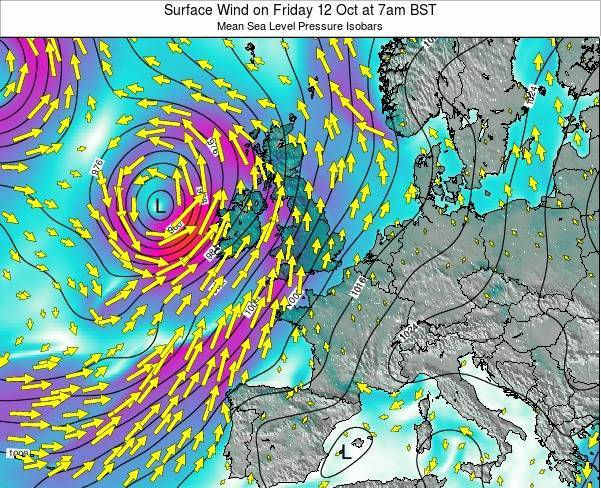
As it happens I did a lecture today about vector fields as part of my module on vector calculus. Whenever I did similar lectures in the past I used the day’s weather map as an illustration, so this morning I downloaded what turned out to be a particularly dramatic example. The curl of the velocity field around the weather system off the west coast of Ireland this morning was definitely non-zero…

Storm Callum turned out to be not as damaging as feared. Apparently it was rather windy in Maynooth overnight, but I slept right through it.

Hubble Problems

Posted in Cute Problems, The Universe and Stuff with tags , on October 12, 2018 by telescoper

Here I am, only connecting again.

Almost every day I get a spam message from a certain person who thinks he can determine the Hubble constant from first principles using  biblical references. The preceding link takes you to an ebook. I was thinking of buying it, but at 99c* I considered it prohibitively expensive.

*I am informed that it has now gone up to £1.30.

My correspondent also alleges that in writing this blog I am doing the Devil’s work. That may be the case, of course, but I can’t help thinking that there must be more effective ways for him to get his work done. Either that or he’s remarkably unambitious.

Anyway, to satisfy my correspondent here is one for the problems folder:

Using  the information provided in Isaiah Chapter 40 verse 22, show that the value of the Hubble constant is precisely 70.98047 km s-1 Mpc-1.

You may quote the relevant biblical verse without proof. In the King James version it reads:

40.22. It is he that sitteth upon the circle of the earth, and the inhabitants thereof are as grasshoppers; that stretcheth out the heavens as a curtain, and spreadeth them out as a tent to dwell in.

By the way, please note that the inverse of the Hubble constant has dimensions of time, not distance.

Answers into my spam folder please (via the comments box).


While I am on the subject of Hubble, I will mention the news that the Hubble Space Telescope is having a few technical problems as a result of a failure of one of its gyros. In fact a few days ago it went into `safe mode’ to help engineers diagnose and fix the problem, during which time no observations are being taken. I’m told by people who know about such things that the spacecraft can actually operate on only one gyro if necessary, using information from other systems for attitude control, so this problem is not going to be terminal, but it will slow down the pointing quite a bit thus make it less efficient. With a bit of luck HST will be back in operation soon.


Moon Child – Pharaoh Sanders

Posted in Jazz, The Universe and Stuff with tags , , , , on October 11, 2018 by telescoper

Following the advice of novelist E.M. Forster to `only connect’, I thought I’d do just that by only connecting  two bits of news. The first is that legendary saxophonist Pharaoh Sanders is playing at the National Concert Hall in Dublin next month and the second is that astronomers have been discussing whether or not a moon can have a moon and, if it can, whether it should be called a moonmoon or a submoon or something else. Well, I think such an object should be called a Moon Child, after the album by Pharaoh Sanders from which this is the title track. With a link like that, I’m sure it’s only a matter of time before I get offered a job as a radio presenter!

Dean’s Lecture – Prof. AC Grayling

Posted in Politics with tags , , on October 11, 2018 by telescoper

Just a quick note to mention that yesterday evening I attended the annual Dean’s Lecture in the Faculty of Arts, Celtic Studies and Philosophy at Maynooth University. This year it was delivered by the renowned philosopher Professor A.C .Grayling and was on the subject of The Meaning of Brexit for the ‘Westminster Model’ and the Future of Democracy. It was a fascinating talk, that involved a historical survey of the development of Parliamentary democracy in the UK (and elsewhere) in the light of the ongoing Brexit fiasco, ending with the case for a `People’s Vote’ as the only likely way out of the current impasse.

You can find a longer review of the lecture by a fellow Maynooth blogger here.

It was also pleasant to have the chance to have a brief chat with the speaker over a glass of wine at a reception after the lecture. Professor Grayling seems a very nice chap! I just wish I shared his optimism. I hope I’m proved wrong, but I fear that things are going to get very nasty in Britain very soon.

World Mental Health Day

Posted in Maynooth, Mental Health with tags on October 10, 2018 by telescoper

image

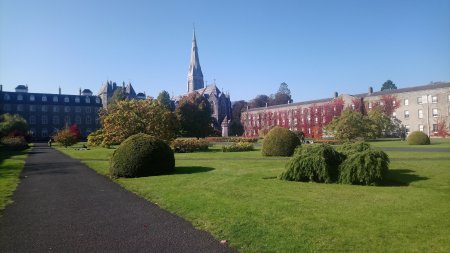
Today is World Mental Health Day 2018, so I’m going to treat myself to lunch in the splendid surroundings of Pugin Hall and then take a walk around the campus in the autumn sunshine. That is all.

UPDATE: That was nice. It’s actually rather warm today – 20°C – and St Joseph’s Square is looking very bonny.

The Leinster Disaster

Posted in History with tags , , , , on October 10, 2018 by telescoper

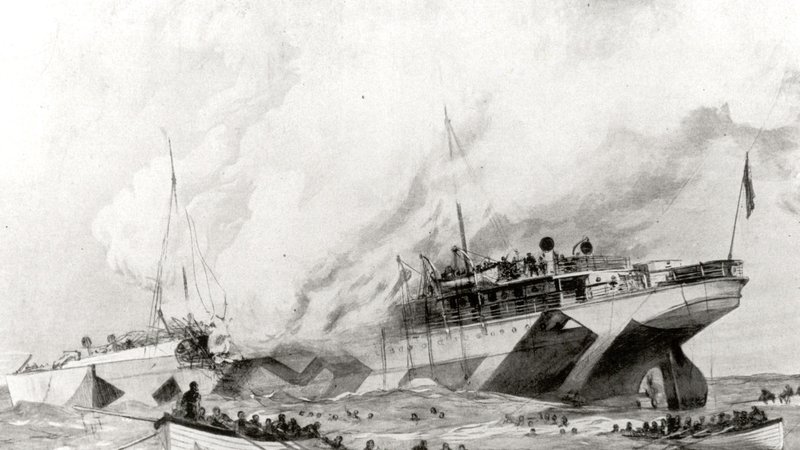
The radio news this morning reminded me that  solemn commemorations were taking place today to mark the centenary of the greatest maritime disaster ever to occur in the Irish Sea.


A little before 9am on 10th October, the Leinster serving as the Royal Mail Ship RMS Leinster, set out from Dún Laoghaire (then named Kingstown), which is about 8 miles south of Dublin, en route to Holyhead, with an estimated 771 people on board. About an hour into her journey, a few miles from the Kish Lighthouse, the Leinster was struck by three torpedoes from German submarine UB-123 and sank. At least 500 people lost their lives in this disaster, and some estimates put the death toll as high as 591. It wasn’t particularly cold that day but the Irish Sea was still rough after a storm had passed through. The survivors of the sinking were largely those who made it into lifeboats, but many of the people who had to attempt to cling to floating wreckage could not hold on until help arrived and were drowned.

To complete this horrible illustration of the tragedy of war, nine days later on 19th October 1918, the U-boat UB-123 struck a mine in the North Sea and went down with all hands.

You can read a fuller account of the Leinster disaster here.

The Open Journal Launch Event

Posted in Maynooth with tags , , , , on October 9, 2018 by telescoper

Tuesday afternoons are usually quite busy for me, with teaching sessions from 12-2 and 3-4 this term, but today turned into almost four consecutive hours of activity as I gave a talk on Open Science at a lunchtime event as part of Maynooth University’s Library `Publication Festival’ which, in turn, is part of `Research Week’. I talked about Open Science generally from the point of view of astrophysics for a bit, but the main purpose of the event was to launch the Open Journal of Astrophysics which also marks the debut of Maynooth Academic Publishing as an OA publisher. Fortunately I’d managed to get everything up and running before the talk so I was able to show the assembled throng the actual journal with actual papers.

Anyway, here are my slides if you’re interested.

P.S. The gentleman at the left of the picture is Professor Philip Nolan, the President of Maynooth University, who launched today’s event.

P.P.S. I’d like to point out that I did not mock the UK Prime Minister Theresa May by dancing at the podium prior to my presentation.


The Open Journal is Open for Submissions Again!

Posted in Open Access, The Universe and Stuff with tags , , on October 8, 2018 by telescoper

I have now finished moving the Open Journal of Astrophysics onto the new Scholastica platform, and it is now open again for submissions! It has taken a lot longer to get to this point than I thought it would when I first proposed the Open Journal of Astrophysics way back in 2012 but better late than never!

Full instructions for authors can be found here. It is there that you will find the `submit’ button shown above, which will take you to a form through which you can upload your paper. All you need to do is upload a few details and the arXiv ID of your paper and we’ll take it from there.

The membership of the Editorial Board is listed here.

The papers published so far can be found here.

Oh, and there’s a blog that will include topical posts about matters astrophysical here.

In a nutshell, any paper that’s suitable for the astro-ph section of the arXiv can be submitted to the Open Journal of Astrophysics. We will consider any `traditional’ papers as well as others which may find it difficult to publish in other journals, such as papers on astrophysics education and outreach, or technical papers relating to instrumentation, mission proposals, and other documents.

Well, that’s about it. I just remains for me to thank all the people without whom this project would never have got off the ground, chiefly Chris Lintott, Arfon Smith and Adam Becker, developers Stuart Lynn and Marc Rohloff, Fiona Morley and the team at Maynooth University Library, and of course the good folk of the wonderful arXiv!

Kenneth Williams does Thermocouples

Posted in Television, The Universe and Stuff with tags , , , on October 7, 2018 by telescoper

Not a lot of people know that the late and very great Kenneth Williams appeared as a guest presenter on the popular and long-running BBC science and technology television programme Tomorrow’s World. This sort of presenting was not really his thing at all – Williams hated working with props of any kind, for example – but he’s word perfect on the script and manages to put his own very distinctive personality into this piece. Why aren’t all science programmes as fabulous as this?

For much of its existence, Tomorrow’s World was broadcast live to air, often immediately after a brief (and sometimes disastrous) tech rehearsal with the gadgets. With his vast experience of live performances in revue, I don’t think that have bothered Kenneth Williams very much. I almost wish that something had gone badly wrong, as he would not doubt have improvised in characteristically hilarious fashion. His familiarity with film and TV work enabled him to use the camera very effectively. He’s certainly very camp, but also very obviously very professional.

Here is a clip from the programme, first broadcast on January 2nd 1981. Enjoy!