Peripheral Visions

Posted in Biographical, Mental Health with tags , , on May 29, 2018 by telescoper

A few days ago I came across the following video, and I thought I’d share it here for two reasons. The first reason is that you might find it surprising, possibly amusing and possibly also bit scary. Keep your eye on the cross in the centre of the screen and observe what happens to the faces either side:

Most people who I’ve shown this to report peculiar distortions of the (familiar) faces either side. This phenomenon is clearly related to the limitations of peripheral vision.

The second reason for posting this is much more personal and relates to my struggles over the years with a form of panic disorder (which I’ve blogged about before, e.g.,  here). The term `panic disorder’ has a very broad definition, so that different individuals experience different forms of panic attacks and they can also take very different forms for the same individual. For me, a “typical” panic episode begins with a  generalised feeling of apprehension or dread. Sometimes that’s as far as it goes. However, more often, there follows a period of increasingly heightened awareness of things moving  in my peripheral vision that I can’t keep track of,  accompanied by auditory and visual hallucinations.  I’ve tried to explain the latter in conversations with friends and colleagues and usually when I do so I describe how the faces of people around me become distorted in a grotesque and terrifying way. When that happens I usually run as fast as I can in whatever direction I can to get away.

On top of the effect of these attacks themselves, there is also the frustration, when they are over, of not really understanding what had happened. What is happening in my brain when a panic episode begins? What is going on with my peripheral vision when it goes awry like it does? Why do some particular places  or circumstances trigger an attack but other, apparently similar, ones don’t?

When I first saw the above video it struck me immediately that it might contain a big clue about these episodes, as the facial distortions that appear there are very similar to what I experience.  Perhaps what goes wrong is that peripheral vision takes over from central vision, i.e. a kind of opposite of tunnel vision,  as a result of some malfunction in the way my brain deals with peripheral data.

Most of the time we just discard data from outside our line-of-sight unless it’s something extremely dramatic and disturbing (whether good or bad); presumably we can’t process everything across our entire field of view so we usually filter out observations coming from the edges. What seems to happen with me is that something interferes with this filtering process so that almost everything gets flagged with a danger signal. My response to these is to look about manically trying to establish whether the threat is real before, usually, just getting out of there as quickly as I can when it becomes overwhelming.

Obviously, this isn’t a complete  answer to any of the many questions I’ve asked myself about this but somehow seeing the effect in the video makes me feel more comfortable with what happens because at least I can see that others can experience a similar phenomenon, even if in very different circumstances.

P.S.  I should say that although about two years ago I quit the medication I was taking to control them, I haven’t had any of these psychotic episodes since then. Reducing stress by leaving my job at Sussex was almost certainly a contributing factor.


Irish Quantum Foundations

Posted in The Universe and Stuff with tags , , , on May 28, 2018 by telescoper

I flew back from Cardiff to Dublin this morning in order to attend a conference called Irish Quantum Foundations which is taking place today and tomorrow on the All Hallow’s Campus of Dublin City University, in Drumcondra (Dublin). I usually take the Hopper bus directly to Maynooth from Dublin Airport but today involved a different journey, via the ordinary No. 16 Dublin Bus.Anyway, I got here on time.

I’m speaking just after lunch so I’m not sure how much time I will have to blog about the meeting, but I couldn’t resist posting this little video related to a talk by Emmanuel Fort which demonstrates a purely classical form of wave-particle duality:

I’ll post further comments about talks if and when I get the time!

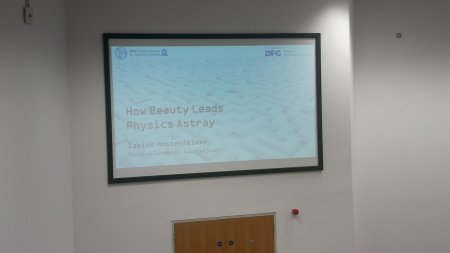
Evening update: two public talks, the first being by renowned physicist and blogger, Sabine Hossenfelder:

The talk ended with a plug for Sabine’s book, which is out soon.

After a short break we had a second public lecture by Nobel Physics Laureate (2016), Duncan Haldane.

The Lord’s Day

Posted in Cricket on May 27, 2018 by telescoper

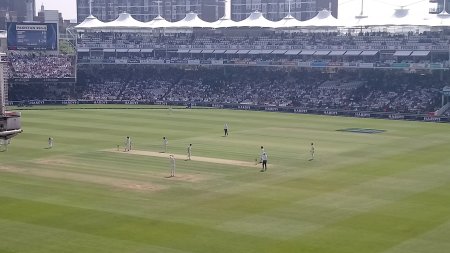
Yesterday I travelled to London (on a very slow train, diverted because of engineering work) in order to watch the third day’s play of the First Test between England and Pakistan at Lord’s.

The above picture was taken from my seat on the top level of the recently refurbished Warner Stand, looking towards the Mound Stand.

Pakistan were well on top going into the third day, having dismissed England for just 184 in their first innings. They started Day 3 on 350 for 8 and added just 13 to their overnight score before Mohammad Abbas was out, at which point the innings closed; Babar Azam had retired hurt the previous day, struck on the arm, and was unable to resume.

England came out to vat, and their performance mirrored the first innings – wickets fell to a mixture of good deliveries and poor shots. Bairstow, for example, was bowled by a beautiful delivery from Amir that nipped back off the seam and Stoneman got one from the legspinner Shadab Khan that turned and kept low. Stokes on the other hand played a weak shot to a nothing ball and was caught at short midwicket.

When Root was out for 68, with the score on 110 for 6, an innings defeat looked inevitable but there then followed a fine century partnership between Jos Buttler and Debutant spinner Dom Bess. I don’t rate Buttler as a Test player and his selection (as a batsman to play at No. 7) was an admission that the higher order was likely to fail, which of course it did. However to give credit where it is due he and Bess played very well, taking England to 235 for 6, adding 125 between them, avoiding an innings defeat and giving England a lead of 56.

It was a good performance from the 7th wicket pair, but England would need at least another 100 runs to have any chance of winning.

England’s batting frailties and later recovery notwithstanding, it was a fine performance in the field from Pakistan who I thought were very impressive.

On Day 4 the England batting collapsed as it had in the first innings: the last four wickets fell for just 7 runs, leaving Pakistan a target 64 to win, which they duly rattled off on less than an hour for the loss of just one wicket.

Well played Pakistan, and congratulations on a thoroughly well deserved victory!

England’s poor performance against this Pakistan team certainly puts that of Ireland a couple of weeks ago into perspective!

Yes!

Posted in Uncategorized on May 26, 2018 by telescoper

It’s a yes in the referendum to repeal the 8th amendment – by a landslide!

Congratulations to everyone who campaigned so hard for a ‘yes’ vote!

The margin of the result (about 2:1 in favour of Repeal) confounds the opinion polls which suggested a much closer result. It seems to me that what happened was that most of the ‘Don’t Knows’ in those poll actually went with ‘Yes’.

Student access to marked examination scripts

Posted in Cardiff, Education, Maynooth with tags , , , on May 25, 2018 by telescoper

I’m currently waiting for the last couple of scripts from my Physics of the Early Universe examination to arrive so I can begin the task of marking them. The examination was yesterday morning, and it’s now Friday afternoon, so I don’t know why it takes so long for the scripts to find their way to the examiner, especially when marking is on such a tight schedule. I’m away next week (in Ireland) so if I don’t get papers by this afternoon they won’t be marked until I return. The missing two are from students sitting in alternative venues, but I don’t see why that means they take over 24 hours  to get to the marker.

(By the way,  `script’ refers to what the student writes (usually in a special answer book), as opposed to the `paper’ which is the list of questions to be answered or problems to be solved in the script.)

Anyway, while I’m waiting for the missing scripts to arrive I thought I’d mention that here in the School of Physics & Astronomy at Cardiff University we have a system whereby students can get access to their marked examination scripts.  This access is limited, and for the purpose of getting feedback on where they went wrong, not for trying to argue for extra marks. The students can’t take the scripts away, nor can they make a copy, but the can take notes which will hopefully help them in future assessments. There’s a similar provision in place in the Department of Theoretical Physics at Maynooth University, where I will be relocating full-time in July, based around a so-called `Consultation Day’.

When I was Head of the School of Mathematical and Physical Sciences at Sussex University I tried to introduce such a system there, but it was met with some resistance from staff who thought this would not only cause a big increase in workload and but also lead to  difficulties with students demanding their marks be increased. That has never been the experience here at Cardiff: only a handful take up the opportunity and those that do are told quite clearly that the mark cannot be changed.  Last year I had only one student who asked to go through their script. I was happy to oblige and we had a friendly and (I think) productive meeting.

If I had my way we would actually give all students their marked examination scripts back as a matter of routine. The fact that we don’t is no doubt one reason for relatively poor performance in student satisfaction surveys about assessment and feedback. Obviously examination scripts have to go through a pretty strict quality assurance process involving the whole paraphernalia of examination boards (including external examiners), so the scripts can’t be given back immediately but once that process is complete there doesn’t seem to me any reason why we shouldn’t give their work, together with any feedback written on it,  back to the students in its entirety.

I have heard some people argue that under the provisions of the Data Protection Act students have a legal right to see what’s written on the scripts – as that constitutes part of their student record – but that’s not my point here. My point is purely educational, based on the benefit to the student’s learning experience.

Anyway, I don’t know how widespread the practice is of giving examination scripts back to students so let me conduct a totally unscientific poll. Obviously most of my readers are in physics and astronomy, but I invite anyone in any academic discipline to vote:

And, of course, if you have any further comments to make please feel free to make them through the box below!


Thirty Years since Section 28..

Posted in History, Politics with tags , , on May 24, 2018 by telescoper

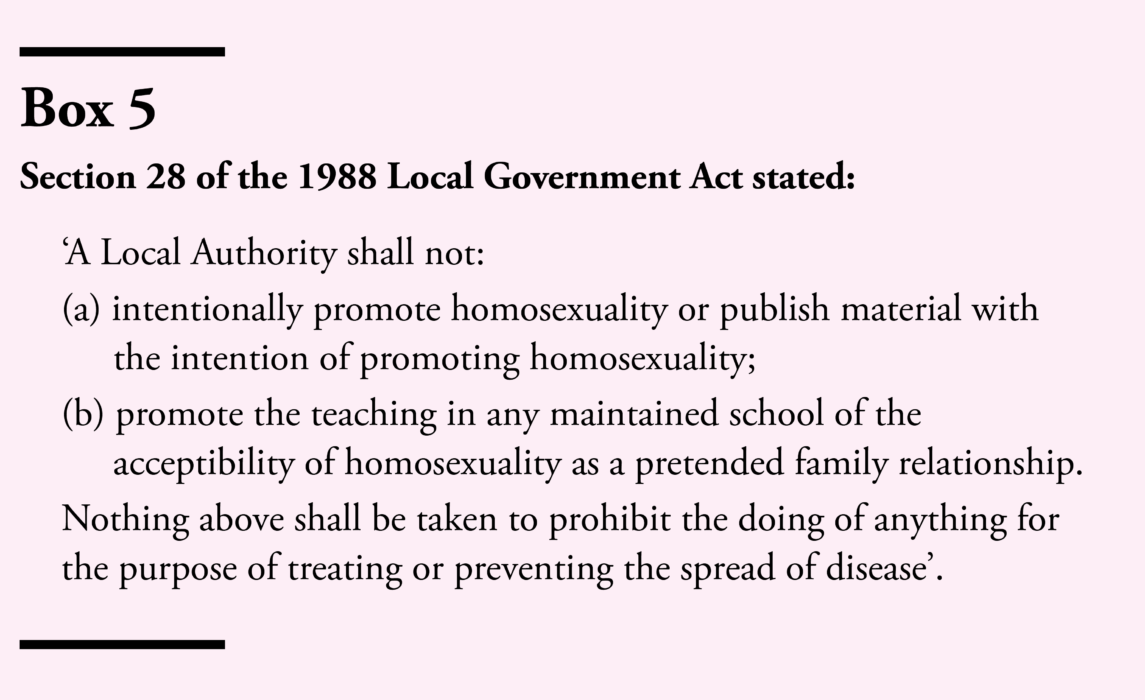
I was reminded by twitter that today is the 30th anniversary of the enactment of the Local Government Act 1988, which included the now notorious Section 28, which contained the following:

I remember very well the numerous demonstrations and other protests I went on as part of the campaign against the clause that became Section 28. Indeed, these were the first large political demonstrations in which I ever took part. But that repugnant and obviously discriminatory piece of legislation passed into law anyway. Students and younger colleagues of mine born after 1988 probably don’t have any idea how much pain and anger the introduction of this piece of legislation caused at the time, but at least it also had the effect of galvanising  many groups and individuals into action. The fightback eventually succeeded; Section 28 was repealed in 2003. I know 30 years is a long time, but it’s still amazing to me that attitudes have changed so much that now we have same-sex marriage. I would never have predicted that if someone had asked me thirty years ago!

I think there’s an important lesson in the story of Section 28, which is that rights won can easily be lost again. There are plenty of people who would not hesitate to bring back similar laws if they thought they could get away with them.  That’s why it is important for LGBT+ people not only to stand up for their rights, but to campaign for a more open, inclusive and discrimination-free environment for everyone.

Thoughts Suggested by a College Examination – Byron

Posted in Literature with tags , , , on May 24, 2018 by telescoper

High in the midst, surrounded by his peers,
Magnus his ample front sublime uprears:
Plac’d on his chair of state, he seems a God,
While Sophs and Freshmen tremble at his nod;
As all around sit wrapt in speechless gloom,
His voice, in thunder, shakes the sounding dome;
Denouncing dire reproach to luckless fools,
Unskill’d to plod in mathematic rules.

Happy the youth! in Euclid’s axioms tried,
Though little vers’d in any art beside;
Who, scarcely skill’d an English line to pen,
Scans Attic metres with a critic’s ken.

What! though he knows not how his fathers bled,
When civil discord pil’d the fields with dead,
When Edward bade his conquering bands advance,
Or Henry trampled on the crest of France:
Though marvelling at the name of Magna Charta,
Yet well he recollects the laws of Sparta;
Can tell, what edicts sage Lycurgus made,
While Blackstone’s on the shelf, neglected laid;
Of Grecian dramas vaunts the deathless fame,
Of Avon’s bard, rememb’ring scarce the name.

Such is the youth whose scientific pate
Class-honours, medals, fellowships, await;
Or even, perhaps, the declamation prize,
If to such glorious height, he lifts his eyes.
But lo! no common orator can hope
The envied silver cup within his scope:
Not that our heads much eloquence require,
Th’ ATHENIAN’S glowing style, or TULLY’S fire.
A manner clear or warm is useless, since
We do not try by speaking to convince;
Be other orators of pleasing proud,—
We speak to please ourselves, not move the crowd:
Our gravity prefers the muttering tone,
A proper mixture of the squeak and groan:
No borrow’d grace of action must be seen,
The slightest motion would displease the Dean;
Whilst every staring Graduate would prate,
Against what—he could never imitate.

The man, who hopes t’ obtain the promis’d cup,
Must in one posture stand, and ne’er look up;
Nor stop, but rattle over every word—
No matter what, so it can not be heard:
Thus let him hurry on, nor think to rest:
Who speaks the fastest’s sure to speak the best;
Who utters most within the shortest space,
May, safely, hope to win the wordy race.

The Sons of Science these, who, thus repaid,
Linger in ease in Granta’s sluggish shade;
Where on Cam’s sedgy banks, supine, they lie,
Unknown, unhonour’d live—unwept for die:
Dull as the pictures, which adorn their halls,
They think all learning fix’d within their walls:
In manners rude, in foolish forms precise,
All modern arts affecting to despise;
Yet prizing Bentley’s, Brunck’s, or Porson’s note,
More than the verse on which the critic wrote:
Vain as their honours, heavy as their Ale,
Sad as their wit, and tedious as their tale;
To friendship dead, though not untaught to feel,
When Self and Church demand a Bigot zeal.
With eager haste they court the lord of power,
(Whether ’tis PITT or PETTY rules the hour;)
To him, with suppliant smiles, they bend the head,
While distant mitres to their eyes are spread;
But should a storm o’erwhelm him with disgrace,
They’d fly to seek the next, who fill’d his place.
Such are the men who learning’s treasures guard!
Such is their practice, such is their reward!
This much, at least, we may presume to say—
The premium can’t exceed the price they pay.

by George Gordon Byron (1788-1824)


Glamorgan v. Middlesex

Posted in Cardiff, Cricket with tags , , , , on May 23, 2018 by telescoper

I took today off on annual leave (as I have to use all my allowance before I depart my job at Cardiff University). My intention was to make the best of the good weather to watch some cricket.

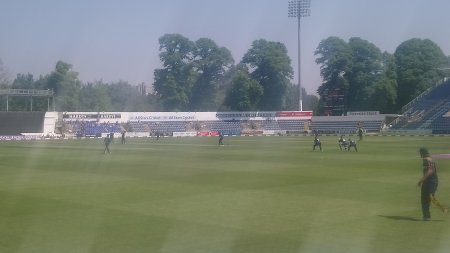
And so it came to pass that this morning I wandered down to Sophia Gardens for the start of the Royal London One-Day Cup (50-over) match between Glamorgan and Middlesex. It also came to pass that about fifteen minutes later I wandered back home again. I hadn’t checked the start time, which was actually 2pm…

The later start screwed up my plans as I had something to do in the evening but I thought I’d at least watch the first team bat (which turned out to be Middlesex).

(I’m not sure what caused the weird stripes on the picture.. .)

It was a lovely afternoon for cricket, and Middlesex got off to a good start in excellent batting conditions. Gradually though Glamorgan’s bowlers established some measure of control. After a mini-collapse of three wickets in three overs (to Ingram’s legspin) it looked like Middlesex might not make 300 (which seems to be the par score in this competition). Unfortunately for Glamorgan, however, de Lange and Wagg were expensive at the death and a flurry of boundaries took Middlesex to 304 for 6 off their 50 overs.

At that point I left Sophia Gardens to get ready to go out.

I’ve just got back to discover that Glamorgan lost by just 2 runs, ending on 302 for 9. It must have been a tense finish, and was a good game overall, but Glamorgan have now lost all three games they have played in this competition..

Is Dark Matter a Superfluid?

Posted in The Universe and Stuff with tags , , , , , , on May 22, 2018 by telescoper

In between marking exams and project reports I’ve been doing a little bit of reading in preparation for a talk that I’m due to give next week, which prompted me to share this talk by Justin Khoury of the University of Pennsylvania, which is about framework that unifies the claimed success of Modified Newtonian Dynamics (MOND) on galactic scales with the that of the standard ΛCDM model on cosmological scales. This is achieved through the physics of superfluidity. The dark matter and MOND components have a common origin, representing different phases of a single underlying substance. In galaxies, dark matter thermalizes and condenses to form a superfluid phase. The superfluid phonons couple to baryonic matter particles and mediate a MOND-like force. This framework naturally distinguishes between galaxies (where MOND is successful) and galaxy clusters (where MOND is not): dark matter has a higher temperature in clusters, and hence is in a mixture of superfluid and normal phase. The rich and well-studied physics of superfluidity leads to a number of observational signatures, discussed in the talk.

The idea that dark matter might be in the form of a superfluid is not new (see e.g. this paper) but there has been a recent surge of interest driven largely by Khoury and collaborators. If you want to find out more, can find a review paper about this model here.

From Maynooth to Cardiff

Posted in Cardiff, Maynooth with tags , on May 21, 2018 by telescoper

So here I am in Dublin Airport, waiting for my flight back to Cardiff. It’s been a nice weekend in Ireland, with good weather and lots to do in and around Maynooth. In the course of my perambulations on Saturday I came across a group of people campaigning to Repeal the Eighth Amendment. I A referendum on that issue takes place on Friday this week (25th). I bought a badge from them, which I’m happy to wear in solidarity:

There are lots of posters around supporting supporting one or other side in the campaign. It’s very noticeable that the `Yes’ ones seem to be getting torn down quite regularly. It’s also noticeable that the `No’ ones are frequently rather crude and sometimes offensive. That’s a shame because there is a serious ethical issue at stake, and a grown-up debate is important. Still, past experience suggests that referendums and grown-up debates don’t necessarily go together.

I won’t be in Ireland for the vote, but I hope the ‘yes’ campaign succeeds in removing what I think is a daft piece of law. If it fails then it won’t stop Irish women having terminations, it will just mean that the continue to have to travel abroad (if they can afford to do so) or take terrible risks have an illegal abortion at home (if they can’t) . For me, a vote for `No’ is therefore just a vote for hypocrisy.

Incidentally, a letter arrived at my Cardiff residence a few days ago from the Human Resources Department at Cardiff University, acknowledging my resignation (which I handed in about 6 weeks ago). I noticed that the letter contains the sentence `We have sent this letter to the home address we have on record for you. If this address is incorrect please contact us..’. Hmmm. If the letter had gone to the wrong address how would I know?

Anyway, I’ll be back in Cardiff for the next week, with another set of exams to mark in a few days, then back to Maynooth. And now it’s time to go to the gate.