This was a huge hit in 1937 for Tommy Dorsey’s Orchestra, featuring the great Bunny Berigan on trumpet:
Follow @telescoperSong of India – Tommy Dorsey
Posted in Uncategorized with tags Bunny Berigan, Song of India, Tommy Dorsey on October 6, 2017 by telescoperFlying Visit
Posted in Biographical on October 5, 2017 by telescoperNo time for a proper post today. I’m currently sitting in Dublin Airport waiting for a flight back to Cardiff. I flew over the Irish Sea yesterday (in an aeroplane) and stayed the night here in Ireland in order to have as full a day as possible. Mission accomplished I’m now on my home.

An aeroplane of the type used to fly passengers.
“What have you been doing?”, I hear you ask. Well, you’ll just have to wait and see… Follow @telescoper
Joseph Bertrand and the Monty Hall Problem
Posted in Bad Statistics, History, mathematics with tags Calcul des probabilités, Joseph Bertrand, Monty Hall, Monty Hall Problem, probability on October 4, 2017 by telescoperThe death a few days ago of Monty Hall reminded me of something I was going to write about the Monty Hall Problem, as it did with another blogger I follow, namely that (unsrurprisingly) Stigler’s Law of Eponymy applies to this problem.
The earliest version of the problem now called the Monty Hall Problem dates from a book, first published in 1889, called Calcul des probabilités written by Joseph Bertrand. It’s a very interesting book, containing much of specific interest to astronomers as well as general things for other scientists. Ypu can read it all online here, if you can read French.
As it happens, I have a copy of the book and here is the relevant problem. If you click on the image it should be legible.
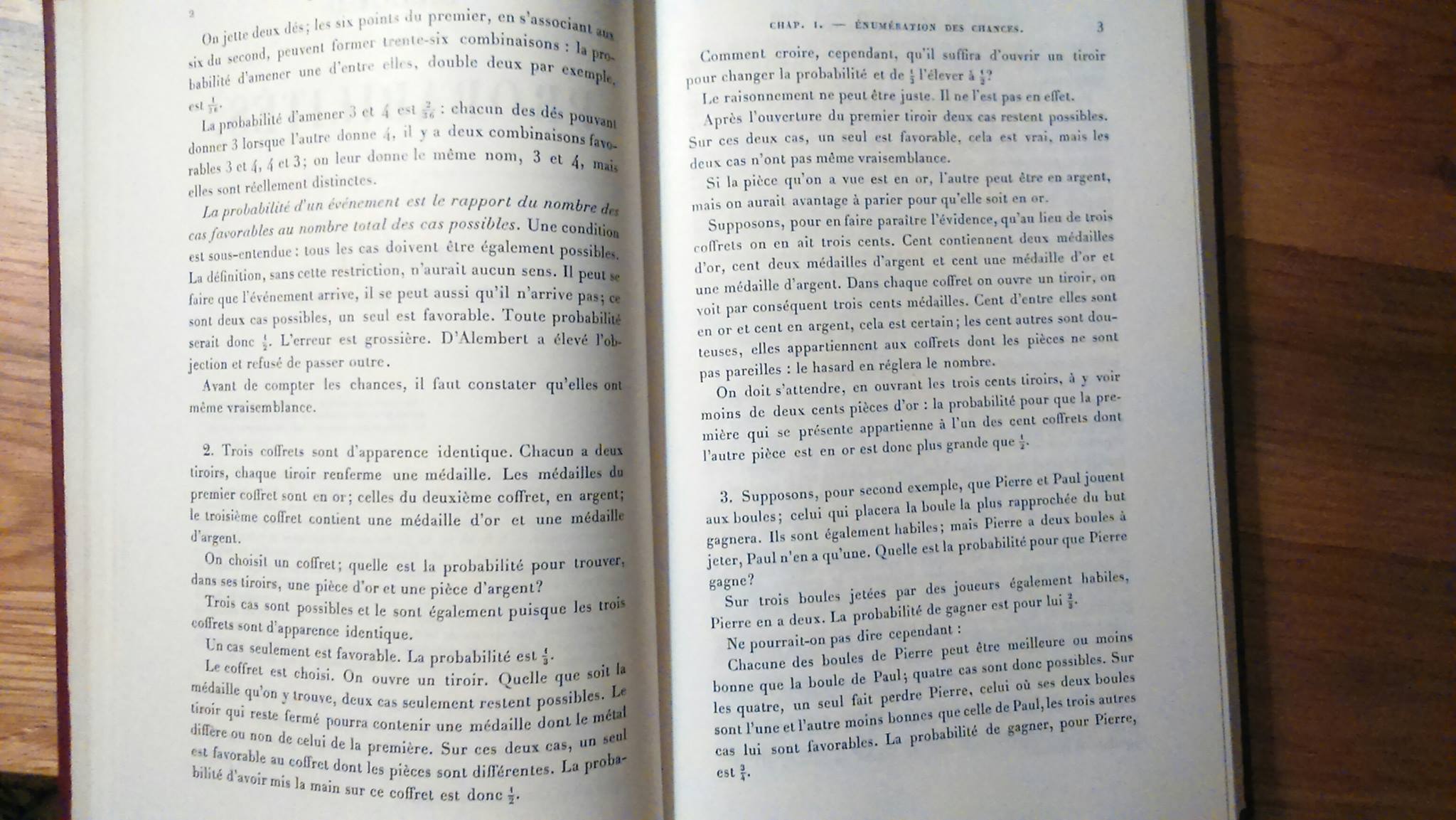
It’s actually Problem 2 of Chapter 1, suggesting that it’s one of the easier, introductory questions. Interesting that it has endured so long, even if it has evolved slightly!
I won’t attempt a full translation into English, but the problem is worth describing as it is actually more interesting than the Monty Hall Problem (with the three doors). In the Bertrand version there are three apparently identical boxes (coffrets) each of which has two drawers (tiroirs). In each drawer of each box there is a medal. In the first box there are two gold medals. The second box contains two silver medals. The third box contains one gold and one silver.
The boxes are shuffled, and you pick a box `at random’ and open one drawer `randomly chosen’ from the two. What is the probability that the other drawer of the same box contains a medal that differs from the first?
Now the probability that you select a box with two different medals in the first place is just 1/3, as it has to be the third box: the other two contain identical medals.
However, once you open one drawer and find (say) a silver medal then the probability of the other one being different (i.e. gold) changes because the knowledge gained by opening the drawer eliminates (in this case) the possibility that you selected the first box (which has only gold medals in it). The probability of the two medals being different is therefore 1/2.
That’s a very rough translation of the part of Bertrand’s discussion on the first page. I leave it as an exercise for the reader to translate the second part!
I just remembered that this is actually the same as the three-card problem I posted about here.
Follow @telescoperG.W. – Eric Dolphy
Posted in Jazz with tags Eric Dolphy, G.W., Outward Bound on October 3, 2017 by telescoperWhat better way to celebrate today’s announcement of the award of the 2017 Nobel Prize for Physics for the detection of Gravitational Waves, than to play this amazing Eric Dolphy track called `G.W.’ from the album Outward Bound?
This album was recorded in 1960, and the stellar personnel listening is as follows: Eric Dolphy (alto saxophone on this track but also bass clarinet and flute elsewhere on the album); Freddie Hubbard (trumpet); Jaki Byard (piano); George Tucker (bass); Roy Haynes (drums). It’s a great line-up but listen out for the opening solo by Dolphy! Wow!
The 2017 Nobel Prize for Physics goes to…
Posted in The Universe and Stuff with tags Advanced LIGO, Barry C. Barish, gravitational waves, Kip Thorne, Nobel Prize for Physics 2017, Rainer Weiss on October 3, 2017 by telescoper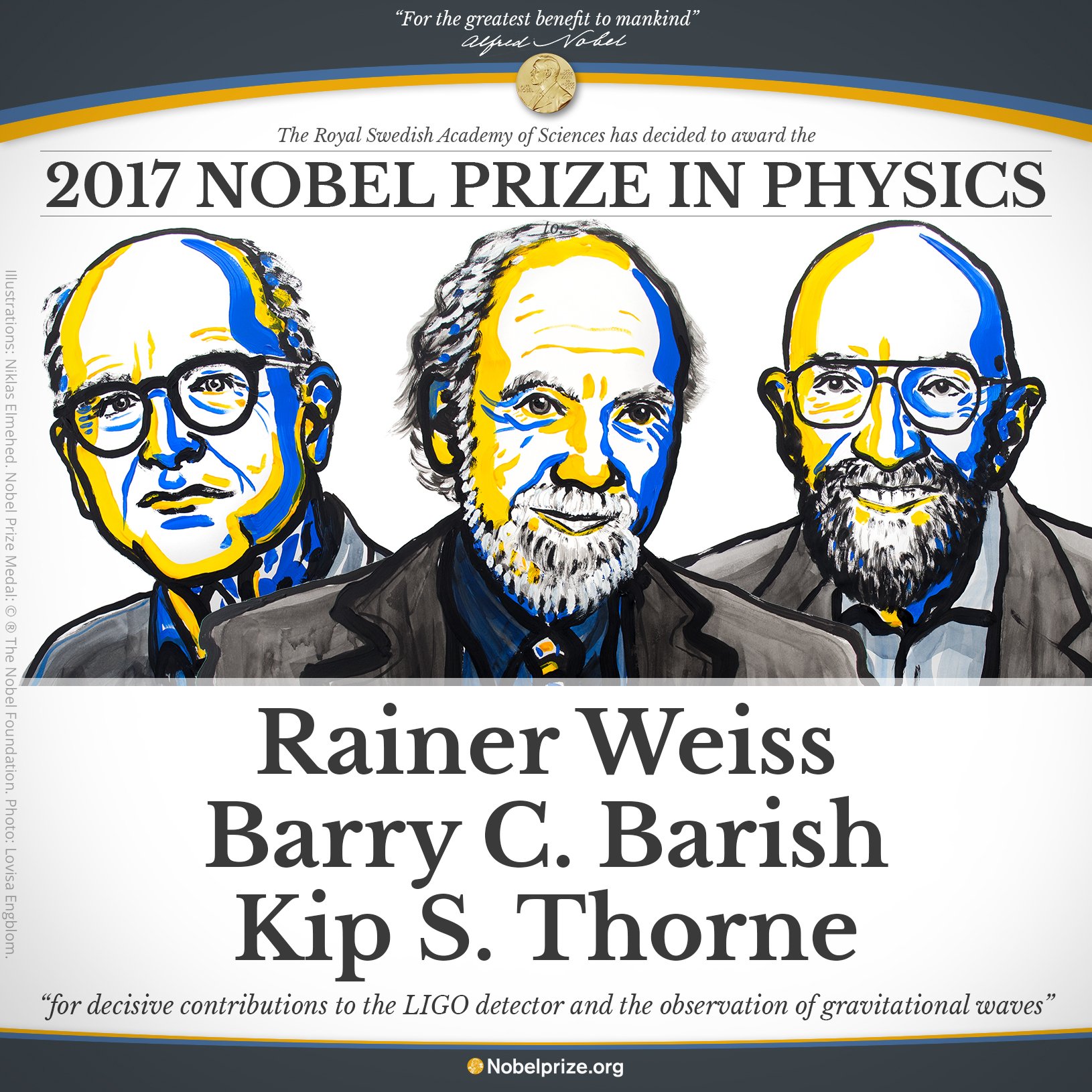
Usually at this time of year I make a point of watching the live announcement of the Nobel Prize for Physics, but this time I was otherwise engaged. On the other hand, this year was the least surprising announcement I can remember for a long time. Confirming almost everyone’s expectations, the award goes to Rainer Weiss (MIT), Barry C. Barish (Caltech) and Kip S. Thorne (Caltech) “for decisive contributions to the LIGO detector and the observation of gravitational waves”. You can see the full citation here.
Perhaps one surprise the split (50% to Weiss and 25% each to Barish and Thorne). I suppose the reason is that it divides the prize equally between MIT and Caltech. Ronald Drever, who had shared in other awards for the LIGO discovery (e.g the Gruber, Shaw and Kavli prizes), sadly passed away earlier this year.
Anyway, heartiest congratulations to the winners and also to all the other members of the LIGO Scientific Collaboration who collectively earned this award! That includes the Gravitational Physics group at Cardiff University who will no doubt be getting pissed celebrating in appropriate style.
Two thoughts. One is that the LIGO Collaboration is very large (the papers have over a thousand authors) but the Nobel Prize rules do not allow this award to be divided among more than three people. This is a problem for `Big Science’ which is always done by large teams. In a real sense, the Nobel Prize for physics reflects the way physics was done when it was founded, over a hundred years ago. It seems to me the limitation perpetuates the myth of the lone genius, when science doesn’t really work like that nowadays. I’m not sure it ever did, actually. I wonder if they’ll ever change?
Another thing that struck me is that the interval between discovery and award seems to be decreasing. For example, he Cosmic Microwave Background was discovered in 1965, but Penzias and Wilson were not awarded the Nobel Prize for its discovery until 1978. I attended the Nobel Prize ceremony in 2005, when George Smoot and John Mather were award the prize for COBE which had happened over a decade earlier. This time the gap between discovery and award is just two years. I suppose that proves that we live in an accelerating universe (Nobel Prize 2011).
Anyway there are too many people in LIGO for them all to be able to attend the Prize Ceremony and Banquet in Stockholm in December, but I hope the winners don’t just give their invitations to senior members of the LIGO collaboration. Perhaps some form of lottery might be organized to allow early career researchers to attend?
As I’ve mentioned before on this blog I had the honour to be invited to the 2006 Nobel Prize ceremony. As a matter of fact, I still have this:

The chocolate has probably gone off by now, though. I stress that I attended not as a winner but as a guest of the Nobel Foundation. It was a wonderful occasion, of which I have very special memories. I’m sure everyone who does get to attend will have a ball! (Geddit?)
Although the Nobel Prize has its limitations as a true reflection of scientific contributions, I still has value in that for once the news media are talking about a great human achievement which contrasts with much of the stuff we have to hear about these days.
Follow @telescoperThe State of Catalonia
Posted in Politics with tags Catalonia, Independence, Referendum on October 2, 2017 by telescoperI’m sure I’m not the only one who was appalled by the scenes of violence yesterday as police tried to stop voting in the `referendum’ on Catalonia. Here’s some footage from the BBC which clearly shows excessive use of force inside a polling station:
This is far from the worst example: elsewhere plastic bullets were fired at unarmed protesters. In all, about 900 people have been reported injured, though this claim is contested and thankfully none of them – as far as I know – seriously.
Whatever you think about the rights and wrongs of the independence movement – and I’ll tell you what I think in a moment – there’s no question that the Spanish government has handled this issue very badly and in so doing has conceded a propaganda victory. There was no need to use force to prevent the voting, as the referendum was unlawful. The national government was undoubtedly in a difficult position, but I think it would have been far better just to let the vote go ahead in full knowledge that it had no constitutional validity. The referendum result (claimed to be about 90% for independence, on a turnout of just over 40%) means nothing even if you actually believe the numbers (which are doubtful). ‘Democracy’ means nothing without the rule of law.
Nevertheless, it just may be that history will judge Sunday 1st October to be the day that Catalonian independence became inevitable not because of the vote per se but because of the reaction to it.
Many seem to be either casting this as a battle between democracy and fascism, raising the spectre of Franco, or, even more absurdly, blaming all this on the European Union, ignoring the blame attached to the antics of the separatists. For a counter to the simple-minded propaganda emanating from the extremes of left and right, you might read this piece.
Of course I’m just an ignorant foreigner and I encourage those with different opinions to express them through the comments box below.
The EU will of course not intervene in what is essentially an internal problem for Spain, but is right to call for a dialogue to begin quickly before things get any worse, as the Commission has made clear:
Under the Spanish Constitution, yesterday’s vote in Catalonia was not legal.
For the European Commission, as President Juncker has reiterated repeatedly, this is an internal matter for Spain that has to be dealt with in line with the constitutional order of Spain.
We also reiterate the legal position held by this Commission as well as by its predecessors. If a referendum were to be organised in line with the Spanish Constitution it would mean that the territory leaving would find itself outside of the European Union.
Beyond the purely legal aspects of this matter, the Commission believes that these are times for unity and stability, not divisiveness and fragmentation.
We call on all relevant players to now move very swiftly from confrontation to dialogue. Violence can never be an instrument in politics. We trust the leadership of Prime Minister Mariano Rajoy to manage this difficult process in full respect of the Spanish Constitution and of the fundamental rights of citizens enshrined therein.
It was wrong to proceed with the referendum, but it was also wrong to use heavy-handed tactics to try to stop it going ahead. There is blame on both sides, and both sides need to get together to sort it out. I’m not optimistic that will happen immediately, but the only way to make peace is by talking to your opponents. Let’s hope that common sense prevails, if not immediately then perhaps eventually.
So what do I think about the case for Catalonian independence? Well, I’m not qualified to talk about the specific arguments, so I’ll keep to the generalities. Let me start with a bit of autobiography that might explain why I see things the way I do. I was born in Wallsend (on Tyneside) in the North East of England. My parents were both born just before World War II started, also in the area where I was born. Of my four grandparents, one was born in England, one in Northern Ireland, one in Scotland, and one in Wales. I always smile when I get to write my nationality on a form, because I put “United Kingdom”. Of course being born in England makes me English too, but I find that less defining than “UK” or “British” or even “Geordie”. To be honest, my ancestry means that I generally find the whole concept of nationality fundamentally silly. I find nationalism silly too, except for those occasions – regrettably frequent nowadays – when nationalism takes on the guise of xenophobia. Then it is truly sinister. Nationalism is a tool by which unscrupulous individuals whip up hatred for political gain, regardless of the human consequences.
It may be apocryphal, but Albert Einstein is reported to have said “nationalism is an infantile disease”. The obvious way to cure it is to grow up and focus on fixing the real problems facing us instead of just waving flags, shouting slogans, and blaming others for our own failings. The reality is that we depend on each other too much for independence to have any meaning, let alone be desirable.
Follow @telescoperWNO Eugene Onegin
Posted in Opera with tags Alexander Pushkin, Eugene Onegin, Pyotr Ilyich Tchaikovsky, Welsh National Opera on October 2, 2017 by telescoperJust time for a quick review of my second opera of the new season at Welsh National Opera, Eugene Onegin by Pyotr Ilyich Tchaikovsky which I saw on Friday evening. This Opera, based on a famous novel in verse by Alexander Pushkin continues this Autumn’s Russian theme, though it is very different in style from Khovanshchina which I saw last week.
The plot revolves around the eponynmous character Eugene Onegin who is dashing and handsome but also arrogant and self-centred. Young Tatyana becomes infatuated with Onegin, and writes him an an impassioned love letter but he haughtily dismissed her advances, not least because she is a simple country girl. Onegin then decides to flirt with Olga, girlfriend of his best friend Lensky who, infuriated, challenges Onegin to a duel. Onegin kills Lensky in the duel then, in remorse, Onegin travels abroad for many years (during which he grows his hair long but apparently doesn’t change his suit). He returns to St Petersburg and attends a posh shindig only to find Tatyana all grown up and the belle of the ball. Now that she has some social standing he now finds her desirable, but it turns out that she’s married (to a Prince no less). Though she still fancies him – Heaven knows why, as Onegin is not at all a likeable character – she puts loyalty before passion, and Onegin is left alone with his regrets.
Tchaikovsky’s music is very beautiful, with memorable arias and passages for the chorus. The most famous piece is, of course, the Polonaise that opens Act III. I have to admit that although I’ve heard this piece dozens of times I never knew how to dance the Polonaise before seeing this production. Here’s what it looks like (from a rather more opulent production):
This production has a conventional design and overall look, and is none the worse for that. It’s very much a piece about a particular time and place. Classic countryside settings are contrasted with beautiful ballroom scenes using a simple but effective staging involving a wall across the entire stage with a large rectangular gap in the centre. This aperture is used as a window, or a grand door for the interior scenes but also as a clever way to suggest outdoor settings. The only problem with this device is that it does restrict the stage area quite a bit, so the ballroom scenes look a bit cramped. Costumes are in period style, their rich colours complementing the rather simple staging. Onegin makes his first appearance in black, complete with a top hat, looking rather like an undertaker.
The Opera is in Three Acts, adding up to seven scenes in all. That makes for quite a few changes of scenery and two intervals or, as I call them, wine breaks. The kind of opera I like best of all is the kind with two intervals…
Nicholas Lester (baritone) was a fine Onegin in a role that’s challenging mainly because the character is so unsympathetic; he does get to sing some lovely music. Natalya Romaniw (soprano) sang and acted beautifully, her transformation from country girl to high society lady was very convincing. Miklós Sebestyén (bass-baritone) took the singing honours, though, with a stunning vocal performance that was very warmly received by the audience. It almost goes without saying that the WNO chorus were excellent, but I’ll say it anyway.
P.S. The house was pretty much full, by the way, which is good news. I just wish more people would turn up for the less familiar works!
Follow @telescoperSupremus No. 58
Posted in Art with tags Art, Kazimir Malevich, Suprematism, Supremus No. 58 on October 1, 2017 by telescoper
Kazimir Severinovich Malevich (1879–1935).Oil on canvas (79.5 x 70.5 cm); painted 1916. State Russian Museum, St. Petersburg.
Follow @telescoper
Close of Play
Posted in Cricket with tags Ashes, cricket, Glamorgan on September 29, 2017 by telescoperYesterday saw the end of this year’s County Championship season, which I take to be definition of the official end of summer. It’s happened very late this year. Is this the latest end to a County Championship season ever?
There is, of course, an inconsequential 50-overs game still going on between England and the West Indies but the proper cricket is over and done with until next spring. Glamorgan won their last game earlier this week against Kent in three days, and finished 7th in the 2nd Division. Some good performances by young players (many of whom came through the Academy) adding a ray of optimism to what has been a fairly disappointing season (though with one highlight in a semi-final spot in the Twenty20 `blast’). Worcestershire finished top of the Second Division and Nottinghamshire were second, so they’ll both be playing in Division 1 next season. Essex won the County Champions in great style, unbeaten for the whole season. The main drama on the final day involved who got relegated along with Warwickshire (the latter having been adrift at the bottom of the Table for some time). Going into the last round of matches, Somerset looked the most likely to go down but they beat fellow strugglers Middlesex. Hampshire clung on for a draw against Warwickshire, giving them the points they needed to overtake Middlesex who will play in Division 2 next season.
Other big news yesterday was the selection of the England squad to tour Australia and play for the Ashes this Winter: Joe Root (capt, Yorkshire), Moeen Ali (Worcestershire), James Anderson (Lancashire), Jonny Bairstow (wk, Yorkshire), Jake Ball (Nottinghamshire), Gary Ballance (Yorkshire), Stuart Broad (Nottinghamshire), Alastair Cook (Essex), Mason Crane (Hampshire), Ben Foakes (wk, Surrey), Dawid Malan (Middlesex), Craig Overton (Somerset), Ben Stokes (Durham), Mark Stoneman (Surrey), James Vince (Hampshire), Chris Woakes (Warwickshire). I’m not particularly impressed with some of the choices (especially Ballance and Vince), and it looks likely that Stokes won’t be available owing to his recent fracas outside a nightclub, but we’ll see.
Anyway, yesterday was also National Poetry Day so it seems apt to mark the end of the County Championship with one of the classic cricket poems, Close of Play by Thomas Moult.
How shall we live, now that the summer’s ended,
And bat and ball (too soon!) are put aside,
And all our cricket deeds and dreams have blended —
The hit for six, the champion bowled for none,
The match we planned to win and never won? …
Only in Green-winged memory they abide.
How shall we live, who love our loveliest game
With such bright ardour that when stumps are drawn
We talk into the twilight, always the same
Old talk with laughter round off each tale —
Laughter of friends across a pint of ale
In the blue shade of the pavilion.
For the last time a batsman is out, the day
Like the drained glass and the dear sundown field
is empty; what instead of Summer’s play
Can occupy these darkling months ere spring
Hails willows once again the crowned king?
How shall we live so life may not be chilled?
Well, what’s a crimson hearth for, and the lamp
Of winter nights, and these plump yellow books
That cherish Wisden’s soul and bear his stamp —
And bat and ball (too soon!) are put aside,
Time’s ever changing, unalterable score-board,
Thick-clustered with a thousand names adored:
Half the game’s magic in their very looks!
And when we’ve learnt those almanacs by heart,
And shared with Nyren … Cardus ….the distant thrill
That cannot fade since they have had their part,
We’ll trudge wet streets through fog and mire
And praise our heroes by the club-room fire:
O do not doubt the game will hold us still!
Follow @telescoper
I Grant You Ample Leave
Posted in Poetry with tags George Eliot, I grant you ample leave, Poem, Poetry on September 28, 2017 by telescoper“I grant you ample leave
To use the hoary formula ‘I am’
Naming the emptiness where thought is not;
But fill the void with definition, ‘I’
Will be no more a datum than the words
You link false inference with, the ‘Since’ & ‘so’
That, true or not, make up the atom-whirl.
Resolve your ‘Ego’, it is all one web
With vibrant ether clotted into worlds:
Your subject, self, or self-assertive ‘I’
Turns nought but object, melts to molecules,
Is stripped from naked Being with the rest
Of those rag-garments named the Universe.
Or if, in strife to keep your ‘Ego’ strong
You make it weaver of the etherial light,
Space, motion, solids & the dream of Time–
Why, still ’tis Being looking from the dark,
The core, the centre of your consciousness,
That notes your bubble-world: sense, pleasure, pain,
What are they but a shifting otherness,
Phantasmal flux of moments?–“
by George Eliot (1819-1880)
Follow @telescoper

 In the Dark