How the Nonbaryonic Dark Matter Theory Grew [CEA]

Posted in The Universe and Stuff with tags , , on January 24, 2017 by telescoper

Another arXiver post, this time from the great Jim Peebles. Always a skeptic about dark matter, especially cold dark matter, it is the hallmark of a great scientist that he weighs up the evidence as objectively as possible.

This is a long review, but well worth reading for its important insights and historical perspective. I agree that the case for non-baryonic dark matter is compelling, but it is also far from proved and it’s still possible that an alternative, equally or more compelling, theory will be found.

arxiver's avatararXiver

http://arxiv.org/abs/1701.05837

The evidence is that the mass of the universe is dominated by an exotic nonbaryonic form of matter largely draped around the galaxies. It approximates an initially low pressure gas of particles that interact only with gravity, but we know little more than that. Searches for detection thus must follow many difficult paths to a great discovery, what the universe is made of. The nonbaryonic picture grew out of a convergence of evidence and ideas in the early 1980s. Developments two decades later considerably improved the evidence, and advances since then have made the case for nonbaryonic dark matter compelling.

Read this paper on arXiv…

P. Peebles
Mon, 23 Jan 17
37/55

Comments: An essay to accompany articles on dark matter detection in Nature Astronomy

View original post

Freedom of Movement isn’t the problem – The problem is in the way the UK fails use the available controls

Posted in Politics with tags , , on January 23, 2017 by telescoper

Here’s an important corrective to some of the misinformation about “Freedom of Movement” within the EU. A summary is that controls are available, but the UK government has never implemented them.

I maintain that freedom of movement is one of the benefits of EU membership, not one of the costs. Why are we throwing away so much to deal with a non-existent problem?

This also explains why the David Cameron’s bluster didn’t persuade anyone in the EU to jump through hoops on his behalf. We could have reduced migration ourselves within existing regulations, but decided not to, no doubt because of the positive economic benefits.

RemaininEU's avatarbrexit853

Myth Buster – Debunking the horror stories surrounding the EU Freedom of Movement directive. 

 Currently Theresa May has made stopping FoM a red-line issue even at the expense of the UK’s membership of the Single Market.

Introduction

 One of the four freedoms enjoyed by EU citizens is the free movement of workers. This includes the rights of movement and residence for workers, the rights of entry and residence for family members, and the right to work in another Member State and be treated on an equal footing with nationals of that Member State. Restrictions apply in some countries for citizens of Member States that have recently acceded to the EU.

There appears to be 4 major arguments in favour of stopping EU migrants exercising this freedom to come and work in the UK. It is my intention to debunk each of these arguments as plainly false.

Claim 1 – “Inability…

View original post 1,485 more words

Mahler’s Sixth Symphony

Posted in Music with tags , , , on January 23, 2017 by telescoper

“Darkness, turbulence and an unmistakable undertone of violence” –  what could be a more fitting way to spend a Friday evening in January 2017 than listening to the epic Sixth Symphony by Gustav Mahler. So apt is this work for the times we’re living through that it was performed on Thursday evening by the London Symphony Orchestra conducted by Sir Simon Rattle and broadcast live on BBC Radio 3; you can catch that performance on the BBC iPlayer here. I’ve always preferred my music live rather than recorded, so I went to St David’s Hall on Friday to hear it performed by the BBC National Orchestra of Wales under the direction of Thomas Søndergård. This was recorded live, and will be broadcast by BBC Radio 3 on Friday 27th January, and available thereafter on iPlayer so you can compare the two versions if you want to.

Before the main course, we heard the excellent BBC National Chorus of Wales singing four motets by another late Romantic composer, Anton Bruckner. The pieces chosen were all settings of latin religous texts: Locus Iste, Os Justi, Christus Factus Est, and Ave Maria. These are beautiful works, and interesting because of the many references they include to earlier musical forms, especially in the Os Justi which is in the Lydian mode, harking back to what at the time it was written (1879) was an obsolete church scale.

These four works last only about 15 minutes in total. That explains why the bar staff weren’t taking interval orders before the concert started – there simply wouldn’t have been enough time to put the drinks out before the first half finished. Fortunately, my seat was near the door of the auditorium so I was able to make a quick escape and get my usual glass of wine at the bar before most of the audience.

And then the Mahler. What can I say? It’s another huge symphony, in four movements lasting about eighty minutes, requiring a huge orchestra including tubas, bass trombones, harps and varied percussion including cowbells, a celesta, and of course the famous hammer..

I mentioned earlier on that I much prefer live concerts. One of the things that I remember vividly from last Friday was the sight of the huge wooden mallet that is used to deliver the “hammer blows of fate” in the final movement, which loomed ominously on stage in front of the percussion section throughout the performance. When it was finally deployed it came down with such force that it buckled the wooden box underneath, but even when it wasn’t being used it had a powerful stage presence. That’s one kind of experience you’ll never get from a recording.

The first movement of this Symphony (Allegro energico) is a battle between a strident march theme and a passionate romantic melody, though the conflict is interrupted by a lengthy passage of remarkable peace and tranquility. In Mahler’s original version of this work, the Scherzo movement (in which the two main themes return in an even more agitated struggle) came second, but on reflection he swapped it with the Andante, which is measured and reflective but still with an undertone of foreboding. I’m not sure if anyone ever performs the original ordering anymore, but out of curiosity I’d like to hear it performed that way. The tonality and thematic content of the Scherzo mean it is more closely related to the Allegro than the Andante, which has led some to argue that, despite what Mahler thought, it should be played second. I don’t think that follows necessarily, but it would be interesting to hear how it works.

The final movement is vast, intense, emotionally draining and absolutely wonderful. The mood changes continually from terror to euphoria, from triumph to tragedy and from optimism to despair. Many people I know dismiss Mahler’s music as “angst-ridden”. I don’t think you can describe all his compositions like that, but it’s fair to say that this symphony is bleak and ultimately nihilistic in its despair. The hammer blows of fate (three in the original composition, with one later removed by Mahler) signal the end of hope, but the end is a whimper rather than a bang. The music subsides into nothingness,  its light fading  into the “Dark Night of the Soul”.

It’s no surpise that this is often called the “Tragic Symphony”, but however bleak the message may seem, it’s always uplifting to experience the “artistic conquest of the terrible”. If civilization is to survive in a world filled with suffering and arbitrary cruelty, then we have to come to terms with reality, not shy away from it. Mahler is one composer who isn’t afraid to tell it the way it is.

The BBC National Orchestra of Wales was on top form for this concert – with outstanding work by the brass section in particular – and were marshalled with great vision and a mastery of detail  by Thomas Søndergård. I’m sure I’ll remember this performance for a very long time.

The Key-Note

Posted in Poetry with tags , on January 22, 2017 by telescoper

Where are the songs I used to know,
Where are the notes I used to sing?
I have forgotten everything
I used to know so long ago;
Summer has followed after Spring;
Now Autumn is so shrunk and sere,
I scarcely think a sadder thing
Can be the Winter of my year.

Yet Robin sings through Winter’s rest,
When bushes put their berries on;
While they their ruddy jewels don,
He sings out of a ruddy breast;
The hips and haws and ruddy breast
Make one spot warm where snowflakes lie
They break and cheer the unlovely rest
Of Winter’s pause – and why not I?

by Christina Rossetti (1830-1894)


Sunday Bloody Sunday

Posted in Biographical, Film, LGBTQ+, Television with tags , , , , on January 22, 2017 by telescoper

I realized this afternoon that I was going to have to come into my office at Cardiff University as there is something I was supposed to finish by midnight today and I had forgotten to bring some stuff I needed to complete it. Setting aside the absurdity of an employer who sets deadlines at 24.00 on a Sunday evening, I was planning to have a quiet night doing the Azed crossword. As I got ready to leave the house I heard myself muttering “Sunday Bloody Sunday” under my breath, and walking through town to get here I was thinking about John Schlesinger’s 1971 film of that title, starring Glenda Jackson, Peter Finch and Murray Head. This film was shown on TV – rather late at night – when I was a teenager in the late 1970s and I’ll never forget the impact this particular scene had on me then. Here’s a clip of Murray Head talking about the scene, which caused quite a stir at the time in some quarters, in which he describes it as a “giant step forward”. Let’s hope we’re not all about to take giant steps backward.

Women’s March in Cardiff 

Posted in Cardiff, Politics with tags , on January 21, 2017 by telescoper

Lots to do today so I’ll just make a note that this afternoon there was a Women’s March in Cardiff along with many around the world (including a huge one in Washington DC) to protest against misogyny and discrimination.

Here’s the scene near the statue of Nye Bevan on Queen Street (looking toward the Castle)  just before the March started around 1pm:

Love and respect to all who took part!

The new President of the USA

Posted in Politics with tags , on January 20, 2017 by telescoper

Well, today’s  the day of the inauguration of the new President of the the United States of America….


wink-putin_1291535b

God help us all.

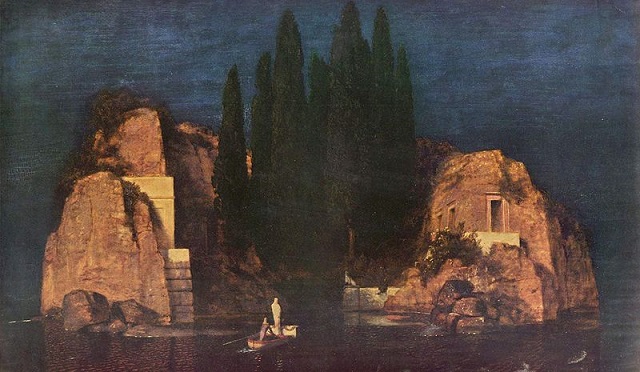
Isle of the Dead

Posted in Art with tags , on January 19, 2017 by telescoper

Isle of the Dead (above) is the best-known painting of Swiss Symbolist artist Arnold Böcklin (1827–1901). Prints of this work were very popular in central Europe in the early 20th century—Vladimir Nabokov observed in his novel Despair that they could be “found in every Berlin home”. Several versions were made – the one shown above is the original (Basel) version, painted in  May 1880 – Oil on canvas; 111 x 155 cm.

To a Louse

Posted in Poetry, Politics with tags , on January 18, 2017 by telescoper

Ha! whaur ye gaun, ye crowlin ferlie?
Your impudence protects you sairly;
I canna say but ye strunt rarely,
Owre gauze and lace;
Tho’, faith! I fear ye dine but sparely
On sic a place.

Ye ugly, creepin, blastit wonner,
Detested, shunn’d by saunt an’ sinner,
How daur ye set your fit upon her-
Sae fine a lady?
Gae somewhere else and seek your dinner
On some poor body.

Swith! in some beggar’s haffet squattle;
There ye may creep, and sprawl, and sprattle,
Wi’ ither kindred, jumping cattle,
In shoals and nations;
Whaur horn nor bane ne’er daur unsettle
Your thick plantations.

Now haud you there, ye’re out o’ sight,
Below the fatt’rels, snug and tight;
Na, faith ye yet! ye’ll no be right,
Till ye’ve got on it-
The verra tapmost, tow’rin height
O’ Miss’ bonnet.

My sooth! right bauld ye set your nose out,
As plump an’ grey as ony groset:
O for some rank, mercurial rozet,
Or fell, red smeddum,
I’d gie you sic a hearty dose o’t,
Wad dress your droddum.

I wad na been surpris’d to spy
You on an auld wife’s flainen toy;
Or aiblins some bit dubbie boy,
On’s wyliecoat;
But Miss’ fine Lunardi! fye!
How daur ye do’t?

O Jeany, dinna toss your head,
An’ set your beauties a’ abread!
Ye little ken what cursed speed
The blastie’s makin:
Thae winks an’ finger-ends, I dread,
Are notice takin.

O wad some Power the giftie gie us
To see oursels as ithers see us!
It wad frae mony a blunder free us,
An’ foolish notion:
What airs in dress an’ gait wad lea’e us,
An’ ev’n devotion!

by Robert Burns (1759-1796)

P.S. This poem was written “On Seeing One On A Lady’s Bonnet, At Church 1786” but it – and the last verse is especially – is currently applicable to the pathetic jingoistic posturing of the UK government.


Hard BrExit Reality Bites UK Science

Posted in Politics, Science Politics with tags , , , , , , on January 17, 2017 by telescoper

Before lunch today I listened to the Prime Minister’s much-heralded speech (full text here) at Lancaster House giving a bit more detail about the UK government’s approach to forthcoming negotiations to leave the European Union. As I had expected the speech was mainly concerned with stating the obvious – especially about the UK leaving the so-called Single Market – though there was an interesting, if rather muddled, discussion of some kind of associate membership of the Customs Union.

As I said when I blogged about the EU Referendum result back in June last year

For example, there will be no access to the single market post-BrExit without free movement of people.

The EU has made it perfectly clear all along that it will not compromise on the “four freedoms” that represent the principles on which the Single Market (correct name; “Internal Market”) is based. The UK government has also made it clear that it is running scared of the anti-immigration lobby in the Conservative Party and UKIP, despite the mountain of evidence (e.g. here) that immigration actually benefits the UK economy rather than harming it. A so-called “hard BrExit” approach has therefore been inevitable from the outset.

In any case, it always seemed to me that leaving the EU (and therefore giving up democratic representation on the bodies that govern the single market) but remaining in the Single Market would be completely illogical to anyone motivated by the issue of “sovereignty” (whatever that means).  So I think it always was – and still is – a choice between a hard BrExit and no BrExit at all. There’s no question in my mind – and Theresa May’s speech has hardened my views considerably – that remaining in the EU is by far the best option for the UK. That outcome is looking unlikely now, but there is still a long way to go and many questions have still to be answered, including whether the Article 50 notification can be revoked and whether the devolved assemblies in Scotland and Northern Ireland have to give separate consent. Interestingly, the Conservative Party manifesto for the 2015 General Election included a commitment to work within the Single Market, so it would be within the constitutional limits on the House of Lords to vote down any attempt to leave it.

Overall, I felt the speech was worthwhile insofar as it gave a bit of clarity on some issues, but it was also full of contradictions on others. For example, early on the PM stated:

Parliamentary sovereignty is the basis of our constitution.

Correct, but in that case why did the UK government appeal the High Court’s decision that this was the case (i.e. that Parliamentary consent was needed to invoke Article 50)? Moreover, why if she thinks Parliament is so important did she not give today’s speech in the House of Commons?

This brings me to what the speech might imply for British science in a post-BrExit era. Here’s what I said in June 2016:

It’s all very uncertain, of course, but it seems to me that as things stand, any deal that involves free movement within Europe would be unacceptable to the powerful  UK anti-immigration lobby. This rules out a “Norway” type deal, among others, and almost certainly means there will be no access to any science EU funding schemes post 2020. Free movement is essential to the way most of these schemes operate anyway.

I’m by no means always right, but I think I was right about that. It is now clear that UK scientists will not be eligible for EU funding under the Horizon 2020 programme.  Switzerland (which is in the Single Market) wasn’t allowed to remain in Horizon 2020 without freedom of movement, and neither will the UK. If the PM does indeed trigger Article 50 by the end of March 2017 then we will leave the EU by April 2019. That means that existing EU projects and funding will probably be stopped at that point, although the UK government has pledged to provide short-term replacement funding for grants already awarded. From now on it seems likely that EU teams will seek to exclude UK scientists.

This exclusion is not an unexpected outcome, but still disappointing. The PM’s speech states:

One of our great strengths as a nation is the breadth and depth of our academic and scientific communities, backed up by some of the world’s best universities. And we have a proud history of leading and supporting cutting-edge research and innovation.

So we will also welcome agreement to continue to collaborate with our European partners on major science, research, and technology initiatives.

From space exploration to clean energy to medical technologies, Britain will remain at the forefront of collective endeavours to better understand, and make better, the world in which we live.

Warm words, but it’s hard to reconcile them with reality.  We used to be “leading” EU collaborative teams. In a few years we’ll  be left standing on the touchlines. The future looks very challenging for science, and especially for fundamental science, in the UK.

But the politics around EU science programmes pales into insignificance compared the toxic atmosphere of xenophobia that has engulfed much of the UK. The overt policy of the government to treat EU citizens in the UK as bargaining chips will cause untold stress, as will the Home Office’s heavy-handed approach to those who seek to confirm the permanent residence they will otherwise lose when the UK leaves the EU. Why should anyone – scientist or otherwise – stay in this country to be treated in such a way? 

All of this makes me think those scientists I know who have already left the UK for EU institutions probably made the right decision. The question is how many more will follow?