A Poem for St David’s Day

Posted in Poetry with tags , , , , on March 1, 2025 by telescoper
Daffodils photographed yesterday at Maynooth University

It’s St David’s Day so, notwithstanding the fact that I’ve just watched Leinster beat Cardiff 42-24 at Rugby,

Dydd Gŵyl Dewi Hapus!

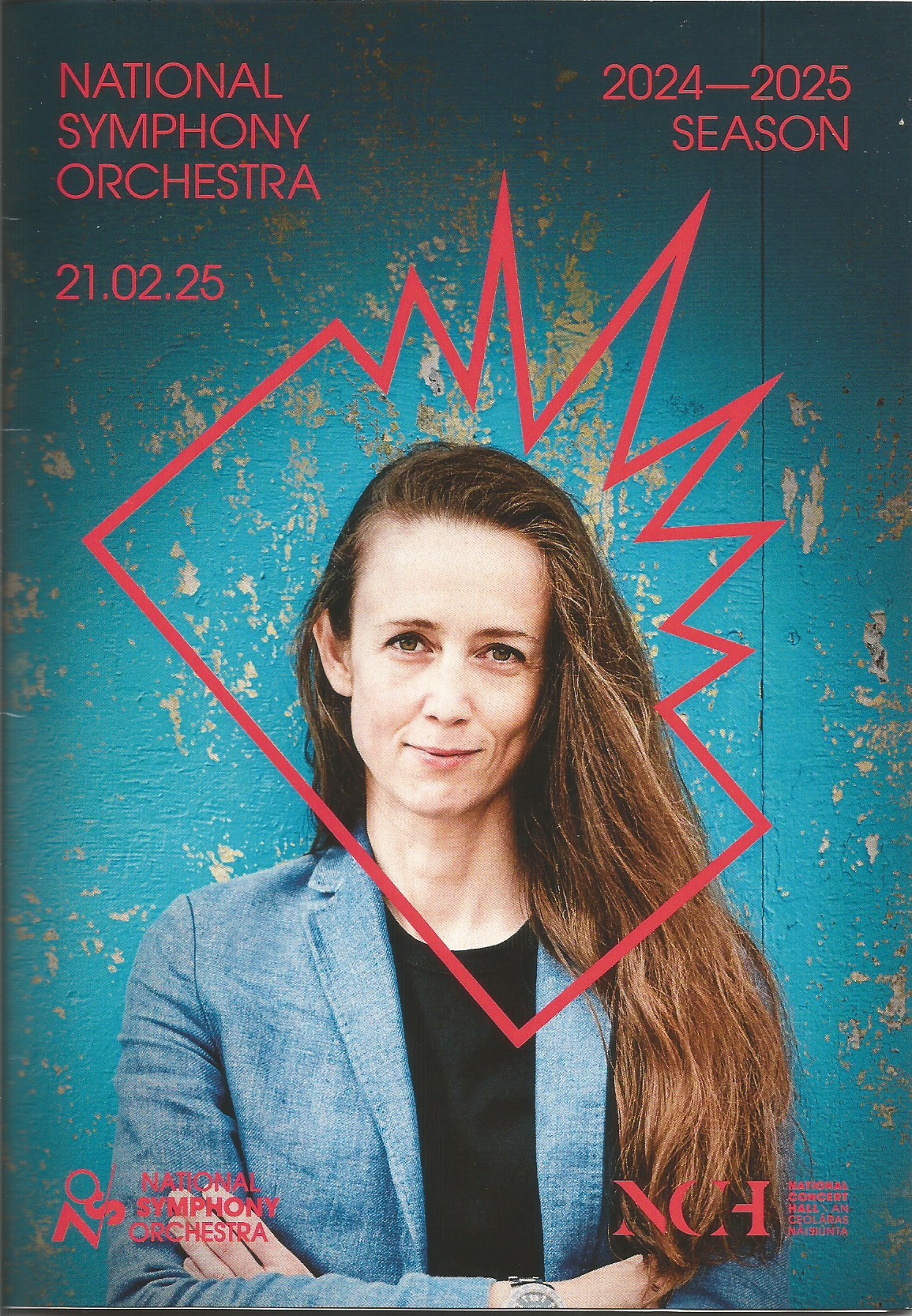
On this day I usually post a poem by a Welsh poet. This, by Dylan Thomas, which was published in 1936 and seems to me to be rather topical, featured in the concert I went to about a month ago.

The hand that signed the paper felled a city;
Five sovereign fingers taxed the breath,
Doubled the globe of dead and halved a country;
These five kings did a king to death.

The mighty hand leads to a sloping shoulder,
The finger joints are cramped with chalk;
A goose's quill has put an end to murder
That put an end to talk.

The hand that signed the treaty bred a fever,
And famine grew, and locusts came;
Great is the hand that holds dominion over
Man by a scribbled name.

The five kings count the dead but do not soften
The crusted wound nor pat the brow;
A hand rules pity as a hand rules heaven;
Hands have no tears to flow.

The Universe Keeper

Posted in Maynooth, The Universe and Stuff with tags , , , , , , on February 28, 2025 by telescoper

Interested in learning a little bit about the ideas behind string theory? Here’s a short video that tries to explain the basics in a thought-provoking way. It features three main characters: The Universe Keeper Renata, inspired by Russian-American physicist Renata Kallosh, the quizzical Wolfie, inspired by the Austrian Nobel laureate Wolfgang Pauli, and the inquisitive Albie, inspired by Albert Einstein.

See what you make of it…

(One of the creators of this video is my PhD student Kay Lehnert, who has just given a departmental seminar in which he mentioned the video.)

Roger Penrose: Discoverer of Black Holes?

Posted in History, The Universe and Stuff with tags , , , , , , , , , on February 27, 2025 by telescoper

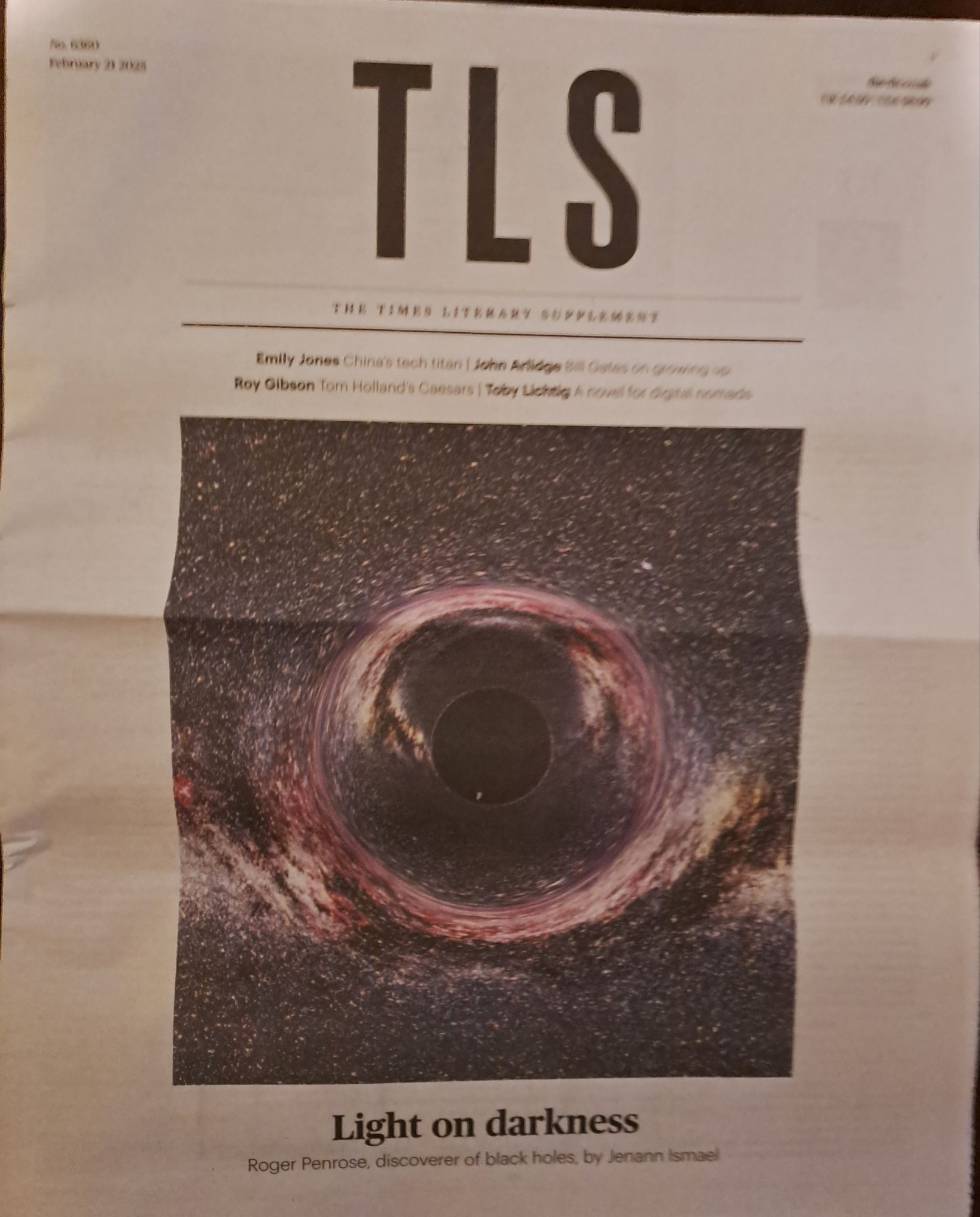
I got home from a busy day on campus to find the 21st February issue of the Times Literary Supplement had landed on my doormat having arrived today, 27th February. It used to take a couple of weeks for my subscription copy to reach Ireland but recently the service has improved. Intriguingly, the envelope it comes in is postmarked Bratislava…

But I digress. This is the cover:

The text below the title “Light on darkness” under the graphic reads “Roger Penrose, discoverer of black holes, by Jennan Ismael”. Nice though it is to see science featured in the Times Literary Supplement for a change and much as I admire Roger Penrose, it is unreasonable to describe him as “the discoverer of black holes”.

A black hole represents a region of space-time where the action of gravity is sufficiently strong that light cannot escape. The idea that such a phenomenon might exist dates back to John Michell, an English clergyman, in 1783, and later by Pierre-Simon Laplace but black holes are most commonly associated with Einstein’s theory of general relativity.  Indeed, one of the first exact solutions of Einstein’s equations to be found describes such an object. The famous Schwarzschild solution was obtained in 1915 by Karl Schwarzschild, who died soon after on the Eastern front in the First World War. The solution corresponds to a spherically-symmetric distribution of matter, and it was originally intended that it could form the basis of a mathematical model for a star. It was soon realised, however that for an object of any mass M there is a critical radius (Rs, the Schwarzschild radius) such that if all the mass is squashed inside Rs then no light can escape.  In terms of the mass M, velocity of light c, and Newton’s constant G, the critical radius is given by Rs = 2GM/c2 . For the mass of the Earth, the critical radius is only 1cm, whereas for the Sun it is about 3km.

Since the pioneering work of Schwarzschild, research on black holes has been intense and other kinds of mathematical solutions have been obtained. For example, the Kerr solution describes a rotating black hole and  the Reissner -Nordstrom solution corresponds to  a black hole with an electric charge.  Various theorems have also been demonstrated relating to the so-called `no-hair’ conjecture: that black holes give very little outward sign of what is inside.

Some people felt that the Schwarzschild solution was physically unrealistic as it required a completely spherical object, but Roger Penrose showed mathematically that the existence of a trapped surface was a generic consequence of gravitational collapse, the result that won him the Nobel Prize in 2020. His work did much to convince scientists of the physical reality of black holes, and he deserved his Nobel Prize, but I don’t think it is fair to say he “discovered” them.

I would say that, as is the case for discoveries in many branches of science, there isn’t just one “discoverer” of black holes: there were important contributions by many people along the way.

P.S. If you want to limit the application of the word “discovery” to observations then I think that the discovery of black holes is down to Paul Murdin and Louise Webster who identified the first really plausible candidate for a black hole in Cygnus X-1, way back in 1971…

P.P.S. The term “Black Hole” was, as far as I know, coined by John Wheeler in 1967.

Roger Penrose is 93.

The University of Edinburgh in Crisis

Posted in Education, Finance with tags , , , , on February 26, 2025 by telescoper

It seems that financial emergencies are spreading around the United Kingdom like a contagion. About a month ago I posted about the crisis at Cardiff University, but now there’s a bombshell about the University of Edinburgh which, according to the Times Higher is planning to make cuts of around £140 million in recurrent expenditure, about 10% of its annual operating budget. This level of cuts is greater than those previously listed at other universities, including Cardiff, the largest of which are measured in tens of millions. The piece goes on to explain that target can’t be reached by voluntary redundancies, which presumably means compulsory redundancies are looming.

I don’t know which particular academic units are under threat, but I’m sure this episode is causing a great deal of stress to a great many people. The only advice I can offer to anyone at Edinburgh worrying about the future is, if they haven’t done so already, to JOIN A UNION!

Talking of which, the University of Edinburgh UCU has pointed out that the University revealed a budget surplus last year and has huge reserves measured in the billions. It accuses managers of manufacturing a crisis in order to cut staff and bring about even more centralisation – thus achieving an even greater level of corporate control over teaching and research activities. The subordination of academia to management is the aim. I don’t doubt that university managers around the world believe that teaching will be largely done by AI anyway which will allow even more lecturing staff to be cut.

I believe that universities need less centralisation not more. The Principal of the University of Edinburgh, Peter Mathieson, is quoted in the Times Higher piece as saying:

We can no longer afford to run duplicative services across the university, often with inconsistent practices which create inefficiencies, increase staff workload and impact our student experience..

This is fair enough, but it is quite wrong to assume that greater centralisation is the solution. In my experience it is “The Centre” that creates inefficiencies, increases staff workload and impacts student experience. That is because it knows far less than Schools and Departments about what is needed to achieve their academic objectives. Universities need a flatter and more responsive structure, not the ever-increasing management bloat that has been imposed on them for decades and which is now causing them to capsize.

Beautiful Equations

Posted in Biographical, mathematics, The Universe and Stuff with tags , , , , on February 25, 2025 by telescoper

I did a lecture today about the Dirac Equation (which is almost 100 years old, having been first presented in 1928). You might think this is a difficult topic to lecture on, but it’s really a piece of cake:

This reminds me that a a while ago I posted about an interesting article on the BBC website that discussed the way mathematicians’ brains appear to perceive “beauty”. A (slightly) more technical version of the story can be found here. According to functional magnetic resonance imaging studies, it seems that beautiful equations excite the same sort of brain activity as beautiful music or art.

The question of why we think equations are beautiful is one that has come up a number of times on this blog. I suspect the answer is a slightly different one for theoretical physicists compared with pure mathematicians. Anyway, I thought it might be fun to invite people offer suggestions through the comments box as to the most beautiful equation along with a brief description of why.

I should set the ball rolling myself, and I will do so with the Dirac Equation:

dirac_equation

This equation is certainly the most beautiful thing I’ve ever come across in theoretical physics, though I don’t find it easy to articulate precisely why. I think it’s partly because it is such a wonderfully compact fusion of two historic achievements in physics – special relativity and quantum mechanics – but also partly because of the great leaps of the imagination that were needed along the journey to derive it and my consequent admiration for the intellectual struggle involved. I feel it is therefore as much an emotional response to the achievement of another human being – such as one feels when hearing great music or looking at great art – as it is a rational response to the mathematical structure involved. But it’s not just that, of course. The Dirac Equation paved the way to many further developments in particle physics. It seems to encapsulate so much about the behaviour of elementary particles in so few symbols. Some of its beauty derives from its compactness- it uses up less chalk in a mathematical physics lecture.

Anyway, feel free to suggest formulae or equations, preferably with a brief explanation of why you think they’re so beautiful.

P.S. Paul Dirac was my (academic) great-grandfather.

R.I.P Roberta Flack (1937-2025)

Posted in Music, R.I.P. with tags , on February 24, 2025 by telescoper

I just heard the sad news of the death at the age of 88 of the wonderful singer Roberta Flack. Many years ago I posted my favourite song of hers (performed live on Top of the Pops way back in 1972) but it seems the link I used is now broken so I’ll post the original version. Roberta Flack’s The First Time Ever I Saw Your Face first appeared on her album First Take back in 1969 but it didn’t become a hit until it featured in Clint Eastwood’s (1971) film Play Misty For Me. Incidentally, the bass player on this track is the great Ron Carter.

It’s probably the most beautiful love song I’ve ever heard and to my mind it hasn’t dated at all in 50 years. I suppose if you’ve ever felt about someone the way it describes you never forget…

Rest in peace, Roberta Flack (1937-2025). To the dark, and the endless skies.

Particle Physics Masterclass at Maynooth

Posted in Education, Maynooth, The Universe and Stuff with tags , , on February 23, 2025 by telescoper

Last week’s announcement about Ireland joining CERN reminded me that I should have advertised the annual Particle Physics Masterclass at Maynooth University long before now, not least because I’m actually teaching particle physics this year. My only excuse is that I’m old and forgetful. Anyway, better late than never; there’s still almost a week until the registration closes.

Since 2012 the Department of Theoretical Physics hosted the International Particle Physics Masterclasses for secondary school students each spring (except for 2020 when it was cancelled due to Covid-19 restrictions).  Now the Department of Theoretical Physics is no more, having been incorporated last year into the Department of Physics, but the Particle Physics Masterclasses continue; the next event will be on Tuesday 18 March 2025.

These Masterclasses give secondary school students the opportunity to discover the world of quarks and leptons for themselves, by performing measurements on real data from CERN, meeting active particle physics researchers and linking up with like-minded students from other countries.  We will join thousands of other secondary school students at more than 100 universities and laboratories around Europe and worldwide in a programme stretching over four weeks.

Physics at the most fundamental level – the smallest and most basic building blocks of matter – is an exotic world.  But a few introductory talks and working with data from CERN will give the students insight into the fundamental particles of matter and the forces between them, as well as what went on during the Big Bang.

In the morning the students are introduced to particle physics, experiments and detectors in lectures given by active particle physics researchers.  After an early lunch, they work on their own with data from the ALICE detector at CERN. Afterwards they participate in a video conference with students from other countries and moderators at CERN, where they discuss and compare their results.  For more information on the masterclasses, see the International Masterclasses web site.

You can find more information about the event here and you can register here. Hurry up though as the deadline for registration is the end of this month, i.e. this Friday, February 28th!

Das Lied von der Erde

Posted in Biographical, Music with tags , , , , , , , on February 22, 2025 by telescoper

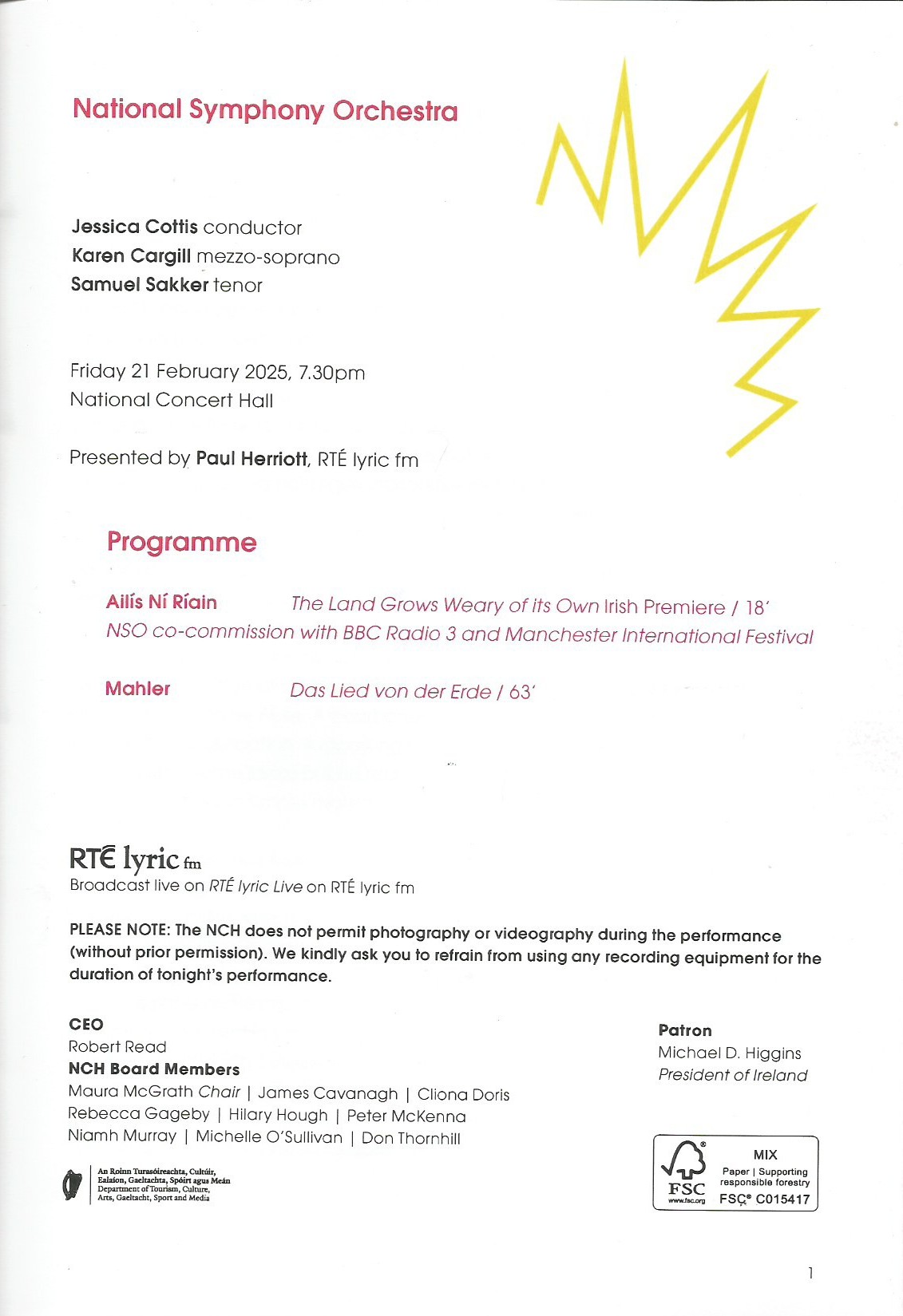
And it came to pass that yesterday evening I travelled into Dublin for another concert at the National Concert Hall. The main item on the menu was Das Lied von der Erde (“The Song of the Earth”), an orchestral work for two voices and orchestra by Gustav Mahler. Sometimes described as a song cycle this piece is a symphony in all but name (and number). Mahler was suspicious about counting this work as his 9th Symphony because of the Curse of the Ninth. He did go on to composer another (numbered) Symphony but did not live to hear it performed. He didn’t live to hear Das Lied von der Erde performed either.

Das Lied von der Erde (“The Song of the Earth”) is a long work – performance time is just over an hour – and it is spread over six movements, thematically linked by translations of classical Chinese poems translated into German by Has Bethge. The final movement, by far the longest, incorporates two texts whereas the others include one each.

This is one of my favourite works but I’ve only ever heard it on the radio or on a recording so I was delighted to see it was coming up at the National Concert Hall. I enjoyed last night’s performance enormously. The National Symphony Orchestra was conducted by Jennifer Cottis with soloists Samuel Sakker (tenor) and Karen Cargill (mezzo-soprano). The start of this piece is difficult for the tenor who has to come in at full volume. At first I thought he was going to struggle, but he hit his straps very quickly and delivered a strong performance. Karen Cargill was superb throughout, her voice very well matched to the demands of the music. I have heard her sing Mahler before, incidentally, in Cardiff, and she was great then too. The whole orchestra played beautifully, but I would pick out the woodwind section for special mention.

That wasn’t the entire concert. There was also the Irish premier of a new work work by Ailís Ní Ríain called The Land Grows Weary of its Own, which is a meditation on the effects on bird populations and migration thereof caused by Earth’s changing climate. It’s an interesting piece, with some fascinatingly complex passages, especially for the percussion. The composer was the audience, but unforunately the auditorium was only about half full for the performance. It only lasts about 20 minutes so the interval came quite quickly. Returning after my glass of wine I could see a much fuller Concert Hall so some people obviously skipped the first piece, which is a shame.

Yesterday was a very rainy and blustery day and on the way home I thought about the number of times I’ve walked from Connolly Station to the NCH yet never been rained on. Last night was no different.

Weekly Update from the Open Journal of Astrophysics – 22/02/2025

Posted in OJAp Papers, Open Access, The Universe and Stuff with tags , , , , , , , , , , , , , , , , , , on February 22, 2025 by telescoper

It’s Saturday morning again so it’s time for an update of papers published at the Open Journal of Astrophysics. Things have picked up a bit after a quiet couple of weeks. Since the last update we have published four new papers which brings the number in Volume 8 (2025) up to 18 and the total so far published by OJAp up to 253.

In chronological order of publication, the four papers published this week, with their overlays, are as follows. You can click on the images of the overlays to make them larger should you wish to do so.

The first paper to report is in fact our 250th paper:  “Untangling Magellanic Streams” by Dennis Zaritsky (Steward Observatory), Vedant Chandra (Harvard), Charlie Conroy (Harvard), Ana Bonaca (Carnegie Observatories), Phillip A. Cargile (Harvard), and Rohan P. Naidu (MIT), all based in the USA. This paper is in the folder marked Astrophysics of Galaxies and it reports on spectroscopic study aimed at teasing out the stellar populations of different strands of the Magellanic Stream. It was published on Tuesday 18th February 2025. Here is the overlay:

You can read the officially accepted version of this paper on arXiv here.

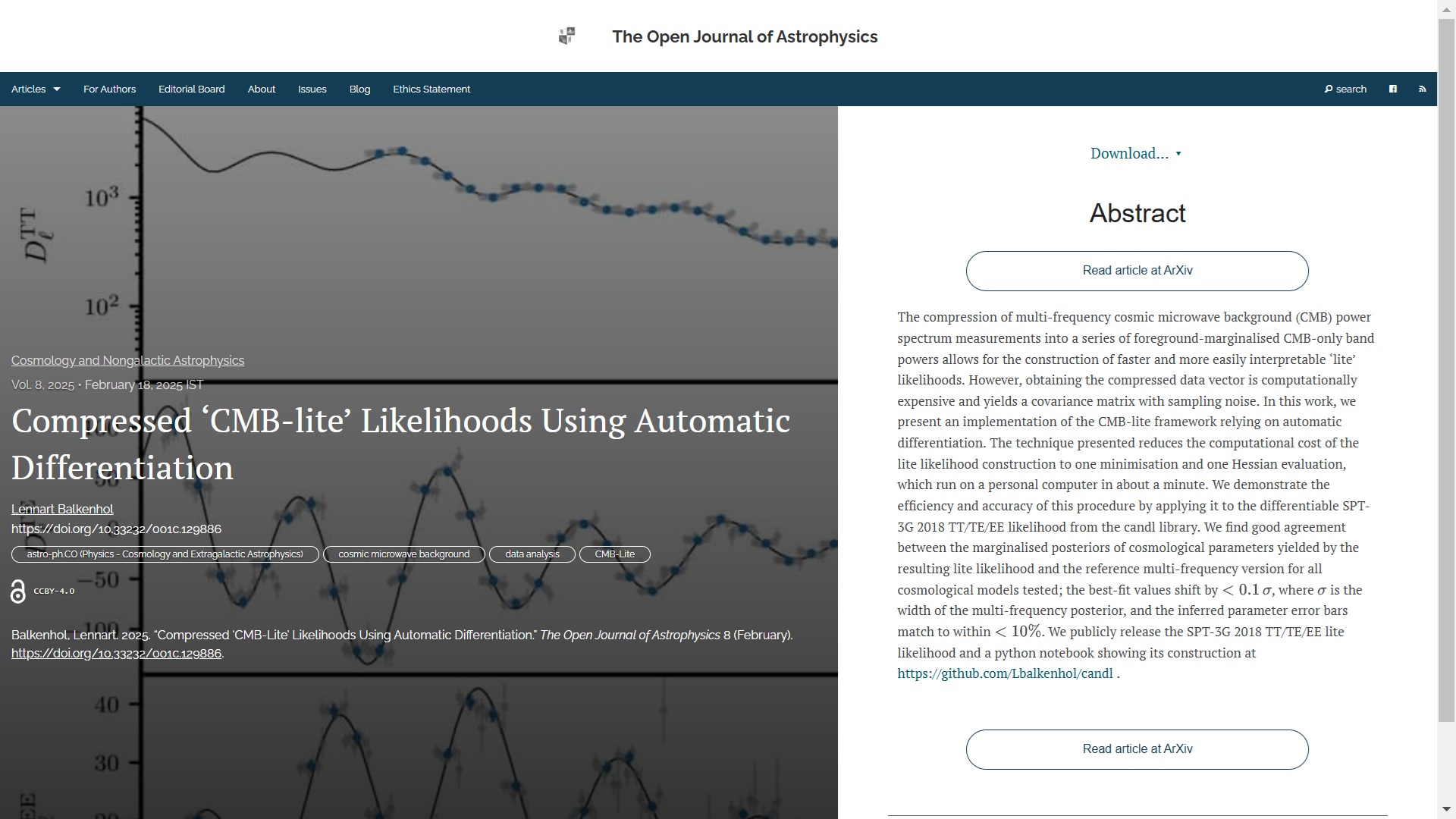
The second paper of the week  is “Compressed ‘CMB-lite’ Likelihoods Using Automatic Differentiation” by Lennart Balkenhol (Institut d’Astrophysique de Paris, France) which was one of two papers published on Wednesday 19th February. It appears in the folder Cosmology and Nongalactic Astrophysics and it describes an implementation of the CMB-lite framework relying on automatic differentiation to reduce the computational cost of the lite likelihood construction.  The overlay is here:

You can find the officially accepted version of this paper on arXiv here.

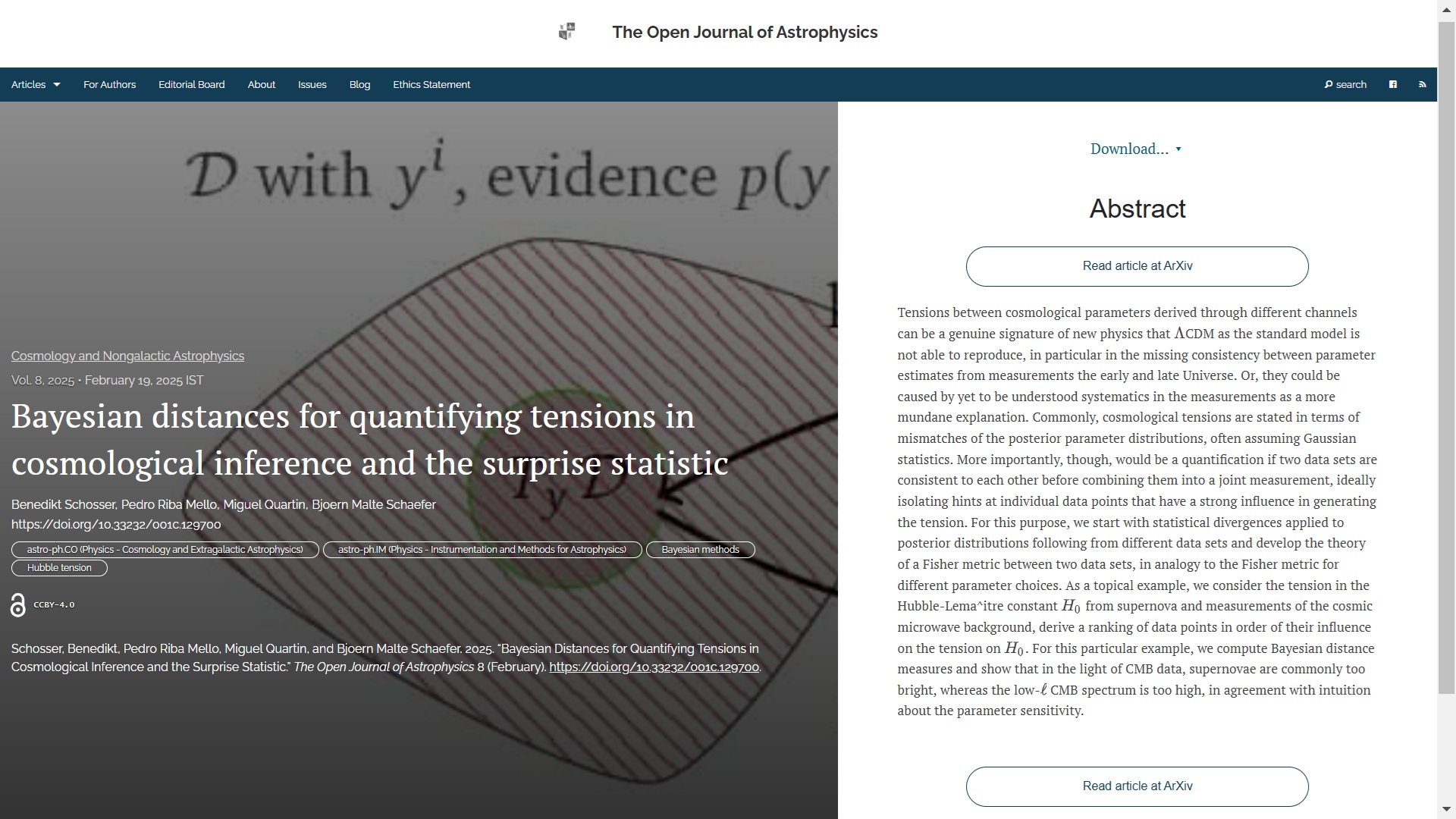
The next paper, also published on Wednesday 19th February in the folder Cosmology and Nongalactic Astrophysics is “Bayesian distances for quantifying tensions in cosmological inference and the surprise statistic” by Benedikt Schosser (Heidelberg, Germany), Pedro Riba Mello & Miguel Quartin (Rio de Janeiro, Brazil) and Bjoern Malte Schaefer (Heidelberg).  It presents a discussion of statistical divergences applied to posterior distributions following from different data sets and their use in quantifying discrepancies or tensions.

Here is the overlay:

The official published version can be found on the arXiv here.

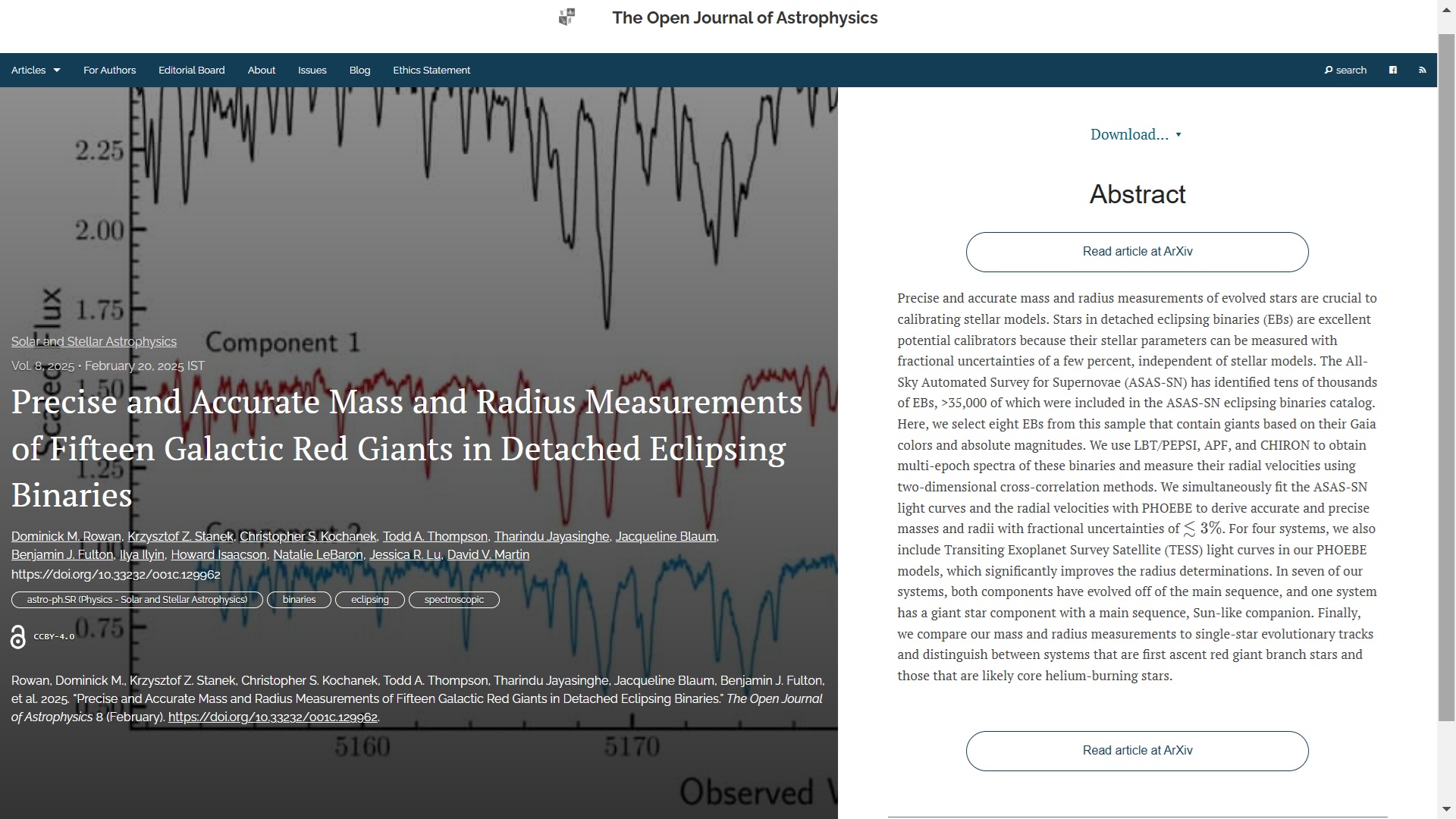
Finally in this batch we have “Precise and Accurate Mass and Radius Measurements of Fifteen Galactic Red Giants in Detached Eclipsing Binaries” by Dominick M. Rowan,  Krzysztof Z. Stanek,  Christopher S. Kochanek & Todd A. Thompson (Ohio State University), Tharindu Jayasinghe (independent researcher),  Jacqueline Blaum (UC Berkeley),  Benjamin J. Fulton (NASA/Caltech),  Ilya Ilyin (AIP Potsdam, Germany),  Howard Isaacson, Natalie LeBaron  &  Jessica R. Lu (UC Berkeley), and  David V. Martin (Tufts University, USA).  This paper was published on Thursday 20th February 2025 in the folder Solar and Stellar Astrophysics and it presents a compilation of mass and readius measurements of red giant stars obtained using spectroscopic measurements together with light curves and the eclipsing binary models obtained using PHOEBE.

The overlay is here:

You can find the “final” version on arXiv here.

That’s all for this week. I’ll do another update next Saturday.