Ireland Joining CERN

Posted in Science Politics, The Universe and Stuff with tags , , , , , , on February 20, 2025 by telescoper

The big news in Irish physics this week was the announcement that Ireland’s application to join the European Organisation for Nuclear Research (CERN) has been accepted in principle, and the country is expected to become an associate member in 2026. The formal process to join began in late 2023, as described here. Maynooth University responded to the news in positive fashion here, including the statement that

This important decision represents a transformative step for Irish science, research, and innovation, unlocking unparalleled opportunities for students, researchers, and industry.

I think this is a very good move for Irish physics, and indeed for Ireland generally. I will, however, repeat a worry that I have expressed previously. There is an important point about CERN membership, however, which I hope is not sidelined. The case for joining CERN made at political levels is largely about the return in terms of the potential in contracts to technology companies based in Ireland from instrumentation and other infrastructure investments. This was also the case for Ireland’s membership of the European Southern Observatory, which Ireland joined almost 7 years ago. The same thing is true for involvement in the European Space Agency, which Ireland joined in 1975. These benefits are of course real and valuable and it is entirely right that arguments should involve them.

Looking at CERN membership from a purely scientific point of view, however, the return to Ireland will be negligible unless there is a funding to support scientific exploitation of the facility. That would include funding for academic staff time, and for postgraduate and postdoctoral researchers to build up an active community as well as, e.g., computing facilities. This need not be expensive even relative to the modest cost of associate membership (approximately  €1.9M). I would estimate a figure of around half that would be needed to support CERN-based science.

The problem is that research funding for fundamental science (such as particle physics) in Ireland has been so limited as to be virtually non-existent by a matter of policy at Science Foundation Ireland, which basically only funded applied research. Even if it were decided to target funding for CERN exploitation, unless there is extra funding that would just lead to the jam being spread even more thinly elsewhere.

As I have mentioned before, Ireland’s membership of ESO provides a cautionary tale. The Irish astronomical community was very happy about the decision to join ESO, but that decision was not accompanied by significant funding to exploit the telescopes. Few astronomers have therefore been able to benefit from ESO membership. While there are other benefits of course, the return to science has been extremely limited. The phrase “to spoil a ship for a ha’porth of tar” springs to mind.

Although Ireland joined ESA almost fifty years ago, the same issue applies there. ESA member countries pay into a mandatory science programme which includes, for example, Euclid. However, did not put any resources on the table to allow full participation in the Euclid Consortium. There is Irish involvement in other ESA projects (such as JWST) but this is somewhat piecemeal. There is no funding programme in Ireland dedicated to the scientific exploitation of ESA projects.

Under current arrangements the best bet in Ireland for funding for ESA, ESO or CERN exploitation is via the European Research Council, but to get a grant from that one has to compete with much better developed communities in those areas.

The recent merger of Science Foundation Ireland and the Irish Research Council to form a single entity called Research Ireland perhaps provides an opportunity to correct this shortfall. If I had any say in the new structure I would set up a pot of money specifically for the purposes I’ve described above. Funding applications would have to be competitive, of course, and I would argue for a panel with significant international representation to make the decisions. But for this to work the overall level of public sector research funding will have to increase dramatically from its current level, well below the OECD average. Ireland is currently running a huge Government surplus which is projected to continue growing until at least 2026. Only a small fraction of that surplus would be needed to build viable research communities not only in fundamental science but also across a much wider range of disciplines. Failure to invest now would be a wasted opportunity. There is currently no evidence of the required uplift in research spending despite the better-than-healthy state of Government finances.

Geometric and General Relativistic Techniques for Non-relativistic Quantum Systems

Posted in Maynooth, The Universe and Stuff with tags , , on February 19, 2025 by telescoper

The other day I mentioned the forthcoming graduation of a Maynooth PhD student. His name is Aonghus Hunter-McCabe and his main supervisor was Maynooth colleague Brian Dolan, and I just took over when Brian retired to see Aognhus through the latter stages. Anyway, asof yesterday, his thesis is available on arXiv (on hep-th) as well as on the Maynooth University Research Archive Library (MURA) here, so as it is all in the public domain I thought I would advertise it here, as I think it is very good indeed (though I would say that!) and also in case anyone out there is looking to employ a PDRA in a related area…

The abstract is:

This thesis explores the application of differential geometric and general relativistic techniques to deepen our understanding of quantum mechanical systems. We focus on three systems, employing these mathematical frameworks to uncover subtle features within each. First, we examine Unruh radiation in the context of an accelerated two-state atom, determining transition frequencies for a variety of accelerated trajectories via first-order perturbation theory. For harmonic motion of the atom in a vacuum, we derive transition rates with potential experimental realizations. Next, we investigate the quantum Hall effect in a spherical geometry using the Dirac operator for non-interacting fermions in a background magnetic field generated by a Wu-Yang monopole. The Atiyah-Singer index theorem constrains the degeneracy of the ground state, and the fractional quantum Hall effect is studied using the composite fermion model, where Dirac strings associated with the monopole field supply the statistical gauge field vortices. A unique, gapped ground state emerges, yielding fractions of the form ν=1/(2⁢k+1) for large particle numbers. Finally, we examine the AdS/CMT correspondence through a bulk fermionic field in an RN-AdS4 background (with a U(1) gauge field), dual to a boundary fermionic operator. Spherical and planar event horizon geometries are discussed, with the temperature of the RN black hole identified with that of the dual system on the boundary. By numerically solving for the spectral functions of the dual theory, for a spherical event horizon at zero temperature, we identify a shift in the Fermi surface from that which arises in the planar case. Preliminary evidence of a phase transition emerges upon examining these spectral functions, again for the spherical horizon, at non-zero temperature.

arXiv:2502.13009

The 250th Publication at the Open Journal of Astrophysics!

Posted in OJAp Papers, Open Access, The Universe and Stuff with tags , on February 18, 2025 by telescoper

It’s been a very busy day for various reasons so I’ll just mention that this morning I published the 250th paper at the Open Journal of Astrophysics. The lucky publication to garner this distinction is “Untangling Magellanic Streams” by Dennis Zaritsky (Steward Observatory), Vedant Chandra (Harvard), Charlie Conroy (Harvard), Ana Bonaca (Carnegie Observatories), Phillip A. Cargile (Harvard), and Rohan P. Naidu (MIT), all based in the USA. Here is the overlay

This will feature in the update on Saturday along with the other papers to be published this week, of which I expect several.

Two Weeks into Term…

Posted in Biographical, Education, Maynooth with tags , on February 17, 2025 by telescoper

I thought that this semester would have had an easier start than the last because I am teaching only one new module (and one familiar one) instead of the two new modules I had last semester. Unfortunately I wasn’t very well before the start of this one and have been struggling to recover so this term hasn’t been easy at all and I’ve had a lot to catch up. At least I’ve managed to stay on top of the lectures and lab sessions and everything so far has gone relatively smoothly. I have to admit though that only two weeks in, I already feel extremely tired. I went to bed at 9pm last night and slept straight through to my alarm at 7am. I’m getting old.

Last week we had our Examination Board meeting for Semester 1 in the Department of Physics. I also attended the Examination Board for the Department of Engineering because I was teaching an Engineering Mathematics module last semester. The students in both Departments should receive their provisional examination results this week, although there have been some gremlins in the campus systems which may lead to a delay in the marks being released.

Semester 2 is a bit more complex than Semester 1 because of a number of interruptions for holidays, etc. The first Monday of this term was actually a holiday, but I don’t actually have lectures on Mondays this term so that didn’t matter, nor will Monday 5th May which is also a holiday. I do, however, have a Particle Physics lecture on Fridays so will miss one on because of the national holiday on April 18th for Good Friday and will have to plan accordingly. The following week (Mon-Fri, starting on 21st April) is the Easter Break, and the week from 17th to 21st March is Study Week (starting with the St Patrick’s Day national holiday on Monday 17th). Although the number of teaching weeks is the same as Semester 1, they are spread out over a longer period with two gaps instead of one. One break is coming up about a month from now, and then another a month after that. This schedule is rather kind to those of us Oldies who tire easily!

Although I’ve kept up with the teaching preparation reasonably well, I have let other things slip. In particular, I have a graduate student getting ready to submit their PhD thesis ahead of an imminent deadline. I promised to read it and supply suggestions/corrections which I have yet to. That’s right at the top of my list for this week.

Talking of PhD students, my first ever official PhD student at Maynooth has already already passed his viva voce examination – about a year ago actually – but owing to bureaucratic delays he won’t graduate until this year, at a conferring ceremony in the March study week mentioned above.

Introducing the Clartiverse™

Posted in Education, mathematics with tags , , , , on February 16, 2025 by telescoper

The recent decision by Maynooth University to appoint a Ranking Strategy and Insights Officer in an attempt to raise the University’s position in university league tables has inspired me to create a new spinout company to provide a service for higher education institutions who want to improve their standing in rankings while avoiding the expense and complication of actually improving the institution or indeed while continuing to pursue policies that drive performance in the opposite direction.

I have decided to name my new company CLARTIVERT™ and the extensive suite of services we will provide is called the Clartiverse™.

The idea of CLARTIVERT™ is to produce, in return for a modest payment equivalent to the salary cost of a Ranking Strategy and Insights Officer, a bespoke league table that guarantees a specified position for any given institution. This can be either your own institution whose position you would like to raise or some competitor institution that you wish to lower. We then promote the league table thus constructed in the world’s media (who seem to like this sort of thing).

The idea behind this company is that the existing purveyors of rankings deliberately manufacture artificial “churn” in the league tables by changing their weighting model every year. Why not take this process to its logical conclusion? Our not-at-all dodgy software works by including so many metrics that an appropriate combination can always be chosen to propel any institution to the top (or bottom). We then produce We achieve all this by deplying a highly sophisticated branch of mathematics called Linear Algebra which we dress up in the fancy terms “Machine Learning” and  “Artificial Intelligence” to impress potential buyers.

To begin we will concentrate on research assessment. This is, of course, covered by existing league tables but our approach is radically different. We will desploy a vastly expanded set of metrics, many of which are currently unused. For example, on top of the usual bibliometric indicators like citation counts and numbers of published papers, we add number of authors, number of authors whose names start with a given letter of the alphabet, letter frequencies occuring in published texts, etc. We adopt a similar approach to other indicators, such as number of academic staff, number of PhD students, number of research managers, initial letters of names of people in these different categories, distribution of salaries for each, and so on.

As well as these quantities themselves we calculate mathematical functions of them, including polynomials, exponentials, logarithms and trigonometricfunctions; sine and cosine have proved very useful in early testing. All these indicators are combined in various ways: not only added, but also subtracted, multiplied, and/or divided until a weighted combination can be found that places your institution ahead of all the others.

In future we will roll out additional elements of the Clartiverse™ to cover other aspects of higher education including not only teaching and student satisfaction but also more important things such as commercialisation and financial impropriety.

P.S. The name Clartiver is derived from the word clart and is not to be confused with that of any other companies providing similar but less impressive services.

Weekly Update from the Open Journal of Astrophysics – 15/02/2025

Posted in OJAp Papers, Open Access, The Universe and Stuff with tags , , , , , , , , , , on February 15, 2025 by telescoper

Time for another quick update of papers published at the Open Journal of Astrophysics. Since the last update we have published two new papers, which brings the number in Volume 8 (2025) up to 14 and the total so far published by OJAp up to 249.

Here are quick descriptions of the two papers concerned; you can click on the images of the overlays to make them larger should you wish to do so.

First one up is “AI-assisted super-resolution cosmological simulations IV: An emulator for deterministic realizations” by Xiaowen Zhang & Patrick Lachance (Carnegie Mellon), Ankita Dasgupta (Penn State), Rupert A. C. Croft & Tiziana Di Matteo (Carnegie Mellon), Yueying Ni (Harvard), Simeon Bird (UC Riverside) and Yin Li (Shenzhen University, China).  It presents a method of achieving super-resolution to rapidly enhance low-resolution runs with statistically correct fine details to generate accurate simulations and mock observations for large galaxy surveys and was published on Monday 10th February 2025 in the folder marked Cosmology and NonGalactic Astrophysics.


You can find the officially accepted version of this paper on arXiv here.

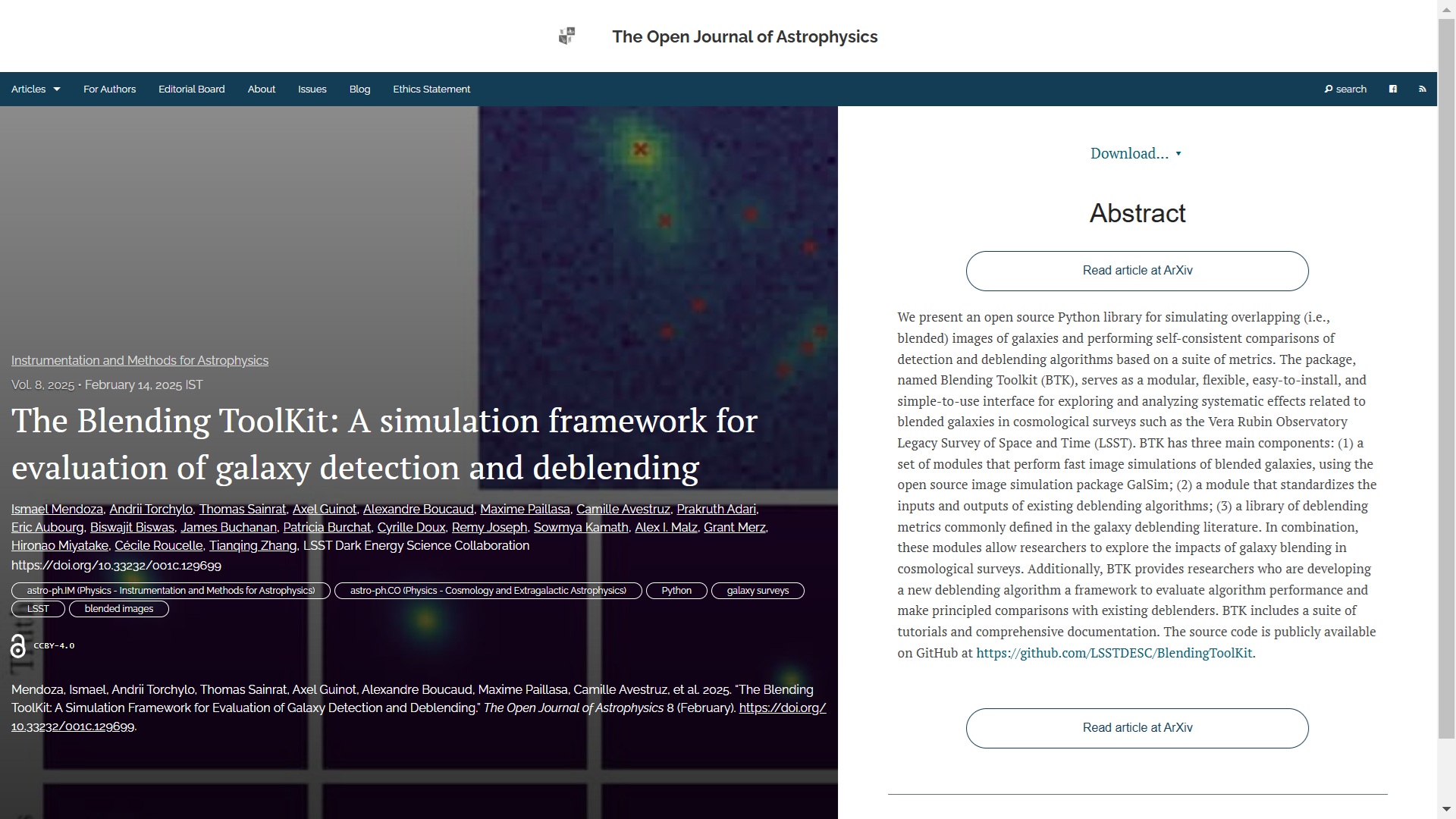
The second paper, published on Friday 14th February 2025 in the folder Instrumentation and Methods for Astrophysics is “The Blending ToolKit: A simulation framework for evaluation of galaxy detection and deblending” which describes a modular suite of Python software for exploring and analyzing systematic effects related to blended galaxy images in cosmological surveys. It was written by Ismael Mendoza (U. Michigan, Ann Arbor, USA) and 19 others, on behalf of the LSST Dark Energy Science Collaboration. I don’t have time to list all the authors here but you can find them on the overlay here:


The accepted version of this paper can be found on the arXiv here.

That’s all for this week. I’ll do another update next week, when I expect to be able to report that we have passed the 250 publication mark.

My Funny Valentine – Bill Evans & Jim Hall

Posted in Jazz with tags , , , on February 14, 2025 by telescoper

The Rodgers & Hart standard My Funny Valentine has been recorded well over a thousand times, with superb jazz versions by Chet Baker and Miles Davis among many others. This is one of my favourites, the result of a 1962 collaboration between pianist Bill Evans and guitarist Jim Hall on the album Undercurrent

On Elon Musk

Posted in Politics, Science Politics with tags , on February 13, 2025 by telescoper

I’m taking the liberty of reblogging this post about the Royal Society’s inaction in the case of Elon Musk. I urge you to read the post. As I said in a previous article:

The venerable Royal Society still counts him as a Fellow, despite his overtly antiscientific dissemination of false information and his support for far-right extremism. I don’t know how Musk was elected an FRS in 2018, perhaps before the worst of his character became widely known, but the fact that he remains a Fellow tarnishes the reputation of that organization.

I urge you to read the following blog post and also to sign (as I have done) the open letter from Stephen Curry.

Professorial Position in Observational Astrophysics or Cosmology at Maynooth University!

Posted in Maynooth, The Universe and Stuff with tags , , , , on February 12, 2025 by telescoper

It’s been a couple of weeks since I announced a job opportunity in the form of Professorial position in Observational Astrophysics or Cosmology at Maynooth University. After a short bureaucratic delay the announcement has just appeared on the AAS Jobs Register here, which gives me an excuse to post about the poistion again. The deadline is 31st March 2025. I hope readers of this blog will help spread the news of this opportunity through their own networks.

The strategic case for this Chair revolves around broader developments in the area of astrophysics and cosmology at Maynooth. Currently there are two groups active in research in these areas, one in the former Department of Experimental Physics (which is largely focussed on astronomical instrumentation) and the other, in the former Department of Theoretical Physics, which is theoretical and computational. We want to promote closer collaboration between these research strands. The idea with the new position is that the holder will nucleate and lead a research programme in the area between these existing groups as well as getting involved in outreach and public engagement.

It is intended that the position to appeal not only to people undertaking observational programmes using ground-based facilities (e.g. those provided by ESO, which Ireland recently joined), or those exploiting data from space-based experiments, such as Euclid, as well as people working on multi-messenger astrophysics, gravitational waves, and so on.

P. S. For those of you reading this from outside Ireland the job includes a proper public service pension, a defined benefit scheme way better than the UK’s USS.

Aubade – Louis MacNeice

Posted in Poetry with tags , , , on February 11, 2025 by telescoper
Having bitten on life like a sharp apple 
Or, playing it like a fish, been happy,

Having felt with fingers that the sky is blue,
What have we after that to look forward to?

Not the twilight of the gods but a precise dawn
of sallow and grey bricks, and newsboys crying war.

by Louis MacNeice (1907-1963)