Stargazing Live on Sussex University Campus – Tonight!

Posted in The Universe and Stuff with tags , , , , on March 18, 2015 by telescoper

Just a quick post to advertise the fact that the BBC Television series Stargazing Live will be broadcast in the evenings this week from Wednesday 18th to Friday 20th March, 2015. The programme is hosted by Professor Brian Cox and Dara O Briain and will be beamed to you (or at least to those of you who have television sets) from Jodrell Bank, which is near Manchester (in the Midlands).

Closer to home, at least for those of you whose home is closer to mine than it is to Jodrell Bank, the Department of Physics & Astronomy at the University of Sussex will be running a series of astronomical activities (including planetarium shows, observing sessions and lectures) for all ages to coincide with the programme tonight (i.e. Wednesday 18th March). This also takes place within One World Week at the University of Sussex, which gives it added interest for both staff and students. There’s nothing like astronomy to make you aware of our shared existence on this little planet…

There are two sessions this evening. One is from 6pm to 7.30pm and the other from 8pm to 9.30pm. You can find full details of both sessions here, but here’s a taster of the menu for the earlier session:

stargazing

It’s lovely and sunny on Sussex University campus as I write this, and the forecast is good for this evening too. Might we be able to get a glimpse of the Aurorae that lit up the skies over Britain last night? I can’t promise that, but there’s a chance! Sadly the forecast for Friday’s partial solar eclipse is not so good, but we live in hope.

Anyway, wherever you are and whatever you do this evening, here’s wishing you Happy Stargazing!

A Solar Eclipse

Posted in Poetry, The Universe and Stuff with tags , , , on March 17, 2015 by telescoper

In that great journey of the stars through space
    About the mighty, all-directing Sun,
    The pallid, faithful Moon, has been the one
Companion of the Earth. Her tender face,
Pale with the swift, keen purpose of that race,
    Which at Time’s natal hour was first begun,
    Shines ever on her lover as they run
And lights his orbit with her silvery smile.

Sometimes such passionate love doth in her rise,
    Down from her beaten path she softly slips,
And with her mantle veils the Sun’s bold eyes,
    Then in the gloaming finds her lover’s lips.
While far and near the men our world call wise
    See only that the Sun is in eclipse.

by Ella Wheeler Wilcox (1850-1919)

Remembering Erdös

Posted in Biographical with tags , , on March 17, 2015 by telescoper

This poster, advertising a forthcoming Summer School in honour of the famous mathematician Paul Erdös arrived this morning, so I thought I’d advertise it through this blog.

Erdos

In case you didn’t know, Paul Erdős (who died in 1996) was an eccentric yet prolific Hungarian mathematician who wrote more than 1000 mathematical papers during his life but never settled in one place for any length of time. He travelled constantly between colleagues and conferences, mostly living out of a suitcase, and showed no interest at all in property or possessions. His story is a fascinating one, and his contributions to mathematics were immense and wide-ranging, and I’m sure the conference in his honour will be fascinating.

A strange offshoot of his mathematical work is the Erdős number, which is really a tiny part of his legacy, but one that seems to have taken hold. Some mathematicians appear to take it very seriously, but most treat it with tongue firmly in cheek, as I certainly do.

So what is the Erdős number? It’s actually quite simple to define. First, Erdős himself is assigned an Erdős number of zero. Anyone who co-authored a paper with Erdős then has an Erdős number of 1. Then anyone who wrote a paper with someone who wrote a paper with Erdős has an Erdős number of 2, and so on. The Erdős number is thus a measure of “collaborative distance”, with lower numbers representing closer connections. I say it’s quite easy to define, but it’s rather harder to calculate. Or it would be were it not for modern bibliographic databases. In fact there’s a website run by the American Mathematical Society which allows you to calculate your Erdős number as well as a similar measure of collaborative distance with respect to any other mathematician. Also, a list of individuals with very low Erdős numbers (1, 2 or 3) can be found here. I did a quick poll around the Department of Mathematics here at the University of Sussex and it seems that the shortest collaborative distance among the staff belongs to Dr James Hirschfeld who has an Erdos Number of 2. There is a paper of his, with M. Deza and P. Frankl, Sections of varieties over finite fields as large intersection families, Proc. London. Math. Soc. 50 (1985), 405-425 and both Michel Deza and Peter Frankl have joint papers with Paul Erdős.

Given that Erdős was basically a pure mathematician, I didn’t expect first to show up as having any Erdős number at all, since I’m not really a mathematician and I’m certainly not very pure. However, his influence is clearly felt very strongly in physics and a surprisingly large number of physicists (and astronomers) have a surprisingly small Erdős number. Anyway, my erstwhile PhD supervisor Professor John D. Barrow emailed to point out that he had written a paper with Robin Wilson, who once co-authored a paper (on graph theory) with Erdős himself. That means that John’s Erdős number is now 2, mine is consequently 3 (unless, improbably, I have unkowingly written a paper with someone who has written a paper with Erdős). Anyone I’ve ever written a paper with has an Erdős number no greater than 4; they of course may have other routes to Erdős than through me.

Anyway, none of that is important compared to the real legacy of Erdős, which is his mathematical work. I’m sure the Summer School will be both rewarding and enjoyable!

When You’re Smiling

Posted in Jazz with tags , on March 16, 2015 by telescoper

I’m not sure it’s possible for any record to be perfect, but there are definitely some that I couldn’t be improved in any way that I can imagine. I can think of a number of Jazz records that fall into that category, including this version of When You’re Smiling made in 1938. It features Billie Holliday and Lester Young along a number of other members of the Count Basie Orchestra (apart from the Count himself, who is replaced by Teddy Wilson on piano).

That this is a favourite record of mine is a bit of a paradox, because I don’t really like the song very much. However, in jazz the tune is just the starting point. In her early recording career, Billie Holliday wasn’t very well known so she was often given relatively unpromising songs to sing. She turned out to be brilliant at turning this base metal into gold and becamse the best singer of a bad song there has ever been.

It’s not just the way Billie Holliday’s voice floats ethereally across the beat as she takes outrageous liberties with both melody and rhythm. Nor is the way she manages to express everything there is about life and love and hearteache through the rather  banal lyrics, investing the song with a deep sense of tragic irony. Nor is it Lester Young’s superbly constructed tenor saxophone solo near the end, which one of the very greatest by one of the very greatest. Nor is it that lightly swinging rhythm section of Freddie Green, Walter Page and Jo Jones who push the whole thing along on gossamer wings, making most of their rivals sound like clodhoppers; the drummer Jones,for example, adds  punctuation in the form of accents to the poetry of Lester Young’s solo. All the component parts are magnificent, but the whole is even greater than their sum. It’s a timeless jazz masterpiece.

I don’t know why I haven’t posted this track before, but better late than never. I hope you can take 3 minutes to enjoy it!

Tell Them Science Is Vital

Posted in Politics, Science Politics with tags on March 15, 2015 by telescoper

To follow up on my previous post, here’s a a lot more about the Tell Them Science Is Vital initiative…

noodlemaz's avatarPurely a figment of your imagination

There’s another election coming up and, whatever the outcome, we’ll all (hopefully) still be doing our jobs and waiting for the situation to improve.

Something the government could do to lay foundations for education, industries and economic growth in the UK is to fund science. Over the last 2 decades, they’ve really let this slide. Enter #TellThemSiV, the new campaign from Science is Vital, to do just that…

Tell Them Science is Vital

In just a few weeks, Britain goes to the polls to vote in a new government. This is obviously a crucial time for science funding and policy.

That is why Science Is Vital needs you to contact your MP or parliamentary candidate.

Since 2010, the science budget, despite having been protected from the worst of the austerity measures by the ring-fence we fought for, will nevertheless have shrunk in real terms by up to 20%.

In…

View original post 811 more words

Science Is Vital, So Don’t Let It Be Strangled.

Posted in Politics, Science Politics with tags , , on March 15, 2015 by telescoper

The General Election looming on the horizon could prove to be a watershed for scientific research in the United Kingdom. In the period immediately following the 2010 Election there was a great deal of nervousness about the possibility of huge cuts to spending on research. One of the most effective campaigns to persuade the new government against slashing funding for science on the grounds that scientific research was likely to be the principal fuel for any economic recovery was led by Science is Vital. I have written a few posts about this organisation.

The scientific community breathed a collective sigh of relief in autumn 2010 when the UK Government announced that research funding would be “ring-fenced” and maintained in cash terms for the duration of the Parliament. Things could have been far worse, as they have been in other parts of the public sector, but over the years the effect of inflation has been that this “flat cash” settlement involves a slow strangulation as opposed to a quick fall of the axe.

A recent piece in the Guardian includes this picture, which speaks for itself:

Science_spendingThe United Kingdom now spends less than 0.5% of its GDP on research, and this fraction is falling rapidly. We are now ranked last in the G8 by this criterion, way behind the USA and Germany. Why are we in this country so unbelievably miserly abou funding research? Other countries seem to recognize its important, so why can’t our politicians see it? We should be increasing our investment in science, not letting it wither away like this.

It seems to me that much more of this squeeze and we’ll be needing to close down major facilities and start withdrawing from important international collaborations. The Science and Technology Facilities Council (STFC) is particularly vulnerable, as such a large fraction of its budget is committed to long-term projects. It’s already trimmed funding for other activities to the bone, with research grants under particularly intense pressure. Will the ongoing Nurse Review of the Research Councils spell doom for STFC, as many of my colleagues think? Will be research funding  be transferred rom universities into research institutes?

Anyway, it seems an appropriate time to advertise the latest campaign from Science is Vital, which involves writing to candidates (including incumbent MPs) in your constituency to Tell Them That Science Is Vital. You might consider including some of the following, or others suggested by the website. If you’re a scientist, describe why your research is important. Here are some suggestions. If there is a local research institute in your constituency, explain how important it is to your local economy (how many people it employs, for example). If you’re a patient, or someone who cares for a patient, say how important you think research into that disease. Ask your candidate or MP to endorse the Science is Vital campaign to increase public funding of science to 0.8% of GDP. And if you do write, remember that the economic argument for investing research isn’t the only one…

Astronomy Look-alikes, No. 95

Posted in Astronomy Lookalikes with tags , , on March 14, 2015 by telescoper

I wonder if anyone else has noticed the resemblance between Coel Hellier, Founder and Head of International Rescue, and Jeff Tracey, Professor of Astrophysics at Keele University? Thunderbirds are go!

Perhaps the UK space programme could benefit significantly from the assistance of his organisation?

Hellier_Tracey

SKA Matters

Posted in Science Politics, The Universe and Stuff with tags , , , , on March 13, 2015 by telescoper

There’s been quite a lot going on recently to do with the Square Kilometre Array (SKA), some of it scientific and some of it political, some of it good and some of it bad. At least those seem to me to be the appropriate descriptions.

First the scientific good news is the the SKA Board has decided which of the planned components of SKA should be constructed during the first phase, which has a budget of around €650M. Details can be found here but, in a nutshell, it seems that the SKA Survey Telescope, which was to be built around the existing pathfinder project ASKAP located in Australia is not going to be built in the first phase. This implies the low-frequency bit of SKA will be in Australia while the higher-frequency activities will be concentrated in South Africa. That seems a pragmatic decision to me based on the budgetary constraints and should lead to a lot of good science being done. At the very least it’s a clear decision.

This positive news has however been overshadowed by an unseemly spat over the choice of headquarters over the location of the SKA Headquarters which has culminated in a rather unhelpful story in Nature. SKA HQ has been temporarily housed at Jodrell Bank Observatory (in the Midlands) since 2012 and there are clearly some who would like it to be located there permanently. There is however a rival bid, from the historic Italian city of Padova, at whose university Galileo Galilei once lectured, and which remains one of the top universities in Italy.

I should put my cards on the table and say that I’ve enjoyed many visits to Padova in my career, starting when I was a PhD student back in the 1980s and have many fond memories of the place. The late co-author of my cosmology textbook, Francesco Lucchin was Director of the Department of Astronomy in Padova at that time. For many years Padova has been home to a large concentration of astronomers and is undoubtedly a centre of excellence. Moreover it is a city that is very well served by transport links, just a short distance from Venice so easily reachable by air, and also on a major railway line offering fast national and international services. It’s also a considerably better place to dine out than Jodrell Bank!

Specola

Padova’s astronomers are housed in the Castello Carrese which adjoins the Specola (above), a tower which was once a working astronomical observatory but, being right in the city centre, has not been useful for such purposes for many moons. When I first started going to Padova the Department of Astronomy was located in the tower and in some nearby buildings but the rest of the Castello Carrese was used as a prison. Now it’s been renovated and all the astronomers have been located there. I remember the frequent walks across the little bridge over the canal to a coffee bar where we often did some of our best research!

Given its strategically important location, Padova was bombed by Allied planes on a number of occasions in 1944 and 1945. My Italian colleagues would regularly draw my attention to the plaque near the entrance to the Specola pointing out that it was hit and badly damaged by Allied bombs during one raid.

Anyway I can certainly see the merits of locating SKA HQ in Padova but it’s not my decision to make. Those responsible have not yet made a final decision, but what’s sad is that a number of stories have been flying around in the media that imply that the UK is trying to exert undue political interference to stop SKA HQ being moved to Italy. Whether this is true or not I don’t know. As far as I’m concerned the powers that be are following proper process and that process has not yet been brought to a conclusion. Whatever the outcome, though, there’s no question that the language being used in the press coverage is very damaging. Let’s hope it can all be resolved amicably.

Now for a spot of lunch and then up to the Royal Astronomical Society where the topic of the Discussion Meeting is, somewhat ironically, Building an Open UK SKA-Science Consortium…

Bloomdido – In Memoriam Charlie Parker

Posted in Jazz with tags , , , , , , on March 12, 2015 by telescoper

bird

Today marks the 60th anniversary of the death of the great saxophonist Charlie Parker (“Bird”) on 12th March 1955. I’ve written quite a few posts relating to Charlie Parker over the years but today has provided a good excuse to spend my lunchtime writing another one, this time featuring one of my favourite tracks from one of my favourite albums. First released in 1952 but in fact recorded in two separate sessions in 1949 and 1950, the album Bird and Diz was actually the last studio album made under the joint leadership of Charlie Parker and Dizzy Gillespie, the two main architects of the bebop revolution; the track I’ve picked has the added advantage of featuring another great musical genius on piano, Thelonious Monk.

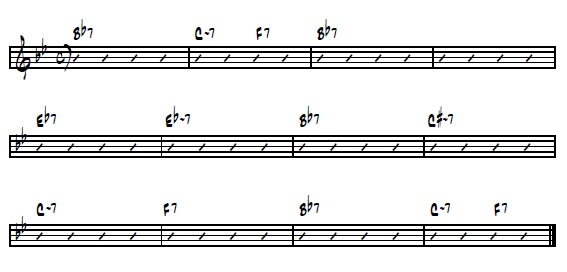
The Charlie Parker composition Bloomdido is yet another of his variations on the blues, though this one is a bit less intricate than some of the others he wrote. Here are the chords for Bloomdido:

Bloomdido

You can see that the progression is based around the standard three chords of a blues in B♭. The foundation is a  “tonic” chord (T) based on the root note of whatever key it’s played in, in this case B♭. This sometimes a basic triad consisting of the first, third and five notes of a major scale starting on that note or, as in this example,  including the dominant 7th so it’s B♭7. The next chord is the subdominant chord  (S), shifting things up by a perfect fourth relative to the tonic, in this case an E♭7 and then finally we have the dominant (D) which brings us up by a fifth from the original root note, in this case F7.

The basic blues sequence in B♭ would be four bars of B♭7 (T), two of E♭7 (S), back to B♭7 (T) for two, then the characteristic bluesy cadence returning to two bars of  B♭7 (T) via one bar each of F7 (D) and E♭7 (S). The sequence for Bloomdido has a few alterations, including a characteristic turnaround at the end instead of the tonic, but is otherwise fairly recognizable. I guess the first part of the title  is a play on the blues origin too, though I wonder if the second part suggests that some of the alterations are inspired by the A-section of the  Juan Tizol standard Perdido?

Some people tell me they find Charlie Parker’s music “too technical” and that somehow if music “needs to be explained” it’s not good music. I don’t understand that attitude at all. I find this music so fascinating and exciting to listen to that I want to try to dig a little bit into it and find out what’s going underneath the surface. It’s particularly striking what a difference a few substitutions and passing chords can make to the overall harmonic “feel” of a piece like this compared to a standard blues sequence, for example. But you don’t need to study the chords to appreciate the sheer beauty of the music that Charlie Parker built on these harmonic foundations; his solo on this track, as on so many others he recorded in his short life,  is just sublime even if you don’t realise how hard it is to play! I guess it all depends whether your way of enjoying a thing is to sit back and let it wash over you, or for it to inspire you to find out more. Many of the physicists I know are deeply interested in music. Perhaps that’s because they’re the sort of people who don’t just think “wow that’s beautiful”, they tend to think “wow that’s beautiful – how does it work?”.

Charlie Parker and Albert Einstein died in the same year, just over a month apart, the former in March 1955 and the latter in April. They were two very different geniuses but it’s as difficult to imagine physics without  Einstein as jazz without Bird.

Forthcoming Attraction: Dark Energy and its Discontents

Posted in Talks and Reviews, The Universe and Stuff with tags , , on March 11, 2015 by telescoper

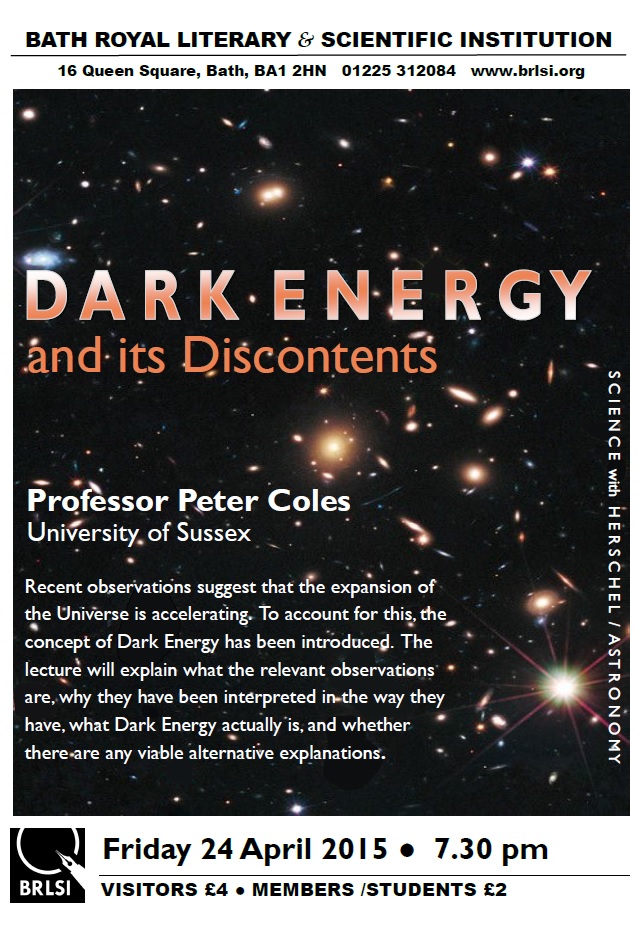
Busy again today, so just time for a spot of gratuitous self-promotion. I shall be giving a public lecture on Friday 24th April 2015 at the very posh-sounding Bath Royal Literary and Scientific Institution. Here is the poster, which explains all. Will I see any readers of this blog there?

Bath_lecture