Fourier Series, Epicycles and Haemorrhoids

Posted in The Universe and Stuff with tags , , , , on August 13, 2015 by telescoper

My attention was drawn to this little video some time ago by esteemed Professor George Ellis. I don’t know why it has taken me so long to share it here. It’s a nice illustration of the principles of Fourier series, by which any periodic function can be decomposed into a series of sine and cosine functions.

This reminds me of a point I’ve made a few times in popular talks about Astronomy. It’s a common view that Kepler’s laws of planetary motion  according to which which the planets move in elliptical motion around the Sun, is a completely different formulation from the previous Ptolemaic system which involved epicycles and deferents and which is generally held to have been much more complicated.

The video demonstrates however that epicycles and deferents can be viewed as parts the construction of a Fourier series. Since elliptical orbits are periodic, it is perfectly valid to present them in the form a Fourier series. Therefore, in a sense, there’s nothing so very wrong with epicycles. I admit, however, that a closed form expression for such an orbit is considerably more compact and elegant than a Fourier representation and also encapsulates a deeper level of physical understanding.

It’s nore entirely relevant to the rest of this post but I discovered last week – by reading a book – that Johannes Kepler suffered so badly from haemorrhoids (piles) that he did all his calculations standing up. I just thought I’d share that with you.

Clearing Advice for Mathematics, Physics and Astronomy Applicants!

Posted in Education with tags , , , , on August 12, 2015 by telescoper

Well, tomorrow is the big day. This year’s A-level results are out on Thursday 13th August, with the consequent scramble across the country to confirm places at university. Good luck to all students everywhere waiting for your results. I hope they are what you expected!

For those of you who didn’t get the grades they needed, I have one piece of very clear advice:

1-dont-panic

The clearing system is very efficient and effective, as well as being quite straightforward to use, and there’s still every chance that you will find a place somewhere good. So keep a cool head tomorrow and follow the instructions. You won’t have to make a decision until 5pm tomorrow, so there’s plenty of time to explore all the options.

As a matter of fact we will have places in the School of Mathematical & Physical Sciences at the University of Sussex. Whether you’re interested in Physics, Astrophysics, Astronomy or Mathematics (or even a combination of those subjects), why not just take a look at the University’s Clearing Page and give us a ring? I’ll be helping out on the phone lines tomorrow myself, so I might get to talk to you in person.

Anyway, here’s a video featuring our excellent admissions team, led by the inestimable Rob Evans, to explain the process:

The 2015  National Student Survey results are just out and they show that the Department of Mathematics has a 94% rating for overall satisfaction; the Department of Physics & Astronomy has 91%. Click the relevant link for more information on our courses in Physics & Astronomy or for Mathematics!

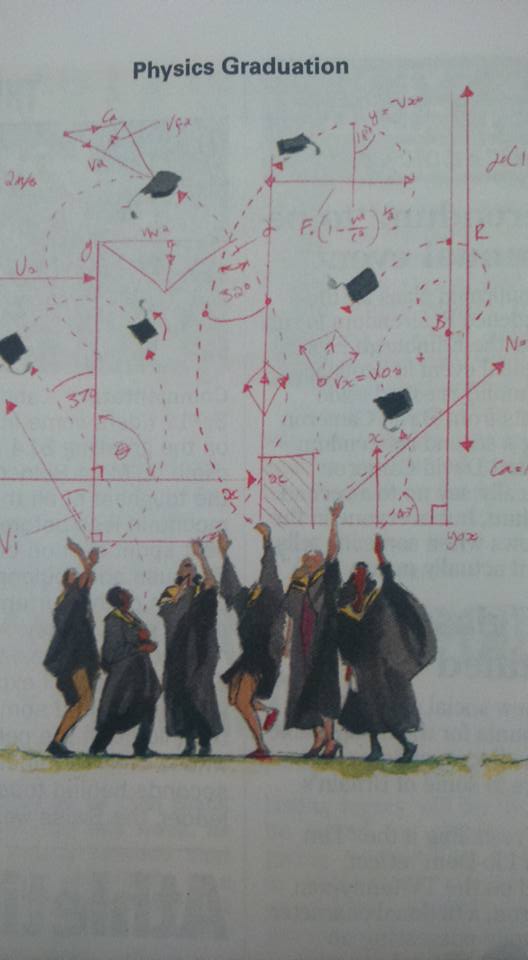
Physics Graduation, according to Private Eye

Posted in Education, The Universe and Stuff with tags , , on August 11, 2015 by telescoper

Very busy day today, what with one thing and another (and another, and another…) so in lieu of a proper post I thought I’d just post this rather excellent cartoon I saw in last week’s Private Eye

Physics Graduation

A Question of Entropy

Posted in Bad Statistics with tags , , on August 10, 2015 by telescoper

We haven’t had a poll for a while so here’s one for your entertainment.

An article has appeared on the BBC Website entitled Web’s random numbers are too weak, warn researchers. The piece is about the techniques used to encrypt data on the internet. It’s a confusing piece, largely because of the use of the word “random” which is tricky to define; see a number of previous posts on this topic. I’ll steer clear of going over that issue again. However, there is a paragraph in the article that talks about entropy:

An unshuffled pack of cards has a low entropy, said Mr Potter, because there is little surprising or uncertain about the order the cards would be dealt. The more a pack was shuffled, he said, the more entropy it had because it got harder to be sure about which card would be turned over next.

I won’t prejudice your vote by saying what I think about this statement, but here’s a poll so I can try to see what you think.

Of course I also welcome comments via the box below…

Who needs critics? Or peer review for that matter…

Posted in Art, Literature, Music, Science Politics with tags , , , , , on August 9, 2015 by telescoper

No time for a proper post today so I’m going to rehash an old piece from about six years ago. In particular I direct your attention to the final paragraph in which I predict that peer review for academic publications will soon be made redundant. There has been quite a lot of discussion about that recently; see here for an example.

Critics say the stangest things.

How about this, from James William Davidson, music critic of The Times from 1846:

He has certainly written a few good songs, but what then? Has not every composer that ever composed written a few good songs? And out of the thousand and one with which he deluged the musical world, it would, indeed, be hard if some half-dozen were not tolerable. And when that is said, all is said that can justly be said of Schubert.

Or this, by Louis Spohr, written in 1860 about Beethoven’s Ninth (“Choral”) Symphony

The fourth movement is, in my opinion, so monstrous and tasteless and, in it’s grasp of Schiller’s Ode, so trivial that I cannot understand how a genius like Beethoven could have written it.

No less an authority than  Grove’s Dictionary of Music and Musicians (Fifth Edition) had this to say about Rachmaninov

Technically he was highly gifted, but also severely limited. His music is well constructed and effective, but monotonous in texture, which consists in essence mainly of artificial and gushing tunes…The enormous popular success some few of Rachmaninov’s works had in his lifetime is not likely to last and musicians regarded it with much favour.

And finally, Lawrence Gillman wrote this in the New York Tribune of February 13 1924 concerning George Gershwin’s Rhapsody in Blue:

How trite and feeble and conventional the tunes are; how sentimental and vapid the harmonic treatment, under its disguise of fussy and futile counterpoint! Weep over the lifelessness of the melody and harmony, so derivative, so stale, so inexpressive.

I think I’ve made my point. We all make errors of judgement and music critics are certainly no exception. The same no doubt goes for literary and art critics too. In fact,  I’m sure it would be quite easy to dig up laughably inappropriate comments made by reviewers across the entire spectrum of artistic endeavour. Who’s to say these comments are wrong anyway? They’re just opinions. I can’t understand anyone who thinks so little  of Schubert, but then an awful lot of people like to listen what sounds to me to be complete dross.

What puzzles me most about the critics is not that they make “mistakes” like these – they’re only human after all – but why they exist in the first place. It seems extraordinary to me that there is a class of people who don’t do anything creative themselves  but devote their working lives to criticising what is done by others. Who should care what they think? Everyone is entitled to an opinion, of course, but what is it about a critic that implies we should listen to their opinion more than anyone else?

(Actually, to be precise, Louis Spohr was also a composer but I defy you to recall any of his works…)

Part of the idea is that by reading the notices produced by a critic the paying public can decide whether to go to the performance, read the book or listen to the record. However, the correlation between what is critically acclaimed and what is actually good (or even popular) is tenuous at best. It seems to me that, especially nowadays with so much opinion available on the internet, word of mouth (or web) is a much better guide than what some geezer writes in The Times. Indeed, the   Opera reviews published in the papers are so frustratingly contrary to my own opinion that I don’t  bother to read them until after the performance, perhaps even after I’ve written my own little review on here.  Not that I would mind being a newspaper critic myself. The chance not only to get into the Opera for free but also to get paid for spouting on about afterwards sounds like a cushy number to me. Not that I’m likely to be asked.

In science,  we don’t have legions of professional critics, but reviews of various kinds are nevertheless essential to the way science moves forward. Applications for funding are usually reviewed by others working in the field and only those graded at the very highest level are awarded money.  The powers-that-be are increasingly trying to impose political criteria on this process, but it remains a fact that peer review is the crucial part of the process. It’s not just the input that is assessed either. Papers submitted to learned journals are reviewed by (usually anonymous)  referees, who often require substantial changes to be made the work before the work can be accepted for publication.

We have no choice but to react to these critics if we want to function as scientists. Indeed, we probably pay much more attention to them than artists do of critics in their particular fields. That’s not to say that these referees don’t make mistakes either. I’ve certainly made bad decisions myself in that role,  although they were all made in good faith. I’ve also received comments that I thought were unfair or unjustifiable, but at least I knew they were coming from someone who was a working scientist.

I suspect that the use of peer review in assessing grant applications will remain in place for a some considerable time. I can’t think of an alternative, anyway. I’d much rather have a rich patron so I didn’t have to bother writing proposals all the time, but that’s not the way it works in either art or science these days.

However, it does seem to me that the role of referees in the publication process is bound to become redundant in the very near future. Technology now makes it easy to place electronic publications on an archive where they can be accessed freely. Good papers will attract attention anyway, just as they would if they were in refereed journals. Errors will be found. Results will be debated. Papers will be revised. The quality mark of a journal’s endorsement is no longer needed if the scientific community can form its own judgement, and neither are the monstrously expensive fees charged to institutes for journal subscriptions.

The Ashes Regained!

Posted in Cricket, Poetry with tags , , , on August 8, 2015 by telescoper

Well, there you have it. England’s cricketers have won the Fourth Test of the Ashes series at Trent Bridge (in the Midlands) by an innings and 78 runs, to take an unassailable 3-1 lead with one game to play. When I settled down to watch the opening overs of the opening match in Cardiff I really did not think England had any chance of winning the series, and even after England won in Cardiff I felt that the Australians would come back strongly. That horrible defeat at Lord’s in the Second Test confirmed that opinion, but emphatic victories in the Third and Fourth Test have proved me wrong. The amazing first day at Trent Bridge, during which Australia were all out for a meagre total of 60 with Broad taking 8-15,  made an England victory and the Ashes virtually certain. It all just proves how little I know about cricket.

At one point it looked like the game would be wrapped up yesterday, inside two days, but Adam Voges and the remaining Australian tailenders clung on doggedly in the fading light of yesterday evening to end the day on 241-7 in response to England’s first innings total of 391-9 declared. The main question this morning was whether they could accumulate the 90 runs needed to make England bat again.

As it happened, neither Starc nor Hazlewood nor Lyon could cope with the swing of Wood and Stokes. Hazlewood in particular led a charmed life for 10 deliveries, during which he never really looked like putting bat to ball, before finally losing his middle stump to Wood. Moments later, Lyon fell in the same manner. In some ways it’s cruel sport when bowlers have to bat in a futile attempt to save a game that’s lost, but the end was mercifully swift.

Nevill battled well to end on 51 not out, but he might have tried a bit harder to protect his tailenders. No doubt he was hoping a not out score would improve his chances of continued selection.

Commiserations to Australian cricket fans. Their team just wasn’t as good as England, with bat or ball. They have a lot of rebuilding to do, and I think it won’t just be the Captain Michael Clarke who won’t be playing another Ashes series, but you can be sure they’ll be back challenging for the Ashes again before long.

And as for England, there are some interesting questions about the next Test at the Oval. Will Jimmy Anderson return, or should England rest him even if he is fit? Does Adam Lyth get another chance to establish hismelf with the pressure off, or do England try to blood another opener? And although Moeen Ali  is an excellent find as a batting all-rounder, he’s not the kind of bowler that’s likely to bowl a team out at Test level. Can we find a world-class spinner to balance the attack? Answers on a postcard, please.

It’s been an extraordinary series so far, consisting of four relatively one-sided matches (three to England and one to Australia). A far cry from the brilliant Ashes series of 2005 which had so many close games, so I guess it’s not been such a great series for the neutral. But then I’m not neutral, so I don’t mind at all..

My Nobel Prize

Posted in Uncategorized on August 7, 2015 by telescoper

Too busy to post tonight, after a long day travelling and working. I thought I’d share this picture of my Nobel Prize Medal…

image

I have had this for almost ten years now. I suppose the chocolate has probably gone off by now..

An Oldie on Social Media

Posted in Uncategorized on August 6, 2015 by telescoper

Despite obviously being far too young (ahem) I am a regular reader of The Oldie magazine. Here’s a brilliant letter I found in the August Edition:

image

Nursery Rhymes For Modern Times, No. 23

Posted in Uncategorized on August 5, 2015 by telescoper

There was a crooked man
Who walked a crooked mile.
He found a crooked sixpence
Beside a crooked stile.
He bought a crooked cat
Who caught a crooked mouse
And they all lived together
In FIFA Headquarters.

Why Research Loans Should Replace Grants For Commercially-Driven Research

Posted in Education, Politics, Science Politics with tags , , , on August 4, 2015 by telescoper

Two recent items in the Times Higher about UK Higher education – concerning the abolition of maintenance grants for less well-off students and whether business should contribute more to the cost of research reminded me of a post I wrote almost exactly five years ago. Was it really so long ago? Anyway, I am old so I am allowed to repeat myself even if people aren’t listening, so here’s the gist of the argument I made way back then….

Universities essentially do two things, teaching and research. However, when you think about it, there’s a fundamental inconsistency in the way these are funded. It seems to me that correcting this anomaly could significantly improve  both the main benefits  universities contribute to the UK economy.

First, research. If  research is going to pay off in the short term it should be funded by private investors, interested businesses or venture capitalists of some sort. Dragon’s Den, even. When the public purse is so heavily constrained, it should only be asked to fund those things that can’t in practice be funded any other way. This is pretty much the opposite of what the Treasury thinks. It wants to concentrate public funds in projects that  can demonstrate immediate commercial potential. Taxpayer’s money used in this way either ends up in the pockets of entrepreneurs if the research succeeds or, if it doesn’t,  the grant has effectively been wasted. It’s yet another example of the taxpayer bearing the risk that an investment might fail, but not sharing in the benefits if it succeeds. This is analogous to the way  the taxpayer bailed out the banking sector in the aftermath of the Credit Crunch in 2008, only to see the profits subsequently transferred back into private hands.  This is happening to an increasing extent elsewhere in the United Kingdom, as public services built up through state investment are being transferred to for-profit organizations. Even our beloved National Health Service seems to be on an irreversible path to privatization.

My proposal for research funding would involve phasing out research grants for groups that want to concentrate on commercially-motivated research and replace them with research loans. If the claims the researchers  make to secure the advance are justified, they should have no problem repaying it  from the profits they make from patent income, commercial sales,  or other forms of exploitation. If not, then they will have to pay back the loan from their own funds (as well as being exposed for having made over-optimistic claims). In the current economic situation the loans could be made at very low interest rates and still save a huge amount of the current research budget for higher education. Indeed after a few years – I suggest the loans should be repayable in 3-5 years –  it would be self-financing. I think a large fraction of research in the Applied Sciences and Engineering should be funded in this way.

The money saved by replacing grants  to commercially driven research with loans could be re-invested in those areas where public investment is really needed, such as pure science and medicine. Here grants are needed because the motivation for the research is different. Much of it does, in fact, lead to commercial spin-offs, but that is accidental and likely to appear only in the very long term. The real motivation of doing this kind of research is to enrich the knowledge base of the UK and the world in general. In other words, it’s for the public good. Remember that?

Most of you probably think that this is a crazy idea, but if you do I’ll ask you to now think about how the government funds teaching in universities and ask yourself why research is handled in such a  different way.

Way back in the mists of time when I was a student, I didn’t have to pay fees and even got a maintenance grant from the government that was more-or-less sufficient to live on. That system changed so that students don’t get grants any more, but may qualify for loans. They also have to pay fees. The government only pays an amount directly to the university on their behalf if they are studying an “expensive” subject, i.e. a laboratory-based science, and that amount is very small (and decreasing with time). This change of policy happened because the (then) Labour government wanted to boost the rate of participation in universities, but didn’t think the taxpayer should pay the whole cost. The logic goes that the students benefit from their education, e.g. in terms of increased earnings over their working lifetime, so they should pay a contribution to it. The policy has changed since then into one in which many students bear the full cost of their tuition.

I don’t come from a wealthy family background so it’s not clear whether I would have been able to go to University under the current system. I would have been prepared to borrow to fund tuition fees, but without a maintenance grant for day-to-day living I don’t think I could have afforded it as my parents could not have supported me financially. In my opinion the removal of maintenance grants is far more likely to deter students from poorer backgrounds from going to University than the introduction of fees.

Anyway, the problem with all these changes is that they have led to a huge increase in enrolment on degree courses in “vocational” areas such as Leisure & Tourism, Media Studies, and Business while traditional courses, such as those in STEM disciplines, providing the sort of rigorous intellectual training that is essential for many sectors of the economy, have struggled to keep up. This is partly because subjects like Mathematics and Physics are difficult, partly because they are expensive, and partly because the UK school system has ceased to provide adequate preparation for such courses. I’m by no means against universities supplying training in vocational subjects, but because these are the areas where the primary beneficiary is indeed the student, I don’t think the government should subsidise them as much as the more rigorous courses that we really need to encourage the brightest students to take up. Universities are not just for training. They have a much deeper purpose.

If it’s fair to ask students to contribute to their teaching, it’s fair to ask commercial companies to pay for the research that they exploit. Just as student grants should be re-introduced for certain disciplines, so should research loans be introduced for others. You know it makes sense.

However, if you want to tell me why it doesn’t, via the comments box, please feel free!