Just thought I’d reblog this to show how close it seems the May 2015 General Election will be. The situation with respect to seats is even more complex. It looks like Labour will lose many of their seats in Scotland to the SNP, but the Conservatives will probably only lose a handful to UKIP.
It looks to me that another hung Parliament is on the cards, so coalitions of either Con+Lib+UKIP or Lab+SNP+Lib are distinct possibilities..
I’ve updated my “Poll of Polls” to include 13 more polls that were carried out since I did my last graph. The graphs now include the Greens as I now have data for them too.
Overall this Poll of Polls shows no real change from last week.
If you want to download the spreadsheet that did this analysis go here. If you want to understand the methodology behind the “Poll of Polls” click here and scroll down to the bit that gives the description.
As as become traditional on this blog I am going to mark the occasion by posting a poem the great Welsh poet, R.S. Thomas. This is called Welsh Testament.
All right, I was Welsh. Does it matter? I spoke a tongue that was passed on To me in the place I happened to be, A place huddled between grey walls Of cloud for at least half the year. My word for heaven was not yours. The word for hell had a sharp edge Put on it by the hand of the wind Honing, honing with a shrill sound Day and night. Nothing that Glyn Dwr Knew was armour against the rain’s Missiles. What was descent from him?
Even God had a Welsh name: He spoke to him in the old language; He was to have a peculiar care For the Welsh people. History showed us He was too big to be nailed to the wall Of a stone chapel, yet still we crammed him Between the boards of a black book.
Yet men sought us despite this. My high cheek-bones, my length of skull Drew them as to a rare portrait By a dead master. I saw them stare From their long cars, as I passed knee-deep In ewes and wethers. I saw them stand By the thorn hedges, watching me string The far flocks on a shrill whistle. And always there was their eyes; strong Pressure on me: You are Welsh, they said; Speak to us so; keep your fields free Of the smell of petrol, the loud roar Of hot tractors; we must have peace And quietness.
Is a museum Peace? I asked. Am I the keeper Of the heart’s relics, blowing the dust In my own eyes? I am a man; I never wanted the drab role Life assigned me, an actor playing To the past’s audience upon a stage Of earth and stone; the absurd label Of birth, of race hanging askew About my shoulders. I was in prison Until you came; your voice was a key Turning in the enormous lock Of hopelessness. Did the door open To let me out or yourselves in?
There’s been a lot of news coverage this week about a very big black hole, so I thought I’d post a little bit of background. The paper describing the discovery of the object concerned appeared in Nature this week, but basically it’s a quasar at a redshift z=6.30. That’s not the record for such an object. Not long ago I posted an item about the discovery of a quasar at redshift 7.085, for example. But what’s interesting about this beastie is that it’s a very big beastie, with a central black hole estimated to have a mass of around 12 billion times the mass of the Sun, which is a factor of ten or more larger than other objects found at high redshift.
Anyway, I thought perhaps it might be useful to explain a little bit about what difficulties this observation might pose for the standard “Big Bang” cosmological model. Our general understanding of galaxies form is that gravity gathers cold non-baryonic matter into clumps into which “ordinary” baryonic material subsequently falls, eventually forming a luminous galaxy forms surrounded by a “halo” of (invisible) dark matter. Quasars are galaxies in which enough baryonic matter has collected in the centre of the halo to build a supermassive black hole, which powers a short-lived phase of extremely high luminosity.
The key idea behind this picture is that the haloes form by hierarchical clustering: the first to form are small but merge rapidly into objects of increasing mass as time goes on. We have a fairly well-established theory of what happens with these haloes – called the Press-Schechter formalism – which allows us to calculate the number-density of objects of a given mass as a function of redshift . As an aside, it’s interesting to remark that the paper largely responsible for establishing the efficacy of this theory was written by George Efstathiou and Martin Rees in 1988, on the topic of high redshift quasars.
Anyway, this is how the mass function of haloes is predicted to evolve in the standard cosmological model; the different lines show the distribution as a function of redshift for redshifts from 0 (red) to 9 (violet):
Note that the typical size of a halo increases with decreasing redshift, but it’s only at really high masses where you see a really dramatic effect. The plot is logarithmic, so the number density large mass haloes falls off by several orders of magnitude over the range of redshifts shown. The mass of the black hole responsible for the recently-detected high-redshift quasar is estimated to be about . But how does that relate to the mass of the halo within which it resides? Clearly the dark matter halo has to be more massive than the baryonic material it collects, and therefore more massive than the central black hole, but by how much?
This question is very difficult to answer, as it depends on how luminous the quasar is, how long it lives, what fraction of the baryons in the halo fall into the centre, what efficiency is involved in generating the quasar luminosity, etc. Efstathiou and Rees argued that to power a quasar with luminosity of order for a time order years requires a parent halo of mass about . Generally, i’s a reasonable back-of-an-envelope estimate that the halo mass would be about a hundred times larger than that of the central black hole so the halo housing this one could be around .
You can see from the abundance of such haloes is down by quite a factor at redshift 7 compared to redshift 0 (the present epoch), but the fall-off is even more precipitous for haloes of larger mass than this. We really need to know how abundant such objects are before drawing definitive conclusions, and one object isn’t enough to put a reliable estimate on the general abundance, but with the discovery of this object it’s certainly getting interesting. Haloes the size of a galaxy cluster, i.e. , are rarer by many orders of magnitude at redshift 7 than at redshift 0 so if anyone ever finds one at this redshift that would really be a shock to many a cosmologist’s system, as would be the discovery of quasars with such a high mass at redshifts significantly higher than seven.
Another thing worth mentioning is that, although there might be a sufficient number of potential haloes to serve as hosts for a quasar, there remains the difficult issue of understanding precisely how the black hole forms and especially how long it takes to do so. This aspect of the process of quasar formation is much more complicated than the halo distribution, so it’s probably on detailed models of black-hole growth that this discovery will have the greatest impact in the short term.
I just came across this post from the Wellcome institute blog and thought I would share it here. It’s linked to a (free) exhibition that opened this week in London which I must try to see.There’s a short video about it here. It includes some disturbing but fascinating photographs of the “The Nutshell Studies of Unexplained Death” a collection of eighteen miniature crime scene models that were built in the 1940’s and 50’s by a progressive criminologist by the name of Frances Glessner Lee. The models, which were based on actual homicides, suicides, and accidental deaths, were created to train detectives to assess visual evidence.You can see a complete set of the photographs here.
I was very sad to hear this afternoon of the death, at the age of 83, of actor Leonard Nimoy. Although he did a great many other things in a long and varied career, Leonard Nimoy will of course be remembered most fondly for his role as Mr Spock, Science Officer of the USS Enterprise, in Star Trek.
I was both fascinated and inspired by Mr Spock when I was young, so Leonard Nimoy’s death is like the loss of an old friend. I’m sure I’m not the only scientist of my generation who is feeling that way today. Mr Spock represented the outsider in all of us.
The big news today is Ed Milliband’s announcement that, if elected, the Labour Party would cut the maximum tuition fee payable by students in English universities from £9K to £6K. That will of course be broadly welcomed by prospective students (and indeed current ones, whose fees will be reduced from 2016 onwards). There is however considerable nervousness around the university sector about whether and how the cut of 33% in fee income will be made good. The proposal seems to be that the shortfall of around £3bn will be made up by grants from government to universities, funded by a reduction in tax relief on pension contributions made by high earners. I have yet to see any concrete proposals on how these grants would be allocated.
I would like here to make a proposal on how this allocation should be done, in such a way that it corrects a serious anomaly in how the current funding arrangements from the Higher Education Funding Council for England (HEFCE) affect Science, Technology, Engineering and Mathematics (STEM) disciplines. For the record, I’ll declare my interest in this: I work in a STEM area and am therefore biased.
I’ll explain my reasoning by going back a few years. Before the introduction of the £9K tuition fees in 2012 (i.e. in the `old regime’), a University would receive income from tuition fees of up to £3375 per student and from a `unit of resource’ or `teaching grant’ that depends on the subject. As shown in the upper part of Table C below which is taken from a HEFCE document:
In the old regime, the maximum income per student in Physics was thus £8,269 whereas for a typical Arts/Humanities student the maximum was £5,700. That means there was a 45% difference in funding between these two types of subject. The reason for this difference is that subjects such as physics are much more expensive to teach. Not only do disciplines like physics require expensive laboratory facilities (and associated support staff), they also involve many more contact hours between students and academic staff than in, e.g. an Arts subject. However, the differential is not as large as you might think: there’s only a factor two difference in teaching grant between the lowest band (D, including Sociology, Economics, Business Studies, Law and Education) and the STEM band B (including my own subject, Physics). The real difference in cost is much larger than that, and not just because science subjects need laboratories and the like.
To give an example, I was talking recently to a student from a Humanities department at a leading University (not my employer). Each week she gets 3 lectures and one two-hour seminar, the latter usually run by a research student. That’s it for her contact with the department. That meagre level of contact is by no means unusual, and some universities offer even less tuition than that. A recent report states that the real cost of teaching for Law and Sociology is less than £6000 per student, consistent with the level of funding under the “old” fee regime; teaching in STEM disciplines on the other hand actually costs over £11k. What this means, in effect, is that Arts and Humanities students are cross-subsidising STEM students. That’s neither fair nor transparent.
In my School, the School of Mathematical and Physical Sciences at the University of Sussex, a typical student can expect around 20 contact hours per week including lectures, exercise classes, laboratory sessions, and a tutorial (usually in a group of four). The vast majority of these sessions are done by full-time academic staff, not PDRAs or PhD students, although we do employ such folks in laboratory sessions and for a very small number of lectures. It doesn’t take Albert Einstein to work out that 20 hours of staff time costs a lot more than 3, and that’s even before you include the cost of the laboratories and equipment needed to teach physics.
Now look at what happens in the `new regime’, as displayed in the lower table in the figure. In the current system, students still pay the same fee for STEM and non-STEM subjects (£9K in most HEIs) but the teaching grant is now £1483 for Physics and nothing at all for Bands C and D. The difference in income is thus just £1,483, a percentage difference of just 16.4%. Worse than this, there’s no requirement that this extra resource be spent on the disciplines with which it is associated. In most universities, though gladly not mine, all the tuition income goes into central coffers and is dispersed to Schools and Departments according to the whims of the University Management.
Of course the higher fee levels have led to an increase in income to Universities across all disciplines, which is welcome because it should allow institutions to improve the quality of their teaching bu purchasing better equipment, etc. But the current arrangements as a powerful disincentive for a university to invest in expensive subjects, such as Physics, relative to Arts & Humanities subjects such as English or History. It also rips off staff and students in those disciplines, the students because they are given very little teaching in return for their fee, and the staff because we have to work far harder than our colleagues in other disciplines, who fob off most of what little teaching their supposed to do onto PhD students badged as Teaching Assistants. It is fortunate for this country that scientists working in its universities show such immense dedication to teaching as well as research that they’re prepared to carry on working in a University environment that is so clearly biased against STEM disciplines.
To get another angle on this argument, consider the comments made by senior members of the legal profession who are concerned about the drastic overproduction of law graduates. Only about half those doing the Bar Professional Training Course after a law degree stand any chance of getting a job as a lawyer in the UK. Contrast this with the situation in science subjects, where we don’t even produce enough graduates to ensure that schools have an adequate supply of science teachers. The system is completely out of balance. Here at Sussex, only about a quarter of students take courses in STEM subjects; nationally the figure is even lower, around 20%.
Now there’s a chance to reverse this bias and provide an incentive for universities to support STEM subjects. My proposal is simple: the government grants proposed to offset the loss of tuition fee income should be focussed on STEM disciplines. Income to universities from students in, especially laboratory-based subjects, could then be raised to about £12K, adequate to cover the real cost of teaching, whereas that in the less onerous Arts and Humanities could be fixed at about about £6K, again sufficient to cover the actual cost of teaching but funded by fees only.
I want to make it very clear that I am not saying that non-STEM subjects are of lower value, just that they cost less to teach.
Anyway, I thought I’d add a totally unscientific poll to see what readers of this blog make of the Labour proposals:
I’m actually on the Scientific Organizing Committee for NAM 2015 and as such I’ll be organizing a part of this meeting, namely a couple of sessions on Cosmology under the title Cosmology Beyond the Standard Model, with the following description.
Recent observations, particularly those from the Planck satellite, have provided strong empirical foundations for a standard cosmological model that is based on Einstein’s general theory of relativity and which describes a universe which is homogeneous and isotropic on large scales and which is dominated by dark energy and matter components. This session will explore theoretical and observational challenges to this standard picture, including modified gravity theories, models with large-scale inhomogeneity and/or anisotropy, and alternative forms of matter-energy. The aim will be to both take stock of the evidence for, and stimulate further investigation of, physics beyond the standard model.
It’s obviously quite a broad remit so I hope that there will be plenty of contributed talks and posters. The NAM 2015 website is now accepting proposals for contributed talks and posters relating to this and other sessions.
NAM is a particularly good opportunity for younger researchers – PhD students and postdocs – to present their work to a big audience so I particularly encourage such persons to submit abstracts. Would more senior readers please pass this message on to anyone they think might want to give a talk?
If you have any questions please feel free to use the comments box (or contact me privately).
Twitter sent me this video about the scientific method yesterday, so I thought I’d share it via this blog.
The term Scientific Method is one that I find it difficult to define satisfactorily, despite having worked in science for over 25 years. The Oxford English Dictionary defines Scientific Method as
..a method or procedure that has characterized natural science since the 17th century, consisting in systematic observation, measurement, and experiment, and the formulation, testing, and modification of hypotheses.
This is obviously a very general description, and the balance between the different aspects described is very different in different disciplines. For this reason when people try to define what the Scientific Method is for their own field, it doesn’t always work for others even within the same general area. It’s fairly obvious that zoology is very different from nuclear physics, but that doesn’t mean that either has to be unscientific. Moreover, the approach used in laboratory-based experimental physics can be very different from that used in astrophysics, for example. What I like about this video, though, is that it emphasizes the role of uncertainty in how the process works. I think that’s extremely valuable, as the one thing that I think should define the scientific method across all disciplines is a proper consideration of the assumptions made, the possibility of experimental error, and the limitations of what has been done. I wish this aspect of science had more prominence in media reports of scientific breakthroughs. Unfortunately these are almost always presented as certainties, so if they later turn out to be incorrect it looks like science itself has gone wrong. I don’t blame the media entirely about this, as there are regrettably many scientists willing to portray their own findings in this way.
When I give popular talks about my own field, Cosmology, I often look for appropriate analogies or metaphors in television programmes about forensic science, such as CSI: Crime Scene Investigationwhich I used to watch quite regularly (to the disdain of many of my colleagues and friends). Cosmology is methodologically similar to forensic science because it is generally necessary in both these fields to proceed by observation and inference, rather than experiment and deduction: cosmologists have only one Universe; forensic scientists have only one scene of the crime. They can collect trace evidence, look for fingerprints, establish or falsify alibis, and so on. But they can’t do what a laboratory physicist or chemist would typically try to do: perform a series of similar experimental crimes under slightly different physical conditions. What we have to do in cosmology is the same as what detectives do when pursuing an investigation: make inferences and deductions within the framework of a hypothesis that we continually subject to empirical test. This process carries on until reasonable doubt is exhausted, if that ever happens. Of course there is much more pressure on detectives to prove guilt than there is on cosmologists to establish “the truth” about our Cosmos. That’s just as well, because there is still a very great deal we do not know about how the Universe works.
Although I no longer work in Wales, I still try to keep up with developments in the Welsh Higher Education sector as they might affect friends and former colleagues who do. I noticed yet another news item on the BBC a week or so ago as a kind of update to another one published a few years ago about the effect of the Welsh Government’s policy of giving Welsh students bursaries to study at English universities. The gist of the argument is that:
For every Welsh student that goes to university across the border the fee subsidy costs the Welsh government around £4,500.
It means this year’s 7,370 first-year students from Wales who study in other parts of the UK could take more than £33m with them. Including last year’s students, the total figure is over £50m.
According to the latest news story on this, the initial estimate of £50M estimate grew first to £77M and is now put at a figure closer to £90M.
I did in fact make exactly the same point about five years ago on this blog, when former Welsh Education Minister Leighton Andrews announced that students domiciled in Wales would be protected from then (then) impending tuition fee rises by a new system of grants. In effect the Welsh Assembly Government would pick up the tab for Welsh students; they would still have to pay the existing fee level of £3290 per annum, but the WAG would pay the extra £6K. I wrote in May 2010:
This is good news for the students of course, but the grants will be available to Welsh students not just for Welsh universities but wherever they choose to study. Since about 16,000 Welsh students are currently at university in England, this means that the WAG is handing over a great big chunk (at least 16,000 × £3000 = £48 million) of its hard-earned budget straight back to England. It’s a very strange thing to do when the WAG is constantly complaining that the Barnett formula doesn’t give them enough money in the first place.
What’s more, the Welsh Assembly grants for Welsh students will be paid for by top-slicing the teaching grants that HECFW makes to Welsh universities. So further funding cuts for universities in Wales are going to be imposed precisely in order to subsidise English universities. This is hardly in the spirit of devolution either!
English students wanting to study in Wales will have to pay full whack, but will be paying to attend universities whose overall level of state funding is even lower than in England (at least for STEM subjects whose subsidy is protected in England). Currently about 25,000 English students study in Wales compared with the 16,000 Welsh students who study in England. If the new measures go ahead I can see fewer English students coming to Wales, and more Welsh students going to England. This will have deeply damaging consequences for the Welsh Higher Education system.
It’s very surprising that the Welsh Nationalists, Plaid Cymru, who form part of the governing coalition in the Welsh Assembly, have gone along with this strange move. It’s good for Welsh students, but not good for Welsh universities. I would have thought that the best plan for Welsh students would be to keep up the bursaries but apply them only for study in Wales. That way both students and institutions will benefit and the Welsh Assembly’s budget will actually be spent in Wales, which is surely what is supposed to happen…
Well, the changes did go ahead, and now the consequences are becoming clearer. The Chief Executive of Welsh university funding agency HEFCW, Dr David Blaney, is quoted as saying
“…in England, English students have to get a loan, so the top universities there have £9,000 coming from each student and also funding from the funding council.
In Wales, a lot of the funding council funding is now spent on the tuition fee grant and that means there’s less money available to invest in the Welsh sector than is the case in England,” he told BBC Wales in an exclusive interview.”
This also mirrors a concern I’ve also discussed in a blog post, which is that the Welsh Government policy might actually increase the number of Welsh students deciding to study in England, while also decreasing the number of other students deciding to study in Wales. Why would this happen? Well, it’s because, at least in STEM subjects, the tuition fee paid in England attracts additional central funding from HEFCE. This additional resource is nowhere near as much as it should be, but is still better than in Wales. Indeed it was precisely by cutting the central teaching grant that the Welsh Government was able to fund its bursaries in the first place. So why should an English student decide to forego additional government support by choosing to study in Wales, and why should a Welsh student decide to do likewise by not going to England?
I really hope the Welsh Government decides to change its policy, though whether an imminent General Election makes that more or less likely is hard to say.
A very busy day back in Sussex meant that I had no time for a post until I finished lecturing at 6pm, so there’s just time for a bit of music before I head home. I thought I’d put up another track by Humphrey Lyttelton, from the same concert at the Royal Festival Hall in July 1951 sponsored by the National Federation of Jazz Organizations (NFJO) from which I posted The Dormouse some time ago. This is an excellent performance of a blues called It makes my love come down, which Humph probably transcribed from the classic original recording by the greatest female blues singer of all time, Bessie Smith. Again it shows the Lyttelton band’s front line in fine fettle, especially when they come together for the last couple of choruses.
The views presented here are personal and not necessarily those of my employer (or anyone else for that matter).
Feel free to comment on any of the posts on this blog but comments may be moderated; anonymous comments and any considered by me to be vexatious and/or abusive and/or defamatory will not be accepted. I do not necessarily endorse, support, sanction, encourage, verify or agree with the opinions or statements of any information or other content in the comments on this site and do not in any way guarantee their accuracy or reliability.

 I’ve updated my “Poll of Polls” to include 13 more polls that were carried out since I did my last graph. The graphs now include the Greens as I now have data for them too.
 of objects of a given mass
  as a function of redshift
  . As an aside, it’s interesting to remark that the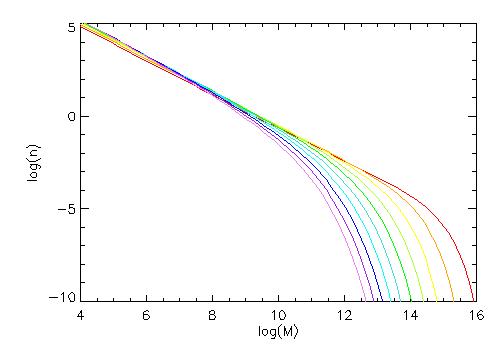
 . But how does that relate to the mass of the halo within which it resides? Clearly the dark matter halo has to be more massive than the baryonic material it collects, and therefore more massive than the central black hole, but by how much?
 for a time order
  years requires a parent halo of mass about
  . Generally, i’s a reasonable back-of-an-envelope estimate that the halo mass would be about a hundred times larger than that of the central black hole so the halo housing this one could be around
  .
. , are rarer by many orders of magnitude at redshift 7 than at redshift 0 so if anyone ever finds one at this redshift that would really be a shock to many a cosmologist’s system, as would be the discovery of quasars with such a high mass at redshifts significantly higher than seven.






 In the Dark