Parametric Resonance – It Don’t Mean A Thing If It Ain’t Got That Swing

Posted in The Universe and Stuff with tags , , , on March 10, 2015 by telescoper

It’s a small universe world. This  lunchtime I turned up to the local Cosmology discussion group for a talk on reheating after inflation during which the topic of parametric resonance came up. To illustrate the concept the speaker showed this nice video, and there was my esteemed former University of Nottingham colleague and fellow jazz enthusiast Roger Bowley explaining all!


Four Times a Supernova

Posted in The Universe and Stuff with tags , , , , on March 9, 2015 by telescoper

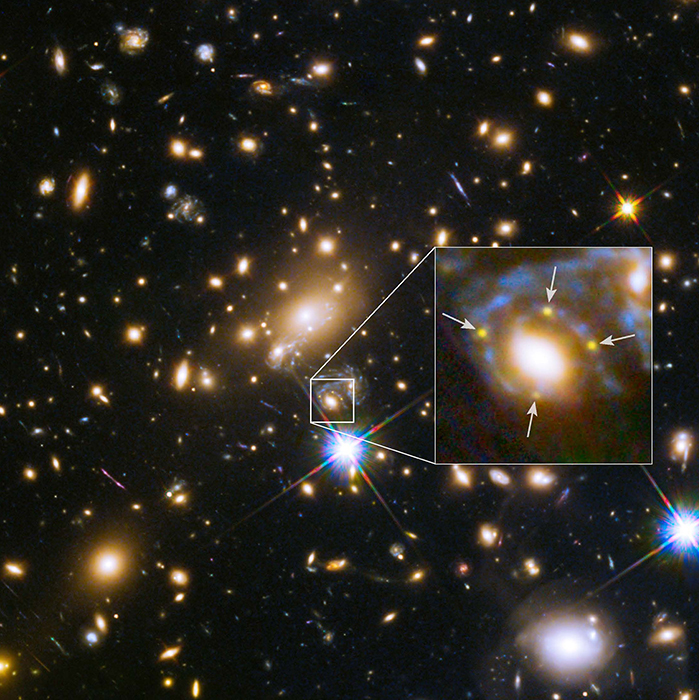
I’ve been a bit pressed for time recently (to put it mildly) so am a bit late catching up on a wonderful observation (by Kelly et al.) reported in last week’s issue of Science. Here’s the abstract:

In 1964, Refsdal hypothesized that a supernova whose light traversed multiple paths around a strong gravitational lens could be used to measure the rate of cosmic expansion. We report the discovery of such a system. In Hubble Space Telescope imaging, we have found four images of a single supernova forming an Einstein cross configuration around a redshift z = 0.54 elliptical galaxy in the MACS J1149.6+2223 cluster. The cluster’s gravitational potential also creates multiple images of the z = 1.49 spiral supernova host galaxy, and a future appearance of the supernova elsewhere in the cluster field is expected. The magnifications and staggered arrivals of the supernova images probe the cosmic expansion rate, as well as the distribution of matter in the galaxy and cluster lenses.

And here’s a nice picture of the system which I ripped of from a nice report in Physics World:

PW-2015-03-05-Commissariat-supernovae

Multiple images of background objects caused by gravitational lensing have been observed before, but the key thing about this particular “Einstein Cross” is that the background object is a type of exploding star called a supernova. That means that the light it emits will decay over time. That light reaches us via four different paths around the intervening galaxy cluster so monitoring the different evolution in the four images will yield direct measurements of the physical scale of the cluster and hopefully  answer a host of interesting cosmological questions.

Tony Blair, dread creature of the forbidden swamp

Posted in Uncategorized on March 8, 2015 by telescoper

Withering. Wonderful. Worth reblogging.

NAM 2015 Open for Registration

Posted in The Universe and Stuff with tags , on March 7, 2015 by telescoper

A bit busy today so I just have time for another quick plug of this year’s  Royal Astronomical Society National Astronomy Meeting, which will be taking place at the splendid Venue Cymru conference centre, Llandudno, North Wales, from Sunday 5th July to Thursday 9th July 2015. I’ve posted most of this before, but I thought I’d post it again because today is the day that registration opened; you can sign up by following the link from here.

To whet your appetite, here are some pictures of lovely Llandudno  I took at the last National Astronomy Meeting there, back in 2011.

The draft science programme is available and you can also find a full list of parallel sessions here. You can also  submit proposals for contributed talks and posters for any of the sessions, including the one I’m organizing described below.


If you’re on Twitter you can keep up-to-date with developments by following their Twitter feed:

I’m actually on the Scientific Organizing Committee for NAM 2015 and as such I’ll be organizing a part of this meeting, namely a couple of sessions on Cosmology under the title Cosmology Beyond the Standard Model, with the following description.

Recent observations, particularly those from the Planck satellite, have provided strong empirical foundations for a standard cosmological model that is based on Einstein’s general theory of relativity and which describes a universe which is homogeneous and isotropic on large scales and which is dominated by dark energy and matter components. This session will explore theoretical and observational challenges to this standard picture, including modified gravity theories, models with large-scale inhomogeneity and/or anisotropy, and alternative forms of matter-energy. The aim will be to both take stock of the evidence for, and stimulate further investigation of, physics beyond the standard model.

It’s obviously quite a broad remit so I hope that there will be plenty of contributed talks and posters. NAM is a particularly good opportunity for younger researchers – PhD students and postdocs – to present their work to a big audience so I particularly encourage such persons to submit abstracts. Would more senior readers please pass this message on to anyone they think might want to give a talk?

If you have any questions please feel free to use the comments box (or contact me privately).

Essays in Physics

Posted in Biographical, Education with tags , , , , , , on March 6, 2015 by telescoper

In the course of a rare episode of tidying-up in my office I came across this. You can click on it to make it bigger if it’s difficult to read. It was the first paper of my finals examination at the University of Cambridge way back in 1985. Yes, that really was thirty years ago…

wpid-wp-1425648226410.jpeg

As you can probably infer from the little circle around number 4, I decided to write an Essay about topic 4. I’ve always been interested in detective stories so this was an easy choice for me, but I have absolutely no idea what I wrote about for three hours. Nor do I recall actually ever getting a mark for the essay, so I never really knew whether it really counted for anything. I do remember, however, that I had another 3-hour examination in the afternoon of the same day, two three-hour examinations the following day, and would have had two the day after that had I not elected to do a theory project which let me off one paper at the end.

I survived this rigorous diet of examinations (more-or-less) and later that year moved to Sussex to start my DPhil, returning here couple of years ago as Head of the same School in which I did my graduate studies. To add further proof that the universe is cyclic, this year I’ve taken on the job of being External Examiner for physics at the University of Cambridge, the same place I did my undergraduate studies.

Anyway, to get back to the essay paper, we certainly don’t set essay examinations like that here in the Department of Physics & Astronomy at the University of Sussex and I suspect they no longer do so in the Department of Physics at Cambridge. I don’t really see the point of making students write such things under examination conditions. On the other hand, I do have an essay as part of the coursework in my 2nd Year Theoretical Physics module. That may seem surprising and I’m not sure the students like the idea, but the reason for having it is that theoretical physics students don’t do experimental work in the second year so they don’t get the chance to develop their writing skills through lab reports. The essay titles I set are much more specific than those listed in the paper above and linked very closely to the topics covered in the lectures, but it’s still an opportunity for physics students to practice writing and getting some feedback on their efforts. Incidentally, some of the submissions last year were outstandingly good and I’m actually quite looking forward to reading this year’s crop!

Brighton’s Green Nightmare

Posted in Brighton, Politics with tags , , on March 5, 2015 by telescoper

Two years ago I posted an item about the effects of industrial action by Brighton & Hove’s refuse collectors, the ironically-named company Cityclean. Strikes and other industrial action have happened intermittently over the last year, but it has been difficult to establish when Cityclean are working and when they are not because the typical level of service is absolutely abysmal. Apparently the latest strike is supposed to have finished, but some drivers are still “working to rule”.

Brighton_rubbish

The fact of the matter is that this state of affairs is the rule in Kemptown, the part of Brighton I live in. The refuse collection service is shockingly unreliable and more often than not the street resembles a rubbish tip, whether or not there’s a strike.

It’s quite obvious who is to blame for all this. Cityclean is managed, badly, by the local Council which is controlled by a shambolic Green Party more interested in splurging money on vanity projects like the infamous i360, and trying to wreck the budget-setting process, than providing decent services for local people. Given the importance the Green Party pretends to attach to recycling and sustainability, it is appalling that the fraction of refuse that is recycled is just 24%, one of the lowest rates in the entire country. The local Greens think the council should take over running bus services too. If they do as good a job of that as they do with the refuse collection service then I’ll probably be walking to work most days of the week.

I keep hearing from people living elsewhere who a flirting with the idea of voting for the Greens in the General Election and Local Elections forthcoming in May. I very much doubt that there will be any “Green Surge” in Brighton, unless it comes in the form of a noxious ooze emanating from mountains of uncollected garbage. I am pretty sure the Green will get wiped off the face of the Council in Brighton and Hove. If you’re actually thinking of voting for them elsewhere, take a look at the mess they’ve made here and I’m sure you will change your mind.

Britain’s only Green MP (Caroline Lucas) is looking to retain her seat in Brighton Pavilion at the General Election. To attempt to achieve this she has initiated a frantic campaign to distance herself from the antics of the Green Party’s representatives on the local council. I find that attitude completely hypocritical and I hope she fails. If she really doesn’t agree with her party she should stand as an independent. I won’t be voting for her anyway. Apart from everything else I’m not in her constituency..

The Law of Averages

Posted in Bad Statistics, Crosswords with tags , , on March 4, 2015 by telescoper

Just a couple of weeks ago I found myself bemoaning my bad luck in the following terms

A few months have passed since I last won a dictionary as a prize in the Independent Crossword competition. That’s nothing remarkable in itself, but since my average rate of dictionary accumulation has been about one a month over the last few years, it seems a bit of a lull.  Have I forgotten how to do crosswords and keep sending in wrong solutions? Is the Royal Mail intercepting my post? Has the number of correct entries per week suddenly increased, reducing my odds of winning? Have the competition organizers turned against me?

In fact, statistically speaking, there’s nothing significant in this gap. Even if my grids are all correct, the number of correct grids has remained constant, and the winner is pulled at random  from those submitted (i.e. in such a way that all correct entries are equally likely to be drawn) , then a relatively long unsuccessful period such as I am experiencing at the moment is not at all improbable. The point is that such runs are far more likely in a truly random process than most people imagine, as indeed are runs of successes. Chance coincidence happen more often than you think.

Well, as I suspected would happen soon my run of ill fortune came to an end today with the arrival of this splendid item in the mail:

dictionary_beel

It’s the prize for winning Beelzebub 1303, the rather devilish prize cryptic in the Independent on Sunday Magazine. It’s nice to get back to winning ways. Now what’s the betting I’ll now get a run of successes?

P.S. I used the title “Law of Averages” just so I could point out in a footnote that there’s actually no such thing.

Sonny Rollins’ letter to Coleman Hawkins

Posted in Jazz with tags , , , , on March 4, 2015 by telescoper

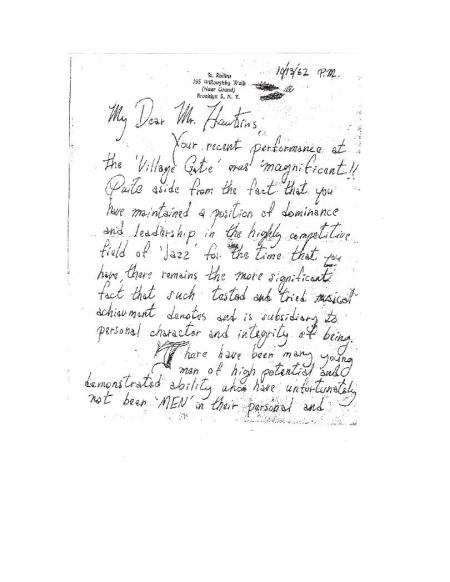
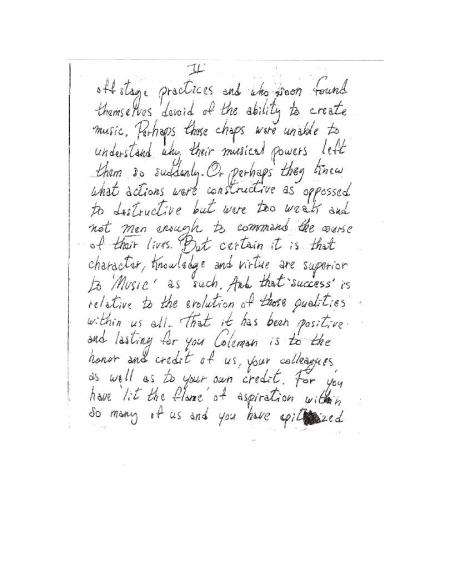
I couldn’t resist reblogging this wonderful letter from one great saxophonist, Sonny Rollins, to another, Coleman Hawkins.

The letter was written in 1962. You can find here on Youtube a recording of the two of them playing the great Jerome Kern tune All The Things You Are at the Newport Jazz Festival just a few months later in summer 1963. The title seems to match the sentiments of the letter rather nicely!

Simon Purcell's avatarSimon Purcell

Do read this, a touching letter from Sonny Rollins to Coleman Hawkins in 1962 (from the website www.jazzclef.com). The greatest players possess not only self-discipline and powers of concentration, but generally, great humility.

View original post

Fifty Shades of Whiteboard

Posted in Biographical, Film with tags , on March 3, 2015 by telescoper

fiftyshades

Uncertainty, Risk and Probability

Posted in Bad Statistics, Science Politics with tags , , , , , , , , on March 2, 2015 by telescoper

Last week I attended a very interesting event on the Sussex University campus, the Annual Marie Jahoda Lecture which was given this year by Prof. Helga Nowotny a distinguished social scientist. The title of the talk was A social scientist in the land of scientific promise and the abstract was as follows:

Promises are a means of bringing the future into the present. Nowhere is this insight by Hannah Arendt more applicable than in science. Research is a long and inherently uncertain process. The question is open which of the multiple possible, probable or preferred futures will be actualized. Yet, scientific promises, vague as they may be, constitute a crucial link in the relationship between science and society. They form the core of the metaphorical ‘contract’ in which support for science is stipulated in exchange for the benefits that science will bring to the well-being and wealth of society. At present, the trend is to formalize scientific promises through impact assessment and measurement. Against this background, I will present three case studies from the life sciences: assisted reproductive technologies, stem cell research and the pending promise of personalized medicine. I will explore the uncertainty of promises as well as the cunning of uncertainty at work.

It was a fascinating and wide-ranging lecture that touched on many themes. I won’t try to comment on all of them, but just pick up on a couple that struck me from my own perspective as a physicist. One was the increasing aversion to risk demonstrated by research funding agencies, such as the European Research Council which she helped set up but described in the lecture as “a clash between a culture of trust and a culture of control”. This will ring true to any scientist applying for grants even in “blue skies” disciplines such as astronomy: we tend to trust our peers, who have some control over funding decisions, but the machinery of control from above gets stronger every day. Milestones and deliverables are everything. Sometimes I think in order to get funding you have to be so confident of the outcomes of your research to that you have to have already done it, in which case funding isn’t even necessary. The importance of extremely speculative research is rarely recognized, although that is where there is the greatest potential for truly revolutionary breakthroughs.

Another theme that struck me was the role of uncertainty and risk. This grabbed my attention because I’ve actually written a book about uncertainty in the physical sciences. In her lecture, Prof. Nowotny referred to the definition (which was quite new to me) of these two terms by Frank Hyneman Knight in a book on economics called Risk, Uncertainty and Profit. The distinction made there is that “risk” is “randomness” with “knowable probabilities”, whereas “uncertainty” involves “randomness” with “unknowable probabilities”. I don’t like these definitions at all. For one thing they both involve a reference to “randomness”, a word which I don’t know how to define anyway; I’d be much happier to use “unpredictability”. Even more importantly, perhaps, I find the distinction between “knowable” and “unknowable” probabilities very problematic. One always knows something about a probability distribution, even if that something means that the distribution has to be very broad. And in any case these definitions imply that the probabilities concerned are “out there”, rather being statements about a state of knowledge (or lack thereof). Sometimes we know what we know and sometimes we don’t, but there are more than two possibilities. As the great American philosopher and social scientist Donald Rumsfeld (Shurely Shome Mishtake? Ed) put it:

“…as we know, there are known knowns; there are things we know we know. We also know there are known unknowns; that is to say we know there are some things we do not know. But there are also unknown unknowns – the ones we don’t know we don’t know.”

There may be a proper Bayesian formulation of the distinction between “risk” and “uncertainty” that involves a transition between prior-dominated (uncertain) and posterior-dominated (risky), but basically I don’t see any qualititative difference between the two from such a perspective.

Anyway, it was a very interesting lecture that differed from many talks I’ve attended about the sociology of science in that the speaker clearly understood a lot about how science actually works. The Director of the Science Policy Research Unit invited the Heads of the Science Schools (including myself) to dinner with the speaker afterwards, and that led to the generation of many interesting ideas about how we (I mean scientists and social scientists) might work better together in the future, something we really need to do.