Another Lord’s Day

Posted in Cricket with tags , , , , , on May 24, 2015 by telescoper

Just time for a quick post to record the fact that yesterday I made my annual pilgrimage to Lord’s Cricket Ground to watch the third day’s play of the First  Test between England and New Zealand.  On previous occasions I’ve had to make the trip from Cardiff to Paddington and back to take in a day at the Test, so had to get up at the crack of dawn, but this time I was travelling from Brighton which is a significantly shorter trip, so I only had to get up at 7 or so. Anyway, I got to the ground in time to have a bacon sandwich and a coffee before play started, with the added pleasure of listening to the jazz band as I consumed both items.

England had batted first in this game, and were on the brink of disaster at 30 for 4 at one stage, but recovered well to finish on 389 all out. Joe Root, Ben Stokes and Moeen Ali all made valuable runs in the middle order. Their performance was put into perspective by New Zealand, however, who had reached 303 for 2 at the end of the first day. It’s hard to say whether it was New Zealand’s strength in batting or England’s lacklustre bowling that was primarily responsible. I suspect it was a bit of both. Talk around the ground was if and when New Zealand might declare. I didn’t think I would declare on a score less than 600, even if tempted to have a go at the England batsman for 30 minutes in the evening, but that speculation turned out to be irrelevant.

Anyway on a cool and overcast morning, New Zealand resumed with Taylor and Williamson at the crease and England desperately needing to take quick wickets. The first breakthrough came after about 40 minutes, with Taylor well caught by wicketkeeper Buttler off the bowling of Stuart Broad. That served to bring in dangerman Brendan McCullum, who promptly hit his first ball for four through the covers. He continued to play his shots but never looked really convincing, eventually getting out to a wild shot off England’s debutant bowler Mark Wood, but not before he’d scored 42 runs at a brisk pace while Williamson at the other end continued to his century in much more sedate fashion.

Light drizzle had started to fall early on in the morning and shortly after McCullum was out it became much heavier. The players took an early lunch and play did not resume until 2.45pm, meaning that over an hour was lost. During the extended lunch interval I took a stroll around the ground, bought an expensive burger, and noted the large number of representatives of the Brigade of Gurkhas, who were collecting money for the Nepal Earthquake Appeal. Here are some of them making use of their vouchers in the Food Village:

Lords_Ghurkas

When play resumed, England quickly took another wicket, that of Anderson, at which point New Zealand were 420 for 5. Wicketkeeper Watling (who had an injury from the first innings) came to the crease and look all at sea, frequently playing and missing and surviving two umpire reviews. He led a charmed life however and ended up 61 not out when the New Zealand innings closed at 523 all out.

One interesting fact about this innings was that “Extras” scored 67. Quite a lot of those were leg-byes, but the number of wides and byes was quite embarrassing. Wicket-keeper Buttler did take a couple of fine catches, but he wasn’t as tidy as one would expect at Test level. England also dropped three catches in the field. New Zealand only added 212 runs for their last 8 wickets, which wasn’t as bad as it could have been for England but it could have been better too. I wasn’t impressed with their bowling, either. Neither Anderson nor Broad looked particularly dangerous, although both took wickets. Wood was erratic too, straying down the legside far too often, but he did improve in his second spell and managed to take three wickets. I think Moeen was the steadiest and most impressive bowler, actually. He also took three, including that of Williamson whose excellent innings ended on  132.

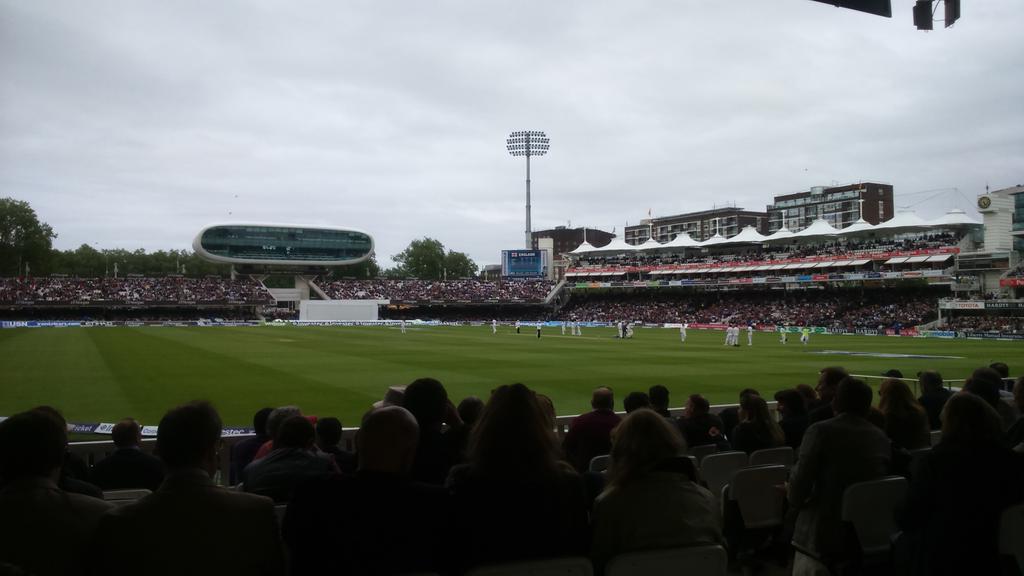
I took this picture from my vantage point in the Warner Stand  just a few minutes before the last New Zealand wicket fell:
Lords_NZ

You can see it was still quite gloomy and dark. My mood was sombre, thinking about Donald Trump’s forthcoming victory in the 2016 United States Presidential Elections.

Incidentally, the Warner Stand is to be knocked down at the end of this season (in September 2015) and rebuilt much bigger and snazzier. I’ve got used to watching cricket from there during my occasional trips to Lord’s so I feel a little bit sad about its impending demise. On the other hand, it does need a bit of modernisation so perhaps it’s all for the best. The first phase of the rebuild should be ready for next season so I look forward to seeing what the new stand looks like in a year or so’s time.

England came out to bat with play extended until 7.30 to make up for the time lost for rain. Lyth faced the first ball, which was short. He played a hook shot which he mistimed. It went uppishly past the fielder at short midwicket for four, but it was a very risky shot to play at the very start of the innings given England’s situation and it made me worry about his temperament. He hit another couple of boundaries and then departed for 12, caught behind. Ballance  came in, faced twelve deliveries and departed, clean bowled, without troubling the scorers. At that point England were in deep trouble at 25-2, still needing over a hundred runs to make New Zealand bat again. With the weather brightening up considerably, Bell and Cook steadied the ship a little and no more wickets were lost before the close of play. I had to leave before the close in order to get the train back to Brighton but the day ended with England on 75-2.

I think New Zealand will win this game, for the simple reason that their bowling, fielding and batting are all better than England’s.  The biggest worry for England is their batting at the top of the order, which is far too fragile, but the bowling lacks penetration and the fielding is sloppy.  It doesn’t bode well for the forthcoming Ashes series but more immediately it doesn’t bode well for Alastair Cook’s position as England captain. But who could replace him?

UPDATE, 7pm Sunday. Contrary to my pessimistic assessment, England played very well on Day 4. Cook batted all day, ending on 153 not out but the star of the show was Ben Stokes who scored the fastest century ever in a test at Lord’s (85 balls). With England on 429 for 6, a lead of 295, any result is possible. England need to bat until about lunch to make the game safe, and only then think about winning it.

UPDATE, 5.38pm Monday. The morning didn’t go entirely England’s way. They only reached 478 all out, a lead of 344. However, New Zealand were in deep trouble straight away, losing both openers without a run on the board. They were in even deeper trouble a bit later when they slumped to 12-3 but then staged a mini-recovery only for two quick wickets to fall taking them to 61-5. There then followed an excellent partnership of 107 between Anderson and Watling who at one point looked like wresting the initiative away from England. Then both fell in quick succession and were soon followed by Craig and Southee. As I write this, New Zealand are 200 for 9. England need one more wicket and have 15 overs left to get it, with two tailenders at the crease.

UPDATE, 6.03pm Monday. It seemed to take forever to come, but Moeen has just caught last man Boult off the bowling of Broad. New Zealand all out for 220 and England win by 124 runs, a victory I simply could not have imagined when I left Lord’s on Saturday. I’ve never been happier to be proved wrong!

This has been one of the great Test matches and I’m really happy I was there for part of it – even if it was only one day! Well played both teams for making such an excellent game of it. Long live Test cricket. There’s nothing like it!

The Diary of One who Disappeared

Posted in Music with tags , , , , , , , on May 22, 2015 by telescoper

At the end of a very busy day before I go home and vegetate, I only just have time for a quick post about the concert I attended last night in St George’s Church, Kemptown. It was a convenient venue for me as it is just at the end of my street; my polling station for the recent elections was there too.

Anyway, the title of the concert is taken from the song cycle of the same name composed by Leoš Janáček. It’s a sequence of 21 poems about a young man who falls for seductive gypsy girl and ends up running away from home to be with her, and care for the baby son she turns out at the end of the cycle to have born. There’s also a very tempestuous piano interlude, labelled Intermezzo Erotico in the programme, which (presumably) depicts the circumstances in which the baby was conceived. This work was performed by mezzo-soprano Anna Huntley and tenor Robert Murray accompanied by James Baillieu at the piano (who also played the piano at the recital I attended last week). Three female voices also took part in a few of these songs; they were hidden away in the gallery so it was quite a surprise when they joined in.

Despite being a big fan of Janáček I’ve never heard this music before, and I found it absolutely wonderful. It involves many abrupt and unexpected changes of mood, with soome simple folk-like melodies juxtaposed with much more disturbed and fragmented musical language. At the end, when the young man reveals that he has a son, the tenor reaches up for two stunning top Cs which took me completely by surprise and sent cold shivers down my spine. I must get a recording of this work. As soon as it had finished I wanted to listen to it all over again.

The Diary of One who Disappeared formed the second half of the concert. The first was also very varied and interesting. We began with he two principal singers taking turns at performing a selection of six from a well-known set of 49 Deutsche Volkslieder by Johannes Brahms. Then Robert Murray – who looks somewhat disconcertingly like Shane Warne – performed the Seven Sonnets of Michelangelo by Benjamin Britten (his Opus 22). These were the first pieces Britten composed specifically for the voice of his partner Peter Pears and were written way back in 1940. They’re all poems about love in its various forms and I think they’re wonderful, especially Sonnet XXX:

Veggio co’ bei vostri occhi un dolce lume,
Che co’ miei ciechi già veder non posso;
Porto co’ vostri piedi un pondo addosso,
Che de’ mie zoppi non è già costume.
Volo con le vostr’ale senza piume;
Col vostr’ingegno al ciel sempre son mosso;
Dal vostr’arbitrio son pallido e rosso,
Freddo al sol, caldo alle più fredde brume.
Nel voler vostro è sol la voglia mia,
I mie’ pensier nel vostro cor si fanno,
Nel vostro fiato son le mie parole.
Come luna da sè sol par ch’io sia;
Chè gli occhi nostri in ciel veder non sanno
Se non quel tanto che n’accende il sole.

It’s a fine poem in itself but Britten’s setting of it is both beautiful and imaginative. I’m guessing that it’s extremely difficult to sing because the vocal line is very complex and has some very challenging intervals. You can almost imagine it being part of a bel canto opera…

The first half of the concert closed with the Seven Gypsy Songs (Opus 55) by
Antonín Dvořák, by far the most famous of which is Songs My Mother Taught Me.

It was a very fine recital with some lovely music, beautifully sung. In fact the singing was so nice a blackbird outside the church decided to join in during the first half. It was a nicely balanced programme tied together by two recurrent themes: Gypsies and love (and sometimes both at the same time). TheI particularly enjoyed the blend of familiar and unfamiliar. For example, although I know the Sonnets by Britten I’ve only ever heard the classic Britten-Pears version so it was interesting to hear it performed by a very different singer.

Phlogiston, Dark Energy and Modified Levity

Posted in History, The Universe and Stuff with tags , , on May 21, 2015 by telescoper

What happens when something burns?

Had you aslked a seventeenth-century scientist that question and the chances are the answer would  have involved the word phlogiston, a name derived from the Greek  φλογιστόν, meaning “burning up”. This “fiery principle” or “element” was supposed to be present in all combustible materials and the idea was that it was released into air whenever any such stuff was ignited. The act of burning was thought to separate the phlogiston from the dephlogisticated “true” form of the material, also known as calx.

The phlogiston theory held sway until  the late 18th Century, when Antoine Lavoisier demonstrated that combustion results in an increase in weight of the material being burned. This poses a serious problem if burning also involves the loss of phlogiston unless phlogiston has negative weight. However, many serious scientists of the 18th Century, such as Georg Ernst Stahl, had already suggested that phlogiston might have negative weight or, as he put it, “levity”. Nowadays we would probably say “anti-gravity”.

Eventually, Joseph Priestley discovered what actually combines with materials during combustion:  oxygen. Instead of becoming dephlogisticated, things become oxidised by fixing oxygen from air, which is why their weight increases. It’s worth mentioning, though, the name that Priestley used for oxygen was in fact “dephlogisticated air” (because it was capable of combining more extensively with phlogiston than ordinary air). He  remained a phlogistonian longer after making the discovery that should have killed the theory.

So why am I rambling on about a scientific theory that has been defunct for more than two centuries?

Well,   there just might be a lesson from history about the state of modern cosmology. Not long ago I gave a talk in the fine city of Bath on the topic of Dark Energy and its Discontents. For the cosmologically uninitiated, the standard cosmological model involves the hypothesis that about 75% of the energy budget of the Universe is in the form of this “dark energy”.

Dark energy is needed to reconcile three basic measurements: (i) the brightness distant supernovae that seem to indicate the Universe is accelerating (which is where the anti-gravity comes in); (ii) the cosmic microwave background that suggests the Universe has flat spatial sections; and (iii) the direct estimates of the mass associated with galaxy clusters that accounts for about 25% of the mass needed to close the Universe. A universe without dark energy appears not to be able to account for these three observations simultaneously within our current understanding of gravity as obtained from Einstein’s theory of general relativity.

We don’t know much about what this dark energy is, except that in order to make our current understanding work out it has to produce an effect something like anti-gravity, vaguely reminiscent of the “negative weight” hypothesis mentioned above. In most theories, the dark energy component does this by violating the strong energy condition of general relativity. Alternatively, it might also be accounted for by modifying our theory of gravity in such a way that accounts for anti-gravity in some other way. In the light of the discussion above maybe what we need is a new theory of levity? In other words, maybe we’re taking gravity too seriously?

Anyway, I don’t mind admitting how uncomfortable this dark energy makes me feel. It makes me even more uncomfortable that such an enormous  industry has grown up around it and that its existence is accepted unquestioningly by so many modern cosmologists. Isn’t there a chance that, with the benefit of hindsight, future generations will look back on dark energy in the same way that we now see the phlogiston theory?

Or maybe the dark energy really is phlogiston. That’s got to be worth a paper!

One More for the Bad Statistics in Astronomy File…

Posted in Bad Statistics, The Universe and Stuff with tags , , , , , on May 20, 2015 by telescoper

It’s been a while since I last posted anything in the file marked Bad Statistics, but I can remedy that this morning with a comment or two on the following paper by Robertson et al. which I found on the arXiv via the Astrostatistics Facebook page. It’s called Stellar activity mimics a habitable-zone planet around Kapteyn’s star and it the abstract is as follows:

Kapteyn’s star is an old M subdwarf believed to be a member of the Galactic halo population of stars. A recent study has claimed the existence of two super-Earth planets around the star based on radial velocity (RV) observations. The innermost of these candidate planets–Kapteyn b (P = 48 days)–resides within the circumstellar habitable zone. Given recent progress in understanding the impact of stellar activity in detecting planetary signals, we have analyzed the observed HARPS data for signatures of stellar activity. We find that while Kapteyn’s star is photometrically very stable, a suite of spectral activity indices reveals a large-amplitude rotation signal, and we determine the stellar rotation period to be 143 days. The spectral activity tracers are strongly correlated with the purported RV signal of “planet b,” and the 48-day period is an integer fraction (1/3) of the stellar rotation period. We conclude that Kapteyn b is not a planet in the Habitable Zone, but an artifact of stellar activity.

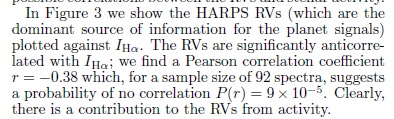
It’s not really my area of specialism but it seemed an interesting conclusions so I had a skim through the rest of the paper. Here’s the pertinent figure, Figure 3,

bad_stat_figure

It looks like difficult data to do a correlation analysis on and there are lots of questions to be asked  about  the form of the errors and how the bunching of the data is handled, to give just two examples.I’d like to have seen a much more comprehensive discussion of this in the paper. In particular the statistic chosen to measure the correlation between variates is the Pearson product-moment correlation coefficient, which is intended to measure linear association between variables. There may indeed be correlations in the plots shown above, but it doesn’t look to me that a straight line fit characterizes it very well. It looks to me in some of the  cases that there are simply two groups of data points…

However, that’s not the real reason for flagging this one up. The real reason is the following statement in the text:

bad_stat_text

Aargh!

No matter how the p-value is arrived at (see comments above), it says nothing about the “probability of no correlation”. This is an error which is sadly commonplace throughout the scientific literature, not just astronomy.  The point is that the p-value relates to the probability that the given value of the test statistic (in this case the Pearson product-moment correlation coefficient, r) would arise by chace in the sample if the null hypothesis H (in this case that the two variates are uncorrelated) were true. In other words it relates to P(r|H). It does not tells us anything directly about the probability of H. That would require the use of Bayes’ Theorem. If you want to say anything at all about the probability of a hypothesis being true or not you should use a Bayesian approach. And if you don’t want to say anything about the probability of a hypothesis being true or not then what are you trying to do anyway?

If I had my way I would ban p-values altogether, but it people are going to use them I do wish they would be more careful about the statements make about them.

Dust, by Phyllis King

Posted in Poetry with tags , , on May 19, 2015 by telescoper

I do not know what dust is.
I do not know where it comes from.
I only know that it settles on things.
I cannot see it in the air or watch it fall.
Sometimes I’m home all day
But I never see it sliding about looking for a place to rest when my back is turned.
Does it wait ’til I go out?
Or does it happen in the night when I go to sleep?
Dust is not fussy about the places it chooses
Though it seems to prefer still objects.
Sometimes, out of kindness, I let it lie for weeks.
On some places it will lie forever
However, dust holds no grudges and once removed
It will always return in a friendly way.

by Phyllis April King

Groovin’ High

Posted in Jazz with tags , , , , on May 18, 2015 by telescoper

I stumbled across this on Youtube and just had to share it. I’ve got this track on an old vinyl LP of Charlie Parker performances recorded live at Birdland, the famous New York jazz club named in his (Bird’s) honour. I don’t think any of the tracks on that album have ever been reissued on CD or for download so I was both surprised and delighted to find this. It was recorded live in 1953, so it’s a bit lo-fi, but what’s particularly interesting is the unusual collection of instruments. Bird is alto sax as usual, but the rest of the band consists of Cornelius Thomas on drums, Bernie McKay on guitar and Milt Buckner on the Hammand Organ. That’s very far from a typical bebop band. Milt Buckner’s organ accompaniment is perhaps an acquired taste but Charlie Parker clearly enjoyed this setting. He plays beautifully throughout, especially during the exciting chase sequence with the drummer near the end. The tune was written by Parker’s old sparring partner Dizzy Gillespie and is based on the chords of Whispering, an old ballad written in 1920. I’m not sure why Dizzy Gillespie decided to hang his tune on that particular harmonic progression, but it’s a thrill to hear Bird racing through the changes in such exhilarating style.

A scientific paper with 5000 authors is absurd, but does science need “papers” at all?

Posted in History, Open Access, Science Politics, The Universe and Stuff with tags , , , , , , , , , on May 17, 2015 by telescoper

Nature News has reported on what appears to be the paper with the longest author list on record. This article has so many authors – 5,154 altogether – that 24 pages (out of a total of 33 in the paper) are devoted just to listing them, and only 9 to the actual science. Not, surprisingly the field concerned is experimental particle physics and the paper emanates from the Large Hadron Collider; it involves combining data from the CMS and ATLAS detectors to estimate the mass of the Higgs Boson. In my own fields of astronomy and cosmology, large consortia such as the Planck collaboration are becoming the rule rather than exception for observational work. Large ollaborations  have achieved great things not only in physics and astronomy but also in other fields. A for  paper in genomics with over a thousand authors has recently been published and the trend for ever-increasing size of collaboration seems set to continue.

I’ve got nothing at all against large collaborative projects. Quite the opposite, in fact. They’re enormously valuable not only because frontier research can often only be done that way, but also because of the wider message they send out about the benefits of international cooperation.

Having said that, one thing these large collaborations do is expose the absurdity of the current system of scientific publishing. The existence of a paper with 5000 authors is a reductio ad absurdum proof  that the system is broken. Papers simply do not have 5000  “authors”. In fact, I would bet that no more than a handful of the “authors” listed on the record-breaking paper have even read the article, never mind written any of it. Despite this, scientists continue insisting that constributions to scientific research can only be measured by co-authorship of  a paper. The LHC collaboration that kicked off this piece includes all kinds of scientists: technicians, engineers, physicists, programmers at all kinds of levels, from PhD students to full Professors. Why should we insist that the huge range of contributions can only be recognized by shoe-horning the individuals concerned into the author list? The idea of a 100-author paper is palpably absurd, never mind one with fifty times that number.

So how can we assign credit to individuals who belong to large teams of researchers working in collaboration?

For the time being let us assume that we are stuck with authorship as the means of indicating a contribution to the project. Significant issues then arise about how to apportion credit in bibliometric analyses, e.g. through citations. Here is an example of one of the difficulties: (i) if paper A is cited 100 times and has 100 authors should each author get the same credit? and (ii) if paper B is also cited 100 times but only has one author, should this author get the same credit as each of the authors of paper A?

An interesting suggestion over on the e-astronomer a while ago addressed the first question by suggesting that authors be assigned weights depending on their position in the author list. If there are N authors the lead author gets weight N, the next N-1, and so on to the last author who gets a weight 1. If there are 4 authors, the lead gets 4 times as much weight as the last one.

This proposal has some merit but it does not take account of the possibility that the author list is merely alphabetical which actually was the case in all the Planck publications, for example. Still, it’s less draconian than another suggestion I have heard which is that the first author gets all the credit and the rest get nothing. At the other extreme there’s the suggestion of using normalized citations, i.e. just dividing the citations equally among the authors and giving them a fraction 1/N each. I think I prefer this last one, in fact, as it seems more democratic and also more rational. I don’t have many publications with large numbers of authors so it doesn’t make that much difference to me which you measure happen to pick. I come out as mediocre on all of them.

No suggestion is ever going to be perfect, however, because the attempt to compress all information about the different contributions and roles within a large collaboration into a single number, which clearly can’t be done algorithmically. For example, the way things work in astronomy is that instrument builders – essential to all observational work and all work based on analysing observations – usually get appended onto the author lists even if they play no role in analysing the final data. This is one of the reasons the resulting papers have such long author lists and why the bibliometric issues are so complex in the first place.

Having thousands of authors who didn’t write a single word of the paper seems absurd, but it’s the only way our current system can acknowledge the contributions made by instrumentalists, technical assistants and all the rest. Without doing this, what can such people have on their CV that shows the value of the work they have done?

What is really needed is a system of credits more like that used in the television or film. Writer credits are assigned quite separately from those given to the “director” (of the project, who may or may not have written the final papers), as are those to the people who got the funding together and helped with the logistics (production credits). Sundry smaller but still vital technical roles could also be credited, such as special effects (i.e. simulations) or lighting (photometic calibration). There might even be a best boy. Many theoretical papers would be classified as “shorts” so they would often be written and directed by one person and with no technical credits.

The point I’m trying to make is that we seem to want to use citations to measure everything all at once but often we want different things. If you want to use citations to judge the suitability of an applicant for a position as a research leader you want someone with lots of directorial credits. If you want a good postdoc you want someone with a proven track-record of technical credits. But I don’t think it makes sense to appoint a research leader on the grounds that they reduced the data for umpteen large surveys. Imagine what would happen if you made someone director of a Hollywood blockbuster on the grounds that they had made the crew’s tea for over a hundred other films.

Another question I’d like to raise is one that has been bothering me for some time. When did it happen that everyone participating in an observational programme expected to be an author of a paper? It certainly hasn’t always been like that.

For example, go back about 90 years to one of the most famous astronomical studies of all time, Eddington‘s measurement of the bending of light by the gravitational field of the Sun. The paper that came out from this was this one

A Determination of the Deflection of Light by the Sun’s Gravitational Field, from Observations made at the Total Eclipse of May 29, 1919.

Sir F.W. Dyson, F.R.S, Astronomer Royal, Prof. A.S. Eddington, F.R.S., and Mr C. Davidson.

Philosophical Transactions of the Royal Society of London, Series A., Volume 220, pp. 291-333, 1920.

This particular result didn’t involve a collaboration on the same scale as many of today’s but it did entail two expeditions (one to Sobral, in Brazil, and another to the Island of Principe, off the West African coast). Over a dozen people took part in the planning,  in the preparation of of calibration plates, taking the eclipse measurements themselves, and so on.  And that’s not counting all the people who helped locally in Sobral and Principe.

But notice that the final paper – one of the most important scientific papers of all time – has only 3 authors: Dyson did a great deal of background work getting the funds and organizing the show, but didn’t go on either expedition; Eddington led the Principe expedition and was central to much of the analysis;  Davidson was one of the observers at Sobral. Andrew Crommelin, something of an eclipse expert who played a big part in the Sobral measurements received no credit and neither did Eddington’s main assistant at Principe.

I don’t know if there was a lot of conflict behind the scenes at arriving at this authorship policy but, as far as I know, it was normal policy at the time to do things this way. It’s an interesting socio-historical question why and when it changed.

I’ve rambled off a bit so I’ll return to the point that I was trying to get to, which is that in my view the real problem is not so much the question of authorship but the idea of the paper itself. It seems quite clear to me that the academic journal is an anachronism. Digital technology enables us to communicate ideas far more rapidly than in the past and allows much greater levels of interaction between researchers. I agree with Daniel Shanahan that the future for many fields will be defined not in terms of “papers” which purport to represent “final” research outcomes, but by living documents continuously updated in response to open scrutiny by the community of researchers. I’ve long argued that the modern academic publishing industry is not facilitating but hindering the communication of research. The arXiv has already made academic journals virtually redundant in many of branches of  physics and astronomy; other disciplines will inevitably follow. The age of the academic journal is drawing to a close. Now to rethink the concept of “the paper”…

‘Beards, shorts & sandals’ 2015 season declared officially open

Posted in Uncategorized on May 16, 2015 by telescoper

The season has arrived and weather here in Brighton is just about right. This morning I bought woolly socks to wear with my sandals and tomorrow will venture forth appropriately clad..

kmflett's avatarKmflett's Blog

Beard Liberation Front

PRESS RELEASE 16th May

Contact Keith Flett 07803 167266

‘BEARDS, SHORTS & SANDALS’ 2015 SEASON DECLARED OFFICIALLY OPEN

sandals

The Beard Liberation Front, the informal network of beard wearers, has said that Saturday May 16th marks the official start of the 2015 Beards, Shorts and Sandals  seasons with broadly warmer weather forecast for the coming period

The BLF has updated guidelines for the 2015 Season:

1] Shorts and sandals may be worn after midday until 8pm at the discretion of the wearer.

2] Where sandals are worn the wearing of socks is discouraged but not forbidden

3] If socks are not worn toenails must be neat, trimmed, clean and fungus free

4] Shorts should ideally be no longer than knee length to provide a balanced image with the beard

5] Shorts should be of conservative design and colour. Wearing of bright red, yellow or floral patterned shorts…

View original post 132 more words

Benjamin Appl and James Baillieu

Posted in History, Music, Poetry with tags , , , , , , , , , on May 16, 2015 by telescoper

Yesterday evening I crossed the border from Brighton into the Labour stronghold of Hove (actually), All Saints Church to be precise. The purpose of my mission was to attend a recital of songs by German baritone Benjamin Appl accompanied at the piano by James Baillieu. This was my fourth Brighton Festival event in as many days, but the shows I have attended have been very different so I have no regrets about booking this particular sequence.

This recital was performed in the nave of All Saints Church in a sideways configuration so the musicians were on one side rather than at the end towards the altar. I have never been to this venue before but it’s quite a regular one for musical events. I suppose they use this arrangement for the more intimate kind of music-making, such as the singing of Lieder, so the performers can be as close as possible to the audience.

The programme consisted of songs either from or inspired by Eastern Europe. The concert began with three fairly well known songs by Franz Liszt based on poems by Heinrich Heine but then continued with six Heine settings by Anton Rubinstein (his Op. 32) which I’d never heard before. These songs are direct and uncluttered and I found them rather charming. The first half closed with The Biblical Songs by Antonín Dvořák, his Opus 99. Based on extracts from the Book of Psalms these very touching works were written when the composer heard his father was gravely ill.

After a short interval and a quick glass of overpriced Pinot Grigio, we continued with Six Songs Op. 90 by Robert Schumann, who also provided the finale with his intensely moving Requiem which was written later but subsequently added to the Opus 90 collection. In between these works by Schumann we heard a selection of songs from Terezin (German name Theresienstadt) the site of a concentration camp. These pieces are much lighter than the art songs surrounding them in the programme, but are invested with a deep sense of tragedy by the circumstances in which they were composed and also performed. The song Wiegala, for example, is a lullabye written by Ilse Weber, a Jewish lady who worked for some time as a nurse in Terezin. She sang it for countless children destined for the gas chambers, and when the time came for her and her son to be murdered she sang it for him too as they walked together to their deaths.

As an aside here I thought I would plug a CD of music from Terezin I bought a while ago that features Anne Sofie von Otter singing some of the heartbreaking songs written by the inhabitants of Terezin. It’s highly recommended, though I have to admit I find it hard to listen to it without bursting into tears.

What struck me most about this recital is that the greatest Lieder are often very simple and often very brief. Some of the greatest songs by, for example, Schubert areas simple that only a genius could have written them
I think it’s the focus that gives each its power and the variety within each collection means there’s always something to hold the listener even in a long programme. Yesterday I complained about the limitations of a programme featuring only one voice, yet this one also featured only one voice but was an unqualified success. The difference, I think, is that these songs were meant to be performed the way we heard them last night…

I really enjoyed this concert. Benjamin Appl has a wonderful baritone voice, and very few vocal mannerisms or affectations. He just lets the music do its stuff. It was an amazingly mature performance for such a young man.I shouldn’t forget the flawless accompaniment provided by James Baillieu either.

Apparently Benjamin Appl was the last private pupil of the late Dietrich Fischer-Dieskau. That provides me with an excuse to include this version of the song Morgen! (Tomorrow!) Opus 27(4) by Richard Strauss, which was performed last night as an upbeat encore to an evening of intensely emotional music.

Und morgen wird die Sonne wieder scheinen
und auf dem Wege, den ich gehen werde,
wird uns, die Glücklichen sie wieder einen
inmitten dieser sonnenatmenden Erde…
und zu dem Strand, dem weiten, wogenblauen,
werden wir still und langsam niedersteigen,
stumm werden wir uns in die Augen schauen,
und auf uns sinkt des Glückes stumme Schweigen..

The first line translates as “And tomorrow the Sun will shine again…” Here is Dietrich Fischer-Dieskau singing it:


A Problems Class in Complex Analysis

Posted in Education, The Universe and Stuff with tags , , , , , on May 15, 2015 by telescoper

My theoretical physics examination is coming up on Monday and the students are hard at working revising for it (or at least they should be) so I thought I’d lend a hand by deploying some digital technology in the form of the following online interactive video-based learning resource on Complex Analysis: