Higher Energy Physics at the LHC

Posted in The Universe and Stuff with tags , , , , on June 3, 2015 by telescoper

I’ve been busy with meetings most of the day but couldn’t resist a quick post to catch up on the exciting events at CERN. Today is the day that the Large Hadron Collider was due to start operating at its highest collision energies so far, 13 TeV. It was quite a nervous morning, and the first attempt to ramp up to this energy failed.

Here was the scene this morning in the control room of the ATLAS experiment.

Control Room

This kind of photograph always reminds me of the inside of a betting shop..

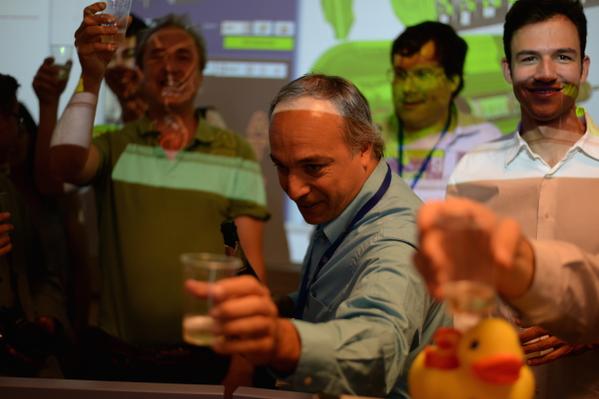
However, it didn’t take long to succeed, at which point much celebration ensued. This story has a strong local connection here in the Department of Physics & Astronomy at the University of Sussex. The run coordinator for the ATLAS experiment on the Large Hadron Collider is Dr Alessandro Cerri of Sussex  and he has figured prominently in today’s action. Here he is, having a glass of bubbly (purely medicinal, I’m assured) when they first achieved stable beams at the new collision scale:

Cerri

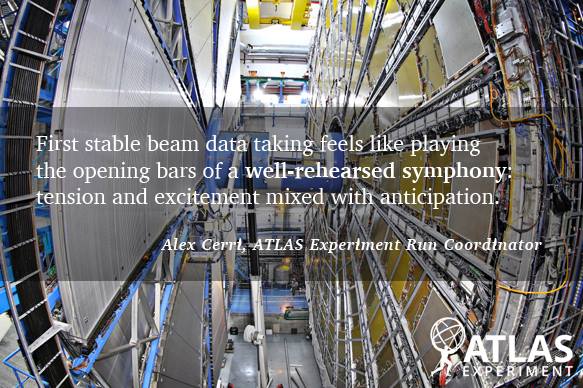
He also produced this nice quote which I took from the ATLAS Twitter feed.

LHC_Restart

It is hoped that operating at 13 TeV will allow the various detectors on the Large Hadron Collider to probe the possible existence of supersysmmetric particles which have so far defied detection. On the other hand if it doesn’t find them it will cause a lot of theorists to go back to the drawing board. Incidentally I’ve been going around asking particle physicists how much they’d be willing to bet on the LHC finding evidence of supersymmetry and I can’t get any of them to make a wager with me. Any one willing to rise to the challenge please do so via the Comments Box.

Of course we all know that the main reason for increasing the LHC’s energy is not to detect supersymmetric particles, or indeed any other evidence of physics beyond the standard model that had previous been accessible. It’s to generate papers with even longer author lists

Big Science is not the Problem – it’s Top-Down Management of Research

Posted in Finance, Science Politics, The Universe and Stuff with tags , , , , on June 2, 2015 by telescoper

I’m very late to this because I was away at the weekend, but I couldn’t resist making a comment on a piece that appeared in the Grauniad last week entitled How can we stop big science hovering up all the research funding? That piece argues for a new system of allocating research funding to avoid all the available cash being swallowed by a few big projects. This is an argument that’s been rehearsed many times before in the context of physics and astronomy, the costs of the UK contribution to facilities such as CERN (home of the Large Hadron Collider) and the European Southern Observatory being major parts of the budget of the Science and Technology Facilities Council that often threaten to squeeze the funds available for “exploiting” these facilities – in other words for doing science. What’s different about the Guardian article however is that it focusses on genomics, which has only recently threatened to become a Big Science.

Anyway, Jon Butterworth has responded with a nice piece of his own (also in the Guardian) with which I agree quite strongly. I would however like to make a couple of comments.

First of all, I think there are two different usages of the phrase “Big Science” and we should be careful not to conflate them. The first, which particularly applies in astronomy and particle physics, is that the only way to do research in these subjects is with enormous and generally very expensive pieces of kit. For this reason, and in order to share the cost in a reasonable manner, these fields tend to be dominated by large international collaborations. While it is indeed true that the Large Hadron Collider has cost a lot of money, that money has been spent by a large number of countries over a very long time. Moreover, particle physicists argued for that way of working and collectively made it a reality. The same thing happens in astronomy: the next generation of large telescopes are all transnational affairs.

The other side of the “Big Science” coin is quite a different thing. It relates to attempts to impose a top-down organization on science when that has nothing to do with the needs of the scientific research. In other words, making scientists in big research centres when it doesn’t need to be done like that. Here I am much more sceptical of the value. All the evidence from, e.g., the Research Excellence Framework is that there is a huge amount of top-class research going on in small groups here and there, much of it extremely innovative and imaginative. It’s very hard to justify concentrating everything in huge centres that are only Big because they’ve taken killed everything that’s Small, by concentrating resources to satisfy some management fixation rather than based on the quality of the research being done. I have seen far too many attempts by funding councils, especially the Engineering and Physical Sciences Research Council, to direct funding from the top down which, in most cases, is simply not the best way to deliver compelling science. Directed programmes rarely deliver exciting science, partly because the people directing them are not the people who actually know most about the field.

I am a fan of the first kind of Big Science, and not only for scientific reasons. I like the way it encourages us to think beyond the petty limitations of national politics, which is something that humanity desparately needs to get used to. But while Big Science can be good, forcing other science to work in Big institutes won’t necessarily make it better. In fact it could have the opposite effect, stifling the innovative approaches so often found in small groups. Small can be beautiful too.

Finally, I’d have to say that I found the Guardian article that started this piece of to be a bit mean-spirited. Scientists should be standing together not just to defend but to advance scientific research across all the disciplines rather than trying to set different kinds of researchers against each other. I feel the same way about funding the arts, actually. I’m all for more science funding, but don’t want to see the arts to be killed off to pay for it.

Gay Astronomers – At Last Some Data!

Posted in Biographical, LGBTQ+, Science Politics with tags , , , , , , on June 1, 2015 by telescoper

Some time ago I wrote a blog post entitled Where are all the LGBT Astrophysicists. I wrote that piece when I accidentally discovered that somebody had recently written a blog post (about Einstein’s Blackboard) which mentions me. I used to look after this famous relic when I was in Nottingham many years ago, you see.

There’s a sentence in that post that says

Professor Coles is one of the few out gay astrophysicists in the UK.

Well, it all depends by what you mean by “few” but at the time I wrote that  I thought there are more gay (or lesbian or bisexual or transgendered) astrophysicists out there than most people probably think. I know quite a large number personally- dozens in fact- most of whom are “out”. It’s a safe bet that there are many more who aren’t open about their sexuality too. However, it is probably the case that LGBT scientists are much less visible as such through their work than colleagues in the arts or humanities. Read two research papers, one written by a straight astrophysicist and one by an LGBT astrophysicist, and I very much doubt you could tell which is which. Read two pieces of literary criticism, however, and it’s much more likely you could determine the sexual orientation of the writer.

You might ask why it matters if an astrophysicist or astronomer is straight or gay? Surely what is important is whether they are good at their job? I agree with that, actually. When it comes to career development, sexual orientation should be as irrelevant as race or gender. The problem is that the lack of visibility of LGBT scientists – and this doesn’t just apply to astrophysics, but across all science disciplines – could deter young people from choosing science as a career in the first place.

Anyway, at last we have some evidence as to whether this might be the case. In 2014 the Royal Astronomical Society (of which I am a Fellow) carried out a demographic survey of its membership. This happens from time to time but this one was the first to include a question about sexual orientation. The Institute of Physics did a similar survey about Physics about a decade ago, but did not include sexual orientation among its question, so this is the first time I’ve seen any data about this from a systematic survey. The results are quite interesting. About 7% of UK respondents (from a total of around a thousand) refused to answer the sexual orientation question but, among those who did, 3% identified themselves as bisexual and 4% as gay men. Both these proportions are significantly higher than the figures for the general UK population reported by the Office of National Statistics. The fraction of respondents in the RAS Survey declaring themselves to be heterosexual was 84%, whereas the corresponding figure from the ONS Survey was 93.5%. The number of UK respondents in the RAS Survey identifying as lesbian was only 0.2%; the proportion of respondents identifying themselves as male was 77.5% versus 21.3% female, which accounts for only some of the difference between gay and lesbian proportions.

So, according to the survey, gay men are actually significantly over-represented in the Royal Astronomical Society compared to the general population. That confirms the statement I made earlier that there are more gay astronomers than you probably think.  It also shows that there is no evidence that gay men are deterred from becoming astronomers. In fact, it seems to be quite the opposite. It’s a different story when it comes to other demographics, however. The RAS membership is older, less ethnically diverse, and more male-dominated than the the general population, so there’s a lot of work to be done redressing the balance there.

On the other hand, next time the Royal Astronomical Society is looking to elect a President it will naturally want to find someone who is representative of its membership, which means an ageing white gay male. I rest my case.

 

Through My Vision

Posted in Education with tags , , , , on May 31, 2015 by telescoper

I just saw this video and thought I would post it here. It features Daniel Hajas, one of our second-year Theoretical Physics students in the Department of Physics and Astronomy at the University of Sussex. In this short documentary he talks about his life and the challenges he faces as a blind person studying physics. Some of it was filmed inside the School of Mathematical and Physical Sciences, so you might see some people you recognise…

Night Sky

Posted in Poetry with tags , , on May 30, 2015 by telescoper

What they are saying is
that there is life there, too:
that the universe is the size it is
to enable us to catch up.

They have gone on from the human:
that shining is a reflection
of their intelligence. Godhead
is the colonisation by mind

of untenanted space. It is its own
light, a statement beyond language
of conceptual truth. Every night
is a rinsing myself of the darkness

that is in my veins. I let the stars inject me
with fire, silent as it is far,
but certain in its cauterising
of my despair. I am a slow

traveller, but there is more than time
to arrive. Resting in the intervals
of my breathing, I pick up the signals
relayed to me from a periphery I comprehend.

by R.S. Thomas (1913-2000)

Health and Safety Notice

Posted in Uncategorized on May 29, 2015 by telescoper

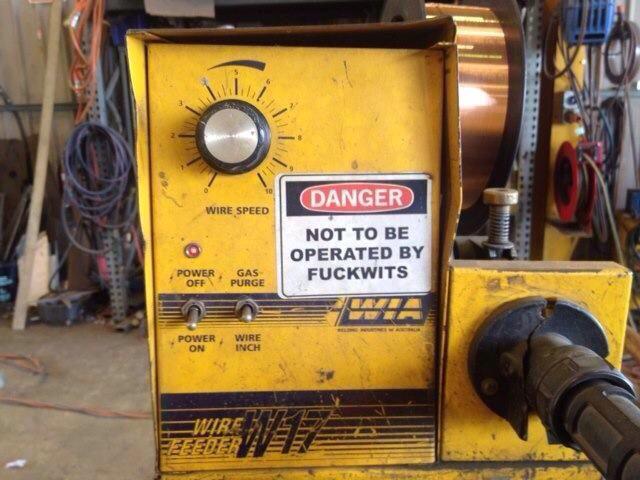
No time for a proper post today so I’ll just show a photograph of some of the equipment in our technical workshop. As Head of School I am personally responsible for Health & Safety matters, hence the new signage…

image

Jazz and Quantum Entanglement

Posted in Jazz, The Universe and Stuff with tags , , , , , on May 28, 2015 by telescoper

As regular readers of this blog (Sid and Doris Bonkers) will know, among the various things I write about apart from The Universe and Stuff is my love of Jazz. I don’t often get the chance to combine music with physics in a post so I’m indebted to George Ellis for drawing my attention to this fascinating little video showing a visualisation of the effects of quantum entanglement:

The experiment shown involves pairs of entangled photons. Here is an excerpt from the blurb on Youtube:

The video shows images of single photon patterns, recorded with a triggered intensified CCD camera, where the influence of a measurement of one photon on its entangled partner photon is imaged in real time. In our experiment the immediate change of the monitored mode pattern is a result of the polarization measurement on the distant partner photon.

You can find out more by clicking through to the Youtube page.

While most of my colleagues were completely absorbed by the pictures, I was fascinated by the choice of musical accompaniment. It is in fact Blue Piano Stomp, a wonderful example of classic Jazz from the 1920s featuring the great Johnny Dodds on clarinet (who also wrote the tune) and the great Lil Armstrong (née Hardin) on piano, who just happened to be the first wife of a trumpet player by the name of Louis Armstrong.

So at last I’ve found an example of Jazz entangled with Physics!

P.S. We often bemoan the shortage of female physicists, but Jazz is another field in which women are under-represented and insufficiently celebrated. Lil Hardin was a great piano player and deserves to be much more widely appreciated for her contribution to Jazz history.


Still Not Significant

Posted in Bad Statistics with tags , on May 27, 2015 by telescoper

I just couldn’t resist reblogging this post because of the wonderful list of meaningless convoluted phrases people use when they don’t get a “statistically significant” result. I particularly like:

“a robust trend toward significance”.

It’s scary to think that these were all taken from peer-reviewed scientific journals…

mchankins's avatarProbable Error

Image

What to do if your p-value is just over the arbitrary threshold for ‘significance’ of p=0.05?

You don’t need to play the significance testing game – there are better methods, like quoting the effect size with a confidence interval – but if you do, the rules are simple: the result is either significant or it isn’t.

So if your p-value remains stubbornly higher than 0.05, you should call it ‘non-significant’ and write it up as such. The problem for many authors is that this just isn’t the answer they were looking for: publishing so-called ‘negative results’ is harder than ‘positive results’.

The solution is to apply the time-honoured tactic of circumlocution to disguise the non-significant result as something more interesting. The following list is culled from peer-reviewed journal articles in which (a) the authors set themselves the threshold of 0.05 for significance, (b) failed to achieve that threshold value for…

View original post 2,779 more words

League Table Positions

Posted in Education, Football with tags , , , , , , , on May 26, 2015 by telescoper

Among the things I didn’t have time to blog about over a very busy Bank Holiday Weekend was the finish of the English Premiership season. I haven’t posted much about my own team, Newcastle United, this season because I haven’t been able to think of anything particularly positive to say. Since Alan Pardew quit in January to join Crystal Palace, Newcastle slumped to such an alarming extent that they went into their last game of the season (against West Ham) just two points above the drop zone. Had they lost their game, which did not seem unlikely on the basis of their recent form, and had Hull won against Manchester United, which did not seem unlikely on the grounds that Man Utd wwould finish in 4th place whatever happened in that game, then Newcastle would be relegated to the Championship. In the event, however, Newcastle won 2-0 which made them safe while Hull could only draw 0-0 which meant that Newcastle would have survived even if they had lost against West Ham. Moreover, Sunderland also lost their last game, which meant that the final Premier League Table looked like this:

Premiership_League

(courtesy of the BBC Website). The important places are 15 and 16, obviously. The natural order of things has been restored….

Another League Table came out over the Bank Holiday. This was the annual Guardian University Guide. I’m deeply sceptical of the value of these league tables, but there’s no question that they’re very important to potential students so we have to take them seriously. This year was pretty good for Sussex as far as the Guardian Table is concerned: the University of Sussex rose to 19th place overall and the two departments of the School of Mathematical and Physical Sciences both improved: Physics & Astronomy is back in the top 10 (at number 9, up from 11th place last year) and Mathematics rose 22 places to take 21st place. Gratifyingly, both finished well above Sunderland.

While these results are good news in themselves, at least around my neck of the woods, as they will probably lead to increased applications to Sussex from students next year, it is important to look behind the simplistic narrative of “improvements”. Since last year there have been several substantial changes to the Guardian’s methodology. The weighting given to “spend-per-student” has been reduced from 15% to 10% of the overall score and the method of calculating “value added” has excluded specific predictions based on “non-tariff” students (i.e. those without UK entry qualifications, especially A-levels). What the Guardian consistently fails to do is explain the relative size of the effect of arbitrary methodological changes on its tables compared to actual changes in, e.g., cash spent per student.

Imagine the outrage there would be if football teams were not told until the end of a Premier League season how many points would be awarded for a win….

Laurie Anderson – All the Animals

Posted in Art, Music with tags , , on May 25, 2015 by telescoper

Taking a short break from the combination of marking examinations and listening to cricket which has been my Bank Holiday Monday so far, so I thought I’d post a brief report on the show I went to last night, which happened to be the last night of this year’s Brighton Festival.

All the Animals was a show put together especially for this year’s Brighton Festival by renowned performance artist Laurie Anderson. She is most famous (at least in the UK) for the amazing record O Superman which was a smash hit in 1981; I posted about that on this blog here. A large number of last night’s audience members were clearly devout Laurie Anderson fans but I’ve never seen one of her live shows so wasn’t sure what to expect.

It turned out to be very much a one-woman show, with Laurie Anderson alone on stage. The show consisted of her telling stories about various animals, including her own pet terrier, Lula Belle, who is now sadly deceased. In between the stories there were musical interludes, with herself performing on an electric violin with various digital effects thrown in, and sometimes she accompanied herself as she performed the stories. The show was shot through with a wry humour and Laurie Anderson herself came across as a very engaging personality.

I had been told that her performances were often dazzling multimedia events, but this turned out not to be like that at all. The big screen at the back of the stage was only used a couple of times, once to show excerpts from a list of extinct animal species and once to show a couple of Youtube clips of Lula Belle. There were no dramatic lighting or other effects either. It was all very low key really. Far from the multimedia extravaganza I had anticipated.

There was enthusiastic applause at the end of the show, but to be honest I felt a little disappointed. Don’t get me wrong: I enjoyed the show, and still think Laurie Anderson is a really interesting artist but I suppose I just built up in myself an expectation of something with a more exciting visual element.

So that’s the end of this year’s Brighton Festival. Still, yesterday I posted the following tweet:

I guess all three predictions proved false. England didn’t lose on Sunday and indeed are very much favourites to win the Test match as I write this. Newcastle United won their game against West Ham and avoided relegation to the Championship. And Laurie Anderson, though definitely interesting, didn’t quite qualify as “fabulous”…