Summer’s drawing to a close and preparing for the imminent arrival of new intake of students is taking up a lot of my time this week, so I thought I’d just put up something I’ve posted before, in the form of a piece of music that celebrates the genius of Django Reinhardt, the great Belgian-born gypsy guitarist who overcame the terrible injuries he suffered as a child (in a fire in his caravan) to become one of the greatest jazz musicians of all time. He had a unique style of playing the guitar he invented himself to get around the fact that the third and fourth digits on his left hand were so badly burned he could effectively only use two fingers. He also had an unparalleled gift for melodic improvisation that won him admirers all around the world and across all styles of music. Add him to your list of famous Belgians right away, for he was most certainly a musical genius.
Here he’s playing the beautifully poignant September Song, by Kurt Weill:
Oh, it’s a long, long while from May to December
But the days grow short when you reach September
There being less than two weeks to go before the forthcoming referendum on Scottish independence, a subject on which I have so far refrained from commenting, I thought I would write something on it from the point of view of an English academic. I was finally persuaded to take the plunge because of incoming traffic to this blog from pro-independence pieces here and here and a piece in Nature News on similar matters.
I’ll say at the outset that this is an issue for the Scots themselves to decide. I’m a believer in democracy and think that the wishes of the Scottish people as expressed through a referendum should be respected. I’m not qualified to express an opinion on the wider financial and political implications so I’ll just comment on the implications for science research, which is directly relevant to at least some of the readers of this blog. What would happen to UK research if Scotland were to vote yes?
Before going on I’ll just point out that the latest opinion poll by Yougov puts the “Yes” (i.e. pro-independence) vote ahead of “No” at 51%-49%. As the sample size for this survey was only just over a thousand, it has a margin of error of ±3%. On that basis I’d call the race neck-and-neck to within the resolution of the survey statistics. It does annoy me that pollsters never bother to state their margin of error in press released. Nevertheless, the current picture is a lot closer than it looked just a month ago, which is interesting in itself, as it is not clear to me as an outsider why it has changed so dramatically and so quickly.
Scientists and academics in Scotland would lose access to billions of pounds in grants and the UK’s world-leading research programmes if it became independent, the Westminster government has warned.
David Willetts, the UK science minister, said Scottish universities were “thriving” because of the UK’s generous and highly integrated system for funding scientific research, winning far more funding per head than the UK average.
Unveiling a new UK government paper on the impact of independence on scientific research, Willetts said that despite its size the UK was second only to the United States for the quality of its research.
“We do great things as a single, integrated system and a single integrated brings with it great strengths,” he said.
Overall spending on scientific research and development in Scottish universities from government, charitable and industry sources was more than £950m in 2011, giving a per capita spend of £180 compared to just £112 per head across the UK as a whole.
It is indeed notable that Scottish universities outperform those in the rest of the United Kingdom when it comes to research, but it always struck me that using this as an argument against independence is difficult to sustain. In fact it’s rather similar to the argument that the UK does well out of European funding schemes so that is a good argument for remaining in the European Union. The point is that, whether or not a given country benefits from the funding system, it still has to do so by following an agenda that isn’t necessarily its own. Scotland benefits from UK Research Council funding, but their priorities are set by the Westminster government, just as the European Research Council sets (sometimes rather bizarre) policies for its schemes. Who’s to say that Scotland wouldn’t do even better than it does currently by taking control of its own research funding rather than forcing its institutions to pander to Whitehall?
It’s also interesting to look at the flipside of this argument. If Scotland were to become independent, would the “billions” of research funding it would lose (according to the statement by Willetts, who is no longer the Minister in charge) benefit science in what’s left of the United Kingdom? There are many in England and Wales who think the existing research budget is already spread far too thinly and who would welcome an increase south of the border. If this did happen you could argue that, from a very narrow perspective, Scottish independence would be good for science in the rest of what is now the United Kingdom, but that depends on how much the Westminster government sets the science budget.
This all depends on how research funding would be redistributed if and when Scotland secedes from the Union, which could be done in various ways. The simplest would be for Scotland to withdraw from RCUK entirely. Because of the greater effectiveness of Scottish universities at winning funding compared to the rest of the UK, Scotland would have to spend more per capita to maintain its current level of resource, which is why many Scottish academics will be voting “no”. On the other hand, it has been suggested (by the “yes” campaign) that Scotland could buy back from its own revenue into RCUK at the current effective per capita rate and thus maintain its present infrastructure and research expenditure at no extra cost. This, to me, sounds like wanting to have your cake and eat it, and it’s by no means obvious that Westminster could or should agree to such a deal. All the soundings I have taken suggest that an independent Scotland should expect no such generosity, and will get actually zilch from the RCUK.
If full separation is the way head, science in Scotland would be heading into uncharted waters. Among the questions that would need to be answered are:
what will happen to RCUK funded facilities and staff currently situated in Scotland, such as those at the UKATC?
would Scottish researchers lose access to facilities located in England, Wales or Northern Ireland?
would Scotland have to pay its own subscriptions to CERN, ESA and ESO?
These are complicated issues to resolve and there’s no question that a lengthy process of negotiation would be needed to resolved them. In the meantime, why should RCUK risk investing further funds in programmes and facilities that may end up outside the UK (or what remains of it)? This is a recipe for planning blight on an enormous scale.
And then there’s the issue of EU membership. Would Scotland be allowed to join the EU immediately on independence? If not, what would happen to EU funded research?
I’m not saying these things will necessarily work out badly in the long run for Scotland, but they are certainly questions I’d want to have answered before I were convinced to vote “yes”. I don’t have a vote so my opinion shouldn’t count for very much, but I wonder if there are any readers of this blog from across the Border who feel like expressing an opinion?
As I wend my way Brightonwards after a week in Wales, I thought I’d request your assistance in deciphering part of a letter I received from SWALEC, the company that supplies gas and electricity to my Cardiff residence.
If anyone out there can explain the logic that leads from a credit of £163.54 to an increase in my monthly payment – other than the obvious one that SWALEC are trying it on – I’d be most grateful!
My week of self-imposed isolation is almost over so I suppose I should try to re-acclimatize myself to the world (or at least the world of the internet) by doing a quick post of a nice video. I remember Brent Tully talking at the conference I went to in Estonia earlier this summer about the work he has been doing with his collaborators on using the local peculiar velocity field to map structures in the galaxy distribution. Now the paper is out in the journal Nature. Laniakeais the name the group chose for the local supercluster which has been known about for some time, but this work provides a more detailed map. The name Laniakea means “immeasurable heaven” in Hawaiian, from “lani” for ‘heaven’ and “akea” for ‘spacious’ or ‘immeasurable’. Rather disappointingly it has nothing to do with Ikea, so sheds little light on my own theory of the Universe.
A few people have asked why I’ve had the sheer effrontery to take a week off and come to Cardiff. Well, it may surprise you to learn that even Heads of School have a holiday entitlement, and in the 18 months I’ve been in that position I’ve only managed to take a small fraction of mine!
But the real reason for this break is that I need some time without disturbance to finish off the long-awaited Second Edition of Cosmology: A Very Short Introduction. Dorothy made me a subtle sign for my office door, but it has proved largely ineffective at preventing distractions. So here I am, back in the Cardiff residence, blocking out as much as I can to get on with some writing.
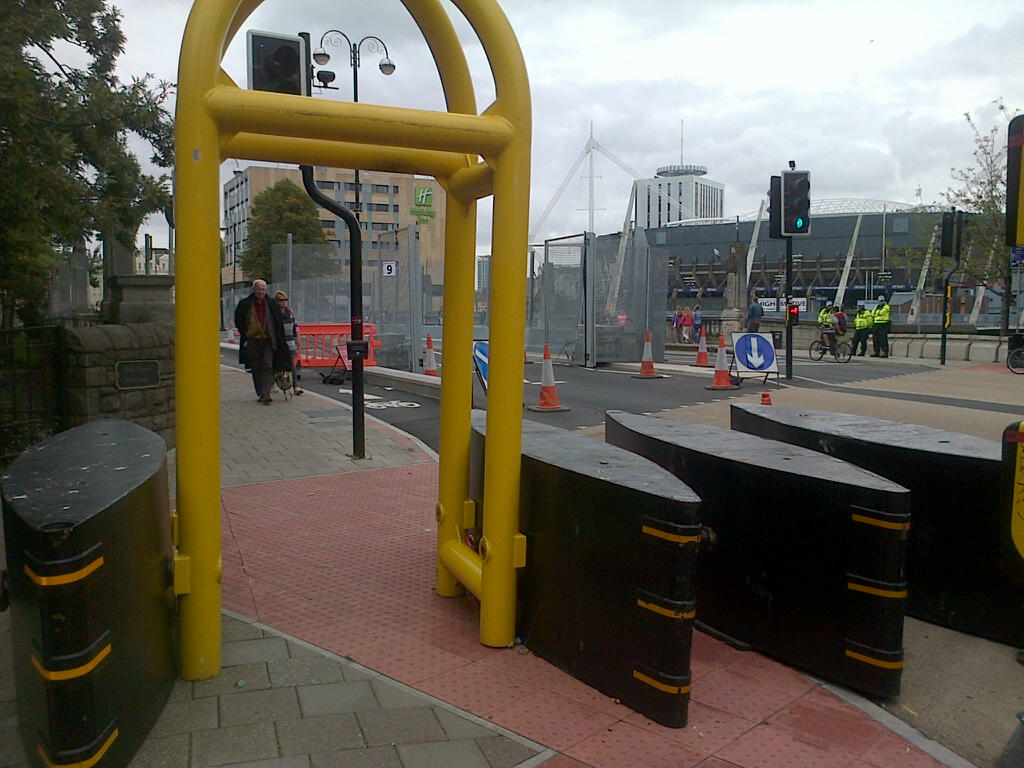
Here I am, back in Cardiff. Though given the roadblocks metal fences and hordes of armed police, you might be forgiven for thinking it was Berlin at the height of the Cold War.
All of beautiful Bute Park is fenced off, and there’s considerable disruption to the traffic through the city. All this will last over a month, and the NATO boondoggle isn’t even here. It actually takes place near Newport, twenty miles away. They’re just using Cardiff for two days..
Whoever made the decision to force this nonsense on the City should be held to account. There should be a full public inquiry into the gross abuse of power. And I hope the people of Cardiff remember this, and express their outrage at the Council when they vote at the next elections..
The photo, by the way, is at the bridge over the Taff at Cowbridge Road. Or is it Checkpoint Charlie?
I’m off to Cardiff this evening, and hope at some point over the weekend to take some pictures of the monstrous barrier described in this post by Keith Flett that has been put up all around town. One of the most important points about this month-long fiasco is that there was no consultation whatsoever with the people of Cardiff before the decision was taken to waste such a vast amount of money. No doubt that’s because if there had been a consultation the response would have been overwhelmingly negative. Who will be held to account? My guess is “nobody”…
Nato Cardiff: is this what democracy looks like?
I live in North London and central Cardiff something that seems to surprise some of my social media followers but is explained by the nature of my job as a union officer and the fact that my partner happens to live in Cardiff…
Next week on 4/5th September there is a Nato Summit meeting, not in Cardiff but at the Celtic Manor hotel outside Newport on the M4.
I’m no fan of Nato. It contains the word ‘treaty’ in its name and history suggests that treaties are an excellent way of starting wars. In addition it appears to be run largely by people who have more than a passing similarity to Dr Strangelove. Of course its opponents are mostly unlovely as well.
Anyway if you are going to have a Nato summit and lots of, at the least, self styled statesmen [&…
Too busy for a proper post today as I’ve got a lot to do before going off for a spot of annual leave. I’m therefore resorting to a standard ploy in such situation, posting a video of a cat. The short clip below features no ordinary cat, however. It’s an example of Pallas’s Cat, Otocolobus manul, a wonderful – but sadly endangered – creature which lives wild in the steppes of Central Asia. Here’s a fine specimen captured in a still photograph:
Although it appears very stocky because of its long fur, it’s actually no bigger than an average domestic cat.
The clip is a valuable reminder to us all that even the coolest and most dignified animals on Earth can be hilarious when placed in an unfamiliar situation. This one has clearly just spotted a camera outside its lair….
The other day I was looking through my copy of Monthly Notices of the Royal Astronomical Society (which I buy for the dirty pictures). Turning my attention to the personal columns, I discovered an advertisement for the Science & Technology Facilities Council which is, apparently, considering investing in new space missions related to astronomy and cosmology. Always eager to push back the frontiers of science, I hurried down to their address in Swindon to find out what was going on.
ME: (Knocks on door) Hello. Is there anyone there?
JULIAN: Oh hello! My name’s Julian, and this is my friend Sandy.
JULIAN: ..on account of that’s the only language spoken around here.
ME: So you’re in charge of the British Space Programme then?
JULIAN: Yes, owing to the budget, the national handbag isn’t as full as it used to be so now it’s just me and her.
SANDY: But never fear we’re both dab hands with thrusters.
JULIAN: Our motto is “You can vada about in any band, with a satellite run by Jules and…
SANDY: …Sand.
ME: I heard that you’re looking for some input.
SANDY: Ooooh. He’s bold, in’e?
ME: I mean for your consultation exercise…
JULIAN: Oh yes. I forgot about that. Well I’m sure we’d welcome your contribution any time, ducky.
ME: Well I was wondering what you could tell me about Moonlite?
SANDY: You’ve come to the right place. She had an experience by Moonlight, didn’t you Jules?
JULIAN: Yes. Up the Acropolis…
ME: I mean the Space Mission “Moonlite”
SANDY: Oh, of course. Well, it’s only small but it’s very stimulating.
JULIAN: Hmmm.
SANDY: Yes. It gets blasted off into space and whooshes off to the Moon…
JULIAN: …the backside thereof…
SANDY: ..and when it gets there it shoves these probes in to see what happens.
ME: Why?
SANDY: Why not?
ME: Seems a bit pointless to me.
JULIAN: There’s no pleasing some people is there?
ME: Haven’t you got anything more impressive?
SANDY: Like what?
ME: Maybe something that goes a bit further out? Mars, perhaps?
JULIAN: Well the French have this plan to send some great butch omi to troll around on Mars but we haven’t got the metzas so we have to satisfy ourselves with something a bit more bijou…
SANDY: Hmm…You can say that again.
JULIAN: You don’t have to be big to be bona.
SANDY: Anyway, we had our shot at Mars and it went willets up.
ME: Oh yes, I remember that thing named after a dog.
JULIAN: That’s right. Poodle.
ME: Do you think a man will ever get as far as Uranus?
JULIAN&SANDY: Oooh! Bold!
SANDY: Well I’ll tell you what. I’ll show you something that can vada out to the very edge of the Universe!
ME: That sounds exciting.
JULIAN: I’ll try to get it up right now.
ME: Well…er…
JULIAN: I mean on the computer
ME: I say, that’s an impressive piece of equipment
JULIAN: Thank you
SANDY: Oh don’t encourage her…
ME: I meant the computer.
JULIAN: Yes, it’s a 14″ console.
SANDY: And, believe me, 14 inches will console anyone!
JULIAN; There you are. Look at that.
ME: It looks very impressive. What is it?
SANDY: This is an experiment designed to charper for the heat of the Big Bang.
JULIAN. Ooer.
SANDY: The Americans launched WMAP and the Europeans had PLANCK. We’ve merged the two ideas and have called it ….PLMAP.
ME: Wouldn’t it have been better if you’d made the name the other way around? I mean with the first bit of WMAP and the second bit of Planck. On second thoughts maybe not..
JULIAN: It’s a little down-market but we have high hopes.
SANDY: Yes, Planck had two instruments called HFI and LFI. We couldn’t afford two so we made do with one.
JULIAN: It’s called MFI. That’s why it’s a bit naff.
ME: I see. What are these two round things either side?
SANDY: They’re the bolometers…
ME: What is this this long thing in between pointing up? And why is it leaning to one side?
SANDY: Well that’s not unusual in my experience …
JULIAN: Shush. It’s an off-axis Gregorian telescope if you must know.
ME: And what about this round the back?
SANDY: That’s your actual dish. It’s very receptive, if you know what I mean.
ME: What’s that inside?
JULIAN: That’s a horn antenna. We didn’t make that ourselves. We had to get it from elsewhere.
ME: So who gave you the horn?
SANDY: That’s for us to know and you to find out!
ME: So what does it all do?
JULIAN: It’s designed to make a map of what George Smoot called “The Eek of God”.
ME: Can it do polarization?
JULIAN: But of course! We polari-ize everything!
ME: Like BICEP?
JULIAN: Cheeky!
SANDY: Of course. We’re partial to a nice lally too!
JULIAN: But seriously, it’s fabulosa…
SANDY: …Or it would be if someone hadn’t neglected to read the small print.
ME: Why? Is there a problem?
JULIAN: Well, frankly, yes. We ran out of money.
SANDY: It was only when we got it out the box we realised.
ME: What?
JULIAN & SANDY: Batteries Not Included!
With apologies to Barry Took and Marty Feldman, who wrote the original Julian and Sandy sketches performed by Hugh Paddick (Julian) and Kenneth Williams (Sandy) for the radio show Round the Horne. Here’s an example of the real thing:
The views presented here are personal and not necessarily those of my employer (or anyone else for that matter).
Feel free to comment on any of the posts on this blog but comments may be moderated; anonymous comments and any considered by me to be vexatious and/or abusive and/or defamatory will not be accepted. I do not necessarily endorse, support, sanction, encourage, verify or agree with the opinions or statements of any information or other content in the comments on this site and do not in any way guarantee their accuracy or reliability.