O(G)HAM

Posted in History, Irish Language with tags , , on October 3, 2024 by telescoper

Here’s a fascinating video about a project looking into Ogham, an early-mediaeval way of writing that dates back to about the 4th Century AD.

As the video reflects, there’s some controversy about whether the ‘g’ is pronounced but most Irish people I know would say “Oham” rather than “Ogam”. Anyway, this video reports on a research collaboration between the University of Glasgow and Maynooth University that aims to harness Digital Technologies to Transform Understanding of Ogham Writing, from the 4th Century to the 21st.

The Return of the Hume Doctoral Scholarships?

Posted in Education, Maynooth with tags , , , on October 2, 2024 by telescoper

This morning it was drawn to my attention that the TSI Building on Maynooth University campus was surrounded by fences and barricades. A colleague then explained that they were there because the President was delivering her latest Presidential Address in one of the lecture theatres there. I was sadly prevented from attending this inspirational event by having better things to do, but naturally assumed the obstacles were in place to prevent people from leaving before the end. It seems however that campus security were worried there might be “protests”. I’m told that there was a kind of protest, with people displaying placards but it was quite a low-key affair.

So what was the subject of the protest?

You may recall that a few weeks ago, while this blog was still banned from campus, I posted an item bemoaning the sudden decision by University Management to scrap the John and Pat Hume Doctoral Scholarships for PhD students at Maynooth University. Well, this decision created an angry response at Faculty and Departmental meetings across campus, as did the President’s obvious intention to keep any discussion off the agenda as much as possible.

It seems that today the President announced a retreat and the Hume Fellowships will continue this year after all. After exhausting all the alternatives, they have at least decided to do the right thing. At least that’s what I’m told. I wasn’t at the speech and there has been no official communication about it to all staff.

There are many reasons to be glad if this programme continues. On the other hand, reversing the decision does not mean that we should pretend it was never made. Every time the Management does something dumb, and is forced to retreat, more of its credibility is eroded. In due course I plan to post the results of a Staff Culture and Climate Survey that was carried out in 2022. I mentioned this here. These results were obtained recently via a Freedom of Information request as they are so bad – especially concerning the performance of the University Executive – that they were buried for two years. The sad thing is that, two years on, the Culture and Climate at Maynooth have deteriorated still further thanks to episodes like the Hume Scholarship fiasco.

Maynooth Space Week Update!

Posted in Maynooth, The Universe and Stuff with tags , on October 1, 2024 by telescoper
Euclid View of the Perseus Cluster

A couple of week ago I posted about the event we are putting on at Maynooth University to mark Space Week in Ireland, which is is from October 4th – 10th this year. The event at Maynooth is on Wednesday October 9th, i.e. a week tomorrow. I’ll be doing a talk, the description of which reads:

Two of the greatest mysteries in modern science concern the nature of the dark matter and dark energy we think dominate the Universe. In this talk I will explain how the European Space Agency’s Euclid mission, launched last year, is designed to shed light on the “dark side” of the cosmos, present some of the early results, and show how you can get involved in analyzing Euclid data.

Anyway, I did think today would provide a good excuse to boost the bookings, but I’m afraid the venue is already full so I needn’t have bothered.

If you didn’t manage to book you can at least read the programme here to see what you’re going to miss!

The Shortest Physics Paper Ever?

Posted in The Universe and Stuff with tags , , on October 1, 2024 by telescoper

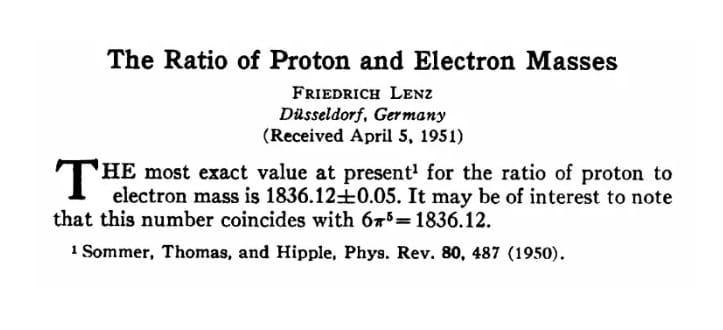
I thought I’d share this for the benefit of those who haven’t seen it already:

Published in the Physical Review in 1951 this paper is just 27 words long, contains one number (+ error bounds), one equation, and one reference. Is this the shortest physics paper ever?

P.S. Current measurements of the electron and proton masses give a ratio inconsistent with the number derived from the measurements in [1].

Penny Dreadful

Posted in Literature, Television with tags , , , , , , , , on October 1, 2024 by telescoper

The other day I was in the local library and walked past the DVD collection on the way to checking out a couple of books. I noticed the boxed set of the first series of Penny Dreadful which was first broadcast in 2014. Ten years is quite a short time for me to catch up with things so I decided to borrow it. I’m glad I did because I thought it was excellent.

It’s hard to describe what Penny Dreadful is about without making it seem absurd, but it’s a horror drama based in Victorian London that features many characters from fiction of that period, including Mary Shelley’s Frankenstein, Oscar Wilde’s Dorian Gray, and numerous others from Bram Stoker’s Dracula including Professor van Helsing and Mina Harker. There are some originals too: Ethan Chandler, a rodeo performer, and the enigmatic Vanessa Ives. These characters join forces with Malcolm Murray who is attempting to find his daughter Mina (the name of the principal female character in Dracula). Mina is the MacGuffin but the quest to find her is mostly sidelined by other plots.

The title of course refers to the “Penny Dreadful“, a form of cheap fiction that was very popular in Victorian London and which often included a supernatural element, as well as lots of gory violence, as does the TV series. Oscar Wilde’s A Picture of Dorian Gray wasn’t a penny dreadful (nor were Frankenstein and Dracula for that matter) but the mix of characters, both mundane and supernatural, is a very ingenious concoction. It was fun trying to spot the literary references and quotations.

It’s also a bit raunchy in places, although when Dorian Gray was about to get it on with hunky cowboy Ethan Chandler, it cut immediately to the closing credits so, disappointingly, we didn’t see any actual rumpy pumpy.

Anyway, it’s a superb cast including Timothy Dalton as Malcolm Murray, Rory Kinnear as The Creature (from the Frankenstein story), and Eva Green as Vanessa Ives. A young Olly Alexander plays the vampire’s familiar Fenton. It’s beautifully photographed, and the sets are a visual feast for lovers of Victoriana. There are one or two anachronisms in the language and setting, but you have to cut a story like this a bit of slack. For example, the Grand Guignol, which supplies a subplot, was really a Parisian phenomenon.

I’ve seen some criticisms of the plotting, as the episodes don’t really resolve: the next one often starts a new thread rather than tying up the existing loose ends. I didn’t actually mind that at all. It seemed to me that this gives it a dreamlike or rather nightmarish quality.

Anyway, I enjoyed this series a lot and I’ll definitely look out for the other two series, as they may well offer excellent binge viewing during the dark autumn months.

Close of Play

Posted in Cricket, Poetry with tags , , , , , , on September 29, 2024 by telescoper

Today saw the end of this year’s County Championship cricket season, which I take to be definition of the official end of summer.  It seems to have come very late this year, and the weather not particularly clement for the last day.

I like county cricket, and hope to be able to see more when I retire and have the time, but I haven’t followed many games this year. I was away for much of the season and a bit busy to pay too much attention for the rest. I still keep an eye on how Glamorgan are doing, though, because of the time I spent living in Cardiff. In fact they won their last game against Gloucestershire yesterday to finish 6th  in the 2nd Division. The match had been affected by rain but both captains decided to try to make a game of it by each forfeiting an innings after Glamorgan declared their first innings 381/4with the best part of two days to play. Gloucestershire never looked like reaching that total and were bowled out for 189. The other Championship game between these two teams, in June, ended in a remarkable tie as Glamorgan were bowled out for 592 needing 593 to win. Of course the great success of the year for Glamorgan was winning the One Day Trophy, beating Somerset in a final deferred by a day and truncated by rain.

Elsewhere in the County Championship, Surrey won the 1st Division while Lancashire and Kent were relegated. Sussex won the 2nd division title and they and Yorkshire were promoted to Division 1 for next season. With Lancs and Yorks in different divisions, there wasn’t be a Roses match this summer, and there won’t be one next season either!

Anyway, as I’ve done before,  it seems apt to mark the end of the County Championship with one of the classic cricket poems, Close of Play  by Thomas Moult.

How shall we live, now that the summer’s ended,
And bat and ball (too soon!) are put aside,
And all our cricket deeds and dreams have blended —
The hit for six, the champion bowled for none,
The match we planned to win and never won? …
Only in Green-winged memory they abide.

How shall we live, who love our loveliest game
With such bright ardour that when stumps are drawn
We talk into the twilight, always the same
Old talk with laughter round off each tale —
Laughter of friends across a pint of ale
In the blue shade of the pavilion.

For the last time a batsman is out, the day
Like the drained glass and the dear sundown field
is empty; what instead of Summer’s play
Can occupy these darkling months ere spring
Hails willows once again the crowned king?
How shall we live so life may not be chilled?

Well, what’s a crimson hearth for, and the lamp
Of winter nights, and these plump yellow books
That cherish Wisden’s soul and bear his stamp —
And bat and ball (too soon!) are put aside,
Time’s ever changing, unalterable score-board,
Thick-clustered with a thousand names adored:
Half the game’s magic in their very looks!

And when we’ve learnt those almanacs by heart,
And shared with Nyren … Cardus ….the distant thrill
That cannot fade since they have had their part,
We’ll trudge wet streets through fog and mire
And praise our heroes by the club-room fire:
O do not doubt the game will hold us still!


Four New Publications at the Open Journal of Astrophysics

Posted in OJAp Papers, Open Access, The Universe and Stuff with tags , , , , , , , , , , , , on September 29, 2024 by telescoper

A day later than has been usual for such things, it’s now time for a quick update of activity at the Open Journal of Astrophysics. This week we have published another batch of four papers which takes the count in Volume 7 (2024) up to 81 and the total published altogether by OJAp up to 196. I think there may come a week in we publish papers on every day of that week, but it was not this week…

In chronological order, the four papers published this week, with their overlays, are as follows. You can click on the images of the overlays to make them larger should you wish to do so.

First one up is “Finding the unusual red giant remnants of cataclysmic variable mergers” by Nicholas Z. Rui and Jim Fuller of California Institute of Technology (Caltech), USA. It presents a discussion of the possible photometric, astroseismological, and surface abundance signatures of red giants formed by mergers of cataclysmic variable stars. It was published on 23rd September 2024 and is in the folder marked Solar and Stellar Astrophysics.

Here is a screen grab of the overlay, which includes the abstract:


You can find the officially accepted version of the paper on the arXiv here.

The second paper to announce, also published on 23rd September 2024, is “Notes on the Practical Application of Nested Sampling: MultiNest, (Non)convergence, and Rectification” by Alexander Dittmann (U. Maryland, USA). A critical analysis of the MultiNest algorithm together with suggestions for approving its applicability. It is in the folder Instrumentation and Methods for Astrophysics.

You can see the overlay here:


The accepted version of this paper can be found on the arXiv here.

The third paper, published on 24th September 2024 in the folder marked High-Energy Astrophysical Phenomena, is called  “Merger Precursor: Year-long Transients Preceding Mergers of Low-mass Stripped Stars with Compact Objects” and is by Daichi Tsuna, Samantha Wu & Jim Fuller (Caltech), Yize Dong (UCLA) and Anthony Piro (Carnegie Observatories), all based in the USA.

Here is the overlay


The final version accepted on arXiv is here.

Last in this batch is “Spectroscopic Observations of the GALEX Nearby Young Star Survey Sample. I. Nearby Moving Group Candidates” by Navya Nagananda (Rochester, NY, USA), Laura Vican (UCLA), Ben Zuckerman (UCLA), David Rodriguez (STScI), Alexander Binks (Tübingen, Germany) & Joel Kastner (Rochester). It describes investigations of the spectra of the GALNYSS sample of over 2000 young stars and the assignment of these stars into moving groups. It is is in the folder marked Solar and Stellar Astrophysics, and was published on 25th September 2024 with this overlay:


You can find the official accepted version on the arXiv here.

That’s all for now. I will post another update in a week.

R.I.P. Maggie Smith (1934-2024)

Posted in Film, R.I.P., Television with tags , , , , , , , , , on September 28, 2024 by telescoper

I heard yesterday of the death at the age of 89 of the great Maggie Smith. Tributes have been appearing around the world at the loss of such a great talent and wonderful personality. I can’t add anything to these except to say that I adored her.

I guess many people will be most familiar her through the work she did in later life, such as the Harry Potter franchise and Downtown Abbey but as an oldie I will always think of her as the eponymous Edinburgh schoolteacher in the 1969 film The Prime of Miss Jean Brodie, based on the Muriel Spark novel of the same name, for which she deservedly won an Oscar as Best Actress for her portrayal of Jean Brodie, an over-zealous teacher with a soft spot for Mussolini’s Fascisti. Here’s the original trailer.

I do hope this film gets shown again soon as a tribute, as it is really superb.

Maggie Smith as Lady Constance Trentham in Gosford Park (2001)

Other roles I particularly remember Maggie Smith for are in are California Suite (for which she also won an Oscar, as Best Supporting Actress). She was absolutely hilarious in Murder by Death, her perfect sense of comic timing generating numerous laugh-out-loud moments in that film.

Maggie Smith with David Niven in Murder by Death (1976)

Maggie Smith was also memorable as the splendidly rude Lady Constance in Gosford Park, a role you might think of as a sort of prelude to her part in Downton Abbey. There are countless other performances I could mention too, on TV, on Film and in the Theatre. She was tremendously versatile and talented, as well as extremely funny. She admitted having learnt a great deal about comedy from Kenneth Williams, with whom she was great friends for a long time.

Rest in peace, Maggie Smith. You’ll be missed so much.

Leonard Slatkin at 80

Posted in Biographical, Music with tags , , , , , , on September 28, 2024 by telescoper

Last night found me once again at the National Concert Hall in Dublin for a concert by the National Symphony Orchestra conducted this time by Leonard Slatkin, who has a long association with the NSO and who was 80 years old on 1st September. I must say he looked very sprightly for a man eighty years of age!

To start the programme we had the world premiere of a piece by Leonard Slatkin’s son, Daniel. Voyager 130 was inspired by the Voyager space mission, and especially by the Golden Records carried by the Voyager probes. Among the pieces of music included on those records is the exquisite Cavatina from Beethoven’s String Quartet No. 13 (Opus 130) from which the composer borrows thematic material for this piece. Daniel Slatkin was actually in the audience for this – in fact he was sitting just two rows in front of me – and went up on stage after the very enjoyable performance.

After that, and some rearranging on stage, we had a performance of Beethoven’s Piano Concerto No. 4 with Dublin-born soloist Hugh Tinney. Although for its time it was very unconventional in structure, this is now a very familiar piece in the concert hall. For the most part it was played very well but I did think the orchestra were a bit stiff and lacking in expression in places. The performance was warmly received by the NCH audience, and Hugh Tinney received a standing ovation at the end.

After the wine break we had another familiar work, the Symphony No. 3 by Johannes Brahms, which Leonard Slatkin conducted without a score. I’m persevering with Brahms. I still don’t find that he moves me as much as many other composers and so many people rave about him that I think I must be missing something. The 3rd Symphony is a very fine work, offering lots of variety across its four movements while maintaining a strong sense of coherence and remaining relatively concise – it lasts about 33 minutes in performance. I’m no expert on Brahms but it seems to me that the 3rd Symphony is where he really found his voice as a symphonic composer and stepped out from the shadow of Beethoven.

Apart from the first piece, it was a very conventional programme but I enjoyed it as did the audience. It’s a pity there weren’t more people there, though. I’d guess that the NCH was about 2/3 full at most.

P.S. Last night Leinster rugby were playing a match at Landsdowne Road (beating the Dragons 34-6) and Shelbourne were playing Sligo Rovers at home in the League of Ireland (a 0-0 draw) so the train home was a bit busier than last time but still uneventful. When I got home later I decided to listen to a recording of the Beethoven Strong Quartet No. 13 before bed…

Dark Matter from Primordial Black Holes?

Posted in The Universe and Stuff with tags , , , , , , , , , on September 27, 2024 by telescoper

We live in a cyclic universe of a sort because every few years somebody tries to resurrect the idea that dark matter is somehow related to primordial black holes, i.e. black holes formed in the very early stages of the history of the Universe so that they have masses much smaller than black holes formed more recently by the collapse of stars or the merger of other black holes. If it forms very early the mass of a PBH could in principle be very small, much less than a star or a planet. The problem with very small black holes is that they evaporate very quickly via Hawking Radiation so would not survive the 14 billion years or so needed to still be in existence today and able to be dark matter.

An idea that was used in the past to circumvent this issue was that something might stop Hawking Radiation proceeding to reduce the mass of a PBH to zero, leaving a relic of finite mass usually taken to be the Planck mass. The suggestion has returned in different (but still speculative) guise recently, fueling a number of media articles of varying degrees of comprehensibility, e.g. here. The technical papers on which these articles are based can be found here and here.

Fortunately, there is now one of those excellent Cosmology Talks explaining the latest idea of how Hawking Radiation might break down and what the consequences are for Primordial Black Holes as a form of Dark Matter.