The Big Four and Your Work

Posted in Open Access with tags , , , , on September 10, 2024 by telescoper

In Agatha Christie’s novel The Big Four (left) the great detective Hercule Poirot tries to identify the members of sinister group of unscrupulous individuals bent on world domination.

When it comes to the world of academic publishing, the members of the The Big Four are somewhat easier to identify, though no less unscrupulous. They are Elsevier, Spring-Nature, Taylor & Francis, and John Wiley & Sons who have cornered almost 50% of the lucrative market in scholarly books and journals and the eye-watering profits that go with that territory.

Recently, however, these companies have found a new way of boosting their profits still further. This involves selling their “content” to tech companies in order to train the generative AI algorithms known as Large Language Models. The latest to do this is Wiley, which has already cashed in to the tune of $44 million. Wiley has not given its authors the right to opt out of this deal nor will authors be remunerated. Others outside the Big Four are also cashing in. Oxford University Press, for example, which publishes Monthly Notices of the Royal Astronomical Society, has done similar deals.

This sort of arrangement provides yet another reason to avoid the commercial publishing sector. Do we become academic researchers in order to be mere “content creators” for Wiley and the rest?

Maynooth University’s Privatized Network

Posted in Maynooth with tags , , , on September 9, 2024 by telescoper

Quite a few people have contacted me to ask why my access to this blog is banned on Maynooth University campus, as indicated at the top of yesterday’s post. As far as I can see, the block applies not only to this site (telescoper.wordpress.com aka telescoper.blog) but every site with an IP address or addresses (a pair in my case) hosted on the WordPress.com domain. I don’t know how many sites that is, but it’s a lot.

When I asked IT Services at Maynooth why I could neither read no write to my own blog via the campus network, it was explained to me that at some point one of the sites hosted on WordPress was involved in a phishing operation so the whole domain was blocked by the “external provider” as it is deemed a security risk. Actually WordPress.com has very strict control of its security, so this allegation is potentially defamatory and damaging to WordPress business. I wouldn’t be surprised if they take legal action. It doesn’t damage my business of course, as I make no money from this blog, but I nevertheless find it extremely annoying. In any case it seems to me an unreasonable and disproportionate restriction.

It was in February 2024 (while I was away in Australia) that Maynooth University privatized its computer network, handing over control of it to a company called Agile Networks. Apparently, this “external provider” now has complete control over web access from Maynooth University and is not accountable to the University for its actions. It, not the University, decides what websites can be accessed by staff and students. So much for academic freedom.

I might add that there has been a plethora of network service outages recently, so I was amused by the self-congratulatory tone of Agile Networks represented by its takeover of Maynooth’s internet access, e.g.

It has revolutionised the campus. It has made every outdoor area of the campus a viable classroom.

That may be true, but it merely reflects the fact that Maynooth does not have anywhere near enough indoor teaching or student study spaces. I’m sure students will be delighted that it is now deemed acceptable for them to study in the “viable classroom” of the great outdoors, complete with freezing cold and pouring rain!

Anyway, I contacted WordPress to tell them of the problem and they confirmed that nobody from either Maynooth University or Agile Networks has contacted them about the alleged security breach. They said

The ideal situation would be that the service provider reviews our documentation and whitelists the IP…

The situation is obviously not ideal…

A New Term

Posted in Biographical, Education, Maynooth with tags on September 8, 2024 by telescoper

WARNING: THIS BLOG IS BANNED ON MAYNOOTH UNIVERSITY CAMPUS

I’m well and truly back from sabbatical: I spent most of Friday filling in forms.

It is now just two weeks before teaching resumes after the summer break. To add even more excitement to this, the building housing the rooms in which half of my scheduled lectures (and many of those of my colleagues) are to take place is still a construction site. The work was supposed to be completed by September 1st. Will the rooms be ready by September 23rd? I have no idea. What will we do if they’re not? I have no idea. We’ll just have to wait and see.

I still have the blackboard in my study that I used to give remote lectures during pandemic times. I wonder if I’ll be using it again? I thought this time round we would have a relatively smooth introduction to term, as opposed to the mad scramble caused in previous years by delayed Leaving Certificate results, but…

Among the new arrivals will be a cohort of students on our MSc in Theoretical Physics and Mathematics. I understand we have approximately 9 students which is not a bad start for a new postgraduate course. That means we’ll have to think up some projects for them to do. I might do that this afternoon, in fact.

Anyway, this coming week we have the first Departmental Meeting of the (new) Department of Physics. Hopefully we might find out how the merger is actually meant to work in practice. The day after that we meet the new (Interim) Dean of the Faculty of Science & Engineering. Incidentally the President of Maynooth University made this appointment in a way that is in direct conflict with the Statutes of the University. That’s par for the course at Maynooth these days, I’m afraid, as is the censorship of this blog.

This time next week we’ll be looking ahead to Welcome Week when the new students arrive and have a chance to look around and choose their modules. The local Facebook page is alive with messages from desperate students and their parents looking for accommodation in or near Maynooth. The University likes to boast about how many more students it will have this year, but not a thought is given to where they will live. The strain of having to travel long distances to campus, combined with the high cost of living necessitating many students to take on more-or-less full time employment, looks likely to ensure that drop-out rates climb still further.

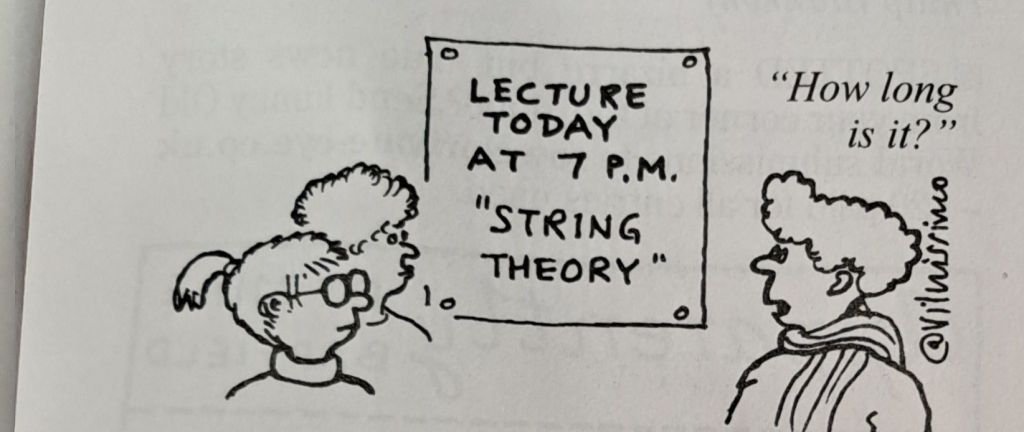
A Question of String Theory

Posted in The Universe and Stuff on September 7, 2024 by telescoper

The answer to the question is that “it’s as long as a piece thereof..”

Two New Publications at the Open Journal of Astrophysics

Posted in OJAp Papers, Open Access, The Universe and Stuff with tags , , , , , , , , , on September 7, 2024 by telescoper

It’s Saturday morning again so here’s another report on activity at the  Open Journal of Astrophysics.  Since the last update we have published two more papers, taking  the count in Volume 7 (2024) up to 73 and the total published by OJAp up to 188.  We’ve still got a few in the pipeline waiting for the final versions to appear on arXiv so I expect we’ll reach the 200 mark fairly soon.

The first paper of the most recent pair, published on September 4th 2024,  and in the folder marked Astrophysics of Galaxies, is “Massive Black Hole Seeds”  by John Regan of the Department of Theoretical Physics at Maynooth University and Marta Volonteri (Sorbonne Université, Paris, France). This article presents a discussion of the pathways to the formation of massive black holes, including both light and heavy initial seeds.

Here is a screen grab of the overlay which includes the abstract:


You can click on the image of the overlay to make it larger should you wish to do so. Those of you who are paying attention will see that there is a bit of a glitch on the left hand side where software has thrown a line break in between the two author names. I have no idea what caused this so I raised a ticket with Scholastica and no doubt it will soon be fixed.  (Update: it is now fixed, 12th September 2024). You can find the officially accepted version of this paper on the arXiv here.

The second paper has the title “The future of cosmological likelihood-based inference: accelerated high-dimensional parameter estimation and model comparison” and was published on 5th September 2024. The authors are Davide Piras (Université de Genève), Alicja Polanska (MSSL) , Alessio Spurio Mancini (Royal Holloway, London), Matthew A. Price(UCL) & Jason D. McEwen (UCL); the latter four are all based in the UK. This paper, which is in  the folder marked Cosmology and NonGalactic Astrophysics, describes an accelerated approach to Bayesian inference in higher-dimensional settings, as required for cosmology, based on recent developments in machine learning and its underlying technology.

Here is a screen grab of the overlay which includes the abstract:


You can click on the image of the overlay to make it larger should you wish to do so. You can find the officially accepted version of the paper on the arXiv here.

That concludes this week’s update. More  next week!

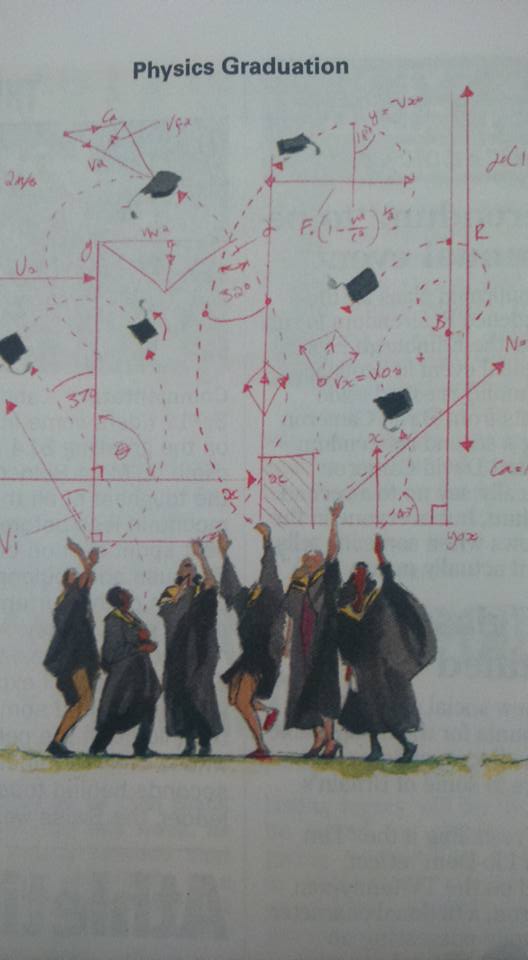
Congratulations to the Class of 24!

Posted in Education, Maynooth with tags , , on September 6, 2024 by telescoper

After almost a whole week of conferring ceremonies at Maynooth University, today was the day that this year’s Theoretical Physics students graduated. We all know that theoretical physicists are la crème de la crème so they were obviously keeping the best until last. Anyway, congratulations all!

Here’s a suitable image from Private Eye years ago:

The Editorial Board of the Open Journal of Astrophysics

Posted in Open Access, The Universe and Stuff with tags , , on September 6, 2024 by telescoper

A couple of months ago, I issued a call for new Editors of the Open Journal of Astrophysics. That was very successful and we added a number of new Editors. The complete list (of 20 members) follows:

Peter Coles* (Department of Theoretical Physics, Maynooth University, Ireland). Cosmology, astrophysics, statistics and methodology.

Thierry Appourchaux (CNRS, Institut d’Astrophysique Spatiale, Orsay, France). Space instrumentation, astroseismology, helioseismology, statistics and methodology.

Emory (Ted) Bunn (Department of Physics, University of Richmond, USA). Relativity, cosmology.

Walter Dehnen (Astronomisches Rechen-Institut, University of Heidelberg, Germany). Stellar dynamics, galaxy dynamics, galaxies, bars, Milky-Way dynamics, Gaia, numerical methods, N-body techniques, smooth particle hydrodynamics (SPH).

Philipp Edelmann (Los Alamos National Laboratory, New Mexico, USA). Stellar astrophysics, hydrodynamics, high-performance computing, supernovae, internal waves, stellar evolution, numerical methods.

Pedro Ferreira (Department of Physics, University of Oxford, UK). Large-scale structure, general relativity, cosmic microwave background, early universe, cosmology.

Andrew Jaffe (Department of Physics, Imperial College, London, UK). Astrophysics, statistics and methodology, cosmology.

Harley Katz (Department of Astronomy and Astrophysics, University of Chicago, USA). Galaxy formation and evolution, numerical simulations

Lucyna Kedziora-Chudczer (School of Physics, University of New South Wales, Sydney, Australia). Active galactic nuclei, polarimetry, atmospheres of planets, exoplanets, solar system planets.

Julien Larena (Laboratoire Univers et Particules de Montpellier, Université de Montpellier, France). Cosmology, gravitation, lensing, large-scale structure, general relativity.

Manuela Magliocchetti (National Institute of Astrophysics, Rome, Italy). Cosmology, galaxies, active galactic nuclei (AGN).

Sean McGee (Department of Physics & Astronomy, University of Birmingham, UK). Galaxy formation, galaxy clusters, galaxy surveys.

Manolis Plionis (Department of Physics, Aristotle University of Thessaloniki, Greece). Observational cosmology, extragalactic astrophysics, large-scale structure, active galactic nuclei.

Alkistis Pourtsidou (Higgs Centre & Institute for Astronomy, Edinburgh, UK). Cosmology, large-scale structure of the Universe, radio astronomy, galaxy surveys.

Justin Read (School of Mathematics and Physics, University of Surrey, UK). Dark matter, cosmology, galaxy formation and evolution, dwarf galaxies, milky way, galactic dynamics, galactic archaeology, computational modeling.

Hanno Rein (Department of Physics and Environmental Sciences, University of Toronto at Scarborough, Canada). Numerical methods, in particular N-body codes and integration methods for planetary systems, planet formation, stochastic processes, planet migration, celestial mechanics, and Saturn’s rings.

Aleks Scholz (School of Physics & Astronomy, University of St Andrews, UK). Exoplanets, brown dwarfs, protoplanetary disks, stellar evolution, star formation.

Elena Sellentin (Sterrewacht Leiden, Leiden University, The Netherlands). Applied Mathematics, Cosmology, Statistics, Statistical Inference.

Elena Terlevich (Instituto Nacional de Astrofísica, Óptica y Electrónica, Puebla, Mexico). Stellar populations in galaxies, observational cosmology, violent star formation, element abundances, dynamics of stellar systems.

Bingbing Wang (Center for Space Plasma and Aeronomic Research, University of Alabama in Huntsville, USA.) Particle astrophysics, MHD turbulence, cosmic rays acceleration, cosmic ray propagation in the Galaxy and heliosphere.

Apologies to anyone who volunteered but has not yet received a reply from me. I’ve been a bit preoccupied these last weeks! The call is still open, though. Here are the areas of arXiv covered by the journal:

  1. astro-ph.GA – Astrophysics of Galaxies. Phenomena pertaining to galaxies or the Milky Way. Star clusters, HII regions and planetary nebulae, the interstellar medium, atomic and molecular clouds, dust. Stellar populations. Galactic structure, formation, dynamics. Galactic nuclei, bulges, disks, halo. Active Galactic Nuclei, supermassive black holes, quasars. Gravitational lens systems. The Milky Way and its contents
  2. astro-ph.CO – Cosmology and Nongalactic Astrophysics. Phenomenology of early universe, cosmic microwave background, cosmological parameters, primordial element abundances, extragalactic distance scale, large-scale structure of the universe. Groups, superclusters, voids, intergalactic medium. Particle astrophysics: dark energy, dark matter, baryogenesis, leptogenesis, inflationary models, reheating, monopoles, WIMPs, cosmic strings, primordial black holes, cosmological gravitational radiation
  3. astro-ph.EP – Earth and Planetary Astrophysics. Interplanetary medium, planetary physics, planetary astrobiology, extrasolar planets, comets, asteroids, meteorites. Structure and formation of the solar system
  4. astro-ph.HE – High Energy Astrophysical Phenomena. Cosmic ray production, acceleration, propagation, detection. Gamma ray astronomy and bursts, X-rays, charged particles, supernovae and other explosive phenomena, stellar remnants and accretion systems, jets, microquasars, neutron stars, pulsars, black holes
  5. astro-ph.IM – Instrumentation and Methods for Astrophysics. Detector and telescope design, experiment proposals. Laboratory Astrophysics. Methods for data analysis, statistical methods. Software, database design
  6. astro-ph.SR – Solar and Stellar Astrophysics. White dwarfs, brown dwarfs, cataclysmic variables. Star formation and protostellar systems, stellar astrobiology, binary and multiple systems of stars, stellar evolution and structure, coronas. Central stars of planetary nebulae. Helioseismology, solar neutrinos, production and detection of gravitational radiation from stellar systems.

We are looking for experienced scientists in any of these areas, and it would indeed be useful to have people who can cover a range of subjects (as some of our existing editors do), but there I think we’re still a bit short on High-Energy Astrophysics, Solar and Stellar Physics, and Galactic Astrophysics. I’d also like to see a better gender balance so applications from female scientists are particularly welcomed, as are astrophysicists from geographical areas not currently covered. The Open Journal of Astrophysics is intended to be a global enterprise!

Please follow the instructions here if you would like to volunteer!

Scopus should be banned

Posted in Maynooth, Open Access with tags , , , on September 5, 2024 by telescoper

I think it’s time to provide an update on the (lack of) progress getting The Open Journal of Astrophysics properly indexed in Scopus (which markets itself as a purveyor of “metrics you can trust”).

You might recall back in June that I reported that OJAp had been included in the index, but unfortunately the Scopus team messed up very badly by omitting about one-third of our papers and most of our citations. Here’s what they did:

In the column marked Documents 2020-23  you will see the number 67. In fact we published 99 articles between 2020 and 2023, not 67. This is easily established here. The number 67 relates to the period 2022-23 only. Accidentally or deliberately, Scopus has omitted a third of our papers from its database. But the error doesn’t end there. Papers published in OJAp between 2020 and 2023 have actually been cited 959 times, not 137. If you restrict the count to papers published in 2022-23 there are 526 citations. It’s no wonder that OJAp has such a low CiteScore, and consequently appears so far down the rankings, when the citation information is so woefully inaccurate. “Metrics you can trust?” My arse!

If you want accurate bibliometric information about the papers published in the two years that Scopus has chosen to ignore you can look here.

I sent this information to Scopus on 15th June, soon after noticing the error, but I then got shunted around. I eventually got a reply on 23rd August, acknowledging the mistake and including this:

I want to assure you that your request has been promptly forwarded to our technical team for the addition of the paper to our database. While we strive to resolve this as swiftly as possible, please be aware that this correction process may take up to four weeks to be completed. 

I think they’re using some definition of “promptly” with which I am unfamiliar. I’m not optimistic that they will actually correct it in four weeks, either, since it took 5 months to get the initial 67 papers indexed.

This all merely demonstrates the folly that so many institutions place so much trust in Scopus. Based on my interactions with them, I wouldn’t trust them with anything at all. Unfortunately the powers that be have decided that Scopus listing is such a reliable indicator of quality that any article not published in a Scopus journal is worthless. Knowing that it has a monopoly, Scopus has no incentive to put any effort into its own quality assurance. It can peddle any error-ridden tripe to its subscribers, most of them paying for the product with taxpayers’ money.

(I might add that if OJAp were a commercial journal, then the willful publication of demonstrably false information about it would be actionable as it is potentially damaging to business. )

Presumably at the instigation of senior management, IT services at Maynooth University are still banning access to this blog from campus. It would make far more sense for them to ban Scopus.

Induction and Conferring

Posted in Biographical, Education, Maynooth with tags , , , , on September 4, 2024 by telescoper

I was away yesterday dealing with some personal matters and on the way home I was so bored that I took a rare glance at my LinkedIn feed and found this, which unfortunately refuses to be embedded properly.

https://www.linkedin.com/posts/royal-grammar-school-newcastle_wearergs-activity-7236768897327087616-8Iz8

Anyway, it reminded me that it was 50 years ago this week that I went through a similar induction process at the Royal Grammar School Newcastle and was about to begin my Secondary Education along with my classmates in 1E, one of whom I wrote about here. We didn’t have “Year 3”, “Year 7” and “Year 11” in those days; we were just called “First Years”, which I guess is Year 7 in today’s currency. The Hall hasn’t changed much since my day. Although it looked enormous then, to a little boy, to an adult it looks very small to accommodate over a thousand pupils. At the morning School Assemblies many of us had to stand around the edges.

Meanwhile, back in the present week, Maynooth University is hosting events at which degrees are conferred. The cohort of undergraduate students graduating at this week’s ceremonies are those that took their final examinations in May/June this year (while I was away on sabbatical) so I didn’t teach any of them this year. I will, however, be seeing some again as they return for postgraduate degrees.

In a couple of weeks we will be having induction events for the new intake of students at Maynooth University. Most of our students are on 4-year programmes, so it well be September 2028 that the latest crop have their conferring ceremonies. If all goes to plan I shall have retired by then.

September – Herman Hesse

Posted in Music, Poetry with tags , , , on September 2, 2024 by telescoper

Der Garten trauert,
kühl sinkt in die Blumen der Regen.
Der Sommer schauert
still seinem Ende entgegen.

Golden tropft Blatt um Blatt
nieder vom hohen Akazienbaum.
Sommer lächelt erstaunt und matt
in den sterbenden Gartentraum.

Lange noch bei den Rosen
bleibt er stehen, sehnt sich nach Ruh.
Langsam tut er die großen
müdgewordnen Augen zu.

by Hermann Hesse (1877-1962)

This poem was set to music in September 1948 by Richard Strauss and became one of his famous Four Last Songs. It was in fact the last of these songs he composed, although it is usually performed as the second song in the sequence. Strauss died in September 1949.

The first verse translates roughly as:

The garden is mourning,
cool sinks the rain sinks into the flowers.
Summer shudders
as it meets its end.