I think it’s time to provide an update on the (lack of) progress getting The Open Journal of Astrophysics properly indexed in Scopus (which markets itself as a purveyor of “metrics you can trust”).
You might recall back in June that I reported that OJAp had been included in the index, but unfortunately the Scopus team messed up very badly by omitting about one-third of our papers and most of our citations. Here’s what they did:
In the column marked Documents 2020-23 you will see the number 67. In fact we published 99 articles between 2020 and 2023, not 67. This is easily established here. The number 67 relates to the period 2022-23 only. Accidentally or deliberately, Scopus has omitted a third of our papers from its database. But the error doesn’t end there. Papers published in OJAp between 2020 and 2023 have actually been cited 959 times, not 137. If you restrict the count to papers published in 2022-23 there are 526 citations. It’s no wonder that OJAp has such a low CiteScore, and consequently appears so far down the rankings, when the citation information is so woefully inaccurate. “Metrics you can trust?” My arse!
If you want accurate bibliometric information about the papers published in the two years that Scopus has chosen to ignore you can look here.
I sent this information to Scopus on 15th June, soon after noticing the error, but I then got shunted around. I eventually got a reply on 23rd August, acknowledging the mistake and including this:
I want to assure you that your request has been promptly forwarded to our technical team for the addition of the paper to our database. While we strive to resolve this as swiftly as possible, please be aware that this correction process may take up to four weeks to be completed.
I think they’re using some definition of “promptly” with which I am unfamiliar. I’m not optimistic that they will actually correct it in four weeks, either, since it took 5 months to get the initial 67 papers indexed.
This all merely demonstrates the folly that so many institutions place so much trust in Scopus. Based on my interactions with them, I wouldn’t trust them with anything at all. Unfortunately the powers that be have decided that Scopus listing is such a reliable indicator of quality that any article not published in a Scopus journal is worthless. Knowing that it has a monopoly, Scopus has no incentive to put any effort into its own quality assurance. It can peddle any error-ridden tripe to its subscribers, most of them paying for the product with taxpayers’ money.
(I might add that if OJAp were a commercial journal, then the willful publication of demonstrably false information about it would be actionable as it is potentially damaging to business. )
Presumably at the instigation of senior management, IT services at Maynooth University are still banning access to this blog from campus. It would make far more sense for them to ban Scopus.
I was away yesterday dealing with some personal matters and on the way home I was so bored that I took a rare glance at my LinkedIn feed and found this, which unfortunately refuses to be embedded properly.
Anyway, it reminded me that it was 50 years ago this week that I went through a similar induction process at the Royal Grammar School Newcastle and was about to begin my Secondary Education along with my classmates in 1E, one of whom I wrote about here. We didn’t have “Year 3”, “Year 7” and “Year 11” in those days; we were just called “First Years”, which I guess is Year 7 in today’s currency. The Hall hasn’t changed much since my day. Although it looked enormous then, to a little boy, to an adult it looks very small to accommodate over a thousand pupils. At the morning School Assemblies many of us had to stand around the edges.
Meanwhile, back in the present week, Maynooth University is hosting events at which degrees are conferred. The cohort of undergraduate students graduating at this week’s ceremonies are those that took their final examinations in May/June this year (while I was away on sabbatical) so I didn’t teach any of them this year. I will, however, be seeing some again as they return for postgraduate degrees.
In a couple of weeks we will be having induction events for the new intake of students at Maynooth University. Most of our students are on 4-year programmes, so it well be September 2028 that the latest crop have their conferring ceremonies. If all goes to plan I shall have retired by then.
This poem was set to music in September 1948 by Richard Strauss and became one of his famous Four Last Songs. It was in fact the last of these songs he composed, although it is usually performed as the second song in the sequence. Strauss died in September 1949.
The first verse translates roughly as:
The garden is mourning, cool sinks the rain sinks into the flowers. Summer shudders as it meets its end.
My first official day back at work after a year-long sabbatical coincides with the first official day of a new Department of Physics at Maynooth University:
I knew this was happening, of course, and it should have happened years ago. Having two separate Physics Departments at Maynooth was not just an oddity. It required the relatively small number of academic staff across the Departments to undertake a huge amount of duplication in teaching thereby wasting resources and increasing workloads. Even combined together, the total complement of 15 academic staff means that we’re still a very small Department.
There are, therefore, potential benefits in this merger but they will take time to accrue. At the moment it only exists on paper, and staff in the two ex-Departments will have to work out what to do next in terms of coordinating teaching and research. In my opinion this all should have been planned and agreed before going ahead, but here we are. We just have to make the best of the situation presented to us by The Management.
For the time being the New Department is just the two Old Departments in a single wrapper. We were already located side-by-side in the same building, the Science Building so there are no large-scale relocations of staff, at least not yet. All existing courses remain the same as before, too. That’s just as well, really, as we start teaching in three weeks!
That’s not to say that nothing has changed. The number of postgraduate and postdoctoral researchers in the Department of Theoretical Physics has been growing and there was consequently a drastic shortage of office space. My return from sabbatical has involved me being granted an elevated status in the new Department: I’ve been moved upstairs out of the old Theoretical Physics Department to an office in the old Experimental Physics Department.
Here’s a question, though. My contract of employment says that I am employed in the Department of Theoretical Physics. Since that Department no longer exists, do I need a new contract or have I been made redundant?
I was obliged to take a taxi home from last week’s appointment. Taxi drivers don’t always make the best company, but this time I was lucky. The driver was a nice friendly chap with an infectious laugh, and when I had settled into my seat he asked me if he wanted him to turn the music down. I said no, it was fine. It wasn’t loud anyway. After a little while I realized that I really liked the music (which I hadn’t heard before) so I asked him to turn it up a bit. He smiled into the mirror, turned up the volume, and thereafter started humming and singing along. I made a note of the name of the band and the record in the hope that I could find it on YouTube, which I did.
Here we are then. This is Juju Music by Nigerian musician King Sunny Adé and his African Beats. Apparently it’s quite a famous record – it was released way back in 1982. I love the complex polyrhythms so typical of African music, and there’s some fine guitar playing on it too. I’ve been listening to it off and on over the whole weekend, so I thought I’d share it here. Enjoy!
I had been looking forward to attending last week’s Irish National Astronomy Meeting in the fine city of Galway but unfortunately I couldn’t go because I had an appointment I couldn’t reschedule (which also kept me offline for a couple of days). This was a shame because it turns out that one of our undergraduate SPUR students at Maynooth, Jake Feeney, together with two colleagues, John Regan and Paddy Kavanagh, won the prize for the best poster at INAM.
Today is 31st August 2024, which is officially the last day of my year-long sabbatical – even if tomorrow is a Sunday, so I won’t be actually returning full-time to the office until Monday 2nd September. After that I have three whole weeks to prepare the new modules I’ll be teaching in the Autumn Semester. I suppose at some point I’ll have to write a report about what I did on my sabbatical, at least from the point of view of work. I’ll keep the rest to myself!
I was planning to cook myself dinner and a few glasses of wine this evening to mark the end of my year of travels. I’ll still be doing that but in the last few days I have been given something else to think about.
About 50 years ago, in September 1974, I was preparing for my first days at the Royal Grammar School (RGS) in Newcastle. I didn’t know anyone else there and had no idea what to expect. I’d won a scholarship under the Direct Grant system so my parents didn’t have to pay fees, which was just as well because they wouldn’t have been able to. The RGS was an all-boys school in those days and most of the boys were from much wealthier backgrounds than I was and their parents paid fees. Many had also been to the RGS Junior School (also fee-paying) whereas I had gone to a state school, so when I arrived for my first day there were quite a few that already knew each other and were much better prepared academically than I was.
The upshot of this was that I found it very difficult there for the first few weeks, both socially and academically. I just wasn’t used to the intensity of the teaching style, the extensive homework, and the fact that I had to try to make friends from scratch.
In the first year the teaching was arranged in “Houses” and the boys in each House had to wear a tie of a specific colour with their (blue) blazer. I was in Eldon House so wore a green tie and my first form was called 1E. Everyone took the same subjects in first and second form.
Among the friends I made in the first year was a boy who had been to the RGS Junior School where he had acquired the nickname “Titch” because of his diminutive stature; his real name was Alan Michael Hawdon although he never used Alan. When he wasn’t “Titch” he was Michael. I found it a bit awkward calling him “Titch” because I was scarcely any taller than he was, but he didn’t mind it at all. Despite not being very tall, he excelled at all sporting events, especially running and gymnastics. He was also very kind, friendly and gregarious. Although I wasn’t anything like as sporty as him, we became good friends. In fact he was the only boy whose home (in Tynemouth) I visited in the first year at RGS. I can’t remember what the occasion was, but we spent an enjoyable day at the coast. I also remember going to the annual school camp in Ryedale and spending quite a lot of time with Titch then. I also remember asking if I could take a picture of him with the old Box Brownie my dad had lent me. He agreed.
The system at RGS was that, after the second year, i.e. after 2E, classes began to diversify and there was some choice of subjects. Forms were no longer composed of students from the same House (though we continued to wear the house tie). When I returned to RGS to start the third year, I was in the “Three Languages” form as I had decided to do German (though I dropped it after one year to concentrate on sciences). I was dismayed to find that Titch was in a different form; since I no longer had any classes with him we drifted apart, though we remained on friendly terms until A-levels and departure for University in 1981 after which I lost contact entirely. All I knew until recently was that he got a Royal Navy Scholarship to do Mechanical Engineering at Nottingham University as a precursor for joining the Navy.
So why am I telling you all this?
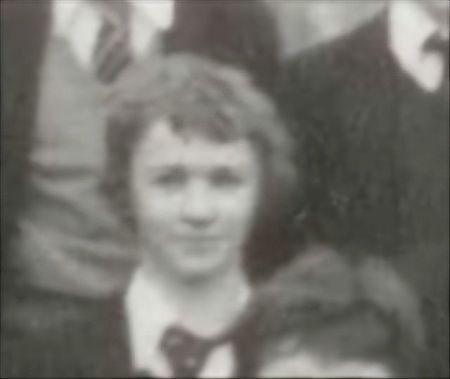
Last week I heard that Michael Hawdon (aka “Titch”) passed away in December 2022. That news came as a shock because he was the fittest and healthiest lad in the class of ’81 and I would have given long odds against him dying at the age of just 59. The picture of him on the left was taken in 1979; the wonky tie was always a trademark.
I gather that, in 1982, before going to university, he had been enlisted to go to the Falklands. However, the ship he was on suffered a mechanical failure and he never got there; the war ended in June 1982 and he went to Nottingham in October that year. After that, he travelled extensively, including spending some time living in New Zealand.
Forty years had passed since we both left RGS and went our very different ways until, in 2021, out of the blue, he sent me an email (signed “Titch”). It seems he had come across my name in connection with some work he had been doing at the UK Space Agency and decided to look me up. He was probably bored during the Covid-19 lockdown but I was very happy that he remembered me at all. Whatever the reason, I was delighted. We exchanged a considerable number of messages sharing memories of RGS days. Then he stopped replying. I don’t know whether he was ill or merely busy, but just a year later he passed away.
I was only 11 when I met Michael Hawdon and so immature that I didn’t know what was going on in my own emotions, but looking back I can see now that I definitely had a crush on him. Maybe it was more than that. I never told him, of course. It wouldn’t have been appreciated let alone reciprocated. I was in any case more than happy just to be able to call him a friend.
I mentioned the photograph of Titch I took in Ryedale just to say that I carried that around with my in my blazer pocket for at least a year. I spent an hour or so today looking for it, but unfortunately it seems I must have lost it. I wish I had been able to find the words to thank him for his friendship all those years ago. The best I can do now is to drink to his memory.
For some we loved, the loveliest and the best That from his Vintage rolling Time hath prest, Have drunk their Cup a Round or two before, And one by one crept silently to rest
I am back in circulation after my little break and, since it’s Saturday, I will resume blogging with another report on activity at the Open Journal of Astrophysics. Since the last update we have published two more papers, taking the count in Volume 7 (2024) up to 71 and the total published by OJAp up to 186. We’ve still got a few in the pipeline waiting for the final versions to appear on arXiv so I expect we’ll reach the 200 mark fairly soon.
The first paper of the most recent pair, published on August 26th 2024, is “Impact of lensing of gravitational waves on the observed distribution of neutron star masses” by Sofia Canevarolo, Loek van Vonderen and Nora Elisa Chisari, all of Utrecht University in the Netherlands. This article presents a discussion of the bias in neutron star mass determinations caused by gravitational lensing of the gravitational waves they produceThe paper is in the folder marked Cosmology and NonGalactic Astrophysics.
Here is a screen grab of the overlay which includes the abstract:
You can click on the image of the overlay to make it larger should you wish to do so. You can find the officially accepted version of the paper on the arXiv here.
The second paper has the title “FORGE’d in FIRE III: The IMF in Quasar Accretion Disks from STARFORGE” and was published (in the early hours of the morning) on 29th August 2024. The authors, all based in the USA, are Philip F. Hopkins (Caltech), Michael Y. Grudic (Carnegie Observatories), Kyle Kremer (Caltech), Stella S. R. Offner (UT Austin), David Guszejnov (UT Austin) and Anna L. Rosen (UCSD). This paper, which is in the folder marked Astrophysics of Galaxies, presents a numerical study of star formation and the initial mass function in quasar accretion disks. The previous two papers in this series have also been published in the OJAp: you can find them here and here; images and movies related to this project can be found here.
Here is a screen grab of the overlay which includes the abstract:
You can click on the image of the overlay to make it larger should you wish to do so. You can find the officially accepted version of the paper on the arXiv here.
That concludes this week’s update. We still have quite a few papers in the pipeline after the summer lull so I expect I’ll have a larger update for you next week!
Posted in Uncategorized on August 28, 2024 by telescoper
It behoves me to disappear from the blogosphere for a couple of days – perhaps not even as long as that – so there will be a (hopefully) short interlude until I return.
Today is the day that students across Ireland receive offers of places at Third-Level Institutions to start next month; the full set of CAO points required for different courses in different institutions are available in searchable form here and in a more user-friendly interface here. I have been away on sabbatical for a year so have been out of the loop for admissions. In past years I got an idea of how things were going from Open Days, etc, but not this time round.
This is of course just the first round of offers so things may change significantly over the next week or two. Students now have to decide whether to accept their first-round offer or try to change course. They have until next Tuesday to do this. Departments won’t know how many new students they have for a while yet.
The official low-tech results for Maynooth (in the lower right of the page shown above) are here. Minimum points required for Maynooth’s – and indeed Ireland’s – most important course, MH206 Theoretical Physics and Mathematics, are 513 this year, up a from 493 last year. Here’s a graph of how the CAO points for this course have varied over the years since 2010:
The entry level has been rather steady but note that Leaving Certificate grades have been adjusted upwards for the past few years so 500 points in 2024 is not equivalent to the same number in (say) 2016. The above graph doesn’t show how many students were recruited each year either.
MH201 General Science is 350 this year (same as last year); MH204 Physics with Astrophysics is 383 this year, up slightly from 376 last year. MH101 General Arts – the most popular course at Maynooth and indeed in all Ireland – has a first round offer of 307 this year, down from 310 last year. Most courses I have looked at in Maynooth have first-round offers this year similar to or lower than last year. Across all institutions, required points have fallen or remained unchanged for about 57% of courses.
This is interesting because it contrasts with news stories about grade inflation on the Leaving Certificate; I blogged about this here. It is perhaps worth pointing out that the CAO points needed for a course is largely a matter of demand versus capacity rather than academic performance. For the last few years Maynooth University has been recruiting more and more students, putting pressure on accommodation, teaching loads and campus space. It seems likely that the desire to keep this trend going is at least part of the reason for the continued falls in CAO points here. This is probably happening to some extent across the sector, though Maynooth has a more urgent need for more students: to pay for the legions of new managers it has appointed. The race to the bottom will really accelerate when the Covid-era Leaving Certificate adjustment is removed.
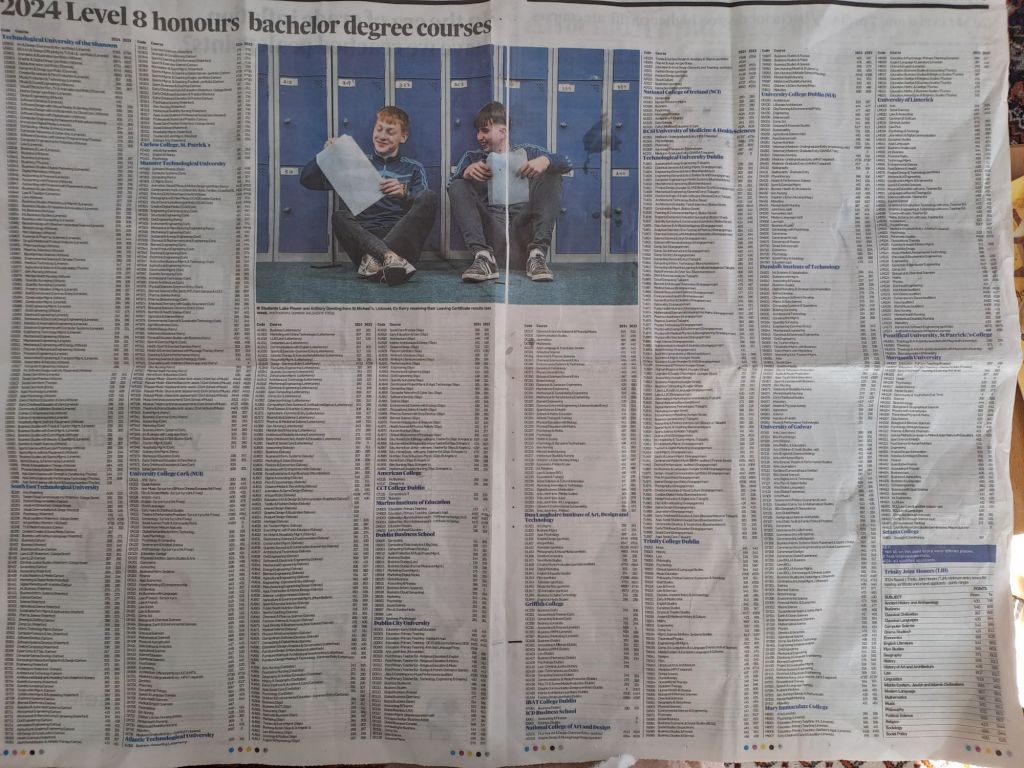
Update: here is the traditional supplement from Thursday’s Irish Times:
The views presented here are personal and not necessarily those of my employer (or anyone else for that matter).
Feel free to comment on any of the posts on this blog but comments may be moderated; anonymous comments and any considered by me to be vexatious and/or abusive and/or defamatory will not be accepted. I do not necessarily endorse, support, sanction, encourage, verify or agree with the opinions or statements of any information or other content in the comments on this site and do not in any way guarantee their accuracy or reliability.





 In the Dark