Glorious video of timelapse photography by, Tom Lowe, the winner of the 2010 Astronomy Photographer of the Year award.

Glorious video of timelapse photography by, Tom Lowe, the winner of the 2010 Astronomy Photographer of the Year award.
Gearing up for another stint in Swindon for the STFC Astronomy Grants Panel this week, I was trying to think of an appropriate theme for a blog post. The following short soliloquy from Macbeth somehow came up in a conversation in the pub last week, so I thought I’d post it here.
We actually “did” Macbeth at school and I was lucky enough to be cast in the best part, Lady Macbeth. No jokes please. I went to an all-boys school and, anyway, in Shakespeare’s time all the female roles were actually played by boys. I still remember quite a lot of the speeches I learned then, including all of Lady Macbeth’s famous Act I soliloquy The raven himself is hoarse. I’ll keep that for another post, so that no compunctious visitings of nature distract me from reading grant applications.
The speech below is remarkable for two things, I think. One is that it’s where one of the central themes of the play is laid bare: the numbing of the moral sense. Lady Macbeth has just died, but Macbeth himself seems no longer to care. He’s indifferent to everything around him, as the events that his ambitions have set in motion carry him to his ultimate doom. The incessant, mechanical rhythm of the verse accentuates this sense of inevitability.
The other thing is that, with the exception of some passages from Hamlet, this short excerpt has a higher density of familiar phrases than just about anything else in Shakespeare. Titles of novels and TV programmes figure prominently throughout the text but somehow it has survived all that borrowing without any diminution of its dramatic effect.
To-morrow, and to-morrow, and to-morrow,
Creeps in this petty pace from day to day,
To the last syllable of recorded time;
And all our yesterdays have lighted fools
The way to dusty death. Out, out, brief candle!
Life’s but a walking shadow, a poor player,
That struts and frets his hour upon the stage,
And then is heard no more. It is a tale
Told by an idiot, full of sound and fury,
Signifying nothing.
It’s almost as if the immortal bard himself knew what it was like to have to travel to Swindon over and over again…
I don’t often blog about things inspired from TV programmes. I don’t watch that many, and those I do see are rarely inspirational. However, last night, I caught the last of the series Renaissance Revolution, presented by Matthew Collings. It was on the subject of a major obsession of mine, the art of Piero della Francesca, and I thought it was wonderful. I regret having missed the previous programmes in the series, but I’m sure I’ll get a chance to see them sometime.
Collings focused on one particular painting by Piero, The Baptism of Christ, which hangs in the National Gallery in London, and which is illustrated below:

The political and religious backround to this painting are almost as fascinating as its composition, based on the offset superposition of a circle (representing heaven) and a square (representing the Earth). The use of perspective was very new around 1450 when this painting was finished, but that’s not the only geometrical aspect to note. There’s a striking use of symmetry (e.g. in the angles of John the Baptist’s arm and leg), and the central vertical axis defined by the dove, John’s hand and Christ’s hands.
Given the mathematical rigour of his compositional techniques, it should come as no surprise to learn that in his lifetime Piero was just as famous as a mathematician as he was as an artist. In other words he was the archetypal renaissance man. Unfortunately, most of his art doesn’t survive; the vast majority of his works were frescoes in various churches, few of which have withstood the test of time. Regrettably, little also is known about Piero the man, except that he lived into his 80s.
A while ago I mentioned another work by Piero which is the origin of my obsession with his paintings. The Flagellation of Christ is a work that has burrowed so far into my psyche that I quite often dream that I’m in the strange building depicted therein:
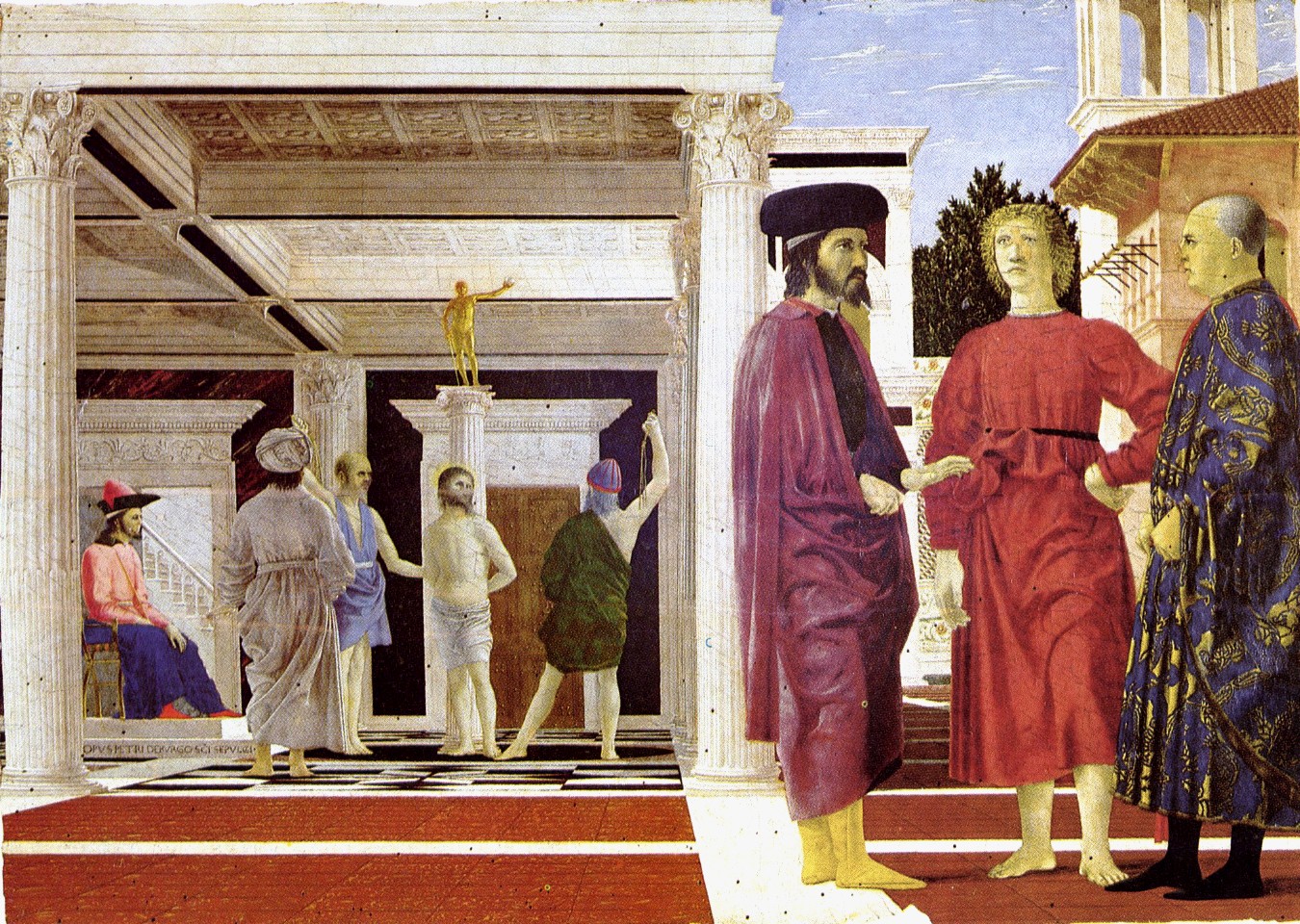
In fact I also use this painting in talks about science – I did so in my talk on Wednesday, in fact. The reason I use it in that context is that it is a bit like the standard model of cosmology. On one level it makes sense: the flat Euclidean geometry mapped out by the precise linear perspective allows us to understand the properties of the space extremely well, including the scale (the vanishing point indicates a front-to-back distance of about 250 ft). This is what our standard cosmology says too:- the universe also has a flat geometry. On the other hand, the more you think about the contents, the more confusing the picture gets. The main subject matter of the painting is to the left, in the background, playing an apparently minor part in the whole thing. Who are the characters surrounding the Christ figure? And who are the three figures in the foreground, dominating the whole composition, but seemingly indifferent to what is going on behind? Do they represent dark energy? Do the other characters represent the dark matter?
That’s not meant to be taken seriously, of course, and nobody actually knows what is really going on in this painting. It’s undoubtedly beautiful, but also an enigma, and that combination is what makes it a great work of art. It’s not easy to understand. It makes you wonder.That’s what science is like too. We have our theories, we have data, but there always remains a great deal we don’t understand. And sometimes the more we think about it, the more confused we get. Just as it is with that painting.
As Mark Collings put it brilliantly in the programme last night
When you’re looking at the picture, analysis isn’t exactly what is going on. You’re seeing and you’re getting pleasure from seeing. Partly the picture is telling you how pleasure is constructed, how it’s created, and partly you’re just lost in it. So when you’re lost in the light of Piero, you’re experiencing when you’ve forgotten how to experience. And you’re suddenly curious when you’ve forgotten how to be curious. And what you’re experiencing and being curious about is .. the world.
It doesn’t matter whether you’re a scientist or an artist (or a poet or a philosopher or a historian or whatever). The need to be curious about the world – or some aspect of it – is surely what it’s all about. During the Renaissance it wasn’t unusual for great minds to embrace science, mathematics and art – just think of Leonardo da Vinci. However, over the centuries we’ve become increasingly specialised and compartmentalised and more focused on making money than on making ideas. We’re losing what above all else is what makes us human, our curiosity.
Our society increasingly sees education simply as a means to develop skilled workers, smart enough to do technically complicated jobs, but not clever enough to ask too many questions about the materialistic treadmill they will spend their life upon. The UK government’s plan to withdraw funding for arts and humanities departments in universities is just another step along this path.
It shouldn’t be like this. Universities should be about learning for learning’s sake; not about teaching facts or skills, but about teaching people to ask questions and figure out their own answers. In other words, they should be about curiosity.
One of the other scary bits of news to emerge last week concerns proposed changes to the arrangements for tuition fees in English universities. According to the Times Higher, the Minister responsible for universities, David Willetts, has admitted that the cuts to university budgets announced in the Comprehensive Spending Review, will occur before any new money flows into universities from whatever new fee arrangements emerge from the government’s deliberations following the Browne Report.
One of the recommendations of the Browne Report was that central government funding for arts, humanities and social sciences be scrapped entirely. Although I’m a scientist and I do think Science is Vital this is a very bad move, as I think other forms of scholarship and learning are vital too, for a wide range of reasons including cultural ones. It was never clear whether arts & humanities departments would be able to recoup the money lost as a result of cuts to central funding, but now it appears they will have to survive for an indeterminate time without any prospect of extra income to offset the shortfall.
The upshot of all this will be a huge and immediate cut in the budgets of many university departments, a state of affairs about which Willetts commented only thus:
You have to expect that there will be pressure on universities to save money, and we don’t think they should be exempt from the pursuit of efficiencies.
Can an immediate 40% cut in teaching income be made by efficiency savings? I don’t think so, Mr Willetts. Even making large-scale redundancies won’t help there, as that costs a lot of money up front.
So why is the government pushing through cuts to university funding before ensuring that the new fee arrangements are in place? A variety of answers are possible. One would be incompetence, always a possibility when politicians are involved. However, although this government has tried to rush things through very quickly, I do not believe that this is something that hasn’t been considered very carefully. I think it’s deliberate. I believe that this government wants some universities to fail, and has found an opportunity to push them over the edge.
It’s not about efficiency savings, it’s about survival of the fattest. Only those places able to dig into their reserves for several years will be able to weather the storm. Some will cope, some won’t. That’s the point.
It’s well known that several universities, most of them post-1992 institutions, have been struggling financially for a considerable time. In the past, special procedures have always been implemented to protect organizations of this type that have been close to insolvency. This government has said that will do things differently, and that universities that go bust will now be allowed to fail. This may involve them closing altogether, or being taken over by private companies. If I were working in a university heavily dependent on income from arts, humanities and social science teaching, I would be extremely nervous about the future. I mean, more nervous than I am anyway, working as a scientist in an institution which is financially sound. And that is already very nervous indeed.
The other side of this particularly nasty coin, is that more “prestigious” institutions specialising in non-STEM areas, such as the London School of Economics, are already considering the option of going private. If the government gives them no support directly, yet insists – as seems likely – in capping the fee students pay at a figure around £7K per annum as well as strangling them with yards of red tape as HEFCE is wont to do, then why not just withdraw from the system and set fees at whatever level they like? It’s unlikely that an institution with a strong science base will go down this road, as the taxpayer is going to continue supporting STEM subjects, but it seems to me that it would make sense for the LSE to opt out of a system whether the costs of membership exceed the benefits received.
In the longer term, the squeeze is set of continue. According again to the Times Higher, the net revenue from fees will only replace part of the funding withdrawn over the CSR period. It looks like five years of struggle during which many departments may go under. The more you think about it, the worse it looks.

However, perhaps a better question than the one I asked a couple of paragraphs ago is the following. Why is the government intent on slashing the budgets of HE institutions, when it appears to have let Vodafone off without paying a bill for £6 billion tax?
That amount would have been more than enough to tide the HE sector over until the new fee stream came online…
Another Friday evening, another concert at St David’s Hall. This time it was the Orchestra of Welsh National Opera, performing a very mixed programme of pieces (by Rachmaninov, Ravel, Webern and Stravinsky). We’ve been hosting a former PDRA of mine, Chiaki Hikage (now at Princeton) and his wife Mihoko for a week so I invited them along. Chiaki gave a seminar on Friday afternoon at which he endured the usual bombardment of questions from Leonid Grishchuk, so I thought he would need some relaxation afterwards. I even managed to get front-row seats. It turned out to be a wonderful evening of twentieth century classical music, full of excitement colour and dramatic contrasts.
First up was The Isle of the Dead, Op. 29 by Sergei Rachmaninov, inspired by a painting of the same name by Arnold Böcklin and written around 1909. The rhythms of the opening passage evoke the motion of a boat moving across the sea to the island, from which point the piece develops among a cloud of increasingly dense harmonic layers into a dark atmosphere full of foreboding. It’s a piece that many probably find a bit melodramatic, but I found it both accessible and fascinating. In fact it struck me that it wouldn’t be out of place as the soundtrack for a horror movie!
After that we had a short break while the stage crew wheeled in the old Steinway for the second piece, the Piano Concerto in G by Maurice Ravel. This is a relatively late piece by Ravel, written around 1930. Its three movements form a sort of sandwich, with the first and third up tempo, jazzy in style and very Gershwinesque. The second, adagio, movement is very different: longer lyrical and tender, although I still detected a jazz influence in the walking bass of the left hand figures during the nocturne passages. The piece was played in sparkling fashion by Jean-Philippe Collard. We were so close that we could hear him humming along as he played. Apparently that bothers some people, but not me. I suppose that’s because so many jazz pianists behave a similar way, as did Glenn Gould.
Anyway, after a glass of wine at the interval it was time for something completely different, the Six Pieces for Orchestra, Op. 6, by Anton Webern. This is a suite of short, intense, atonal pieces, sort of orchestral aphorisms, that embrace a huge range of musical ideas. Although sometimes a bit cryptic, I found these pieces in their own way at least as evocative as the Rachmaninov we heard earlier. The disorientating atonality of the compositions gives them an edgy restlessness, which I found very absorbing. If they were to be used in a film soundtrack it would definitely have to be a psychological thriller or film noir.
The last work was probably the most familiar, The Firebird Suite (No. 2, 1919 version) by Igor Stravinsky from the ballet of the same name. This consists of five pieces, again of varied tempo and colour, ending in an exhilirating finale.
Overall it was a hugely enjoyable evening, with all parts of the orchestra tested to the limits and emerging with flying colours. I’d like to put in a special word for the percussionists, though. Perhaps because my Dad used to play the drums I always feel they don’t get the credit they deserve standing there at the back. In particular, during the Webern and Stravinsky works, the percussionists – especially the tympanist – had an awful lot to do, and did it absolutely superbly. However, all parts of the orchestra played their parts equally well under the baton of Lothar Koenigs. This orchestra has had a few problems recently so it was a relief to find them on such good form.
The St David’s Hall was only about two-thirds full, but the audience was thoroughly appreciative – especially for the outstanding performance of the Ravel Piano Concerto. I’m going to get hold of a recording of it by Jean-Philippe Collard as soon as I can!
P.S. Our front row tickets only cost £22 each. Amazing.
After a short-lived burst of optimism following the announcement of the better-than-expected results of the Comprehensive Spending Review for science funding, it seems levels of nervousness are again increasing about what might lie in store for the Science and Technology Facilities Council (STFC).
It appears the “near-cash” funding for RCUK, the umbrella organisation that sits above the seven Research Councils will be fixed over the period of the CSR but, within that overall pot, the Medical Research Council (MRC) will have its funding stream protected in real terms, meaning the others will be have to be reduced in real terms. How the pie will be divided up remains to be seen, but I believe there is some pretty tough negotiating going on behind the scenes right now. RCUK chief Adrian Smith has apparently been given detailed instructions by the Treasury on how to carry out the budget allocations, but I haven’t seen the manual…
However, this is only part of the story. The other part, as the e-astronomer has already pointed out, is rather scary. As well as “near-cash” funding, the Research Councils also receive funds marked “capital”. I’m not an accounting expert, but I’m told this is all pretty normal practice for large organisations. What has emerged recently is that the capital part of the RCUK budget is to be cut by a whopping 44%. A rumour is spreading that STFC has been told to expect at least a 30% cut in capital funding and instructed to budget accordingly.
This could herald a return of the nightmare scenario I blogged about not long ago. The point is that, owing to the nature of STFC, a very large part of its budget is tied up in the capital stream. In fact it’s even worse than you might imagine because large international subscriptions, including CERN and ESO, are currently paid for, at least in part, out of STFC’s capital budget. According to the journal Nature,
That money pays for everything from radio telescopes to Antarctic research stations. In particular, the cuts will hit the Science & Technology Facilities Council (STFC), which funds particle physics and astronomy. The council, which has struggled financially for years, has been told to prepare for its capital funding to fall by a third, according to documents seen by Nature. That could jeopardize Britain’s participation in organizations such as the European Southern Observatory.
Another factor that adds to the vulnerability of our ESO membership is the longrunning saga of the VISTA telescope. When the UK joined ESO (in 2002), this telescope – which hadn’t been built then – was put up as an “in kind” contribution to the UK’s joining fee. However, VISTA wasn’t actually handed over to ESO until December 2009, significantly behind schedule and it is still undergoing performance verification. In principle, ESO could require the UK to pay a substantial fine for the late delivery and it is STFC that would have to find the funds. I don’t know what the precise fine would be, but I’ve heard figures from £16M to about twice that.
Although Science Minister David Willetts is on record as saying that he was not planning to withdraw from any European collaborations, including ESO, the VISTA debacle may force his hand if it means the cost of continuing membership exceeds the penalties for withdrawal.
Withdrawing from ESO would destroy a huge part of the UK’s ground-based astronomy activity, as we have already withdrawn from (or are planning to withdraw from) most other facilities we used to have access to. It would also damage our credibility as international scientific partners in a more general sense. But if it isn’t ESO that gets chopped it will be something else. It’s difficult to see how STFC can cope with this cut without something going to the wall.
The Royal Astronomical Society has written to Fellows requesting that they write to their MPs to point out the consequences of drastic cuts to STFC’s budget, citing withdrawal from ESO as one possible outcome.
There’s no doubt about it, it’s brown trousers time.
Regular readers of this blog – both of them – will know that I engage, from time to time, in acitivities we are usually obliged to call “outreach”. For once, the OED gives a meaning which is pretty much spot on what is involved:
The activity of an organization in making contact and fostering relations with people unconnected with it, esp. for the purpose of support or education and for increasing awareness of the organization’s aims or message.
For us scientists this word means going out into the wider community (often, but not exclusively, in schools) and talking about our work to generate interest in science and also to explain what we do to the people who actually pay for it, i.e. taxpayers. This general activity is increasingly important for science generally, and astronomy has a particularly important part to play as it is not only very photogenic – there are lots of wonderful images to excite and engage the audience – but it also gives people the chance to think, at least for a while, about matters far removed from the mundanities of everyday life.
Most astronomy departments in Britain have very active outreach programmes and their importance is even recognized in, e.g., research grant applications, which nowadays require a statement about “public engagement” to be submitted alongside the technical science case.
I think colleagues in more mainstream subjects (e.g. condensed matter physics) often get a bit jealous of the astronomers in their department gallivanting off to all kinds of venues in the evenings to give talks. We usually say that what we’re doing is raising the profile of the discipline so that more students apply to do physics, justify our existence to the taxpayer, and so on. All very laudible things to do, but I have to admit I don’t really think of those things when I go off to do a popular talk. It’s not for the money either; I’m not famous enough to command a fee for public speaking, but even if I were I would probably waive it. The real reason I do these things because I like talking, especially about astrophysics, and especially to people who are interested enough to make a positive decision to come and listen.
Anyway, the reason for that rambling preamble about outreach was that yesterday I went to London to give a talk – in the upstairs room of a nice pub in the Marylebone area of Central London – for a group called Just Friends. When I was invited to give the talk I was a bit nervous because previous speakers had included David Starkey and Sir Roy Strong, as well as fellow astronomer and rising media star Marek Kukula, who actually turned up last night to lend me moral (?) support. My nervousness was, of course, entirely unjustified and the audience turned out to be very friendly.
I’ll leave it to the reader to work out what sort of people make up Just Friends, but there’s a bit of a clue in the list of previous speakers…
Because of the unusual location I had to take my own data projector along, which meant lugging it around all evening. Actually it wasn’t really “my own”. I borrowed it from a colleague in the department, so I was a bit nervous about breaking it as well as unsure how well it would work. As it happens, it all worked fine and I handed it back safely this morning.
Anyway, the room turned out to be very full and my talk – a variation on the theme of the Cosmic Web – seemed to go down quite well with an audience which was considerably less rowdy than I’d expected given that the talk was in a pub. After a fairly lengthy Q+A at the end and a quick drink, I headed back to Paddington for the 22.45 train back to Cardiff, getting home about 1.30am, exhausted but having enjoyed the evening enormously.
I suppose the price for having a captive audience and the chance to meet interesting new people at events like this is that you end up spreading yourself a bit thin. The morning after it feels less like outreach and more like overreach. The younger folk in the department seem to cope much better with all this scooting about. I’m definitely getting old.
Contrary to popular myth, Greensleeves was not written by Henry VIII. It was actually composed by the person who seems to have written all the best tunes, Trad. Here’s my favourite version, in a jazz style that’s very far from “Trad”, by a superb band led by John Coltrane, as found on the brilliant album Africa/Brass recorded in 1961.
ps. I think it was the pianist McCoy Tyner who wrote the arrangement for this piece, but I’m not 100% certain of that.
This, written by W.H. Auden, is probably one of the most famous poems written about physics. A quick google about showed me that Cosmic Variance already featured it, along with a bit of an explanation of some of the scientific references contained within it. What I’m not sure whether what that article says about Auden’s own father was a physicist is correct. I always thought he was a medical doctor…
If all a top physicist knows
About the Truth be true,
Then, for all the so-and-so’s,
Futility and grime,
Our common world contains,
We have a better time
Than the Greater Nebulae do,
Or the atoms in our brains.
Marriage is rarely bliss
But, surely it would be worse
As particles to pelt
At thousands of miles per sec
About a universe
Wherein a lover’s kiss
Would either not be felt
Or break the loved one’s neck.
Though the face at which I stare
While shaving it be cruel
For, year after year, it repels
An ageing suitor, it has,
Thank God, sufficient mass
To be altogether there,
Not an indeterminate gruel
Which is partly somewhere else.
Our eyes prefer to suppose
That a habitable place
Has a geocentric view,
That architects enclose
A quiet Euclidean space:
Exploded myths – but who
Could feel at home astraddle
An ever expanding saddle?
This passion of our kind
For the process of finding out
Is a fact one can hardly doubt,
But I would rejoice in it more
If I knew more clearly what
We wanted the knowledge for,
Felt certain still that the mind
Is free to know or not.
It has chosen once, it seems,
And whether our concern
For magnitude’s extremes
Really become a creature
Who comes in a median size,
Or politicizing Nature
Be altogether wise,
Is something we shall learn
You can hear a recording, made in 1965, of the poet himself reading this poem here.
I don’t have time to post much today so I thought I’d just put up a quick item about something that the e-astronomer (aka Andy Lawrence) has already blogged about, and generated a considerable amount of discussion about so I’ll just chip in with my two-penny-worth.
Some time ago I posted an item explaining how, in the run-up to last week’s Comprehensive Spending Review, the Royal Academy of Engineering had argued, in a letter to the Department of Business, Innovation and Skills (BIS), that government research funding should be
… concentrated on activities from which a contribution to the economy, within the short to medium term, is foreseeable. I recognise that this calls for significant changes in practice but I see no alternative in the next decade. This may mean disinvesting in some areas in order properly to invest in others.
They went on to say that
BIS should also consider the productivity of investment by discipline and then sub-discipline. Once the cost of facilities is taken into account it is evident that ‘Physics and Maths’ receive several times more expenditure per research active academic compared to those in ‘Engineering and Technology’. This ratio becomes significantly more extreme if the comparison is made between particle physics researchers and those in engineering and technology. Much of particle physics work is carried out at CERN and other overseas facilities and therefore makes a lower contribution to the intellectual infrastructure of the UK compared to other disciplines. Additionally, although particle physics research is important it makes only a modest contribution to the most important challenges facing society today, as compared with engineering and technology where almost all the research is directly or indirectly relevant to wealth creation.
I had hoped that this unseemly attack on particle physics would have been seen for what it was and would have faded into the background, but a recent article by Colin Macilwain has brought it back into the spotlight. I quote
UK engineers have started a scrap that will grow uglier as the spending cuts begin.
I should add that MacIlwain isn’t particularly supportive of the engineers’ position, but he does make some interesting remarks on the comparitively low status held by engineers in the United Kingdom compared to other countries, a point alsotaken up on Andy Lawrence’s blog. In my opinion this bare-faced attempt to feather their own nest at the expense of fundamental physics isn’t likely to generate many new admirers. Neither is the fact – and this is a point I’ve tried to make before – that the engineers’ argument simply doesn’t hold any water in the first place.
The point they are trying to make is that research in engineering is more likely to lead to rapid commercial exploitation than research in particle physics. That may be true, but it’s not a good argument for the government to increase the amount of research funding. If engineering and applied science really is “near market” in the way that the RAEng asserts, then it shouldn’t need research grants, but should instead be supported by venture capital or direct investment from industry. The financial acumen likely to be available from such investors will be much for useful for the commercial exploitation of any inventions or discoveries than a government-run research council. To be fair, as MacIlwain’s article explains, a large fraction of engineering research (perhaps 75%) is funded by commerce and industry. Moreover some engineering research is also too speculative for the market to touch and therefore does merits state support. However, that part that needs state support needs it for precisely the same reason that particle physics does, i.e. that its potential is long-term rather than short term. This means that is in the same boat as fundamental physics and shouldn’t keep pretending that it isn’t. If engineering research needs government funding then ipso facto it’s not likely to generate profits in the short term.
I think scientists and engineers would all be better off if they worked together to emphasize the amazingly successful links between fundamental physics and technology, as demonstrated by, e.g., the Large Hadron Collider at CERN and the mutual interdependence of their disciplines.
United we stand, and all that…


