The Word Game

Posted in Uncategorized with tags , , , on September 24, 2009 by telescoper

I don’t know why, but something just reminded me of a silly game I invented to make lectures more interesting. Probably it’s because the students have started coming back after the summer break. I started playing this game at one of the Erice schools run by Norma Sanchez, but it’s a long time since then and I can’t remember which one in particular it was. I never told Professor Sanchez this was going on in case she thought it was too flippant. I’ve always been scared of her since she loomed towards me and scribbled all over my transparencies at the end of one of my lectures because she disagreed with my use of the word “theory” (instead of model).

The thing about this and other schools of its ilk is that there are a bunch of invited experts giving short courses of lectures (maybe 4-6) to an audience of graduate students and young postdoctoral researchers. It’s quite intensive and I felt that it needed something to take away some of the strain.

The Word Game is played by one lecturer at a time. The other lecturers give the nominated individual a word which he/she must weave into his/her next lecture. There is no restriction on the word, and generally the more obscure it is the better. In the advanced version of the game the word is given to the lecturer immediately before the lecture (in a sealed envelope). However, for beginners I recommend giving the word at least a few hours beforehand to let them think a bit how to get the target word into their talk.

The audience have been told that the lecturer is going to include a target word and their job is to spot which word it is. If they succeed then the lecturer loses and has to pay a forfeit (perhaps a round of drinks for the successful spotters). If the students don’t get the right word then the lecturer wins and he gets a reward (probably also of alcoholic form). If the lecturer fails to include the word at all they to buy drinks for the lecturers as well as living out the rest of their days in shame. A league table is kept as the school goes on and the lecturer with the most successful word insertions at the end is declared the winner.

Choice of target word is tricky. If you make it too mundane then it is impossible to spot and if it’s too bizarre then it’s too easy. However, the former case can be avoided to some extent by insisting that the word occurs only once in the lecture. In the latter case the lecturer can use the device of introducing sundry other random complicated words to throw the audience off the scent of a tricky word. I generally award bonus marks if the word is embedded elegantly in the talk rather than hidden in a cloud of other words.

Not all lecturers want to play the game of course and some are more successful than others. I’d like to single out Brian Schmidt for his outstanding performance at one school, smoothly interpolating the word AUTOCLAVE into a lecture on Type Ia Supernovae in such a way that it went completely unnoticed by the students. On the other hand, I have also to mention that Rocky Kolb, misguidedly going for the advanced option during his first ever attempt at the game, completely failing to get the word AARDVARK into his lecture. In fact he insisted on being given the word in a sealed envelope after he arrived at the lecturer’s podium, starting his lecture with the words “May I have the envelope please?” That’s what you get for being cocky, Rocky.

I’ve always managed to get the words in myself, and did once successfully conceal ONOMATOPOEIA in a talk about galaxy formation. On the other hand, my attempt to get CANDELABRA into a talk about higher-order correlation functions was easily – and expensively – rumbled.

Cranks Anonymous

Posted in Biographical, Books, Talks and Reviews, The Universe and Stuff with tags , , , , on September 22, 2009 by telescoper

Sean Carroll, blogger-in-chief at Cosmic Variance, has ventured abroad from his palatial Californian residence and is currently slumming it in a little town called Oxford where he is attending a small conference in celebration of the 70th birthday of George Ellis. In fact he’s been posting regular live commentaries on the proceedings which I’ve been following with great interest. It looks an interesting and unusual meeting because it involves both physicists and philosophers and it is based around a series of debates on topics of current interest. See Sean’s posts here, here and here for expert summaries of the three days of the meeting.

Today’s dispatches included an account of George’s own talk which appears to have involved delivering a polemic against the multiverse, something he has been known to do from time to time. I posted something on it myself, in fact. I don’t think I’m as fundamentally opposed as Geroge to the idea that we might live in a bit of space-time that may belong to some sort of larger collection in which other bits have different properties, but it does bother me how many physicists talk about the multiverse as if it were an established fact. There certainly isn’t any observational evidence that this is true and the theoretical arguments usually advanced are far from rigorous.The multiverse certainly is  a fun thing to think about, I just don’t think it’s really needed.

There is one red herring that regularly floats into arguments about the multiverse, and that concerns testability. Different bits of the multiverse can’t be observed directly by an observer in a particular place, so it is often said that the idea isn’t testable. I don’t think that’s the right way to look at it. If there is a compelling physical theory that can account convincingly for a realised multiverse then that theory really should have other necessary consequences that are testable, otherwise there’s no point. Test the theory in some other way and you test whether the  multiverse emanating from it is sound too.

However, that fairly obvious statement isn’t really the point of this piece. As I was reading Sean’s blog post for today you could have knocked me down with a feather when I saw my name crop up:

Orthodoxy is based on the beliefs held by elites. Consider the story of Peter Coles, who tried to claim back in the 1990’s that the matter density was only 30% of the critical density. He was threatened by a cosmological bigwig, who told him he’d be regarded as a crank if he kept it up. On a related note, we have to admit that even scientists base beliefs on philosophical agendas and rationalize after the fact. That’s often what’s going on when scientists invoke “beauty” as a criterion.

George was actually talking about a paper we co-wrote for Nature in which we went through the different arguments that had been used to estimate the average density of matter in the Universe, tried to weigh up which were the more reliable, and came to the conclusion that the answer was in the range 20 to 40 percent of the critical density. There was a considerable theoretical prejudice at the time, especially from adherents of  inflation, that the density should be very close to the critical value, so we were running against the crowd to some extent. I remember we got quite a lot of press coverage at the time and I was invited to go on Radio 4 to talk about it, so it was an interesting period for me. Working with George was a tremendous experience too.

I won’t name the “bigwig” George referred to, although I will say it was a theorist; it’s more fun for those working in the field to guess for themselves! Opinions among other astronomers and physicists were divided. One prominent observational cosmologist was furious that we had criticized his work (which had yielded a high value of the density). On the other hand, Martin Rees (now “Lord” but then just plain “Sir”) said that he thought we were pushing at an open door and was surprised at the fuss.

Later on, in 1996, we expanded the article into a book in which we covered the ground more deeply but came to the same conclusion as before.  The book and the article it was based on are now both very dated because of the huge advances in observational cosmology over the last decade. However, the intervening years have shown that we were right in our assessment: the standard cosmology has about 30% of the critical density.

Of course there was one major thing we didn’t anticipate which was the discovery in the late 1990s of dark energy which, to be fair, had been suggested by others more prescient than us as early as 1990. You can’t win ’em all.

So that’s the story of my emergence as a crank, a title to which I’ve tried my utmost to do justice since then. Actually, I would have liked to have had the chance to go to George’s meeting in Oxford, primarily to greet my ertswhile collaborator whom I haven’t seen for ages. But it was invitation-only. I can’t work out whether these days I’m too cranky or not cranky enough to get to go to such things. Looking at the reports of the talks, I rather think it could be the latter.

Now, anyone care to risk the libel laws and guess who Professor BigWig was?

Future Fees

Posted in Science Politics with tags , , , on September 21, 2009 by telescoper

There’s been a lot of news coverage today arising from a new report by the Confederation of British Industry (CBI) which argues that students should in future pay higher tuition fees to go to British universities. As you can probably imagine this has generated quite a lot of comment, but since some of the remarks I’ve heard are based on misunderstandings I thought I’d give my angle on  is happening and what the implications are.

For a start, the tuition fees paid by students at present are not the sole (or even the largest part) of the income paid to universities for undergraduate education. The way the funding councils work is to pay each university directly an amount for teaching each student (called the recurrent grant). This amount depends on the course. There is a basic level (which for 2009/10 is £3,947), but this is increased for subjects which require experimental work. The result is that there are four funding bands: A (which is clinical medicine, the most expensive); B (which includes science subjects such as physics); C (which includes subjects with laboratory or fieldwork element); and D (everything else).

The level of funding for an individual student in each price band in 2009/10 is

  • band A – £15,788
  • band B – £6,710
  • band C – £5,131
  • band D – £3,947

Physics (and Astronomy) is in band B, so the department receives £6,710 directly from the government for each student doing a course in these subjects.

Brought in in 2006, the “top-up” fee (currently £3225) is in addition to this, although it does not have to be paid immediately by the students. They can borrow the money at an advantageous interest rate and only have to pay it back when  they have left their University and started to earn money at a level sufficient to trigger the repayment. Here in Wales the situation is a little bit more complicated because the students don’t pay the full “top-up” fee payable in England. Instead they pay a lower rate (currently £1285) and the Welsh Assembly Government makes good the shortfall to the University. In Scotland there are no tuition fees payable by the students.

Anyway, for Physics at least, the tuition fee is only about one-third the total income for each student. It looks, then, like the government does actually pay the lion’s share of the cost of higher education, especially in science and medicine. However, it is worth remarking that if the UK devoted the same share of its GDP as the OECD mean (1.1%) then students would not have to pay top-up fees at all in order to fund the entire University system at an adequate level. Clearly a political decision was made that funding Trident, ID cards,  and wars in Iraq and Afghanistan was a much better use for taxpayers’ money than providing universal free higher education.

I don’t actually object to the principle that students should make a contribution to the cost of their university education but I think the fairest way to do that is via the taxation system. There are many problems with the system we have, which is an attempt at a British compromise that actually gives us the worst of all worlds. The Labour party was scared to allow fees to be set too high for fear of alienating its traditionalists by discouraging those from poorer background from going to university. On the other hand, it didn’t want to set them too low because that wouldn’t bring in sufficient extra money. In the end they settled at an in-between level, i.e. one that achieved very little and alienated people anyway.

For a start the level of top-up income is not really high enough to pay for the investment that is needed. Many leading universities are in fact making redundancies because the additional revenue  realised by top-up fees was not enough to meet the rising pay bill resulting from a generous salary settlement last year. Moreover, the idea that top-up fees would satisfy the right-wingers by introducing some kind of “market” was a complete delusion. All universities (big and small, old and new, good and less good) charged the same level of fee.

I went to university in the 1980s when the system was very different. There were no top-up fees and, because I wasn’t from a wealthy family, I received a full maintenance grant to cover the cost of living and studying during the three years of my degree. That’s the big difference nowadays: nobody gets a full maintenance grant. Universities do use some of their tuition fee money to provide contributions to poorer students but they generally amount to a few thousand pounds a year. That’s not enough to live on, so most students either rely on their parents to help them or have to work during term-time. I never had to do either of those.

Anyway the CBI report says that the level of tuition fees should increase to around £5000, the student loan interest rate should increase and there should be fewer bursaries. Even within its own terms I don’t think this makes much sense. In fact, I could understand them better if they had argued to remove the cap altogether. The posh places – Oxbridge and perhaps a few others – which can probably fill their places  charging whatever they like could actually afford a fairly generous bursary scheme that might encourage a few talented working class kinds to go there to ease these institutions’ consciences.  Other universities would be forced to set their own fee levels according to the demands of income and recruitment.  The system would be increasingly differentiated by cost and quality, but students from poorer backgrounds would  be excluded to an even greater extent than they are now. I wouldn’t like a university system built along those lines but it seems to me that it would suit the mentality of the CBI.

The big issue about today’s debate, however, is that neither the Labour nor the Conservative Party is going to say what they’re going to do about university funding until after the general election next year. Certainly  neither of them will say whether the fee will go up to £5000. For once, I agree with Sally Hunt  (general secretary of the Universities and Colleges Union) who has urged them both to come clean. Keeping silent about this when other public sector cuts are clearly on the table is both spineless and dishonest. Just what you’d expect from politicians, in fact.

For what it’s worth I predict that after the next election higher education will suffer a classic double-whammy. Whichever party takes power, the resulting government will be forced to make large-scale cuts in public spending to keep the country’s finances under control. I think what they’ll do is cut the unit of resource (probably by a large amount, say 25%) at the same time as increasing the tuition fee element. They can then claim that University funding has been protected while at the same time cutting the cost of the system to the public purse. Students will end up paying more for less. But, hey, at least it will keep the bankers happy and that’s what we’re here for after all.

Astrostats

Posted in Bad Statistics, The Universe and Stuff with tags , , , , , , , , , on September 20, 2009 by telescoper

A few weeks ago I posted an item on the theme of how gambling games were good for the development of probability theory. That piece  contained a mention of one astronomer (Christiaan Huygens), but I wanted to take the story on a little bit to make the historical connection between astronomy and statistics more explicit.

Once the basics of mathematical probability had been worked out, it became possible to think about applying probabilistic notions to problems in natural philosophy. Not surprisingly, many of these problems were of astronomical origin but, on the way, the astronomers that tackled them also derived some of the basic concepts of statistical theory and practice. Statistics wasn’t just something that astronomers took off the shelf and used; they made fundamental contributions to the development of the subject itself.

The modern subject we now know as physics really began in the 16th and 17th century, although at that time it was usually called Natural Philosophy. The greatest early work in theoretical physics was undoubtedly Newton’s great Principia, published in 1687, which presented his idea of universal gravitation which, together with his famous three laws of motion, enabled him to account for the orbits of the planets around the Sun. But majestic though Newton’s achievements undoubtedly were, I think it is fair to say that the originator of modern physics was Galileo Galilei.

Galileo wasn’t as much of a mathematical genius as Newton, but he was highly imaginative, versatile and (very much unlike Newton) had an outgoing personality. He was also an able musician, fine artist and talented writer: in other words a true Renaissance man.  His fame as a scientist largely depends on discoveries he made with the telescope. In particular, in 1610 he observed the four largest satellites of Jupiter, the phases of Venus and sunspots. He immediately leapt to the conclusion that not everything in the sky could be orbiting the Earth and openly promoted the Copernican view that the Sun was at the centre of the solar system with the planets orbiting around it. The Catholic Church was resistant to these ideas. He was hauled up in front of the Inquisition and placed under house arrest. He died in the year Newton was born (1642).

These aspects of Galileo’s life are probably familiar to most readers, but hidden away among scientific manuscripts and notebooks is an important first step towards a systematic method of statistical data analysis. Galileo performed numerous experiments, though he certainly carry out the one with which he is most commonly credited. He did establish that the speed at which bodies fall is independent of their weight, not by dropping things off the leaning tower of Pisa but by rolling balls down inclined slopes. In the course of his numerous forays into experimental physics Galileo realised that however careful he was taking measurements, the simplicity of the equipment available to him left him with quite large uncertainties in some of the results. He was able to estimate the accuracy of his measurements using repeated trials and sometimes ended up with a situation in which some measurements had larger estimated errors than others. This is a common occurrence in many kinds of experiment to this day.

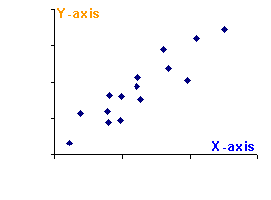
Very often the problem we have in front of us is to measure two variables in an experiment, say X and Y. It doesn’t really matter what these two things are, except that X is assumed to be something one can control or measure easily and Y is whatever it is the experiment is supposed to yield information about. In order to establish whether there is a relationship between X and Y one can imagine a series of experiments where X is systematically varied and the resulting Y measured.  The pairs of (X,Y) values can then be plotted on a graph like the example shown in the Figure.
XY

In this example on it certainly looks like there is a straight line linking Y and X, but with small deviations above and below the line caused by the errors in measurement of Y. This. You could quite easily take a ruler and draw a line of “best fit” by eye through these measurements. I spent many a tedious afternoon in the physics labs doing this sort of thing when I was at school. Ideally, though, what one wants is some procedure for fitting a mathematical function to a set of data automatically, without requiring any subjective intervention or artistic skill. Galileo found a way to do this. Imagine you have a set of pairs of measurements (xi,yi) to which you would like to fit a straight line of the form y=mx+c. One way to do it is to find the line that minimizes some measure of the spread of the measured values around the theoretical line. The way Galileo did this was to work out the sum of the differences between the measured yi and the predicted values mx+c at the measured values x=xi. He used the absolute difference |yi-(mxi+c)| so that the resulting optimal line would, roughly speaking, have as many of the measured points above it as below it. This general idea is now part of the standard practice of data analysis, and as far as I am aware, Galileo was the first scientist to grapple with the problem of dealing properly with experimental error.
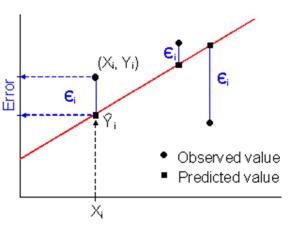
error

The method used by Galileo was not quite the best way to crack the puzzle, but he had it almost right. It was again an astronomer who provided the missing piece and gave us essentially the same method used by statisticians (and astronomy) today.

Karl Friedrich Gauss was undoubtedly one of the greatest mathematicians of all time, so it might be objected that he wasn’t really an astronomer. Nevertheless he was director of the Observatory at Göttingen for most of his working life and was a keen observer and experimentalist. In 1809, he developed Galileo’s ideas into the method of least-squares, which is still used today for curve fitting.

This approach involves basically the same procedure but involves minimizing the sum of [yi-(mxi+c)]2 rather than |yi-(mxi+c)|. This leads to a much more elegant mathematical treatment of the resulting deviations – the “residuals”.  Gauss also did fundamental work on the mathematical theory of errors in general. The normal distribution is often called the Gaussian curve in his honour.

After Galileo, the development of statistics as a means of data analysis in natural philosophy was dominated by astronomers. I can’t possibly go systematically through all the significant contributors, but I think it is worth devoting a paragraph or two to a few famous names.

I’ve already mentioned Jakob Bernoulli, whose famous book on probability was probably written during the 1690s. But Jakob was just one member of an extraordinary Swiss family that produced at least 11 important figures in the history of mathematics.  Among them was Daniel Bernoulli who was born in 1700.  Along with the other members of his famous family, he had interests that ranged from astronomy to zoology. He is perhaps most famous for his work on fluid flows which forms the basis of much of modern hydrodynamics, especially Bernouilli’s principle, which accounts for changes in pressure as a gas or liquid flows along a pipe of varying width.
But the elder Jakob’s work on gambling clearly also had some effect on Daniel, as in 1735 the younger Bernoulli published an exceptionally clever study involving the application of probability theory to astronomy. It had been known for centuries that the orbits of the planets are confined to the same part in the sky as seen from Earth, a narrow band called the Zodiac. This is because the Earth and the planets orbit in approximately the same plane around the Sun. The Sun’s path in the sky as the Earth revolves also follows the Zodiac. We now know that the flattened shape of the Solar System holds clues to the processes by which it formed from a rotating cloud of cosmic debris that formed a disk from which the planets eventually condensed, but this idea was not well established in the time of Daniel Bernouilli. He set himself the challenge of figuring out what the chance was that the planets were orbiting in the same plane simply by chance, rather than because some physical processes confined them to the plane of a protoplanetary disk. His conclusion? The odds against the inclinations of the planetary orbits being aligned by chance were, well, astronomical.

The next “famous” figure I want to mention is not at all as famous as he should be. John Michell was a Cambridge graduate in divinity who became a village rector near Leeds. His most important idea was the suggestion he made in 1783 that sufficiently massive stars could generate such a strong gravitational pull that light would be unable to escape from them.  These objects are now known as black holes (although the name was coined much later by John Archibald Wheeler). In the context of this story, however, he deserves recognition for his use of a statistical argument that the number of close pairs of stars seen in the sky could not arise by chance. He argued that they had to be physically associated, not fortuitous alignments. Michell is therefore credited with the discovery of double stars (or binaries), although compelling observational confirmation had to wait until William Herschel’s work of 1803.

It is impossible to overestimate the importance of the role played by Pierre Simon, Marquis de Laplace in the development of statistical theory. His book A Philosophical Essay on Probabilities, which began as an introduction to a much longer and more mathematical work, is probably the first time that a complete framework for the calculation and interpretation of probabilities ever appeared in print. First published in 1814, it is astonishingly modern in outlook.

Laplace began his scientific career as an assistant to Antoine Laurent Lavoiser, one of the founding fathers of chemistry. Laplace’s most important work was in astronomy, specifically in celestial mechanics, which involves explaining the motions of the heavenly bodies using the mathematical theory of dynamics. In 1796 he proposed the theory that the planets were formed from a rotating disk of gas and dust, which is in accord with the earlier assertion by Daniel Bernouilli that the planetary orbits could not be randomly oriented. In 1776 Laplace had also figured out a way of determining the average inclination of the planetary orbits.

A clutch of astronomers, including Laplace, also played important roles in the establishment of the Gaussian or normal distribution.  I have also mentioned Gauss’s own part in this story, but other famous astronomers played their part. The importance of the Gaussian distribution owes a great deal to a mathematical property called the Central Limit Theorem: the distribution of the sum of a large number of independent variables tends to have the Gaussian form. Laplace in 1810 proved a special case of this theorem, and Gauss himself also discussed it at length.

A general proof of the Central Limit Theorem was finally furnished in 1838 by another astronomer, Friedrich Wilhelm Bessel– best known to physicists for the functions named after him – who in the same year was also the first man to measure a star’s distance using the method of parallax. Finally, the name “normal” distribution was coined in 1850 by another astronomer, John Herschel, son of William Herschel.

I hope this gets the message across that the histories of statistics and astronomy are very much linked. Aspiring young astronomers are often dismayed when they enter research by the fact that they need to do a lot of statistical things. I’ve often complained that physics and astronomy education at universities usually includes almost nothing about statistics, because that is the one thing you can guarantee to use as a researcher in practically any branch of the subject.

Over the years, statistics has become regarded as slightly disreputable by many physicists, perhaps echoing Rutherford’s comment along the lines of “If your experiment needs statistics, you ought to have done a better experiment”. That’s a silly statement anyway because all experiments have some form of error that must be treated statistically, but it is particularly inapplicable to astronomy which is not experimental but observational. Astronomers need to do statistics, and we owe it to the memory of all the great scientists I mentioned above to do our statistics properly.

La Traviata

Posted in Opera with tags , on September 19, 2009 by telescoper

Summer must be over: the students are returning to University next week;  the cricket season is just about to end; the football season is well under way; the Last Night of the Proms is all done and dusted. But at least it all means the Opera season has started again!

Last night I went to the Wales Millennium Centre to see Welsh National Opera’s production of La Traviata by Giuseppe Verdi. Actually, to be precise, this was a co-production with Scottish Opera who supplied the sets scenery and costumes, it was directed by David McVicar and was first staged in Scotland before transferring to Wales for this run.

La Traviata is one of the most enduringly popular of all operas – and is one of the most frequently performed. It’s quite curious that its first performance in Venice was a complete disaster and it took several revisions before it became established as part of the operatic repertoire. A production like the one we saw last night, however, makes it abundantly clear why it is such an evergreen classic. Act I in particular is just one memorable tune after another.

The opera is based on the novel La Dame Aux Camélias which later became a play with the same name. It tells the story of Violetta, a glamorous courtesan and flamboyant darling of the Paris party scene. She meets a young chap called Alfredo at a spectacular do in her house in Act I and he tells her he’s completely in love with her. She laughs him off and he departs crestfallen. When the party’s over and  he’s gone, though, she finds herself thinking about him. The trouble with Violetta is that she is already seriously ill with consumption (tuberculosis) at the start. She knows that she is doomed to die and is torn between her desire to be free and her growing love for Alfredo.

Cut to Act II, Scene I, a few months later. Violetta and Alfredo are shacked up in a love nest away from Paris. While Alfredo is away paying off some of Violetta’s bills, Alfredo’s father Giorgio turns up and tries to convince Violetta to abandon her relationship with his son because its scandalous nature threatens their family’s prospects, particular his daughter’s (Alfredo’s sisters) plans to get married. Violetta eventually agrees to do a runner. Alfredo returns and meets his father who tries to convince him to return to his family in Provence. Alfredo is distraught to hear of Violetta’s departure, refuses to go with his father, and vows to find Violetta again.

Scene 2 is back in Paris, at the house of a lady called Flora. There’s a lot of singing and dancing and general riotousness.Alfredo turns up, slightly the worse for drink and proceeds to gamble (winning a huge amout of money). Violetta turns up and Alfredo insults her by throwing his winnings at her. He’s then overcome by remorse but the Baron Douphol, a wealthy friend of Violetta, is outraged and challenges Alfredo to a duel.

Act III is set a few months later in Violetta’s bedroom where she’s clearly dying. Alfredo has run off after wounding the Baron in a duel. The doctor gives Violetta just a few hours to live. Alfredo returns. The lovers forgive each other and embrace. Violetta dies.

In this performance Violetta was Greek soprano Myrtò Papatanasiu, a name that’s quite new to me. She’s tall, elegant and has a lovely voice. Violetta is quite a demanding role- there are several tricky coloratura passages to cope with – but her character is quite complicated too. Although we know she’s ill right from the start she’s not by any means a passive victim. She’s a courtesan who has clearly put it about a bit, but she’s also got a strong moral sense. She’s vulnerable, but also at times very strong. I thought Myrtò Papatanasiu was a wonderful Violetta who not only sang beautifully but had a mesmerising stage presence.

The other star of the show (for me) was Dario Solari as Alfredo’s father. His richly textured baritone voice was a revelation to me. He was quite limited as an actor but musically excellent.

Tenor Alfie Boe’s Alfredo was less convincing. His voice was not as powerful as the other principals and at times he sounded very strained. He’s quite small in stature as well as voice and I found it hard to imagine that this particular Violetta would fall so dramatically for him. However Alfredo is torn between the powerful personalities of Violetta and his father so in a strange way his relative weakness worked out pretty well in that mixture.

The  look of the opera – staging and costumes – was also stunning. The Paris parties were riots of colour and movement with just as much debauchery as desired.

All in all an excellent production which I thoroughly enjoyed from start to finish. It was so good, in fact, that even after seeing it many times, and knowing very well what was going to happen, the final scene of Violetta’s death was still deeply moving. My love of Italian opera makes me regret even more that the UK will be be leaving the European Union in 2020.

Finally, I should also mention that La Traviata has a wonderful overture. I’ll probably stop going to opera when I no longer get butterflies in my stomach during the overture. It’s childish but I still get excited like that sitting  in the theatre waiting for the performance to start. This overture certainly does that for me, and it also underlines the  underlying tragedy of the story. Opening with ghostly strings that presage Violetta’s inevitable death, it then bursts into one of the beautiful melodies that Verdi seemed to be able to produce at the drop of a hat. Genius.

A Well Placed Lecture

Posted in The Universe and Stuff with tags , on September 18, 2009 by telescoper

I noticed that the UK government has recently dropped its ban on product placement in television programmes. I wanted to take this opportunity to state Virgin Airlines that I will not be taking this as a Carling cue to introduce subliminal Coca Cola advertising of any Corby Trouser Press form into this blog.

This week I’ve been giving Marks and Spencer lectures every AIG afternoon to groups of 200 sixth form Samsung students on the subject of the Burger King Big Bang. The talks seemed to go down BMW quite well although I had Betfair trouble sometimes cramming all the Sainsbury things I wanted to talk about in the Northern Rock 30 minutes I was allotted. Anyway, I went through the usual stuff about the Carlsberg cosmic microwave background (CMB), even showing the noise on a Sony television screen to explain that a bit of the Classic FM signal came from the edge of the Next Universe.  The CMB played an Emirates important role in the talk as it is the Marlboro smoking gun of the Big Bang and established our Standard Life model of L’Oreal cosmology.

The timing of these lectures was Goodfella’s Pizza excellent because I was able to include Crown Paints references to the Hubble Ultra Deep Kentucky Fried Chicken Field and the Planck First Direct initial results that I’ve blogged about in the past week or so.

Now that’s all over, Thank God It’s Friday and  I’m getting ready to go to the Comet Sale Now On Opera. ..

First Light from Planck!

Posted in The Universe and Stuff with tags , , , on September 17, 2009 by telescoper

Credit to Andrew Jaffe for alerting me to the fact that ESA’s first press release concerning Planck has now been, well, released…

I last blogged about Planck when it had reached its orbit around L2 and cooled down to its working temperature of 100 milliKelvin. Over the ensuing weeks it has been tested and calibrated, prodded and poked (electronically of course) and generally tuned up. More recently it has completed a “mini-survey” to check that it’s all working as planned.

The way Planck scans means that it takes about six months to cover the whole sky, which is much longer than the two-week period allowed for the mini-survey. This explains the fact that a relatively narrow slice of the celestial sphere has been mapped. However, you can see the foreground emission from the Galactic plane quite clearly. Here is the region shown in the box split into the nine separate frequency channels that Planck observes:

The High Frequency Instrument (HFI) is more sensitive to dust, while the Low Frequency Instrument (LFI) detects more radio emission. It all seems to be working as expected!

And finally here’s a blow up of the smaller square above the Galactic plane shown as seen by  LFI and HFI:

This region is much less prone to foreground emission. The fact that similar structures are seen in the two completely independent receivers shows that the structure is not just instrument noise. In other words, Planck is seeing the cosmic microwave background!

Now Planck will carry out its full survey, scanning the sky for another year or so. There will then be an intense period of data analysis for about another year after which the key science results will be published. Exciting times.

Birthday Blog

Posted in Columbo on September 16, 2009 by telescoper

It’s crept up on me and I wouldn’t have noticed unless it had been pointed out to me last week. Today, 16th September, is the anniversary of my first ever blog post, so today is this blog’s first birthday.

On behalf of Columbo and myself I thought I’d take this opportunity to thank everyone who has contributed with comments, questions, corrections for my numerous errors, and incoming links which have helped increase my readership to the stratospheric level of 300 hits a day.

Columbo himself was particularly excited by the news of this blog’s birthday, as you can tell from the picture below.

P1010033

In case you’re interested, the most popular post of the year was this one, with more hits than any other by an enormous factor. I realise that I could raise this blog’s profile further by adding similar off-colour content involving sexual innuendo, but I refuse to descend to such a level and will instead celebrate by showing a picture of a hot pussy.

P1010027

Lessening Anomalies

Posted in Cosmic Anomalies, The Universe and Stuff with tags , , , , , on September 15, 2009 by telescoper

An interesting paper caught my eye on today’s ArXiv and I thought I’d post something here because it relates to an ongoing theme on this blog about the possibility that there might be anomalies in the observed pattern of temperature fluctuations in the cosmic microwave background (CMB). See my other posts here, here, here, here and here for related discussions.

One of the authors of the new paper, John Peacock, is an occasional commenter on this blog. He was also the Chief Inquisitor at my PhD (or rather DPhil) examination, which took place 21 years ago. The four-and-a-half hours of grilling I went through that afternoon reduced me to a gibbering wreck but the examiners obviously felt sorry for me and let me pass anyway. I’m not one to hold a grudge so I’ll resist the temptation to be churlish towards my erstwhile tormentor.

The most recent paper is about the possible  contribution of  the integrated Sachs-Wolfe (ISW) effect to these anomalies. The ISW mechanism generates temperature variations in the CMB because photons travel along a line of sight through a time-varying gravitational potential between the last-scattering surface and the observer. The integrated effect is zero if the potential does not evolve because the energy shift falling into a well exactly balances that involved in climbing out of one. If in transit the well gets a bit deeper, however, there is a net contribution.

The specific thing about the ISW effect that makes it measurable is that the temperature variations it induces should correlate with the pattern of structure in the galaxy distribution, as it is these that generate the potential fluctuations through which CMB photons travel. Francis & Peacock try to assess the ISW contribution using data from the 2MASS all-sky survey of galaxies. This in itself contains important cosmological clues but in the context of this particular question it is a nuisance, like any other foreground contamination, so they subtract it off the maps obtained from the Wilkinson Microwave Anisotropy Probe (WMAP) in an attempt to get a cleaner map of the primordial CMB sky.

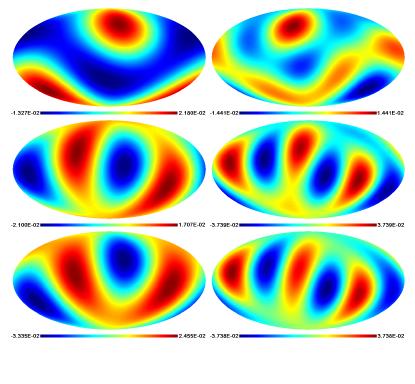
The results are shown in the picture below which presents  the lowest order spherical harmonic modes, the quadrupole (left) and octopole (right) for the  ISW component (top) , WMAP data (middle) and at the bottom we have the cleaned CMB sky (i.e. the middle minus the top). The ISW subtraction doesn’t make a huge difference to the visual appearance of the CMB maps but it is enough to substantially reduce to the statistical significance of at least some of the reported anomalies I mentioned above. This reinforces how careful we have to be in analysing the data before jumping to cosmological conclusions.

peacock

There should also be a further contribution from fluctuations beyond the depth of the 2MASS survey (about 0.3 in redshift).  The actual ISW effect could therefore  be significantly larger than this estimate.

Making the Changes

Posted in Jazz with tags , , , , on September 15, 2009 by telescoper

I often find myself trying to explain to people why I love listening to Jazz. Most people either don’t know much about it or don’t like it at all, especially if it’s “modern”. The trouble is, explaining why it’s so hard to play jazz doesn’t usually make people want to go and listen to it.  “There’s no proper tune”  and  “It’s just noise” are just a couple of the comments I heard in a pub a few weeks ago when somebody put a Miles Davis track on the internet jukebox.

It’s partly a matter of language, of course. The most exquisite Japanese poetry probably sounds like noise to a Westerner who can’t understand the language. When it comes to jazz,  even if you do know a bit about the music you’re by no means guaranteed an easy listening experience. But, played at the highest level, with a driving rhythm section and a star soloist improvising through a constantly shifting pattern of harmonies, there’s no music to match it for sheer white-knuckle intensity.

Far from being “just noise”,   jazz is a tightly disciplined musical form. The freedom given to the soloist to create their own melody comes in fact at a very high price because the melodic line of a jazz solo must constantly recalibrate itself in relationship to the harmonic changes going on beneath it. The chord progression within which the original melody was embedded provides the soloist with the challenge of playing something that fits as well as being new and interesting to listen to.  Usually the actual tune is played only briefly at the start and thereafter becomes pretty much irrelevant until recapitulated at the end of the performance. What really matters to a jazz soloist is not the original melody but the chords.

Each chord establishes a tonal centre and a related scale that  furnishes a reference frame in the space of possible musical notes. When the rest of the band makes the chord changes the soloist must transform to a different coordinate system. The progression of chords as the tune unfolds thus has the effect of pushing and pulling the soloist in different tonal directions. A great jazz solo requires strict adherence to this framework and it imposes tremendous discipline on all the musicians involved.

In a slow 12-bar blues the gravitational effect of the relatively simple chord pattern is especially strong, which is no doubt why it has such a powerfully expressive effect when the soloist plays a “blue note” such as a flattened fifth on top of major scale chords.

In more complicated tunes keeping your place within the constantly shifting harmonic framework is a real challenge, especially if the chord progression is complicated and especially at fast tempi in which the chord changes go flying past at a rate of knots. Such numbers turn into a rollercoaster ride for both musicians and audience.

It’s not just the speed of fingers that makes great soloists so electrifying, but their astonishing mental agility. I remember seeing the great saxophonist Sonny Stitt at Ronnie Scott’s club in London playing the jazz standard How the Moon. Nothing unusual about that because it’s part of the jazz repertoire. The thing was, though, that he played 12 choruses, each one in a different key. How he managed to keep track of everything is completely beyond me. I wasn’t the only one in the audience shaking his head in disbelief.

Giant Steps by John Coltrane is an example I posted a while ago of a supreme piece of high-speed improvisation, and I thought I’d follow it up with this wonderful performance  in which the legendary Charlie Parker plays an extended solo, very fast.

The tune is in fact a variation of a 1930s hit  called Cherokee. Most popular tunes have a 32 bar basic format of the type AABA, with B representing the bridge or middle eight. Cherokee has a similar structure, but is 64 bars long. Its chord progression is both complicated and unusual, with lots of changes to remember especially in the (16-bar) bridge which is fiendishly difficult to play. This makes it fertile ground for improvising on and it quickly became a standard test vehicle for jazz soloists and a yardstick by which saxophonists in particular tended to measure each other’s skill.

During the bebop era it became fairly common practice for musicians to borrow chord sequences from other tunes. Many Charlie Parker pieces, such as Anthropology, are based on the chords from I Got Rhythm for example. There’s a famous story about a recording session involving Charlie Parker during which the band decided to do a version of Cherokee (i.e. using the chord sequence but with a different melody). During the take, however, they absent-mindedly played the actual melody rather than playing something else over the chords. There was a cry of anguish from producer in the control room who had hoped that if they stayed off the actual tune of Cherokee he wouldn’t have to pay composers royalties and the performance ground to a halt.  Shortly after, they did another take, called it Ko-ko and it quickly became a bop classic. This is a later version of Ko-ko, played live, during which Bird runs through the changes like a man possessed. What it must be like to be able to play like this!